Postage stamp tempest: Why can’t the U.S. have scandals like this?

July 15, 2013

Hey, David Dewhurst:  Do you really think the women who opposed your oppression of them were out of line?  None of them has said you must lick her derriére.

Here’s how they do it in Europe; from The Guardian:

Femen-inspired postage stamp angers French right

Designers say youthful depiction of Marianne for new stamp was partially inspired by Femen founder Inna Shevchenko

You know enough about France from your world history class to know that the nation has, for decades, used an image of a woman as their symbol of liberty (“liberté“).  For obscure reasons, the French have come to call their Liberty, Marianne.  Her image appears on coins, stamps, and wherever else an image can be used.  Most often an artist uses a beautiful French woman — Catherine Deneuve was the model for years — but about as often the name of the model is more obscure.  This is the first time anyone has said a non-French woman might be the model, though the woman named is living in France now, as a refugee from the Ukraine.

Francois Hollande at the unveiling of the new Marianne stamp. Photograph: Francois Mori/AFP/Getty Images

Francois Hollande at the unveiling of the new Marianne stamp. Photograph: Francois Mori/AFP/Getty Images


It was supposed to be a straightforward new postage stamp to mark François Hollande’s presidency: a more youthful depiction of Marianne, the feminine symbol of the French Republic, reflecting the Socialist president’s promise to help the younger generation.

Instead, the portrait has sparked a spat on the political right after one of its designers said it was partially inspired by Inna Shevchenko, a leading member of the feminist activist group Femen.

The designers, David Kawena and Olivier Ciappa, had previously said their inspirations ran from the Renaissance to French comic strips and Japanese manga. But after the stamp’s launch on Sunday, Ciappa tweeted: “For all those who are asking who the model was for Marianne, it’s a mix of several women, but above all Inna Shevchenko, founder of Femen.”

Probably the most famous image comes from the painting by Eugene Delacroix, Liberty Leading the Nation:
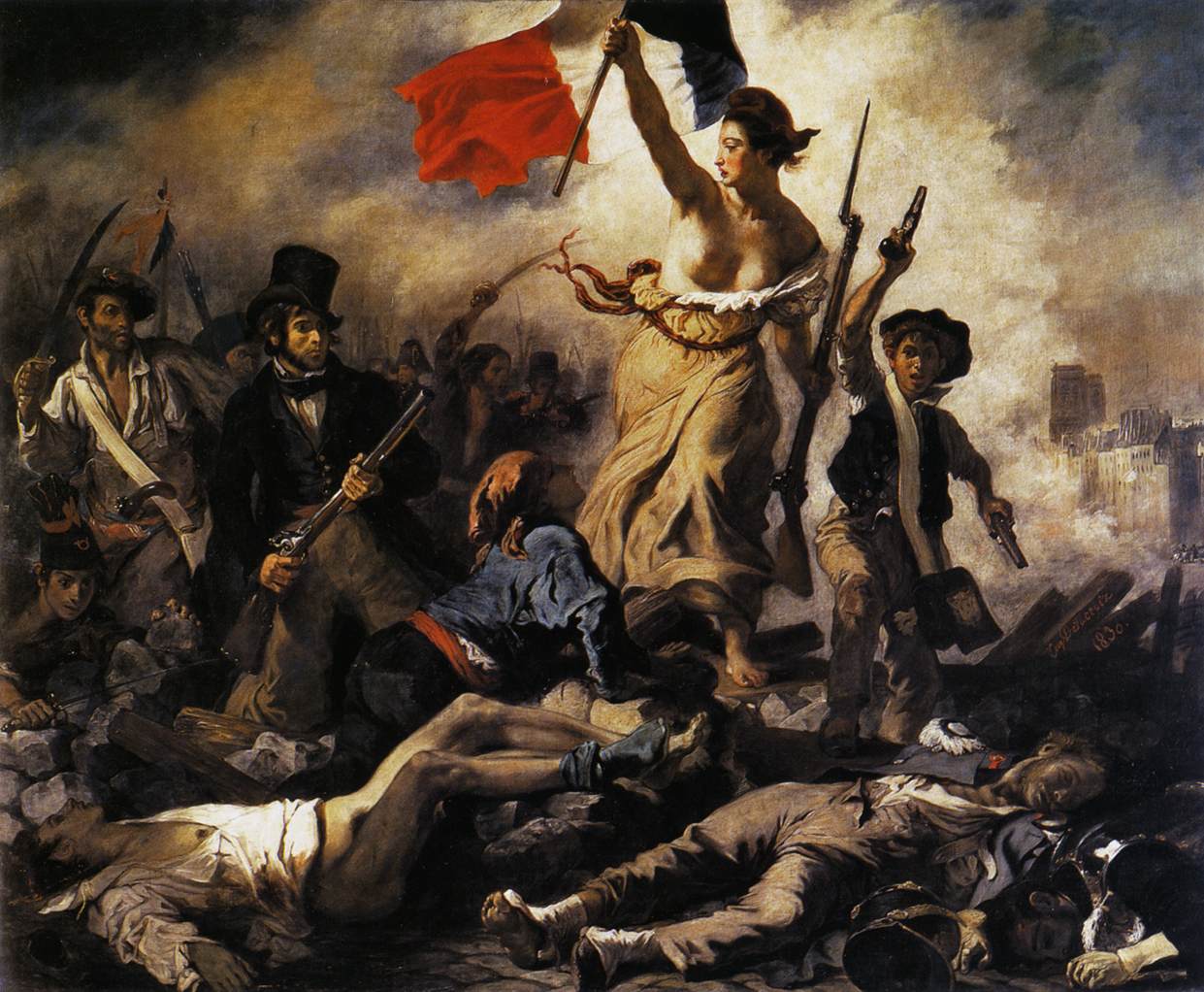
Eugene Delcroix's paiting, Liberty Leading the Nation,

Eugene Delacroix’s paiting, Liberty Leading the Nation, commemorating the 1830 uprising against the French King. That’s “Marianne” holding the flag.

That painting is in a division of the Louvre; it was defaced just this past February, in an odd September 11 protest, by a wacko who insisted the attacks on the World Trade Center and the United States were government-sponsored.   But I digress.

Christine Boutin, a former minister under Nicolas Sarkozy and founder of the Christian Democrat party, tweeted her disgust and her party called for a boycott of “this outrageous stamp”, saying it was an attack “on the dignity of women and the sovereignty of France” and should immediately be withdrawn.

Inna Shevchenko, a member of the women's rights group Femen. Photograph: Charles Platiau/Reuters

Inna Shevchenko, a member of the women’s rights group Femen. Photograph: Charles Platiau/Reuters

Femen, which often stages topless street protests, was started in Ukraine but is now based in Paris after Shevchenko was granted political asylum following outrage at her felling of a giant cross in Ukraine in support of the Russian band Pussy Riot.

Femen’s most high-profile protests in France have targeted the street demonstrations against same-sex marriage. It also recently staged an anti-fascist protest in Notre Dame cathedral and attempted to ambush the French president at an airshow.

Ciappa, whose exhibition of photographs of imagined gay couples was vandalised in Paris the anti same-sex marriage protests, wrote on Facebook on Monday that he had received “messages of threats and hatred” against him on Twitter, “some violent and some funny, such as Christine Boutin’s call to boycott my stamp”.

Yeah, but here’s the money line:

Shevchenko tweeted: “Femen is on French stamp. Now all homophobes, extremists, fascists will have to lick my ass when they want to send a letter.”

Several French artists have designed different Mariannes for French stamps, but this is thought to be the first inspired in part by a woman who isn’t French.

I have some bad news, perhaps, for U.S radical right-wing wackoes:  I understand that the model for the French symbol of Liberty, Marianne, was really Texas State Sen. Wendy Davis.   The artist was seeking a model who demonstrated the French ideal of a woman standing up to lead her nation against the supposed juggernaut of Fascist oppression and repression.  President Hollande is fearful of noting that, however, because he doesn’t want Texas Gov. Rick Perry to make a trip to France to poach businesses to move to Texas.

Texas State Sen. Wendy Davis reading documents at her Senate desk, in the photo perhaps used as a model for the new Marianne.

Texas State Sen. Wendy Davis reading documents at her Senate desk, in the photo perhaps used as a model for the new Marianne.

Hollande doesn’t fear any businesses would actually relocate from France to Paris; he just doesn’t want to waste any good French cheese or wine on a visiting Rick Perry.

In other Austin rumors, according to my sources at the groseille à l’oignon,  the Texas Republic asked France for rights to the image for their own anti-State of Texas postage stamps just to tick off Rick Perry and the FBI, and the Texas Tea Party is considering using Marianne as their image on their stationery, posters and bumper stickers.  If only they knew.

In the end, we have an entirely pointless, postage stamp tempest, with an artist sneaking in as a model a topless protester to play the role of the top-slipping symbol of French liberty, and typical French insouciance in arguments.  You know darn well that Harry Reid would love to use that line Ms. Schevchenko Tweeted — and so would Wendy Davis, and Rick Perry, and Joe Biden, and even Orrin Hatch.

Maybe all they have to do is pose topless, protesting some infringement on freedom.  Would they do that, even for freedom?

More:

Delcroix's painting on display in Lens, France, earlier in 2013.  Foreign Policy image.

Delcroix’s painting on display in Lens, France, earlier in 2013. Foreign Policy image.

The 2008 version of Marianne, under President Sarkozsy.

The 2008 version of Marianne, under President Sarkozsy. This is the immediate predecessor of the 2013 version.

1945 version of Marianne

From Stampboards.com: “Marianne” is a national emblem of France and an allegory of Liberty and Reason. She has been portrayed in various ways on a number of stamps issued by France over the years, often wearing a Phrygian cap, symbolic of Liberty. Here is an image of a stamp featuring my favorite version of her: the “Grande Marianne de Gandon,” designed and engraved by Pierre Gandon, and issued by France on March 12, 1945, Scott No. 556, Y&T No. 733.

Bust of Marianne sculpted by Théodore Doriot, in the French Senate.

Bust of Marianne sculpted by Théodore Doriot, in the French Senate.


Again: Why do we worry about global warming? It ain’t the climate, it’s the people

July 15, 2013

This is almost entirely an encore post, repeated for the benefit of the millions who missed it the first time who make fools of themselves when they argue we don’t need to save trees.  It’s not about trees.

Kids hiking in a forest. These are the humans environmentalists worry about, these four, and a few billion like them.  Photo from American Forests.

Kids hiking in a forest. These are the humans environmentalists worry about, these four, and a few billion like them. Photo from American Forests.

Alun Salt gave great advice about not bothering to engage idiots, pigs, denialists or trolls (here, among other places).  He said I should avoid lengthy answers to blogs that have little audience.

This is probably one of those occasions.

But in a running attempt to stimulate serious thought at a denialist blog, I got a question that has been rather common, and a question which indicates the deep serious misunderstanding denialists and even some well-meaning, overly-skeptical sensible people have:

Why worry about  climate change, since the climate is changing all the time?  Especially, why are people like Al Gore urging that we stop climate change, when CO2 has no great direct effect on human health?  Shouldn’t environmentalists be cheering climate change on, since it’s a “natural process?”

The answer is lost on the other blog, as Mr. Salt predicted it would be.  But since I’ve gotten some version of the question repeatedly in the last month, I may as well repeat the answer here, for the record.

The short answer to why we worry about climate change is that, as with almost all environmental protection, we are worried first about the quality of life of humans, and ultimately about the ability of human life to survive at all.

Here’s the question put to me there:

Ed I’m a little confused. I thought we were talking about the effect of co2 on the climate not the effect of co2 on human health. Co2 is not a toxic gas and would have no effect on human health. The fact that humans weren’t around when co2 was 10-20 times higher has absolutely nothing to do with its effect on climate.
Ed there was no runaway greenhouse effect [link added here] or climate catastrophe. The planet was fine during the phanerazoic. There is actually a lack of co2 in the atmopshere comapred to that time.

Here’s my answer, with a few more links than their format would allow:

No, you’re not a little confused.  You’re a lot confused, greatly misinformed, and not thinking hard.

We worry about CO2’s effects on climate only because we worry about the future of humanity.  Many of us who have children and wish them the same blessings of having children and grandchildren, have thought through the truth of the matter that we don’t possess and rule the Earth for ourselves, but instead act only as stewards for future generations.

No Earth, no humans; but at the same time, no habitable Earth, no humans.  In the long run, Earth doesn’t care.  It’ll do fine — without humans.

We can’t damage the planet.  We can only damage its habitability for humans.

I don’t know what sort of dystopian Randian future you and other Do Nothings hope for, but it’s a future contrary to human life, American values, and all known religions.

We’re talking about the future of humans.  I tell “skeptics,” “If you don’t care, butt out.  You’ll be dead in the short run anyway, but that’s no reason to stand in the way of action not to ensure a livable planet for our grandchildren.”

You also fail to understand chemistry, pollution, and how the world works.  CO2 is indeed a toxic gas.  For about a century now we’ve had indoor air standards that require air circulation to keep CO2 down below concentrations of about 500 5000 ppm [see comments], because at that level it starts to have dramatic effects on humans working.  It clouds their thinking and causes drowsiness.  CO2 is a conundrum, in that it is also necessary to trigger mammalian breathing.  If CO2 drops too low, we don’t take in enough oxygen and may pass out.  Too much oxygen in place of CO2 is a problem in that regard.  A substance can be both essential and a  pollutant, at the same time. (This has vexed food safety experts for years, especially after the 1958 Delaney Clause; substances we know to be essential nutrients can be carcinogenic, in the same concentrations, or in the same concentrations with a slight twist in chemical formula — how do we regulate that stuff?)

English: Main symptoms of carbon dioxide toxic...

Main symptoms of carbon dioxide toxicity (See Wikipedia:Carbon_dioxide#Toxicity). References: Toxicity of Carbon Dioxide Gas Exposure, CO2 Poisoning Symptoms, Carbon Dioxide Exposure Limits, and Links to Toxic Gas Testing Procedures By Daniel Friedman – InspectAPedia Davidson, Clive. 7 February 2003. “Marine Notice: Carbon Dioxide: Health Hazard”. Australian Maritime Safety Authority. Model: Mikael Häggström. To discuss image, please see Template talk:Häggström diagrams (Photo credit: Wikipedia)

CO2 is toxic in much greater proportions — it was a CO2 cloud that killed thousands in Cameroon 30 years ago or so, if you know history.

Clearly you did not know that we’ve regulated indoor CO2 for decades.  Clearly you haven’t looked at the medical journals‘ discussion on CO2 — and I’ll wager you’d forgotten the Cameroon incident, if you ever knew about it.

CO2 is a toxic gas (the dose is the poison); CO2 has dramatic effects on human health — too little and we die, too much and we die.

The fact that humans were not around when CO2 was much higher is exactly the point.  That was presented here, as it is in most venues, as support for a claim that we don’t need to worry about CO2 pollution.  Well, that’s right — if we don’t care about a habitable Earth.  But when CO2 was higher, life for humans was impossible.

I think it’s reckless to run an experiment on what would happen with higher CO2 levels, using the entire planet as a testing place, and testing the hypotheses on just how much CO2 will kill us all off, and how.

How about a control group, at least?

In the past, massive CO2 created massive greenhouse effects that would devastate us today — not as a toxic gas, but as a result of the warming that greenhouse gases do.

Let us understand the physical conundrum of CO2 here:  Without the greenhouse effect from the human-historic levels of CO2, this would be an ice planet.  Our lives today depend on the greenhouse effects of CO2.

Consequently, anyone who claims there is no greenhouse effect fails to understand physics, chemistry, biology and history.  (Heck, throw in geology, too.)  Life would be impossible but for the greenhouse effect.  Life is impossible without water, too, but you can’t live totally surrounded by water.

Can it be true that there can never be too much of a good effect, with regard to greenhouse gases?  Ancient Greek ideas of “all things in moderation” applies here.  We need a Goldilocks amount of CO2 in our atmosphere — not to much, not too little; not too hot, not too cold.

To the extent that higher CO2 levels didn’t produce a total runaway greenhouse effect, as some hypothesize exists on Venus, we know that was due to other feedbacks.  Early on, for example, CO2 began to be reduced by photosynthesizing life.  Animal life today would be impossible but for that occurrence.  Few if any modern chordates could breathe the very-low oxygen atmosphere of the early Earth, and live.  Those feedbacks and limiting situations do not exist today.

Greenhouse Effect

Greenhouse Effect. Wikipedia image

So now we face a double or triple whammy.  The reduction in CO2 in the air was accomplished through a couple billion years of carbon sequestration through plants.  In fact, a lot of carbon was sequestered in carbon-rich fossils, stuff we now call coal and oil.  Oxygen replenishment was accomplished with massive forests, and healthy oceans, with a great deal of photosynthesis.  This created a rough CO2 equilibrium (with fluctuations, sure) that existed we know for at least the last 50,000 years, we’re pretty sure for the last 100,000 years (we know that from carbon-dating calibration exercises).

Today we have removed fully 30% of the forests that used to replenish oxygen and lock up a lot of CO2 (some estimates say 50% of the forests are gone); modern plant communities cannot pluck CO2 out fast enough.  Plus, we’re releasing a lot of that old, sequestered carbon in coal and oil — at rates unprecedented in human history.

Will more CO2 warm the planet?  We know from the fact that the planet is warm enough for life, that more CO2 will warm the planet more.  Anyone who says differently does not know physics and chemistry, nor history.

Is there anything that can stop that effect?  Sure — healthy, massive forests, and healthy oceans.  Reducing carbon emissions could help a lot, too.  But we’re committed for about a century.  CO2 in the atmosphere doesn’t fall to the ground like particulate pollution.  it drifts until it is incorporated into something else, either through photosynthesis or other chemical reactions.  It takes a mole of CO2 a couple of centuries to come out of the air.  We’re stuck with elevated and elevating CO2 regardless our actions, for a century or two, even if we are wildly successful in reining in emissions and creating sequestration paths.

What happens when CO2 levels get higher than 350 ppm?  History, physics and chemistry tells us glaciers will melt, rainfall patterns will alter dramatically, sea levels will rise, carbon will be absorbed by the seas in increasing amounts (causing acidification — simple chemistry).  [See the counter in the right column of this blog; by July 2013, CO2 temporarily climbed above 400 ppm in a spike, and rested dangerously close to 400 ppm constantly.]

It’s a very exciting experiment.  The entire human race is at stake. How much CO2 will it take to produce the effects that kill us all?  It’s likely that changing rainfall patterns and rising sea levels will produce wars over resources, long before CO2 itself starts being physically toxic.  That’s what the Pentagon’s big thinkers say.  That’s what the Chinese big thinkers say, which is why they are working to reduce emissions even without an enforceable treaty.

As experiments go, I think it’s immoral to use humans in experimentation without getting their consent, and without passing the entire experiment through the Institutional Review Board to make sure the experiment is useful, necessary, and done ethically.

Do you have those consent statements?  All seven billion of them?  Have you got approval from the research overseers of the institution?

If you don’t have permission to proceed with this progeny-killing experiment, why do you propose to proceed?  Many people believe that, if the courts on Earth don’t get us, a higher court will.

How will you plead wherever the call to justice is delivered?

More:


July 10, 1850, Millard Fillmore succeeds to the presidency

July 10, 2013

Millard Fillmore was elected vice president largely because he was on the ticket with the very popular Gen. Zachary Taylor, hero of the Mexican War.

About 15 months into his presidency, President Taylor took ill  after presiding over July 4 festivities in blazing heat.  He died on July 9, 1850; Vice President Millard Fillmore took the oath as president the next day, and served out the term.  163 years ago today, Millard Fillmore served his first day as President.

Millard Fillmore in an 1850 lithograph by Francis DAvignon after a photograph by Matthew Brady (unclear if this was before or after his ascending to the presidency) - Library of Congress image

Millard Fillmore in an 1850 lithograph by Francis D’Avignon after a photograph by Matthew Brady (unclear if this was before or after his ascending to the presidency) – Library of Congress image

Taylor had encouraged New Mexico and California to draw up state constitutions, which would have disallowed slavery in those states.  To southern leaders who threatened secession, Taylor promised to personally lead the army that would hold the union together by force, and personally hang those who had proposed rebellion.

Fillmore had presided over the Senate during months of furious debate on issues that always seemed to come down to slavery.  Because he didn’t hold to the views of the Whig Party which had elected the Taylor-Fillmore ticket, even more than Taylor had strayed, the cabinet resigned.  Fillmore appointed Daniel Webster as Secretary of State, and proceeded to push for compromise on issues to avoid war.  His machinations helped get California admitted as a free state, but left New Mexico as a territory.  His support of the Fugitive Slave Act alienated even more Whigs, and by 1852 the Whigs refused to nominate Fillmore for a term of his own.  He left office in 1853, succeeded by Franklin Pierce.

Fillmore’s greatest accomplishment as president, perhaps, was his sending a fleet of ships to Japan to force that nation to open up to trade from the U.S.  The political furor over the Fugitive Slave Act, the Missouri Compromise, and other issues around slavery, tend to eclipse the memory of the good that Fillmore did.

Nota bene:  Controversy surrounded the death of Taylor.  Because he had threatened southern secessionists and incurred anger from several other groups, from the time of his death there were rumors he had been poisoned with arsenic.  Officially, the cause of death was gastroenteritis; popular accounts note that he had, in the heat of July, drunk milk and eaten cherries and cucumbers.  Certainly strep, staph or other bacteria in the milk could have created a problem.  In 1991 a team led by George Washington University Law Professor James Starrs exhumed Taylor’s body from his Louisville, Kentucky burial plot, and tested his remains for arsenic at the Oak Ridge National Laboratory.  Analysis presented to the Kentucky medical examiner indicated arsenic levels way too low for a poisoning victim.

[This is an encore post, in parts.]

More:

"An Available Candidate: The One Qualific...

“An Available Candidate: The One Qualification for a Whig President”. Political cartoon about the 1848 presidential election which refers to Zachary Taylor or Winfield Scott, the two leading contenders for the Whig Party nomination in the aftermath of the Mexican-American War. Published by Nathaniel Currier in 1848, digitally restored. (Photo credit: Wikipedia)  Despite the cynicism of many , Zachary Taylor won the Whig Party nomination, and the presidency.  Taylor died just over a year after his inauguration.


History of America, or art in America, or American art, or . . .

July 9, 2013

Brilliant piece from Grant Snider — history teachers, this should be a poster in your classroom, no?  Art teachers?

Grant Snider's

Grant Snider’s “American Art, exploring a country through its paintings”

In the course of a junior-level, high school U.S. history class, students should experience each of these works, and many others.  This is one whimsical way to work with serious and uplifting material, no?

Mr. Snider has a short essay — inspiring — and the information on each of the works he portrays, at the Modern Art site (I’ve added links below, here).

Since that formative vacation, the art museum is always one my of first stops in visiting a new city. In the comic above, I’ve curated my ideal collection of 20th-century American art. Here’s a list of works in order of appearance:

Jasper Johns, “Flag”

Edward Hopper,Morning Sun

Ellsworth Kelly, “Red Blue Green”

Wayne Thiebaud, “Refrigerator Pie”

Grant Wood, “Young Corn”

Roy Lichtenstein, “Whaam!”

Stuart Davis, “Colonial Cubism”

Andy Warhol, “Campbell’s Soup Cans”

George Bellows, “Dempsey and Firpo”

Jackson Pollock, “Autumn Rhythm”

Georgia O’Keeffe, “Sky Above Clouds III”

What are your favorite American art works, and what do they portray or demonstrate that you like?

More:


Even when he’s almost correct, David Barton doctors his accounts of history to make them false: Misquoting John Adams

July 5, 2013

Here’s David Barton‘s screw-up of a John Adams letter:

David Barton cuts John Adams's words off

David Barton’s “Wallbuilders” website featured John Adams’s description of July 2 — but conveniently edited out Adams’s own words, to make it appear as something else. Barton misses the history! What sort of anti-American cuts the words of John Adams when Adams defends liberty’s heritage?

Other groups make the same error as David Barton's Wallbuilders, but without obvious cover ups, restricting their comments to "Independence Day." Accuracy helps, always.

Other groups make the same error as David Barton’s Wallbuilders, but without obvious cover ups, restricting their comments to “Independence Day.” Accuracy helps, always.

“The . . . day of July, 1776?”  What day?

[Barton’s site changes annually, but it keeps repeating the cover-up.]

Faithful readers, and good students of history know that John Adams thought, in 1776, that July 2 would be celebrated as Independence Day.  Why?  July 2, 1776, was the day the 2nd Continental Congress voted to declare the colonies independent of Britain, and no longer under the rule of the Crown or Parliament.

The Declaration of Independence — the press release explaining Richard Henry Lee’s resolution for independence — sat ready to be discussed.  The Congress did not adopt the Declaration until two days later, on July 4.

Our Independence Day celebration falls on the date of the adoption of the Declaration, not the date of the actual resolution declaring independence.

This is a point of great humor among historians.  Even John Adams, more prescient than most soothsayers, could not predict accurately when Americans would celebrate independence.  Here at Millard Fillmore’s Bathtub, we often make a post on or about July 2, noting that humorous discrepancy.

That’s interesting.  It’s inspiring to know these august figures, near-gods in the American pantheon of the 21st century, got things wrong.  It’s humorous.  It’s good history.

What in the hell was David Barton thinking?

What evil purpose is he trying to serve by hiding real history, in such a bizarrely petty way?  Why create a hoax when the words themselves support the point you’re wishing to make, that John Adams thought Americans should celebrate independence?

Screenshot of David Barton's webpage, showing his bizarre butchery of Adams's words.

Screenshot of David Barton’s webpage, showing his bizarre butchery of Adams’s words.

Sheesh! He comes so close to getting something accurate, but he can’t resist monkeying with the words of the Founders.  David Barton reminds me of the guy who cheated at golf so much that, one day when he hit a hole-in-one, he wrote “0!” on the scorecard.  A man who will lie to us about one of the most famous letters in American history will lie about anything, for fun.

More:

John Adams, ca 1816, by Samuel F.B. Morse (Bro...

‘David Barton said what?’ By the time this portrait was painted, Adams knew Americans would celebrate the 4th, and not the 2nd; he seems to be glaring right at David Barton, to tell Barton to quit jerking around with history – John Adams, ca 1816, by Samuel F.B. Morse (Brooklyn Museum) Wikipedia image


Fly your flag today! July 4, 2013, 237 years since the Declaration of Independence

July 4, 2013

It’s a day of tradition — oddly enough, since we are in reality a very new nation, and Lee’s resolution to declare independence from Britain came on July 2.

A soak in Millard Fillmore’s Bathtub is nothing if not a steeping in tradition.  Fly your flag today, to celebrate the independence of the American colonies of Britain.

Fourth of July: NPR has already read the Declaration of Independence (or will soon, if you’re up early), PBS is ready to broadcast the Capitol Fourth concert  (maybe a rebroadcast is available, if you’re off at your own town’s fireworks — check your local listings), your town has a parade somewhere this weekend, or a neighboring community does, and fireworks are everywhere.

At the White House, traditionally, new citizens are sworn in — often people who joined our armed forces and fought for our nation, before even getting the privileges of citizenship.  Fireworks on the Capital Mall will be grand, with the White House hosting a few thousand military people and their families from some of the best views.  Traditionally, five photographers, chosen by lottery, get to shoot photos of the fireworks from the windows of the Washington Monument; will that occur, with the Monument shut down from public view for repair from the earthquake?

There will be great fireworks also in Baltimore Harbor over Fort McHenry, the fort whose siege inspired Francis Scott Key to write the “Star-spangled Banner” from his boat in the harbor, in 1814. Firworks will frighten the bluebirds nesting at Yorktown National Battlefield.  I suspect there will be a grand display at Gettysburg, on the 150th anniversary of the end of that battle. July 4, 1863, also marked the end of the Siege of Vicksburg; tradition holds that Vicksburg did not celebrate the 4th of July for 83 years after that. I’ll wager there will be fireworks there tonight.  In Provo, Utah, the city poobahs will have done all they can to try to live up to their self-proclaimed reputation as having the biggest Independence Day celebration in the nation.  The celebration in Prescott, Arizona, is muted by the tragic deaths of 19 Hot Shot firefighters last week; will drought halt the fireworks, too?  There will be fireworks around the Golden Gate Bridge, in Anchorage, Alaska, reflecting on the waters of Pearl Harbor, and probably in Guam, American Samoa, and the Northern Marianas Islands.

Fireworks on the Fourth is a long tradition — a tradition that kept John Adams and Thomas Jefferson alive, until they both died on the 50th anniversary of the Declaration of Independence, in 1826, the sounds of the fireworks letting Adams know the celebration had begun (Adams erroneously celebrated that Jefferson, the Declaration’s author, still lived, unable to know Jefferson had passed just hours earlier).

Remember to put your flag up today.

Astronaut Eugene Cernan and the U.S. Flag -- Apollo 17 on the Moon (NASA photo)

Last flag on the Moon: Astronaut Eugene Cernan and the U.S. Flag — Apollo 17 on the Moon (NASA photo)

If you’re not on the Moon, here are some tips on flag etiquette, how to appropriately fly our national standard.

Also:

Lunar Reconnaissance Orbiter photo of Apollo 17 landing site

Lunar Reconnaissance Orbiter photo of Apollo 17 landing site

This is mostly an encore post, but I so love that photo of the flag with the Earth in the distance.

Happy birthday, Kathryn!

Fireworks in Duncanville, Texas, for July 4

Fireworks in Duncanville, Texas, for July 4 — Kathryn Knowles’s birthday. We’re always happy the town chimes in with the celebratory spirit.

Tip of the old scrub brush to Thomas Jefferson, Richard Henry Lee, John Adams, Benjamin Franklin, Roger Sherman, Robert Livingston, and the cast of thousands of patriots including George Washington.


One more time: Basic climate science with Bill Nye

July 4, 2013

What year is this? 2013?

Shouldn’t the Sputnik Revolution in science education have obviated the need for this video, like 30 years ago?

One more time, the basics of climate change/global warming, with Bill Nye the Science Guy explaining; from the ClimateRealityProject.org:

http://vimeo.com/climatereality/climate101

climate change, CO2, global warming, science, Bill Nye, environmental protection, Clean Air, Air Pollution

More:

Newsweek, March 4, 1957,

Cover of Newsweek Magazine, from March 4, 1957; notice this concern about U.S. science competency came seven months before Sputnik was launched by the Soviet Union. Science deniers then delayed action until after the Soviets demonstrated clearly that the U.S. was behind. (Image from Computer History.org)


Quote of the moment, still: John Adams, July 2 “the most memorable Epocha in the History of America”

July 2, 2013

“The Second Day of July 1776 will be the most memorable Epocha, in the History of America. . . . It ought to be solemnized with Pomp and Parade, with Shews, Games, Sports, Guns, Bells, Bonfires, and Illuminations from one End of this Continent to the other from this Time forward forever more.”
John Adams to Abigail Adams, July 3, 1776

1776 filled the calendar with dates deserving of remembrance and even celebration. John Adams, delegate from Massachusetts to the Second Continental Congress, wrote home to his wife Abigail that future generations would celebrate July 2, the date the Congress voted to approve Richard Henry Lee’s resolution declaring independence from Britain for 13 of the British colonies in America.

Continental congress DSC_0607

Scene of the crime — Independence Hall in Philadelphia, where the Second Continental congress approved the resolution to declare the colonies independent from Britain – (Photo credit: diablodale)

Two days later, that same Congress approved the wording of the document Thomas Jefferson had drafted to announce Lee’s resolution to the world.

Today, we celebrate the date of the document Jefferson wrote, and Richard Henry Lee is often a reduced to a footnote, if not erased from history altogether.

Who can predict the future?

(You know, of course, that Adams and Jefferson both died 50 years to the day after the Declaration of Independence, on July 4, 1826. In the 50 intervening years, Adams and Jefferson were comrades in arms and diplomacy in Europe, officers of the new government in America, opposing candidates for the presidency, President and Vice President, ex-President and President, bitter enemies, then long-distance friends writing almost daily about how to make a great new nation. Read David McCullough‘s version of the story, if you can find it.)

(Yes, this is mostly an encore post.)

More, and Related articles:

The Lee Resolution.

The Lee Resolution, passed by the Second Continental Congress on July 2, 1776 – Wikipedia image (Wait a minute: Are those numbers added correctly? What are they?)


Two portraits of Pete Seeger (with Judy Collins)

July 2, 2013

A couple of photos I stumbled on recently.

The Seeger family in 1921; the youngest one is Pete, in his father’s lap:

Seeger family, 1921

The Seeger Family, 1921 Pete Seeger, the now-93 year-old folk singer, is sitting on his father’s lap.  Pete’s father was musicologist Charles Louis Seeger, Jr.; his mother was the violinist Constance de Clyver Edson.  The other two children are probably Pete’s older brothers Charles, III, and John.  This photo probably was taken while Charles and Constance toured the American south to teach music, after his having to leave UCLA because of his pacifist stance during World War I.

And 92 years later, with Judy Collins:

Judy Collins and Pete Seeger, photo by David Rocco, at the Clearwater Festival in Hudson, New York, June 15, 2013.

Judy Collins and Pete Seeger, photo by the preservationist David Rocco, at the Clearwater Festival in Hudson, New York, June 15, 2013. (We think that’s Pete’s wife, Toshi, on the far right edge of the photo.)

More:


Texas State Capitol Rotunda — all quiet on the former front, for now

June 28, 2013

A vertical panorama — neat idea.

Joe Deshotel  - Panorama of empty rotunda at Texas Capitol - dome to floor. Posted on Twitter June 27, 2013

Joe Deshotel – Panorama of empty rotunda at Texas Capitol – dome to floor. Posted on Twitter June 27, 2013

This is the building that, just hours before, had been crowded by thousands of people hoping to get into the Texas Senate Chamber to see Sen. Wendy Davis’s filibuster.

Star on the dome of the Texas State Capitol; a similar star is five very long stories below, on the floor.

Star on the dome of the Texas State Capitol; a similar star is five very long stories below, on the floor. Image via Shapleigh.org, “Grover’s Tub.”

Look carefully, and you can see that the guides in the Capitol don’t lie — the star on the dome reflects the star on the floor (or vice versa).

Can you get a similar shot of the rotunda of your state capitol? Would you do it and send it in, or post it and give us the link?

Tip of the old scrub brush to Reeve Hamilton.


Amazon haiku to Sen. Wendy Davis’s pink Mizuno shoes

June 27, 2013

(Yes, you’re right — the shoes are red, not pink.)

Texas State Sen. Wendy Davis‘s filibuster so insinuated itself into our culture already that it is now a part of shoe reviews at Amazon.com:

Mizuno running shoes for sale at Amazon.com -- the same shoes Sen. Wendy Davis wore during her filibuster on June 25, 2012.

Mizuno running shoes for sale at Amazon.com — the same shoes Sen. Wendy Davis wore during her filibuster on June 25, 2012.

Customer Review


147 of 150 people found the following review helpful

5.0 out of 5 stars SHOES HAIKUS, June 27, 2013

By

mistersnoid “mistersnoid”

This review is from: Mizuno Women’s Wave Rider 16 Running Shoe (Apparel)

Wendy wore these, and
she wasn’t even running.
Here’s hopes she soon will!

Standing and talking,
one needs a lot of support.
You have all of ours.

More:

Mizuno's red running shoes, worn by Texas Sen. Wendy Davis.  Image from Outside the Beltway

Mizuno’s red running shoes, worn by Texas Sen. Wendy Davis. Image from Outside the Beltway


Dumb ways to die, and a catchy tune

June 25, 2013

Here’s a video I meant to post months ago — but I can’t find it now.  Martketplace had a story on it today.

The idea is, “don’t get hit by a train.”

Still from short movie PSA,

Still from short movie PSA, “Dumb Ways To Die.”

It’s a safety message from Australia.  Highest and best use of PSAs, if you ask me [most links added here].

A clever Australian public service ad campaign promoting train safety has swept a number of advertising prizes at the Cannes Lions International Festival of Creativity, the world’s biggest annual awards show for professionals in the creative communications industry.

In all, the rail safety campaign took home the most prizes ever awarded to one campaign in the festival’s history.

“We’re thrilled with the outcome of the campaign. The main reason for that is that it starts a discussion about train safety in a way that young people will associate. We’ve deliberately not been threatening or shown graphic imagery,” said Leah Waymark, general manager of corporate relations at Metro Trains, Melbourne’s private rail service.

Metro Trains helped to co-produce the three-minute video, “Dumb Ways to Die,” which was created to teach people to be careful around trains. Since its November 2012 release, the video has racked up more than 50 million YouTube views, sparked several parodies, and even spawned an iPhone game. Not bad for a safety warning advertising campaign.

See for yourself:

The vocals remind me of early Edie Brickell and the New Bohemians; I wonder if the artist has any other work out there worth listening to.

It won’t be popular for flash mobs, I predict.

Curious update, September 19, 2013:  This ad has been banned in Russia.  No kidding.

Controversy

Everyone fell head over heels in love with the campaign. Except Russia. (Naturally). The video was censored by the Russian government and viewers were informed that, “This content is not available in your country due to a legal complaint from the government.”   The Russian government convinced itself that this video promotes suicide in an attractive comic format and will entice children and teenagers to “push the red button,” “set fire to their hair” and “poke a grizzly bear with a stick.”

More:

Don’t miss the karaoke version!


June 23: Happy birthday, Sholes Typewriter!

June 23, 2013

And so it came to pass that on June 23, 1868, the U.S. Patent Office in the Department of Commerce issued a patent to Messrs. “Sholes, Glidden & Soule” for a “Type-Writer.”

Drawing for a Typewriter, 06/23/1868 (ARC Identifier: 595503); Patented Case Files, 1836 - 1956; Records of the Patent and Trademark Office; Record Group 241; National Archives.

From the U.S. National Archives Administration: Dated June 23, 1868, this is the printed patent drawing for a “Type-Writer” invented by Christopher L. Sholes, Carlos Glidden, and J. W. Soule. Drawing for a Typewriter, 06/23/1868 Drawing for a Typewriter, 06/23/1868 (ARC Identifier: 595503); Patented Case Files, 1836 – 1956; Records of the Patent and Trademark Office; Record Group 241; National Archives.

With a keyboard a lot like a piano, this 1868 invention looks a lot more like the typewriters we know and love than William Burt’s 1829 “typographer.”

Amazing how much this stuff has changed in 150 years, isn’t it?

Tip of the old scrub brush to Jude Crook:

More:

Sholes typewriter, 1873. Museum, Buffalo and E...

Five years after this patent, Mr. Sholes offered this machine for sale, in 1873. Museum, Buffalo and Erie County Historical Society (the history society founded by former President Millard Fillmore, incidentally) Wikipedia photo


Annals of global warming: Keeling Curve gone vertical

June 22, 2013

What is the Keeling Curve?

What does it look like now?  See this graphic from the New York Times:

Keeling Curve graph and grahic, New York Times, May 11, 2013

New York Times, May 11, 2013

See the daily update of the Keeling Curve at the Scripps Institute site, University of California at San Diego.

More:


Unintentional dry humor from CBO; don’t make a Denali out of a molehill, though

June 21, 2013

A mountain by any other name would be just as high. Image of Denali from Tiny Green Cabins

A mountain by any other name would be just as high. Image of Denali from Tiny Green Cabins

I get e-mail from the Congressional Budget Office.  I asked them to keep me posted on the studies they do, and they have.

Today, this:

S. 155, a Bill to Designate a Mountain in the State of Alaska as Denali

cost estimate

June 21, 2013
read complete document  (pdf, 27 kb)

As ordered reported by the Senate Committee on Energy and Natural Resources on June 18, 2013.

CBO estimates that enacting this legislation to name a peak in Alaska would have no significant impact on the federal budget and would not affect direct spending or revenues; therefore, pay-as-you-go procedures do not apply. S. 155 contains no intergovernmental or private-sector mandates as defined in the Unfunded Mandates Reform Act and would not affect the budgets of state, local, or tribal governments.

Calling a mountain by its name won’t affect the budget?  Good news, I’m sure.  Shakespeare was right.

The testimony of National Park Service Deputy Director Peggy O’Dell is instructive:

STATEMENT OF PEGGY O’DELL, DEPUTY DIRECTOR FOR OPERATIONS, NATIONAL PARK SERVICE, DEPARTMENT OF THE INTERIOR, BEFORE THE SUBCOMMITTEE ON NATIONAL PARKS OF THE SENATE ENERGY AND NATURAL RESOURCES COMMITTEE, CONCERNING S. 155, TO DESIGNATE A MOUNTAIN IN THE STATE OF ALASKA AS DENALI.

April 23, 2013

Mr. Chairman, thank you for the opportunity to present the Department of the Interior’s views on S. 155, a bill to designate a mountain in the State of Alaska as Denali.

The National Park Service appreciates the long history and public interest for both the name Mount McKinley and the traditional Athabascan name, Denali. The Department respects the choice made by this legislation, and does not object to S. 155.

Located in what is now Denali National Park and Preserve, the highest peak in North America has been known by many names. The National Park Service’s administrative history of the park notes that, “The Koyukon called it Deenaalee, the Lower Tanana named it Deenaadheet or Deennadhee, the Dena’ina called it Dghelay Ka’a, and at least six other Native groups had their own names for it.

“In the late 18th century various Europeans came calling, and virtually everyone who passed by was moved to comment on it. The Russians called it Bulshaia or Tenada, and though explorers from other nations were less specific, even the most hard-bitten adventurers were in awe of its height and majesty.

“No American gave it a name until Densmore’s Mountain appeared in the late 1880s, and the name that eventually stuck—Mount McKinley—was not applied until the waning days of the nineteenth century,” a gesture of support to then-President William McKinley.

In 1975, the State of Alaska officially recognized Denali as the name of the peak, and requested action by the U.S. Board on Geographic Names to do the same.

In 1980, Congress changed the name of Mount McKinley National Park to Denali National Park and Preserve (P.L. 96-487, Section 202), but did not act on the name change for the mountain.

In Washington, Congress designates mountains.  In Alaska, mountains designate you.

More:

Mount McKinley

Near-antique poster advertising Ranger Services at the National Park Formerly Known as Mount McKinley. Photo by Kirt Baab