Friday Photo: Washington Monument from the top down

October 26, 2012

U.S. Department of Interior, on Instagram:

http://distilleryimage8.instagram.com/7ca1151c1eea11e2957722000a1f9a39_7.jpg

Interior’s Instagram caption: It’s not every day you see the #Washington #Monument from this angle. #dc #mall #bestofteday

For me, additional security in Washington, D.C., has stolen much of the fun, joy and awe of the Washington Monument — compounded by the damage from the 2011 Virginia earthquake.

Before September 2011, the Washington Monument was open until midnight in summer months.  Tourists head off for dinner and hotels at before 6:00 p.m. — the tourist lines disappear, and especially after 10:00 p.m. on most nights, one could, or one and the three or four visiting friends you had could, without waiting catch the elevator to the top for an absolutely matchless view of Washington D.C. at night.

Spy on the White House; spot the tourists dangling feet in the Reflecting Pool at the Lincoln Memorial; see the light in the Capitol Dome indicating Congress in session, and gloat that you were in recreational mode instead.  See a couple kissing on the steps of the Jefferson Memorial, thinking no one would see them.  Watch the arc of U.S. Airways airplanes coming down the Potomac River corridor, panicking anyone in the USA Today building who happened to look out and look down on an aircraft passing by, and almost hear the screams from the non-frequent DCA fliers as the plane banked sharply at low level to line up with the runway at National Airport (it will never be Reagan to true aviation buffs, who still miss the controllers who gave us confidence in that thrill ride).

For the Fourth of July, the National Park Service (NPS) used to conduct a lottery to select a tiny handful of professional photographers to shoot the fireworks, one of the best displays on Earth.  The fireworks shoot from near the Lincoln Memorial.  Does NPS do that any more?

Then walk down the stairway, past the hundreds of carved memorial stones, gifts of Americans who wished to honor George Washington by contributing some large, expensive rock to the interior of the obelisk rising Pharaoh-style out of the swamp near the Tidal Basin.  Notice the color line shift that marked the Know-Nothing Party control of the group building the monument — the original American Tea Party austerity group, who stopped construction for 20 years just to prove they could impose austerity on those ‘spendthrifts’ who wished to build a monument to a man, even without any public money, and even though they controlled the commission only from 1855 to 1858 (the Civil War intervened).

The Washington Monument, all 555 feet, 5 1/8 inches of it, is closed now.  When I visited last, in June, damage from the earthquake was still being assessed, and to protect the monument and the public, no access to the interior was allowed.  Around the base, the 50 U.S. flags still fly 24 hours each day; but the paths to the monument now have blockades to stop any unauthorized truck, perhaps laden with explosives, and the public benches sat empty where we used to meet small-town Americans awed by the thing, and foreign tourists in awe of America.

The caption from Interior begs more explanation.  Why don’t we see this view?  The Washington Mall — that expanse of grass and, now, museums between the U.S. Capitol on the east end and the Potomac-side Lincoln Memorial on the west — graces pilots’ air charts as a civilian no-fly zone.  After too many small-plane pilots gave the FAA fits, and somebody parked one on the lawn of the White House, FAA banned all flights over the mall, except by police or other official aircraft.  Pragmatically it’s the D.C. cops and Marine One helicopters who might be able to capture this view.

How did Interior get the shot?  The Instagram doesn’t explain. Perhaps it was part of the work to repair and restore the monument from the earthquake.

This picture highlights some interesting things. You can see wear and discoloration of the stone, from weather.  Discoloration is not consistent; you can see how the windows at the top alter the even flow of water.  Acid rain causes the stone to turn gray, then black; the monument is light only from a couple of scrubbings (though, contrary to climate denialist and GOP claims, Clean Air Act control of acid rain reduces the damage since 1972).  Some of the discoloration may be from copper solutions washed off the window frames by the rain.

If you look closely, you can see one of the cracks caused by the earthquake.  At the peak rests a tiny pyramid of aluminum, undistinguishable from the limestone.  Aluminum?  Yes — while the metal is a very common element around the Earth, refining it out of ore was difficult, commercially impossible in the 1880s when the Monument was completed.  As a last tribute to Washington, builders capped it with what was then one of the most precious metals on Earth, aluminum.  Soon after, the advent of mass quantities of generated electricity made aluminum refining commercially viable; today we make disposable drink cans out of what was once the most precious metal on Earth, when purified.  One may ponder how George Washington would consider such technological changes in the nation where he hoped every citizen might have a “vine and fig tree,” first to cap his monument with aluminum, and then make millions of tons of the stuff to throw away.  We are an industrial society to an extent Washington did not, perhaps could not anticipate.  Would he approve?

About a quarter of the way up from the base, you see the color of the limestone changed, as I noted earlier.  All the stone on the face of the monument came from the same quarry; however, during the cessation of construction during the rule of the Know Nothings on the monument commission, rock from the quarry continued to come out, to be used in other projects.  By the time construction on the monument was restarted, rock quarrying pulled out limestone of a slightly darker, more reddish color.  Builders decided to continue with the color variation rather than pull down the stone already stacked.  The Washington monument thus becomes a memorial not only to Washington, but also to the politics he futilely hoped would not affect our nation’s government, even non-governmental commissions working around and about the government.  That color line preserves in stone some of the political errors of the mid-19th century.  It remains unclear whether anyone ever learned a beneficial lesson from those times.

At the base you see patterns of stone unrecognized at ground level (are those white stripes the benches to wait in line to get up to the top?).  Around the monument a phalanx of 50 U.S. flags, which fly constantly (except in hurricanes), and you can see the lights that illuminate the flags and the monument at night.  Flying into Washington, D.C., at night, becomes one of the great vistas of the world, pierced by the shining white spire of the Washington Monument against a black sky (or dark blue, better), and the panorama of great public buildings, also lighted limestone.

Under local and federal zoning rules, skyscrapers are not allowed in that core area, to preserve the buena vista.

And finally, in the photo you can see fewer than a dozen people, colored dots at the base of the structure.  Are they looking up?

More:


One more time: “Do we really know who Donald Trump is, or where he came from?”

October 26, 2012

Donald Trump is at it again.  His $5 million offer to get Obama’s grades mystifies me, and irritates me (why doesn’t he just call Harvard, and see what GPA was required to graduate with the honors on Obama’s diploma?).  It’s clear Trump has not bothered to see whether information is available on Obama, but is instead attempting a political smear.

Should we be concerned at all?  David Letterman savaged Trump on his show October 24, but then invited Trump to appear on October 25, and let Trump get away without challenging most of his big whoppers.  Letterman seemed to sense he was not witnessing a political exposé, but instead was witness to the dying throes of a man whose talent and time seem to be restricted to hair design, these days.

Heh.  Why should we believe Donald Trump?  In addition to the manifold reasons you may have already accumulated to dismiss the guy as a crank and a crackpot, consider that we don’t have a clue about his bona fides.

Who is Donald Trump, really?  I posted this originally in February 2011 — and since then, Trump has failed to release any whiff of evidence to clear up his murky background.  He’s not released his birth certificate (except a forgery), he’s not been able to establish that he ever attended a college in America.   In short, he’s vulnerable exactly to the type of unfair and churlish attack he’s making on President Obama.

Here’s how it unfolds:

Donald Trump demonstrated his ability to spread hoax information at the CPAC Conference recently — a group who love to hear hoaxes and spread them, as much as fourth-grade boys love to hear and spread jokes about flatulence.

But can he take it?  [Note the hoax insinuations below are underlined.]  Could Donald Trump withstand the kind of attack* he made on President Obama?

I mean, he claims President Obama may not have attended Columbia because Trump hasn’t personally interviewed anyone who knew him there — despite years of stories in alumni magazines, major media interviews with the people who knew Obama there, etc., etc.

Donald Trump and unidentified woman

Gratuitous picture that makes trump look funny or evil, with gratuitously misleading caption: “Donald Trump wants people to stop asking why no one, in America, can remember his high school and college days.” Alternative caption: “Donald Trump, two of his closest friends and an unnamed woman discuss politics and government policy.”

Does Trump have room to talk?  His Wikipedia bio claims he attended Fordham University for a brief period (got kicked out, maybe?), but didn’t graduate.  It claims he got an undergraduate degree from the Wharton School in Pennsylvania.

A search found no one from Wharton who remembers Donald Trump as a student there.  Jon Huntsman, the founder of Huntsman Container and Huntsman Chemical, the guy who invented the “clamshell box” for McDonalds, is one of the most famous and wealthy Wharton grads (and also the father of Jon Huntsman, Jr., the recently resigned Obama Ambassador to China).  He never saw Trump on campus at Wharton.  James DePriest, the outstanding conductor now with the Oregon Symphony (and fun to watch, trust me) — he never ran into Trump on campus when he attended Wharton.  There’s no record of Trump having had a roommate there. Alan Rachins, the famous actor who graduated from Wharton — not only never took a class with Trump, but said he never heard of Trump attending classes at the time.

Who is Donald Trump?  Where did he come from?  How come no one remembers him?

But the fog gets inkier.

Trump was not only a football standout in high school, he was a social standout, winning awards for his community involvement (although, no one at the high school in his hometown remembers his attending classes there).

But during the time he claims to have attended Fordham, no one remembers him.  No social standout.  No football hero.  Was he ever really at Fordham?

And what about his odd religious beliefs?  There are jokes about his worship of money — but what sort of religion would lead a man to claim that the 2008 economic collapse was “an Act of God?”  Yes, he really believes that.  His “god” appears to have a grudge against the United States and its economy.  Even in his greatest economic ventures, he pays homage to Muslim Hindu religious landmarksWhat is his secret agenda on religion?

Where did Donald Trump come from?  Why does no one in his hometown high school remember him?  Why did he drop out of sight at the time he claims to have attended Fordham University?  Did he buy his way into a listing as an alumnus of Wharton, after so many Wharton grads don’t remember seeing him there?   Who can trust a guy who worships (if he does worship at all) a “god” who strikes down the U.S. economy?

Who is Donald Trump?  Why did no one at CPAC check his questionable credentials before giving Trump a national platform?  Why is CPAC mum about this entire affair?  Why did Fox News conspire to obscure the message and candidacy of Ron Paul, with their new darling, Donald Trump?

Worse for Trump, most of the things in this screed are factually accurate.  Those who live by the inaccurate spin can die by it, too.

Scarier:  Which conservative sites will have the guts to question** Trump’s secret credentials?

Read more here, at Oh, For Goodness Sake [archived here] (and here at “Donald Trump Pants On Fire”), and here, at PolitiFact.

_____________________________

*   That is, “completely hoaxed up.”

**  Oh, yeah — that should have read, “gullibility to fall for.”  When will the blog owner correct that glaring error?***

*** Not until Trump apologizes to President Obama.

More:

Save


Typewriter of the moment: An old one, manual or electric (yours?)

October 25, 2012

Typewriter

A manual, Royal typewriter (Photo by mikeymckay)

It’s enough to make an old typewriter guy drive to Arizona, for more than the air (with a stop in Albuquerque at the Owl Cafe for an Owl burger, of course).

Polymath reporter Bill Geist from CBS News reported this piece for Sunday Morning, in February, featuring Mesa Typewriter Exchange in Arizona, and more:

Where is that movie on typewriters“The Typewriter in the 21st Century.”  Geist was poaching on their material a bit, wasn’t he?

Bring on the movie!

More:


Typewriter of the moment: e. e. cummings

October 25, 2012

Typewriter of the poet and author e. e. cummings:

Typewriter of e. e. cummings at NYPL, photo by Chris Wolack, WildmooBooks

Typewriter of e. e. cummings, displayed at the New York Public Library, 2012. Photo by Chris Wolack, WildmooBooks

Through March of 2012, 250 objects from the collections of the New York Public Library were displayed to celebrate the 100th anniversary of the opening of the library’s Stephen A. Schwarzman Building.  A few of the objects exhibited were typewriters, including this one.

Did you notice?  The keyboard shows only capital letters!  Did that anger cummings, or make him crazy?  Not that we can see.

More: 

Self-Portrait, Oil Painting. Cummings in the 1950s. Courtesy of Nancy T. Andrews, via Modern American Poetry


Tip of the old scrub brush to Chris Wolack at WildmooBooks.


U.S. actions to support Agenda 21: Soil conservation, farm and rural development; no population control, no black helicopters

October 24, 2012

Not sure what Agenda 21 is?  It’s the larger program of the United Nations to pick up where the U.S. Soil Conservation Service left off (SCS is now the U.S. Natural Resources Conservation Service, NRCS).  Erosion control.  Don’t deplete the soils.  Keep water sources clean and flowing.  Use wise plowing practices to prevent another Dust Bowl.  Get Girl Scouts and Boy Scouts and Future Farmers of America and 4-H Clubs to build check dams and plant beneficial trees.

See a quick explanation of Agenda 21 here (courtesy of Grist, here).

Keenan Wynn and a Coke machine, Dr. Strangelove (publicity still?)

Keenan Wynn as Col. Bat Guano, pauses before shooting open a Coke machine to get change to place a call to the President of the United States to save the world, in Stanley Kubrick’s “Dr. Strangelove, Or How I Learned to Stop Worrying and Love the Bomb,” (publicity still?).  Agenda 21 is not like “Dr. Strangelove,” except perhaps in the minds of those poisoned by dramatic over-consumption of Coca-Cola or Monster Cola.

You can’t find that stuff easily on Google, nor Bing, usually.  Instead you’ll find people worrying about black helicopters, the massive, unseen and never-detected UN Army poised to take over U.S. golf courses, and unhinged rants about forced population control, rants worthy of Col. Bat Guano but lacking Kubrick’s and Southern’s and George’s wit or Keenan Wynn‘s sharp delivery.  (Yes, if you hear someone complaining about Agenda 21, you may and perhaps should say, “That’s Bat Guano!”)

Agenda 21 is the umbrella agency under which nations who are members of the UN undertake studies of Earth’s resources, human effects upon those resources, and which makes recommendations about how to save our planet’s resources from depletion.  KyotoRio CopenhagenIPCC.

Agenda 21 is about as milk toast a policy initiative as it is possible to get.  Why all the angst among so-called neo-conservatives and so-called libertarians?  Beats me.  I can only imagine that they have never read any of the documents, know nothing of the issues discussed, and have slept through much of the past 50 years on farm and food production issues.

Should we fear, as Paul Sadler‘s GOP opponent for the Texas U.S. Senate seat does, that Agenda 21 will require Texas to turn over all its golf courses to the UN?  No, we should instead pay attention to what the government has actually done in support of Agenda 21 initiatives — all of which are voluntary under the Agenda 21 program and the UN Charter.  Also, perhaps, we should make sure to vote against anyone who tries to instill fear by misstating what Agenda 21 is, or does, or “requires” (Yeah, you, Ted Cruz — what sort of crazy are you on? and this is why we’re voting for Paul Sadler instead; we need rational people who love Texas more than crazies who speak smack about golf courses and people who golf).

Here’s the White House list of activities to support Agenda 21 in the last four years; can you find the black helicopters and UN takeover of U.S. territory?  No, neither can anyone else:

Policy Initiatives

President Obama’s administration understands that a strong American economy is contingent upon a strong rural economy. Since the creation of the White House Rural Council, the President has made historic investments in rural America designed to drive job growth.  The actions will help ensure the development of a rural economy built to last.  These actions include:

Doubling Small Business Administration (SBA) Investment Funds for Rural Small Businesses
Announced August 2011

The Administration established a rural “carve-out” in the Small Business Investment Company (SBIC) Impact Investment Program that will invest in distressed areas and emerging sectors such as clean energy.  SBA will provide up to a 2:1 match to private capital raised by the fund.  SBA and the U.S. Department of Agriculture (USDA) are committed to partnering to drive $350 million of investment capital through the fund and existing SBICs into rural small businesses over five years, doubling the current rate of investment.

Providing Job Search Information through USDA Field Offices
Announced August 2011

The USDA and Department of Labor (DOL) partnered to offer job training information and better utilize the rural footprint of the USDA field offices across the country to provide them with greater access to job search resources by reducing the driving times and distances for rural customers seeking program information.

Expansion of the National Health Service Corps to Critical Access Hospitals
Announced August 2011

The Department of Health and Human Services (HHS) expanded eligibility for the National Health Service Corps loan repayment program so that Critical Access Hospitals, those with 25 beds or fewer, can recruit new physicians, using student loan repayment incentives.  This program will help hospitals across the country recruit needed staff.  Once a hospital has qualified as a service site, it can then apply for student loan repayment on behalf of its primary care physicians, nurse practitioners, and physician assistants.

Expanding Health Information Technology in Rural Communities
Announced August 2011

USDA and HHS signed an agreement to improve access to capital for rural hospitals and other providers seeking to implement health information technology and expand the health IT workforce in rural communities.

Commercial Aviation Biofuels Partnership
Announced August 2011

The Navy, the Department of Energy, and USDA have joined forces to spur the creation of an advanced biofuels industry that will support commercial aviation, with a pledge of $510 million, over three years, under the Defense Production Act of 1950.

Promoting a Bioeconomy through BioPreferred
Announced February 2012

To support the Administration’s “Blueprint for a Bioeconomy,” the President is utilizing the purchasing power of the Federal government by directing Federal agencies to take additional steps to significantly increase the purchase of biobased products over the next two years, which will create thousands of new rural jobs and drive innovation where biobased products are grown and manufactured. Utilizing the existing BioPreferred program, the Federal government will use its procurement power to increase the purchasing and use of biobased products, promoting rural economic development, creating new jobs, and providing new markets for farm commodities. Biobased products include items like paints, soaps and detergents and are developed from farm grown plants, rather than chemicals or petroleum bases. The biobased products sector marries the two most important economic engines for rural America: agriculture and manufacturing.

Rural Jobs Accelerator
Announced February 2012

The “Rural Jobs Accelerator” will link Federal programs to facilitate job creation and economic development in rural communities by utilizing regional development strategies. The “Rural Jobs Accelerator” will allow multiple agencies to coordinate technical assistance and grant/loan programs so that a consortium of public and private rural entities can have a single access point within the Federal government, allowing for improved access, streamlining of programs, and better leveraging of resources.  USDA and EDA will leverage approximately $14 million in funding, with technical support from Delta Regional Authority, Appalachian Regional Commission, Department of Housing and Urban Development, and the Department of Education.

Development of Rural Health IT Workforce
Announced February 2012

HHS and the DOL signed a memorandum of understanding to link community colleges and technical colleges that support rural communities with available materials and resources to support the training of HIT professionals.  Rural health care providers face challenges in harnessing the benefits of health information technology (HIT) due to limited capital and a workforce that is not trained to work within the expanding field of HIT. Due to lower financial operating margins and limited capital, funds for hiring new staff or training existing staff in HIT implementation and maintenance are often simply not available to rural health care providers.  The Bureau of Labor Statistics estimates that the needed HIT workforce will increase by 20 percent by the year 2016.  A significant part of that growth will come in rural areas, which are served by approximately 2,000 rural hospitals, 3,700 Rural Health Clinics as well as the more than 3,000 Community and Migrant Health Centers that are either located in or serve rural communities.

Timber and National Forest Restoration
Announced  February 2012

USDA’s Forest Service, in conjunction with the White House Rural Council, released a strategy to increase the scale of restoration treatments like forest thinning, reforestation, and other activities to restore and sustain the health of our forests.  In addition to environmental benefits, these activities create jobs in the forest industry which has been hurt significantly by the economic downturn.  The strategy relies on (1) using collaborative approaches to broaden public support for forest restoration; (2) expanding restoration tools like the Collaborative Forest Landscape Restoration Program and stewardship contracting; (3) better targeting budget resources; and (4) streamlining forest planning and analysis without sacrificing quality.

Mortgage Refinancing
Announced February 2012

The Administration announced an initiative to assist rural homeowners refinance their mortgages at lower interest rates through USDA’s Rural Development agency. By reallocating existing funding, at no additional cost to taxpayers, USDA will have almost doubled the amount of funds available to homeowners seeking to lower their mortgage payments or avoid foreclosure.  Under the new allocation, the amount of the $24 billion program dedicated to refinancing will increase from $520 million to $1.1 billion, allowing USDA to meet the growing demand for refinance transactions.

Task Force on Tourism and Competitiveness
Announced January 2012

On January 19, the President signed an Executive Order creating a Task Force charged with developing a National Travel and Tourism Strategy with recommendations for new policies and initiatives to promote domestic and international travel opportunities throughout the United States. The strategy will include recommendations to promote visits to the United States public lands, waters, shores, monuments, and other iconic American destinations, thereby expanding job creation in the United States, as well as tourism opportunities in rural communities. The Task Force is co-chaired by Secretary Salazar and Secretary Bryson, with participation from USDA, other agencies and WH offices.

Advancing Water Quality Conservation across the U.S.
Announced May 2012

The United States Department of Agriculture (USDA) announced the launch of a new National Water Quality Initiative committed to improving one to seven impaired watersheds in every U.S. state and territory. The Initiative is part of the Obama Administration’s White House Rural Council which is working in partnership with farmers, ranchers and forest owners to improve conservation of working lands in rural America. The 157 selected watersheds were identified with assistance from state agencies, key partners, and USDA’s Natural Resources Conservation Service (NRCS) State Technical Committees. NRCS will make available at least $33 million in financial assistance to farmers, ranchers and forest landowners this year to implement conservation practices to help provide cleaner water for their neighbors and communities.

Small Business Administration Investing in Rural Small Businesses
Announced June 2012

The Administration extended more than $400 million in FY 2011 of investments in rural America through the Small Business Investment Company (SBIC) Impact Investment Program, at no cost to taxpayers. Nearly $2 billion in additional funding will be invested by the end of fiscal year 2016. These investments will continue to help finance, grow, expand, and modernize rural small business operations around the country.

MOU to Improve Support in the Colonias
Announced June 2012

The U.S. Department of Agriculture-Rural Development (USDA-RD), Housing and Urban Development, and Department of Treasury’s Community Development Financial Institutions Fund (CDFI) partnered to create the Border Community Capital Initiative. This collaboration is designed to expand access to capital in the U.S/Mexico border region which includes some of the poorest communities in the country. The Memorandum of Understanding (MOU) will provide up to $200,000 to nonprofit and/or tribal financial institutions that serve colonias. This funding will go to increase access to basic necessities such as safe drinking water, adequate sewage systems, and safe, sanitary housing.

U.S Department of Education Investing in Rural Schools
Announced June 2012

Through the national broadband plan, the Obama Administration will leverage the power of technology to overcome distance and increase collaboration to accelerate student achievement in rural schools. The White House Rural Council partnered with the U.S Department of Education to deliver a new online community of practice groups for rural schools. This online tool will create virtual communities of practice for educators to connect to resources, tools, colleagues, experts, and learned activities both within and beyond schools. The Administration is using technology to break down geographic barriers and address rural isolation in education.

Accelerating Broadband Infrastructure Deployment
Announced June 2012

On June 14, 2012 President Obama signed an Executive Order to make broadband construction along Federal roadways and properties up to 90 percent cheaper and more efficient. U.S agencies that manage Federal properties and roads will partner to offer carriers a single approach to leasing Federal assets for broadband deployment. Providing a uniform approach for broadband carriers to build networks will speed the delivery of connectivity to communities, business, and schools in rural America. In order to further expand the nations broadband service, more than 25 cities and 60 national research universities are partnering to form “US Ignite.” US Ignite will create a new wave of services that will extend programmable broadband networks to 100 times the speed of today’s internet. This partnership will improve services to Americans and drive job creation, promote innovation, and create new markets for American business.

Supporting Appalachian Communities
Announced June 2012

Facilitated through the White House Rural Council, the Appalachian Regional Commission (ARC) developed a Livable Communities Initiative. This initiative is a partnership between ARC, the U.S Environmental Protection Agency (EPA), and the U.S Department of Agriculture Rural Development (USDA RD). The initiative provides technical assistance to small rural towns to help them develop and implement strategies for making the communities more livable and competitive. The partnership will focus on expanding transportation choices, supporting thriving and distinctive rural communities by investing in rural town centers, and extending affordable housing opportunities.

There is nothing seriously objectionable in that list of activities.  If you’re an astute, patriotic American, you’ll recognize a lot of actions that strengthen our nation.  Maybe opposition to Agenda 21 is a virus spread by an insect vector — there is no rational explanation for it, certainly.

More:

Highlights from the video, as listed at the White House blog:

Drought Relief: President Obama also toured McIntosh Family Farms in Missouri Valley, Iowa to see drought damage first-hand and offer relief to those being effected. The President announced that the Department of Agriculture will begin to buy up to $170 million worth of pork, chicken, lamb, and catfish. And the President is directing the Department of Defense — which purchased more than 150,000 million pounds of beef and pork in the last year alone — to encourage its vendors to accelerate meat purchases for the military and freeze it for future use.

“Understand this won’t solve the problem. We can’t make it rain,” the President said. “But this will help families like the McIntoshes in states across the country, including here in Iowa. And we’re going to keep doing what we can to help because that’s what we do. We are Americans. We take care of each other.”

To learn more, the Department of Agriculture is collecting resources for farmers, ranchers, and small businesses wrestling with this crisis at USDA.gov/drought. More information still is available at WhiteHouse.gov/drought.

Banner Year for the U.S. Wind Industry: Also this week, the Energy Department and Lawrence Berkeley National Laboratory released a new report highlighting strong growth in America’s wind energy market in 2011 and underscoring the importance of continued policy support and clean energy tax credits to ensure that the U.S. remains a leading producer and manufacturer in this booming global industry.As President Obama has made clear, we need an all-of-the-above approach to American energy and the U.S. wind industry is a critical part of this strategy. In fact, wind energy contributed 32 percent of all new U.S. electric capacity additions last year, representing $14 billion in new investment.

Wall of Shame on Agenda 21; sites that promote the crazies:


We’ve seen ships like Romney before . . .

October 22, 2012

. . . and we should be forewarned.

Seriously.  There once was a great battleship named HMS Romney.  What did it do?

HMS Romney was a 50-gun fourth rate of the Royal Navy. She served during the American War of Independence, and the French Revolutionary and Napoleonic Wars in a career that spanned forty years.

“Fourth rate” means “good” in this case  — more guns, but still a ship-of-the-line.

Did it help Americans out?  No.

Launched in 1762, the Romney spent most of her early career in North American waters, serving on the Newfoundland station, often as the flagship of the commander-in-chief. The ship was involved in the tensions leading up to the American Revolution when she was sent to support the Boston commissioners enforcing the Townshend Acts in 1768. Her actions involved impressing local sailors, confiscating a vessel belonging to John Hancock and providing a refuge for the unpopular commissioners when rioting broke out. She remained in American waters for part of the ensuing war, but towards the end operated in European waters after the French entry to the conflict.

After heckling American patriots, the Romney had a checkered career for another 20+ years.

[After the American Revolution] The Romney was laid up in ordinary or under repair for most of the subsequent years of peace, but returned to active service on the outbreak of war with Revolutionary France. She was in the Mediterranean supporting Lord Hood’s occupation of Toulon in 1793, and remained there for several years. During this time she captured the 44-gun French Sibylle. The Romney briefly returned to North America and then served in the Red Sea. Assigned to blockade the Dutch coast, the Romney ran aground in November 1804 while sailing to join the fleet off Den Helder. She broke up after attempts to float her off failed.

Ran aground?  Sounds rather like the end of the administration of George W. Bush, doesn’t it?  Oh, more than you might suspect.  Capt. John Colville tried to save the ship as it broke up, losing a few men. Eventually the Dutch rescued the British sailors, and in an act of kindness, allowed them to return to their country:

As was standard practice, Colvill was subsequently tried by court martial aboard the Africaine on 31 December for the loss of his ship. The court acquitted him, his officers and his men of all blame.[15] The court found the cause of the accident to be the thick fog and the ignorance of the pilots. The court required the pilots to forfeit their pay, barred them from piloting any of His Majesty’s Ships, and imprisoned them for a time in the Marshalsea.[16]

The total loss of life in the wreck was between nine and eleven men.[2][14]

“Thick fog and ignorance of the pilots.”  But no one in command was found to blame.  Ship lost, a handful of men lost (bad accounting kept the total from being clear?), but the muck-a-mucks escaped liability.

I don’t like that story one bit.

The loss of the Romney, Man-o-war, October 5, 1805; painting by Richard Corbould in the National Maritime Museum (Britain)

The loss of the Romney, Man-o-war, November 1804; painting by Richard Corbould, 1805, in the National Maritime Museum (Britain)


Historical view: Nothing new under the Sun, with regard to gay rights

October 22, 2012

Rev. Phil Snider, Brentwood Christian Church, Missouri - Jonathan Turley image

Rev. Phil Snider, Brentwood Christian Church, Missouri – Jonathan Turley image

We’ve heard it all before.  Truly, “there is nothing new under the Sun.” (Ecclesiastes 1.9)

Debates on policy, in and before legislative bodies, would run much better if the people involved truly had a sense of history, of what had been said before, by whom, and what the outcomes of those speeches were.  When we hear a speech, is it the flowery oratory of Cicero, or the exhortatory commands of Demosthenes?  (You recall Plutarch’s comparison of the famous Roman orator, and the famous Greek orator, of course.)

Just a word of caution:  Before your bile rises, before you find the comments box, be sure you listen all the way to the end of this short speech.

According to Advocate.com:

When the Springfield, Mo., City Council was considering an LGBT rights ordinance this summer, the Reverend Phil Snider of the Brentwood Christian Church delivered a surprising message to council members.

That was August 2012.  The ordinance was tabled for “further study.”  Rev. Snider blogs, as it turns out; you may want to read more of his thinking there.  One of my correspondents wanted a transcript; I haven’t found that, but it turns out the speech in the video was based on a two-part sermon series he did earlier, “What does the Bible say about homosexuality?”  You can see both sermons on his Facebook site, Part I, and Part II.  Much of the quoted historical material appears in Part II.

The text of the proposed ordinance (amendments to the city’s human rights resolution) found here.

What sort of evidence would one use to contradict the long view of history?  Please discuss in comments.

More:


Gradient Sun, NASA video for classroom use

October 21, 2012

Real science often is more fantastic that the stuff people make up. Haldane was right.

Still shot from NASA solar gradient video

Not the Sun you’re used to seeing.

In a century our studies of the Sun progressed from the deep calculations based on erroneous assumptions of what our star is make of  (Lord Kelvin‘s calculations on how long the iron in the Sun would take to cool to its present color), to today’s solar studies, in which nearly every moment of the Sun’s life is recorded through a half dozen different sensors, by satellites and telescopes and whatever other means we have to capture data from the Sun’s burning.

It’s hard science — but it borders on art, too, doesn’t it?  Watch this:

Gradient Sun [HD Video], originally uploaded by NASA Goddard Photo and Video.

What’s going on here?

Via Flickr:

Watching a particularly beautiful movie of the sun helps show how the lines between science and art can sometimes blur. But there is more to the connection between the two disciplines: science and art techniques are often quite similar, indeed one may inform the other or be improved based on lessons from the other arena. One such case is a technique known as a “gradient filter” – recognizable to many people as an option available on a photo-editing program. Gradients are, in fact, a mathematical description that highlights the places of greatest physical change in space. A gradient filter, in turn, enhances places of contrast, making them all the more obviously different, a useful tool when adjusting photos. Scientists, too, use gradient filters to enhance contrast, using them to accentuate fine structures that might otherwise be lost in the background noise. On the sun, for example, scientists wish to study a phenomenon known as coronal loops, which are giant arcs of solar material constrained to travel along that particular path by the magnetic fields in the sun’s atmosphere. Observations of the loops, which can be more or less tangled and complex during different phases of the sun’s 11-year activity cycle, can help researchers understand what’s happening with the sun’s complex magnetic fields, fields that can also power great eruptions on the sun such as solar flares or coronal mass ejections.

The images here show an unfiltered image from the sun next to one that has been processed using a gradient filter. Note how the coronal loops are sharp and defined, making them all the more easy to study. On the other hand, gradients also make great art. Watch the movie to see how the sharp loops on the sun next to the more fuzzy areas in the lower solar atmosphere provide a dazzling show.

NASA/Goddard Space Flight Center

NASA/Goddard Space Flight Center

To download this video go to: svs.gsfc.nasa.gov/goto?11112

NASA image use policy.

NASA Goddard Space Flight Center enables NASA’s mission through four scientific endeavors: Earth Science, Heliophysics, Solar System Exploration, and Astrophysics. Goddard plays a leading role in NASA’s accomplishments by contributing compelling scientific knowledge to advance the Agency’s mission.

Follow us on Twitter

Like us on Facebook

Find us on Instagram

Teachers ought to figure out how to use this in classrooms — and I don’t mean astronomy, physics and chemistry only.  Can you find a use for this film in geography?  History? English and literature?

Sometime shortly after World War II scientists captured film of a mass coronal ejection from the Sun.  You probably can imagine the film I’m remembering.  That snippet found its way into films students saw in science, geography, chemistry, biology (“this is our Sun, from which all living things get energy, through photosynthesis”), and probably a half dozen other subjects.  It was spectacular, and it was just about all that was available for classroom use, then.  Students now probably have never seen it.  Worse, my experience is that students in high school generally have very little familiarity with the science projects carried out by agencies like NASA and the National Science Foundation, and they know very little about the Sun, or the Moon and other planets.

Teachers, the state isn’t going to help you put this into your classrooms.  Can you figure out some way to get it in?

More:


Gilbert and Near, Woody’s “Pastures of Plenty”

October 20, 2012

Woody Guthrie wrote of freedom . . . when was this written? 1930-something?  [1941, it turns out.]

Ronnie Gilbert and Holly Near combine on one of my favorite arrangements of the song.

[That one disappeared? Try this one; click through if you have to:]

[Maybe this one will work:]

This film must be at least ten years old, maybe more.  The song is more than 60 years old [71 years — from 1941].

It’s still a powerful indictment of corporate greed, heartless and oppressive immigration policies, and it’s a case for a strong labor movement.

Be sure you vote in the November 6 elections.  Sing this song on the way to the polls.

More:


Big Tex, RIP (1953-2012)

October 19, 2012

We took a few hours at the State Fair of Texas a few days ago.

Today comes the sad news that Big Tex, the symbol of the Fair, burned to his metal bones.

he two most common elements in the universe are hydrogen and stupidity.

Big Tex at 60, earlier this week, catching sun on a good Fair day.

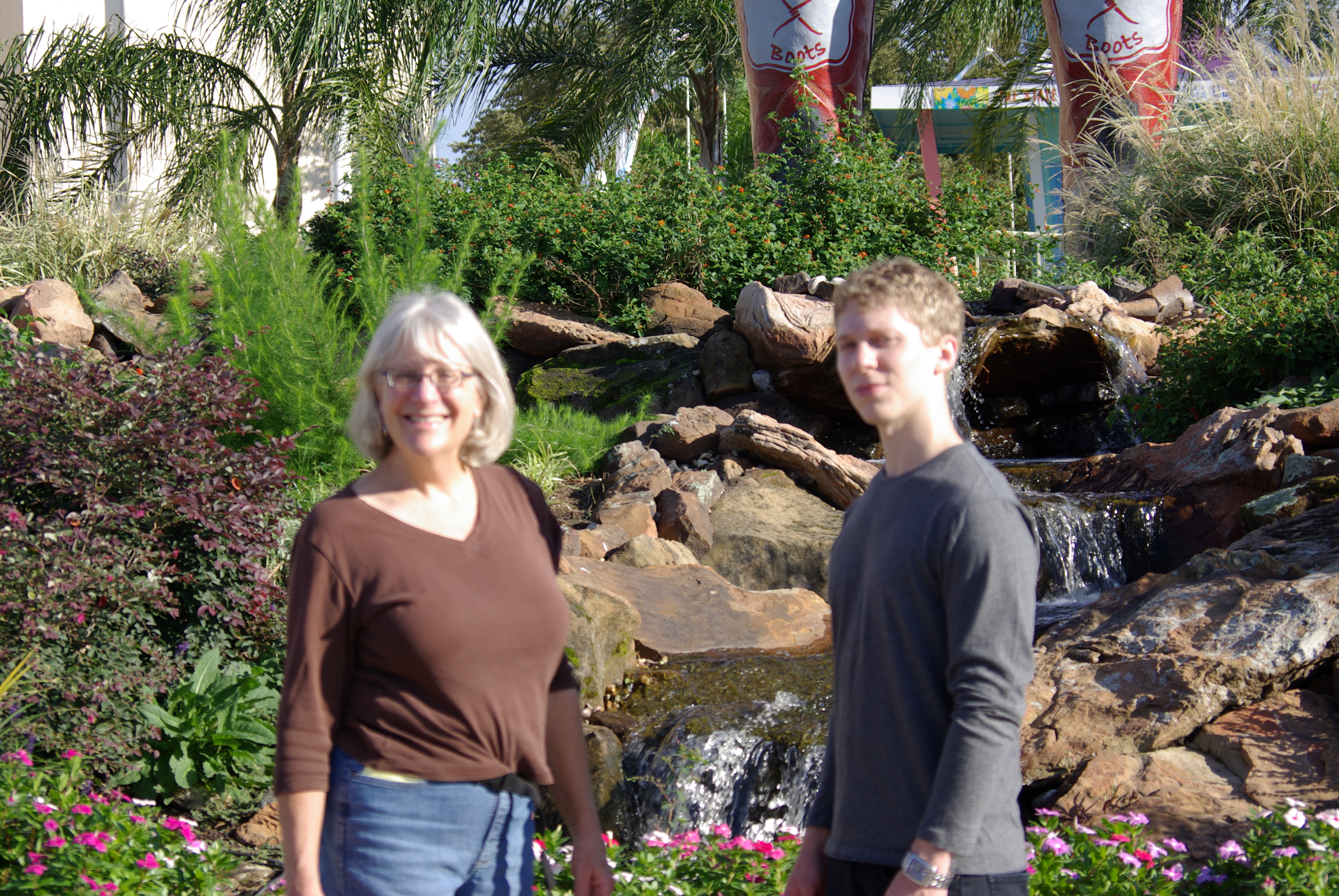
It was more of an unposed photo, as Kathryn and James read about the landscaping and the use of large, unsculpted Oklahoma stone in the garden at his feet.

Kathryn Knowles and James Darrell at the feet of Big Tex, 2012-10-17 State Fair 2012 024

Kathryn and James admiring the rockscaping at Big Tex’s garden, October 16, 2012

Big Tex looked fine — if we’d thought his 60 years showed at all, I’d have worked to get the focus just right, and get more of Tex in the photo.

Later that evening I thought the Dracula lighting might show a bit of his years.  Maybe it was just the lighting, though.  It had been a long day, and it was less than a week before the end of his 2012 run.

Big Tex at night 2012-10-16 State Fair 2012 243

Dracula lighting at night highlighted craggy old Tex’s age, perhaps.

Tex had always been a popular stop, one place everyone knew.  The family safety plan always included Big Tex.  “Where do I go if we get separated.”  “We’ll meet at Big Tex.”  Heck, even after the advent of cell phones, Big Tex was a popular meet-up-after-the-fair-day location.

They say your arteries, veins and nerves get worn after a good life.  Big Tex had some electronics in him, and electrical motors, to operate his jaw and to allow an announcer (in a booth on the ground) to play the Voice of Big Tex, offering a Texas “Howdy, Folks!” to people coming in to the Fair for the first, or 100th time.  One of those pieces of wire seems to have crossed another one this morning, some time after 8:00 a.m., just as the Fair opened for it’s last Friday of 2012 (the Fair closes Sunday).

There was a spark.  And then, he was gone.

Big Tex on fire, photo by John McKibbin via DallasNews.com

Big Tex on fire, photo by John McKibbin via DallasNews.com

More:


Seats still open for “In Their Own Voices” teacher workshop on racism, at Little Rock Central High School National Historic Site

October 16, 2012

E-mail from the Little Rock Central High School National Historic Site, with a training opportunity for teachers:

In Their Own Voices workshop

October 20-21, 2012

Arkansas Dept. of Education professional development workshop at Little Rock Central High School NHS

Little Rock Central High School National Historic Site invites Arkansas educators and community advocates to participate in a two day workshop focusing on challenging racism prevalent in and out of the classroom and the community. This program, an approved ADE professional development workshop, will bring participants together for an open reflection and dialogue on the effects of racism and the diversity of our own self-understanding. The overarching goal for our In Their Own Voices workshop is to afford our participants an opportunity to identify their own biases and feel comfortable in their space to approach such issues as race, bullying, tolerance and other-isms in the classroom and the community. To apply, please click attachment below and send to Agnolia Gay at agnolia.gay@gmail.com

Registration for workshop

Move quickly! (That’s this weekend.)  If anyone from Dallas is headed up, please let me know.

Little Rock Central High School

Little Rock Central High School, National Historical Site Visitors Center –  (Photo credit: bigskyred)


Date coincidences: Happenstance or omen?

October 16, 2012

In the approximately 33 minutes Texas curriculum standards allow to teach the Declaration of Independence, I frequently slip in some biography to help students chunk the knowledge.  Of course, biography for the Declaration includes Thomas Jefferson.  If one talks of Jefferson, especially with limited time, one is obligated to relate the story of the friendship of Jefferson with John Adams, which descended into partisan squabbling by 1796, and outright enmity in the election of 1800.  Then one relates how they were essentially tricked into resuming their friendship, and their correspondence (which makes good DBQs for pre-AP and AP classes), and the always touching story of their deaths, both on July 4, 1826, the 50th anniversary of the Declaration of Independence.

Then a student asks about divine intervention in history.  I explain that history is so rich, one can find coincidences on almost every day of the calendar.  For two examples, consider the births of Abraham Lincoln and Charles Darwin, hours or minutes apart on February 12, 1809; the births of Mark Twain and Winston Churchill on the same date (November 30), and their love of whiskey and cigars.

These coincidences often seem eerie, or pre-ordained, and that is enough of a hook to get that chunk of history into the minds of students so they remember them, or to compare the lives or events involved, to sharpen their critical skills.  (Ha!  Then just try to dissuade high school students from the eerie or pre-ordained notion; coincidences?  Not to the non-critical-thinking high schooler . . . or too many voters.)

So I was interested to find, and it made me smile, that Mahatma Gandhi and Groucho Marx share a birth date, October 2 (Gandhi in 1869, Marx in 1890).  That date was also the birthday of the comic strip we know as “Peanuts,” in 1950.  (Does a piece of literature, especially a comic strip, have a “birthday?”)

BLAHS Award, copyright Mark Sackler at Millennium Conjectures

BLAHS Award, created by Mark Sackler at Millennium Conjectures

I learned that following a link to the blog of Mark Sackler, who shares the birthday — exactly with Charlie Brown, and the day with Marx and Gandhi.

Following the link over there, to the Millennium Conjectures™, I also learned Mr. Sackler awarded Millard Fillmore’s Bathtub a BLAHS Award, for having a funny name.

Hey, any attention is good attention, right?

I also found there some hope that, at least in some alternative universe, I might be getting a good night’s sleep.

I wonder whether there is any photograph of Groucho Marx and Mahatma Gandhi together.  (Neither of them seemed to be using their given first name, you’ll note . . .)

More:


Here’s a fine kettle of apples you’ve gotten us into . . . cheapskate

October 14, 2012

Apples are an all-American success story-each ...

Apples are an all-American success story-each of us eats more than 19 pounds of them annually. Photo credit: Wikipedia

Noticed any increase in food prices yet?

Here in Texas, all meat prices are up, but especially beef.  Beef ranchers in Texas sold off their herds because they couldn’t feed them during the drought, except with very expensive imported hay.  That held prices down for a while, but now there is a lot less beef to be bought.  Prices rise.

Drought also hammered corn crops this year, and last year.  To keep corn markets growing, corn state legislators had gone whole hog into using corn for alcohol to be added to gasoline.  That demand didn’t drop with the crop decreases, however, and we’ve been hearing for months how corn-into-alcohol pressures food markets.

Lucio Machado picks Golden Delicious apples in a Washington orchard.  Goodfruit.com

Lucio Machado picks Golden Delicious apples in a Washington orchard. Goodfruit.com

Drought hammers our fruit crops, too.  Comes now news from Washington state about the added wrinkle:  Washington’s apple crops bend the tree boughs — who will pick them?

Two key problems:  First, the crackdowns on immigrant workers reduced supply dramatically.  Second, citizens or documented workers find higher pay in the turnaround in construction.

Result:  Apples may stay in the trees, boosting apple prices to consumers.

Wholly apart from the foolish denial that we need to do something about global warming, the added policy flaws of shutting off immigration flow on the chuckle-headed and wrong assumption that immigration hurts the economy, and the continued denial of our too-modest economic recovery, will now cost you money directly at the supermarket.

The Wall Street Journal reported:

PASCO, Wash.—Washington state is enjoying the second-biggest apple crop in its history, but farmers warn they may have to leave up to one-quarter of their bounty to rot, because there aren’t enough pickers.

“I’m down 40% from the labor I need,” said Steve Nunley, manager of a 3,000-acre apple orchard for Pride Packing Co. in Wapato, Wash. Mr. Nunley said he has 200 pickers right now, but needs close to 400. He has increased pay to $24 for every 1,000-pound bin of Gala apples they pick, compared with $18 last year. Even so, he expects to have to let tons of fruit fall unpicked this season.

Washington’s bumper crop, forecast at 109 million boxes of Red Delicious, Gala, Granny Smith and other varieties, comes as drought and poor growing conditions have led to dismal harvests in parts of the U.S. Michigan lost much of its apple crop this year, and poor conditions have depressed the yields in New York state and North Carolina.

And:

But Washington’s farmers can’t fully cash in on their good fortune. The national crackdown on illegal immigration has shrunk the pool of potential farm workers in the state, while at the same time, the modest economic rebound has given immigrants more opportunities than before in construction, landscaping and restaurants.

*   *   *   *   *

Not far away, outside a church in Pasco, a migrant from Mexico’s Michoacán state, 47-year-old José Carranza, said he planned to skip the fruit harvest this year. Mr. Carranza believes he can do better in construction work, which is picking up.

How bad is it, really?  Take a look at several other pieces on this issue, recently:

How much additional will you be paying for goods this year because of GOP “we-can’t-afford-to-be-great-anymore” policies, or racist immigration policies?  Will your modest tax cuts offset that expense?

Perhaps we should pay a bit more in federal money to help fix the real problems, and stop pretending that the price of everything is the same as the cost.

You know the aphorisms:  A conservative economist is a person who can tell you price of any item or service, but doesn’t know the value of education, parenting, or good social structure, and ignores the costs of doing nothing.

And the Tom Magliozzi Law (of the Car Guys):  The cheapskate always pays more.

Studies from the Federal Reserve indicates immigrants boost our economy greatly; making life tough for immigrants, or hoping they’ll “self-deport,” damages our economy.

How’s that applesauce?

More:


823 Texas school boards say they are “anti-testing”

October 12, 2012

Political consultant and columnist Jason Stanford out of Austin Tweeted an interesting note today:  823 school boards in Texas now have passed resolutions opposing “over-reliance on high-stakes testing.”

From the Texas Association of School Administrators (TASA) website:

Testing Resolution Update

Submitted by Alberto Rivas on October 11, 2012

As of October 11, 823 school districts representing more than 4.3 million students have notified us that they’ve adopted the testing resolution opposing the over-reliance on high-stakes testing. That’s 80 percent of Texas school districts and 88 percent of all Texas public school students.

If you believe the current testing system is strangling our public schools, imposing relentless test preparation and memorization and is stealing the love of learning from your students, then we encourage you to present the resolution to your board for consideration. You can use the sample resolution as written or modify it to meet your needs.

See the list of districts that have adopted the resolution.

Here’s the text of the sample resolution:

WHEREAS, the over reliance on standardized, high stakes testing as the only assessment of learning that really matters in the state and federal accountability systems is strangling our public schools and undermining any chance that educators have to transform a traditional system of schooling into a broad range of learning experiences that better prepares our students to live successfully and be competitive on a global stage; and

WHEREAS, we commend Robert Scott, former Commissioner of Education, for his concern about the overemphasis on high stakes testing that has become “a perversion of its original intent” and for his continuing support of high standards and local accountability; and

WHEREAS, we believe our state’s future prosperity relies on a high-quality education system that prepares students for college and careers, and without such a system Texas’ economic competitiveness and ability to attract new business will falter; and

WHEREAS, the real work of designing more engaging student learning experiences requires changes in the culture and structure of the systems in which teachers and students work; and

Whereas, what occurs in our classrooms every day should be student-centered and result in students learning at a deep and meaningful level, as opposed to the superficial level of learning that results from the current over-emphasis on that which can be easily tested by standardized tests; and

WHEREAS, We believe in the tenets set out in Creating a New Vision for Public Education in Texas (TASA, 2008) and our goal is to transform this district in accordance with these tenets; and

WHEREAS, Our vision is for all students to be engaged in more meaningful learning activities that cultivate their unique individual talents, to provide for student choice in work that is designed to respect how they learn best, and to embrace the concept that students can be both consumers and creators of knowledge; and

WHEREAS, only by developing new capacities and conditions in districts and schools, and the communities in which they are embedded, will we ensure that all learning spaces foster and celebrate innovation, creativity, problem solving, collaboration, communication and critical thinking; and

WHEREAS, these are the very skills that business leaders desire in a rising workforce and the very attitudes that are essential to the survival of our democracy; and

WHEREAS, imposing relentless test preparation and boring memorization of facts to enhance test performance is doing little more than stealing the love of learning from our students and assuring that we fall short of our goals; and

WHEREAS, we do not oppose accountability in public schools and point with pride to the stellar performance of our students, but believe that the system of the past will not prepare our students to lead in the future and neither will the standardized tests that so dominate their instructional time and block our ability to make progress toward a world-class education system of student-centered schools and future-ready students;

THEREFORE BE IT

RESOLVED that the ___________ ISD Board of Trustees calls on the Texas Legislature to reexamine the public school accountability system in Texas and to develop a system that encompasses multiple assessments, reflects greater validity, uses more cost efficient sampling techniques and other external evaluation arrangements, and more accurately reflects what students know, appreciate and can do in terms of the rigorous standards essential to their success, enhances the role of teachers as designers, guides to instruction and leaders, and nurtures the sense of inquiry and love of learning in all students.
PASSED AND APPROVED in this _____ day of _____________, 2012.

823 school districts in Texas, looking out for 4.3 million students.  The Texas Lege mostly represents the Tea Party against the People of Texas these days; don’t look for quick action.

Is your school district one of the 823?

More:


PBS resources for teachers . . . (history, especially)

October 10, 2012

Too often I fear the conservative War on Public Broadcasting is really just an extension of their War on Education and War on Science.

PBS and NPR have the facts, and tell ’em, straight.  Poll after poll, year after year, PBS comes up as the “most trusted” news source in America, with NPR right up there.

Why would conservatives want to go after such a fine, accurate and useful institution?  They know the history, and they tell that, too.

Comes an e-mail today:

Invite your students to explore the challenges and triumphs of the U.S. Presidents with a collection of digital resources from PBS LearningMedia! Choose from thousands of free classroom-ready tools including videos, lesson plans, interactive games, and primary source documents. For anytime/anywhere access to social studies content and more – sign up today – it’s free!

Digital Resources

Tap into the excitement and energy of election season with PBS LearningMedia! Use these targeted resources to punctuate your lesson plan, instigate dialogue in the classroom, and expand your students’ awareness of the U.S. presidents and the institution of the Presidency. Register today on PBS LearningMedia for instant- access to thousands of additional classroom-ready, contextualized resources.

President for a Day
Grades 3-8 | Interactive with Support Materials

This activity puts your students in the Oval Office and invites them to make decisions about meeting Cabinet members, making speeches to the public, and how to handle a foreign crisis.

Documenting the President
Grades 3-9, 11-13+ + | Video

A photographer can preserve a moment, and be a silent participant. Give your class a brief history of the power held and captured by presidential photographers from Lincoln to Kennedy and beyond.

Documenting Key Presidential Decisions
Grades 6-13+ | Interactive

Challenge your students to examine primary source documents and match them to key presidential decisions. Documents include a letter from the secretary of war (1945), remarks at Brandenberg Gate (1987), the Civil Rights Act of 1964, and annotated notes and letters from various moments in history.

FDR: New Deal Program
Grades 9-12 | Video + Support Materials

Give your students a view of the enormous hurdles faced by President Roosevelt during the Great Depression. See how the New Deal transformed the relationship between government and economy.

Abraham Lincoln, Attorney at Law
Grades 1-12 | Video + Support Materials

Invite your class to consider how an early career as a “prairie” lawyer prepared Lincoln for his presidential role as he developed his confidence, sense of fairness, and social skills.

LBJ and the Great Society
Grades 9-12

Using newsreel footage, archival photos, and interviews, offer our students the opportunity to explore the rich legacy of President Johnson’s “Great Society.”

They’ve got professional development courses for teachers:

Professional Development

Explore these timely professional development resources in PBS LearningMedia:

Effective Media-Rich Lessons
Grades 13+ | Video + Discussion Questions
Join Katelin Corbett and Evan Feldman, two physics teachers in New York City, as they discuss the benefits of using digital media in the classroom, model best practices, and share guidelines for effective use of media in the physics classroom.

Build a Bridge Between Disciplines
Grades 6-8, 13+ | Interactive
Build a bridge between two disciplines by identifying a connecting concept, or idea that has value in both disciplines. Complete the structure by adding instructional activities that build students’ understanding of the concept, within and across disciplines.

Close Reading of Text: MLK “Letter from Birmingham Jail”
Grades 13+ | Video + Support Materials
Join David Coleman, a contributing author to the Common Core State Standards, as he models a close reading of Martin Luther King’s Letter from Birmingham Jail.

This Week’s Featured Courses:

NEW Bridging World History: A Special Collection from the Annenberg Foundation (SOST502)
Grades 9-12 | Syllabus | Sign Up | Course Catalog

NEW America’s History in the Making: A Special Collection from the Annenberg Foundation (SOST507)
Grades 6-12 | Syllabus | Sign Up | Course Catalog

Fall Term II Begins October 24 – enroll today!
Visit pbsteacherline.org or call 800-572-6386 for more information.

And here’s what’s new:

New & Noteworthy

Common Core Support
Let PBS LearningMedia enhance your efforts to better-understand the CCSSI with professional development video clips, and classroom resources tied to the Standards. Register for full access – anytime, anywhere.

The Election Collection
The PBS LearningMedia Election 2012 Collection is an aggregation of curated and contextualized election-related resources for K-12 classrooms with a primary focus on middle and high school. Jump into the collection by clicking here – or search under the keyword, Election.

PBS Teacher Innovator Awards
PBS LearningMedia and The Henry Ford are proud to bring you the third annual Teacher Innovator Awards in recognition of innovative PreK-12 classroom educators, media specialists, technology coordinators, and homeschool educators who use digital media to enhance student learning. To enter, tell us how you have innovated with digital media to enhance student learning. Submissions are now being accepted – click here to enter!