History and economics of energy use and conservation – a more accurate version

July 30, 2011

Our memorial to George Washington neared completion in the 1880s.  For an obelisk more than 550 feet tall to honor the Father of Our Country, planners decided to top it with a “capstone” made of the what was, then the most precious metal known on Earth.  The top is a pyramid, and the top of the pyramid is a one-pound block of this precious metal.

What was the most precious metal known to humans in 1880?  Gold?  Platinum?  Tungsten, perhaps, not yet chosen to be filaments in the yet-to-be-perfected Edison “A” lightbulb?

Washington’s Monument is topped with aluminum.

Yeah, aluminum.

“But,” you begin to sputter in protest, “aluminum is almost ubiquitous in soils, and it’s cheap — we use it in soda cans because it’s cheaper than steel or glass, for FSM’s sake!”

Today, yes.  In 1880, no.  Aluminum requires massive amounts of energy to refine the stuff from ore.  Aluminum is common in soils and rocks, but it couldn’t be refined out easily for use.

That problem’s solution was electricity, generated from coal or especially falling water.  For a while, our nation’s biggest aluminum refining plants resided in the state of Washington, not because they were close to aluminum ore deposits, but because there was a lot of cheap electricity available from the Grand Coulee and other dams on the mighty Columbia River.  It was cheaper to transport the ore long distances for refining than to transport the electricity.

This history reveals a lot about science, history, energy use, resource conservation and economics — areas in which most climate denialists appear to me to lack knowledge and productive experience.

Peter Sinclair more often explains why climate denialists get things wrong.  In this video, the first of what could be a significant series, Sinclair explains how we got to where we are today in energy use and conservation — or energy overuse and lack of conservation, if the Tea Party and Rand Paul get their way.  (Notice the ingots of aluminum shown in the historic film footage.)

This is history which has been largely covered up, partly because so much critical stuff happened in the 1960s, 1970s and 1980s, a time the internet doesn’t cover well.

5,842

Tribute to the Space Shuttle — video of every mission

July 29, 2011

From the good folks at Nature:

Nature said:

NASA’s 30-year Space Transportation System (STS) program came to an end on 21st July 2011. The Space Shuttle fleet delivered the Hubble Space Telescope, the International Space Station, and dozens of satellites, space probes, crew and supplies. Two Shuttles were lost: Challenger in 1986 and Columbia in 2003. The touchdown of Atlantis at Kennedy Space Center marked the end of an era, after 135 missions. This video shows all of them in chronological order. http://www.nature.com/spaceshuttle

Soundtrack: ‘PX3’ and ‘Retreat! Retreat!’ by 65daysofstatic.

Frank Swain at Sciencepunk added:

No sooner than the smell of low Earth orbit had worn off the space shuttle Atlantis, Nature editor Adam Rutherford was stitching together footage of its final mission into this wonderful tribute to the golden age of manned spaceflight.

So long, Space Shuttle.  We miss you already.

(75,535)


Teaching with original documents, at the 6th Floor Museum

July 29, 2011

6th Floor Museum Seminar - teachers in the Dallas Police Station, at Oswald's interrogation room

Teachers inspect the Dallas Police station, where accused assassin Lee Harvey Oswald was held. The door at left opens on the room where Oswald was interrogated by police. Panorama photo by Ed Darrell, use encouraged, with attribution; click for larger version

It’s been a good week of finding sources, for history issues across the spectrum, not just about the Kennedy assassination in Dallas.

Certainly one of the highlights was a bus tour that carried us from Dallas’s Love Field airport, along the route of Kennedy’s motorcade, to Parkland Hospital, and then through Oak Cliff along the route accused assassin Lee Oswald is believed to have traveled after the assassination to his capture at the much restored Texas Theatre on Jefferson Boulevard.

In the photo above we discuss the actions of Dallas Police after Oswald’s capture.  This room is in the old homicide division of the old Dallas Police Station, a building still in use for municipal offices and being renovated after the police department moved to a newer building a few years ago.  The door at the left leads to the room where Oswald was questioned about his actions and his knowledge of the day’s events.

Oswald's interrogation room in the old Dallas Police Department - photo by Ed Darrell, 6th Floor Museum teachers seminar

Cops and their desks departed years ago, but Oswald's interrogation room holds a fascinating, film noir atmosphere; view from inside the room, as teachers discuss events of November 22, 1963, in the larger office outside. Photo by Ed Darrell; click for larger view


Getting to the Guns of August: July 28, 1914, Austria declared war on Serbia

July 28, 2011

Wikipedia photo and caption: Austro-Hungarian troops executing captured Serbians, 1917. Serbia lost about 850,000 people during the war, a quarter of its pre-war population.

Wikipedia photo and caption: Austro-Hungarian troops executing captured Serbians, 1917. Serbia lost about 850,000 people during the war, a quarter of its pre-war population.

According to the Associated Press, today is the anniversary of the declaration of war that really got World War I started:  Austria declared war on Serbia on July 28, 1914.

Serbian nationalists assassinated Austrian Crown Prince Franz Ferdinand and his wife Sofie in Sarajevo, the traditional Serbian capital then held by Austria, the previous June.  After a summer of demands on Serbia by Austria, which Serbia could not or would not meet, Austria declared war.

More: 


On the 7th floor of the 6th Floor Museum

July 27, 2011

Posting is slow this week, some of you have noted.

I’m on the 7th floor of the old Texas School Book Depository building.  Teacher training, you know.  A great series of sessions put together by the 6th Floor Museum, with the Library of Congress and Texas Bar, on teaching with original documents using the resources of the 6th Floor Museum, a unique Dallas resource.

I’ll have pictures, and probably more . . . eventually.

Please feel free to comment away.


Happy birthday, Bugs Bunny! 71 today

July 27, 2011

On July 27, 1940, Bugs Bunny burst onto screens across the nation in his first Warner Bros. cartoon, “A Wild Hare.”

Lobby card for "A Wild Hare," Warner Bros, via Wikimedia

Lobby card for "A Wild Hare," Warner Bros, via Wikimedia

Who was it said this?

Bugs Bunny is who we hope to be, but Daffy Duck is who we secretly fear we are.

Happy birthday, Bugs!

More: 


Haunted by Santayana’s Ghost: FDR warns about Republican hypocrisy and sarcasm, from 1936

July 23, 2011

A haunting by Santayana’s Ghost:

Was this a convention speech?  I wonder when and where it was.  Can anyone help?

_____________

Ha!  In comments, SBH points us to the text of the speech.  FDR addressed the New York State Democratic Convention, in Syracuse, on September 29, 1936 (Can you imagine — does any state have such thing still —  state party conventions so late in the year, today?).  He found it at UC-Santa Barbara’s American Presidency Project website.  Here’s the text of the excerpt above, plus a little:

In New York and in Washington, Government which has rendered more than lip service to our Constitutional Democracy has done a work for the protection and preservation of our institutions that could not have been accomplished by repression and force.

Let me warn you and let me warn the Nation against the smooth evasion which says, “Of course we believe all these things; we believe in social security; we believe in work for the unemployed; we believe in saving homes. Cross our hearts and hope to die, we believe in all these things; but we do not like the way the present Administration is doing them. Just turn them over to us. We will do all of them- we will do more of them we will do them better; and, most important of all, the doing of them will not cost anybody anything.”

But, my friends, these evaders are banking too heavily on the shortness of our memories. No one will forget that they had their golden opportunity—twelve long years of it.

Remember, too, that the first essential of doing a job well is to want to see the job done. Make no mistake about this: the Republican leadership today is not against the way we have done the job. The Republican leadership is against the job’s being done.


Typewriter of the moment: July 23, 1829 William A. Burt’s typographer patented

July 23, 2011

William Austin Burt received a patent on a typographer on July 23, 1829 — signed personally by President Andrew Jackson.

First patent issued for a typewriter, July 23, 1829, to William Austin Burt -- signed by Andrew Jackson

Image of the first patent issued for a typewriter, July 23, 1829, to William Austin Burt, a Michigan surveyor and inventor. It was signed personally by President Andrew Jackson.

The typographer is considered the forerunner to the typewriter.

Burt’s chief reputation came from his work as a surveyor in Michigan.  He discovered the massive iron ore deposits for which Michigan became famous, the iron that fueled much of American industrialization in the 19th and 20th centuries.  He discovered one of the world’s largest deposits of copper, the Calumet and Hecla Mine.  He invented the solar compass, to survey areas where iron deposits made magnetic compasses inaccurate.

Drawing of W. A. Burt's typographer, the first patented typewriter - Wikimedia image

Patent drawing of W. A. Burt’s typographer, the first patented typewriter – Wikimedia image

Some of Burt’s biographies do not mention his invention of the typewriter.

Burt was born in an era of great technological development and invention.  People in all walks of life invented devices to aid their work, or just for the joy of invention.  Even future president Abraham Lincoln invented a device to float cargo boats in shallow water, hoping to increase river commerce to his home county, Sangamon County, Illinois.

Burt invented devices to aid his work in surveying, a very important service industry in frontier America.   Because surveyors often worked on the frontier, they were famous for discovering natural resources in the course of their work. So it was that Burt, working in the Upper Peninsula of Michigan, found his magnetic compasses spinning wildly.  Suspecting a natural phenomenon, Burt ordered his crew to look for ferrous rocks, and they quickly determined they were in an area rife with iron deposits.

It was to further surverying in such areas that Burt invented the solar compass.

Even uninteresting frontiersmen could lead lives that fascinate us today.  Was it Burt’s inventiveness that led him to such a life as a surveyor, or was it his work that pushed him to invent?

First typewritten letter, 1829 - Wikimedia Image

First letter ever written on a typewriter, in 1829 — to Martin Van Buren, then Vice President Secretary of State of the U.S., and future Vice President and President. Notice the letter was written nearly two months prior to the patent being issued on the device upon which it was written. Wikimedia image


Still no fireworks at Texas SBOE . . . yet

July 21, 2011

July 21, Austin — The board reconvened at 5:35.  An amendment to the approval of Tech System’s chemistry supplement was quickly passed.  Without any discussion, physics and IPC (“integrated physics and chemistry” — science for kids who will not be interested in science, and for teachers who can’t make them interested — but I digress), approved on raise-of-hand, quick votes — both in under three minutes total.

Biology! Staff notes there are some noted errors contested by publishers; the board again discusses what constitutes an error.  Craig begs for delay to tomorrow, since no one on TEA staff appears to have any biology expertise to rule on whether an error is an error.

Publisher in question is Holt McDougall — the #1 biology textbook publisher, for textbooks in high schools and junior colleges.  Holt asked for a hearing on the errors.  If I understand the discussion, the board is saying they’ll stick with the panel recommendations, since they are doing that for all other publishers. In short, the process is unclear to those who invented the process and those who are ruling on the product.  This would be a good essay from Richard Feynman, wouldn’t it?

Dollars to doughnuts, those members who now claim not to be able to figure out whether errors of biology are errors of biology, will be saying soon that they are competent to rule on key theories of science (evolution).

[Remember to see the immediately previous post, for links to Texas Freedom Network and Texas Observer blogs also covering this process live.]

Oy.  Twenty minutes of discussion on whether to ask a representative from Holt to explain why Holt thinks designated errors are not errors.  Board doesn’t know their own process — are errors noted by a vote of the review panel, or by a simple designation from any panelist without discussion.

Motion to hear from the publisher.  Mavis Knight wants to know why a motion is required, if the SBOE rules say the board can call a publisher any time.  (“And, Texas doesn’t execute innocent people, either.”) Garza discusses issue before the vote.  Debatable motion?  Yes.  “I don’t think we’re going to learn anything new from the publisher.”  (Who said that?)

Knight speaks in favor of hearing, to learn how the publisher got to their conclusion that the designated error is not an error.  Soto agrees.  Ratliff favors the motion, too — “to make sure that what we’re about to approve for the next decade is the best possible material” — and because the board doesn’t know whether the question from the panel represents a consensus or a wild hare.  Clayton — “is [the publisher] also a biologist, and can he address the issue?”  “I wonder if we’re wasting our time listening to a publisher instead of a biologist.”

[Lost some text — sorry]

6:06, motion to listen to publisher fails, 7-7.

Update, after adjournment:  Board voted to approve Holt-McDougall’s supplement on the condition that the publisher change things identified as errors by the review panel.  Board, by voting not to hear the publisher, failed to note that the “errors” are contested.  View of  biologists present is that the board is ordering Holt-McDougall to introduce errors.  Before final approval, can we get the board to come down on accurate science’s side?  This is the quiet erosion of good science I feared.

Board then pulled out three products for discussion, approving the others (biology, remember) on a hand vote.  Products pulled out are Adaptive Curriculum, Learning.com’s Adaptive Curriculum on their platform, and Technical Laboratory Systems’ SciTEX Biology.

Gail Lowe says the objection is the addition of Haeckel’s embryo drawings.  This is an old issue with Texas creationists.  They jumped on the Discovery Institute’s claim that Haeckel’s drawings show evolution, but where evolution doesn’t occur.  (Haeckel fudged drawings, biologists have known for years — but his fudged drawings haven’t been used to make his erroneous point in 50 years . . .).

Publisher steps up and shows photographs that they have agreed to substitute.

Somehow, the creationists fail to notice that what has happened is they are insisting on photographs that show evolution in stead of a drawing.  (Turns out the drawings are not Haeckel’s after all — just line drawings of embryoes).  Creationist Gail Lowe excitedly makes the motion to accept the product with photos instead of line drawings.  (Somewhere a Discovery Institute wizard is having a heart attack.)

Board proceeds to make similar motion for Learning.com’s version of Adaptive Curriculum’s stuff.

6:25 p.m.

Lowe complains of spelling, punctuation and subject-verb agreement issues on the slides for SciTEX Biology.  Motion to insist they be corrected before they make it to classroom.  Discussion . . . (discussion?  discussion?)

The science is right, but the spelling is wrong.  [To this old copy editor, this strikes me as bizarre.]  “In the future we need to appoint at least one member to each panel who is an expert in the English language.”  (missed which guy said that)

Motion to approve, with errors to be fixed, passes.

Item 8, biology supplements, as amended, is approved.

No fight.

Counsel says there must be a formal motion to reject the materials from the ID/Creationist guys.  Motion passes.

I’m a fireworks fan, but missing fireworks in this room is a good deal.

Board adjourned for the evening.  Votes on other issues, and final approval, tomorrow.


Debt ceiling: Pure politics?

July 20, 2011

Courtesy of some guy who goes by the handle Americus Paulytics:

Here’s the count of how many Republican U.S. Senators voted to increase the debt ceiling the last eleven times it’s been done

1997: 55
2002: 31
2003: 50
2004: 50
2006: 51
2007: 26
2008: 34
2008: 33

Then Obama was elected.

2009: 2
2009: 1
2010: 0

Bill Clinton occupied the White House in 1997; George W. Bush lived there the next seven times the Senate voted.  Is there a trend here?

Is  that account of events correct?

Tip of the old scrub brush to Marion Young.


“Eat your peas, Gregor”

July 20, 2011

Gregor Mendel was born July 20 in 1822.

Google’s doodle honors the man now generally regarded as the “father of modern genetics.”  The Washington Post blogs note, “Rare is the monk who gets to be celebrated for passing down his genes.”

Oblivious to Mendel’s work and significance, and to much else in the world of knowledge, the Texas State Board of Education debates how to frustrate the teaching of evolution with hearings in Austin tomorrow, and a vote on supplementary materials to texts in biology on Friday, July 22.

Mendel would urge, pray for Texas and the children who will be saddled with the decision of the Texas SBOE.

Look up something about Mendel.  Maybe we could all learn something from him.

Google doodle - gregormendel11-hp

Google Doodle honoring Fr. Gregor Mendel, "father of modern genetics"


Bathtub reading for a broiling July

July 18, 2011

Make that a cold bath.  It hit 107° F here Friday.  15th consecutive 100°-plus day?  17th?  200th?

Birds refuse to bathe in the bird bath — they’re saving it to drink.  The sprinkler system misfired yesterday — had to kill the power to fix a kitchen light and the clock on the sprinkler got a few hours off — and we were alerted by dozens of bluejays broadcasting the news.  “Water!” they screamed.  Dallas isn’t supposed to be home to robins, but there were three of them dancing on the wet sidewalk with the jays, plus assorted other birds — house finches, mourning doves, white-winged doves, cardinals, and that little scamp, the Bewick’s wren.  The woodpeckers declined to land on the ground.  No room for grackles.

While soaking, and cooling, what do we read?  In total chaos, or at least, in no particular order:

New Year's 1909, cartoon by John T. McCutcheon of Chicago

Cartoon by Chicago cartoonist John T. McCutcheon, 1909

You can only read until your fingers get all wrinkly.  There’s still stuff on the reading stack!

Another soak, for another time.


Hard truths about the debt ceiling and uncertainty in the Treasury market

July 16, 2011

Two organizations provide information to Congress in an unbiased manner, with great care for accuracy and completeness of information:  The Congressional Research Service (CRS), an arm of the Library of Congress, and the General Accountability Office (GAO), formerly the General Accounting Office.  Both agencies share the unique status of being organs of the Congress, and not the executive branch.

Consequently, we and Congress should give particular consideration to a report issued by GAO on February 22, 2011:

Debt Limit: Delays Create Debt Management Challenges and Increase Uncertainty in the Treasury Market

GAO-11-203 February 22, 2011
Highlights Page (PDF)   Full Report (PDF, 52 pages)   Accessible Text   Recommendations (HTML)

Summary

GAO has prepared this report to assist Congress in identifying and addressing debt management challenges. Since 1995, the statutory debt limit has been increased 12 times to its current level of $14.294 trillion. The Department of the Treasury (Treasury) recently notified Congress that the current debt limit could be reached as early as April 5, 2011, and the Congressional Budget Office (CBO) projects that under current law debt subject to the limit will exceed $25 trillion in 2021. This report (1) describes the actions that Treasury traditionally takes to manage debt near the limit, (2) analyzes the effects that approaching the debt limit has had on the market for Treasury securities, and (3) describes alternative mechanisms that would permit consideration of the link between policy decisions and the effect on debt when or before decisions are made. GAO analyzed Treasury and market data; interviewed Treasury officials, budget and legislative experts, and market participants; and reviewed practices in selected countries.

The debt limit does not control or limit the ability of the federal government to run deficits or incur obligations. Rather, it is a limit on the ability to pay obligations already incurred. While debates surrounding the debt limit may raise awareness about the federal government’s current debt trajectory and may also provide Congress with an opportunity to debate the fiscal policy decisions driving that trajectory, the ability to have an immediate effect on debt levels is limited. This is because the debt reflects previously enacted tax and spending policies. Delays in raising the debt limit create debt and cash management challenges for the Treasury, and these challenges have been exacerbated in recent years by a large growth in debt. In the past, Treasury has often used extraordinary actions, such as suspending investments or temporarily disinvesting securities held in federal employee retirement funds, to remain under the statutory limit. However, the extraordinary actions available to the Treasury have not kept pace with the growth in borrowing needs. For example, unlike the past, the amount potentially provided by the extraordinary actions for 1 month in fiscal year 2010 was less than the monthly increase in debt subject to the limit for most months of the year. As a result, once debt reaches the limit, Congress will likely have less time than in prior years to debate raising the debt limit before there are disruptions to government programs and services. This trend is likely to continue given the long-term fiscal outlook. Failure to raise the debt limit in a timely manner could have serious negative consequences for the Treasury market and increase borrowing costs. Also, some of the actions that Treasury has taken to manage the amount of debt near the limit add uncertainty to the Treasury market. In the past, Treasury has postponed auctions and dramatically reduced the amount of bills outstanding, which compromised the regularity of auctions and the certainty of supply on which Treasury relies to achieve the lowest borrowing cost over time. GAO’s analysis suggests that borrowing costs modestly increased during debt limit debates in 2002, 2003, and most recently in 2010. In addition, managing debt near the debt limit diverts Treasury’s limited resources away from other cash and debt management issues at a time when Treasury already faces challenges in lengthening the average maturity of its debt portfolio. Observers and participants suggested improving the link between the spending and revenue decisions that drive debt and changes in the debt limit. Better alignment could be possible if decisions about the debt level occur in conjunction with spending and revenue decisions as opposed to the after-the-fact approach now used. This practice, which is similar to practices used in some other countries, might facilitate efforts to change the fiscal path by highlighting the implications of tax and spending decisions on changes in debt. To avoid potential disruptions to Treasury markets and help inform fiscal policy decisions in a timely way, Congress should consider ways to better link decisions about the debt limit with decisions about spending and revenue. Treasury provided technical comments on a draft of this report, which GAO incorporated as appropriate.

Recommendations

Our recommendations from this work are listed below with a Contact for more information. Status will change from “In process” to “Open,” “Closed – implemented,” or “Closed – not implemented” based on our follow up work.

*     *     *     *     *     *     *

Matters for Congressional Consideration

Recommendation: The projections of a growing debt burden have raised concerns both in Congress and in the public. Well-designed budget processes and metrics can help as Congress and the President seek to address the federal government’s long-term fiscal challenge. The current design of the debt limit does not engender or facilitate debate over specific tax or spending proposals and their effect on debt. In addition, the uncertainty it creates can lead to disruptions in the Treasury market and in turn to higher borrowing costs. To avoid these potential disruptions to the Treasury market and to help inform the fiscal policy debate in a timely way, Congress may wish to consider ways to better link decisions about the debt limit with decisions about spending and revenue. Such a process would build on the approach used in 2008 and 2009 when Congress passed and the President signed three laws that were expected to increase borrowing with a corresponding increase in the debt limit. This report presents a number of approaches that could serve as a basis for better linking decisions about spending and revenue with decisions about the debt limit.

Status: In process

Comments: When we determine what steps the Congress has taken, we will provide updated information.

Use the links near the top of the report to get to the full report.

Pay particular attention to this, repeated from above:

The debt limit does not control or limit the ability of the federal government to run deficits or incur obligations. Rather, it is a limit on the ability to pay obligations already incurred. While debates surrounding the debt limit may raise awareness about the federal government’s current debt trajectory and may also provide Congress with an opportunity to debate the fiscal policy decisions driving that trajectory, the ability to have an immediate effect on debt levels is limited. This is because the debt reflects previously enacted tax and spending policies. Delays in raising the debt limit create debt and cash management challenges for the Treasury, and these challenges have been exacerbated in recent years by a large growth in debt.

Tip of the old scrub brush to Michael A. Ryder.

_____________

Wall of shame:  Bloggers and others who do not have a clue


Lunch in Waco, Elvis Presley style

July 8, 2011

So I found myself in Waco, Texas, after noon and hungry.  Where to eat?

Fortunately, I’d read about the burger emporium favored by none other than Elvis Presley, Health Camp.

Health Camp Drive In, Waco Texas, Photo by Ed Darrell

Even after the lunch rush cars and pickups crowd the door at Health Camp.

Who names a burger joint “Health Camp?”

Established in 1949, it’s still dispensing “100% Angus ground chuck” burgers.  While it’s not a competitor for the title of World’s Best, to me, it’s a good burger, and the fries were pretty good, too.  The place specializes in milkshakes in a wide variety of flavors, including banana, butterscotch and peanut butter.  I did not ask if the peach flavor comes from fresh, or real peaches.

Here’s a photo from a few years back:

Health Camp burger stand in Waco, Texas

Health Camp burger stand in Waco, Texas - TexasBurgerGuy

It looks much the same.  If you’re passing through on Interstate 35, it’s not really that hard to find it at 2601 Circle Road.  Circle Road terminates literally in a circle — a “circus” in British terminology — less than 100 yards off of I-35.  Take Exit 333A going either north or south, aim for South Valley Mills Road on the east side of the freeway.  The next intersection is the Circle off of Circle Road.  Other roads going into the Circle include LaSalle Avenue, Robinson Road.  Elite Circle Grill has a larger, easier to find sign — and the two essentially share a parking lot.   If you’re at the Elite Circle Grill, you’re close enough to Health Camp to walk.

Health Camp in Waco, Evlis's local favorite, photo by Ed Darrell

More parking than needed, Health Camp shares parking lot with the Elite Circle Grill; daytime shots suffer from not showing the neon on the flying-V sign. Photo by Ed Darrell, use encouraged, with attribution.

The business here is drive-in food, especially burgers and milkshakes.  Someone did a photo essay on drive-ins in Texas, and a dozen or so framed pictures of famous greasers lines the small dine-in room.  It’s formica and vinyl, and signs with plastic red letters on white — some of which have not been changed in months, perhaps in years.

It’s a classic place.  Not classy, but classic.

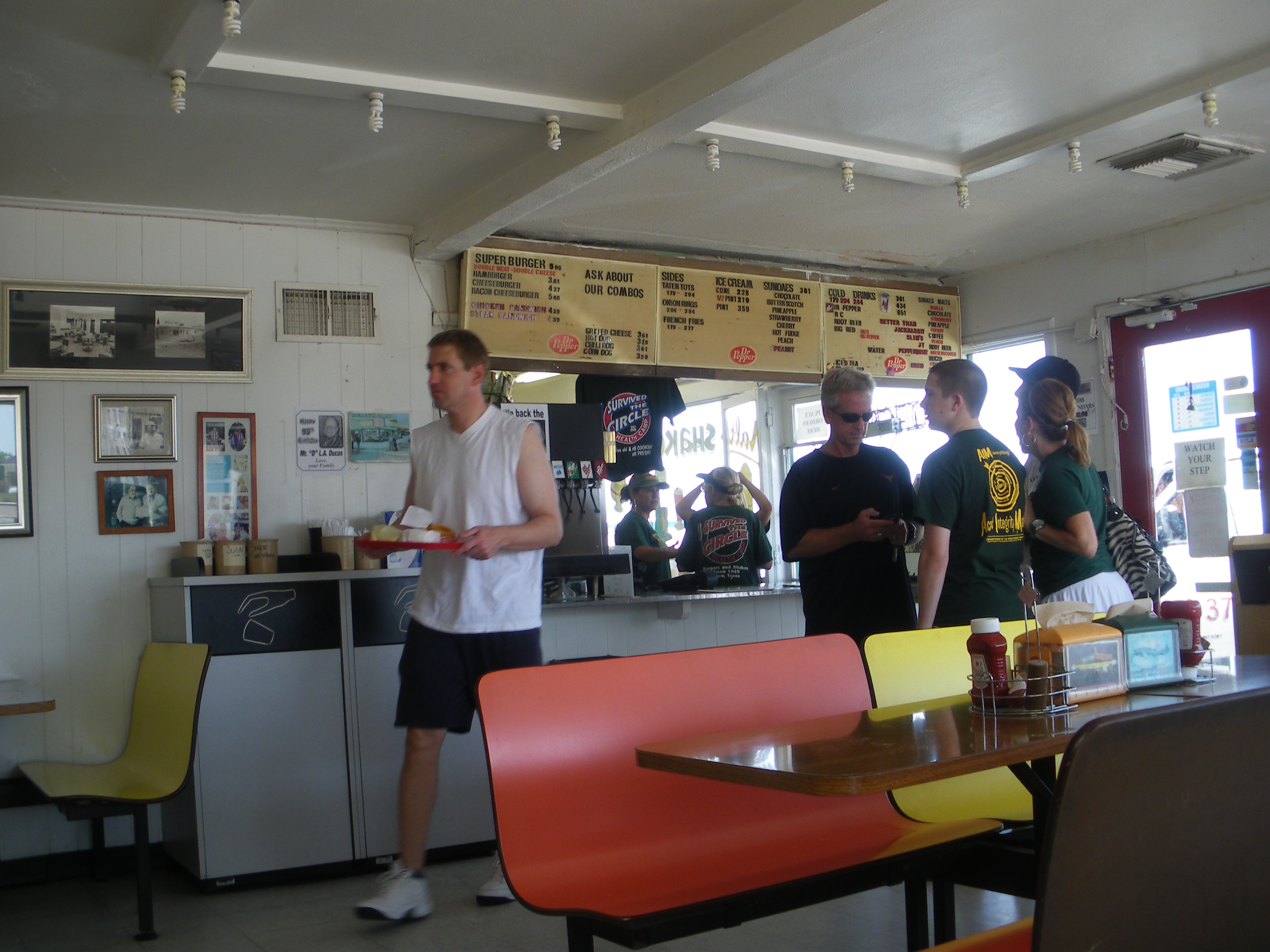
Interior of Health Camp Drive-in in Waco, Texas,   photo by Ed Darrell

Atmosphere? You came here for the burgers and the milkshakes. The seats work, the tables are clean, the ketchup isn't watered down. You want decor? Go to McDonalds.

They know what they’ve got.  A combo meal — burger, fries or tots or rings, and drink, will be north of $6.00; add a shake, you’re up to $8.00  Change back from your $10 or $20.

I got a cheeseburger, mayo, “all the way.”  Very good beef, satisfying, fresh and sweet onions.  Fries could have been cut in the place, but I’ll wager they were frozen — not highly processed beyond that.  Fried to a good crisp, they screamed for ketchup.

A stop here beats a stop at any of the big chains, but will cost you a bit more.  True burger aficionados may complain.  Let ’em.

I’ll stop there again with pleasure, unless I think I have time to try the Elite Circle Grill for a comparison.  I thought fondly of the Owl Burger at the Owl Cafe in Albuquerque, and the Big H from Hires Drive-In in Salt Lake City, both superior to the Health Camp product.  But they are related closely enough for horseshoes.

Health Camp cheeseburger and fries - photo by Ed Darrell

The Health Camp cheeseburger comes wrapped unassumingly in paper, served on a plastic tray. Clearly the management puts its effort into ingredients and preparation.


Ben Stein in a nutshell (appropriately)

July 8, 2011

Ben Stein is too easy to kick around anymore.  His views on politics, science, and general public policy have inflated so much above the troposphere that he really cannot speak about life on the ground at all.  The movie mockumentary “Expelled!” provided the early signs of pundit dementia.

Graphic for Ben Stein's American Spectator column

Graphic for Ben Stein's American Spectator column: Even in the art, Stein's out of it; his column is titled, "Nation's Pulse," but the graphic shows Uncle Sam hooked up to a machine measuring everything but his pulse. Even Sam's genitals get wired, but the nurse isn't counting heartbeats, nor does it appear any other monitor is.

At the same time, he’s a friend of dogs.  One of his tributes to his old dog literally brought tears to my eyes, and reminded me much of the old saying that heaven has no room for those who don’t like dogs.  That also raised the horrible vision of spending eternity in a heaven with dog-lovers who also happen to be political idiots.

Stein won’t kick dogs, but he’ll kick scientists, and poor people, and anyone in the middle class.  Maybe heavens don’t take people solely on the basis of their affection for dogs.

I digress.

At the remains of the American Spectator — a once-great, nearly revolutionary and smart journal of conservatism slipped on the slime to twitchy, bumper-sticker politics — Stein’s every-issue column turned to his vacation in an exclusive and expensive home in Sandpoint, Idaho, his distaste for undeveloped land and and outright fear of wilderness, friends, and the birth of his granddaughter, nicknamed Coco:

I feel so worried about Coco, She is only a tiny infant with eyes barely open. What do I want Coco to know? To do her best. To love her parents. To forgive. To be a lot more prudent about money than I am. To be grateful for this, our America, the best place in the universe. To turn her will and her life over to God and turn to Him for help in every situation.

But I wish my parents and Alex’s parents were here to help. And I wish my sister lived closer so she could help. And that Mr Nixon were still alive to give the leaders of this nation some clue about how to lead a nation. I am excited about Coco, but I am scared.

Right emotions, wrong thoughts.  We need Lyndon Johnson, with a concern for eliminating poverty among the aged (something he did!), not Richard Nixon.  With the possible exception of his trip to China, nothing Nixon did couldn’t have been done better by Johnson with another four years, or Humphrey, had we had the sense.

But that’s Stein.  He’s human on the family front, full of emotion, loving dogs, getting a cold treat for his ill wife, worrying about the future his granddaughter faces, especially from his privileged palace in Sandpoint, a nice nearly-wild area unfortunately become home of right-wing militias, Aryan-loving neo-Nazis and Keystone Kops-style militias — then switching to his brain-driven mode from emotion-driven, and doing everything he can to make sure anyone who lacks a few million dollars in the bank courtesy of the Old Man will be unable to rise above the fears.  Stein luckily led a charmed life, dependent on the kindness of family, friends and strangers, and he cannot understand why others don’t do the same.  Stein’s solutions stand magnificently out of reason:  Out of work?  Take a tax cut.  Need money to go to college?  Your father needs a tax cut, if he’s rich.  Health care tough to find because you can’t pay for it?  Tax cuts for the owner of the company you wish to work for.  And stop your arguing for more practical or workable solutions whining.

Stein stands in such sharp contrast to the Nepali prince Siddhartha, whose views of real life led him to forsake his princely heritage and seek spiritual enlightenment.  One hopes for a Stein-like character with the conscience of Siddhartha, but the practicality of Ross Perot who once noted that what America really needs is a political leader who will fill some potholes, and then, instead of holding a press conference about it, fill some more potholes.

Ben Stein’s road of life has been stripped of most potholes.  It’s so smooth, he can’t understand why everyone doesn’t drive that way, going to fancy school’s on Dad’s big money, hobnobbing with Republicans at the country club and occasionally taking the opportunities they toss your way.  Wouldn’t such a life be divine?