February 19, 2009
You can go read this at P. Z. Myers’s Pharyngula, but I’m going to pirate most of his post here to reiterate the point for Texas: Intelligent design doesn’t belong in Texas science classrooms, and intelligent design’s attacks on evolution don’t belong there either, because they are not backed by science.
ID’s propaganda tank, the Discovery Institute, invited a biologist from the University of Vermont, Nicholas Gotelli, to debate one of their spokesmen. The biologist declined.
Unable to perform in science venues, the Discovery Institute is working to get Texas high school students to take Dr. Gotelli’s place. That’s why Texas scientists and educators are up in arms against the proposals from the Texas State Board of Education — Texas high school kids cannot do the work of science, and shouldn’t be called on to be the patsy for the Discovery Institute in classrooms, for grades.
Here’s the invitation; be sure to read Dr. Gotelli’s response, further below.
Dear Professor Gotelli,
I saw your op-ed in the Burlington Free Press and appreciated your support of free speech at UVM. In light of that, I wonder if you would be open to finding a way to provide a campus forum for a debate about evolutionary science and intelligent design. The Discovery Institute, where I work, has a local sponsor in Burlington who is enthusiastic to find a way to make this happen. But we need a partner on campus. If not the biology department, then perhaps you can suggest an alternative.
Ben Stein may not be the best person to single-handedly represent the ID side. As you’re aware, he’s known mainly as an entertainer. A more appropriate alternative or addition might be our senior fellows David Berlinski or Stephen Meyer, respectively a mathematician and a philosopher of science. I’ll copy links to their bios below. Wherever one comes down in the Darwin debate, I think we can all agree that it is healthy for students to be exposed to different views–in precisely the spirit of inviting controversial speakers to campus, as you write in your op-ed.
I’m hoping that you would be willing to give a critique of ID at such an event, and participate in the debate in whatever role you feel comfortable with.
A good scientific backdrop to the discussion might be Dr. Meyer’s book that comes out in June from HarperCollins, “Signature in the Cell: DNA and the Evidence for Intelligent Design.”
On the other hand, Dr. Belinski may be a good choice since he is a critic of both ID and Darwinian theory.
Would it be possible for us to talk more about this by phone sometime soon?
With best wishes,
David Klinghoffer
Discovery Institute
Gotelli wrote back:
Dear Dr. Klinghoffer:
Thank you for this interesting and courteous invitation to set up a debate about evolution and creationism (which includes its more recent relabeling as “intelligent design”) with a speaker from the Discovery Institute. Your invitation is quite surprising, given the sneering coverage of my recent newspaper editorial that you yourself posted on the Discovery Institute’s website: http://www.evolutionnews.org/2009/02/
However, this kind of two-faced dishonesty is what the scientific community has come to expect from the creationists.
Academic debate on controversial topics is fine, but those topics need to have a basis in reality. I would not invite a creationist to a debate on campus for the same reason that I would not invite an alchemist, a flat-earther, an astrologer, a psychic, or a Holocaust revisionist. These ideas have no scientific support, and that is why they have all been discarded by credible scholars. Creationism is in the same category.
Instead of spending time on public debates, why aren’t members of your institute publishing their ideas in prominent peer-reviewed journals such as Science, Nature, or the Proceedings of the National Academy of Sciences? If you want to be taken seriously by scientists and scholars, this is where you need to publish. Academic publishing is an intellectual free market, where ideas that have credible empirical support are carefully and thoroughly explored. Nothing could possibly be more exciting and electrifying to biology than scientific disproof of evolutionary theory or scientific proof of the existence of a god. That would be Nobel Prize winning work, and it would be eagerly published by any of the prominent mainstream journals.
“Conspiracy” is the predictable response by Ben Stein and the frustrated creationists. But conspiracy theories are a joke, because science places a high premium on intellectual honesty and on new empirical studies that overturn previously established principles. Creationism doesn’t live up to these standards, so its proponents are relegated to the sidelines, publishing in books, blogs, websites, and obscure journals that don’t maintain scientific standards.
Finally, isn’t it sort of pathetic that your large, well-funded
institute must scrape around, panhandling for a seminar invitation at a little university in northern New England? Practicing scientists receive frequent invitations to speak in science departments around the world, often on controversial and novel topics. If creationists actually published some legitimate science, they would receive such invitations as well.
So, I hope you understand why I am declining your offer. I will wait patiently to read about the work of creationists in the pages of Nature and Science. But until it appears there, it isn’t science and doesn’t merit an invitation.
In closing, I do want to thank you sincerely for this invitation and for your posting on the Discovery Institute Website. As an evolutionary biologist, I can’t tell you what a badge of honor this is. My colleagues will be envious.
Sincerely yours,
Nick Gotelli
P.S. I hope you will forgive me if I do not respond to any further e-mails from you or from the Discovery Institute. This has been entertaining, but it interferes with my research and teaching.
Of course, that’s what Judge William Overton told creationists to do way back in 1982, in the Arkansas trial. Just do the science, and it will be in the textbooks as if by magic.
If creationists won’t listen to a federal judge, why would they listen to Vermont biologist?
Spread the word; friends don't allow friends to repeat history.
 111 Comments |
  Creationism, History, Intelligent Design, Research, Science | Tagged: Creationism, Evolution, Intelligent Design, Nicholas Gotelli, Quackery, Science |
  Permalink
 Posted by Ed Darrell
February 14, 2009
On Darwin’s birthday, two Texas legislators wrote about the stakes in the tussle between creationists on the one side, and educators, scientists and economic development on the other, in the Houston Chronicle.
Somebody gets it! Will Gov. Rick Perry and SBOE Chairman Don McLeroy get the message? McLeroy was reappointed as chairman a week ago — but the appointment must be approved by the State Senate. Is a fight possible?
[Can a newspaper copyright the words of public servants doing their jobs?]
Feb. 12, 2009, 12:14AM
As scientists and educators across Texas and the nation mark the 200th birthday of Charles Darwin with calls for a renewed commitment to science education, the State Board of Education continues to engage in narrow theological debate about the validity of evolution. If Texas schoolchildren are to succeed in the 21st Century economy, the SBOE must focus less on internal philosophical differences and more on improving science instruction.
Last month, the board once again got bogged down in a bitter dispute over this issue. Members tentatively approved new science curriculum standards that protect teaching of evolution in one area, while creationists succeeded in watering it down elsewhere. Sadly, it was just the latest battle in the “culture war” being fought by a board that decides what more than 4.7 million Texas children learn in their public schools.
Families should be the primary educators on matters of faith, not our public schools. Regardless of board members’ personal beliefs on creationism and evolution, science classrooms are not the place for resolving such disagreements about faith. Those classrooms should focus on science.
Despite one’s personal stance on evolution, its teaching is critical to the study of all the biological sciences.
Scientists from our state’s universities have expressed this to the board, and have warned that watering down science education would undermine biotechnology, medical and other industries that are crucial to our state’s future.
Last session, the Legislature committed to investing $3 billion over the next 10 years in making Texas the global leader in cancer research and finding cures. This historic investment is certain to bring economic and academic opportunities to our state.
Sadly, even as our state takes one step forward, the SBOE moves us two steps back by continuing to support a diminished standard for science education. Texas’ credibility and its investment in research and technology are placed at risk by these ongoing, unproductive debates.
This is a critical issue and a critical time. Study after study has demonstrated that states which do well in science education have the brightest long-term economic future. According to Gov. Rick Perry’s Select Commission on Higher Education and Global Competitiveness, despite improved scores in math and reading, Texas’ students continue to lag alarmingly behind other states in science proficiency.
The National Assessment of Education Progress revealed that only 23 percent of Texas 8th graders achieved proficiency in science, compared with 41 percent of students in the top-performing states — the states with which we compete for jobs.
Yet the board continues to undermine high-quality science instruction, allowing our students to slip further behind.
To ensure that the SBOE works as it should, we have filed legislation to place the board under periodic review by the Sunset Advisory Commission and hold them accountable for their performance, just as we do the Texas Education Agency and other state agencies.
The decisions of the SBOE not only impact millions of young lives on a daily basis, but impact the economic progress of our state as well.
For these reasons and many others, the public has a right to full disclosure and oversight.
The board has escaped such scrutiny for far too long. The disregard for educators, instructional experts and scientists can’t continue. It’s time to take a closer look at the operations and policies of the State Board of Education.
Our state, and especially our kids, deserve better.
Ellis represents the Houston area and parts of Fort Bend County; Rose represents Blanco, Caldwell and Hays counties.
Thank you, Houston Chronicle.
Resources:
Spread the word; friends don't allow friends to repeat history.
Leave a Comment » | Creationism, Education, Education reform, Evolution, Government, Intelligent Design, Religion, Science, Separation of church and state, State school boards, Texas, Texas Lege, Textbook Selection, Textbooks | Tagged: Competitiveness, Creationism, Education, Intelligent Design, Science, Texas, Texas Lege | Permalink
Posted by Ed Darrell
February 12, 2009
Interesting compilation: In honor of Darwin’s 200th anniversary, take Steve Bratteng’s 13 questions evolution answers that intellligent design cannot; add to that some almost-recent polling data on creationism among Republicans, and kick off a discussion.
Someone posting at the Cecil Adams’ site, Straight Dope, did just that. Go join the discussion.
Trying to flatter me, of course, they linked to this blog — but it’s all Steve Bratteng’s work.
His questionnaire deserves a much broader audience. So, Welcome Straight Dopers.
Update: Goin’ viral now — A forum at Free Republic picked up on the quiz, too (from Straight Dope?). Go check out the discussion there — lots of concern that the malaria question is answered by the existence of Rachel Carson, which means those who propose that don’t understand evolution and haven’t read Rachel Carson, either. Welcome, Freepers.
Spread the word; friends don't allow friends to repeat history.
6 Comments | Charles Darwin, Darwin, Evolution, Health care, Intelligent Design, Science | Tagged: Charles Darwin, Darwin, Evolution, evolutionary medicine, Intelligent Design, Science, Steve Bratteng | Permalink
Posted by Ed Darrell
February 1, 2009
Answers to Steve Bratteng’s quiz, “13 things evolution can answer that intelligent design cannot,” are back up, at that post.
Spread the word; friends don't allow friends to repeat history.
Leave a Comment » | Biology, Creationism, Evolution, Health care, Intelligent Design, Texas | Permalink
Posted by Ed Darrell
January 18, 2009
Stephen Bratteng, a biology teacher at Westwood High School in Austin put this together. I got the list from him when I heard him testify in favor of solid science in biology textbooks, in hearings before the Texas State Board of Education in 2003.
Here are questions that evolution can answer, but intelligent design cannot.
If intelligent design cannot offer any insight into these things, but evolution can, why should we allow intelligent design or any other flaccid “alternative” to evolution into science classes? (Here’s the Institute for Creation Research, spending hundreds of words to fog over their inability to answer a single one of the questions!)
Why not teach our children the best we know, rather than junk we don’t know at all?
Mr. Bratteng’s 13 Questions
- Why does giving vitamin and mineral supplements to undernourished anemic individuals cause so many of them to die of bacterial infections?
- Why did Dr. Heimlich have to develop a maneuver to dislodge food particles from people’s wind pipes?

Dr. Henry Heimlich
- Why does each of your eyes have a blind spot and strong a tendency toward retinal detachment? But a squid whose eyesight is just as sharp does not have these flaws?
- Why are depression and obesity at epidemic levels in the United States?
- When Europeans came to the Americas, why did 90 percent of the Native Americans die of European diseases but not many Europeans died of American diseases?
- Why do pregnant women get morning sickness?
- Why do people in industrialized countries have a greater tendency to get Crohn’s disease and asthma?
- Why does malaria still kill over a million people each year?*
- Why are so many of the product Depends sold each year?
- Why do people given anti-diarrheal medication take twice as long to recover from dysentery as untreated ones?
- Why do people of European descent have a fairly high frequency of an allele that can make them resistant to HIV infection?
- Close to home: Why do older men often have urinary problems?

Cedar tree near Austin, Texas
- And why do so many people in Austin get cedar fever?
Of course, I don’t have the list of all the answers! (Can you help me out, Dear Reader? List what you know in comments.)
Resources:

American Red Cross poster on Heimlich Maneuver, from BusinessInsider
* Update November 2016: Actually, malaria death rates have been below a million/year worldwide since 2000; in 2015, fewer than 470,000 people died. At other posts on this blog you can learn that most of this great progress against malaria has been accomplished without DDT. Mr. Bratteng’s question remains valid, despite the happy decline in malaria deaths.
Save
Spread the word; friends don't allow friends to repeat history.
17 Comments | Darwin, Evolution, Intelligent Design, Junk science, State school boards, Texas, Textbook Selection, Textbooks, Voodoo science, Woo | Tagged: Education, Evolution, Intelligent Design, Junk science, Science, Science Standards, Textbooks, Voodoo science | Permalink
Posted by Ed Darrell
November 19, 2008
Ouch. As I noted in my testimony in 2003, much of Texas business is based on the pragmatic applications of evolution. Today, the Texas State Board of Education heard that businesses are leaving Texas because of the danger that an ill-educated workforce might hamper the business.
According to Evosphere:
Andrew Ellington, the UT Austin biochemistry professor spoke and said that he has formed two biomedical companies that use “directed evolution” (he presumably means gene sequencing techniques) to manufactures and delivers drugs for humans. He started these in Boston, MA, and Durham, NC, not Austin, because he needed to be sure there were plenty of workers properly trained in evolutionary biology that could understand the modern recombinant DNA techniques that are needed to produce and deliver the drugs. He spoke harshly about the “retrograde” Texas SBOE and its interference in accurate and reliable science education.
Most of the members of SBOE were there in 2003 when they tried to trap Ellington into admitting that evolution couldn’t occur because of the “handedness” issue. Ellington’s lab was where the handedness issue was put to bed, and he instead delivered a 15-minute tour-de-force lecture on how handedness is not a problem for evolution at all.

Dr. Andrew Ellington, a professor of biochemistry at the University of Texas, spoke to reporters at a Texas Freedom Network press conference following his testimony to the Texas State Board of Education, November 19, 2008
I guess they didn’t listen then. Will they listen now?
Spread the word; friends don't allow friends to repeat history.
11 Comments | Business, Creationism, Education, Evolution, Intelligent Design, Politics, Science, Texas, Texas Citizens for Science, Texas Freedom Network | Tagged: Andy Ellington, Business, Creationism, Education, Evolution, Intelligent Design, Politics, Science, Texas | Permalink
Posted by Ed Darrell
November 19, 2008
The Texas State Board of Education (SBOE) hearings on proposals for new science standards kick off today — and will probably run long into the night.
You can probably still sneak comments in. You can listen to the hearings in streaming audio, live. You can read the live blog reports from Texas Citizens for Science (TCS) President Steve Schafersman.
Texas science teacher Joe Lapp (a member of TCS) will give the board some good advice — will they listen?
Lapp will say:
My name is Joe Lapp, but I go by Spider Joe. I teach children about spiders, about the biology and physics of a spider’s world. My mission is to stoke passion for science in children and to empower children to think like scientists. I like to think that I’m launching these children into productive future careers as scientists, and indirectly, through them, contributing to solving some of mankind’s most serious challenges.
I’m watching what is going on here in the State Board of Education. You’re vying over what to teach about science and about evolution in particular. Some of you say, “teach the weaknesses with evolution.” Some of you say, “the ‘weaknesses’ are phony, don’t teach them.” You argue over whether science includes the supernatural or is restricted to just natural phenomena.
I ask you, how many of you grew up to be scientists? How many of you make a living teaching science to children? In a world full of people who dedicate their lives to science or science education, how many of you on the board are one of these specialized experts?
I’m suggesting that you recognize that you yourselves don’t have the answers.
We all come to the table with preferences and biases, but we’re talking about our children’s education and their future lives. When a scientist approaches a question, she may have a preferred answer, one that might win her the Nobel prize. When Pons and Fleischmann performed their cold fusion experiment, they wanted to see more energy output than input. Their bias blinded them to the truth, and rather than winning the Nobel Prize they became laughing stocks. If a scientist wants to know the truth, she must design an experiment that might show her desired outcome wrong; she must delegate her answer to the outcome of an experiment that ignores her biases.
The State Board of Education has a choice. One option is to play politics with our children’s future and vote your bias, regardless of the truth. The other option is to delegate your answer to the outcome of an experiment that ignores your biases, so that the answer better reflects the truth.
Fortunately for you, you have already performed the experiment. You delegated answers to your questions about science and evolution to experts in science and science education. They answered in the form of your September TEKS drafts. I urge you not to suffer the embarrassing fate of Pons and Fleischmann and to accept your experimental results. I suspect that politics introduced biases into the November drafts. Don’t fudge your results.
Please show your respect for children and science by making this a scientific decision and not a political one. Launch children into science by example. Envision children growing up to create new biofuels, cure cancers, eliminate AIDS, end malnutrition, reverse global warming, and save our wondrous natural resources for future generations.
Science is our children’s future.
Resources:
Spread the word; friends don't allow friends to repeat history.
1 Comment | Biology, Business, Creationism, Education, Education reform, Evolution, History, Intelligent Design, Politics, Public education, Science, Separation of church and state, State school boards, Texas | Tagged: Biology, Business, Education, Education reform, Evolution, Intelligent Design, Science, Science Standards, Texas | Permalink
Posted by Ed Darrell
November 18, 2008
Many scientists and researchers call Texas home, working at the Johnson Space Center, Texas A&M University, the University of Texas, University of Texas at Dallas, Texas Christian University, Southern Methodist University, Baylor University, Rice University, the University of Houston, Texas Tech, the University of Texas Southwest Medical Center, M. D. Anderson Cancer Center . . . well, you get the idea.
These are people who work in science every day. Many of them dedicate their lives to research in biological sciences, where evolution theory is the foundation and framework that hold all the biological sciences together.
In a groundbreaking poll released today by the Texas Freedom Network, 98% of Texas scientists told the Texas State Board of Education to quit trying to inject religion into public school science classes under the guise of intelligent design.
Will the Texas State Board of Education members listen to wise, professional advice?
The report highlights five key findings from the survey:
1. Texas scientists (97.7 percent) overwhelmingly reject “intelligent design” as valid science.
2. Texas science faculty (95 percent) want only evolution taught in science classrooms.
3. Scientists reject teaching the so-called “weaknesses” of evolution, with 94 percent saying that those arguments are not valid scientific objections to evolution.
4. Science faculty believe that emphasizing “weaknesses” of evolution would substantially harm students’ college readiness (79.6 percent) and ability to compete for 21st-century jobs (72 percent).
5. Scientists (91 percent) strongly believe that support for evolution is compatible with religious faith.
The survey results show that politicians who argue that there is a scientific controversy over evolution are not supported by scientists even in a state as conservative as Texas, [TFN President Kathy] Miller said.
Texas scientists report that their students from Texas too often are unprepared for college science curricula in biology because evolution wasn’t taught to them. This increases costs at the college level where remedial work must be done, and it discourages many capable students from pursuing careers in science. The report urges SBOE to listen to Texas scientists:
It is no exaggeration to say that Texas colleges and universities have a world-class science faculty and boast some of the most respected science educators found anywhere. These scientists should be an invaluable resource in crafting curriculum standards that prepare Texas schoolchildren for college and for the jobs of tomorrow. But is anyone listening? The State Board of Education would do well to heed the advice from these professors. The science education of a generation of students hangs in the balance. [page 9]
Hearings on proposed changes to the science curriculum are scheduled for Wednesday, November 19, in Austin. Steve Schafersman, Texas Citizens for Science, will live blog the hearings for his Houston Chronicle blog, Evosphere.
Resources:
Spread the word; friends don't allow friends to repeat history.
37 Comments | Creationism, Education, Intelligent Design, Politics, Science, Texas, Texas Citizens for Science, Texas Freedom Network | Tagged: Creationism, Education, Evolution, Intelligent Design, Politics, Science, Texas, Texas Citizens for Science, Texas Freedom Network | Permalink
Posted by Ed Darrell
November 10, 2008
Update: Teachers may sign up to get CEU credits for this event. Check in at the sign-in desk before the event — certificates will be mailed from SMU later.
It will be one more meeting of scientists that Texas State Board of Education Chairman Dr. Don McLeroy will miss, though he should be there, were he diligent about his public duties.
Dr. Barbara Forrest, one of the world’s foremost experts on “intelligent design” and other creationist attempts to undermine the teaching of evolution, will speak in the Faith and Freedom Speaker Series at Southern Methodist University (SMU) in Dallas. Her evening presentation will serve as a warning to Texas: “Why Texans Shouldn’t Let Creationists Mess with Science Education.”
Dr. Forrest’s presentation is at 6:00 p.m., in the Hughes-Trigg Student Center in the Hughes-Trigg Theatre, at SMU’s Campus. The Faith and Freedom Speaker Series is sponsored by the Texas Freedom Network’s (TFN) education fund. Joining TFN are SMU’s Annette Caldwell Simmons School of Education and Human Development, Center for Teaching Excellence, Department of Anthropology, Department of Biological Sciences, and Department of Philosophy.
Hughes-Trigg is at 3140 Dyer Street, on SMU’s campus (maps and directions available here).
Seating is limited for the lecture; TFN urges reservations be made here.

Dr. Forrest being interviewed by PBS's NOVA crew, in 2007. Southeastern Louisiana University photo.
From TFN:
Dr. Barbara Forrest
is Professor of Philosophy at Southeastern Louisiana University. She is the co-author with Paul R. Gross of Creationism’s Trojan Horse: The Wedge of Intelligent Design (2004; 2007), which details the political and religious aims of the intelligent design creationist movement. She served as an expert witness in the first legal case involving intelligent design, Kitzmiller et al. v. Dover Area School District. She is a member of the Board of Directors for the National Center for Science Education and Americans United for Separation of Church and State. Widely recognized as a leading expert on intelligent design, she has appeared on Larry King Live, ABC’s Nightline, and numerous other television and radio programs.
Also see:
Spread the word; friends don't allow friends to repeat history.
Leave a Comment » | Accuracy, Biology, Creationism, Education, Education quality, Ethics, Evolution, Famous trials, Freedom - Political, geology, Heroes, History, Hoaxes, Intelligent Design, Junk science, Jurisprudence, Justice, Law, Natural history, Paleontology, Politics, Public education, Rampant stupidity, Science, Separation of church and state, State school boards, Teaching, Texas, Texas Citizens for Science, Texas Freedom Network, Textbook Selection, Voodoo science, War on Education, War on Science | Tagged: Barbara Forrest, Creationism, Education quality, Evolution, History, Junk science, Politics, Science, Science Curriculum, Texas, Texas Freedom Network, Voodoo science | Permalink
Posted by Ed Darrell
October 28, 2008
The Constructive Curmudgeon headlined his post on the matter “Atheist for Intelligent Design in Boulder. This is not a Joke.”
But of course, it is a joke. The punchline is bad, which suggests it’s a bad joke, but the science is worse, which makes it a joke.
It only means there are atheists with bad ideas, too. Atheism is a big tent, apparently.
It’s our old buddy Bradley Monton, the darling of Telic Thoughts.
You’ll note Monton’s science background is not front and center: He’s a philosopher.
No matter how often the philosophers tell us that somebody should be watching out for all the damage flying pigs could do to aircraft and parked cars, we are obligated to point out that pigs don’t fly.
Monton will argue for federal regulation of flying pigs intelligent design at Old Main Chapel in Boulder, Tuesday, October 28, at 7:30 p.m. Douglas Groothuis, the Constructive Curmudgeon and philosopher at a Denver seminary, may be there to lead the standing ovation, and to distribute newspapers to protect the audience from flying pigs as they go back to their cars.
(The lecture series is hosted by Alistair Norcross, a philosophy prof at Colorado University who usually argues for scalar utilitarianism. I guess he’s not bothered to check out the usefulness of intelligent design — or, more accurately, its uselessness.)
Spread the word; friends don't allow friends to repeat history.
17 Comments | Creationism, Evolution, Intelligent Design, Junk science, Politics, Rampant stupidity, Science, Voodoo science | Tagged: Evolution, Intelligent Design, Junk science, Rampant stupidity, Science, Voodoo science | Permalink
Posted by Ed Darrell
August 24, 2008
Page A1 of the New York Times on Sunday, August 24, 2008: “A Teacher on the Front Line as Faith and Science Clash.”
Read it, and consider these questions:
- Would your local paper have the guts to report on this issue, for your local schools? (The Times went to Florida; heaven knows few Florida papers could cover the issue in Florida so well.)
- What is your local school board doing to support science education, especially for evolution, in your town? Or is your local school board making it harder for teachers to do their jobs?
- What is your state education authority doing to support science education, especially in evolution, in your state? Or is your state school board working to make it harder for teachers to do their jobs, and working to dumb down America’s kids?
- Do your school authorities know that they bet against your students when they short evolution, because knowledge about evolution is required for 25% of the AP biology test, and is useful for boosting scores on the SAT and ACT?
- Does your state science test test evolution?
- Do your school authorities understand they are throwing away taxpayer dollars when they encourage the teaching of voodoo science, like intelligent design?
It takes a good paper like the Times to lay it on the line:
The Dover decision in December of that year [2005] dealt a blow to “intelligent design,” which posits that life is too complex to be explained by evolution alone, and has been widely promoted by religious advocates since the Supreme Court’s 1987 ban on creationism in public schools. The federal judge in the case called the doctrine “creationism re-labeled,” and found the Dover school board had violated the constitutional separation of church and state by requiring teachers to mention it. The school district paid $1 million in legal costs.
That hasn’t slowed the Texas State Board of Education’s rush to get the state entangled in litigation over putting religious dogma in place of science. The Texas Education Agency (TEA) is already embroiled in one suit, brought by the science-promoting science curriculum expert they fired for noting in an e-mail that science historian Barbara Forrest was speaking in a public event in Austin. TEA may well lose this case, and their side is not helped when State Board Chairman Don McLeroy cavorts with creationists in a session teaching illegal classroom tactics to teachers. Clearly Texas education officials are not reading the newspapers, the court decisions, or the science books.
Here’s one of the charts accompanied the article. While you read it, consider these items: The top 10% of science students in China outnumber all the science students in the U.S.; the U.S. last year graduated more engineers from foreign countries than from the U.S.; the largest portion were from China. China graduated several times the number of engineers the U.S. did, and almost all of them were from China.
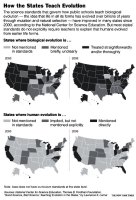
Copyright 2008 by the New York Times
Can we afford to dumb down any part of our science curriculum, for any reason? Is it unfair to consider creationism advocates, including intelligent design advocates, as “surrender monkeys in the trade and education wars with China?”
Update: 10:00 p.m. Central, this story is the most e-mailed from the New York Times site today; list below the fold.
Read the rest of this entry »
Spread the word; friends don't allow friends to repeat history.
5 Comments | Biology, Charles Darwin, Creationism, Darwin, Education, Education quality, Evolution, Intelligent Design, Politics, Public education, Religion, Science, Separation of church and state, State school boards, Teaching, Texas, Texas Citizens for Science, Texas Education Agency (TEA), Texas Freedom Network, Voodoo science, War on Education, War on Science | Tagged: Creationism, Don McLeroy, Education, Evolution, Politics, Religion, Science, Texas, Voodoo science | Permalink
Posted by Ed Darrell
August 18, 2008
Louisiana’s state legislature — the legislature that the Supreme Court slapped down in 1987 for trying to introduce religion into science classes in Edwards v. Aguillard — rushed through a bill drafted by the deaf-to-the-law Discovery Institute which purports on its face to make it legal for Louisiana science teachers to teach creationism, intelligent design, tarot card reading, UFO-ism, or any other crank science that the teacher feels compelled to offer.

A Louisiana alligator used by c design proponetsist Denyse O'Leary to illustrate a blog post about Louisiana's litigation bait law on creationism in schools. Without any appreciation of th irony, or as a subtle warning, we can't say. (photo from The Advocate?)
Louisiana’s Gov. Bobby Jindal, R-Mars, rushed to sign the brain-sucker into law, in his ambitious quest to get John McCain to name him as the nominee for vice president. It appears on the surface that Jindal’s national political aspirations will have to wait, but the law he signed requires Louisiana’s school districts to be ready when the students come back in the next few weeks, to do whatever it is they are going to do about creationism and other crank science.
Discovery Institute minions have been hawking creationism wares, and other creationists have offered to put Genesis into the science curriculum — but the law does not authorize those actions or wares itself. Instead, it passes the judgment to local school boards, sort of.
“Sort of.” Words that make a litigator’s heart flutter when talking about to-be-implemented laws! You’d think that, with all the money the Discovery Institute spends to entice legislators and school board members to poke their noses into matters they do not know, DI could spend a few thousands of dollars to get a competent legislative law drafter to draft a workable law. The cheapskates always pay more, Click and Clack say, and here’s another case to prove the point. It would have been difficult to intentionally write a law better intended to get local school boards sued.
A few of us noted the law does not indemnify local school districts against lawsuits if they goof and put religion into science classes. This is important, because the law requires local school districts to step up to the line and have a policy in place by the start of this school year. Which means, if the district doesn’t have the policy written out now, they’re late.
Tony Whitson at Curricublog spent time this summer pondering exactly how the law works, what it requires, and who it requires to act. His analysis — that the law is litigation bait just waiting to snare a local school board, a real “Dover Trap” — is cool, hard, and chilling. Go read it at his blog.
Whitson recommends that the Louisiana Board of Elementary and Secondary Education get an opinion from the state’s attorney general. This will not comply with the impossible and punishing deadline the legislature established, but it’s a much wiser stewardship of local monies, to try to avoid litigation. Tony wrote:
Taking stock of the situation: To summarize where things now stand, in light of everything above:
The law is by no means so benign as its promoters pretend. It will unleash all manner of chaotic mischief. On the other hand, there is a method to this madness, making it predictable that the perpetrators’ strategy will be to insinuate Exploring Evolution into the state’s (and then other states’) public schools.
BESE and the school districts cannot comply with the statute, which commands that
The State Board of Elementary and Secondary Education and each city, parish, or other local public school board shall adopt and promulgate the rules and regulations necessary to implement the provisions of this Section prior to the beginning of the 2008-2009 school year.
There are legal requirements (public notice, etc.) for adopting administrative rules for implementing legislation that make it impossible for that to be done by every state and district school board before the new school year begins.
So what can BESE do?
My suggestion is that BESE, at it’s meeting Tuesday, should move to request an opinion from the State Attorney General. They should ask him for an opion advising them, the district Boards of Education, and individual school principals, as to who will be responsible for the costs of defending against litigation for unconstitutional state promotion of religion in the use of supplemental materials. Presumably, if there’s a suit brought directly against BESE itself because of the substance of a text they have approved, then they would be defended by the AG’s office, on behalf of the state (like when the AG hired Wendell Bird as as special assistant for defending the state’s “Balanced Treatment” law). But will the AG commit his office to defending every district, every school, and every teacher whose use of “supplemental materials” is challenged for violation of the First Amendment?
Louisiana’s legislature set a trap for Louisiana science teachers and local school boards — whether intentionally or not is immaterial. Rather than authorize specific material for the curriculum, the new creationism law requires school boards to analyze materials to supplement the science curriculum. The law passes the buck to the local school boards.
So, Louisiana school board members now must become expert on science, and Constitutional law.
Rule of thumb: It costs a school board about $1 million every time they goof and put religion into science classrooms, in litigation costs alone. Louisiana’s legislature didn’t appropriate any money to compensate the school boards.
This law promises to entangle science educators and curriculum, and ensnare local school boards – all of which helps dumb down science achievement and prevent U.S. kids from getting the education they need to compete in a global economy. Alas.
Spread the word; friends don't allow friends to repeat history.
3 Comments | Creationism, Education, Education success, Evolution, First day, History, Intelligent Design, Politics, Rampant stupidity, Science, Teaching, Voodoo science | Tagged: Creationism, Education, Evolution, History, Intelligent Design, Louisiana, Politics, Science, Voodoo science | Permalink
Posted by Ed Darrell
August 12, 2008
This will be a short post, and so will confuse the long-winded but short-thought intelligent design advocates, especially those who claim to be philosophers, and especially those who claim to be philosophers of science who can see a role for intelligent design.
A short visit to Telic Thoughts last week produced a revelation that they have a new philosopher who wants to argue that intelligent design “philosophically” could be science, if. I answered that argument at some length, in lay terms, here: “Intelligent Design, a pig that does not fly.”
Dr. Francis Beckwith, at Baylor, appears to have dropped his campaign to teach philosophy in science classes since he rediscovered that God visits the Pope, and since he moved on to more serious philosophical pursuits and away from his practice of confusing people about the law of separation of church and state in America (especially confusing the Texas State Board of Education). We hope Beckwith sticks with philosophy and stays out of Texas textbooks.
So there was a vacancy in the phalanx of defenders of intelligent design, in the slot reserved for company store philosohers. Dr. Brad Monton volunteered for the job. Monton has a blog, here. Monton philosophizes at the University of Colorado.
What should be the role of theism in science? Exactly this: Theism should encourage scientists to be diligent, to be honest, to ask tough questions, and be kind. Theism should encourage scientists to be wise stewards of their lab resources and time, and to share the fruits of their work with humanity, for the benefit of all creation (no, not “creationism”).
That’s it. Honest and thorough, not mean. Work quickly and true.
If scientists stick to the noble purposes of their work, using these noble methods, we will see a quick death to creationism and intelligent design, which clamor and riot to be included in the science texts though they have not a lick of evidence to support them that is honest, true and nobly gained.
Philosophical debates do not belong in high school science classes, nor middle school or elementary school science classes. The fun of science, the honest ethics of science, the value of science, and the stuff of science are appropriate topics for those science classes. Especially school kids should not be encouraged to offer unevidenced, petulent denials of the facts as we know them. That will only encourage them to become larcenists, disturbed individuals, and Republican state legislators. Heaven knows we don’t need those.
Wes Elsberry agrees at his blog, The Austringer, but with more felicity:
The issue is not whether science could make progress in spite of re-adoption of 17th century theistic science, but whether theistic science could provide any benefit to the methods of science today. Monton, Plantinga, and the neo-Luddites have not convincingly made that case. Mostly, they haven’t even badly made that case. They seem to assume that science would be better off reverting to 17th century theistic science and become perplexed when scientists disagree with them. We had that debate, we call it “the 19th century”. Nobody has shown that the mostly-theistic body of scientists who decided to eschew supernatural conjectures as part of science were wrong to do so. Mostly, I think, because they were right to do so, and their reasoning still applies today.
Monton seeks a publisher. I wish he’d seek a course in botany, another in zoology, another in genetics, and one in evolution. He might find something worth publishing, then.
Philosophically, anything fits in science, if there is evidence to support it, and especially if there is theory that supports it and offers solid explanations that can be relied upon. But we don’t teach philosophy to kids. We teach the kids the evidence. Philosophically, any voodoo science could be considered science, if there were evidence to support it. Philosophically, the FAA should regulate flying pigs that pose a threat to commercial and general aviation. Pragmatically, however, pigs don’t fly. In regulation of our air space, and in our science classes, we rely on theory backed by hard evidence. I wish theists would all agree on that point, and shut up about intelligent design until some institute of discovery actually provides research results that provide evidence that ID is science, rather than philosophy.
See? I said it would be short.
Spread the word; friends don't allow friends to repeat history.
10 Comments | Accuracy, Creationism, Education, Evolution, Intelligent Design, Politics, Religion, Science, State school boards, Teaching, Voodoo science | Tagged: Creationism, Education, Evidence, Evolution, Intelligent Design, Philosophy, Religion, Science, State Boards of Education, Voodoo science | Permalink
Posted by Ed Darrell
June 30, 2008
I love the headline: “Anti-science law signed by Louisiana’s exorcist governor.”
Tony Whitson’s quick analysis is good, too.
One might begin to think Louisiana really is cursed. Katrina, Rita, other political troubles — and then they elect the bright, young reformer as governor, and he turns out to be a voodoo history and voodoo science practitioner — heck, maybe he practices just plain old voodoo.
All this comes at a time when it may have saved John McCain from making a mistake that would make George McGovern’s selection of Tom Eagleton look like wisdom of the ages (when news came out that Eagleton had undergone convulsive shock therapy for depression, he was replaced on the ticket by Sargent Shriver, but not after much damage had been done to the credibility and viability of the McGovern campaign — why Nixon thought it necessary to sponsor burglary to defeat this ticket is one of the mysteries of the ages of Shakespearian tragedy come to life in in American politics).
Mind you, I like and respect McGovern, and I found working with Tom Eagleton on the Senate Labor Committee a great joy.
Spread the word; friends don't allow friends to repeat history.
Leave a Comment » | Campaigns, Creationism, Education, Evolution, History, Intelligent Design, Politics, Science, War on Education, War on Science | Tagged: 2008 campaign, Creationism, Education, Evolution, History, Intelligent Design, War on Education | Permalink
Posted by Ed Darrell
June 29, 2008
In the end, Dr. James Dobson and other ideological Christians may be the worst enemies of the idea that intelligent design should be taught as science. They just can’t resist emphasizing that ID is, to them, good Christian doctrine.
In the latest outbreak, the New Zealand chapter of Dobson’s group Focus on the Family has sent copies of the DVD, “The Privileged Planet,” to 400 New Zealand high schools. Why?
Focus on the Family’s executive director Tim Sisarich said the material was intended to expose pupils to an alterative theory of cosmology.
“We’re a Christian organisation so we believe that God made the planet and God made the cosmos … Science takes a theory and tries to establish it as the truth, and that’s all this is.”
Education Ministry senior manager Mary Chamberlain said parents had a right to withdraw children from religious instruction.
This undercuts the lobby group, Discovery Institute (DI), which argues that intelligent design should be considered good science and not religiously related. The DVD in question features an intelligent design advocate, Guillermo Gonzalez, who was denied tenure at Iowa State University in 2007 — in that flap, DI argued that the DVD was good science, not religion.
Creationism does tend to require being flexible on the truth. When fundraising, or when trying to defend Christian ideas, intelligent design is Christian doctrine. When DI and others are trying to sneak ID into science curricula in the U.S., it’s not religion at all, but scientifically related.
Treating subjects in that fashion is a form of moral relativism, or to most people, simple dishonesty.
(The discussion at the site of the Dominion Post is quite lively; see what New Zealanders think of intelligent design.)
Tip of the old scrub brush to Dr. Bumsted at Grassroots Science.
Update: P. Z. Myers at Pharyngula was already on it. Morris, Minnesota is just such a hub of scientific activity, it’s difficult to stay ahead of Dr. Myers when we’re stuck here in what appears to be the scientific backwater of Dallas.
Spread the word; friends don't allow friends to repeat history.
13 Comments | Creationism, Education, Intelligent Design, Politics, Religion, Science, Separation of church and state | Tagged: Creationism, Education, Intelligent Design, Politics, Religion, Science, Separation of church and state | Permalink
Posted by Ed Darrell





 Millard Fillmore's Bathtub
