Let there be light: January 27, anniversary of bright idea

January 29, 2009

Oops, missed this anniversary date!

First page of patent granted to Thomas Edison on January 27, 1880 -- for light bulb

First page of patent granted to Thomas Edison on January 27, 1880 -- for light bulb

Thomas Alva Edison got a patent for “electric-lamp” on January 27, 1880.

According to the Our Documents site:

In 1878 the creation of a practical long-burning electric light had eluded scientists for decades. With dreams of lighting up entire cites, Edison lined up financial backing, assembled a group of brilliant scientists and technicians, and applied his genius to the challenge of creating an effective and affordable electric lamp. With unflagging determination, Edison and his team tried out thousands of theories, convinced that every failure brought them one step closer to success. On January 27, 1880, Edison received the historic patent embodying the principles of his incandescent lamp that paved the way for the universal domestic use of electric light.

(Information excerpted from American Originals by Stacey Bredhoff; [Seattle and London; The University of Washington Press, 2001] p. 62–63.

Our Documents grew out of the National Archives list of 100 milestone documents important to American history — Edison’s patent application was voted one of the top 100.  Our Documents is now a joint exercise combining the efforts of the National Archives, National History Day, and USA Freedom Corps.

Page from Edisons application for patent for an electric lamp - National Archives

Page from Edison's application for patent for an "electric lamp" - National Archives


Forgotten anniversaries: Microwave oven patent

January 26, 2009

Some history really does need to be rewarmed.

January 24 marks the anniversary of the granting of the patent for the microwave oven, “Method of treating foodstuffs.” Do your texts even refer to this by-product of World War II?  What benefits of microwave ovens can your students come up with?  Will they offer the apocryphal question about how Native Americans could possibly have invented popcorn with their wood-fired microwave ovens?

Dr. Percy L. Spencer noted that a chocolate bar in his shirt pocket had melted when he was working around an operating radar tube, at Raytheon Corp., during World War II (the patent application for microwave cooking was filed on October 8, 1945).  With a little experimentation, he determined the microwaves from the radar tube were rapidly cooking things — think exploding egg, think popping corn.

Drawing from the patent of the microwave oven, granted to Percy L. Spencer on January 24, 1950; courtesy the Southwest Museum of Engineering, Communications and Computation

Drawing from the patent of the microwave oven, granted to Percy L. Spencer on January 24, 1950; courtesy the Southwest Museum of Engineering, Communications and Computation

One of the problems Spencer had to overcome was that radar tubes cooked foods way too fast.  He had to tune the magnetron tubes to produce wavelengths with less energy, to heat food more slowly so the cooking could be controlled.  Spencer explained this process of invention in the first page of text on the patent itself.

Perhaps one could create an interesting DBQ with only patents, tracing radio and radar through the microwave oven.

This is one device you probably can demonstrate  safely  in any history classroom.

Resources:

Tip of the old scrub brush to Rhapsody in Book’s Weblog.


On life support since 2006: R.I.P., VHS

December 24, 2008

The last U.S. source of pre-recorded VHS videos has pulled the plug.

VHS is dead, but for the twitches of life carrying on in schools and homes where people cling to the format Hollywood has not supported for the past two years.

Stories in ArsTechnica and The Los Angeles Times say Distribution Video Audio, the last U.S. supplier, will toss its inventory in early 2009.

After three decades of steady if unspectacular service, the spinning wheels of the home-entertainment stalwart are slowing to a halt at retail outlets. On a crisp Friday morning in October, the final truckload of VHS tapes rolled out of a Palm Harbor, Fla., warehouse run by Ryan J. Kugler, the last major supplier of the tapes.

“It’s dead, this is it, this is the last Christmas, without a doubt,” said Kugler, 34, a Burbank businessman. “I was the last one buying VHS and the last one selling it, and I’m done. Anything left in warehouse we’ll just give away or throw away.”

How much longer can DVD hold on?

Asked how the death of VHS might affect U.S. education, Mrs. Americanteacher said, “Hold on, I need to stoke the wood in the stove here, and clean the chalkboard.  Just a minute.  I’ll get back to you.”

VHS was about 30 years old.

Interment will be in thousands of landfills across North America, though some relics will be sent to small shrines in bars and bodegas around the world, mostly in second- and third-world countries.


Historic winds of December

December 17, 2008

In English, it’s just one letter difference between “winds” and “wings.”  An encore post, commemorating one historic event from December 17 involving both winds and wings:

December 17, written in the wind

Wright Bros. flyer at Kittyhawk, first flight

Photo from Treasures of the Library of Congress; “First Flight” by John T. Daniels (d. 1948); this is a modern gelatin print from the glass negative.

Ten feet in altitude, 120 feet traveled, 12 seconds long. That was the first flight in a heavier-than-air machine achieved by Orville and Wilbur Wright of Dayton, Ohio, at Kittyhawk, North Carolina, on December 17, 1903.

From the Library of Congress:

On the morning of December 17, 1903, Wilbur and Orville Wright took turns piloting and monitoring their flying machine in Kill Devil Hills, North Carolina. Orville piloted the first flight that lasted just twelve seconds. On the fourth and final flight of the day, Wilbur traveled 852 feet, remaining airborne for 57 seconds. That morning the brothers became the first people to demonstrate sustained flight of a heavier-than-air machine under the complete control of the pilot.

No lost luggage, no coffee, no tea, no meal in a basket, either.

Resources on the Wright Brothers’ first flight:


Mark Twain and Nikola Tesla

November 29, 2008

I like this photo of Mark Twain.

November 30 is the anniversary of the birth of Mark Twain, born 1835 (a year of an appearance of Halley’s Comet).  The photo was taken in the spring of 1894 in the laboratory of inventor Nikola Tesla, and originally published to illustrate an article in the legendary Century Magazine, by T.C. Martin called “Tesla’s Oscillator and Other Inventions,” in the April 1895 issue.

Mark Twain, in the laboratory of Nikola Tesla, 1894 - photo in public domain to the best of my knowledge

Mark Twain, in the laboratory of his friend, the inventor Nikola Tesla, 1894 - photo in public domain to the best of my knowledge (See Wikimedia)

Who is that to Twain’s right in the photo?  Tesla?


Chuck Yeager/BOOM! Day

October 14, 2008

I won’t let the whole day go by without a nod to one of my heroes, Chuck Yeager.  On October 14, 1947, Yeager pushed the Bell X-1 just a little faster than the flight plan called for, and broke the sound barrier, over Edwards Air Force Base, California.

Brig. Gen. Chuck Yeager, recipient of the Congressional Silver Medal of Honor.  MedalofHonor.com

Chuck Yeager and a modern aircraft -- yes, he's flown it, too.


Last year, belatedly, I got around to posting on the flight, and on Yeager, and on the deeper meaning of flight records and the space race on the psyche of America in the 1950s, 1960s and 1970s.  More details and sources there.  It’s a year later, Yeager is 85, but the story still gets me the same way.  Just over a year ago, Yeager flew in a fighter and broke the sound barrier again, one of the oldest people ever to do that.

You could fly your flag in his honor.  If there’s a stiff breeze when you do, the ends of the flag will snap in the wind — they break the sound barrier, and you hear the report.  Wonderfully appropriate, don’t you think?

Here’s a salute to you, Chuck Yeager!


400 years of river history: NY celebrates Hudson, Champlain and Fulton in 2009

July 26, 2008

Okay, it’s the 202nd anniversary of Robert Fulton’s historic, 32-hour steamboat trip from New York City to Albany, demonstrating the viability of steamboat travel for commerce on the Hudson.  But for such a historic river, why not delay that fete for a couple of years and roll it into the 400th anniversary of Champlain’s exploration of the lake that now bears his name, and Henry Hudson’s discover of the mouth of the river to the south, the Hudson, whose mouth is home to New York City.

400 years of Hudson River history in 2009 - Hudson, Champlain, Fulton

400 years of Hudson River history in 2009 - Hudson, Champlain, Fulton

And so 2009 marks the Quadricentennial Celebration on the Hudson, honoring Hudson, Fulton and Champlain.

Alas, the committee to coordinate the celebration along the length of the river was not put in place until February, so there is a scramble.  Local celebrations will proceed, but the overall effort may fall short of the 1909 tricentennial, with replicas of Hudson’s ship, Half Moon, and Champlain’s boats, and Fulton’s steamer, and parades, and festivals, and . . .

Still, the history is notable, and the stories worth telling.

Most of my students in U.S. and world history over the past five years have been almost completely unaware of any of these stories.  One kid was familiar with the Sons of Champlin, the rock band of Bill Champlin, because his father played the old vinyl records.  Most students know nothing of the lore of Hudson, the mutiny and the old Dutch stories that have thunder caused by Hudson and his loyal crewman bowling in the clouds over the Catskills.  They don’t even know the story of Rip van Winkle, since it’s not in the Texas Essential Knowledge and Skills (TEKS) list and so gets left out of even elementary school curricula.  Is this an essential piece of culture that American children should know?  American adults won’t know it, if we don’t teach it.

Henry Hudson, from a woodcut

Henry Hudson, from a woodcut

Explorations and settlement of Quebec by Samuel de Champlain get overlooked in post-NCLB texts.  Texts tend to make mention of the French settlement of Canada, but placing these explorations in the larger frame of the drive to find a route through or around North America to get to China, or the often-bitter contests between French, English, Spanish, Dutch and other European explorers and settlers gets lost.  French-speaking Cajuns just show up in histories of Texas and the Southwest, with little acknowledgment given to the once-great French holdings in North America, nor the incredible migration of French from Acadia to Louisiana that gives the State of Louisiana such a distinctive culture today.

French explorer and settler Samuel de Champlain

French explorer and settler Samuel de Champlain

Champlain’s explorations and settlement set up the conflict between England and France that would result in the French and Indian War in the U.S., and would not play out completely until after the Louisiana Purchase and War of 1812.

Fulton’s steamboat success ushered in the age of the modern, non-sail powered navies, and also highlights the role geography plays in the development of technology. The Hudson River is ideally suited for navigation from its mouth, north to present-day Albany.  This is such a distance over essentially calm waters that sail would have been preferred, except that the winds on the Hudson were not so reliable as ocean winds.  Steam solved the problem.  Few other rivers in America would have offered such an opportunity for commercial development — so the Hudson River helped drive the age of steam.

New York City remains an economic powerhouse.  New York Harbor remains one of the most active trading areas in the world.  Robert Fulton helped propel New York ahead of Charleston, Baltimore and Boston — a role in New York history that earned him a place in for New York in the U.S. Capitol’s Statuary Hall.  The steamboat monopoly Fulton helped establish was a key player in Gibbons v. Ogden, the landmark Supreme Court case in which the Court held that Congress has the power to regulate commerce between states — an upholding of the Commerce Clause against the old structures created under colonial rule and the Articles of Confederation.

Robert Fultons statute in the U.S. Capitol - photo by Robert Lienhard

Robert Fulton's statute in the U.S. Capitol - photo by Robert Lienhard

400 years of history along the Hudson, a river of great prominence in world history.  History teachers should watch those festivities for new sources of information, new ideas for classroom exercises.

Resources:


Real dope on human evolution

July 24, 2008

Subtitle this one, “DBQs in prehistory, paleontology, and anthropology.”

Younger son James complained yesterday about . . . well, about stuff he wasn’t taught. His questions to me were about what was available in the history textbooks on the great advances in science in the 20th century.

Very little is available, really. What had set him off was his summer reading where he’s been introduced, for the first time, to particle physics of the past 30 years. History texts may mention Einstein’s letter to FDR which started the Manhattan project. An outstanding history and science student in a U.S. high school can pass through the experience without ever learning what Einstein’s equation, E=mc², actually means, or how it pertains to his letter to Roosevelt, or when and how Einstein came up with it, how Einstein’s papers changed physics, how Einstein’s ideas were tested, how Einstein’s pacifism and Jewish heritage drove him to the U.S., and so on. Great advances in particle physics, or even in practical applications like CAT scans and PET scans, have fallen out of the books and out of the curriculum. 21st century medicine, but 20th century science texts and 19th century history texts. It’s the David-Bartonization of American education.

The stuff wasn’t covered in his AP physics or AP chemistry classes (what’s up with that?!), nor were most of the great discoveries even mentioned in any of the AP history courses.

No wonder the head of the Texas State Board of Education knows so little about science. Cue the country/western version of the story, “Been dumb as a stump so long it looks like genius to me.”** Plus, this makes it clear why the versions of curricula the SBOE head favors must be resisted.

Texas standards and national standards in history ask that students be familiar with American inventions and innovation. In reality that translates to Eli Whitney and the cotton engine, because it’s a key factor in the rise of plantation economics in the South prior to the Civil War; maybe some mention of water-powered looms; Edison and the light bulb; Ford and the assembly line; and maybe a mention of radio or television, usually with regard to the effects on culture. I know a teacher who has a great unit for Texas history on barbed wire and the Colt .45. World history mentions James Watt and the steam engine.* The Wright brothers and the airplane get a couple of sentences. Humans going to the Moon gets a few sentences, but not as much as Sputnik, because, well because Sputnik scared the bejeebers out of some of the people who yelled loudest at Texas and Florida textbook meetings, I imagine.

I’m not going to fix all of that, not right now. It’s a subject that deserves more time in the cooker, I think.

But I’m also working on plans for this next year. Pre-history human migrations, geological development of the planet — and last night I discovered a group hitting the Bathtub for information about humans and evolution. Sheesh! Another place where the history and science texts short the glorious science, where a student is more likely to be struck by lightning waiting for the bus than to get decent coverage of human evolution in the classroom. (Hey. Do you know a teacher who covers human evolution well in any subject? Put it in comments, below — I want to congratulate her, or him. I also want to steal the lesson plans.)

Here’s a quick fix, using some seminal documents that are perfectly classroom usable: Go to the Nature magazine website, and specifically look for the section, “focus on human origins.” If your administrators aren’t fully versed on No Child Left Behind, you can claim these as “research-based” (they are purely research-based; the law asks that our pedagogical methods be research-based, though, not the content, and that’s impossible; most of what we do in the classroom is tradition-based unsupported by any significant research, and federal laws and state regulations generally require the opposite of what the research says . . . don’t get me started). But I digress.

Nature is one of the premier science journals, a peer-reviewed or juried journal that is the prime place for key research findings to be published (along with Science, the other science journal giant). Most of their material is hidden away on the internet, held in proprietary sites available to scientists whose research institutions spring for expensive subscriptions (no, these journals are generally NOT available through the databases most high schools and non-research colleges purchase). Much of the best research of the last century is unavailable to high school teachers or students. This is true of chemistry, physics, biology and geology. The textbooks tend to obfuscate and cover the stuff up — or in the case of particle physics, ignore the field.

Several years ago Nature pulled about a dozen of the seminal papers in human evolution studies out of their vaults, making them available for free. These papers include some of the real classics:

Frankly, I wouldn’t expect to see these in a real DBQ in anything except, perhaps, human geography — but I can dream, can’t I? You can certainly create outstanding DBQ exercises with exerpts from these and a few other sources. Or you can simply use these complete papers in your classes. Except for a select few debate students at the upper echelons of competitiveness, real research papers fall out of the curriculum, and it’s a shame.

There is drama in these papers. Some of them shake the Earth, but in coolly scientific words. Ironically, the papers are not written so technically that they are beyond the ken of most high school readers. These papers are real history, real science, and our students deserve to read them.

Nature deserves our thanks for making these papers available. I wish other seminal papers were available, from Nature, and from other science and history research journals. Students would benefit from reading real history about the fall of the Berlin Wall, or the development of public health to fight tuberculosis. Students could mightily use to read about physics, biology, meteorology, geology, and other sciences upon which we rely to save the human race.

_____________________

* James Rowland of Woodlands High School in the Conroe Independent School District led a group of us teachers in an exercise last week at Texas Christian University in Fort Worth, asking the question about who invented the steam engine and when. With six different AP or advanced world history texts, we came up with eight different answers, including two different years given for Watt’s work.

** Yes, from Richard Fariña’s 1966 novel, Been Down So Long It Looks Like Up to Me (finished two days before his fatal motorcycle accident), and the song (pay no attention to the Lee Hazelwood-Nancy Sinatra song, but remember the Doors’s version is probably unsuitable for classroom use).

Resources:


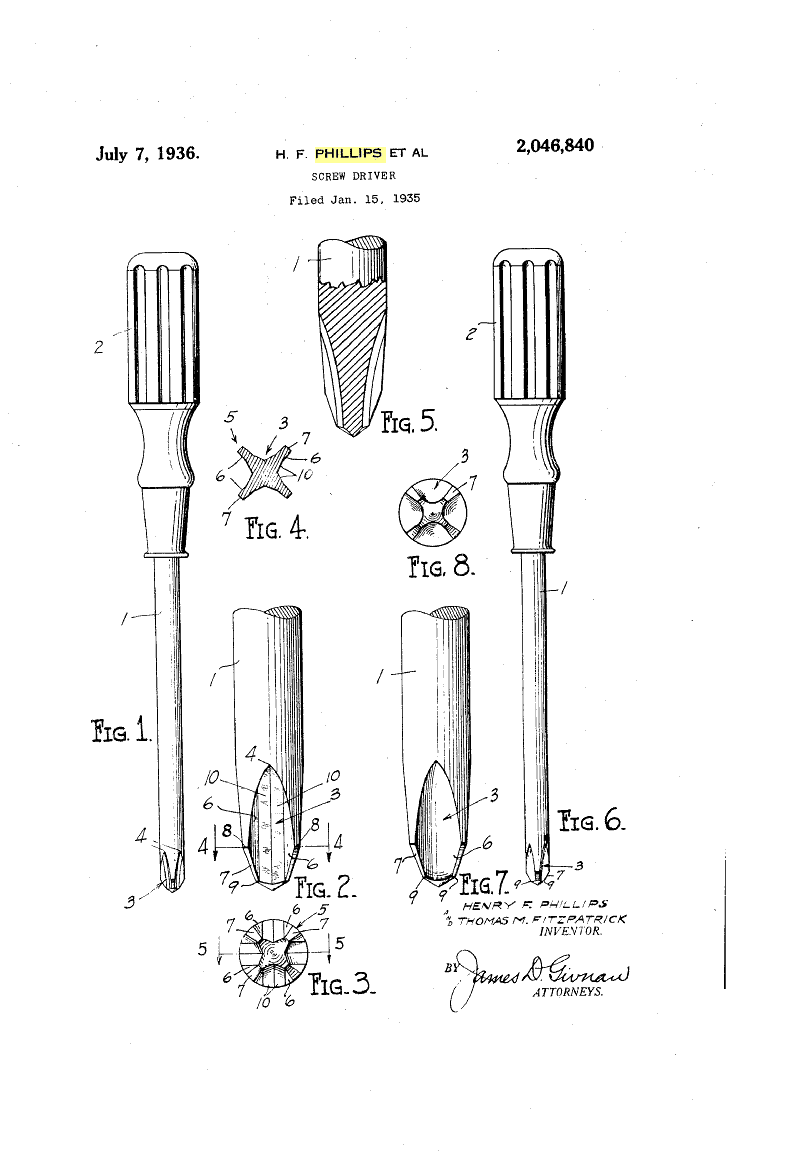
Henry F. Phillips — when do we celebrate?

August 10, 2007

Herny Phillips' patent for the Phillips screw and screwdriver (Google Patents)

Patent drawings for the Phillips screw and screwdriver, 1936

Only Crook in Town was alerted to the work of Henry F. Phillips by an alert and helpful librarian (well — aren’t they all?). She worries –January 15 is Martin Luther King, Jr., Day, and July 7 is the middle of the summer — what day would be appropriate to celebrate the invention and patenting of the Phillips Screwdriver? (If image above does not display, click the thumbnail picture at the end of the post.)

Ah, history teachers, you noticed that the drawing comes from Google’s files of patent applications. And now you wonder: What other wonderful illustrations can we legally rip off to use in class? Wonderful question — what do you find?

The Phillips screwdriver came along in time for World War II and the mass assembly of aircraft, and aircraft instrument panels. The Phillips screw head helped aircraft assemblers keep from scratching the black metal of the rest of the panel while securing instruments into the forms.

Read the rest of this entry »