Ardeatine Massacre: Bombers were soldiers, not terrorists

August 13, 2007

Our Italian physicist friend, Dorigo, at A Quantum Diaries Survivor reports that an Italian court ruled against a newspaper that started a campaign to deny the history of the Ardeatine Massacre.

Good news today. The supreme court of Cassazione in Italy has ruled that the press campaign labeling “terrorists” the GAP partisans who organized the bombing of Via Rasella in nazi-occupied Rome in 1944, launched by the national newspaper “Il Giornale”, was a striking example of manipulation of historic truth for political means. The newspaper is owned by Paolo Berlusconi (brother of Silvio, formerly premier of Italy in 1994 and 2001-2006), and was directed by Vittorio Feltri . . . a journalist who never hid his sympathy for the extreme right.

What was the Ardeatine Massacre?

Statue memorial to the victims of the Ardeatine Massacre, Italy Wikipedia:

The massacre of Fosse Ardeatine (Italian: Eccidio delle Fosse Ardeatine) took place in Rome, Italy during World War II. On 23 March 1944, 2 German soldiers, 31 Italian soldiers of Battaglione Bozen and a few Italian civilians passing along the road, were killed when members of the Italian Resistance set off a bomb close to a column of German soldiers who were marching on via Rasella[1]. This terrorist attack was led by the Gruppi di Azione Patriottica, of Rosario Bentivegna, Carla Capponi, Antonello Trombadori (Head of GAP in Roma) and the approval of Sandro Pertini (later President of Italian Republic), in order to provocate the reaction of SS troops.

Adolf Hitler is reported but never confirmed to have ordered that within 24 hours, one-hundred Italians were to be shot for each dead German. Commander Herbert Kappler in Rome concluded that ten Italians for each dead German would be sufficient and quickly compiled a list of 320 civilians who were to be killed. Kappler voluntarily added ten more names to the list when the 33rd German/Italian died after the Partisan attack. The total number of people murdered at the Fosse Ardeatine was 335, most Italians. The largest cohesive group among the murdered were the members of Bandiera Rossa, a Communist military Resistance group.

Why is there controversy 60 years later? Read the rest of this entry »


Oliver W. Hill, history maker, 100

August 6, 2007

Oliver W. Hill in 1999, when he was 92; lawyer in Brown v. Board case

Literally while writing the previous post about the importance of recording history before the witnesses leave us, I heard on KERA-FM, NPR reporter Juan Williams’ intimate, detailed and stirring story about Oliver W. Hill, one of the lawyers who brought one of the five cases that resulted in the historic 1954 reversal of U.S. law, in Brown v. Topeka Board of Education (347 U.S. 483).

Oliver W. Hill died Sunday, in Richmond, Virginia. He was 100.

In 1940, Mr. Hill won his first civil rights case in Virginia, one that required equal pay for black and white teachers. Eight years later, he was the first black elected to the Richmond City Council since Reconstruction.

A lawsuit argued by Mr. Hill in 1951 on behalf of students protesting deplorable conditions at their high school for blacks in Farmville became one of five cases decided under Brown.

That case from Farmville offers students a more personal view of their own power in life. The case resulted from a student-led demonstration at Moton High School in Farmville. Moton was an all-black school, with facilities amazingly inferior to the new white high school in Farmville — no indoor plumbing, for example. While the Virginia NAACP failed at several similar cases earlier, and while the organization had a policy of taking no more school desegregation cases, the students’ earnestness and sincerity swayed Oliver Hill to try one more time:

On May 23, 1951, a NAACP lawyer filed suit in the federal district court in Richmond, VA, on behalf of 117 Moton High School, Prince Edward County, VA, students and their parents. The first plaintiff listed was Dorothy Davis, a 14-year old ninth grader; the case was titled Dorothy E. Davis, et al. v. County School Board of Prince Edward County, Virginia, et. al. It asked that the state law requiring segregated schools in Virginia be struck down.

Davis was consolidated with four other cases, from the District of Columbia, Delaware, South Carolina, and Brown from Kansas; it was argued in 1953, but the Court deadlocked on a decision. When Chief Justice Arthur Vinson died and was replaced by the (hoped-to-be) conservative Chief Justice Earl Warren, Warren got the Court to re-hear the case. Because he thought it was such an important case in education, Warren worked to get a solid majority. The Court which was deadlocked late in 1953, in May 1954 issued the Brown decision unanimously, overturning the separate-but-equal rule from Plessy v. Ferguson (1896) (167 U.S. 537).

Brown was the big boulder whose rolling off the hill of segregation gave power to the civil rights movement of the 1950s and 1960s. That decision and the horrible murder of Emmett Till in Mississippi in the summer of 1955 inspired civil rights worker Rosa Parks to take a stand, and take a seat for human rights on a Montgomery, Alabama city bus in December of 1955, which led to the 1956 Montgomery Bus Boycott, led by the new preacher in town, a young man named Martin Luther King, Jr. When the Supreme Court again chose civil rights over segregation in the bus case, the wake of the great ship of history clearly showed a change in course.

Oliver Hill was there, one of the navigators of that ship of history.


NC flag desecration case moving

August 1, 2007

The Asheville Citizen-Times reported that the lawyer for the couple arrested in North Carolina for flying their U.S. flag upside-down will plead them not guilty, and then move to dismiss the case.

Hot issue?  The article has more than 400 comments from readers.  

Previous coverage:


Immigrants win Pennsylvania case: Hazleton’s anti-immigrant law struck down

July 26, 2007

News from the Pennsylvania ACLU (watch the right wing blogs explode, especially in Texas when they figure out the Farmers Branch ordinance is based on Hazleton’s ordinance, and that the judge in Pennsylvania used language similar to the TRO language used by the judge in Texas looking at the Farmers Branch ordinance) (text of press release and background from Pennsylvania ACLU):

Judge’s Decision Upholds Fair Treatment for All

“The genius of our Constitution is that it provides rights even to those who evoke the least sympathy from the general public. In that way, all in this nation can be confident of equal justice under its laws.” – Judge Munley’s Lozano v. Hazleton decision, pp. 188-189

In the first trial decision of its kind, a federal court has declared unconstitutional a local ordinance that sought to punish landlords and employers for doing business with undocumented immigrants. The landmark decision in the closely-watched challenge to Hazleton’s anti-immigrant ordinance held that the ordinance cannot be enforced.

ACLU Hazleton logo

“We are grateful the court recognized that municipal laws like those in Hazleton are unconstitutional. The trial record showed that these ordinances are based on propaganda and deception,” said Vic Walczak, Legal Director of the ACLU of Pennsylvania and a lead attorney in the case. “Hazleton-type laws are designed to make life miserable for millions of immigrants. They promote distrust of all foreigners, including those here legally, and fuel xenophobia and discrimination, especially against Latinos.”

Read the rest of this entry »


Tripoli 6 home in Bulgaria today

July 24, 2007

The six health workers — five nurses and one physician — accused and convicted and sentenced to death for practices that passed HIV/AIDS to hundreds of Libyan children in a series of trials devoid of evidence, reason and justice — are home in Bulgaria today.

Tripoli Six home in Sofia, Bulgaria

The president of Bulgaria pardoned them of any wrongdoing. Details from the Associated Press via The New York Times:

SOFIA, Bulgaria (AP) — Five Bulgarian nurses and a Palestinian doctor were pardoned by President Georgi Parvanov upon their arrival in Sofia on Tuesday after spending 8 1/2 years in prison in Libya.

The medics, who were sentenced to life in prison for allegedly contaminating children with the AIDS virus, arrived on a plane with French first lady Cecilia Sarkozy and the EU’s commissioner for foreign affairs, Benita Ferrero-Waldner.

The six came down the steps from the airplane and were welcomed on the tarmac by family members who hugged them, one lifting the Palestinian doctor off the ground.

They were given bouquets of flowers, and Bulgaria’s president and prime minister were on hand, greeting the nurses and Sarkozy, who had been part of the delegation that negotiated the group’s return.

Their defense had been that the contamination of tools used in the hospital caused the infections before the six arrived to help out. Before the second trial, an international team of scientists tracked mutations and the evolution of the viruses in each victim, and produced DNA evidence that proved beyond the shadow of a doubt that the infections had occurred prior to any of the six arriving in Libya. The evidence was not granted credence by Libya’s courts, and the six were reconvicted and resentenced. Their release was negotiated only after European sources created a fund to handsomely compensate the victims’ families.

Thank you, readers, for your e-mails, letters and phone calls. In the U.S., it was the work of Nature writer Declan Butler, and bloggers like Revere at Effect Measure, and Tara C. Smith at Aetiology who carried the torch for justice. Give them some credit.


Even more on Odessa Bible class case

July 20, 2007

Oh, and, there’s more.

Also see Ed Brayton’s posts here:

Here’s the press release from the Liberty Legal Institute:

The ACLU put their initial complaint on-line, and may follow with more documents as the case progresses:

The Texas Freedom Network has sponsored high-level criticism of Bible study class curricula; their critiques forced changes in the curriculum used in Odessa, but the modified curriculum does not pass Constitutional, academic or Bible study muster, according to a careful report from Southern Methodist University (in Dallas) Bible study professor Mark Chancey. TFN has several reports and press releases on the general issue:

And from the local newspaper, the daily Odessa American:


Odessa Bible class case

July 20, 2007

In the continuing religious freedom/education drama in Texas, the school district in Odessa, Texas, approved a Bible study course using a curriculum indicted by the Texas Freedom Network’s expert-in-Bible-studies advisors as religious indoctrination rather than academically rigorous study. Citizens in Odessa sued the district to have that action declared unconstitutional.

The case is being readied for trial, with motions from plaintiffs and defendants flying back and forth. I should be watching it carefully, and I probably should be offering close coverage here for teachers, parents and administrators in Texas.

But I haven’t been able to dig into the stuff yet. In the interim, Ed Brayton at Dispatches from the Culture Wars has been following the case closely, and providing timely blog updates. He’s made connections with the legal teams on both sides and has access to the legal documents filed so far.

Don’t wait: Get on over to Dispatches from the Culture Wars and get updated on the case.

This would be a good topic for a civics class project, too, it seems to me. You may want to capture documents as they come out for DBQ exercises in the coming school year.


Quote of the moment: Learned Hand

July 10, 2007

Learned Hand

If we are to keep our democracy, there must be one commandment: Thou shalt not ration justice.

Learned Hand, 1872-1961, U.S. judge, U.S. Court of Appeals for the 2d Circuit, 1924-1951, chief judge after 1939 to retirement; “Thou Shalt Not Ration Justice,” 1951.


Encore post: Recognizing bogus history, 2

July 3, 2007

Editor’s Note:  I’m traveling this week, celebrating our independence 231 years on.  While mostly out of pocket, I’ll feature some encore posts, material that deserves another look to keep it from fading from memory.  This post, below, is the second of a two-part series from August 2006.

Recognizing bogus history, 2

Bogus history infects political discussions more than others, though there are some areas where bogus history strays into the realm of science (false claims that Darwin and Pasteur recanted, for example).

1. The author pitches the claim directly to the media or to organizations of non-historians, for pay.

Historians are detectives, and they like to share what they find. One historian working in the papers of one figure from history will find a letter from another figure, and pass that information on to the historian working on the second figure. Historians teach history, write it up for scholarly work, and often spin it in more fascinating tales for popular work. Most years there are several good works competing for the Pulitzer Prize in history. Academic historians, those tied to universities and other teaching institutions, join societies, attend meetings, and write their material in journals — all pitched to sharing what they have learned.

Bogus historians tend to show up at conferences of non-historians. Douglas Stringfellow’s tales of World War II derring do were pitched to civic clubs, places where other historians or anyone else likely to know better, generally would not appear (Stringfellow’s stories of action behind enemy lines in World War II won him several speaking awards, and based on his war record, he was nominated to a seat in Congress for Utah, in 1952, which he won; a soldier who knew Stringfellow during the war happened through Salt Lake City during the 1954 re-election campaign, and revealed that Stringfellow’s exploits were contrived; he was forced to resign the nomination). Case in point: David Barton speaks more often to gun collectors than to history groups.

2. The author says that a powerful establishment is trying to suppress his or her work.

Sen. Joseph McCarthy insisted that anyone who opposed his claims that communists dominated certain government agencies, or that any given person was a communist, was because those who challenged him were, themselves, part of the greater conspiracy, trying to silence him. Utah Sen. Arthur V. Watkins, who chaired the committee that recommended censure for Sen. McCarthy, lost his own re-election campaign in 1958 in part to the belief by Utah voters that such a conspiracy existed and had succeeded in suppressing McCarthy.

But there was no organized campaign against McCarthy.  Individual Americans, spurred by patriotism, the Boy Scout Law, or just a sense that truth is valuable, spoke up against him, time and again in many different forums.  Sen. Watkins powerfully opposed communism.  Later historians found any truth in McCarthy’s claims against the State Department and other government agencies, and his critics, got there accidentally, below the usual levels of coincidence.

3. The sources that verify the new interpretation of history are obscure; if they involve a famous person, the sources are not those usually relied on by historians.

Most internet hoaxes simply don’t list sources. Bogus quotes circulating that have been attributed to Madison, Jefferson, Washington, Lincoln, and others, often list a year, and nothing else. When I staffed the Senate, several times a year I’d get letters to work on with claims that the Supreme Court had ruled in 1892 that the U.S. is, officially, a “Christian nation.” Usually there there was no case name attached, but I came to understand that the case referred to was the Church of the Holy Trinity vs. U.S. 1892 was far enough back that it was a difficult case for people outside of a decent law library to get — and then, it is couched in 1892 legalese, which makes it difficult to understand. It is an obscure enough case that most of the time it won’t be checked out. If the case can be produced, rarely will it be among lawyers who can interpret what happened from the fog of the language of the decision. The case is not listed at the Cornell University Law School’s on-line Legal Information Institute, nor at Findlaw.com — the databases they rely on go back to 1893. There is a full text copy at the Justicia website. [This was written in 2007.]

The case involved a law that prohibited the importing of laborers, and the Court ruled that the law probably was not intended to apply to a white, white collar worker, a preacher from England (the law was probably aimed at Chinese workers, coming as it did in that time when immigration from China was prohibited). It appears from the case that the church had argued some First Amendment justification to be exempt, and the U.S. Solicitor General had argued in response that the First Amendment requires the courts to assume that the government is hostile to religion; Justice David Brewer wrote at length about how the nation had accommodated religion over the years, especially Christianity, in dismissing the Solicitor General’s argument (he did not accept the church’s argument, either). This sort of writing is called obiter dicta in legal studies — words of an opinion wholly unnecessary to the decision. The case is cited rarely, and never for its religious “ruling,” because that was not what was ruled, and the language was not applied as law then, nor has it been since.  The Supreme Court ruled that importing preachers from England was not covered by the law. The ruling makes no mention of religion.

A bit of reflection on what really happened in history should make this clear: Consider the effect of such a ruling by the Supreme Court on later cases involving textbooks, busing of parochial students, student prayer, Bible readings, etc. Had such a precedent existed, lawyers would have sniffed it out regardless its obscurity.

4. Evidence for the history is anecdotal.

America’s founders carefully wrote laws that assure religious freedom, largely by creating a separation of state and church. To those unhappy with such a separation, every utterance of a founder in which God is praised, or invoked in any way, becomes “proof” that the founders did not mean what they wrote in the laws. Anecdote trumps any other evidence, to these people.
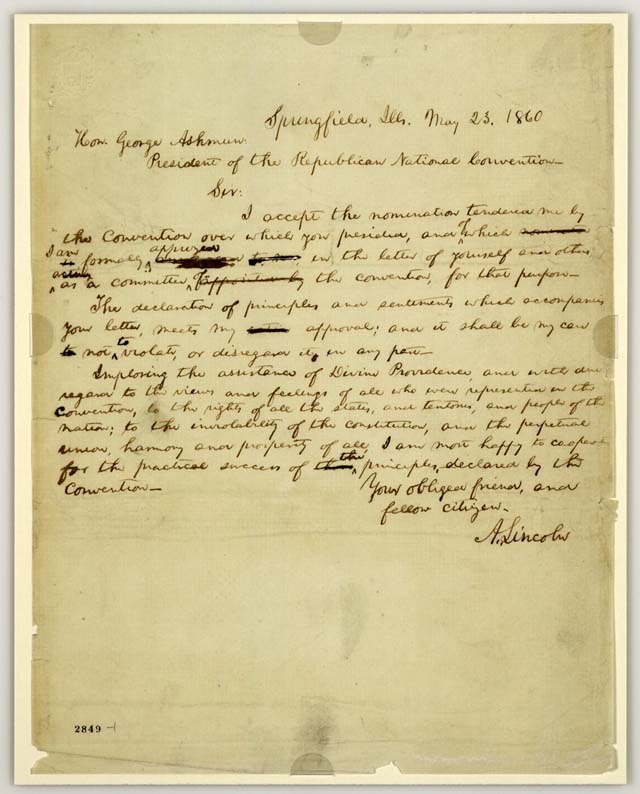
Abraham Lincoln's letter to the president of the Republican National Convention of 1860, accepting the convention's nomination for the presidency.

Abraham Lincoln’s letter to the president of the Republican National Convention of 1860, accepting the convention’s nomination for the presidency. It was written, you will note, from Springfield, Illinois, 200 miles away from Chicago where the convention was held.

To prove to me the piety of Abraham Lincoln, a fellow showed me photograph of a plaque on a church in Chicago, said to be the church where Abraham Lincoln said his prayers every morning during the Republican Convention of 1860, at which Lincoln got the nomination for president. Other records — newspapers, Lincoln’s letters and other documents, show that, as was the fashion in 1860, Lincoln did not attend the convention in Chicago, but as a candidate for president, stayed at home in Springfield, nearly 200 miles away.

Most real history can be read in documents, and does not need to rely on folk retellings exclusively.

5. The author says a belief is credible because it has endured for some time, or because many people believe it to be true.

Faced with the evidence that a dozen quotes he had attributed to figures such as James Madison, George Washington and Patrick Henry were whole cloth inventions, Texas quote-purveyor David Barton issued a statement urging people not to rely on them because they were “questionable.

A great example of belief triumphing over fact presents itself as the Cardiff Giant, now on display at the Farmers’ Museum in Cooperstown, New York (go visit when you visit the Baseball Hall of Fame). After an argument with a cleric over whether the Bible’s claim that giants once existed, a tobacconist named George Hull hired stonecarvers to carve a giant; then he hired a farmer to bury the carving on his farm, and claim to have struck it when planting. Once discovered the “petrified man” was put on display, for a fee. Hull got lucky: Syracuse businessmen offered to buy it from him for an enormous sum.

Paleontologist Othniel Marsh inspected it on display, and pronounced it a hoax. For some odd reason, that increased the popularity of the attraction. Carnival and side show entrepreneur P. T. Barnum offered $60,000 for the carving, but was refused. Barnum then had a plaster replica made and put on display. The owners of the original hoaxed carving sued, but the suit was thrown out because they could not demonstrate the “genuineness” of their own hoax.  Barnum made more money than the original.  A hoaxed hoax is even more popular than the truth.

A photo (staged?) of the 1869 unearthing of the Cardiff Giant (Cardiff, New York). Photograph courtesy Farmers Museum via Associated Press, and via National Geographic.

A photo (staged?) of the 1869 unearthing of the Cardiff Giant (Cardiff, New York). Photograph courtesy Farmers Museum (where the carving now rests, on display to museum visitors)  via Associated Press, and via National Geographic.

6. The author has worked in isolation.

Historians often help each other. Good historians put out queries to many sources, the better to assure accuracy. So, conversely, if there are only a few people who know anything about an account, that fact alone may cause suspicion. Clifford Irving’s hoax biography of Howard Hughes, while remarkably accurate in some regards, was unraveled when enough people familiar with Hughes called the bluff — including, of course, Hughes himself. The book got as far as it did with extreme secrecy on Irving’s part. Working alone makes error easier, and is essential for intentional frauds.

7. The author must propose a new interpretation of history to explain an observation.

Various conspiracy claims require that key people act counter to their known character. If Franklin Roosevelt had “allowed” Pearl Harbor to occur in order to get the U.S. into war, his actions over the previous six years to support Britain start to make little sense. Had Lyndon Johnson been part of a conspiracy to assassinate John Kennedy, his later carrying out the legislative plan of Kennedy runs contrary to all such motivations. If the founders of the U.S. actually intended to make Christianity the state religion, their efforts to disestablish the churches in all 13 colonies, efforts to write bills of rights for each state including freedom of religion, and efforts to create the First Amendment in the Bill of Rights seem like incredible, repeated errors.

Bogus history is much like the conjectured problems that result from time travel: Change one jot of history, and there is a cascading effect on later events. In many cases,were the bogus histories accurate, what follows could not be so, and we wouldn’t be here to discuss it.

Those are the seven warning signs of bogus history. Bogus, or voodoo history should be suspected if two or more of the signs are present — though it is quite possible for actual history to show more than two signs (perhaps actual history could show all seven signs — but I’d have to see an example before stating it’s so).

More:


40 years of Loving — the changes we see

June 15, 2007

1968 propelled history in dramatic fashion, much of it tragic. History teachers might await the 40th anniversary stories of 1968’s events, knowing that the newspapers and television specials will provide much richer material than any textbook could hope for.

Was 1967 less momentous? Perhaps. But an anniversary this week only serves to highlight how the entire decade was a series of turning points for the United States. This week marks the 40th anniversary of the Supreme Court’s issuing the decision in Loving v. Virginia. The Lovings had been arrested, convicted and exiled from the state of Virginia for the crime of — brace yourself — getting married.

Richard and Mildred Loving, Bettman-Corbis Archive

Photo of Richard and Mildred Loving from Bettman-Corbis Archive.

You see, Virginia in those days prohibited marriage between a black person and a white person. So did 15 other states. In language that is quaint and archaic to all but Biblical literalist creationists, the trial judge said:

“Almighty God created the races white, black, yellow, malay and red, and he placed them on separate continents. And but for the interference with his arrangement there would be no cause for such marriages. The fact that he separated the races shows that he did not intend for the races to mix.”

The Lovings appealed their conviction. They appealed to the U.S. Supreme Court. And on June 12, 1967, the Supreme Court of the United States struck down laws that prohibit a person of one “race” from marrying a person of another. (I put “race” in quotes because, as we have since learned from DNA studies, there is just one race among us, the human race. Science verifies that the Supreme Court got it right, as did the Americans before them who wrote the laws upon which the Supreme Court’s decision was based.)

From 1958 to 1967 — nine years the case wended through the courts. Oral argument was had on April 10 — the decision coming down in just two months seems dramatically quick by today’s standards. This was one of the cases that angered so many Americans against the Court presided over by Chief Justice Earl Warren.

Ed Brayton at Dispatches from Culture Wars points to a statement from Mildred Loving on this anniversary. The statement is below the fold. Read the rest of this entry »


Utah to get vouchers over objections of people?

May 30, 2007

Only in America can a state get what it votes against, maybe.

Utah’s Attorney General Mark Shurtleff’s opinion would require the Utah State Board of Education to implement school vouchers now, even though the state legislature did not intend the implementation now, and even though the people may reject the plan for vouchers in a November election.

According to the Shurtleff’s opinion, vouchers would have to be implemented despite the state’s rejection of them.  The Deseret Morning News tried to explain the mess.

Complicating affairs is a “technical amendment” passed by the legislature after the original voucher authorization legislation, to correct problems in the first bill.  The referendum is on the first bill; the amendment was billed as a “clean-up” bill fixing technical problems with the first bill.  But the attorney general now says that the amendment can stand alone, and consequently the law would require the Board to implement a law they oppose, even if the people reject the law.

So, of course, the courts may be asked to parse out the truth and the law.

If you’re not confused yet, stick around.   Mark Twain famously said no man’s life, limb, nor property is safe so long as the legislature is in session.  Utah’s corollary is that nothing is safe even after the legislature goes home.


Worst ever U.S. industrial accident, 1947: 576 dead

April 14, 2007

April 16 marks the 60th anniversary of the Texas City Disaster. A large cargo ship being loaded with tons of ammonium nitrate caught fire and exploded, setting fire to other nearby ships, one of which exploded, and devastating much of the town. In all, 576 people died in Texas City on April 16 and 17, 1947.

View of Texas City from across the bay, in Galveston, April 16, 1947

View of Texas City from Galveston, across the bay, after the explosion of the French ship SS Grandcamp, April 16, 1947. Photo from International Association of Fire Fighters Local 1259

The incident also produced one of the most famous tort cases in U.S. history, Dalehite vs. United States, 346 U.S. 15 (1953). (Here is the Findlaw version, subscription required.)

The entire Texas City fire department was wiped out, 28 firefighters in all. The International Association of Fire Fighters, Local 1259 has a website dedicated to the history of the disaster, with a collection of some powerful photographs.

More below the fold. Read the rest of this entry »


Kid blogs for human rights, asks that kids be let out of U.S. jails

March 5, 2007

Really.

I can’t gloss this at all, and so far it checks out as presented. Political Teen Tidbits is a blog run by a bright young Texan with a conscience. She’s trying to draw attention to the bizarre cases that keep coming out of Texas’ immigration detention practices.

Political Teen Tidbits thinks we should let the 9-year-old Canadian kid out of jail. Go read the details — what do you think?


Dressing as Jesus for Halloween

February 22, 2007

Educators get a few seconds to make a decision, usually with other kids yelling and a fight breaking out across the hallway. Lawyers and judges have more time.

But even with the advantage of cool reflection, the levels of irony in this case are too thick to cut through.

Can a kid dress as Jesus about to be crucified, for Halloween? Is the costume religious? If so, is the school’s allowing it to be worn an impermissible endorsement of religion? Is the costume blasphemous? If so, would the school be sued if they didn’t ban it? Is the costume in good taste, compared to the kid dressed as a chainsaw serial-killer, or one of the phantasms from Nightmare on Elm Street?

How do 10-year-old kids always come up with these questions?

With the disclosure that what I have comes from a press release from the Alliance Defense Fund, which has its biases, I post the details of the case as we have them so far, below the fold. Read the rest of this entry »


Dissent effective: Stimson resigns from detainee post

February 4, 2007

Charles Stimson resigned Friday. Stimson is the attorney who was deputy secretary of defense for detainee affairs. You may recall he was the person who suggested in a radio interview that business clients of lawyers who provide legal counsel to detainees should pressure the attorneys not to represent the detainees, a suggestion that is contrary to the ethical canons of attorneys.

According to the New York Times:

Stimson drew outrage from the legal community — and a disavowal from the Defense Department — for his Jan. 11 comments, in which he also suggested some attorneys were being untruthful about doing the work free of charge and instead were ”receiving moneys from who knows where.”

He also said companies might want to consider taking their legal business to other firms that do not represent suspected terrorists.

The Defense Department disavowed the suggestion. Attorney General Albert Gonzalez also disavowed Stimson’s remarks. But Stimson said that the controversy hampered his effectiveness on the job. The NY Times said:

Stimson publicly apologized several days after the radio interview, saying his comments did not reflect his values and that he firmly believes in the principles of the U.S. legal system.

But it didn’t completely quiet critics.

The Bar Association of San Francisco last week asked the California State Bar to investigate whether Stimson violated legal ethics by suggesting a boycott of law firms that represent Guantanamo Bay detainees.

Earlier posts:
