Gov. Rick Perry commuted a death sentence today. This is the first commutation in eight years so close to an execution. Any commutation recommendation is rare in Texas.
Is this just one commutation, or does it signal a change?
Gov. Rick Perry commuted a death sentence today. This is the first commutation in eight years so close to an execution. Any commutation recommendation is rare in Texas.
Is this just one commutation, or does it signal a change?
 3 Comments |
  Current History, History, Justice, Law, Texas, Texas history |
  Permalink
 Posted by Ed Darrell
. . . Friday, but the president didn’t tell us about it until today.
According to the the New York Times (which broke the story):
“The unfair treatment that he’s been on the receiving end of has been a distraction for the department,” the official said.
Injustice even as he leaves. It’s the fair treatment Gonzales received that should have forced him out. The U.S. Justice Department is a mess above the political appointee level, with serious mismanagement, mal-management and lack of management threatening justice and the administration of law at several levels.
Other notable coverage: The Washington Post story now includes notes to Gonzales’s terse announcement, and links to recent stories in the Post which lend perspective and a lot of information.
Leave a Comment » | Capturing history, Civil Rights, History, Jurisprudence, Justice, Law, Politics, Presidents, Scandals, U.S. Constitution | Permalink
Posted by Ed Darrell
Stuart Pivar initiated a suit for libel against P. Z. Myers (of Pharyngula), over Myers’ caustic reviews of Pivar’s recent book. Myers is not talking (on advice of counsel); others are providing solid background, including Andrea Bottaro at Panda’s Thumb, Scientific American, the Lippard Blog, Overlawyered, Science after Sunclipse and Positive Liberty (all blogs that you read on occasion, right?).
In the comments to Bottaro’s post at Panda’s Thumb, someone asked:
What exactly is a “crackpot,” and how does one attain the status of “classic?”
Isn’t that rather the key question of life? How can we tell the cranks from the prophets, the dross from the gold?
My comments appear at Panda’s Thumb, but why not put it down here, too? This is a topic often addressed here: Voodoo science, voodoo history, bogus science, bogus history, and who can tell the difference, and who cares?
6 Comments | Accuracy, Jurisprudence, Justice, Law, Science, Voodoo science | Permalink
Posted by Ed Darrell
Remember the two people kicked out of President Bush’s Independence Day speech in West Virginia for wearing protest t-shirts in 2004? Nicole and Jeffery Rank, now of Corpus Christi, Texas, were charged with trespassing.
But they were invited to attend the speech.
“This settlement is a real victory not only for our clients but for the First Amendment,” said Andrew Schneider, executive director of the ACLU of West Virginia. “As a result of the Ranks’ courageous stand, public officials will think twice before they eject peaceful protesters from public events for exercising their right to dissent.”
In the course of the suit it was discovered that the official advance manual for the Bush White House urged removing dissenters from speech audiences, so the original claims that the action was just overzealous local officials was refuted. One wonders if the advance manual has been changed.
When asked if are glad they decided stand up for their beliefs, both answered “absolutely” without hesitation.
“We have thoroughly not enjoyed our 15 minutes [of fame]. It’s cost us personally and professionally,” Jeff Rank said. “The thing that we’re fighting for, the Constitution, the Bill of Rights, is just too important to this country to lay down on something like this.”
The First Amendment may have been wounded, but it’s still alive.
Other resources:
Tip of the old scrub brush to blueollie.
1 Comment | Civil Rights, Dissent, First Amendment, Jurisprudence, Justice, U.S. Constitution | Permalink
Posted by Ed Darrell
Our Italian physicist friend, Dorigo, at A Quantum Diaries Survivor reports that an Italian court ruled against a newspaper that started a campaign to deny the history of the Ardeatine Massacre.
Good news today. The supreme court of Cassazione in Italy has ruled that the press campaign labeling “terrorists” the GAP partisans who organized the bombing of Via Rasella in nazi-occupied Rome in 1944, launched by the national newspaper “Il Giornale”, was a striking example of manipulation of historic truth for political means. The newspaper is owned by Paolo Berlusconi (brother of Silvio, formerly premier of Italy in 1994 and 2001-2006), and was directed by Vittorio Feltri . . . a journalist who never hid his sympathy for the extreme right.
What was the Ardeatine Massacre?
The massacre of Fosse Ardeatine (Italian: Eccidio delle Fosse Ardeatine) took place in Rome, Italy during World War II. On 23 March 1944, 2 German soldiers, 31 Italian soldiers of Battaglione Bozen and a few Italian civilians passing along the road, were killed when members of the Italian Resistance set off a bomb close to a column of German soldiers who were marching on via Rasella[1]. This terrorist attack was led by the Gruppi di Azione Patriottica, of Rosario Bentivegna, Carla Capponi, Antonello Trombadori (Head of GAP in Roma) and the approval of Sandro Pertini (later President of Italian Republic), in order to provocate the reaction of SS troops.
Adolf Hitler is reported but never confirmed to have ordered that within 24 hours, one-hundred Italians were to be shot for each dead German. Commander Herbert Kappler in Rome concluded that ten Italians for each dead German would be sufficient and quickly compiled a list of 320 civilians who were to be killed. Kappler voluntarily added ten more names to the list when the 33rd German/Italian died after the Partisan attack. The total number of people murdered at the Fosse Ardeatine was 335, most Italians. The largest cohesive group among the murdered were the members of Bandiera Rossa, a Communist military Resistance group.
Why is there controversy 60 years later? Read the rest of this entry »
4 Comments | 1941-1945, Accuracy, Bogus history, History, History Revisionism, Hoaxes, Jurisprudence, Justice, Politics, TAKS, TEKS, Voodoo history, War, World War II | Tagged: Ardeatine Massacre, Holocaust, Human Rights, Rome, Travel, World War II | Permalink
Posted by Ed Darrell

Literally while writing the previous post about the importance of recording history before the witnesses leave us, I heard on KERA-FM, NPR reporter Juan Williams’ intimate, detailed and stirring story about Oliver W. Hill, one of the lawyers who brought one of the five cases that resulted in the historic 1954 reversal of U.S. law, in Brown v. Topeka Board of Education (347 U.S. 483).
Oliver W. Hill died Sunday, in Richmond, Virginia. He was 100.
In 1940, Mr. Hill won his first civil rights case in Virginia, one that required equal pay for black and white teachers. Eight years later, he was the first black elected to the Richmond City Council since Reconstruction.
A lawsuit argued by Mr. Hill in 1951 on behalf of students protesting deplorable conditions at their high school for blacks in Farmville became one of five cases decided under Brown.
That case from Farmville offers students a more personal view of their own power in life. The case resulted from a student-led demonstration at Moton High School in Farmville. Moton was an all-black school, with facilities amazingly inferior to the new white high school in Farmville — no indoor plumbing, for example. While the Virginia NAACP failed at several similar cases earlier, and while the organization had a policy of taking no more school desegregation cases, the students’ earnestness and sincerity swayed Oliver Hill to try one more time:
On May 23, 1951, a NAACP lawyer filed suit in the federal district court in Richmond, VA, on behalf of 117 Moton High School, Prince Edward County, VA, students and their parents. The first plaintiff listed was Dorothy Davis, a 14-year old ninth grader; the case was titled Dorothy E. Davis, et al. v. County School Board of Prince Edward County, Virginia, et. al. It asked that the state law requiring segregated schools in Virginia be struck down.
Davis was consolidated with four other cases, from the District of Columbia, Delaware, South Carolina, and Brown from Kansas; it was argued in 1953, but the Court deadlocked on a decision. When Chief Justice Arthur Vinson died and was replaced by the (hoped-to-be) conservative Chief Justice Earl Warren, Warren got the Court to re-hear the case. Because he thought it was such an important case in education, Warren worked to get a solid majority. The Court which was deadlocked late in 1953, in May 1954 issued the Brown decision unanimously, overturning the separate-but-equal rule from Plessy v. Ferguson (1896) (167 U.S. 537).
Brown was the big boulder whose rolling off the hill of segregation gave power to the civil rights movement of the 1950s and 1960s. That decision and the horrible murder of Emmett Till in Mississippi in the summer of 1955 inspired civil rights worker Rosa Parks to take a stand, and take a seat for human rights on a Montgomery, Alabama city bus in December of 1955, which led to the 1956 Montgomery Bus Boycott, led by the new preacher in town, a young man named Martin Luther King, Jr. When the Supreme Court again chose civil rights over segregation in the bus case, the wake of the great ship of history clearly showed a change in course.
Oliver Hill was there, one of the navigators of that ship of history.
1 Comment | Bill of Rights, Civil Rights, DBQ sources, Education, Education quality, Education spending, Fourteenth Amendment, Jurisprudence, Justice, Law, U.S. Supreme Court | Permalink
Posted by Ed Darrell
Whose voice do you hear, really, when you read material that is supposed to be spoken by God? Morgan Freeman is a popular choice — he’s played God at least twice now, racing George Burns for the title of having played God most often in a movie. James Earl Jones?

Statue of Rep. Barbara Jordan at the Austin, Texas airport that bears her name. Photo by Meghan Lamberti, via Accenture.com
For substance as well as tone, I nominate Barbara Jordan’s as the voice you should hear.
I’m not alone. Bill Moyers famously said:
When Max Sherman called me to tell me that Barbara was dying and wanted me to speak at this service, I had been reading a story in that morning’s New York Times about the discovery of forty billion new galaxies deep in the inner sanctum of the universe. Forty billion new galaxies to go with the ten billion we already knew about. As I put the phone down, I thought: it will take an infinite cosmic vista to accommodate a soul this great. The universe has been getting ready for her.
Now, at last, she has an amplifying system equal to that voice. As we gather in her memory, I can imagine the cadences of her eloquence echoing at the speed of light past orbiting planets and pulsars, past black holes and white dwarfs and hundreds of millions of sun-like stars, until the whole cosmic spectrum stretching out to the far fringes of space towards the very origins of time resonates to her presence.
Virgotext carried a series of posts earlier in the year, commemorating what would have been Jordan’s 71st birthday on February 21. (Virgotext also pointed me to the Moyers quote, above.)
Now, when the nation seriously ponders impeachment of a president, for the third time in just over a generation, Ms. Jordan’s words have more salience, urgency, and wisdom. It’s a good time to revisit Barbara Jordan’s wisdom, in the series of posts at Virgotext.
“There is no president of the United States that can veto that decision.”
“My faith in the Constitution is whole.”
“We know the nature of Impeachment. We’ve been talking about it a while now.”
“Indignation so great as to overgrow party interests.”
And finally:
The rest of the hearing remarks are all here. It’s a longer clip than the others but honestly, there is not a good place to cut it.
This is Barbara Jordan on the killing floor.
This was a woman who understands history, who illustrates time and again that we are, with every action, with every syllable, cutting the past away from the present.
She never mentions Nixon by name. There is the Constitution. There is the office of the Presidency. But Richard Nixon the president has already ceased to exist. By the time she finishes speaking, he is history.
“A President is impeachable if he attempts to subvert the Constitution.”
Also see, and hear:
Virgotext’s collection of Barbara Jordan stories and quotes is an excellent source for students on Watergate, impeachment, great oratory, and Barbara Jordan herself. Bookmark that site.

Rep. Barbara Jordan sitting calmly among tension, at a House Committee meeting (probably House Judiciary Committee in 1974).
Update 2019: Here is the full audio of Barbara Jordan’s speech. It is still salient, and if you listen to it you will understand better what is going on in Congress today.
Barbara Jordan, Statement on the Articles of Impeachment, at AmericanRhetori.com.
3 Comments | Barbara Jordan, Democracy, Ethics, Famous quotes, Free press, Good Quotes, Heroes, History, History audio sources, Justice, Leadership, Patriotism, Presentations, Presidents, Quotes, Reason, Scandals, Texas, Texas history, Texas Lege, U.S. Constitution, U.S. House of Representatives, Watergate scandal | Tagged: Barbara Jordan, Democracy, Ethics, Famous quotes, Heroes, History, Texas | Permalink
Posted by Ed Darrell
News from the Pennsylvania ACLU (watch the right wing blogs explode, especially in Texas when they figure out the Farmers Branch ordinance is based on Hazleton’s ordinance, and that the judge in Pennsylvania used language similar to the TRO language used by the judge in Texas looking at the Farmers Branch ordinance) (text of press release and background from Pennsylvania ACLU):
“The genius of our Constitution is that it provides rights even to those who evoke the least sympathy from the general public. In that way, all in this nation can be confident of equal justice under its laws.” – Judge Munley’s Lozano v. Hazleton decision, pp. 188-189
In the first trial decision of its kind, a federal court has declared unconstitutional a local ordinance that sought to punish landlords and employers for doing business with undocumented immigrants. The landmark decision in the closely-watched challenge to Hazleton’s anti-immigrant ordinance held that the ordinance cannot be enforced.

“We are grateful the court recognized that municipal laws like those in Hazleton are unconstitutional. The trial record showed that these ordinances are based on propaganda and deception,” said Vic Walczak, Legal Director of the ACLU of Pennsylvania and a lead attorney in the case. “Hazleton-type laws are designed to make life miserable for millions of immigrants. They promote distrust of all foreigners, including those here legally, and fuel xenophobia and discrimination, especially against Latinos.”
Leave a Comment » | Bill of Rights, Citizenship, Civil Rights, Economics, Human Rights, Immigration, Jurisprudence, Justice, Law, U.S. Constitution | Permalink
Posted by Ed Darrell
The six health workers — five nurses and one physician — accused and convicted and sentenced to death for practices that passed HIV/AIDS to hundreds of Libyan children in a series of trials devoid of evidence, reason and justice — are home in Bulgaria today.

The president of Bulgaria pardoned them of any wrongdoing. Details from the Associated Press via The New York Times:
SOFIA, Bulgaria (AP) — Five Bulgarian nurses and a Palestinian doctor were pardoned by President Georgi Parvanov upon their arrival in Sofia on Tuesday after spending 8 1/2 years in prison in Libya.
The medics, who were sentenced to life in prison for allegedly contaminating children with the AIDS virus, arrived on a plane with French first lady Cecilia Sarkozy and the EU’s commissioner for foreign affairs, Benita Ferrero-Waldner.
The six came down the steps from the airplane and were welcomed on the tarmac by family members who hugged them, one lifting the Palestinian doctor off the ground.
They were given bouquets of flowers, and Bulgaria’s president and prime minister were on hand, greeting the nurses and Sarkozy, who had been part of the delegation that negotiated the group’s return.
Their defense had been that the contamination of tools used in the hospital caused the infections before the six arrived to help out. Before the second trial, an international team of scientists tracked mutations and the evolution of the viruses in each victim, and produced DNA evidence that proved beyond the shadow of a doubt that the infections had occurred prior to any of the six arriving in Libya. The evidence was not granted credence by Libya’s courts, and the six were reconvicted and resentenced. Their release was negotiated only after European sources created a fund to handsomely compensate the victims’ families.
Thank you, readers, for your e-mails, letters and phone calls. In the U.S., it was the work of Nature writer Declan Butler, and bloggers like Revere at Effect Measure, and Tara C. Smith at Aetiology who carried the torch for justice. Give them some credit.
5 Comments | Evolution, Human Rights, Jurisprudence, Justice, Law, Public health, Reason | Permalink
Posted by Ed Darrell

“Girl Scout drama presentation for Hinamatsuri (Doll’s Festival), on Japanese Girl’s Day, at the Crystal City, Texas, internment facility operated by the Justice Department, 1943-45.
Each of us has pockets of ignorance; some of the pockets are larger than others.
How did I miss that there were Japanese-American internees in Texas? If I stumbled across that fact before, it really didn’t register. Reviewing the website for the University of Texas – San Antonio’s Institute of Texas Cultures, I came across the Spring 2007 Newsletter, which is dedicated to the Crystal City internment facility.
Crystal City is unknown to many other Texans, too, I wager. Study of a list of the War Department “Relocation” camps shows nothing in Texas. Surprise! The U.S. Justice Department also operated camps of interned Americans of Japanese descent. The War Department rounded up Japanese Americans in west coast states and their neighbors; the Bureau of Immigration and Naturalization Services, the old INS which was rolled into the Department of Homeland Security after the 2001 attacks on New York and Washington, arrested and detained Japanese-Americans from the rest of the United States. INS operated at least four such camps in Texas. Read the rest of this entry »
15 Comments | 1941-1945, Boy Scouts of America, Civil Rights, DBQ sources, Girl Scouts, History, Japanese American internment, Justice, Law, Lesson plans, Texas history, World War II | Permalink
Posted by Ed Darrell
In the continuing religious freedom/education drama in Texas, the school district in Odessa, Texas, approved a Bible study course using a curriculum indicted by the Texas Freedom Network’s expert-in-Bible-studies advisors as religious indoctrination rather than academically rigorous study. Citizens in Odessa sued the district to have that action declared unconstitutional.
The case is being readied for trial, with motions from plaintiffs and defendants flying back and forth. I should be watching it carefully, and I probably should be offering close coverage here for teachers, parents and administrators in Texas.
But I haven’t been able to dig into the stuff yet. In the interim, Ed Brayton at Dispatches from the Culture Wars has been following the case closely, and providing timely blog updates. He’s made connections with the legal teams on both sides and has access to the legal documents filed so far.
Don’t wait: Get on over to Dispatches from the Culture Wars and get updated on the case.
This would be a good topic for a civics class project, too, it seems to me. You may want to capture documents as they come out for DBQ exercises in the coming school year.
Leave a Comment » | Bill of Rights, Capturing history, Citizenship, DBQ sources, Education, First Amendment, Freedom - Political, Historic documents, History, History blogs, Jurisprudence, Justice, Law, Public education, Religious Freedom, Texas, Texas Freedom Network, U.S. Constitution | Permalink
Posted by Ed Darrell
We hope the Tripoli 6 are out of Tripoli, Libya, soon. Libyan courts commuted the death sentences delivered to the six health workers, but the commutation was to life sentences; late news indicates that Libya has agreed to extradite the six to Bulgaria in return for payments to the families of the 400+ children who were victimized by the hospital screw-ups for which the six are erroneously blamed.
Libya claims to have confessions from the health workers. Evidence suggests they were tortured to sign hoax confessions.
For rational people who care for justice, there is a powerful moral here. Forensic evidence shows that the HIV viruses that infected hundreds of children at a hospital, infected the children and evolved well before the five nurses and one doctor got to the hospital. In short, it is physically impossible in time for the accused workers to have been responsible for the infections. They are innocent.
But of course, this evidence is based on evolutionary paradigms, the same way that all DNA evidence is. The Libyan courts waved the evidence off, essentially, convicting the workers in a second trial after a team of international scientists completed a special research project showing, with the highest degree of assurance, the impossibility of liability to the accused.
Creationism is relativism with King James language: Facts are not facts, science is not science, what is true in the laboratory and in the wild, not true in a creationist court. The Libyan courts dismissed what would have been exonerating evidence in U.S. and most European courts.
And so another international team was assembled to raise the extortion demanded by Libya, and a settlement negotiated. U.S. scientists contributed time and expertise; the U.S. government appears to have deferred to European governments.
Sadly, the people who created the conditions for infecting 400 kids with HIV will go unpunished in this creationist court.
Effect Measure over at the Seed stable of science blogs has a much more complete explanation of the case, with links detailing the heroic work of scientists, and I encourage you to read that account and follow the links.
Justice, justice shalt thou pursue.
– Deuteronomy 16:20
Leave a Comment » | Creationism, Hoaxes, Junk science, Justice, Law, Science, Science and faith | Permalink
Posted by Ed Darrell

— Learned Hand, 1872-1961, U.S. judge, U.S. Court of Appeals for the 2d Circuit, 1924-1951, chief judge after 1939 to retirement; “Thou Shalt Not Ration Justice,” 1951.
2 Comments | Famous quotes, History, Jurisprudence, Justice, Law, Quotes | Permalink
Posted by Ed Darrell
Americans seeking justice and healing for crimes committed during the civil rights movement, from about 1953 through at least the 1970s, championed a proposed law that would establish a unit in the Justice Department to clear up some of these old cases before the perpetrators all die — sort of a civil rights cold case division.
H.R. 923 is called “The Emmett Till Unsolved Civil Rights Crime Act” in honor of the slain young boy whose murderers were convicted by a racist-tinged jury, and then bragged about the murder in a national magazine.
The bill passed the House of Representatives June 21, 422 to 2.
It was scheduled for a quick vote in the U.S. Senate, a unanimous consent motion, to speed the bill to President Bush, so the investigations can begin quickly.
Then that old curmudgeon hurdle to progress and to the 21st century, Oklahoma Republican Sen. Tom Coburn stepped in. He put a “hold” on the bill, which is a notice that a senator has gross objections to a matter. As a matter of courtesy in that great deliberative body, holds are honored.
The bill is dead, unless Coburn removes his hold.
Coburn may be a nice guy otherwise, but his recent holds, stopping action honoring Presidential Medal of Honor winner Rachel Carson, and now, delaying justice already too long denied, go beyond the pale of polite society. These are thuggish actions.
I hope he’ll reconsider. But if past history is any sign — his refusal to allow the Senate to vote to stop cockfighting was one mackerel by moonlight — he won’t.
Say a prayer for America today. When justice and honor cannot be had in the U.S. Senate, because one man is a crank — when his saner colleagues cannot prevail upon him — our nation is in trouble. Don’t fly your flag upside down today — but be sure it flies in protest of Sen. Tom Coburn’s inactions.
1 Comment | Civil Rights, History, Justice, Law, Rampant stupidity | Permalink
Posted by Ed Darrell
Editor’s Note: I’m traveling this week, celebrating our independence 231 years on. While mostly out of pocket, I’ll feature some encore posts, material that deserves another look to keep it from fading from memory. This post, below, is the second of a two-part series from August 2006.
Bogus history infects political discussions more than others, though there are some areas where bogus history strays into the realm of science (false claims that Darwin and Pasteur recanted, for example).
1. The author pitches the claim directly to the media or to organizations of non-historians, for pay.
Historians are detectives, and they like to share what they find. One historian working in the papers of one figure from history will find a letter from another figure, and pass that information on to the historian working on the second figure. Historians teach history, write it up for scholarly work, and often spin it in more fascinating tales for popular work. Most years there are several good works competing for the Pulitzer Prize in history. Academic historians, those tied to universities and other teaching institutions, join societies, attend meetings, and write their material in journals — all pitched to sharing what they have learned.
Bogus historians tend to show up at conferences of non-historians. Douglas Stringfellow’s tales of World War II derring do were pitched to civic clubs, places where other historians or anyone else likely to know better, generally would not appear (Stringfellow’s stories of action behind enemy lines in World War II won him several speaking awards, and based on his war record, he was nominated to a seat in Congress for Utah, in 1952, which he won; a soldier who knew Stringfellow during the war happened through Salt Lake City during the 1954 re-election campaign, and revealed that Stringfellow’s exploits were contrived; he was forced to resign the nomination). Case in point: David Barton speaks more often to gun collectors than to history groups.
2. The author says that a powerful establishment is trying to suppress his or her work.
Sen. Joseph McCarthy insisted that anyone who opposed his claims that communists dominated certain government agencies, or that any given person was a communist, was because those who challenged him were, themselves, part of the greater conspiracy, trying to silence him. Utah Sen. Arthur V. Watkins, who chaired the committee that recommended censure for Sen. McCarthy, lost his own re-election campaign in 1958 in part to the belief by Utah voters that such a conspiracy existed and had succeeded in suppressing McCarthy.
But there was no organized campaign against McCarthy. Individual Americans, spurred by patriotism, the Boy Scout Law, or just a sense that truth is valuable, spoke up against him, time and again in many different forums. Sen. Watkins powerfully opposed communism. Later historians found any truth in McCarthy’s claims against the State Department and other government agencies, and his critics, got there accidentally, below the usual levels of coincidence.
3. The sources that verify the new interpretation of history are obscure; if they involve a famous person, the sources are not those usually relied on by historians.
Most internet hoaxes simply don’t list sources. Bogus quotes circulating that have been attributed to Madison, Jefferson, Washington, Lincoln, and others, often list a year, and nothing else. When I staffed the Senate, several times a year I’d get letters to work on with claims that the Supreme Court had ruled in 1892 that the U.S. is, officially, a “Christian nation.” Usually there there was no case name attached, but I came to understand that the case referred to was the Church of the Holy Trinity vs. U.S. 1892 was far enough back that it was a difficult case for people outside of a decent law library to get — and then, it is couched in 1892 legalese, which makes it difficult to understand. It is an obscure enough case that most of the time it won’t be checked out. If the case can be produced, rarely will it be among lawyers who can interpret what happened from the fog of the language of the decision. The case is not listed at the Cornell University Law School’s on-line Legal Information Institute, nor at Findlaw.com — the databases they rely on go back to 1893. There is a full text copy at the Justicia website. [This was written in 2007.]
The case involved a law that prohibited the importing of laborers, and the Court ruled that the law probably was not intended to apply to a white, white collar worker, a preacher from England (the law was probably aimed at Chinese workers, coming as it did in that time when immigration from China was prohibited). It appears from the case that the church had argued some First Amendment justification to be exempt, and the U.S. Solicitor General had argued in response that the First Amendment requires the courts to assume that the government is hostile to religion; Justice David Brewer wrote at length about how the nation had accommodated religion over the years, especially Christianity, in dismissing the Solicitor General’s argument (he did not accept the church’s argument, either). This sort of writing is called obiter dicta in legal studies — words of an opinion wholly unnecessary to the decision. The case is cited rarely, and never for its religious “ruling,” because that was not what was ruled, and the language was not applied as law then, nor has it been since. The Supreme Court ruled that importing preachers from England was not covered by the law. The ruling makes no mention of religion.
A bit of reflection on what really happened in history should make this clear: Consider the effect of such a ruling by the Supreme Court on later cases involving textbooks, busing of parochial students, student prayer, Bible readings, etc. Had such a precedent existed, lawyers would have sniffed it out regardless its obscurity.
4. Evidence for the history is anecdotal.
America’s founders carefully wrote laws that assure religious freedom, largely by creating a separation of state and church. To those unhappy with such a separation, every utterance of a founder in which God is praised, or invoked in any way, becomes “proof” that the founders did not mean what they wrote in the laws. Anecdote trumps any other evidence, to these people.
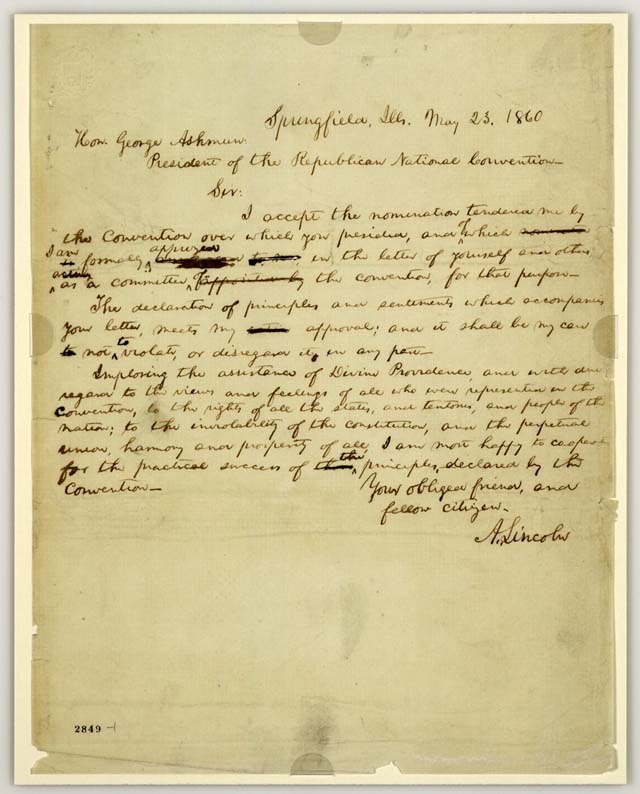
Abraham Lincoln’s letter to the president of the Republican National Convention of 1860, accepting the convention’s nomination for the presidency. It was written, you will note, from Springfield, Illinois, 200 miles away from Chicago where the convention was held.
To prove to me the piety of Abraham Lincoln, a fellow showed me photograph of a plaque on a church in Chicago, said to be the church where Abraham Lincoln said his prayers every morning during the Republican Convention of 1860, at which Lincoln got the nomination for president. Other records — newspapers, Lincoln’s letters and other documents, show that, as was the fashion in 1860, Lincoln did not attend the convention in Chicago, but as a candidate for president, stayed at home in Springfield, nearly 200 miles away.
Most real history can be read in documents, and does not need to rely on folk retellings exclusively.
5. The author says a belief is credible because it has endured for some time, or because many people believe it to be true.
Faced with the evidence that a dozen quotes he had attributed to figures such as James Madison, George Washington and Patrick Henry were whole cloth inventions, Texas quote-purveyor David Barton issued a statement urging people not to rely on them because they were “questionable.“
A great example of belief triumphing over fact presents itself as the Cardiff Giant, now on display at the Farmers’ Museum in Cooperstown, New York (go visit when you visit the Baseball Hall of Fame). After an argument with a cleric over whether the Bible’s claim that giants once existed, a tobacconist named George Hull hired stonecarvers to carve a giant; then he hired a farmer to bury the carving on his farm, and claim to have struck it when planting. Once discovered the “petrified man” was put on display, for a fee. Hull got lucky: Syracuse businessmen offered to buy it from him for an enormous sum.
Paleontologist Othniel Marsh inspected it on display, and pronounced it a hoax. For some odd reason, that increased the popularity of the attraction. Carnival and side show entrepreneur P. T. Barnum offered $60,000 for the carving, but was refused. Barnum then had a plaster replica made and put on display. The owners of the original hoaxed carving sued, but the suit was thrown out because they could not demonstrate the “genuineness” of their own hoax. Barnum made more money than the original. A hoaxed hoax is even more popular than the truth.

A photo (staged?) of the 1869 unearthing of the Cardiff Giant (Cardiff, New York). Photograph courtesy Farmers Museum (where the carving now rests, on display to museum visitors) via Associated Press, and via National Geographic.
6. The author has worked in isolation.
Historians often help each other. Good historians put out queries to many sources, the better to assure accuracy. So, conversely, if there are only a few people who know anything about an account, that fact alone may cause suspicion. Clifford Irving’s hoax biography of Howard Hughes, while remarkably accurate in some regards, was unraveled when enough people familiar with Hughes called the bluff — including, of course, Hughes himself. The book got as far as it did with extreme secrecy on Irving’s part. Working alone makes error easier, and is essential for intentional frauds.
7. The author must propose a new interpretation of history to explain an observation.
Various conspiracy claims require that key people act counter to their known character. If Franklin Roosevelt had “allowed” Pearl Harbor to occur in order to get the U.S. into war, his actions over the previous six years to support Britain start to make little sense. Had Lyndon Johnson been part of a conspiracy to assassinate John Kennedy, his later carrying out the legislative plan of Kennedy runs contrary to all such motivations. If the founders of the U.S. actually intended to make Christianity the state religion, their efforts to disestablish the churches in all 13 colonies, efforts to write bills of rights for each state including freedom of religion, and efforts to create the First Amendment in the Bill of Rights seem like incredible, repeated errors.
Bogus history is much like the conjectured problems that result from time travel: Change one jot of history, and there is a cascading effect on later events. In many cases,were the bogus histories accurate, what follows could not be so, and we wouldn’t be here to discuss it.
Those are the seven warning signs of bogus history. Bogus, or voodoo history should be suspected if two or more of the signs are present — though it is quite possible for actual history to show more than two signs (perhaps actual history could show all seven signs — but I’d have to see an example before stating it’s so).
More:
6 Comments | Accuracy, Bad Quotes, Bogus history, Ethics, History, History Revisionism, Hoaxes, Jurisprudence, Justice, Law, Research, Student projects, U.S. Supreme Court, Voodoo history, Voodoo science, Writing history | Permalink
Posted by Ed Darrell
You are currently browsing the archives for the Justice category.


Ed Darrell on Texas's Colorado River


Come on in, the water's fine. Come often: Cleanliness is next to godliness.


 Millard Fillmore's Bathtub
