Old and Wise? Stones older than Supreme Court

December 8, 2012

Some wag at Associated Press noticed recently that the Rolling Stones’ average age puts them older than the U.S. Supreme Court.  (Did some one notice this before AP?)  Franklin Roosevelt criticized the Court as “nine old men.”  Women have improved the Court, but age sometimes makes us wonder, still, if new ideas wouldn’t help.

Rolling Stones in 2012, 50th anniversary

Left to right, Charlie Watts, Keith Richard, Ron Wood and Mick Jagger; Bill Wyman absent from this photo; Rolling Stones, 50th Anniversary Tour 2012 – Samir Hussein photo WireImage, via Rolling Stone magazine. Other than no ties, they dress not-too flamboyantly.

Maybe we should wonder about increasing the wisdom that comes with age:

Rolling Stones:

Mick Jagger, 69

Keith Richards, 68

Charlie Watts, 71

Ronnie Wood, 65

Bill Wyman (rejoining them on tour), 76

Average age:  69.8 years (calculated from whole years only)

U.S. Supreme Court:

Antonin Scalia, 76

Anthony Kennedy, 76

Clarence Thomas, 64

Ruth Bader Ginsburg, 79

Stephen Breyer, 74

John G. Roberts, 57

Samuel A. Alito, Jr., 62

Sonia Sotomayor, 58

Elena Kagan, 52

Average age:  68.4 years

U.S. Supreme Court, Roberts Court 2010 – Back row (left to right): Sonia Sotomayor, Stephen G. Breyer, Samuel A. Alito, and Elena Kagan. Front row (left to right): Clarence Thomas, Antonin Scalia, Chief Justice John G. Roberts, Anthony Kennedy, and Ruth Bader Ginsburg – Wikimedia image. This bunch wears less colorful, but sillier costumes. Justice Ginsburg tends to favor neckwear the same way Keith Richards does; what else might they have in common?

A wise-beyond-his-teen-years camper at Camp Rising Sun of the Louis August Jonas Foundation, in the 1960s or early 1970s, observed, “You cannot be both young and brave, and old and wise.”  Certainly one would hope to achieve the happier medium of brave and wise (not necessarily in that order), but humans being who we are and experience being the master teacher that it is, we find ourselves on one end of both spectra, either wizened in age, or brave perhaps because of youth.

The Stones, celebrating their 50th year as a band in 2012, probably rock better than the Court does.  One can’t help wondering whether the wisdom of the Stones wouldn’t serve us better than that of the current court.  Ironically, those most wise at the Court tend to be the younger ones (Breyer definitely excluded).  I’d be inclined to swap out Alito and Scalia  for any two of the Stones.  Maybe Roberts for a third.

Thomas?  Well, he’s almost a contemporary, and I had lunch with him a couple of times (Senate staff).  I hate to criticize a lunch companion so.  But comparing Jagger’s record at the London School of Economics with Thomas’s record in academia, yeah, I could be persuaded.  I dealt with Breyer, too (not at lunch), and am inclined to think he could rock pretty well.

Perhaps the answer is that we need more rock and roll in the halls of justice.  Pete Seeger, Arlo Guthrie and Bruce Springsteen, among others, would probably agree.

If both groups banned the use of hair dye, would it improve anything they do?

Which bunch would you rather have dispensing final decisions on justice?  Which bunch would you prefer to see in concert?

More:


Department of Interior finally settled the Native American trust case

November 27, 2012

Here’s a headline that shouldn’t be buried in lame duck Congress folderol nor holiday news doldrums:  The U.S. Department of Interior (DOI) and plaintiffs in the Cobell case reached a settlement that the court has approved. This is the end of litigation — parties hope — on the long-running saga of government mismanagement of trust accounts held by the Bureau of Indian Affairs (BIA) for the benefit of Native Americans, over the last century.

Billions of dollars went missing to bad accounting.

Elouise Cobell met with President Barack Obama in the Oval Office, 2010

Elouise Cobell met with President Barack Obama in the Oval Office, in December 2010, after the passage and signing of the Claims Resolution Act of 2010.

Wikipedia has a concise, but thorough enough description of the case and its predecessors:

Cobell v. Salazar (previously Cobell v. Kemp- thorne and Cobell v. Norton and Cobell v. Babbitt) is a class-action lawsuit brought by Native American representatives against two departments of the United States government. The plaintiffs claim that the U.S. government has incorrectly accounted for the income from Indian trust assets, which belong to individual Native Americans (as beneficial owners) but are managed by the Department of the Interior (as the legal owner and fiduciary trustee). The case was filed in the United States District Court for the District of Columbia. The original complaint asserted no claims for mismanagement of the trust assets, since such claims could only properly be asserted in the United States Court of Federal Claims.

Arguments, appeals and deeper investigation strung the case out; lead plaintiff Elouise Cobell, a member of the Blackfoot Tribe, did not live to see the end of the case (she died in 2011).

It’s difficult to judge whether justice has been served in this case, and that judgment may not be ripe for many years.  Ending the litigation should create some hope for better conditions on Indian Reservations, and for Native Americans across the nation.  Especially the education benefits of the law required to settle the case, could provide a foundation for future prosperity of the affected tribes and people.

DOI announced the settlement in a press release November 26 (links in the body of the release added here):

Salazar Announces Final Steps on Cobell Litigation and Implementation of Settlement


Settlement includes land consolidation program to help promote tribal self-determination and strengthen economic development

11/26/2012

WASHINGTON, D.C. – Secretary of the Interior Ken Salazar today lauded the final approval of the Cobell settlement and outlined steps that Interior will take to help implement the historic $3.4 billion settlement. The settlement resolves a long-running class action lawsuit regarding the U.S. government’s trust management and historical accounting of individual American Indian trust accounts. It became final on November 24, 2012, following action by the Supreme Court and expiration of the appeal period.

“With the settlement now final, we can put years of discord behind us and start a new chapter in our nation-to-nation relationship,” said Salazar. “Today marks another historic step forward in President Obama’s agenda of reconciliation and empowerment for Indian Country and begins a new era of trust administration.”

The settlement includes a $1.5 billion fund to be distributed to class members for accounting and potential trust fund and asset mismanagement claims. The settlement also includes a $1.9 billion fund for a land consolidation program that allows for the voluntary sale of individual land interests that have “fractionated,” or split among owners, over successive generations. Fractionated land can have many owners – sometimes hundreds or more – diminishing the land’s value and making it difficult for individuals to use the land for agriculture, business development, or housing from which tribes can benefit. Up to $60 million of the $1.9 billion fund may be set aside to provide scholarships for American Indians and Alaska Natives to attend college or vocational school.

“This marks the historic conclusion of a contentious and long running period of litigation,” said Hilary Tompkins, Solicitor for the Department of the Interior. “Through the hard work and good will of plaintiffs, Interior and Treasury officials and Department of Justice counsel, we are turning a new page and look forward to collaboratively working with Indian country to manage these important funds and assets.”

Payments to Claimants
The Claims Administrator will now begin overseeing disbursement of the $1.5 billion to nearly 500,000 class members. The court previously approved GCG, Inc., as the Claims Administrator. The Department of the Treasury will transfer the $1.5 billion to an account at JP Morgan Chase, a bank approved by the court. Per the terms of the settlement agreement, Interior’s Office of the Special Trustee (OST) has assisted GCG with its database by supplying contact information of individual class members from its records.

“We will continue to work with GCG to ensure it has the information it needs to make expeditious and accurate payments,” Deputy Secretary of the Interior David J. Hayes said. “At the same time, we’re focused on making meaningful improvements to our trust administration so that we’re more transparent, responsive and accountable in managing these substantial funds and assets.”

Trust Land Consolidation Program
The Department of the Interior will use $1.9 billion from the Trust Land Consolidation Fund to acquire interests in trust and restricted lands that have “fractionated” over successive generations since the 1880s.

Individual owners will be paid fair market value for such interests with the understanding that the acquired interests will remain in trust and be consolidated for beneficial use by tribal communities. Interested sellers may convey their fractional interests on a voluntary basis. Currently, there are over 2.9 million fractional interests owned by approximately 260,000 individuals.

While the settlement was pending, Interior held a series of consultation meetings with tribes in 2011 to ensure that this landmark program incorporates tribal priorities and promotes tribal participation in reducing land fractionation in a timely and efficient way. These discussions informed a draft land consolidation plan released in February of 2012. Interior is incorporating public comments and expects to release an updated plan by the end of the year for additional consultation.

“The land consolidation program is our chance to begin to solve a fractionation problem that has plagued Indian country for decades,” said Interior Assistant Secretary of Indian Affairs Kevin K. Washburn. “We are anxious to get started. We know that Interior’s continued outreach through consultations with Indian Country is a crucial component to accomplishing truly open government-to-government communication”

Congress approved the Cobell settlement on November 30, 2010 as part of the Claims Resolution Act of 2010. President Obama signed the legislation on December 8, 2010. The district court approved the Cobell settlement on August 4, 2011 and it has been upheld through the appeals process.

For additional information about the individual class-action payments, please contact GCG, Inc. at 1-800-961-6109 or via email at Info@IndianTrust.com

For additional information on the Trust Land Consolidation Program, please visit http://www.doi.gov/cobell/index.cfm

More:

  • Page in memory of Elouise Cobell, the lead plaintiff in the case — who died in 2011; President Obama described Ms. Cobell, and the litigation, in remembering her:  ¶”As treasurer of the Blackfeet Nation, Elouise spoke out when she saw that the federal government had failed to account for billions of dollars that it owed to hundreds of thousands of her fellow Native Americans. In 1996, she filed suit, and for 15 years, tirelessly led a legal battle, with seven trials, 10 appeals, and dozens of published decisions. She fought her battle not just in the courts, but in the halls of Congress before finally securing justice for more than 300,000 American Indians and Alaska Natives in the form of a $3.4 billion settlement.  ¶”The agreement reached in Cobell v. Salazar marked the largest government class-action settlement in our nation’s history. The scholarship fund this settlement established will give more Native Americans access to higher education. Tribes will have more control over their own lands. Elouise’s tireless efforts strengthened the government-to-government relationship with Indian country, and a generation of Native Americans and all Americans has seen the promise of justice realized.  ¶”Last December, I had the privilege to meet with Elouise in the Oval Office prior to signing into law a bill to make things right. The Claims Resolution Act of 2010 is a direct result of the settlement that bears her name. It is proof of an enduring American idea – that change is always possible.”

225 years ago today, in this room

September 17, 2012

Independence Hall, Philadelphia; room where the Constitution was created and signed; Dept of Interior photo

Caption from Department of Interior’s Tumblr site: 225 years ago today, the Constitution of the United States was signed in Independence Hall. Today, you can tour the Hall and see where the Declaration of Independence and Constitution were both signed, and you can also view the Liberty Bell [close by]. This is a site not to miss while visiting Philadelphia.
Photo: National Park Service

Does this room look a little familiar?  You’ve probably seen Howard Chandler Christy’s painting of the event we celebrate today.

Howard Chandler Christy’s “Signing of the Constitution,” 1940

Howard Chandler Christy’s “Signing of the Constitution,” 1940; Architect of the Capitol image. This massive, 20′ x 30′ painting hangs in the House Wing of the U.S. Capitol, in the east stairway — a location where, alas, most people cannot get to without a guide anymore.

Click to the Architect of the Capitol’s site for the story of the painting, intended by Congress to fill a gap in the story of America told by art in the Rotunda and throughout the halls of the building.

Dr. Gordon Lloyd, Pepperdine University, creator of the interactive

Dr. Gordon Lloyd, Pepperdine University’s School of Public Policy, and expert in the Constitution and its history.  I met Lloyd almost a decade ago, in programs for history teachers, sponsored by the Bill of Rights Institute, Liberty Fund, and National Endowment for the Humanities.

My old friend Dr. Gordon Lloyd of Pepperdine University, working with the Ashbrook Center for Public Affairs, created a study tool from the Christy painting which should be used a lot more in classrooms.  Click over to the Edsitement site, and see for yourself.

Every year there are a few more tools on the internet to study the Constitution with, for teachers to use in the classroom on Constitution Day and every day.  I wonder what will be the effects in another decade.

How important is it that students learn the Constitution, what it says, and how it affects our daily lives?  How important is it that students learn the history of the creation of the Constitution, and does that history reverberate for those students as they venture out into their roles as citizens in the republic created by the document?

More:


Mermelstein: The man who forced us to remember

August 20, 2012

I first posted a version of this back in August 2006.  Since that time not much showed up on the internet to commemorate the story of Mel Mermelstein, nor to burn his deeds into the history books.  Millard Fillmore’s Bathtub had many fewer readers each day, then too.  This is a story that should not be forgotten about a story that must not be forgotten.

Mr. Mel Mermelstein, in 1993, recording an oral history for the US Holocaust Memorial  Museum

Mr. Mel Mermelstein, in 1993, recording an oral history for the US Holocaust Memorial Museum

In early August 1985, Melvin Mermelstein struck a powerful blow against bogus history and historical hoaxes. Mel won a decision in a California court, in a contract case.

A group of Holocaust deniers had offered a $50,000 reward for anyone who could prove that the Holocaust actually happened. Mermelstein had watched his family marched to the gas chambers, and could testify. He offered his evidence. The Holocaust deniers, of course, had no intention of paying up. They dismissed any evidence offered as inadequate, and continued to claim no one could prove that the Holocaust actually occurred.

Mermelstein, however, was a businessman and he knew the law. He knew that the offer of the reward was a sweepstakes, a form of contract. He knew it was a contract enforceable in court.  He sued to collect the offered reward.  The reward was an offer, and Mel Mermelstein accepted the offer and, he said, he performed his part of the bargain. The issue in court would be, was Mermelstein’s evidence sufficient?

Mermelstein’s lawyer had a brilliant idea. He petitioned the court to take “judicial notice” of the fact of the Holocaust. Judicial note means that a fact is so well established that it doesn’t need to be evidenced when it is introduced in court — such as, 2+2=4, the freezing point of water is 32 degrees Fahrenheit, 0 degrees Celsius, etc.

The court ruled that the evidence presented overwhelmingly established that the Holocaust had occurred — the court made judicial note of the Holocaust. That ruling meant that, by operation of law, Mermelstein won the case. The only thing for the judge to do beyond that was award the money, and expenses and damages.

You can read the case and other materials at the Nizkor Holocaust remembrance site.

Appalachian State University takes the Holocaust seriously — there is a program of study on the issue, reported by the Mountain Times (the school is in Boone, North Carolina — not sure where the newspaper is).

Teaching the Holocaust to Future Generations

Mountain Times, August 17, 2006

As co-directors of Appalachian State University’s Center for Judaic, Holocaust and Peace Studies, Rennie Brantz and Zohara Boyd are always eager to expand and improve the center’s methods of education. Seldom, though, does this involve airfare.

Brantz and Boyd recently visited Israel to participate in the Fifth International Conference for Education: Teaching the Holocaust to Future Generations. The four-day conference was held in late June at Yad Vashem, an institute and museum in Jerusalem that specializes in the Nazi Holocaust. [link added]

“Yad Vashem is an incredible institute,” Brantz said. “It was founded in the ’50s to remember and commemorate those who perished in the Holocaust, and has been the premier international research institute dealing with the Holocaust.”

As Santayana advises, we remember the past in order to prevent its recurring. Clearly, this is a past we need to work harder at remembering.

Despite having been ordered to acknowledge the Holocaust, pay up on their sweepstakes offer, and apologize to Mr. Mermelstein, Holocaust deniers continue to publish claims that Mr. Mermelstein’s account is not accurate, or that it is contradictory or in some other way fails to measure up to the most strict tests of historical accuracy.  So it is important that you remember the story of Mel Mermelstein, and that you spread it far and wide.

More:


UFOs? GOP says ‘you gotta believe’ – Primer on Voter ID laws and their gross injustice

August 3, 2012

Quoted completely from Bill Moyers’ site; he makes the case clearly:

Moyers & Company | The Hollow Defense of Voter ID Laws

UFO Sightings Are More Common Than Voter Fraud

August 2, 2012

by Hamed Aleaziz, Dave Gilson and Jaeah Lee, Mother Jones

We’re proud to collaborate with Mother Jones in sharing graphs and charts that reveal truth about voting obstacles. Scroll down for stats and facts related to efforts to restrict voting, the prevalence of voter ID laws, what discourages new voters and the the pervasive fiction of voter fraud.


BLOCK THE VOTE

Since 2001, nearly 1,000 bills that would tighten voting laws have been introduced in 46 states.

24 voting restrictions have passed in 17 states since 2011. This fall, new laws could affect more than 5 million voters in states representing 179 of the 270 electoral votes needed to win the presidency.

In the past two years, 5 battleground states (Florida, Iowa, Ohio, Pennsylvania, and Wisconsin) have tightened their voting laws.

As of April, 74 restrictive voting laws were on the table in 24 states.

Sources: Brennan Center for Justice, NAACP


CARD-CARRYING AMERICANS ONLY

Since 2011, 34 states have introduced laws requiring voters to show photo ID, and 9 states have passed photo ID laws, affecting 3.8 million voters.

2.2 million registered voters did not vote in 2008 because they didn’t have proper ID.

*Does not include laws awaiting DOJ clearance, blocked by courts, or not in effect until after 2012. Source: National Conference of State Legislatures

Last year, 12 states introduced laws requiring birth certificates or other proof of citizenship to vote; 3 passed.

Only 48 percent of women have a birth certificate with their current legal name on it.

Texas’ new ID law permits voters to use concealed-handgun licenses as proof of identity, but not state university IDs.

Sources: Brennan Center for JusticeGabriel R. Sanchez, Stephen A. Nuño, and Matt A. Barreto


DISCOURAGING NEW VOTERS

80 percent of the 75 million eligible voters who did not take part in the 2008 election were not registered to vote.

In 2008, more than 1/3 of voters cast ballots before Election Day. In 2011, 5 states passed bills to restrict early voting.

States with Election Day registration have 7 to 12 percent greater turnout than states without. Last year, 5 states introduced bills that eliminate Election Day registration.

12 percent of minority voters report registering through voter drives, twice the rate of white voters. In 2011, Florida and Texas passed laws making registration drives much harder to organize.

Florida state Sen. Mike Bennett, a supporter of the tougher voter registration law, said, “I don’t have a problem making it harder. I want people in Florida to want to vote as bad as that person in Africa who walks 200 miles across the desert. This should not be easy.”

Source: Caltech/MIT Voting Technology Project


LOCKING OUT EX-CONS

4 million Americans who have completed prison sentences are ineligible to vote. 38 percent of disenfranchised voters are African American.

13 percent of African-American men cannot vote due to criminal records, a rate 7 times the national average.

The United States and Belgium are the only democracies that disenfranchise citizens for lengthy or indefinite periods after completing prison sentences.

To regain their voting rights, released felons in Iowa must provide the address of the judge who convicted them and a credit report showing they have paid off their court costs. “They make the process just about impossible,” said a 40-year-old ex-con who’d stolen a soda machine as a teen.


IN SEARCH OF STOLEN VOTES

dog voting

While defending its precedent-setting photo ID law before the Supreme Court, Indiana was unable to cite a single instance of voter impersonation in its entire history.

A 2005 report by the American Center for Voting Rights claimed there were more than 100 cases of voter fraud involving 300,000 votes in 2004. A review of the charges turned up only 185 votes that were even potentially fraudulent.

In support of a voter ID law, Kansas Secretary of State (and the legal brains behind a slew of anti-immigration laws) Kris Kobach cited 221 incidents of voter fraud in the state between 1997 and 2010. Yet those cases produced just 7 convictions — none related to impersonating other voters.

Last December, Republican National Committee Chairman Reince Priebus declared that Wisconsin is “absolutely riddled with voter fraud.” In fact, the state’s voter fraud rate in 2004 was 0.0002 percent — just 7 votes.

In 2008, John McCain said fraudulent registrations collected by ACORN were “one of the greatest frauds in voter history in this country, maybe destroying the fabric of democracy.” The Congressional Research Service found no proof that anyone improperly registered by ACORN tried to vote.

Federal convictions for election fraud, 2002-05

  • Voting while ineligible: 18
  • Voting multiple times: 5
  • Registration fraud: 3

UNIDENTIFIED FLYING OBJECTS

Dog and UFO

Between 2000 and 2010, there were:

649 million votes cast in general elections

47,000 UFO sightings

441 Americans killed by lightning

13 credible cases of in-person voter impersonation

Special hat tip to craigconnects.org

Additional sources:

  • A 2005 report by the American Center for Voting Rights…: The Myth of Voter Fraud by Lorraine C. Minnite
  • 13 credible cases…: Justin Levitt, Loyola Law School

From the show

Related Features:

So there’s the case in a nutshell — a large, meaty nut’s shell.

More: 


July 19, 2012

Found this at Under the Lobsterscope — our incarceration rates form a testament to one of the greatest failures of the U.S. over the past two decades. Live links added here for your convenience.

(This may be the last time we use the reblog feature — it’s very clunky!)

btchakir's avatarUnder The LobsterScope


Here are the facts… you make your own conclusion. Personally, I think making prisons a private industry sucks— I wonder when they’ll be exporting the prisoners to China.


View original post


June 15: Magna Carta anniversary, #797

June 15, 2012

Today, June 15, 2012, is the 797th anniversary of the signing of the Magna Carta.  The document laid a foundation for freedom, almost 800 years ago, upon which we stand today.

Runnymede, Magna Carta Isle, photo by Wyrdlight, Antony McCallum, 2008 (Wikimedia)

What event critical to western history and the development of the democratic republic in the U.S. happened here in 1215?

A teacher might use some of these photos explaining the steps to the Constitution, in English law and the heritage of U.S. laws. Other than the Magna Carta, all the events of Runnymede get overlooked in American studies of history. Antony McCallum, working under the name Wyrdlight, took these stunning shots of this historic meadow. (He photographs stuff for studies of history, it appears.)

Maybe it’s a geography story.

View of Runnymede Meadow from Engham Village -- Wyrdlight photo through Wikimedia

View of Runnymede Meadow from Engham Village — Wyrdlight photo through Wikimedia

Several monuments to different events of the past millennium populate the site. The American Bar Association dedicated a memorial to the Magna Carta there — a small thing open to the air, but with a beautiful ceiling that is probably worth the trip to see it once you get to England.

Wikipedia explains briefly, with a note that the ABA plans to meet there again in 2015, the 800th anniversary of the Great Charter:

Magna Carta Memorial


The Magna Carta Memorial & view towards the ‘medes’


Engraved stone recalling the 1985 ABA visit

Situated in a grassed enclosure on the lower slopes of Cooper’s Hill, this memorial is of a domed classical style, containing a pillar of English granite on which is inscribed “To commemorate Magna Carta, symbol of Freedom Under Law”. The memorial was created by the American Bar Association to a design by Sir Edward Maufe R.A., and was unveiled on 18 July 1957 at a ceremony attended by American and English lawyers.[5]

Since 1957 representatives of the ABA have visited and rededicated the Memorial renewing pledges to the Great Charter. In 1971 and 1985 commemorative stones were placed on the Memorial plinth. In July 2000 the ABA came:

to celebrate Magna Carta, foundation of the rule of law for ages past and for the new millennium.

In 2007 on its 50th anniversary the ABA again visited Runnymede and during the convention installed as President Charles Rhyne who devised Law Day which seeks in the USA an annual reaffirmation of faith in the forces of law for peace.

The ABA will be meeting at Runnymede in 2015 on the 800th anniversary of the sealing of the original charter.

The Magna Carta Memorial is administered by the Magna Carta Trust, which is chaired by the Master of the Rolls.[10]

In 2008, flood lights were installed to light the memorial at night, but due to vandalism they now lie smashed.

I’ll wager the lights get fixed before 2015.

Detail of the Magna Carta monument at Runnymed...

Detail of ceiling of the Magna Carta Memorial detailing play of light, and star pattern, Runnymede – Wikimedia image

More, resources:

This is mostly an encore post.


Still looking? Again, here’s how to find “separation of church and state” in the Constitution

May 16, 2012

It’s an election year. People get crazy. I’ve already heard from a dozen wacko candidates that “separation of church and state isn’t in the Constitution.”

Yes it is. Separation of church and state resides in the Constitution.  Here’s a post from 2010 to help them find it.

_____________

It’s been at least 20 years since I first heard the old canard of an argument that “there’s no separation of church and state in the Constitution.” I think I first heard it attributed to David Barton, which would make sense, since he doesn’t understand the Constitution, but neither does he fear sharing his misunderstandings.

It was an incorrect statement then, and it’s been incorrect since September 1787. Separation of state and church is woven throughout the Constitution, part of the warp and woof.

Recently, latter-day Constitution ignorami repeat the old canard.

Toles cartoon on dangers of marrying church and state

Toles cartoon on dangers of marrying church and state

I was surprised to discover I’ve not posted this before on this blog. So here’s a slightly-edited version of a response I gave many months ago to someone who made that silly claim, a basic description that I developed years ago to explain the issue, in speeches by members of the Senate Subcommittee on the Constitution:

Separation of church and state: It’s in the Constitution.

I don’t play a constitutional lawyer on television, I am one*, but it seems to me anyone can read the Constitution and see. Especially if one understands that the Constitution sets up a limited government, that is, as Madison described, one that can do only what is delegated to it. The Constitution is a short document.

Where should you look to find separation of church and state in the Constitution?

First, look in the Preamble. It is made clear that the document is a compact between citizens: “We the people . . . do ordain and establish this Constitution . . .” The usual role of God ordaining (in some western nations) is altered, intentionally. It is not God who establishes this government, but you and I, together. From the first words of the Constitution, there is separation of church and state. The power of our government grows out of a secular compact between you and me, and 308 million other residents of the nation. We have a government created by consent of the governed, as the Declaration of Independence said a just government should be. It is not a government created by the will of God directly (though some, including the Mormons, argue it is divinely inspired). We have no divine right kings or other monarchs. The government is not the grantor of rights from God, but is instead the protector of the rights of citizens, whatever the source of the rights.

Second, look in the key parts of the document itself. Start with Article 1. The legislative branch is given no role in religion; neither is any religion given any role in the legislature. In Article 2, the executive branch gets no role in religion, and religion gets no role in the executive branch. In Article 3, the judicial branch gets no role in religion, and religion gets no role in the judicial branch. In Article 4, the people get a guarantee of a republican form of government in the states, but the states get no role in religion, and religion gets no role in state government. This is, by design of the founders, a perfect separation of church and state.

Third, in Article 6, the convention wrote the hard and fast rule that no religious test can be used for any office in government, federal, state or local, means that no official will have a formal, governmental role in religion, and no religion can insist on a role in any official’s duties.

Fourth, Amendment 1 closes the door to weasling around it: Congress is prohibited from even considering any legislation that might grant a new bureaucracy or a new power to get around the other bans on state and church marriage, plus the peoples’ rights in religion are enumerated.

Fifth: In 1801 the Baptists (!) in Danbury, Connecticut, grew concerned that Connecticut would act to infringe on their church services, or teachings, or right to exist. So they wrote to President Jefferson. Jefferson responded with an official declaration of government policy on what the First Amendment and Constitution mean in such cases. Jefferson carefully constructed the form of the device as well as the content with his Attorney General, Levi Lincoln, to be sure that it would state what the law was. This “letter” is the proclamation. It’s an official statement of the U.S. government, collected in the president’s official papers and not in his personal papers. Make no mistake: Jefferson’s letter to the Danbury Baptists was an official act, an official statement of the law of the United States. Jefferson intended it to assuage the Baptists in Danbury, to inform and warn the Connecticut legislatures, and to be a touchstone to which future Americans could turn for information. It was only fitting and proper for the Supreme Court to use the letter in this capacity as it has done several times.

Sixth: The phrase, “separation of church and state” dates back another 100 years and more, to the founding of Rhode Island. It is the religion/state facet of the idea of government by consent of the governed without interference from religious entities, expressed so well in the Mayflower Compact, in the first paragraphs of the Declaration of Independence, and carried through in the Constitution (see especially the Preamble, above).

No, the phrase “separation of church and state” never appears in the Constitution. The principles of separation of church and state are part of the warp and woof, and history, of the document, however. The law is clear, the law was clear, the law has always been clear, and denying the Constitution says what it says won’t change it or make it go away. You could just as easily point out that the word “democracy” or “democratic” never appears in the document, though we rely on democratic mechanisms and institutions to make it work. You could point out that nowhere does it say that our national government is a republic, though it is. The Constitution doesn’t say “checks and balances,” nor does it say “federalism.” The Constitution doesn’t mention political parties. The Constitution was written before the advent of broadcasting, and makes no mention of radio nor television, nor of the internet — but the First Amendment freedoms apply there anyway. The Constitution doesn’t say “privacy,” though it protects your right to privacy.

You won’t find “separation of church and state” as a phrase in the Constitution. If you read it, you’ll find that the concept of the separation of state and church can’t be taken out of the document, either — it’s a fundamental principle of our government.

More, and Resources:

__________

* A non-practicing one. We have way more than 50,000 lawyers in Texas. That’s enough trouble for one lifetime. Someone has to look out for the welfare of the world.


The anti-teacher, anti-lawyer, anti-education, anti-math, anti-civil rights truth behind “Kill all the lawyers”

March 10, 2012

Mostly an encore post — something we shouldn’t have to repeat, but thoughts that deserve a place in everyone’s mind in an election year.  I originally posted this back in 2006.

Poster from Michael Boyd's 2000 production of Henry VI, Part II, at Stratford

All this murder of lawyers, teachers, accountants, education and civil rights, is bloody business. Poster from Michael Boyd’s 2000 production of Henry VI, Part II, at Stratford; PBS image via Wikipedia

In an otherwise informative post about a controversy over alternative certification for school administrators, at EdWize, I choked on this:

The Department leaders, Klein, Seidman and Alonso, lawyers all (perhaps Shakespeare was correct), are rigid ideologues who have alienated their work force as well as the parents of their constituents

Did you catch that? Especially the link to the Shakespeare line, “The first thing we do, let’s kill all the lawyers?”

This is not exactly history we’re fisking here — it’s drama, I suppose. Still, it falls neatly into the category of debunkings, not too unlike the debunking of the story of Millard Fillmore’s bathtub.

The line from Shakespeare is accurate. It’s from Henry VI, Part II. But it’s not so much a diatribe against lawyers as it is a part of a satirical indictment of those who would overthrow government, and oppress the masses for personal gain.

It is Dick the Butcher who says the line. Jack Cade has just expressed his warped view that he should be king, after having attempted a coup d’etat and taken power, at least temporarily. Cade starts in with his big plans to reform the economy — that is, to let his friends eat cheap or free, while other suffer and starve.

Dick chimes in to suggest that in the new regime, the lawyers ought to be the first to go — they protect rights of people and property rights, and such rights won’t exist in Cade’s imagined reign. Cade agrees. The purpose of killing the lawyers, then, is to perpetuate their rather lawless regime.

At that moment others in Cade’s conspiracy enter, having captured the town Clerk of Chatham. The man is put on trial for his life, accused of being able to read and keep accounts. Worse, he’s been caught instructing young boys to read.

There is no saving the poor Clerk at that point.  Cade orders the Clerk to be hanged, “with his pen and inkhorn around his neck” (even the pen was considered dangerous!).

Thus Shakespeare relates how terrorists of old steal government and rights, by killing the lawyers, the educated, and especially the teachers.

It’s still true today. Those who would steal rights from people, those who would oppress others, assault the rule of law, education, and those who spread learning. Beware those who urge death to law and learning; they are related to Dick the Butcher, philosophically, at least.  (No offense to honest butchers, I hope — especially to members of the UFCW.  Dick the Butcher was not a member of any butcher’s union.)

Here is the text, from the site “William Shakespeare — the Complete Works”:

CADE
Be brave, then; for your captain is brave, and vows
reformation. There shall be in England seven
halfpenny loaves sold for a penny: the three-hooped
pot; shall have ten hoops and I will make it felony
to drink small beer: all the realm shall be in
common; and in Cheapside shall my palfrey go to
grass: and when I am king, as king I will be,–

ALL
God save your majesty!

CADE
I thank you, good people: there shall be no money;
all shall eat and drink on my score; and I will
apparel them all in one livery, that they may agree
like brothers and worship me their lord.

DICK
The first thing we do, let’s kill all the lawyers.

CADE
Nay, that I mean to do. Is not this a lamentable
thing, that of the skin of an innocent lamb should
be made parchment? that parchment, being scribbled
o’er, should undo a man? Some say the bee stings:
but I say, ’tis the bee’s wax; for I did but seal
once to a thing, and I was never mine own man
since. How now! who’s there?

(Enter some, bringing forward the Clerk of Chatham)

Smith the Weaver and Dick the Butcher seize the Clerk of Chatham, Bunbury print of Henry VI, Part II scene

Smith the Weaver and Dick the Butcher seize the Clerk of Chatham, in Act IV, scene ii of Henry VI, Part II. Engraving by Henry William Bunbury, from collection of the Folger Shakespeare Library; original published by Thos. Macklin Poets Gallery, London, 1795

SMITH
The clerk of Chatham: he can write and read and
cast accompt.

CADE
O monstrous!

SMITH
We took him setting of boys’ copies.

CADE
Here’s a villain!

SMITH
Has a book in his pocket with red letters in’t.

CADE
Nay, then, he is a conjurer.

DICK
Nay, he can make obligations, and write court-hand.

CADE
I am sorry for’t: the man is a proper man, of mine
honour; unless I find him guilty, he shall not die.
Come hither, sirrah, I must examine thee: what is thy name?

CLERK
Emmanuel.

DICK
They use to write it on the top of letters: ’twill
go hard with you.

CLERK
Sir, I thank God, I have been so well brought up
that I can write my name.

ALL
He hath confessed: away with him! he’s a villain
and a traitor.

CADE
Away with him, I say! hang him with his pen and
ink-horn about his neck.

>Exit one with the Clerk

More, Resources (some from Zemanta):


Oldest federal judge remembered: Followed the Boy Scout Oath

February 11, 2012

He served on the federal bench through his 104th birthday, slowing down only when death took him last month.

Federal Judge Wesley E. Brown, at 103, in Wichita, Kansas - photo by Larry Smith for the New York Times

Federal Judge Wesley E. Brown, then 103, at his desk in the courthouse in Wichita, Kansas, in 2010 - photo by Larry Smith for the New York Times. Note the computer pictured behind Judge Brown -- not a technophobe.

U.S. Federal District Judge Wesley Brown died last month.  At a memorial service, those who knew him paid homage to his lifelong devotion to the Boy Scout Oath.  At the risk of angering the copyright poobahs at Associated Press, I quote from the AP story from Wichita, Kansas, carried at the site of Fox 6 WBRC (somewhere in Alabama):

“He was truly a first among equals – an icon of all that is good and faithful and true, both as a person and as a judge,” said U.S. District Judge Katherine Vratil, now the chief judge for the federal district in Kansas.

Mike Lahey, Brown’s law clerk for the past 24 years, said the judge’s life was governed by two oaths: one that he took to be a district judge in 1962 and the other when he became a Boy Scout in 1920.

Lahey said the judge often would recite the oath to him from memory: “On my honor I will do my best to do my duty to God and my country and to obey the scout law; to help other people at all times; to keep myself physically strong, mentally awake and morally straight.”

“To Judge Brown those words were never a simple rite of passage,” Lahey said. “To him, they were the aspiration of what a man should be and he adopted them as a guide for the rest of his life.”

He was born three years before Scouting was incorporated in the U. S. and lived past Scouting’s 100th anniversary.  Any other Scouters out there with greater longevity in Scouting?

An article in The Wichita Eagle laid out the historical perspective of Brown’s astonishing service:

Brown served during an era of changing civil rights, equality for men and women in the workplace and legal battles over Internet privacy.

During the 1970s, Brown told a Wichita hospital it couldn’t fire a woman because she was single and pregnant and ruled that North High School had to let a girl on its golf team. During the 1980s, Brown ordered millions of dollars in payments to railroad workers denied promotions because they were Americans of African descent.

More recently, Brown presided over cases including a $3 million athletic ticket scandal at the University of Kansas, where he studied physical education under James Naismith.

Calvin Coolidge was president when Brown entered the University of Kansas as an undergraduate in 1925.

Brown studied by night and worked to support himself at the Ford Motor Co. factory in Kansas City. When the Great Depression hit, he found himself having to write pink slips notifying fellow workers that they were out of jobs. One of those pink slips was his own. He finished law school working as a secretary for a local attorney’s office for $15 a week.

At his first job for a Hutchinson law firm, Brown made $25 a month, before being elected as Reno County attorney from 1935 to 1939.

Brown never let age get in his way. When he joined the Navy in World War II he was 37 — the oldest in his unit.

He was a past president of the Kansas Bar Association. He became chief judge for the Kansas federal district in 1971.

Brown assumed senior status in 1979, which is seen in the federal court system as semi-retirement at full salary. Brown, however, continued to work full time for the next three decades.

More: 


Birthers: Lacking the sense God gave chickens

January 30, 2012

Birthers are still claiming the Earth is flat, still looking for a missing link, still claiming Judge Crater didn’t go missing, and still embarrassing America?

Yep.

Barack Obama's Long Form Birth Certificate

Barack Obama’s Long Form Birth Certificate – image from Snopes.com (available many places)

Orly Taitz was in court in Georgia, losing another case because she lacks even a whiff of a scintilla of an iota of evidence to back any of her claims that President Barack Obama was not born in Honolulu, Hawaii, as his now-released long-form birth certificate, short-form birth certificate, contemporary newspapers, eyewitnesses and all other evidence indicate.  They have no evidence, and they have clowns for lawyers:

In court filings, Obama’s legal team has called the “birther” allegations baseless and the criticisms of his birth records “patently unfounded.” The filings also noted 68 similar challenges filed have been dismissed and, during a 2009 challenge, a federal judge in Columbus fined Taitz $20,000 for “frivolous” litigation.

But I stumbled onto a wildly misnamed blog, The Constitution Club*, where the issue is given credence and way too many electrons.

(Are lobotomies legal, again?  Can people perform self-lobotomies?  Just wondering.)

I added some references to sites in the real world, so that anyone not totally insane might find an anchor in reality and follow the threads back to the light.

The post’s author, Daniella Nicole, tried to make a defense of the birthers insane, destructive antics.

I responded, but you never can tell when the birthers will plug their ears, cover their eyes and start singing “Born in the U.S.A.” at the top of their lungs to avoid information that would require them to appear sober.  My comment went straight to “moderation.”  Probably too many links, or too many high-quality links (thank you, Cornell University Law Library’s Legal Information Institute).   For the record, here’s my last reply to Daniella Nicole:

[Daniella Nicole wrote:]

I daresay any of the GOP contenders, or to use your reference, SNL’s the Church Lady, Frankie and Willie or one of the Coneheads, would all be better than the clown (or Homey D. Clown from In Living Color, if you will) currently in office.

Excuse me. I had mistaken you for an American, a patriot, and someone who bears no ill will to the American people.

Unless Obama has lied about who his father is and the birth certificate is a fraud (which would raise other legal issues), Obama is NOT a natural born citizen. Period.

“Born on American soil” means “natural born American citizen.” Obama was born on American soil. End of your argument.

BUT, had he been born on foreign soil, with one American citizen parent, he would still be a natural born citizens — as is John McCain, born in Panama (and not on a military base, but in the local Panama hospital).

Remind me never to refer any of my clients or friends to you for immigration advice.

The Supreme Court actually set the precedent of defining natural born as born of two American citizen parents in the 1875 case Minor v. Happersett. Note it was not a dicta, which is an authoritative statement by a court that is not legally binding, but an actual precedent, which is a rule of law established for the first time by a court and is referred to by other courts afterwards.

The holding in Minor was that women are not voting citizens. The case dealt with Mrs. Minor’s attempt to register to vote. Obama is not a woman, and the issue you’re talking about has nothing to do with registering to vote. So, if the case says what you claim, it MUST be in obiter dicta. [Obiter dicta means those parts of the decision in which the court explains how and why it ruled as it did, but NOT the key ruling itself.]  No offense, but you really could use some legal training. At least get a Black’s Law dictionary, will you?

Here, read excerpts from the opinion:

The question is presented in this case, whether, since the adoption of the fourteenth amendment, a woman, who is a citizen of the United States and of the State of Missouri, is a voter in that State, notwithstanding the provision of the constitution and laws of the State, which confine the right of suffrage to men alone. We might, perhaps, decide the case upon other grounds, but this question is fairly made. From the opinion we find that it was the only one decided in the court below, and it is the only one which has been argued here. The case was undoubtedly brought to this court for the sole purpose of having that question decided by us, and in view of the evident propriety there is of having it settled, so far as it can be by such a decision, we have concluded to waive all other considerations and proceed at once to its determination.

So it would be error to claim the case got to the issue of who is a “natural born citizen” at all. It did not.

And, had you read the case, you’d know that. In fact, the case says the opposite of what you claim. It says:

Additions might always be made to the citizenship of the United States in two ways: first, by birth, and second, by naturalization. This is apparent from the Constitution itself, for it provides [n6] that “no person except a natural-born citizen, or a citizen of the United States at the time of the adoption of the Constitution, shall be eligible to the office of President,” [n7] and that Congress shall have power “to establish a uniform rule of naturalization.” Thus new citizens may be born or they may be created by naturalization.

The Constitution does not, in words, say who shall be natural-born citizens. Resort must be had elsewhere to ascertain that. At common-law, with the nomenclature of which the framers of the Constitution were familiar, it was never doubted that all children born in a country of parents who were its citizens became themselves, upon their birth, citizens also. These were natives, or natural-born citizens, as distinguished from aliens or foreigners. Some authorities go further and include as citizens children born within the jurisdiction without reference to the citizenship of their [p168] parents. As to this class there have been doubts, but never as to the first. For the purposes of this case it is not necessary to solve these doubts. It is sufficient for everything we have now to consider that all children born of citizen parents within the jurisdiction are themselves citizens. The words “all children” are certainly as comprehensive, when used in this connection, as “all persons,” and if females are included in the last they must be in the first. That they are included in the last is not denied. In fact the whole argument of the plaintiffs proceeds upon that idea.

Under the power to adopt a uniform system of naturalization Congress, as early as 1790, provided “that any alien, being a free white person,” might be admitted as a citizen of the United States, and that the children of such persons so naturalized, dwelling within the United States, being under twenty-one years of age at the time of such naturalization, should also be considered citizens of the United States, and that the children of citizens of the United States that might be born beyond the sea, or out of the limits of the United States, should be considered as natural-born citizens. [n8] These provisions thus enacted have, in substance, been retained in all the naturalization laws adopted since. In 1855, however, the last provision was somewhat extended, and all persons theretofore born or thereafter to be born out of the limits of the jurisdiction of the United States, whose fathers were, or should be at the time of their birth, citizens of the United States, were declared to be citizens also. [n9]

If you’re going to opine on citizenship, you would do well to read a summary of actual citizenship law, and don’t take the odd rantings of anti-Obama people on the internet.

Dani said:

Interestingly, many refer to Vattel’s definition of natural born (which is essentially the same thing and may have influenced the founders in their work on the Constitution), but it is not Vattel that sets legal precedent. The Supreme Court can and did set the precedent in the matter in 1875.

Minor v. Happersett, 88 U.S. 162 (1875) most assuredly did not rule that a child must have two U.S. citizen parents to be a citizen, nor to be a “natural born” citizen. Read the case’s key sections above.

The precedent that is important here is the presidency of Chester Alan Arthur, a man who, like Obama, had a father born in a foreign country, and who was not a citizen of the U.S. at the time of Arthur’s birth. While opponents tried to make an issue of this in the campaign of 1880, it was a non-starter. You know the rest — Arthur was elected vice president under James Garfield, and ascended to the presidency upon Garfield’s death after being shot (no, Orly Taitz was not the shooter). So, had Hapersett had anything to do with presidential eligibility, it would have applied to Arthur. Since Arthur served out his term as president, it’s pretty clear that the actual precedent supports Obama’s eligibility 100%.

Somebody told you a tall tale about the case — it’s about whether a woman may vote, not about what is a natural born citizen. Seriously, how could anyone confuse those issues?

Congress in 2008 (including Hillary Clinton and Barack Obama) also defined natural born as having been born to two American citizen parents when a challenge to John McCain’s eligibility was issued.So, even by the standard and definition of Congress, including Obama himself, he is not legally qualified or eligible.

1. That was a non-binding resolution, stating the opinion of the U.S. Senate.
2. The resolution, S. Res. 511 in the 110th Congress, ( does NOT say “two American citizen parents,” but instead refers to children born to “Americans.” Obama’s mother was an American.
3. Obama was born on American soil, and so the resolution, covering kids born outside the U.S., is inapplicable, and off the mark.

Obama was not born to two American citizen parents, by his own admission and via the birth certificate which he has provided to America. Ergo, he is not a natural born American citizen and does not meet the Constitutional requirement for the office of President of the United States of America. As such, not only is he not legally qualified to be in the office he currently holds, but he is not legally eligible to be on any ballot in the U.S. for the upcoming election. Period.

Except, none of the laws you cite says what you’d need it to say. Obama is natural born because he was born in the U.S. He is also natural born having been a child of a U.S. citizen. He is fully legally qualified — at least, to people who know the law, and who appreciate that it’s necessary to follow the laws.

If wishes were horses, beggars would ride. Your wishes do not change the law. Your misstatements of the cases and the laws do not change the laws. Your wish to find something bad against Obama, a good man and a good president, does not give you a leg to stand on, nor a horse to ride.

And how, pray tell, is using legal means to resolve serious legal matters “polluting the courts”? That is what they are there for.

Junk lawsuits. Nuisance suits. Orly Taitz has already been fined for making these nuisance claims. The evidence needed to challenge Obama’s eligibility simply does not exist, except in the fevered and overactive imaginations of those crazies. The stuff in Georgia this last week is a supreme embarrassment to America — but thank God, the courts got it right.

But by all means, continue to stamp your foot and blather on about this. Your work on this insane and hopeless issue keeps you off the streets, and out of real politics. You can’t do damage to a school board race while you’re lost in the ozone on citizenship and Obama.

_____________

* Maybe by “Constitution Club” they mean “a club with which to beat the Constitution,” and not a group of people joining together in a noble cause, you think?

Earlier at Millard Fillmore’s Bathtub


Why we worry about global warming: It ain’t the climate, it’s the people

January 9, 2012

Alun Salt gave great advice about not bothering to engage idiots, pigs, denialists or trolls (here, among other places).  He said I should avoid lengthy answers to blogs that have little audience.

This is probably one of those occasions.

But in a running attempt to stimulate serious thought at a denialist blog, I got a question that has been rather common, and a question which indicates the deep serious misunderstanding denialists and even some well-meaning, overly-skeptical sensible people have:

Why worry about  climate change, since the climate is changing all the time?  Especially, why are people like Al Gore urging that we stop climate change, when CO2 has no great direct effect on human health?  Shouldn’t environmentalists be cheering climate change on, since it’s a “natural process?”

The answer is lost on the other blog, as Mr. Salt predicted it would be.  But since I’ve gotten some version of the question repeatedly in the last month, I may as well repeat the answer here, for the record.

The short answer to why we worry about climate change is that, as with almost all environmental protection, we are worried first about the quality of life of humans, and ultimately about the ability of human life to survive at all.

Here’s the question put to me there:

Ed I’m a little confused. I thought we were talking about the effect of co2 on the climate not the effect of co2 on human health. Co2 is not a toxic gas and would have no effect on human health. The fact that humans weren’t around when co2 was 10-20 times higher has absolutely nothing to do with its effect on climate.
Ed there was no runaway greenhouse effect or climate catastrophe. The planet was fine during the phanerazoic. There is actually a lack of co2 in the atmopshere comapred to that time.

Here’s my answer, with a few more links than their format would allow:

No, you’re not a little confused.  You’re a lot confused, greatly misinformed, and not thinking hard.

We worry about CO2’s effects on climate only because we worry about the future of humanity.  Many of us who have children and wish them the same blessings of having children and grandchildren, have thought through the truth of the matter that we don’t possess and rule the Earth for ourselves, but instead act only as stewards for future generations.

No Earth, no humans; but at the same time, no habitable Earth, no humans.  In the long run, Earth doesn’t care.  It’ll do fine — without humans.

We can’t damage the planet.  We can only damage its habitability for humans.

I don’t know what sort of dystopian Randian future you and other Do Nothings hope for, but it’s a future contrary to human life, American values, and all known religions.

We’re talking about the future of humans.  I tell “skeptics,” “If you don’t care, butt out.  You’ll be dead in the short run anyway, but that’s no reason to stand in the way of action not to ensure a livable planet for our grandchildren.”

You also fail to understand chemistry, pollution, and how the world works.  CO2 is indeed a toxic gas.  For about a century now we’ve had indoor air standards that require air circulation to keep CO2 down below concentrations of about 500 ppm, because at that level it starts to have dramatic effects on humans working.  It clouds their thinking and causes drowsiness.  CO2 is a conundrum, in that it is also necessary to trigger mammalian breathing.  If CO2 drops too low, we don’t take in enough oxygen and may pass out.  Too much oxygen in place of CO2 is a problem in that regard.  A substance can be both essential and a  pollutant, at the same time. (This has vexed food safety experts for years, especially after the 1958 Delaney Clause; substances we know to be essential nutrients can be carcinogenic, in the same concentrations, or in the same concentrations with a slight twist in chemical formula — how do we regulate that stuff?)

CO2 is toxic in much greater proportions — it was a CO2 cloud that killed thousands in Cameroon 30 years ago or so, if you know history.

Clearly you did not know that we’ve regulated indoor CO2 for decades.  Clearly you haven’t looked at the medical journals‘ discussion on CO2 — and I’ll wager you’d forgotten the Cameroon incident, if you ever knew about it.

CO2 is a toxic gas (the dose is the poison); CO2 has dramatic effects on human health — too little and we die, too much and we die.

The fact that humans were not around when CO2 was much higher is exactly the point.  That was presented here, as it is in most venues, as support for a claim that we don’t need to worry about CO2 pollution.  Well, that’s right — if we don’t care about a habitable Earth.  But when CO2 was higher, life for humans was impossible.

I think it’s reckless to run an experiment on what would happen with higher CO2 levels, using the entire planet as a testing place, and testing the hypotheses on just how much CO2 will kill us all off, and how.

How about a control group, at least?

In the past, massive CO2 created massive greenhouse effects that would devastate us today — not as a toxic gas, but as a result of the warming that greenhouse gases do.

Let us understand the physical conundrum of CO2 here:  Without the greenhouse effect from the human-historic levels of CO2, this would be an ice planet.  Our lives today depend on the greenhouse effects of CO2.

Consequently, anyone who claims there is no greenhouse effect fails to understand physics, chemistry, biology and history.  (Heck, throw in geology, too.)  Life would be impossible but for the greenhouse effect.  Life is impossible without water, too, but you can’t live totally surrounded by water.

Can it be true that there can never be too much of a good effect, with regard to greenhouse gases?  Ancient Greek ideas of “all things in moderation” applies here.  We need a Goldilocks amount of CO2 in our atmosphere — not to much, not too little; not too hot, not too cold.

To the extent that higher CO2 levels didn’t produce a total runaway greenhouse effect, as some hypothesize exists on Venus, we know that was due to other feedbacks.  Early on, for example, CO2 began to be reduced by photosynthesizing life.  Animal life today would be impossible but for that occurrence.  Few if any modern chordates could breathe the very-low oxygen atmosphere of the early Earth, and live.  Those feedbacks and limiting situations do not exist today.

So now we face a double or triple whammy.  The reduction in CO2 in the air was accomplished through a couple billion years of carbon sequestration through plants.  In fact, a lot of carbon was sequestered in carbon-rich fossils, stuff we now call coal and oil.  Oxygen replenishment was accomplished with massive forests, and healthy oceans, with a great deal of photosynthesis.  This created a rough CO2 equilibrium (with fluctuations, sure) that existed we know for at least the last 50,000 years, we’re pretty sure for the last 100,000 years (we know that from carbon-dating calibration exercises).

Today we have removed fully 30% of the forests that used to replenish oxygen and lock up a lot of CO2 (some estimates say 50% of the forests are gone); modern plant communities cannot pluck CO2 out fast enough.  Plus, we’re releasing a lot of that old, sequestered carbon in coal and oil — at rates unprecedented in human history.

Will more CO2 warm the planet?  We know from the fact that the planet is warm enough for life, that more CO2 will warm the planet more.  Anyone who says differently does not know physics and chemistry, nor history.

Is there anything that can stop that effect?  Sure — healthy, massive forests, and healthy oceans.  Reducing carbon emissions could help a lot, too.  But we’re committed for about a century.  CO2 in the atmosphere doesn’t fall to the ground like particulate pollution.  it drifts until it is incorporated into something else, either through photosynthesis or other chemical reactions.  It takes a mole of CO2 a couple of centuries to come out of the air.  We’re stuck with elevated and elevating CO2 regardless our actions, for a century or two, even if we are wildly successful in reining in emissions and creating sequestration paths.

What happens when CO2 levels get higher than 350 ppm?  History, physics and chemistry tells us glaciers will melt, rainfall patterns will alter dramatically, sea levels will rise, carbon will be absorbed by the seas in increasing amounts (causing acidification — simple chemistry).

It’s a very exciting experiment.  The entire human race is at stake. How much CO2 will it take to produce the effects that kill us all?  It’s likely that changing rainfall patterns and rising sea levels will produce wars over resources, long before CO2 itself starts being physically toxic.  That’s what the Pentagon’s big thinkers say.  That’s what the Chinese big thinkers say, which is why they are working to reduce emissions even without an enforceable treaty.

As experiments go, I think it’s immoral to use humans in experimentation without getting their consent, and without passing the entire experiment through the Institutional Review Board to make sure the experiment is useful, necessary, and done ethically.

Do you have those consent statements?  All seven billion of them?  Have you got approval from the research overseers of the institution?

If you don’t have permission to proceed with this progeny-killing experiment, why do you propose to proceed?  Many people believe that, if the courts on Earth don’t get us, a higher court will.

How will you plead wherever the call to justice is delivered?


Heart of Atlanta Motel and civil rights

December 28, 2011

PG posted this photo in one of his collections at Chamblee54:

Heart of Atlanta Motel, 1956 - Special Collections and Archives,Georgia State University Library

Heart of Atlanta Motel, 1956 - Special Collections and Archives,Georgia State University Library

I wondered whether this is the motel in the case testing the 1964 Civil Rights Act — and sure enough, it is.  The case was decided, finally, by the U.S. Supreme Court in 1964, Heart of Atlanta Motel, Inc., v. United States, 379 U.S. 241 (1964) .

This important case represented an immediate challenge to the Civil Rights Act of 1964, the landmark piece of civil rights legislation which represented the first comprehensive act by Congress on civil rights and race relations since the Civil Rights Act of 1875. For much of the 100 years preceding 1964, race relations in the United States had been dominated by segregation, a system of racial separation which, while in name providing for “separate but equal” treatment of both white and black Americans, in truth perpetuated inferior accommodation, services, and treatment for black Americans.

During the mid-20th century, partly as a result of cases such as Powell v. Alabama, 287 U.S. 45 (1932); Smith v. Allwright, 321 U.S. 649 (1944); Shelley v. Kraemer, 334 U.S. 1 (1948); Sweatt v. Painter, 339 U.S. 629 (1950); McLaurin v. Oklahoma State Regents, 339 U.S. 637 (1950); NAACP v. Alabama, 357 U.S. 449 (1958); Boynton v. Virginia, 364 U.S. 454 (1960) and probably the most famous, Brown v. Board of Education of Topeka, 347 U.S. 483 (1954), the tide against segregation began to turn. However, segregation remained in full effect into the 1960s in parts of the southern United States, where the Heart of Atlanta Motel was located, despite these decisions.

The Atlanta Time Machine, a great collection of photos in the history of Atlanta and Georgia, has more photos, and this description of the site:

The Heart of Atlanta motel, located at 255 Courtland Street NE, was owned by Atlanta attorney Moreton Rolleston Jr.  Rolleston, a committed segregationist, refused to rent rooms at his hotel to black customers.  Upon passage of the Civil Rights Act of 1964, Rolleston immediately filed suit in federal court to assert that the law was the result of an overly broad interpretation of the U.S. Constitution’s commerce clause.  Rolleston represented himself in the case, HEART OF ATLANTA MOTEL, INC. v. UNITED STATES ET AL., which  went all the way to the United States Supreme Court.  Rolleston lost when the Supreme Court ruled that Congress was well within its powers to regulate interstate commerce in such a manner.  The Hilton Hotel now stands on the former site of the Heart of Atlanta Motel.

Texts in law school rarely have illustrations.  I know the motel mostly as a citation on pages of text, great grey oceans of somnambulent text.  This case is important in civil rights, though it is mentioned almost never in history texts.  What are these cases really about?  These photos offer us insight.

The Heart of Atlanta Motel aspired to greatness in the late 1950s and 1960s — evidenced by this publicity flyer photo from the Atlanta Time Machine; notice the flag flying for the motel’s Seahorse Lounge (Atlanta is landlocked):

Heart of Atlanta Motel publicity photo - Atlanta Time Machine

Heart of Atlanta Motel publicity photo - Atlanta Time Machine; not just a podunk "motor lodge," but a "resort motel." Click for larger image.

For the 1960s, this place offered great amenities, including two swimming pools and in-room breakfast service.

Flyer for the Heart of Atlanta Motel, circa 1960 - Atlanta Time Machine image

Flyer for the Heart of Atlanta Motel, circa 1960 - Atlanta Time Machine image

This photo is amusing — I can just imagine the difficulties of launching a motor boat of this size in one of the swimming pools, obviously for a publicity stunt.  The photo is dated February 27, 1960, in the Pullen Library Collection.

Boat in the pool at the Heart of Atlanta Motel, 1960 - Atlanta Time Machine image

Boat in the pool at the Heart of Atlanta Motel, 1960 - Atlanta Time Machine image

To compare how times have changed, you may want to look at this aerial photo of the area, including the Heart of Atlanta Hotel, and compare it with modern photos which show the Hilton Hotel that replaced the property.

Rolleston appears to have had a big ego.  As noted above, he represented himself in this case, and he argued it in the Supreme Court.  Here’s a picture from about that time, from the University of Missouri-Kansas City Law School “Famous Trials” site:

Moreton Rolleston, Jr., owner of the Heart of Atlanta Motel and the attorney who argued the case at the Supreme Court - UMKC Law School image

Moreton Rolleston, Jr., owner of the Heart of Atlanta Motel and the attorney who argued the case at the Supreme Court - UMKC Law School image; photo: Wayne Wilson/Leviton-Atlanta

You may decide for yourself whether this fits the old legal aphorism that a lawyer who represents himself in a case has a fool for a client.  The Oyez site at the University of Chicago provides access to the audio of the oral arguments.  Did Rolleston argue ably?  Rolleston argued against Archibald Cox, who went on to fame in the Watergate scandals.  This appears to have been Rolleston’s only appearance before the Supreme Court; it was Cox’s ninth appearance (he argued 20 cases before the Court in his career, several well known and notable ones).

Heart of Atlanta vs. United States was argued on October 5, 1964.  The opinion was issued on December 14, 1964, a 9-0 decision against Rolleston and segregation authored by Justice Tom C. Clark (one of Dallas’s earliest Eagle Scouts).

This was a fight Mr. Rolleston picked.  He was not cited nor indicted for violation of the Civil Rights Act, but instead asked for an injunction to prevent the law’s enforcement; according to the published decision,

Appellant, the owner of a large motel in Atlanta, Georgia, which restricts its clientele to white persons, three-fourths of whom are transient interstate travelers, sued for declaratory relief and to enjoin enforcement of the Civil Rights Act of 1964, contending that the prohibition of racial discrimination in places of public accommodation affecting commerce exceeded Congress’ powers under the Commerce Clause and violated other parts of the Constitution. A three-judge District Court upheld the constitutionality of Title II, §§ 201(a), (b)(1) and (c)(1), the provisions attacked, and, on appellees’ counterclaim, permanently enjoined appellant from refusing to accommodate Negro guests for racial reasons.

Oyez summarizes the case question:

Facts of the Case 

Title II of the Civil Rights Act of 1964 forbade racial discrimination by places of public accommodation if their operations affected commerce. The Heart of Atlanta Motel in Atlanta, Georgia, refused to accept Black Americans and was charged with violating Title II.

Question 

Did Congress, in passing Title II of the 1964 Civil Rights Act, exceed its Commerce Clause powers by depriving motels, such as the Heart of Atlanta, of the right to choose their own customers?

The decision turned on the commerce clause, and the reach of Congressional power to regulate interstate commerce.

Decision: 9 votes for U.S., 0 vote(s) against
Legal provision: Civil Rights Act of 1964, Title II

The Court held that the Commerce Clause allowed Congress to regulate local incidents of commerce, and that the Civil Right Act of 1964 passed constitutional muster. The Court noted that the applicability of Title II was “carefully limited to enterprises having a direct and substantial relation to the interstate flow of goods and people. . .” The Court thus concluded that places of public accommodation had no “right” to select guests as they saw fit, free from governmental regulation.

Good decision.

Heart of Atlanta Motel is gone.  The site is occupied by the Hilton Atlanta, today.


Religious freedom for students in public schools — what is the law?

December 7, 2011


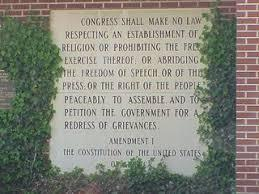
It's engraved in stone. The First Amendment, at the entrance to the Bremen Public Library in Bremen, Indiana. The Bremen Public Library serves the citizens of German Township in Marshall County, Indiana. Photo from Bremen Library.

It’s engraved in stone. The First Amendment, at the entrance to the Bremen Public Library in Bremen, Indiana. The Bremen Public Library serves the citizens of German Township in Marshall County, Indiana. Photo from Bremen Library.


President Clinton directed the Secretary of Education and the Attorney General to inform  each school district in America about the law on religious freedom in public schools.  This was the law in 2000 when Clinton left office, and it still is the law.  This statement is still accurate. [And if that site stays weird or doesn’t work for you, check it out here at the 5th Circuit U.S. Court of Appeals.]

UNITED STATES DEPARTMENT OF EDUCATION
THE SECRETARY


“…Schools do more than train children’s minds. They also help to nurture their souls by reinforcing the values they learn at home and in their communities. I believe that one of the best ways we can help out schools to do this is by supporting students’ rights to voluntarily practice their religious beliefs, including prayer in schools…. For more than 200 years, the First Amendment has protected our religious freedom and allowed many faiths to flourish in our homes, in our work place and in our schools. Clearly understood and sensibly applied, it works.”

President Clinton
May 30, 1998


Dear American Educator,

Almost three years ago, President Clinton directed me, as U.S. Secretary of Education, in consultation with the Attorney General, to provide every public school district in America with a statement of principles addressing the extent to which religious expression and activity are permitted in our public schools. In accordance with the President’s directive, I sent every school superintendent in the country guidelines on Religious Expression in Public Schools in August of 1995.

The purpose of promulgating these presidential guidelines was to end much of the confusion regarding religious expression in our nation’s public schools that had developed over more than thirty years since the U.S. Supreme Court decision in 1962 regarding state sponsored school prayer. I believe that these guidelines have helped school officials, teachers, students and parents find a new common ground on the important issue of religious freedom consistent with constitutional requirements.

In July of 1996, for example, the Saint Louis School Board adopted a district wide policy using these guidelines. While the school district had previously allowed certain religious activities, it had never spelled them out before, resulting in a lawsuit over the right of a student to pray before lunch in the cafeteria. The creation of a clearly defined policy using the guidelines allowed the school board and the family of the student to arrive at a mutually satisfactory settlement.

In a case decided last year in a United States District Court in Alabama, (Chandler v. James) involving student initiated prayer at school related events, the court instructed the DeKalb County School District to maintain for circulation in the library of each school a copy of the presidential guidelines.

The great advantage of the presidential guidelines, however, is that they allow school districts to avoid contentious disputes by developing a common understanding among students, teachers, parents and the broader community that the First Amendment does in fact provide ample room for religious expression by students while at the same time maintaining freedom from government sponsored religion.

The development and use of these presidential guidelines were not and are not isolated activities. Rather, these guidelines are part of an ongoing and growing effort by educators and America’s religious community to find a new common ground. In April of 1995, for example, thirty-five religious groups issued “Religion in the Public Schools: A Joint Statement of Current Law” that the Department drew from in developing its own guidelines. Following the release of the presidential guidelines, the National PTA and the Freedom Forum jointly published in 1996 “A Parent’s Guide to Religion in the Public Schools” which put the guidelines into an easily understandable question and answer format.

In the last two years, I have held three religious-education summits to inform faith communities and educators about the guidelines and to encourage continued dialogue and cooperation within constitutional limits. Many religious communities have contacted local schools and school systems to offer their assistance because of the clarity provided by the guidelines. The United Methodist Church has provided reading tutors to many schools, and Hadassah and the Women’s League for Conservative Judaism have both been extremely active in providing local schools with support for summer reading programs.

The guidelines we are releasing today are the same as originally issued in 1995, except that changes have been made in the sections on religious excusals and student garb to reflect the Supreme Court decision in Boerne v. Flores declaring the Religious Freedom Restoration Act unconstitutional as applied to actions of state and local governments.

These guidelines continue to reflect two basic and equally important obligations imposed on public school officials by the First Amendment. First, schools may not forbid students acting on their own from expressing their personal religious views or beliefs solely because they are of a religious nature. Schools may not discriminate against private religious expression by students, but must instead give students the same right to engage in religious activity and discussion as they have to engage in other comparable activity. Generally, this means that students may pray in a nondisruptive manner during the school day when they are not engaged in school activities and instruction, subject to the same rules of order that apply to other student speech.

At the same time, schools may not endorse religious activity or doctrine, nor may they coerce participation in religious activity. Among other things, of course, school administrators and teachers may not organize or encourage prayer exercises in the classroom. Teachers, coaches and other school officials who act as advisors to student groups must remain mindful that they cannot engage in or lead the religious activities of students.

And the right of religious expression in school does not include the right to have a “captive audience” listen, or to compel other students to participate. School officials should not permit student religious speech to turn into religious harassment aimed at a student or a small group of students. Students do not have the right to make repeated invitations to other students to participate in religious activity in the face of a request to stop.

The statement of principles set forth below derives from the First Amendment. Implementation of these principles, of course, will depend on specific factual contexts and will require careful consideration in particular cases.

In issuing these revised guidelines I encourage every school district to make sure that principals, teachers, students and parents are familiar with their content. To that end I offer three suggestions:

First, school districts should use these guidelines to revise or develop their own district wide policy regarding religious expression. In developing such a policy, school officials can engage parents, teachers, the various faith communities and the broader community in a positive dialogue to define a common ground that gives all parties the assurance that when questions do arise regarding religious expression the community is well prepared to apply these guidelines to specific cases. The Davis County School District in Farmington, Utah,is an example of a school district that has taken the affirmative step of developing such a policy.

At a time of increasing religious diversity in our country such a proactive step can help school districts create a framework of civility that reaffirms and strengthens the community consensus regarding religious liberty. School districts that do not make the effort to develop their own policy may find themselves unprepared for the intensity of the debate that can engage a community when positions harden around a live controversy involving religious expression in public schools.

Second, I encourage principals and administrators to take the additional step of making sure that teachers, so often on the front line of any dispute regarding religious expression, are fully informed about the guidelines. The Gwinnett County School system in Georgia, for example, begins every school year with workshops for teachers that include the distribution of these presidential guidelines. Our nation’s schools of education can also do their part by ensuring that prospective teachers are knowledgeable about religious expression in the classroom.

Third, I encourage schools to actively take steps to inform parents and students about religious expression in school using these guidelines. The Carter County School District in Elizabethton, Tennessee, included the subject of religious expression in a character education program that it developed in the fall of 1997. This effort included sending home to every parent a copy of the “Parent’s Guide to Religion in the Public Schools.”

Help is available for those school districts that seek to develop policies on religious expression. I have enclosed a list of associations and groups that can provide information to school districts and parents who seek to learn more about religious expression in our nation’s public schools.

In addition, citizens can turn to the U.S. Department of Education web site (http://www.ed.gov) for information about the guidelines and other activities of the Department that support the growing effort of educators and religious communities to support the education of our nation’s children.

Finally, I encourage teachers and principals to see the First Amendment as something more than a piece of dry, old parchment locked away in the national attic gathering dust. It is a vital living principle, a call to action, and a demand that each generation reaffirm its connection to the basic idea that is America — that we are a free people who protect our freedoms by respecting the freedom of others who differ from us.

Our history as a nation reflects the history of the Puritan, the Quaker, the Baptist, the Catholic, the Jew and many others fleeing persecution to find religious freedom in America. The United States remains the most successful experiment in religious freedom that the world has ever known because the First Amendment uniquely balances freedom of private religious belief and expression with freedom from state-imposed religious expression.

Public schools can neither foster religion nor preclude it. Our public schools must treat religion with fairness and respect and vigorously protect religious expression as well as the freedom of conscience of all other students. In so doing our public schools reaffirm the First Amendment and enrich the lives of their students.

I encourage you to share this information widely and in the most appropriate manner with your school community. Please accept my sincere thanks for your continuing work on behalf of all of America’s children.

Sincerely,


Richard W. Riley
U.S. Secretary of Education


RELIGIOUS EXPRESSION IN PUBLIC SCHOOLS

Student prayer and religious discussion: The Establishment Clause of the First Amendment does not prohibit purely private religious speech by students. Students therefore have the same right to engage in individual or group prayer and religious discussion during the school day as they do to engage in other comparable activity. For example, students may read their Bibles or other scriptures, say grace before meals, and pray before tests to the same extent they may engage in comparable nondisruptive activities. Local school authorities possess substantial discretion to impose rules of order and other pedagogical restrictions on student activities, but they may not structure or administer such rules to discriminate against religious activity or speech.

Generally, students may pray in a nondisruptive manner when not engaged in school activities or instruction, and subject to the rules that normally pertain in the applicable setting. Specifically, students in informal settings, such as cafeterias and hallways, may pray and discuss their religious views with each other, subject to the same rules of order as apply to other student activities and speech. Students may also speak to, and attempt to persuade, their peers about religious topics just as they do with regard to political topics. School officials, however, should intercede to stop student speech that constitutes harassment aimed at a student or a group of students.

Students may also participate in before or after school events with religious content, such as “see you at the flag pole” gatherings, on the same terms as they may participate in other noncurriculum activities on school premises. School officials may neither discourage nor encourage participation in such an event.

The right to engage in voluntary prayer or religious discussion free from discrimination does not include the right to have a captive audience listen, or to compel other students to participate. Teachers and school administrators should ensure that no student is in any way coerced to participate in religious activity.

Graduation prayer and baccalaureates: Under current Supreme Court decisions, school officials may not mandate or organize prayer at graduation, nor organize religious baccalaureate ceremonies. If a school generally opens its facilities to private groups, it must make its facilities available on the same terms to organizers of privately sponsored religious baccalaureate services. A school may not extend preferential treatment to baccalaureate ceremonies and may in some instances be obliged to disclaim official endorsement of such ceremonies.

Official neutrality regarding religious activity: Teachers and school administrators, when acting in those capacities, are representatives of the state and are prohibited by the establishment clause from soliciting or encouraging religious activity, and from participating in such activity with students. Teachers and administrators also are prohibited from discouraging activity because of its religious content, and from soliciting or encouraging antireligious activity.

Teaching about religion: Public schools may not provide religious instruction, but they may teach about religion, including the Bible or other scripture: the history of religion, comparative religion, the Bible (or other scripture)-as-literature, and the role of religion in the history of the United States and other countries all are permissible public school subjects. Similarly, it is permissible to consider religious influences on art, music, literature, and social studies. Although public schools may teach about religious holidays, including their religious aspects, and may celebrate the secular aspects of holidays, schools may not observe holidays as religious events or promote such observance by students.

Student assignments: Students may express their beliefs about religion in the form of homework, artwork, and other written and oral assignments free of discrimination based on the religious content of their submissions. Such home and classroom work should be judged by ordinary academic standards of substance and relevance, and against other legitimate pedagogical concerns identified by the school.

Religious literature: Students have a right to distribute religious literature to their schoolmates on the same terms as they are permitted to distribute other literature that is unrelated to school curriculum or activities. Schools may impose the same reasonable time, place, and manner or other constitutional restrictions on distribution of religious literature as they do on nonschool literature generally, but they may not single out religious literature for special regulation.

Religious excusals: Subject to applicable State laws, schools enjoy substantial discretion to excuse individual students from lessons that are objectionable to the student or the students’ parents on religious or other conscientious grounds. However, students generally do not have a Federal right to be excused from lessons that may be inconsistent with their religious beliefs or practices. School officials may neither encourage nor discourage students from availing themselves of an excusal option.

Released time: Subject to applicable State laws, schools have the discretion to dismiss students to off-premises religious instruction, provided that schools do not encourage or discourage participation or penalize those who do not attend. Schools may not allow religious instruction by outsiders on school premises during the school day.

Teaching values: Though schools must be neutral with respect to religion, they may play an active role with respect to teaching civic values and virtue, and the moral code that holds us together as a community. The fact that some of these values are held also by religions does not make it unlawful to teach them in school.

Student garb: Schools enjoy substantial discretion in adopting policies relating to student dress and school uniforms. Students generally have no Federal right to be exempted from religiously-neutral and generally applicable school dress rules based on their religious beliefs or practices; however, schools may not single out religious attire in general, or attire of a particular religion, for prohibition or regulation. Students may display religious messages on items of clothing to the same extent that they are permitted to display other comparable messages. Religious messages may not be singled out for suppression, but rather are subject to the same rules as generally apply to comparable messages.

THE EQUAL ACCESS ACT

The Equal Access Act is designed to ensure that, consistent with the First Amendment, student religious activities are accorded the same access to public school facilities as are student secular activities. Based on decisions of the Federal courts, as well as its interpretations of the Act, the Department of Justice has advised that the Act should be interpreted as providing, among other things, that:

General provisions: Student religious groups at public secondary schools have the same right of access to school facilities as is enjoyed by other comparable student groups. Under the Equal Access Act, a school receiving Federal funds that allows one or more student noncurriculum-related clubs to meet on its premises during noninstructional time may not refuse access to student religious groups.

Prayer services and worship exercises covered: A meeting, as defined and protected by the Equal Access Act, may include a prayer service, Bible reading, or other worship exercise.

Equal access to means of publicizing meetings: A school receiving Federal funds must allow student groups meeting under the Act to use the school media — including the public address system, the school newspaper, and the school bulletin board — to announce their meetings on the same terms as other noncurriculum-related student groups are allowed to use the school media. Any policy concerning the use of school media must be applied to all noncurriculum-related student groups in a nondiscriminatory matter. Schools, however, may inform students that certain groups are not school sponsored.

Lunch-time and recess covered: A school creates a limited open forum under the Equal Access Act, triggering equal access rights for religious groups, when it allows students to meet during their lunch periods or other noninstructional time during the school day, as well as when it allows students to meet before and after the school day.

Revised May 1998


List of organizations that can answer questions on religious expression in public schools

Religious Action Center of Reform Judaism
Name: Rabbi David Saperstein
Address: 2027 Massachusetts Ave., NW, Washington, DC 20036
Phone: (202) 387-2800
Fax: (202) 667-9070
Web site: http://www.rj.org/rac/
American Association of School Administrators
Name: Andrew Rotherham
Address: 1801 N. Moore St., Arlington, VA 22209
Phone: (703) 528-0700
Fax: (703) 528-2146
Web site: http://www.aasa.org
American Jewish Congress
Name: Marc Stern
Address: 15 East 84th Street, New York, NY 10028
Phone: (212) 360-1545
Fax: (212) 861-7056
National PTA
Name: Maribeth Oakes
Address: 1090 Vermont Ave., NW, Suite 1200, Washington, DC 20005
Phone: (202) 289-6790
Fax: (202) 289-6791
Web site: http://www.pta.org
Christian Legal Society
Name: Steven McFarland
Address: 4208 Evergreen Lane, #222, Annandale, VA 22003
Phone: (703) 642-1070
Fax: (703) 642-1075
Web site: http://www.clsnet.com
National Association of Evangelicals
Name: Forest Montgomery
Address: 1023 15th Street, NW #500, Washington, DC 20005
Phone: (202) 789-1011
Fax: (202) 842-0392
Web site: http://www.nae.net
National School Boards Association
Name: Laurie Westley
Address: 1680 Duke Street, Alexandria, VA 22314
Phone: (703) 838-6703
Fax: (703) 548-5613
Web site: http://www.nsba.org
Freedom Forum
Name: Charles Haynes
Address: 1101 Wilson Blvd, Arlington, VA 22209
Phone: (703) 528-0800
Fax: (703) 284-2879
Web site: http://www.freedomforum.org

-###-


Can “Pepper-spraying cop” use copyright to stop the use of his image?

November 22, 2011

Just looking at a few of the dozens of parodies that make use of the photographic image of the cop at UC-Davis with the pepper spray can.

What if he, or UC-Davis, wanted to slow down the parodies, to catch their breath?  Could he, or the university, copyright the image and enforce copyright?  Do such over-the-top and often abusive parodies fall within the parody rules?

What say you, legal beagles?  What say you, anyone?

Pepper Spray Cop and Edvard Munch's "The Scream"

One of the least offensive parodies using the cop's image.