Kids Bill of Rights

November 18, 2011

Kids write and sing about the Bill of Rights — captured on video by the folks at EmergentOrder.com (the producers of the second Keynes/Hayek video).

How close to right are they?  Can you use this in class?

Can your kids improve on this, or do something like it?


Scalia and Thomas: Neither is Caesar’s wife

November 18, 2011

It sure looks like a breach of ethics, but James Oliphant writes in the Los Angeles Times that there is no formal rule prohibiting a sitting Supreme Court justice from hobnobbing with a law firm set to argue a gargantuan case in a few months.

The day the Supreme Court gathered behind closed doors to consider the politically divisive question of whether it would hear a challenge to President Obama’s healthcare law, two of its justices, Antonin Scalia and Clarence Thomas, were feted at a dinner sponsored by the law firm that will argue the case before the high court.

The occasion was last Thursday, when all nine justices met for a conference to pore over the petitions for review. One of the cases at issue was a suit brought by 26 states challenging the sweeping healthcare overhaul passed by Congress last year, a law that has been a rallying cry for conservative activists nationwide.

The justices agreed to hear the suit; indeed, a landmark 5 1/2-hour argument is expected in March, and the outcome is likely to further roil the 2012 presidential race, which will be in full swing by the time the court’s decision is released.

The lawyer who will stand before the court and argue that the law should be thrown out is likely to be Paul Clement, who served as U.S. solicitor general during the George W. Bush administration.

Clement’s law firm, Bancroft PLLC, was one of almost two dozen firms that helped sponsor the annual dinner of the Federalist Society, a longstanding group dedicated to advocating conservative legal principles. Another firm that sponsored the dinner, Jones Day, represents one of the trade associations that challenged the law, the National Federation of Independent Business.

Another sponsor was pharmaceutical giant Pfizer Inc, which has an enormous financial stake in the outcome of the litigation. The dinner was held at a Washington hotel hours after the court’s conference over the case. In attendance was, among others, Mitch McConnell, the Senate’s top Republican and an avowed opponent of the healthcare law.

The featured guests at the dinner? Scalia and Thomas.

One wishes for some of the usual journalistic “balancing,” with someone to note who among the crowd represents the opposite side in the case, and someone else to note that the dinner had a lot of other sponsors.  But one might get uneasy thinking that the usual journalistic balancing can’t be mustered here, and that Scalia and Thomas just don’t care about appearances of ethical violations, if they can get away with it.

Lower court judges have clear ethical guidance on the issue, counseling against such appearances:

It’s nothing new: The two justices have been attending Federalist Society events for years. And it’s nothing that runs afoul of ethics rules. In fact, justices are exempt from the Code of Conduct that governs the actions of lower federal judges.

If they were, they arguably fell under code’s Canon 4C, which states,A judge may attend fund-raising events of law-related and other organizations although the judge may not be a speaker, a guest of honor, or featured on the program of such an event.“

Those rules do not apply to the nine people who sit on the nation’s highest court.

In those few times I lunched with Thomas and worked with him, when he staffed environmental issues for Indiana’s Missouri’s Sen. John Danforth, I found him an agreeable lunch companion and smart, but a great idealogue.  Had I known then what we all know now, I would have paid closer attention, asked different and sharper  questions, and kept notes.  And I might have dropped a few hints about history, and Caesar’s wife.  Supreme Court justices should consider themselves wedded to the American republic, and act accordingly.

What do you think, Dear Reader?  Was this a violation of ethics, even if not required by the rules that apply to Supreme Court justices?


“It Takes Balls To Execute An Innocent Man”

August 4, 2011

Occasionally I stumble into a discussion of whether anywhere in the U.S. a government may have executed an innocent person.  Generally I note the horrible Texas case in which Texas fought for years for the point that a convicted murderer whose three allowed appeals had been exhausted should not be allowed to reopen his case simply because new evidence of his innocence had emerged.  In Herrera v. Collins (506 US 390, 1993), Texas won the right to not allow evidence of innocence to get a review of the case, and the man was executed.

Ladies and gentlemen I ask you:  Why would a state fight for the right to execute an innocent man, to the Supreme Court, if it did not intend to use that right?

The question rises more frequently these days as Texas Gov. Rick Perry steams toward announcing he will run for the presidency.

I point out that Herrera came down nearly eight years before Perry stumbled into the governor’s chair, his having been standing outside the door as Lieutenant Governor when George W. Bush persuaded the Supreme Court — most of the same justices — to stop both the popular vote and change the electoral vote to give him the presidency.  So we can’t blame that one on Perry.

But we can blame the execution of Todd Willingham on Rick Perry, even understanding that he was relying on what he assumed to be good evidence in his naturally uncurious waltz of destruction across Texas.   Perry could claim he got bad advice.  Though Texas’s governer really has little more than ceremonial power and some appointments, for someone like Perry it is a big job he can barely handle.  People would cut him slack on letting an innocent man die, convicted of a capital crime that as the evidence showed at the time probably did not occur, if he’d just confess it.

Instead, Perry engaged in a four-year campaign to cover up the affair — a cover up that is so far successful.

Jonathan Chait blogging at New Republic cites Politico and The New Yorker on the way to painting all Texans as morally bankrupt for allowing the coverup to go on — justifiably, I think.  While the newspapers cover the story, outrage does not rise from the drought-stricken populace.  New Republic’s blog explained the cover-up, and Texas’s blase attitude:

Alexander Burns and Maggie Haberman have a story for Politico about Rick Perry’s limitations as a general election candidate. It’s a really excellent piece on its own terms, but at the same time, it’s a bit of a parody of a Politico story in that it takes a vital moral question, drains it of all its moral significance, and presents it in purely electoral terms. The thesis of the piece is that Perry appeals to very conservative white southerners, but not to anybody else, making him a questionable choice to head the Republican ticket. The piece bears out that thesis pretty well. In the middle it includes a glancing reference to one episode of Perry’s gubernatorial tenure:

Perry would also have to answer for parts of his record that have either never been fully scrutinized in Texas, or that might be far more problematic before a national audience.

Veterans of Sen. Kay Bailey Hutchison’s unsuccessful 2010 primary challenge to Perry recalled being stunned at the way attacks bounced off the governor in a strongly conservative state gripped by tea party fever. Multiple former Hutchison advisers recalled asking a focus group about the charge that Perry may have presided over the execution of an innocent man – Cameron Todd Willingham – and got this response from a primary voter: “It takes balls to execute an innocent man.”

The Willingham case is just one episode in Perry’s gubernatorial tenure that could be revived against him in the very different context of a national race, potentially compromising him in a general election.

If you’re not familiar with this episode, David Grann wrote about in for the New Yorker in 2009 in what may be the single greatest piece of journalism I have ever read in my life. (I am biased, as David is a friend and former colleague.) The upshot is that Perry is essentially an accessory to murder. He executed an innocent man, displaying zero interest in the man’s innocence. When a commission subsequently investigated the episode, Perry fired its members.

I’m a Texan, and I’m appalled.  Dear Reader, what can a Texan do?  Please advise.

Surely the rest of America would be concerned and shocked, no?  We can excuse goofs in the histories of our presidential candidates.  Especially since Nixon, we should be doubly wary of those who work hard to cover up their errors, rather than learn from them.

By the way, in the latest action, the office of the Texas Attorney General issued a report on the duties of the commission established to investigate Texas justice to make it more fair — the commission whose members Perry fired when they got close to the Willingham case.  The report says that that Willingham case is water under the bridge, that the commission may not investigatet cases that predate the commission’s creation.

It’s a gross miscarriage of justice, and an attack on the democratic form of government which relies very much on continuous improvement of governmental processes, especially the due processes of criminal justice.


That flag you flew yesterday — want to burn it today?

July 5, 2011

Some of the more astute students in our high school classes ask questions about everything.  For example, they ask:  “What does the Pledge of Allegiance mean, when it says, ‘ . . . and to the Republic for which it stands?'”

Is the Pledge all that important?  Is the flag all that important?

Maybe.  How would you answer that question, really?

Penn and Teller offer a demonstration:

What do you think?  Did they burn a flag?  Should that sort of performance be legal?

What if Penn and Teller burned a flag in the White House?

An exercise in ambiguity:  A fictional drama about a sleight of hand, illusionary performance.  (Best line:  The answer to the question, “Did you go to law school?”  For the record, yes, I did go to law school.  I’m an amateur clown.)

Did you fly your  flag yesterday?


Little Rock’s Central High School, monument for civil rights

July 1, 2011

On the way out of Little Rock, Arkansas, after our day at the William Jefferson Clinton Presidential Library and Museum, we stopped at the Little Rock Central High School National Historic Site.

Little Rock Central High School in 2011, photo by Ed Darrell - use permitted with attribution

Little Rock Central High School in 2011, photo by Ed Darrell - use permitted with attribution

In 1957 nine African American kids tried to enroll at the school, breaking high school segregation in Little Rock.  After assuring President Dwight Eisenhower that the Arkansas National Guard would preserve the peace, Gov. Orval Faubus ordered the Guard to keep the students out.  Eisenhower called up the Guard to federal duty, and sent in the 101st Airborne from the regular U.S. Army to enforce the desegregation rules.  (Imagine any president doing that today!)

Pre-Art Deco front of Little Rock Central High School, built in 1927 - photo 2011 by Ed Darrell, use permitted with attribution

Pre-Art Deco front of Little Rock Central High School, built in 1927

Eventually Little Rock closed down all the schools for more than a year, and then federal courts ordered the schools opened, but desegregated.  One black student graduated that first year, Ernest Green.  The other eight all graduated, but from other schools around the world.

Today, it’s history, even in Little Rock.

Little Rock Central High remains in use today.  The National Park Service maintains a visitor center across the intersection from the school, with the old Magnolia Oil gas station, restored, on another corner, and a monument to the Little Rock Nine and civil rights on the remaining corner  (Magnolia Oil was absorbed into Mobil, which took on Magnolia’s flying horse emblem).  Our Dallas Independent School District, Teaching American History Grant group visited in mid-June.  Classes were out.   The visitor center remains open year around.

I was particularly curious to see whether and how the historical events, and the commemoration of them, affect the school itself.
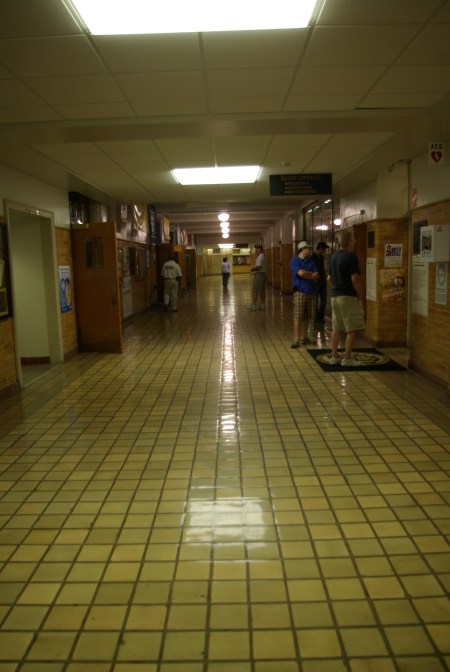
Hallway inside Little Rock Central High School, photo by Ed Darrell, use permitted with attribution

The hallway outside the auditorium on the main floor of Little Rock Central High School.

On the inside, it’s a normal American high school — though in a grand building (I’d compare this to Ogden, Utah’s Ogden High School, a WPA-style project of a decade later’s construction, and a grand old building students and citizens have come to love).

Walls bear posters from student clubs.  Signs direct students to classes, or the auditorium, or the lunchroom.  The office looks more like the 1970s than the 1930s — I suspect it has been updated.  Ceilings have been redone since 1927, with newer fluorescent lighting and acoustic ceiling tiles, which only brings the architecture of 1927 down to 1970s box-style building standards.

Sign announcing a club meeting, Little Rock Central High School, 2011 - photo by Ed Darrell, use permitted with attribution

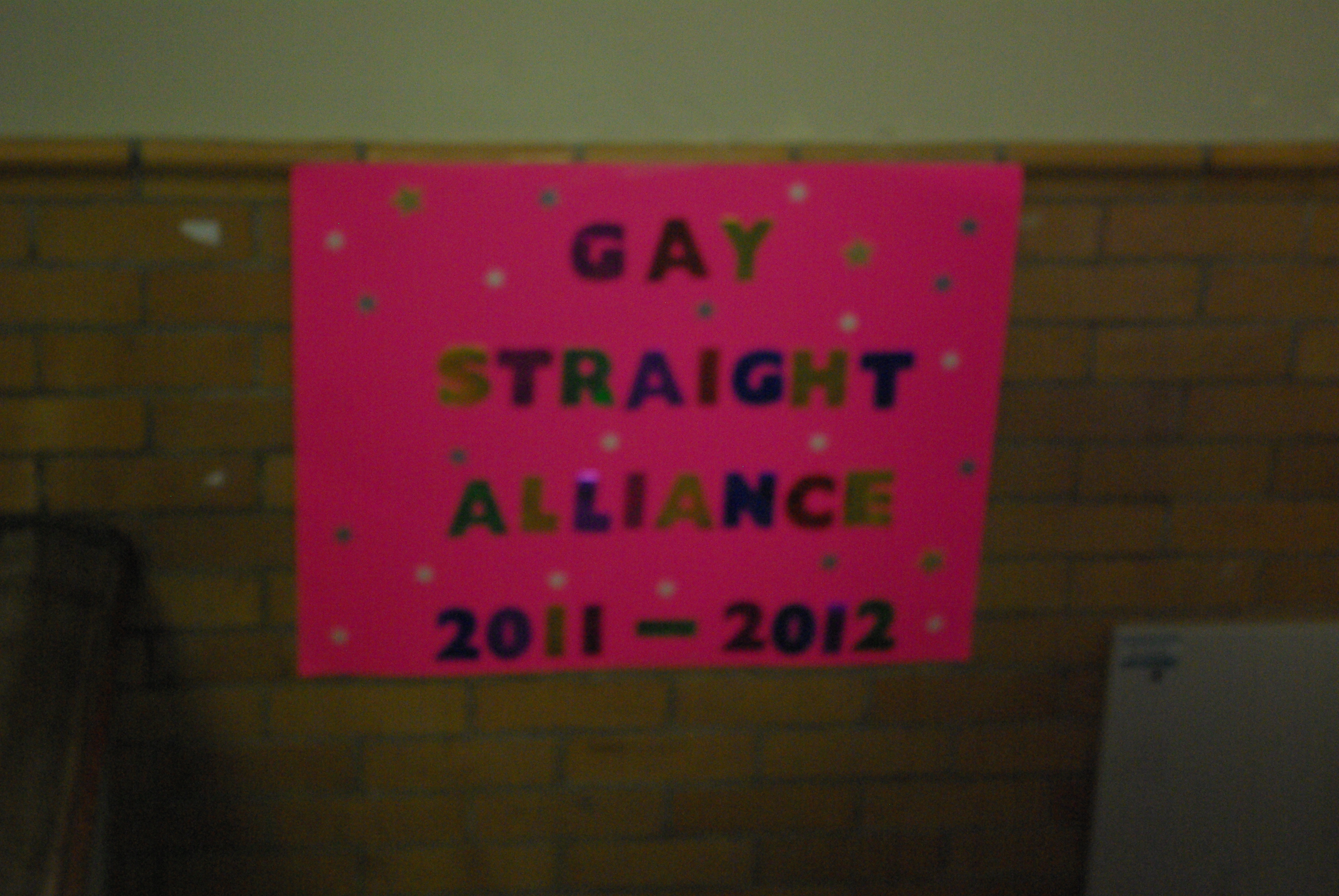
Walls of Little Rock Central carry notices of club meetings, much as in 1957. Some of the clubs have changed; the Gay-Straight Alliance probably was not active in LIttle Rock in 1957. Changes in U.S. culture in the 54 years since the Little Rock Nine, are reflected in the citizens and their actions, and not necessarily in the physical buildings.

It’s a working school, and not a monument on a pedestal frozen in time in any sense.

The school opened 30 years before it became an icon in the struggle for civil rights.   It is a massive structure, intended perhaps as a sort of monument to Little Rock and to Education.  NPS describes it at their website:

Built in 1927 as Little Rock Senior High School, Central was named “America’s Most Beautiful High School” by the American Institute of Architects.

Designed as a mix of Art Deco and Collegiate Gothic architectural styles, the building is two city blocks long and includes 150,000 square feet of floor space. More than 36 million pounds of concrete and 370 tons of steel went into the building’s construction. It cost $1.5 million to construct in 1927. The school received extensive publicity upon its opening. An article in the Arkansas Gazette said, “we have hundreds of journalists in our fair city for the dedication” of the new high school.

At its construction, Central’s auditorium seated 2,000 people and included a 60 x 160 ft. stage that doubled as the gymnasium. A new library was built in 1969 and named for longtime principal Jess W. Matthews.  In 1953 the school’s name was changed to Little Rock Central High School, in anticipation of construction of a new high school for white students, Hall High School in Pulaski Heights.

Computer classroom at Little Rock Central High, June 2011 - photo by Ed Darrell; use premitted with attribution

Computer classroom at Little Rock Central High - Historic preservation cannot prevent the updating of classroom technology. Wiring these classroomms for computer networks must be quite difficult.

I thought it interesting that the original construction did not include a library.  The auditorium’s doubling as a basketball gymnasium explains the massive stage — suitable for Las Vegas, really.  “Multi-purpose” building for schools originated much earlier than the 1970s as I had imagined.  The 1927 plans included neither the tendency to overbuild fschools for athletics, nor today’s pre-occupation with making schools appear as academic enclaves.

Visiting the site you can learn that the $1.5 million cost consumed the entire building budget for the district in 1927.  In keeping with the separate but equal doctrine of the times (see Plessy v. Ferguson), the Little Rock district “planned” to build a high school for blacks at the same time.  No money remained for either design or construction.

City leaders — I would imagine black city leaders, without much help from whites, but I may be too cynical — raised money to pay the same architects to create a complementary design for the school that would be called Dunbar.  Private funding paid for construction, too.  Exactly this sort of discrimination against blacks roiled across America from 1896 into the 1950s — only 16 states banned discrimination by race, with laws that were not always enforced.  These issues were key to several of the cases rolled into the Supreme Court appeal that we usually call simply The Brown Decision — facilities were involved in the cases in Topeka, Kansas, Prince Edward County, Virginia, Delaware, and Washington, D.C.

Looking at Little Rock Central High School today one can see the physical manifestation of the insidious separate but equal doctrine, and understand perhaps why it collided with the drive for rights in Little Rock, at the corner of 14th Street and South Park Street.  The school’s address is listed as 1500 South Park.  14th Street, running along the north edge of campus, has been renamed Daisy L. Gatson Bates Drive, in honor of the NAACP organizer who provided wise counsel, sage advice, a ride to school on most mornings and friendship to the students who made up the Little Rock Nine.

A large amount of history resides in Little Rock.

Ha! — You don’t need to rely on my photos at all.  Turns out NPS has a photo slide show at their website.  Note how my ideas paralleled theirs — and honest, I didn’t see that before our tour.  Actually, the auditorium curtains were closed, nor did we get into the balcony — the photo from NPS is much better than any I got.

Nota bene: The intense, three-year program of study of U.S. history for this three dozen or so teachers is made possible by a grant from the U.S. Department of Education, a Teaching American History Grant.  Such grants fund the study of American history for teachers across the nation, to spur better teaching from greater understanding and knowledge of history.  These grants generally float at the top of the pool of programs to be cut first when the budget axes fall.  We are grateful to the Department of Education.  And while my writings here do not necessarily reflect the views of any of my employers, past or present, they should — and the Senate, Department of Education and others in the stream of funding would be well-advised to continue these grants.


UFOs? Obama-ordered news blackouts? No: Brain failures

June 28, 2011

Come on, you can figure out how this applies to those stories about Obama’s secret orders — or more accurately, the lack of those orders.  From Neil deGrasse Tyson and the argument from ignorance, presented at St. Petersburg College, Florida, 2007:

Tip of the old scrub brush to Neil deGrasse Tyson, and his Tweet.


Anniversary of the Magna Carta, 1215

June 15, 2011

On June 15, 1215, King John affixed his seal to the Magna Carta, in a ceremony at Runnymede, England.

An encore post:

Runnymede, Magna Carta Isle, photo by Wyrdlight, Antony McCallum, 2008 (Wikimedia)

What event critical to western history and the development of the democratic republic in the U.S. happened here in 1215?

A teacher might use some of these photos explaining the steps to the Constitution, in English law and the heritage of U.S. laws. Other than the Magna Carta, all the events of Runnymede get overlooked in American studies of history. Antony McCallum, working under the name Wyrdlight, took these stunning shots of this historic meadow. (He photographs stuff for studies of history, it appears.)

Maybe it’s a geography story.

View of Runnymede Meadow from Engham Village -- Wyrdlight photo through Wikimedia

View of Runnymede Meadow from Engham Village — Wyrdlight photo through Wikimedia

Several monuments to different events of the past millennium populate the site. The American Bar Association dedicated a memorial to the Magna Carta there — a small thing open to the air, but with a beautiful ceiling that is probably worth the trip to see it once you get to England.

Wikipedia explains briefly, with a note that the ABA plans to meet there again in 2015, the 800th anniversary of the Great Charter:

Magna Carta Memorial


The Magna Carta Memorial & view towards the ‘medes’


Engraved stone recalling the 1985 ABA visit

Situated in a grassed enclosure on the lower slopes of Cooper’s Hill, this memorial is of a domed classical style, containing a pillar of English granite on which is inscribed “To commemorate Magna Carta, symbol of Freedom Under Law”. The memorial was created by the American Bar Association to a design by Sir Edward Maufe R.A., and was unveiled on 18 July 1957 at a ceremony attended by American and English lawyers.[5]

Since 1957 representatives of the ABA have visited and rededicated the Memorial renewing pledges to the Great Charter. In 1971 and 1985 commemorative stones were placed on the Memorial plinth. In July 2000 the ABA came:

to celebrate Magna Carta, foundation of the rule of law for ages past and for the new millennium.

In 2007 on its 50th anniversary the ABA again visited Runnymede and during the convention installed as President Charles Rhyne who devised Law Day which seeks in the USA an annual reaffirmation of faith in the forces of law for peace.

The ABA will be meeting at Runnymede in 2015 on the 800th anniversary of the sealing of the original charter.

The Magna Carta Memorial is administered by the Magna Carta Trust, which is chaired by the Master of the Rolls.[10]

In 2008, flood lights were installed to light the memorial at night, but due to vandalism they now lie smashed.

I’ll wager the lights get fixed before 2015.


Detail of the Magna Carta monument at Runnymed...

Detail of the Magna Carta monument at Runnymede. I took this photo some time in the early Eighties. (Photo credit: Wikipedia)


Detail of ceiling of the Magna Carta Memorial detailing play of light, and star pattern, Runnymede – Wikimedia image

More, resources:

Also on June 15:


Sowell wrong about DDT and Rachel Carson

May 16, 2011

Thomas Sowell bolloxed it up at National Review Online:

Who blames Rachel Carson, an environmentalist icon, because her crusading writings against DDT led to the ban of this insecticide in countries around the world — followed by a resurgence of malaria that killed, and continues to kill, millions of people in tropical Third World countries?

To which I responded:

Rachel Carson Homestead painting of Ms. Carson: Rachel Carson, a child of the Allegheny Valley, was a writer and an ecologist. There have been great writers whose descriptions of natural history and stories of the natural world charm and delight readers; and there have been scientists whose work excites the public attention. Rachel Carson rises to a heroic stature because her conscience called for action, not only words. (Painting by Minette Bickel)

Rachel Carson Homestead painting of Ms. Carson: “Rachel Carson, a child of the Allegheny Valley, was a writer and an ecologist. There have been great writers whose descriptions of natural history and stories of the natural world charm and delight readers; and there have been scientists whose work excites the public attention. Rachel Carson rises to a heroic stature because her conscience called for action, not only words.” (Painting by Minette Bickel)

Who blames Rachel Carson?

Only someone ignorant of malaria and DDT, or someone with a real political axe to grind.

Malaria did not “resurge” when DDT was banned on cotton crops in the U.S.  The U.S. ban did not extend to Africa, and DDT has never been banned in Africa nor most of Asia.

Malaria deaths have declined steadily over the past 50 years, generally as DDT use was reduced.  In 1959 and 1960, the peak years of DDT use, 4 million people died from malaria, worldwide.  WHO cut back on DDT use in 1965 when mosquitoes began showing serious resistance and immunity to the stuff, but by 1972, when the U.S. banned agricultural use of DDT (but continued exports), about 2 million people died annually from malaria.

Today, largely without DDT, malaria deaths are down to under 900,000 — a 75% reduction in deaths from peak DDT use.

Instead, since 2000 we’ve been using integrated vector management (IVM) to hold mosquito populations down, and we’ve been using improved medical care to treat humans who have malaria.  IVM and beefed up medical care was what Rachel Carson recommended in her book, Silent Spring, in 1962.

So, there is no cause-effect relationship between Ms. Carson and the U.S. ban on DDT, nor between that ban and malaria deaths.  In fact, there are fewer malaria deaths now than when DDT was used irresponsibly.

Carson was right.  It’s a good thing wise people listened to her.

More information?  See Millard Fillmore’s Bathtub:
https://timpanogos.wordpress.com/ddt-chronicles-at-millard-fillmores-bathtub/

Who knows what comments see the light of day over there?

How many times will conservative commentators of all stripes abuse the DDT/Rachel Carson story before they start getting it right?  How much does that skew their views from the accurate and wise view?


Green Hell? Milloy slanders Ruckelshaus as “mass murderer”

March 10, 2011

This week, EPA bashing took front and center on the performance stage that passes as Congress these days.  There is a school of thought that thinks EPA should be eviscerated because EPA is carrying out the mandate an earlier Congress gave it, to clean up the air.  Especially, the recent assailants claim, EPA should not try to reduce carbon emissions, because clean air might cost something.

Steven Milloy, making stuff up and passing it as fact

Steven Milloy, who makes crude and false claims against William Ruckelshaus, a great lawyer and the hero of the Saturday Night Massacre. Why does Milloy carry such a pathetic grudge?

Wholly apart from the merits, or great lack of merits to those arguments, the anti-EPA crowd is just ugly.

78-year-old William Ruckelshaus, the Hero of the Saturday Night Massacre, a distinguished lawyer and businessman, and the founding Director of EPA who was called back to clean it up after the Reagan administration scandals, granted an interview on EPA bashing to Remapping Debate, an ambitious, independent blog from the Columbia School of Journalism designed to provide information essential to policy debates that too-often gets overlooked or buried.  [Remapping Debate sent a note that they are not affiliated with CSJ; my apologies for the error.]

Ruckelshaus, as always, gave gentlemanly answers to questions about playing politics with science, and bashing good, honest and diligent government workers as a method of political discourse.

Steven Milloy, one of the great carbuncles on the face of climate debate or any science issue, assaulted Ruckelshaus at Milloy’s angry, bitter blog, Green Hell.  Milloy calls Ruckelshaus “a mass-murderer,” a clear invitation for someone to attack the man. Milloy wrote, cravenly:

He’s the 20th century’s only mass murderer to survive and thrive (as a venture capitalist) in the 21st century.

Milloy owes Ruckelshaus an apology and a complete retraction.  I rather hope Ruckelshaus sues — while Milloy will claim the standards under New York Times vs. Sullivan as a defense, because Ruckelshaus is a public figure, I think the only question a jury would have to deal with is how much malice aforethought Milloy exhibits.  Malice is obvious.  Heck, there might not even be a question for a jury — Milloy loses on the law (nothing he claims against Ruckelshaus is accurate or true in any way).

This is much more damning than what got two NPR officials to lose their jobs.

Who will stand up for justice here?  Rep. Upton?  Rep. Boehner?  Anthony Watts?

I tried to offer a correction, and since then have written Milloy demanding an apology and retraction — neither comment has surfaced yet on Milloy’s blog.  Here’s the truth Milloy hasn’t printed:

No, Sweeney did not rule that DDT is not a threat to the environment. He said quite the opposite. Sweeney wrote, in his ruling:

20. DDT can have a deleterious effect on freshwater fish and estuarine organisms when directly applied to the water.

21. DDT is used as a rodenticide. [DDT was used to kill bats in homes and office buildings; this was so effective that, coupled with accidental dosing of bats from their eating insects carrying DDT, it actually threatened to wipe out some species of bat in the southwest U.S.]

22. DDT can have an adverse effect on beneficial animals.

23. DDT is concentrated in organisms and can be transferred through food chains.

On that basis, two federal courts ruled that DDT must be taken off the market completely. Sweeney agreed with the findings of the courts precisely, but he determined that the law did not give him the power to order DDT off the market since the newly-proposed labels of the DDT manufacturers restricted use to emergency health-related tasks. With the benefit of rereading the two federal courts’ decisions, Ruckelshaus noted that the courts said the power was already in the old law, and definitely in the new law. [See, for example, EDF v. Ruckelshaus, 439 F. 2d 584 (1971)]

DDT was banned from use on crops in the U.S. as an ecosystem killer. It still is an ecosystem killer, and it still deserves to be banned.

Ruckelshaus’s order never traveled outside the U.S. DDT has never been banned in most nations of the world, and even though DDT has earned a place on the list of Dirty Dozen most dangerous pollutants, even under the Persistent Organic Pollutants Treaty of 2001, DDT is available for use to any country who wishes to use it.

Please get your facts straight.

Would you, Dear Reader,  help spread the word on Facebook, Reddit, Twitter, or any other service you have, that the Brown Lobby has gone too far in it’s error-based propaganda against clean air and those who urge a better environment?  Please?


Bull baiting bill not appearing ready, Utah legislator proposes for killing horses instead

January 20, 2011

You couldn’t make this stuff up, and if you did, you should see a therapist.

As the Utah 2011 legislative session gets underway, state Rep. Curt Oda wasted no time in introducing a bill that reflects his legislative priority. He is not using his position as a legislator, however, to try to create jobs, improve schools, or protect children, for example. Instead, his bill, H.B. 210,  encourages the torture and killing of animals.

Oda wants to amend the state’s animal cruelty law, Section 76-9-301, to exempt “pests” and “feral” animals from the definition of animal. This means that to the extent they were protected, these animals would no longer be protected by the state’s animal cruelty law. Oda is reported to have told a local newspaper that “feral” animals and “pests” could be shot with a bow and arrow, for example, decapitated or clubbed to death.

Why kill horses with such brutality?  Dog fighting and cock fighting clearly wouldn’t fly?  Bear baiting won’t work — not enough bears?  Surely there are more humane ways to deal with “pest” animals.


A real missed anniversary: Death of Hiram Walker, defendant in the case of Rose 2d of Aberlone

January 16, 2011

Another missed anniversary on January 12.

Detroit grocer Hiram Walker, founder of St. Mary's Church

Detroit grocer Hiram Walker, defendant in the case of Rose 2d of Aberlone, Sherwood v. Walker; it is one of the most famous contracts cases in American law. No photo of the cow was found.

Hiram Walker — yes, that Hiram Walker — died on January 12, 1899.  He was a Detroit grocer, and distiller, but dabbled in a lot of businesses.  Among those dabbles:  Land and cattle.

Every law student knows about Walkers dealing in one particular cow:  Rose 2d of Aberlone.

In addition to these notable accomplishments, Mr. Walker was also a cattle breeder and was party to a famous contracts case known as “The Pregnant-Cow Case.” (33 N.W. 919 (Mich. 1887).) According to the majority opinion, Walker agreed with Theodore Sherwood, a banker, to sell him a cow of distinguished ancestry known as “Rose 2d of Aberlone”. The price was $80, both parties believing Rose to be sterile. When Walker discovered that she was pregnant and worth between $750 and $1,000, he refused to deliver her. Sherwood sued and prevailed in the trial court, but lost on appeal. This case illustrates the contract law rules of rescission of contract by mutual mistake. Because both parties believed they were contracting for a sterile cow, there was a mutual mistake of fact, and therefore ground for rescission. However, the dissent in the case, written by Justice Sherwood, notes that Sherwood believed that Rose “might be made to breed” and purchased her on that chance.

Mutual mistake.  Rescission.  What law student doesn’t cram that case before the final?

Sherwood v. Walker 33 N.W. 919 (Mich. 1887).  The Pregnant Cow Case. (Short version here.  Is a full-text version available on-line for free?  History of the case from the Michigan Courts History site, here.) Fans of the Coen brothers’ True Grit may want to note it was a case in replevin.

No, the case did not settle the issues of replevin nor rescission.  We’re talking law, not the movies. “Thus and such is the law, except sometimes,” as our

When can a person get out of a contract?  When both parties are mistaken about key properties of the object of the contract, one party can back out.

The Michigan Supreme Court held that a party who has given apparent consent to a contract of sale may refuse to execute it, or may void it after it has been completed if the consent was founded, or the contract made, upon the mistake of a material fact—such as the subject matter of the sale, the price, or some collateral fact materially inducing the agreement—and this can be done when the mistake is mutual. Where the item actually delivered or received is different in substance from the thing bargained for and intended to be sold, there is no contract. However, if it is only a difference in some quality or accident, even though the mistake may have been the actuating motive to the purchaser or seller, or both, the contract remains binding. Where a cow was contracted to be sold upon the understanding of both parties that she was barren and useless for breeding purposes, and it appeared that such was not the case, the vendors had a right to rescind the contract, and refuse to deliver the property. The Cow Case has since received attention as, literally, a textbook example of contract law issues.  (Wallace D. Riley, President, Michigan Supreme Court Society)

Hiram Anderson, the defendant in Sherwood v. Walker, died 112 years ago, January 12.

The contract controversy rages on.

Comedians should be able to find many straight lines in that history.

More:


How to find “separation of church and state” in the Constitution

December 27, 2010

It’s been at least 20 years since I first heard the old canard of an argument that “there’s no separation of church and state in the Constitution.”  I think I first heard it attributed to David Barton, which would make sense, since he doesn’t understand the Constitution, but neither does he fear sharing his misunderstandings.

It was an incorrect statement then, and it’s been incorrect since September 1787.  Separation of state and church is woven throughout the Constitution, part of the warp and woof.

Recently, latter-day Constitution ignorami repeat the old canard.

Toles cartoon on dangers of marrying church and state

Toles cartoon on dangers of marrying church and state

I was surprised to discover I’ve not posted this before on this blog.  So here’s a slightly-edited version of a response I gave many months ago to someone who made that silly claim, a basic description that I developed years ago to explain the issue, in speeches by members of the Senate Subcommittee on the Constitution:

Separation of church and state: It’s in the Constitution.

I don’t play a constitutional lawyer on television, I am one*, but it seems to me anyone can read the Constitution and see. One can see especially if one understands that the Constitution sets up a limited government, as Madison described, one that can do only what is delegated to it. The Constitution is a short document.

Where should you look to find separation of church and state in the Constitution?

First, look in the Preamble.  It is made clear that the document is a compact between citizens: “We the people . . . do ordain and establish this Constitution . . .” The usual role of God ordaining (in some western nations) is altered, intentionally. It is not God who establishes this government, but you and I, together. From the first words of the Constitution, there is separation of church and state.  The power of our government grows out of a secular compact between you and me, and 308 million other residents of the nation.   We have a government created by consent of the governed, as the Declaration of Independence said a just government should be.  It is not a government created by the will of God directly (though some, including the Mormons, argue it is divinely inspired).  We have no divine right kings or other monarchs under the Constitution.  The government is not the grantor of rights from God, but is instead the protector of the rights of citizens, whatever the source of the rights and whatever the rights.

Second, look in the key parts of the document itself.  Start with Article 1 The legislative branch is given no role in religion; neither is any religion given any role in the legislature. In Article 2, the executive branch gets no role in religion, and religion gets no role in the executive branch. In Article 3, the judicial branch gets no role in religion, and religion gets no role in the judicial branch. In Article 4, the people get a guarantee of a republican form of government in the states, but the states get no role in religion, and religion gets no role in state government. This is, by design of the founders, a perfect separation of church and state.

Third, in Article 6, the convention wrote the hard and fast rule that no religious test can be used for any office in government, federal, state or local, means that no official will have a formal, governmental role in religion, and no religion can insist on a role in any official’s duties.

Fourth, Amendment 1 closes the door to weasling around it: Congress is prohibited from even considering any legislation that might grant a new bureaucracy or a new power to get around the other bans on state and church marriage, plus the peoples’ rights in religion are enumerated.

Fifth: In 1801 the Baptists (!) in Danbury, Connecticut, grew concerned that Connecticut would act to infringe on their church services, or teachings, or right to exist. So they wrote to President Jefferson. Jefferson responded with an official declaration of government policy on what the First Amendment and Constitution mean in such cases. Jefferson carefully constructed the form of the device as well as the content with his Attorney General, Levi Lincoln, to be sure that it would state what the law was. This “letter” is the proclamation. It’s an official statement of the U.S. government, collected in the president’s official papers and not in his personal papers. Make no mistake: Jefferson’s letter to the Danbury Baptists was an official act, an official statement of the law of the United States. Jefferson intended it to assuage the Baptists in Danbury, to inform and warn the Connecticut legislatures, and to be a touchstone to which future Americans could turn for information. It was only fitting and proper for the Supreme Court to use the letter in this capacity as it has done several times.

Sixth: The phrase, “separation of church and state” dates back another 100 years and more, to the founding of Rhode Island. It is the religion/state facet of the idea of government by consent of the governed without interference from religious entities, expressed so well in the Mayflower Compact, in the first paragraphs of the Declaration of Independence, and carried through in the Constitution (see especially the Preamble, above).

No, the phrase “separation of church and state” never appears in the Constitution. The principles of separation of church and state are part of the warp and woof, and history, of the document, however. The law is clear, the law was clear, the law has always been clear, and denying the Constitution says what it says, won’t change it or make it go away.  You could just as easily point out that the word “democracy” or “democratic” never appears in the document, though we rely on democratic mechanisms and institutions to make it work.  You could point out that nowhere does it say that our national government is a republic, though it is.  The Constitution doesn’t say “checks and balances,” nor does it say “federalism.”  The Constitution doesn’t mention political parties.  The Constitution was written before the advent of broadcasting, and makes no mention of radio nor television, nor of the internet — but the First Amendment freedoms apply there anyway.  The Constitution doesn’t say “privacy,” though it protects your right to privacy.

You won’t find “separation of church and state” as a phrase in the Constitution.  If you read it, you’ll find that the concept of the separation of state and church can’t be taken out of the document, either — it’s a fundamental principle of our government.

More, and Resources:

__________

*  A non-practicing one.  We have way more than 50,000 lawyers in Texas.  That’s enough trouble for one lifetime.  Someone has to look out for the welfare of the world.


Lens incompetence: Watts Up looks through the wrong end of the telescope

December 27, 2010

The wags and denialists over at Anthony Watts’ joint are up to their old tricks, accusing others of their own errors.  Today it’s a guest post by Bernie Lewin, in which he claims that climate warming was all psychological, a “scare”:

Yet we can find precedents to this science-base scare in many health scares of recent decades, and also in environmental scares since the DDT cancer scare triggered by Silent Spring, politicised by the EDF and legalized by the newly formed EPA. (See Scared to Death which finds a repeating pattern to these science-based scares.)

Woman looking through the wrong end of a telescope

This woman might be corrected; global warming denialists will staunchly insist she knows what she’s doing and doesn’t need YOUR advice.

He fails to even think that Rachel Carson was right.  Lewin demonstrates incompetence at history, law and science, and the first point of the Scout Law, all in one sentence.

So much error.  So little time to correct.

  1. Carson didn’t claim DDT caused cancer. She noted that we create thousands of chemicals that may cause cancer, that cancers were rising in frequency, and that there was no testing of the new substances prior to their marketing.   Was there a DDT/cancer scare?  Lewin doesn’t offer any evidence.  (We had to correct Matt Ridley on this a couple of weeks ago — see his post here.)
  2. EDF (Environmental Defense Fund, now known as Environmental Defense) was on DDT without Carson — suing to stop DDT spraying (for no good reason) on Long Island in 1968.  EDF relied on science that was courtroom ready.  (I had misremembered the year of EDF’s suit in an earlier version of this post; my apologies to the two or three who may have read it.)  EDF’s suits established, on the basis of science, that DDT is an uncontrollable poison in the wild.  Lewin ignores science and law in his off-hand indictment of Carson’s book and ED.
  3. EPA didn’t act against DDT until 1972.  EPA banned DDT use on agricultural crops in the U.S. because DDT kills non-target species and, basically, entire ecosystems.  EPA was specific:  The ban had nothing to do with cancer.  Once again, Lewin ignores history, science and law.

So, in Lewin’s guest post, we see the pattern that continues at Watts’s place — unfair and wrong indictments of science, ignorance of history, little understanding of law.

All while trying to mock scientists:  ‘Of course scientists are almost always wrong,’ Watts’s blog argues, once again.

Watts won’t let me correct his errors there, even though he’s still coddling those who misdescribe Rachel Carson as a mass murderer, while denying he does it himself.  Consequently his readers won’t be alerted to this post because Watts or his minions will edit out the automatic ping his blog gets that this post is here.  Propaganda promoting falsehood can’t stand the sunlight of fact and truth.

Just because there’s a scare doesn’t mean there’s not a reason to be scared.  DDT is a deadly toxin, so long-lived that it almost cannot ever be eradicated from the environment.  It kills everything small, quickly, unless so much of it is used that the small things evolve quickly to be resistant and immune to it.

So, if we are to assume, as Lewin wrote, that the anti-warming bunch is to warming what the campaign against Rachel Carson by the DDT manufacturers was to DDT’s harms, we get a hint of what’s really up at Watts Up:  Any anti-warming claim is a hoax.  Why put it so cryptically, if that’s what they meant to say?

When Lewin looks at the history of DDT and Rachel Carson, he’s looking at the false history, and he draws the wrong conclusions.  Should we trust a guy so sloppy with the facts to be right on anything else?


Best law firm holiday card, from Manatt, Phelps & Phillips, LLP

December 20, 2010

Forget the imaginary War on Christmas and all the Fa-la-olderal surrounding that fight.What about the greeting from your company’s law firm? I understand this card, from Manatt, Phelps & Phillips, won the Wall Street Journal’s designation as best law firm card of 2010. Yes?

Apologies — it will play when you open the thing — I’ve put it below the fold so you don’t get surprised.

Read the rest of this entry »


Quote of the moment: 1971, U.S. Court of Appeals for the District of Columbia orders a review of the safety of DDT

November 23, 2010

Excerpted from ENVIRONMENTAL DEFENSE FUND, INCORPORATED et al., Petitioners, v. William D. RUCKELSHAUS, Administrator of the Environmental Protection Agency & Environmental Protection Agency, Respondents, Izaak Walton League of America, Montrose Chemical Corporation of California, State of New York, Intervenors, 439 F.2d 584 (1971); Chief Judge David L. Bazelon wrote the decision.

This is a petition for review of an order of the Secretary of Agriculture,1 refusing to suspend the federal registration of the pesticide DDT or to commence the formal administrative procedures that could terminate that registration.

Born in Wisconsin, David L. Bazelon grew up in Chicago and practiced law there. In 1949, President Truman named him to the United States Court of Appeals for the District of Columbia Circuit, often described as the country's most influential court, next to the Supreme Court. At 40, he was the youngest judge ever appointed to that court. From 1962-1978 he served as chief judge, retiring in 1986 as a senior judge.

*      *      *      *      *

We conclude that the order was based on an incorrect interpretation of the controlling statute, and accordingly remand the case for further proceedings.  In this case the Secretary has made a number of findings with respect to DDT. On the basis of the available scientific evidence he has concluded that (1) DDT in large doses has produced cancer in test animals and various injuries in man, but in small doses its effect on man is unknown; (2) DDT is toxic to certain birds, bees, and fish, but there is no evidence of harm to the vast majority of species of nontarget organisms; (3) DDT has important beneficial uses in connection with disease control and protection of various crops. These and other findings led the Secretary to conclude ‘that the use of DDT should continue to be reduced in an orderly, practicable manner which will not deprive mankind of uses which are essential to the public health and welfare. To this end there should be continuation of the comprehensive study of essentiality of particular uses and evaluations of potential substitutes.’38

There is no reason, however, for that study to be conducted outside the procedures provided by statute. The Secretary may, of course, conduct a reasonable preliminary investigation before taking action under the statute. Indeed, the statute expressly authorizes him to consult a scientific advisory committee, apart from the committee that may be appointed after the issuance of a cancellation notice.39 But when, as in this case, he reaches the conclusion that there is a substantial question about the safety of a registered item, he is obliged to initiate the statutory procedure that results in referring the matter first to a scientific advisory committee and then to a public hearing. We recognize, of course, that one important function of that procedure is to afford the registrant an opportunity to challenge the initial decision of the Secretary. But the hearing, in particular, serves other functions as well. Public hearings bring the public into the decision-making process, and create a record that facilitates judicial review.40 If hearings are held only after the Secretary is convinced beyond a doubt that cancellation is necessary, then they will be held too seldom and too late in the process to serve either of those functions effectively.

The Secretary’s statement in this case makes it plain that he found a substantial question concerning the safety of DDT, which in his view warranted further study. Since we have concluded that that is the standard for the issuance of cancellation notices under the FIFRA, the case must be remanded to the Secretary with instructions to issue notices with respect to the remaining uses of DDT, and thereby commence the administrative process.

*        *        *        *        *

We stand on the threshold of a new era in the history of the long and fruitful collaboration of administrative agencies and reviewing courts. For many years, courts have treated administrative policy decisions with great deference, confining judicial attention primarily to matters of procedure.48 On matters of substance, the courts regularly upheld agency action, with a nod in the direction of the ‘substantial evidence’ test,49 and a bow to the mysteries of administrative expertise.50 Courts occasionally asserted, but less often exercised, the power to set aside agency action on the ground that an impermissible factor had entered into the decision, or a crucial factor had not been considered. Gradually, however, that power has come into more frequent use, and with it, the requirement that administrators articulate the factors on which they base their decisions.51

Strict adherence to that requirement is especially important now that the character of administrative litigation is changing. As a result of expanding doctrines of standing and reviewability,52 and new statutory causes of action,53 courts are increasingly asked to review administrative action that touches on fundamental personal interests in life, health, and liberty. These interests have always had a special claim to judicial protection, in comparison with the economic interests at stake in a ratemaking or licensing proceeding.

To protect these interests from administrative arbitrariness, it is necessary, but not sufficient, to insist on strict judicial scrutiny of administrative action. For judicial review alone can correct only the most egregious abuses. Judicial review must operate to ensure that the administrative process itself will confine and control the exercise of discretion.54 Courts should require administrative officers to articulate the standards and principles that govern their discretionary decisions in as much detail as possible.55 Rules and regulations should be freely formulated by administrators, and revised when necessary.56 Discretionary decisions should more often be supported with findings of fact and reasoned opinions.57 When administrators provide a framework for principled decision-making, the result will be to diminish the importance of judicial review by enhancing the integrity of the administrative process, and to improve the quality of judicial review in those cases where judicial review is sought.

Remanded for further proceedings consistent with this opinion.

(President Nixon’s Secretary of Agriculture Clifford M. Hardin reviewed DDT regulations and decided no further action was required — since 1958, USDA had been reducing and eliminating DDT from use on USDA lands, as was the Department of the Interior.  Environmental Defense Fund sued, arguing more action should have been required.  In a complex decision, the U.S. Court of Appeals for the District of Columbia ordered more study of the issue.  By the time of the decision, the Environmental Protection Agency (EPA) had been established, and EPA Director William D. Ruckelshaus took Hardin’s place as defendant, with EPA assuming USDA’s position as defendant agency.  EPA’s review resulted in a ban on use of DDT on crops in the U.S.)

Some historians and many critics of EPA’s decision to ban DDT from agricultural use in the U.S. fail to acknowledge the importance of this ruling.  Judge Bazelon said that great caution alone is not sufficient on the part of administrators, and he ordered that the evidence against DDT be placed on the public record for public scrutiny.  “Public scrutiny” in this case would mean analysis by scientists, pesticide manufacturers, farming and farm support organizations, health workers, policy makers, and reporters.

On one hand, this decision tends to favor DDT advocates.  Judge Bazelon said the administrator in charge of carrying out FIFRA, the Federal Insecticide, Fungicide and Rodenticide Act, must give advocates of DDT the basis for the ruling: “On the basis of the available scientific evidence he has concluded that (1) DDT in large doses has produced cancer in test animals and various injuries in man, but in small doses its effect on man is unknown; (2) DDT is toxic to certain birds, bees, and fish, but there is no evidence of harm to the vast majority of species of nontarget organisms; (3) DDT has important beneficial uses in connection with disease control and protection of various crops.”

On the other hand, Bazelon’s order means that the significant harms of DDT must  be spelled out in public — so that the administrator’s ruling can be contested if it does not do what FIFRA requires.  In other places in the decision, Judge Bazelon notes that Congress had required, through FIFRA, that a pesticide determined to be uncontrollably dangerous must be taken off the market, under the justification that it was “mislabeled.”  Lower courts had already made that determination on DDT.  Bazelon’s order set the stage to require the administrator to ban DDT as a matter of law — the administrator being  the Secretary of Agriculture originally, or the Director of EPA under the reorganization of the government that created EPA .

Critics of William Ruckelshaus’s decision to ban DDT miss this point of the law.  Under the findings of the nearly year-long hearing in EPA’s administrative law courts, DDT was found to be an uncontrollable poison in the wild.  FIFRA required such a pesticide to have its registration cancelled, with very little wiggle room to make a case for any continued use of the stuff.  Ruckelshaus’s action stopped the immediate shutdown of DDT manufacturing in the U.S.   This proved to be a mixed benefit decision.  While the U.S. benefited financially from export of DDT, that the U.S. exported a chemical banned for most uses inside the U.S. proved to be a sore point in foreign relations with other nations; also most of the manufacturing sites were highly contaminated, so much so that the manufacturers declared bankruptcy rather than stick around to clean them up under the rules of the Superfund which took effect in 1984.  Taxpayer dollars now pay for massive cleanup operations of DDT manufacturing sites in California, Michigan, and Alabama, and other places.