Caption from Tropas de Ulramar: Re-enactors dressed as participants in the Battle of Medina fire a musket volley during a ceremony on Saturday, Aug. 20, 2011, commemorating the 198th anniversary of the Battle of Medina. The event was sponsored by the Texas Society – Sons of the American Revolution. The Battle of Medina was fought on Aug. 18, 1813, when a Spanish army, attempting to win Texas from the Republican Army of the North, which was supported by the United States and included veterans of the American Revolution, won a battle fought south of San Antonio near Espey. It is thought that about 800 Republicans died in the battle. [Other estimates put the death toll on the Texas side at 1,500] Photo: BILLY CALZADA
The long drive for Texas independence from Mexico may be more clearly seen in the light of the continents-long struggles for independence that included not only the American Revolution, but also revolutions in the nations of Haiti, Mexico, Chiapas, and others across Central America and South America. The Battle of Medina was a part of that earlier history. Fought on August 18, 1813, it was more deadly than any other battle in the wars for Texas independence, it is linked to Mexico’s long history of struggle. It occurred in the same year that Haiti got independence, and in the middle of the War of 1812, which helps to obscure the history of the battle.
Chapman’s report said:
“Contrary to popular belief, the struggle for democracy in Texas did not begin with the Anglo-led revolution of 1835-36,” author and historian James Haley wrote in a recent Austin American-Statesman article. “In fact, the yearning for liberty had its own ongoing legacy in Latin America.
“As early as 1810, movements for independence began simultaneously in Venezuela and Argentina. It was also in 1810, on Sept. 16, that the Mexican priest Father Miguel Hidalgo y Costilla raised his famous grito, the cry for social justice that opened the Mexican campaign for independence, a date now celebrated as Diez y Seis.”
America was drawn into that campaign when it funded a small force under the control of Bernardo Gutierrez de Lara, one of Father Hidalgo’s emissaries. A former Army officer, Augustus Magee, went along with the expedition to offer military advice. The Gutierrez-Magee Expedition, also called the Green Flag Rebellion because of its banner, soon captured Nacogdoches. All went well for the expedition — too well — and Texas independence was quickly claimed. Spain took immediate measures to quell the insurrection.
It ended at the Battle of Medina, “the biggest, bloodiest battle ever fought on Texas soil,” a South Texas historian says.
Spanish forces slaughtered more than 1,000 of the rebels, perhaps as many as 1,500. The battle methods, and total extirpation of the losing forces, would recur in the Texas Revolution.
Fewer than 100 republic troops survived the battle, Thonhoff said. Those not killed in the battle were later chased down and executed. Retaliation went on for days. Royalist forces swept into San Antonio and took revenge on anyone they suspected of aiding the rebel forces. One of the royalist officers was a young Lt. Antonio Lopez de Santa Anna.
The bodies of soldiers killed in battle were left where they fell. It would be nine years before their bones were gathered and buried in a communal grave.
This story should translate well to the Texas-required 7th-grade history course. Here is a cause — the archaeological excavation and historical marking of the battlefield itself — which lends itself well to getting students to write letters to state legislators and state education authorities. Here is news of an archaeological site that could provide work for a generation of diggers, and experience for countless school kids taken on tour. And the story of the battle is one of those relatively unknown gems that excite students who realize, after they discover it, that they know something that most others do not know.
Medina Battle -State of Texas historic marker Near Leming, Texas. Wikipedia image
As well, this should be supplement to world history courses, which in my experience too often overlook the independence wars and successes in Central and South America. The article mentions independence movements in Argentina and Venezuela. The United States fought Britain in the War of 1812, which was the western fallout of England’s simultaneous war with Napoleon (who was on the road to getting his comeuppance in Russia). Haiti’s drive for independence from France racked that Caribbean nation. A mapping exercise showing the various independence movements occurring between 1800 and 1826 provides links to parts of the narrative of American nations’ independence that often gets overlooked.
The battle also ties together several otherwise loose threads in the Texas history curriculum.
The Gutierrez-McGee Expedition falls into that time period and that type of movement to steal Texas known as the filibusters.
The treachery of the Green Flag Rebels in executing the Spanish officers in San Antonio after the Spanish had surrendered raises issues of ethics in battle that are rich for discussion.
Incompetence with which the Texian forces were led into the battle, missing completely the feint the Spanish troops made until they were already into a classic battle trap, is another place to emphasize the importance of having good leaders especially in rebellion (this will become clear to students, perhaps, when they study the events of 1775 and 1776 and Washington’s leadership, in the 8th grade curriculum in Texas).
Santa Anna’s presence as a young officer at the Battle of Medina suggests that he got the idea of “no quarter” early in his career; see how the tactic plays out 23 years later at the Battle of the Alamo, the Battle of Coleto, Goliad, and the Battle of San Jacinto, with an older Santa Anna in command.
In the context of Texas’ becoming a “majority-minority” state with a very large population with historical ties to Mexico, the Battle of Medina deserves greater consideration in Texas history curricula.
Partly due to the brutality of the Spanish victors to the survivors, wounded and dead, the battlefield itself was not cleaned up for years — bodies lay across a wide area. Medina was a touchy point, a point of embarrassment perhaps to local Mexicans and Texians, a loyalty test for the Spanish rulers. So the battle site was ignored and hushed up. 200 years later, we don’t know the exact site of the battle. A lot of work remains to be done, exploration of archives in Spain, Mexico and Texas, exploration of map collections, archaeological and paleontological work on the suspected sites of the battle. But every year this work remains undone, the story becomes that much more difficult to find. It is unlikely we’ll ever know all that we probably should about the Battle of Medina.
For teachers and parents, Patrick M. Reynolds cartoons of Texas history were staples in the Dallas Morning News for years. His treatment of the Green Flag Republic, the Gutierrez-McGee Expedition, and the Battle of Medina are really among the best available for the junior high/middle school audience. You can buy the books directly from Reynolds’ Red Rose Studios; alas, I don’t have handy a key to which volumes of these graphic history books hold which stories. Reynolds has a compilation of all of the stories, however, in a slightly smaller format than the others, such as shown at Amazon.com.
Do not confuse this Texas battle with the Battle of Medina Rioseco, an 1808 battle between Napoleon’s forces and the Spanish Guerrillas, in the Peninsular Campaign; different continent
Spread the word; friends don't allow friends to repeat history.
August 15, 1945, was VJ Day — the day that World War II ended in the Pacific Theatre. VJ is an acronym for Victory Japan. Victory in Europe, VE Day, was declared the previous April.
VJ Day is affiliated with a series of images that students of U.S. history should recognize; these images tell much of the story of the day and the events of the weeks leading up to it.
The most famous image is Alfred Eisenstadt’s photograph of an exuberant sailor kissing a swept-off-her-feet- for-the-moment nurse in Times Square, New York City. This is one of the most famous photographs from the most famous photographer from Life Magazine:
The Smack Seen ‘Round the World, photo by Alfred Eisenstadt, Life Magazine, August 15, 1945
Eisenstadt coolly titled his photo “VJ Day, Times Square.” It came to be known as The Smack Seen ‘Round the World. It was fitting that the photo would be taken by Eisenstadt, since his work came to be a symbol of Henry Luce’s Life Magazine in a pre-television era when photography magazines like Life and Look were key news organs for the nation.
Before the victory celebration, there had to be a victory. Japan asked for conditional surrender discussions, but the Allied forces insisted on unconditional surrender. Japanese military officials were rather certain that, if the Soviet Union entered the Pacific War, Allied victory would be assured. Japan hoped to either get a conditional surrender agreement, according to some sources, or inflict heavy losses on Allied forces to get better surrender conditions, but before Russia entered the war. Russia and Japan had long-standing grudges against one another dating from before their earlier war in the first decade of the 20th century.
Mural in the Adams Building of the Library of Congress,m with Thomas Jefferson’s views on education, and education’s importance to liberty. (Click for larger version)
Under the standards for social studies the Texas State Board of Education promulgates, Texas high school kids must learn to read charts and extract information from them.
In the criticism of the small-school curriculum planning system, CSCOPE, conservative critics demonstrate both that they are not as smart as a Texas high school kid, OR they don’t know feces in economics.
Note the chart; it’s a fuzzy picture, but it shows an arrow indicating which economic systems have more government involvement, or control, or “interference” in Texas conservative talk; and note the comments:
So, in other words, the conservatives worry because a chart shows that socialism and communism have “more government control and planning,” and the conservatives come unglued. They read the chart incorrectly; generally conservatives can be counted on to favor less government control in economic matters, which this chart shows is a virtue of free market economics systems.
Let me repeat: They read the chart incorrectly.
Worse, there’s a guy who professes to teach economics in a California college who says he doesn’t teach this stuff.
.@gbmegafan Got a source for that pic? I teach economics — but not that kind 4 sure!
What do they want, what does he teach? That communism offers more economic freedom from government regulation than free enterprise?
Clearly they didn’t bother to read the chart. These critics are the epitome of knee-jerk reactionaries: If there is a word about something they don’t like, they assume the entire piece is tainted and biased against them. If you said, “We say the Pledge of Allegiance every day as a defense against communism,” they’d claim you’re teaching communism.
Yeah, I know: The chart could have been done differently. But this is EXACTLY the sort of stuff the Texas Education Agency favors on standardized tests students must pass to advance and graduate, to make sure students read the questions, and the charts.
Are you as smart as a Texas high school student? Then you’re smarter than the critics of CSCOPE, at least in this case.
CSCOPE Response to Lesson Regarding Economic Systems
CSCOPE strongly believes in the greatness of the free enterprise system and how it has helped build our country into the envy of all other nations. Free markets are a critical part of our American way of life. It is important to note that the activity in question is in a high school course and not in a grade 6 lesson. This twenty-minute activity is part of a six-day lesson on various economic systems at the high school level that are state required teaching standards set forth by the State Board of Education. The State Board of Education requires students to learn the following economic systems in World History:
WH.18: Economics. The student understands the historical origins of contemporary economic systems and the benefits of free enterprise in world history. The student is expected to:
WH.18A: Identify the historical origins and characteristics of the free enterprise system, including the contributions of Adam Smith, especially the influence of his ideas found in The Wealth of Nations.
WH.18B: Identify the historic origins and characteristics of communism, including the influences of Karl Marx.
WH.18C: Identify the historical origins and characteristics of socialism.
Furthermore, the State Board of Education establishes student expectations that focus on social studies skills. For the World History unit referenced above, the following social studies skills are included:
WH.30: Economics: The student communicates in written, oral, and visual forms. The student is expected to:
WH.30C: Interpret and create written, oral, and visual presentations of social studies information.
The goal of this activity is to address the content and skills standards that have been adopted by the State Board of Education, and it is absolutely not promoting a way of life contrary to what we value as Americans. In this activity, students examine four different flags, beginning with the US flag, and analyze the colors, the design, and the graphics as symbols of each country’s characteristics and economic systems. Students then design a flag to demonstrate their understanding of the characteristics of socialism, as the standard requires (WH.18C).
CSCOPE has a significant emphasis on the free enterprise system. The other economic systems are only addressed as required by State Board of Education. Additionally, every lesson and activity in our system is customizable. The teacher in the classroom is the final authority on whether or not the lesson should be customized for his or her students and community.
CSCOPE would also like to reassure parents and community members that there is a comparable activity in the lesson that focuses on free markets where students are asked to read about characteristics of free enterprise in The Wealth of Nations, complete an analysis chart, and discuss with their classmates the characteristics and benefits of the free enterprise system. In addition, in Texas History, World History, US History, and US Government courses, students are engaged extensively in studying the principles of the US free enterprise system and the role it plays in American society. Furthermore, Texas graduation requirements specify that students take an economics course, and this course focuses entirely on the American free market system.
CSCOPE staff takes great pride in helping educators teach the standards established by the State Board of Education. This dedicated staff works each day to ensure that teachers have the best resources available to help Texas school children succeed, and they continually focus on improving the system for the districts they serve. We are committed to helping every parent and community member better understand CSCOPE. Please contact CSCOPE through the http://www.cscope.us site if you have further questions or concerns.
One may wonder if the references to Adam Smith and Wealth of Nations threw the critics; more than once I’ve been confronted by a yahoo at a meeting in Texas who argues that we in the U.S. don’t need any foreign influences in our laws or economy, like that “socialist” Adam Smith! (To be fair, he published in England . . .)
The charges from “Sharon” can’t help but remind you of that famous political smear campaign against then-U.S. Sen. Claude Pepper, of Florida, in which his opponent called him “Red” Pepper, and accused him of ::GASP!!:: matriculating while a student in college — and not just matriculating, but matriculating in public!
Yes, this is an attempted political smear of CSCOPE, Texas teachers, and Texas education.
P.S.: I’d love to have a copy of that chart in a readable form; if you have access to the chart, especially to information that indicates where it really comes from (it looks like CSCOPE, but it’s fuzzy here), please send me a copy. Thanks.
In the American Film Institute‘s polling to find the greatest hero in the movies, Atticus Finch finished first. Interesting that a class from Arlington, Virginia’s Washington-Lee High School found one of the best venues anywhere to watch the film to study it.
TO KILL A MOCKINGBIRD ranks 25th on AFI’s 100 Years…100 Movies list of greatest American films, and AFI named Atticus Finch the greatest hero in this history of American film when it announced its AFI’s 100 Years…100 Heroes and Villains list in 2003. AFI also recognized the film for its #1 ranking of Best Courtroom Dramas in AFI’s 10 Top 10 list and its #2 ranking on AFI’s 100 Years…100 Cheers America’s Most Inspiring Films list, just behind IT’S A WONDERFUL LIFE. The film, which premiered in Los Angeles on Christmas day in 1962 and opened wide in 1963, was directed by Robert Mulligan and produced by Alan J. Pakula. [Screenplay was by the great Texas playwright Horton Foote.]
From the White House YouTube site:
President Obama hosted a film screening of To Kill a Mockingbird in the Family Theater at The White House to commemorate its 50th anniversary with guests including local students from Washington-Lee High School, Mary Badham Wilt, the actress who played Scout, and Veronique Peck, widow of Gregory Peck who played Atticus Finch. The President also acknowledged the American Film Institute for their commitment to the fine arts and NBC Universal and USA Network for their efforts to commemorate this important film.
What venues could one use in Dallas? Check with the Sixth Floor Museum, to see if their 7th floor facility is available. Check to see if there is a room available at the Earl Cabell Federal Building, or the George L. Allen Court building. The old, renovated Texas Theater on Jefferson Boulevard might cut a deal. Surely there is a room big enough at the Belo Mansion, the home of the Dallas Bar Association — if it’s not totally booked up for other events. With the Horton Foote connection, perhaps the Wyly Theater could find a rehearsal room to throw up a screen. Odds are pretty good you could get an attorney to come talk law and civil rights at any of those locations.
How could a teacher sneak a viewing of this movie into the curriculum? Isn’t it tragic that we have to sneak in great classics?
No television cameras. No professional photographers. An employee of American Airlines, Andres Otero, standing by, caught the event, probably with his phone camera.
Here’s the picture, published in the obscure Queens Gazette:
Congressional Medal of Honor Winner Rodolfo Hernandez received a salute from active duty military, as he boarded an American Airlines flight to Washington, D.C., for Medal of Honor Day, March 25. Photo by Andres Otero, American Airlines
California-native Corporal Rodolfo P. Hernandez served in the U.S. Army, and saw action in the Korean conflict. He and his unit came under attack near Wontong-ni, Korea, on May 31, 1951. Here’s the citation, from the Congressional Medal of Honor Society:
Cpl. Hernandez, a member of Company G, distinguished himself by conspicuous gallantry and intrepidity above and beyond the call of duty in action against the enemy. His platoon, in defensive positions on Hill 420, came under ruthless attack by a numerically superior and fanatical hostile force, accompanied by heavy artillery, mortar, and machine gun fire which inflicted numerous casualties on the platoon. His comrades were forced to withdraw due to lack of ammunition but Cpl. Hernandez, although wounded in an exchange of grenades, continued to deliver deadly fire into the ranks of the onrushing assailants until a ruptured cartridge rendered his rifle inoperative. Immediately leaving his position, Cpl. Hernandez rushed the enemy armed only with rifle and bayonet. Fearlessly engaging the foe, he killed 6 of the enemy before falling unconscious from grenade, bayonet, and bullet wounds but his heroic action momentarily halted the enemy advance and enabled his unit to counterattack and retake the lost ground. The indomitable fighting spirit, outstanding courage, and tenacious devotion to duty clearly demonstrated by Cpl. Hernandez reflect the highest credit upon himself, the infantry, and the U.S. Army.
Congressional Medal of Honor awardee Cpl. Rodolfo P. Hernandez - Congressional Medal of Honor Society image
Cpl. Hernandez received the Congressional Medal of Honor on April 21, 1962.
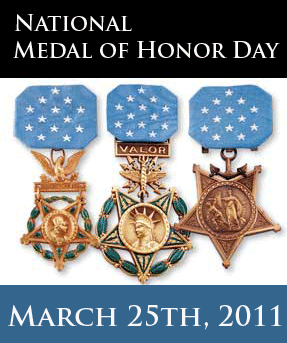
No, I had not heard of Medal of Honor Day, either.
Here are some details from MedalofHonorNews.com, so you can get a head start on next year’s observation:
National Medal of Honor Day is officially observed on March 25th. The Medal of Honor is the highest distinction that can be awarded by the President, in the name of the Congress, to members of the Armed Forces who have distinguished themselves conspicuously by gallantry and intrepidity at the risk of their lives above and beyond the call of duty.
“This holiday should be one of our most revered. Unfortunately all too many Americans are not even aware of its existence.” Home of Heroes
The date of March 25th was chosen because the first Medals of Honor were awarded to members of Andrew’s Raiders on March 25, 1863, for their actions during the “Great Locomotive Chase.”
“Hard times ask us to put a greater good before our own interests. It is sometimes physically or emotionally painful. Yet throughout history, you will find common men and women who fought selflessly in a variety of ways for something so much larger than just their own benefit.
Today, we’re fighting terrorism and the spread of tyranny. We’re challenged by market upheaval, joblessness and perhaps hunger. But the human spirit is resilient and can withstand more than sometimes we are able to immediately comprehend.
It’s up to each of us to not lay and wait for better days, but instead look for opportunities to make the lives of those around us better. National Medal of Honor Day is not a celebration. It is a solemn time to reflect on the freedom we enjoy, its price, and how our own bravery can improve the world around us.”
Home of Heroes, a premier resource of Medal of Honor information on the internet suggests:
“National Medal of Honor day is celebrated in some communities, however for the most part the occasion comes and goes with little notice. As a patriotic American there are a few things you can do to commemorate this day:
Fly your flag with pride and patriotism on this day.
Remember our heroes. As a gesture of your appreciation, why not take just a few moments in the week prior to National Medal of Honor Day to mail a “Thank You” card to one of our living Medal of Honor recipients. You can find a list of the living as well as information on writing to them among the pages of the Home of Heroes website or contact the Congressional Medal of Honor Society who will forward the letter to the Medal of Honor Recipient.
Inform your local media. Most newspapers aren’t even aware that this special day exists. Why not tip your local media to the occasion. Before you do, check out the Home of Heroes database for Medal of Honor recipients from your city and state as well as any who might be buried in your city. This information can give your media a “local angle” that can increase the probability that they will consider doing a story to remind Americans of our heroes.
Consider doing something in your local schools, or even on a civic level, if there is a Medal of Honor recipient living near your location. School ideas at the Home of Heroes website.
Presidents and the Constitution, Bill of Rights Institute
This Presidents and the Constitution focuses on Abraham Lincoln and the Emancipation Proclamation. Though he had always hated slavery, President Lincoln did not believe the Constitution gave him the authority to bring it to an end—until it became necessary to free the slaves in order to save the Union. With the Emancipation Proclamation, which he viewed as an essential wartime measure to cripple the Confederacy’s ability to fight, Lincoln took the first step toward abolition of slavery in the United States.
If you teach social studies, you probably know about the Bill of Rights Institute already — subscribe for lesson plans, news updates, and news about seminars. They do good work, and the provide great resources.
Spread the word; friends don't allow friends to repeat history.
Old friend and thorn in the side Gil Brassard in Baton Rouge alerted us to this wonderful marriage of modern technology and history from David Palermo Photography — an interactive, panoramic view of the cockpit of the Enola Gay, the B-29 from which the first atomic bomb used in war was dropped.
How can you use this in class, teachers? Got a lesson plan that puts a student in the seat of the pilot?
For technical reasons beyond my ken, one may not make this a full screen image. No problem. Go to David Palermo’s site, and see this as big as your computer monitor. I recommend viewing it there — it’s better, really.
Palermo has a portfolio of cockpits he’s shot at the Smithsonian, including the French Concorde, Gemini VII, a Bell Huey helicopter, Mercury Friendship VII, and a Lockheed Martin X-35 — with spherical panoramas available of those and more (look for the link that says “HD360°” and look at the drop-down menu). He sells massive prints of the cockpits — something special for aviation and space buffs.
Spread the word; friends don't allow friends to repeat history.
From the Amon Carter Museum education department (in Fort Worth):
During the Gilded Age, the U.S. economy boomed, the population soared, and Americans flourished. Well, not all Americans; for some this time was not prosperous. During an educator workshop on December 9, [2010] explore both sides of this period using paintings and sculpture from the Amon Carter’s collection. [Send a note of interest to: education@cartermuseum.org.]
Eastman Johnson (1824–1906), Bo-Peep, 1872, oil on canvas, Amon Carter Museum of American Art, Fort Worth, Texas, 1980.
Or just sign up:
Thursday, December 9, 2010 – 5:00pm – 7:00pm
The Gilded (or Not-So-Gilded) Age
Educator Workshop: $12 for museum members and $15 for nonmembers
During the Gilded Age (late 1800s to the early 1900s), the U.S. economy boomed, the population soared, and Americans prospered. Well, not all Americans; for some this time in American history was not prosperous. Explore both sides of this period using paintings and sculpture from the Amon Carter’s collection. This workshop is most appropriate for educators of all grade levels teaching English, language arts, social studies, U.S. history, and visual art, although others may benefit. Refreshments are provided from 4:30 to 5 p.m.
It’s the beginning of a new school year, and as every one knows, World History begins with the Paleolithic period–the Old Stone Age, the evolutionary moment from which all of our amazing human culture derives. Keep that trowel sharp!
Guide to the Stone Age
The Stone Age (known to scholars as the Paleolithic era) in human prehistory is the name given to the period between about 2.5 million and 20,000 years ago. It begins with the earliest human-like behaviors of crude stone tool manufacture, and ends with fully modern human hunting and gathering societies…. Read more
Control of Fire
The discovery of fire, or, more precisely, the controlled use of fire was, of necessity, one of the earliest of human discoveries. Fire’s purposes are multiple, some of which are to add light and heat, to cook plants and animals, to clear forests for planting, to heat-treat stone for making stone tools, to burn clay for ceramic objects…Read more
The Ileret Footprints
Not as well known and much younger than the Laetoli footprints are the Ileret footprints, two sets of fossilized footprints of a possible Homo erectus or Homo ergaster discovered at the FwJj14E site, near the modern town of Ileret in Kenya. Read more…
See what I mean? Go see what else she’s got. Some of us are going into the third week, and are already past that lecture . . .
Spread the word; friends don't allow friends to repeat history.
James is home for the weekend, then back to Wisconsin on Sunday for a summer of physics beyond my current understanding. He flew home to wish bon voyage to Kenny, who is off to Crete to learn how to teach English, and then (we hope) to find a position teaching English to non-English speakers somewhere in Europe.
I wondered: What about that volcano erupting in Iceland?
Little worry for the trip over, this weekend. Longer term?
So I turned to the Smithsonian to find a volcano expert, and came up with this video of Smithsonian Geologist Liz Cottrell who explains where the eruption of Eyjafjallajökull fits in history, and maybe some — with a lesson in how to pronounce Eyjafjallajökull’s name.
So:
Can teachers figure out how to use this in geography, and in world history? (Science teachers, you’re on your own.)
Life is a gamble if you live close to a volcano, and sometimes when just happen to be downwind.
In the past couple of hundred years, maybe volcanoes worldwide have been unusually quiet.
As to size of eruptions and the damage potential: We ain’t seen nothin’ recently!
It wasn’t in the textbooks before, and after the Texas State Soviet of Education finished work on new social studies standards last month, the Great Cowboy Strike of 1883 remains a topic Texas students probably won’t learn.
In the history of labor in the U.S., the common story leaves out most of the great foment that actually drove progressive politics between, say, 1865 and 1920. Union organization attempts, and other actions by workers to get better work hours and work conditions, just get left behind.
Then there is the sheer incongruity of the idea. A cowboy union? Modern cowboys tend toward conservative politics. Conservatives like to think of cowboys as solitary entrepreneurs, and not as workers in a larger organization that is, in fact, a corporation, where workers might have a few grievances about the fit of the stirrups, the padding of the saddle, the coarseness of the rope, the chafing of the chaps, the quality of the chuck, or the very real dangers and hardships of simply doing a cowboy’s job well.
Until today, I’d not heard of the Great Cowboy Strike of 1883.
COWBOY STRIKE OF 1883. In the two decades after the Civil War the open-range cattle industry dominated the Great Plains, then died and was replaced by closed-range ranching and stock farming. In West Texas during the 1880s new owners, representing eastern and European investment companies, gained control of the ranching industry and brought with them innovations threatening to many ranchhands. Previously, cowboys could take part of their pay in calves, brand mavericks, and even run small herds on their employers’ land. New ranch owners, interested in expanding their holdings and increasing their profits, insisted that the hands work only for wages and claimed mavericks as company property. The work was seasonal. It required long hours and many skills, was dangerous, and paid only an average of forty dollars a month. The ranch owners’ innovations, along with the nature of the work, gave rise to discontent.
In 1883 a group of cowboys began a 2½-month strike against five ranches, the LIT, the LX, the LS, the LE, and the T Anchor,qqv which they believed were controlled by corporations or individuals interested in ranching only as a speculative venture for quick profit. In late February or early March of 1883 crews from the LIT, the LS, and the LX drew up an ultimatum demanding higher wages and submitted it to the ranch owners. Twenty-four men signed it and set March 31 as their strike date. The original organizers of the strike, led by Tom Harris of the LS, established a small strike fund and attempted, with limited success, to persuade all the cowboys in the area of the five ranches to honor the strike. Reports on the number of people involved in the strike ranged from thirty to 325. Actually the number changed as men joined and deserted the walkout.
It was the wrong time to strike. With a full month remaining before the spring roundup, ranchers had plenty of time to hire scabs and strikebreakers, to replace the striking cowboys. Some ranches increased wages, but most of them fired the strikers and made the strikers crawl back to beg for jobs. Santayana’s Ghost is tapping at the chalk board about the potential lessons there. (You should read the whole article at TSHA’s site.)
It didn’t help that the striking cowboys didn’t have a very large strike fund, nor that they drank a lot of the strike fund up prematurely.
The Great Cowboy Strike, unimpressive as it was, is part of a larger story about labor organizing and progressive politics especially outside the cities in that larger Progressive Era, from the Civil War to just after World War I. It involves large corporations running the ranches — often foreign corporations with odd ideas of how to raise cattle, and often with absentee ownership who hired bad managers. The strike talks about how working people were abused in that era, even the supremely independent and uniquely skilled cowboy. It offers wonderful opportunities to improve our telling the story of this nation, don’t you think?
And that got me thinking: What if Edith Wharton had Facebooked? Had she lived in our time and communicated digitally, I wonder what her literature would be like. Looking at five days of cursive writing and personal letters made me realize that her compulsion to jot down her thoughts was no different than ours today when we tweet about what we had for lunch or share some fab link we just discovered. The difference between a letter written longhand and a Facebook post is that one takes a little bit longer (and leaves a more lasting trace), but the purpose is the same. Whether we live on a grand, Whartonian scale or a quieter, more ordinary one, we feel more significant when we share intimacies about ourselves with others.
There’s a good warm-up and/or journaling exercise in there for literature teachers.
Spread the word; friends don't allow friends to repeat history.
Or, until that account is unsuspended by the forces supporting Donald Trump: Follow @FillmoreWhite, the account of the Millard Fillmore White House Library
We've been soaking in the Bathtub for several months, long enough that some of the links we've used have gone to the Great Internet in the Sky.
If you find a dead link, please leave a comment to that post, and tell us what link has expired.
Thanks!
Retired teacher of law, economics, history, AP government, psychology and science. Former speechwriter, press guy and legislative aide in U.S. Senate. Former Department of Education. Former airline real estate, telecom towers, Big 6 (that old!) consultant. Lab and field research in air pollution control.
My blog, Millard Fillmore's Bathtub, is a continuing experiment to test how to use blogs to improve and speed up learning processes for students, perhaps by making some of the courses actually interesting. It is a blog for teachers, to see if we can use blogs. It is for people interested in social studies and social studies education, to see if we can learn to get it right. It's a blog for science fans, to promote good science and good science policy. It's a blog for people interested in good government and how to achieve it.
BS in Mass Communication, University of Utah
Graduate study in Rhetoric and Speech Communication, University of Arizona
JD from the National Law Center, George Washington University


 Posted by Ed Darrell







 Millard Fillmore's Bathtub