The Story of Stuff

December 15, 2007

How many different lesson plans can you get from this video? How about from this video with the add-ons?

Vodpod videos no longer available. from www.willbrehm.com

posted with vodpod
You can see a higher quality version at Will Brehm’s “Story of Stuff” website.

The site offers a lot. E-mail updates on issues, cheap DVDs of the movie ($10.00 each for the first 10, $9.00 each for the next 10 . . . you may want to get a copy for each social studies classroom), background stories to the movie, story of Annie Leonard, background sheets, lists of organizations working on the issues and reading lists and more. I found no lesson plans, but you can surely cobble one together for an hour class, with 20 minutes taken up by the film. Plus you can download the movie, for free.

Go noodle around the site: There are lots of possibilities for student projects, student discussions, in-class exercises, homework, and fun.

This movie details, quickly and with good humor, the economics of recycling, the economics of waste disposal, and the economics of production. This provides a great gateway to talk about civics and government, and how to make things happen like garbage collection and recycling; a gateway to talk about economics, especially the various flows of money and goods; a gateway to talk about geography and how we have used our land and rivers to bury and carry waste; and how we use natural resources generally.

This would also be a good video for Boy Scout merit badge classes for the Citizenship in the Community and Citizenship in the Nation badges.

Contrasted with most of the industrial grade video I’ve seen for economics classes, this is fantastic. It’s better than any of the sometimes ambitious, but ultimately dull productions from the Federal Reserve Banks (are you listening, Richard Fisher? Hire Will Brehm’s group). (No offense, Osgood — yours is the best of that lot.)

Sen. Tom Coburn, R-Okla., probably has political objections to the movie, claiming it leans left, which indicates it’s in the mainstream. If you’re using any other supplemental material in your classes, this just balances it out.

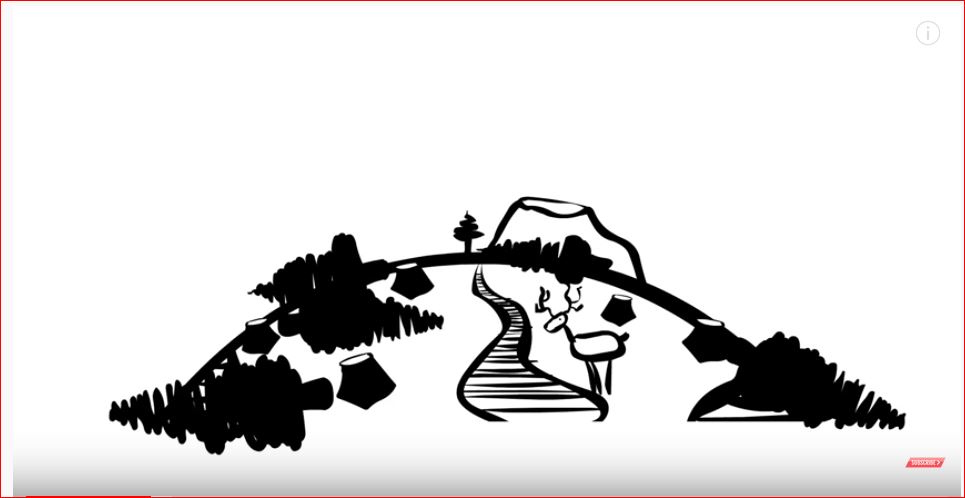
Screen capture from the film, “Story of Stuff”

Human Liberty Bell: Tribute to photos of Mole & Thomas

December 12, 2007

Surely you’ve seen some of these photos; if you’re a photographer, you’ve marveled over the ability of the photographer to get all those people to their proper positions, and you’ve wondered at the sheer creative genius required to set the photos up.

Like this one, a depiction of the Liberty Bell — composed of 25,000 officers and men at Fort Dix, New Jersey. The photo was taken in 1918.

Mole & Thomas photo, Human Liberty Bell The Carl Hammer Gallery in Chicago featured an exhibit of these monumental photos in April and May, 2007:

The outbreak of World War I and its inherent violence engendered a new commitment by the world’s photographers to document every aspect of the fighting, ending an era of In A Patriotic Mole, A Living Photograph, Louis Kaplan, of Southern Illinois University, writes, “The so-called living photographs and living insignia of Arthur Mole [and John Thomas] are photo-literal attempts to recover the old image of national identity at the very moment when the United States entered the Great War in 1917.

Mole’s [and Thomas’s] photos assert, bolster, and recover the image of American national identity via photographic imaging. Moreover, these military formations serve as rallying points to support U.S. involvement in the war and to ward off any isolationist tendencies. In life during wartime, [their] patriotic images function as “nationalist propaganda” and instantiate photo cultural formations of citizenship for both the participants and the consumers of these group photographs.”

The monumentality of this project somewhat overshadows the philanthropic magnanimity of the artists themselves.Instead of prospering from the sale of the images produced, the artists donated the entire income derived to the families of the returning soldiers and to this country’s efforts to re-build their lives as a part of the re-entry process.

Eventually, other photographers, appeared on the scene, a bit later in time than the activity conducted by Mole and Thomas, but all were very clearly inspired by the creativity and monumentality of the duo’s production of the “Living” photograph.

One of the most notable of those artists was Eugene Omar Goldbeck. He specialized in the large scale group portrait and photographed important people (Albert Einstein), events, and scenes (Babe Ruth’s New York Yankees in his home town, San Antonio) both locally and around the world (Mt. McKinley). Among his military photographs, the Living Insignia projects are of particular significance as to how he is remembered.

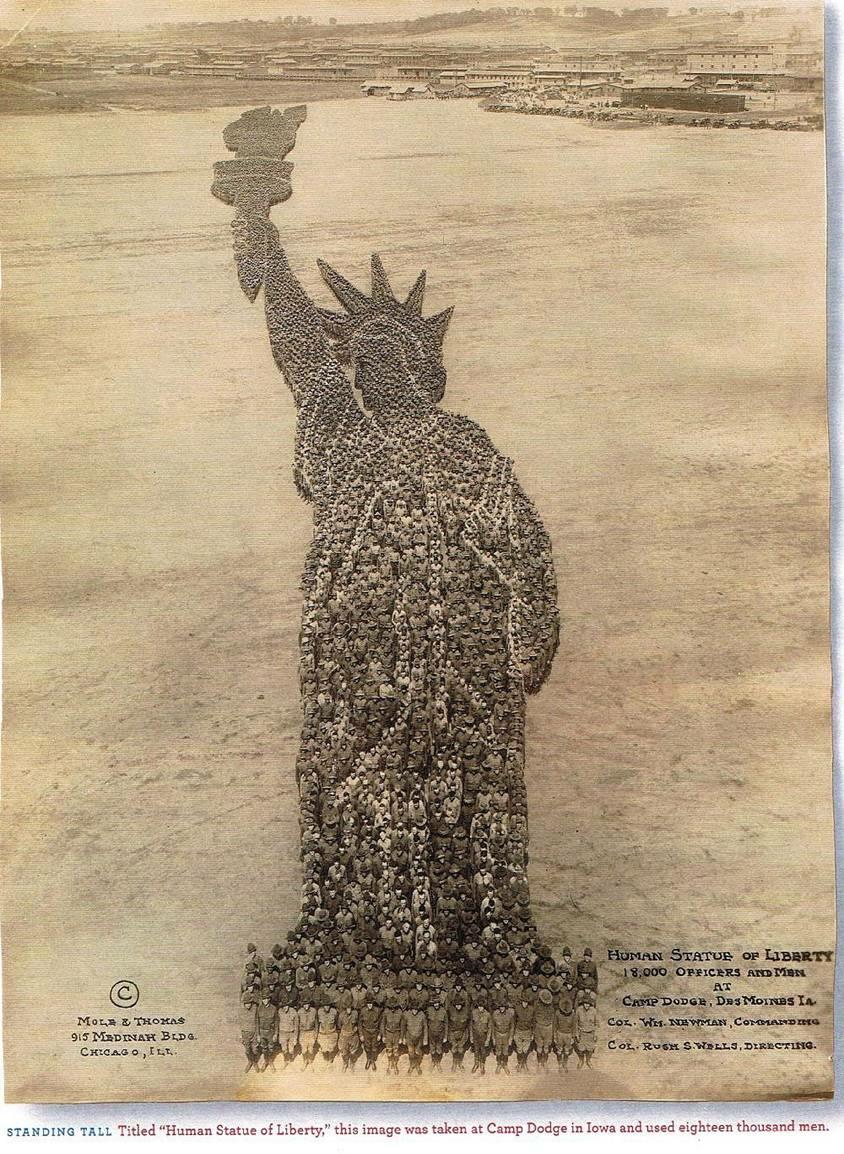
Using a camera as an artist’s tool, using a literal army as a palette, using a parade ground as a sort of canvas, these photographers made some very interesting pictures. The Human Statue of Liberty, with 18,000 men at Camp Dodge, Iowa?


statue-of-liberty-human-camp-dodge-from-snopes.jpg

Most of these pictures were taken prior to 1930. Veterans who posed as part of these photos would be between 80 and 100 years old now. Are there veterans in your town who posed for one of these photos?


Good photographic copies of some of these pictures are available from galleries. They are discussion starters, that’s for sure.

Some questions for discussion:

  1. Considering the years of the photos, do you think many of these men saw duty overseas in World War I.
  2. Look at the camps, and do an internet search for influenza outbreaks in that era. Were any of these camps focal points for influenza?
  3. Considering the toll influenza took on these men, about how many out of each photo would have survived the influenza, on average?
  4. Considering the time, assume these men were between the ages of 18 and 25. What was their fate after the Stock Market Crash of 1929? Where were they during World War II?
  5. Do a search: Do these camps still exist? Can you find their locations on a map, whether they exist or not?
  6. Why do the critics say these photos might have been used to build national unity, and to cement national identity and will in time of war?
  7. What is it about making these photos that would build patriotism? Are these photos patriotic now?

These quirky photos are true snapshots in time. They can be used for warm-ups/bell ringers, or to construct lesson plans around.

Tip of the old scrub brush to Gil Brassard, a native, patriotic and corporate historian hiding in Baton Rouge, Louisiana.


Celebrate the Ides of December!*

December 10, 2007

December 15th is Bill of Rights Day, a tradition since Franklin Roosevelt first declared it in 1941.

The Bill of Rights, National Archive

It falls on Saturday this year — which means teachers can choose whether to commemorate it Friday, or next Monday, or on both days. It marks the date of the approval of the Bill of Rights, in 1790.

Texas requires social studies teachers to spend a day on the Constitution. The law isn’t well enforced, but Bill of Rights Day might be a good time to fill the legal duty in your classrooms.

The Bill of Rights Institute offers lesson plans and supporting materials (see “Instructional Materials” in the left column). Below the fold I copy a list from the Institute’s webpage on Bill of Rights Day.

More material here, and the National Archives material can be reached here.
_____________
* The ides is merely the middle of the month. Of course you thought of Shakespeare’s witch warning Julius Caesar to “beware the ides of March.” In this case, we can celebrate the ides of December — Hanukkah mostly gone, Christmas, Eid and KWANZAA on the way.
Read the rest of this entry »


Student project: Photography + cartography + internet

December 6, 2007

Ignoble Gases nicely describes the mashup between on-line mapping services and digital photography, with a bit of blogging thrown in.

Mapping services now have the capacity to link photographs of a site with its exact latitude and longitude, or exact address.  Maps of cities can feature links to photos of the site (other than satellite or aerial photos) submitted by readers, and other descriptive material.

So, geography teachers:  Have your kids mapped out your town and put it on the web to encourage tourism?  Great discussion topics:  What are the advantages of such technologies, and what are the parent-scaring disadvantages, or dangers of them?

I really cannot do justice to the concepts here — read the article at Ignoble Gases.


Bill of Rights Day, December 15

December 4, 2007

We get e-mail, sometimes good stuff — this piece from the Bill of Rights Institute. [I copied it, art, links and all — please pass it on.]

Are you ready for Bill of Rights Day, December 15? The Bill of Rights Institute has resources for teachers:

Celebrate Bill of Rights Day with the Bill of Rights Institute!

The Bill of Rights Institute invites you to celebrate Bill of Rights Day on December 15, 2007 by taking advantage of the resources on the Constitution and Bill of Rights we are offering educatorsFREE of charge. These activities will engage your students and demonstrate the importance of the Bill of Rights in their lives. Utilize the lessons on December 14th as part of a Bill of Rights Day celebration for your students or save the lessons for use throughout the school year.

Access our website and find:

  • Founders Online includes audio clips, biographical essays, classroom activities
    videos on our nation’s Founding Fathers
  • Readings for your students on the Bill of Rights
  • Free, complete lesson plans for middle and high school students
  • Background information from Princeton University professor Dr. Ken Kerch
    on First Amendment freedoms
  • Links to other Bill of Rights Day resources

Check out the Bill of Rights Institute’s Bill of Rights Day site today!


Make ocean foam in your classroom!

December 2, 2007

I’m not sure exactly why, but my post on ocean foam in Australia continues to be one of the most popular.

Now you can make ocean foam in your classroom! I suppose this was planned for a science class, but why not use it in geography or world history?

Kid making ocean foam, at NY Hall of Science

Instructions here: What Molecules are in Ocean Foam? (repeated below the fold). This is one of several easy-to-do science experiments promoted at the Pfizer Foundation Discovery Lab at the New York Hall of Science.

Also see this explanation from New Scientist about how foam forms on ocean waves in the first place.

Go ahead. Cover the entire school with it.

Read the rest of this entry »


“Evening at the Fed” Dallas registration deadline Nov. 22

November 21, 2007

Dallas-area economics, government and history teachers need to watch the deadline to register for the Dallas Federal Reserve Bank’s “Evening at the Fed,” scheduled for November 29, 2007.

Deadline to register is November 22.

Good dinner, continuing education credits (professional development), a few good ideas for your classroom. See my previous post, here.


Texas History Day, and National History Day 2008

November 12, 2007

Your classes are gearing up for the competition, no?

Alfie Kohn might not like the idea of competition in history. In a state famous for competition in almost everything, but most famous for athletic competitions to the detriment of academics, I find great appeal in a contest that requires kids to find, analyze and write history.

Then the students get together to present and discuss history — and usually about 60 Texas kids go on to the National History Day festival. (Details here from the Texas State Historical Association)

Q. What is Texas History Day?

A. Texas History Day, a part of the National History Day program, is a yearlong education program that culminates in an annual state-level history fair for students in grades six through twelve. It provides an opportunity for students to demonstrate their interest in, and knowledge of, history through creative and original papers, performances, documentaries, individual interpretive web sites, or three-dimensional exhibits.

Over the course of the school year, students research and produce a History Day entry, the results of which are presented at a regional competition in early spring. From there, some students advance to the state fair in May, or even to the national contest held each June at the University of Maryland at College Park. At each level of competition, outstanding achievement may be recognized through certificates, medals, trophies, or monetary awards. The most important rewards are the skills and insight that students acquire as they move through the History Day program.

As many as 33,000 young Texans are involved in the program at the regional and state level each year. More than 900 students participate in Texas History Day, and approximately 60 students represent Texas at National History Day each year.

The 2008 National History Day Theme is “Conflict and Compromise in History.”

Texas has 23 regions for preliminary rounds. Details here. A list of sample topics for Texas students should give lots of good ideas.

The topics and the papers promise a lot. These projects could make good lesson plans. (Who publishes the winning entries? I have not found that yet.)

Don’t forget the Texas History Day T-shirt Design Contest — entries are due by December 14, 2007.


Essay contest: Being an American

October 31, 2007

I get e-mail, some of it interesting, some of it useful in the classroom.

The Bill of Rights Institute’s essay contest has a deadline just over a month away. Are your students entering?

Here’s the e-mail I got:

___________________________________

It is not too late for you and your students to win over $63,000 in awards by entering the Being an American essay contest.

Assign the essay question to your students today!
They will explore civic values, describe American ideals, and connect with the Constitution. The top winners will attend an awards ceremony in Washington, D.C. on April 4-5, 2008!

Contest ends December 3, 2007!
Visit the contest website for more information
.


The curve of binding history

October 16, 2007

From this lead paragraph in a BusinessWeek story could come a heck of a semester of high school economics:

Leonid Hurwicz was born in Moscow in 1917, the year that Vladimir Lenin led the Bolshevik seizure of power in Russia. Ninety years later—on Oct. 15, 2007—Hurwicz was awarded a Nobel prize in economics, in part for explaining the fundamental flaw in the central planning that Lenin imposed in the Soviet Union.


Prehistory and art: Lesson plan material

October 7, 2007

Teachers looking for good interactive graphics on human migration in prehistoric times should take a look at the website of Australia’s Bradshaw Foundation. The map requires an Adobe Flash player, and I cannot embed it here — but go take a look, here. “The Journey of Man” seems tailor made for classroom use, if you have a live internet connection and a projector.

Ancient art is the chief focus of the foundation.

Ancient paintings, the Bradshaw paintings, at the Bradshaw Foundation Examples of some of the most famous cave and rock paintings populate the site, along with many lesser known creations — the eponymous paintings, the Bradshaw group, generally disappear from U.S. versions of world history texts. The Bradshaw Foundation website explains:

The Bradshaw Paintings are incredibly sophisticated, as you will see from the 32 pictures in the Paintings Section, yet they are not recent creations but originate from an unknown past period which some suggest could have been 50,000 years ago. This art form was first recorded by Joseph Bradshaw in 1891, when he was lost on an Kimberley expedition in the north west of Australia. Dr. Andreas Lommel stated on his expedition to the Kimberleys in 1955 that the rock art he referred to as the Bradshaw Paintings may well predate the present Australian Aborigines.

This ancient art carries a story that should intrigue even junior high school students, and it offers examples of archaeological techniques that are critical to determining the ages of undated art in the wild:

According to legend, they were made by birds. It was said that these birds pecked the rocks until their beaks bled, and then created these fine paintings by using a tail feather and their own blood. This art is of such antiquity that no pigment remains on the rock surface, it is impossible to use carbon dating technology. The composition of the original paints cant be determined, and whatever pigments were used have been locked into the rock itself as shades of Mulberry red, and have become impervious to the elements.

Fortuitously, in 1996 Grahame Walsh discovered a Bradshaw Painting partly covered by a fossilised Mud Wasp nest, which scientists have removed and analysed using a new technique of dating, determining it to be 17,000 + years old.

Texas history and geography teachers should note the Bradshaw Foundation’s work on prehistorica art in the Pecos River Valley: “Pecos Experience: Art and archeaology in the lower Pecos.” There is much more here than is found in most Texas history texts — material useful for student projects or good lesson plans.

Painting from Panther Cave, lower Pecos, Texas - Bradshaw Foundation


Trial by Jury (grades 5-8)

September 30, 2007

Trial simulations put students into the middle of tough topics in government, economics and history — or can do, depending on how well the simulations work. In the middle of the fight is a great place to learn.

Scholastic.com features a series of lesson plans suitable for government and civics. Looking for Constitution Day lesson plans I stumbled into a trial-by-jury simulation, with the mock trial script all prepared for you, for grades 5 through 8.

It looks to me to be a good way to study the jury system (see Amendments 6 and 7 of the Constitution).  The lesson plans and materials were designed, and their dissemination supported by the American Board of Trial Advocates.  Yes, that’s a group with a view; no, the bias doesn’t show up in the classroom materials, really.

Here’s a graphic on amending the Constitution, from the same site. This could be reproduced for student journals, printed for small posters, or, check with your high school drafting classes to see whether they won’t print this out for you in a poster size, in color. Scholastic.com features nine graphic pages like that one.

Trial by jury provides the foundation for some of our greatest drama: On television with Perry Mason, Matlock, Law & Order, Boston Legal, or L.A. Law; on the stage with Inherit the Wind and Ayn Rand’s The Night of January 16th; in opera with Gilbert and Sullivan’s Trial by Jury (okay, in operetta). This is the sort of thing students enjoy, and probably will remember.

How and why to show up for jury duty is one of the most important understandings our students can take away.

Justice by the People logo, from Scholastic.com


50 years after Little Rock: Lesson plans

September 27, 2007

Tolerance.org features a solid lesson plan on what the nation should have learned from the events in Little Rock, Arkansas, in 1957 — when nine African American students challenged segregation and sought to enroll at Little Rock’s Central High School. It’s timely — the actual anniversary is this month. This is a key point for Texas’s U.S. history standards:

September 2007 – This month, our nation marks the 50th anniversary of the Little Rock Nine’s attempt to integrate schools. Have we really learned how to break down barriers?

This lesson plan is excerpted from the 2007-2008 Mix It Up Planner. Learn more about national Mix It Up at Lunch Day, to be held on Nov. 13, 2007!

Objectives:

  • Students will draw conclusions about boundary crossing from history and literature.
  • Students will identify boundaries in their classroom or school, cross those boundaries, report back and reflect on what they learned.

Tolerance.org carries several lesson plans teachers will find useful.


From Homer, to Homer Simpson

September 26, 2007

Daumier's drawing, Thetis dipping Achilles in the River Styx

Homer Simpson and fried beignet

Images: Daumier’s drawing of Thetis dipping Achilles in the River Styx; Homer Simpson and the official fried beignet of Louisiana, credit for the latter lost, though no doubt copyrighted.

Homer to Homer Simpson: This is at least a good class warm up, if not a whole lesson plan of itself. Shades of Harry Wong, who knew there were such links?

What? Ken Jennings knew?

Tip of the old scrub brush to Alun Salt at Clioaudio, and at Revise and Dissent, for pointing to Debra Hamel at Blogographos.


Constitution Day! Monday, September 17, 2007

September 14, 2007

Are you ready for it, teachers?

Howard Chandler Christy's painting of the Scene at the Signing of the Constitution