November 30, Whiskey and Cigar Day: How will you celebrate Twain and Churchill?

November 25, 2013

The Author, painting the fence next to Mark Twain's home in Hannibal, Missouri, in 2012.  Had to trade some marbles and a yo-yo for the privilege . . .

The Author, painting the fence next to Mark Twain’s home in Hannibal, Missouri, in 2012. Had to trade some marbles and a yo-yo for the privilege . . .

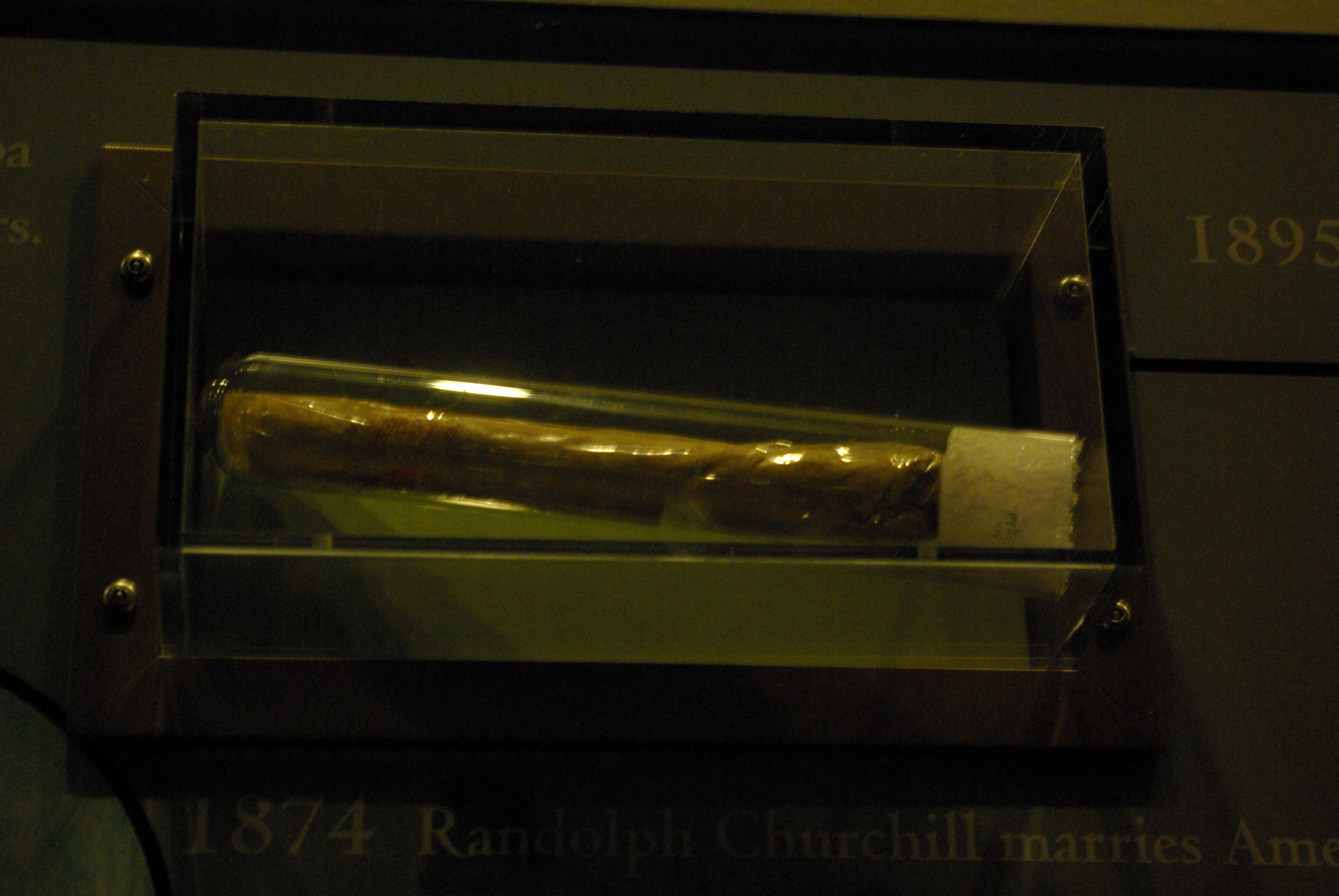
This Saturday, November 30, is Whiskey and Cigar Day, the day we celebrate the births of Samuel Clemens, better known as Mark Twain, and Winston Churchill.

Whiskey and cigars are appropriate, even before noon (good thing it’s a Saturday, eh?)

What do you plan to celebrate?

How do you celebrate, if you don’t plan to use cigars or whiskey?  Readings from the men?

Comments are open for your ideas.

A cigar of Winston Churchill's, on display in Fulton, Missouri

A cigar of Winston Churchill’s, on display in Fulton, Missouri

More:


Banned Books Week is coming, September 22-28, 2013

September 18, 2013

Got a stack of banned books ready?

Banned Books Week is September 22-28 for 2013.

Banner for Banned Books Week 2013

So THAT’s what Lady Liberty holds in her left hand. (Reading the Declaration of Indpendence can still get you into trouble in a few places — mostly not in the U.S., but even in the U.S.)

We still have banned books?  Is that bad?

Consider, first, that on September 17, 2013, the Texas State Board of Education opened hearings on science textbooks to be “adopted” for Texas schoolsRadical elements of the SBOE furiously organized to stack rating panels with people who want to censor science, to stop the teaching of Darwin’s work on evolution.  (No, I’m not kidding.)

This comes in the middle of a rancorous fight in Texas over CSCOPE, a cooperative lesson-plan exchange set up by 800 Texas school districts to help teachers meet new Texas education standards adopted years ago (without new books!).  Critics labeled reading lists and any reading on religions other than Christianity “socialist” or “Marxist,” and complained that Texas social studies books do not slander Islam.

Then there is the flap over Persepolis, in Chicago.  With all the other trouble Chicago’s schools have several bluenoses worked to get this graphic “novel” banned (it’s not really a novel; it’s a memoir).  They complained about graphic violence in what is a comic book.  Persepolis tells the story of a young woman growing up in Iran during the Iranian Revolution.

The autobiographical graphic memoir Persepolis by Marjane Satrapi was pulled from Chicago classrooms this past May by Chicago Public Schools CEO Barbara Byrd-Bennett due to “inappropriate” graphic language and images, specifically, scenes of torture and rebellion. Parents, teachers, and First Amendment advocates protested the ban, and as a result — while still pulled from 7th grade — Persepolis is currently under review for use in grades 8-10. (For details, see CBLDF Rises to Defense of Persepolis.)

Persepolis is an important classroom tool for a number of reasons. First, it is a primary source detailing life in Iran during the Revolution and the Iran-Iraq War . Readers of all ages get a glimpse of what life is like under repressive regimes and relive this period in history from a different perspective. It also begs detailed discussion of the separation of church and state. Furthermore, this is a poignant coming-of-age story that all teens will be able to relate to and serves as a testament to the power of family, education, and sacrifice.

In America, textbooks get attacked for telling the truth about Islam and not claiming it is a violence-based faith; and supplemental reading gets attacked when it presents the violence the critics complain was left out of the texts.

We need to think this through.

What banned books have you read lately?

More:

Cover of "Persepolis"

Persepolis has been made into a movie.


Quote of the moment: Mark Twain, “death was an exaggeration”

September 3, 2013

Words of encouragement in tough times, from Samuel Clemens, writing as Mark Twain:

” . . . the report of my death was an exaggeration.” Mark Twain

The note was published in the New York Journal, June 2, 1897.  While it’s true that Twain wrote this, most popular citations have added and rearranged words.

Text of the note:

James Ross Clemens, a cousin of mine was seriously ill two or three weeks ago in London, but is well now.  The report of my illness grew out of his illness, the report of my death was an exaggeration.

Mark Twain with kitten, in 1907 - Wikipedia image

Mark Twain with kitten, in 1907 – Wikipedia image

Save

Save


Lost history: Groucho Marx died on August 19, 1977

August 19, 2013

1958 Publicity photo of Groucho Marx from the television program You Bet Your Life.  NBC Television-NBC Photo/Photographer:  Elmer Holloway

1958 Publicity photo of Groucho Marx from the television program You Bet Your Life. NBC Television-NBC Photo/Photographer: Elmer Holloway

36 years ago?  Grouch Marx died on August 19, 1977? 

cropped version of Image:Grouchoicon.jpg - &qu...

The man became an icon, though too few know the great history behind the icon. “Self-made caricature of Groucho Marx” Wikipedia image


That means that not only have your high school history students probably never seen much, or anything, of Groucho Marx and his comic genius; it means their parents don’t know him, either.

What a great tragedy.

Groucho Marx brought genius to American comedy films, to radio, and then to television.  His genius was of a sort that does not age, but remains fresh to audiences of today — get a group of teenagers to view Duck Soup or A Day at the Races and you’ll find them laughing heartily at even some of Marx’s more cerebral jokes.  It is symbolic that the films that brought writer Norman Cousins to laughter, and a lack of pain, were Marx Brothers movies (in the day when one had to rent a projector to show the film, long before VCR).  Cousins went on to a grand second career talking about hope in healing, starting with the book, Head First: The Biology of Hope and the Healing Power of the Human Spirit.  I recommend these films to anyone seriously injured or ill, or recovering.  We got VHS, and then DVD copies of several of the films when our kids were ill, with great effect.

Groucho Marx should be in the pantheon of great Americans, of the 20th century, if not all time, studied by children in high school, for history and for literature purposes.

Groucho’s been gone for 36 years, and we are much poorer for his passing.

More:

Groucho grills Ray Bradbury and a woman named Leticia on You Bet Your Life in a 1955 episode:

English: Groucho Marx & anonymous blogging

“I intend to live forever, or die trying.” ― Groucho Marx (Wikipedia image)


Mark Twain in Fort Worth

July 29, 2013

Mark Twain statue, Trinity Park, Fort Worth, Texas Photo by Barbara Schmidt © 2010

Mark Twain statue, Trinity Park, Fort Worth, Texas Photo by Barbara Schmidt © 2010

I’m falling down in my Mark Twain fandom, obviously.  Barbara Schmidt, who keeps the fine site, TwainQuotes (www.twainquotes.com), features this photo of Mark Twain holding an open copy of The Adventures of Huckleberry Finn, on one of the main pages at her site.

I did not know such a statue of Twain existed in Texas, let alone within an hour’s travel from my home.  I’ll have to track it down.

Why is it there?  Twain never set foot in Fort Worth, that I know.

What other great statues hide around Dallas and Fort Worth?

More:

Mark Twain in Fort Worth's Trinity Park, by Amy Moore, at Everything Everywhere

Mark Twain in Fort Worth’s Trinity Park, by Amy Moore, at Everything Everywhere.  The statue was created by Gary Lee Price.


July 26: Happy birthday, George Bernard Shaw

July 26, 2013

George Bernard Shaw standing in the snow. (Actually, at Niagara-on-the-Lake, site of an annual Shaw festival) Wikipedia image

George Bernard Shaw standing in the snow. (Actually, at Niagara-on-the-Lake, site of an annual Shaw theater festival) Wikipedia image

Rather like a ghost of a ghost of Shakespeare, George Bernard Shaw occupies one of those uncomfortable seats in history:  Everybody knows the name, few people know anything about him, and though his work shapes our culture, probably fewer can tell you how, or why.

George Bernard Shaw shaking his head while looking at his bust, done by Sigismund de Strobl (Today in Literature)

Caption from Today in Literature: Shaw shaking his head while looking at his bust, done by Sigismund de Strobl (Photo from TinL, too)

Today in Literature sent out a note:

George Bernard Shaw was born in Dublin on this day in 1856 — “fifty years to soon,” according to his calculations, and as if from another planet: “Whether it be that I was born mad or a little too sane, my kingdom was not of this world.”

Shaw portrays his parents as wildly divergent oddballs, their only shared emotion being a feeling of disinterested neutrality towards their offspring: “We as children had to find our own way in a household where there was neither hate nor love.” Mother’s habit of “lavishing indifference” upon him granted Shaw objectivity, and taught him to keep people at arm’s length — close enough to be moved by them, distant enough to be moved only to a quip, a quarrel, or a cause. And Dad was “a model father” because his ruinous enthusiasms for alcohol and tobacco inspired the son to abstain from both.

If, as Shaw claimed, “drink and lunacy were minor specialities” in his clan, then perhaps the spirit of detachment ran in the family too. Shaw seemed to think so: “Fortunately I have a heart of stone,” he wrote in 1939, “else my relations would have broken it long ago.” Biographer Michael Holroyd, concurring that the Shaws were an odd bunch, tells the final years and moments of one madcap uncle this way:

Uncle Barney was an inordinate smoker as well as a drunkard. Frequently drunk by dawn, he lived a largely fuddled life until he was past fifty. Then, relinquishing alcohol and tobacco simultaneously, he passed the next ten years of his life as a teetotaler, playing an obsolete wind instrument called an ophicleide. Towards the end of this period, renouncing the ophicleide* and all its works, he married a lady of great piety, took off his boots and fell completely silent. He was carried off to the family asylum where, “impatient for heaven,” he discovered an absolutely original method of committing suicide … involving as it did an empty carpet bag. However, in the act of placing this bag on his head, Uncle Barney jammed the mechanism of his heart in a paroxysm of laughter, which the merest hint of his suicidal technique never failed to provoke among the Shaws — and the result was that he died a second before he succeeded in killing himself.

Can you name any of Shaw’s works?  Which of them have you read, or seen performed?

What’s your favorite Shaw story?  Which of your favorite Shaw stories are untrue, or hoaxes?

______________

* The ophicleide is not well known today; it’s similar to the sudophone.

More:

George Bernard Shaw in 1899, at 43.

George Bernard Shaw in 1899, at 43. Most photos show Shaw as an old man — he should, perhaps, be remembered more as a young rake. Wikimedia image.  Shaw said, “The liar’s punishment is, not in the least that he is not believed, but that he cannot believe anyone else.” Quintessence of Ibsenism, 1891, “The Two Pioneers.”


Animated Maurice Sendak: How do you keep from being eaten and mauled by a monster?

June 17, 2013

Maurice Sendak, to his death, held on to some of his childhood concerns; and he worried about how we teach our children to deal with the world, and those scary things.

From Blank on Blank, PBS Digital Studios.

How do kids make it?  “They want to survive,” Sendak said.  “They Want To Survive.”

More:


Quote of the moment: Rachel Carson, on why her nature writing sounds so much like poetry

June 14, 2013

Rachel Carson said:

“If there is poetry in my book about the sea, it is not because I deliberately put it there, but because no one could write truthfully about the sea and leave out the poetry.”

Cover of The Gentle Subversive, by Mark Hamilton Lytle, for Oxford University Press.

Cover of The Gentle Subversive, by Mark Hamilton Lytle, for Oxford University Press.

Bug Girl wrote a fine review last year of an often over-looked book on Carson, The Gentle Subversive: Rachel Carson, Silent Spring, and the Rise of the Environmental Movement  (Mark Hamilton Lytle, 2007. Oxford Univ. Press.)  It’s worth your click over there to read a nice piece on Carson, on women in science, and on nature writing.

Bug Girl spends the necessary time and space answering critics of Carson, of Silent Spring, and those few odd but incredibly active and loud advocates who claim we can conquer disease if we can only spread enough DDT poison around the Earth.  Go see.

I find it impossible to stand in a place like Yosemite and not hear John Muir‘s voice — and it’s probably that John Muir found that, too.  Or stand on the shores of Waldon Pond and not hear Henry David Thoreau, or stand on sandy soil in Wisconsin and not hear Aldo Leopold, or sit on a redrock outcropping in southern Utah and not hear Ed Abbey.  They probably heard similar voices.  But they had the presence of mind to write down what they heard.

Writing wonderful prose, or poetry, must be easier when the subject sings of itself in your ears, and paints itself in glory for your eyes.

If Carson’s prose borders on poetry, does that add to, or subtract from its science value?

More:

U.S. President Theodore Roosevelt (left) and n...

U.S. President Theodore Roosevelt (left) and nature preservationist John Muir, founder of the Sierra Club , on Glacier Point in Yosemite National Park. In the background: Upper and lower Yosemite Falls. Wikipedia image


‘Twas the 18th of April in ’75 . . . (Paul Revere’s Ride, 243rd anniversary)

April 18, 2013

The annual reminder:

Paul Reveretonight’s the anniversary of his famous ride.

John Copley's painting of Paul Revere

Paul Revere, 1768, by John Singleton Copley (1738-1815)

John Copley painted all the bigwigs of revolutionary Boston, including this portrait of the famous horse-mounted alarm before he turned older and grayer.

And as April 18 is the anniversary of Revere’s ride, April 19 is the anniversary of the “shot heard ’round the world.”

Both events are celebrated in poetry; April is National Poetry Month. This could be a happy marriage for history and English classrooms.

Teachers, this is your cue to break out the Longfellow and Emerson and Whitman, and tie them together in the thread that runs from the French and Indian War clearly through the American Civil War, and we might hope, to today.  Give the kids some culture to get their mental juices flowing for the tests.

National Poetry Month 2013 poster

More:


So-called conservatives out of their minds — still, but moreso: 3 reasons not to fear ‘Brave New World’

April 11, 2013

You can’t make up this kind of crazy.  This guy’s been Tweeting this to everyone he can find on Twitter:

Seriously?  Hatcheries for children?

Isaac Asimov‘s great off-the-cuff essay one why 1984 wouldn’t be like 1984 is sort of a prototype of the sort of take-down of dystopias one finds in literary and historical circles.  (Once I had a link to a version of the essay, but it’s buried in the bowels of the internet now.)

First edition cover

Is this where we are going, so rapidly in this handbasket? First edition cover, Aldous Huxley’s Brave New World – Wikipedia image

But it never makes the true crazies see the light.  They can’t see contrary evidence.

Asimov’s essay noted Orwell’s lack of foresight in simple things, and human things.  In Orwell’s Big Brother dystopia, Winston Smith couldn’t get razor blades or shoe laces, indicators of the economic failures of Big Brother.  Asimov wrote that, in reality,  he used an electric razor, and wore slip-on shoes.  Blades and laces were foreign to his world, too, but not evidence of dystopia; instead, they were evidence of changing fashion and innovation. Orwell thought Big Brother would watch everyone with electronics.  We learned that people as a mass, who use phones, especially cell phones, and the internet, put out too much information in total for a Big Brother to make sense of it, absent other indicators — and that even when hints of wrong-doing turn up, the bureaucracies tend to prevent quick action, or any action at all.  (See the report of the 9/11 Commission.)

One wishes Asimov were alive to do a take-down of the Brave New World fears.  One also suspects those living in fear of Huxley wouldn’t understand the takedown.

Huxley himself gave it away.  Nothing in scientific discoveries has altered Huxley’s errors of prediction (if he was “predicting” and not simply fantasizing).

So, here are three reasons a rational human should not fear we are on the verge of Brave New World, as Huxley scared us all:

  1. Huxley’s dead, and out of date.  Huxley died 50 years ago (on November 22, 1963, coincidentally enough — Sam Theissen with find some omen in that; superstition can’t be stamped out of those who refuse to learn).  Huxley’s premises, his assumptions about society, don’t work in a modern world.  Huxley’s imaginings were almost pre-modern science.  His story doesn’t imagine electricity on the Navaho or Hopi or Apache reservations.  He didn’t foresee Interstate Highways, nor even Route 66, and America’s love affair with travel and the automobile.  He didn’t see the rise of broadcast television and radio, nor rock ‘n roll, nor especially did he see the cultural effects of popular radio on U.S., British or world politics.  Huxley assumes a Soviet-style dictatorship can work.  We know better.  We have Solzhenitsyn.  We had Sakharov protesting in the Soviet Union, and Oppenheimer protesting in the U.S.  That should also remind us that Huxley missed nuclear power.  Huxley simply missed most of the technology and especially culturally-affective technology that makes a Brave New World impossible.
  2. Human hatcheries don’t work.  Hatcheries work for fish; we’ve been unable to make them work for most birds.  Critically, they don’t work for humans, nor for any other complex mammalian — nor chordate, in the ways Huxley describes the embryoes being programmed for certain kinds of intelligence and physical traits.  Oddly, that seems to be the focus of Thiessen’s fears — but the technology simply doesn’t work.
  3. Sex is fun. Huxley’s story required that sex and procreation be done away with.  Oh, there was some sex — but procreative sex is presented as a shameful character flaw, like patricide, embezzling or drug dealing.  Brave New World is frustrated, in the 20th century, by the backseats of cars and the simple fact that sex is so much fun.  Raising kids is fun, too, and valued by adults the world over, a value that got much more expression after World War II.

It’s difficult to imagine kids in high school reading Brave New World without giggling, and without noting the difficulties of the story now (try to get a high school kid to believe Superman used phone booths . . .).

Sam Thiessen is convinced civilization will collapse — he’s written books about it.  I wonder about people who miss the ultimately fatal flaw of Huxley’s story, that humans love one another, and humans like to have sex.  Those who fear Huxley’s book is a forecast, I think, either don’t get enough sex, or don’t know how.

The things are going with current witch hunts, Texas teachers who use Huxley’s book should look out — Thiessen and his fellow travelers will soon accuse them of indoctrinating students in the stuff, instead of warning them against it.  After all, Thiessen seems to have missed the warnings himself.

I’d wager that in other rants, self-titled conservatives and libertarians like Thiessen rail at the usual-suspect decline in morals, including a lot of actions shocking to them, caused by the fact that most people find sex really fun.  Does it not make sense that they’d take a step back, and see that the behavior they claim disgusts them, also makes possible the broken future they fear?

Oblivious to this odd balance of freedoms, they then campaign to end the immorality they see, never thinking that by doing so they advance the dystopia they claim to fear.  What a tangled web we weave when first we practice to misperceive.

More:

A note about the title of the book:

O wonder!
How many goodly creatures are there here!
How beauteous mankind is! O brave new world,
That has such people in’t.

  ♦ William Shakespeare, The Tempest, Act V, Scene I; spoken by Miranda


Phillis Wheatley: Poem for Presidents Day (2013)

February 18, 2013

What is a good flag flying occasion without some inspiring poetry?

Get your flag up (if it’s not up already), and read some poetry from a remarkable woman, in this encore post.

From the Poem-a-Day folks at the American Academy of Poets:

His Excellency General Washington
by Phillis Wheatley

George Washington

George Washington, as he appears on the one-dollar bill.

Celestial choir! enthron’d in realms of light,
Columbia’s scenes of glorious toils I write.
While freedom’s cause her anxious breast alarms,
She flashes dreadful in refulgent arms.
See mother earth her offspring’s fate bemoan,
And nations gaze at scenes before unknown!
See the bright beams of heaven’s revolving light
Involved in sorrows and the veil of night!

The Goddess comes, she moves divinely fair,
Olive and laurel binds Her golden hair:
Wherever shines this native of the skies,
Unnumber’d charms and recent graces rise.

Muse! Bow propitious while my pen relates
How pour her armies through a thousand gates,
As when Eolus heaven’s fair face deforms,
Enwrapp’d in tempest and a night of storms;
Astonish’d ocean feels the wild uproar,
The refluent surges beat the sounding shore;
Or think as leaves in Autumn’s golden reign,
Such, and so many, moves the warrior’s train.
In bright array they seek the work of war,
Where high unfurl’d the ensign waves in air.
Shall I to Washington their praise recite?
Enough thou know’st them in the fields of fight.
Thee, first in peace and honors—we demand
The grace and glory of thy martial band.
Fam’d for thy valour, for thy virtues more,
Hear every tongue thy guardian aid implore!

One century scarce perform’d its destined round,
When Gallic powers Columbia’s fury found;
And so may you, whoever dares disgrace
The land of freedom’s heaven-defended race!
Fix’d are the eyes of nations on the scales,
For in their hopes Columbia’s arm prevails.
Anon Britannia droops the pensive head,
While round increase the rising hills of dead.
Ah! Cruel blindness to Columbia’s state!
Lament thy thirst of boundless power too late.

Proceed, great chief, with virtue on thy side,
Thy ev’ry action let the Goddess guide.
A crown, a mansion, and a throne that shine,
With gold unfading, WASHINGTON! Be thine.

American Poet Phyllis Wheatley, detail from the Boston Women's Memorial on Commonwealth Ave.

American Poet Phillis Wheatley, detail from the Boston Women’s Memorial on Commonwealth Ave.

Who was the inspiring woman, Phillis Wheatley? Read her biography at the Academy of American Poets site.

Phillis Wheatley was the first black poet in America to publish a book. She was born around 1753 in West Africa and brought to New England in 1761, where John Wheatley of Boston purchased her as a gift for his wife. Although they brought her into the household as a slave, the Wheatleys took a great interest in Phillis’s education. Many biographers have pointed to her precocity; Wheatley learned to read and write English by the age of nine, and she became familiar with Latin, Greek, the Bible, and selected classics at an early age. She began writing poetry at thirteen, modeling her work on the English poets of the time, particularly John Milton, Thomas Gray, and Alexander Pope. Her poem “On the Death of the Rev. Mr. George Whitefield” was published as a broadside in cities such as Boston, New York, and Philadelphia and garnered Wheatley national acclaim. This poem was also printed in London. Over the next few years, she would print a number of broadsides elegizing prominent English and colonial leaders.

More, at the AAP site.


Query: Who wrote this first? Two novels that change a 14 year-old’s life, Lord of the Rings and Atlas Shrugged

February 7, 2013

Eye of Sauron, or John Galt?

Lord of the Rings features a time when evil almost wins. Atlas Shrugged celebrates such dystopia.

I first heard this within the past couple of years.  As with too many really good lines that get passed around the internet, it came to me first with no source listed.

It’s rather brilliant.  To whom do we properly give credit for its invention?

There are two novels that can change a bookish fourteen-year old’s life: The Lord of the Rings and Atlas Shrugged. One is a childish fantasy that often engenders a lifelong obsession with its unbelievable heroes, leading to an emotionally stunted, socially crippled adulthood, unable to deal with the real world. The other, of course, involves orcs.

Update:  In comments, Ellie and Liam both point to John Rogers at Kung Fu Monkey, March 19, 2009.  Sounds good.  Can anyone pin it on anyone else, earlier?

More:


Quote of the moment: Ebenezer Scrooge, and darkness is cheap (still, in 2012)

December 25, 2012

Roberto Innocenti, Scrooge on a dark staircase

Ebenezer Scrooge, up a dark staircase; “Darkness was cheap, and Scrooge liked it.” Illustration by , via Pinterest

Quote of the moment (an encore post for the season, with a bit of context thrown in later):

Darkness is cheap, and Scrooge liked it.

– Charles Dickens, A Christmas Carol, Stave 1

I thought of that line of Dickens’s when, months ago,  I read of this celebration of darkness, ignorance and calumny. Although, with the recent renewing of Limbaugh’s contract, it may no longer be true that his particular brand of darkness is cheap.

Still, it remains dark.

John Leach, Scrooge meets Ignorance and Want

Scrooge meets Ignorance and Want, the products of his stinginess (drawing by John Leech, 1809-1870)

(More about the drawing below the fold)

Read the rest of this entry »


Typewriter of the moment: Mark Twain’s Hammond

December 5, 2012

Still hoping to find a photo of Samuel Clemens at work on a typewriter.

But until then, this one will have to do:

Mark Twain's Hammond typewriter, Jerry J. Davis photo

A Hammond typewriter that once belonged to Samuel Clemens, or Mark Twain. Photographed by Jerry J. Davis, in an unstated location, probably Hannibal, Missouri

A Hammond typewriter, from oobject.com; perhaps not the typewriter that WAS pictured above; but Twain used this one, and the link to the photo above has died but good.

A Hammond typewriter, from oobject.com; perhaps not the typewriter that WAS pictured above; but Twain used this one, and the link to the photo above has died but good.

Other photos of Twain’s typewriter must exist; and since we know of at least two such machines, there must be some photos of each of them, no?  I wish museums and historians would consider the value of images of some of these objects, and make high quality photos of some of these famous machines.

Twain’s fascination with technology shines clearly in his work.  From his earliest writings we get lyrical and accurate descriptions of the mechanical workings of Mississippi riverboats, for one example.  A Connecticut Yankee in King Arthur’s Court paints a long paean to technology of the late 19th century, transplanted in the tale several centuries earlier.

Some accounts claim The Adventures of Huckleberry Finn to be the first manuscript completed by typewriter — this one, perhaps? TwainQuotes.com features what may be a description of this history:

…I will now claim — until dispossessed — that I was the first person in the world to apply the typewriter to literature…The early machine was full of caprices, full of defects — devilish ones. It had as many immoralities as the machine of today has virtues. After a year or two I found that it was degrading my character, so I thought I would give it to Howells…He took it home to Boston, and my morals began to improve, but his have never recovered.

– “The First Writing Machines”

As a publisher and investor, Twain pushed the development of automated typesetting machines to quickly publish the memoirs of former President Ulysses S Grant.  Though the books were set quickly, and the best-selling memoirs provided an income for Grant’s widow, the technology was still balky and cost Twain his own fortune.

Mark Twain's Hammond typewriter - TwainQuotes.com

Twain’s Hammond at the Mark Twain Museum in Hannibal, Missouri. Image from TwainQuotes.com. Is this the same machine pictured above? There are similarities, but differences more than just the angle.

We shouldn’t be surprised with his acerbic comments on the machines; Twain’s caustic humor targeted everything in modern life.  TwainQuotes.com notes a fraction of a letter to his longtime friend:  Twain’s Hammond at the Mark Twain Museum in Hannibal, Missouri. Image from TwainQuotes.com

The machine is at Bliss’s, grimly pursuing its appointed mission, slowly & implacably rotting away at another man’s chances for salvation.

I have sent Bliss word not to donate it to a charity (though it is a pity to fool away a chance to do a charity an ill turn), but to let me know when he has got his dose, because I’ve got another candidate for damnation. You just wait a couple of weeks & if you don’t see the TypeWriter coming tilting along toward Cambridge with the raging hell of an unsatisfied appetite in its eye, I lose my guess.

– Letter to William Dean Howells, 25 June 1875

Were things really so bad?

I regret to note that in our visit to Hannibal last June I did not encounter any typewriters.  Clearly, I’ll have to go back.

Tip of the old scrub brush to OObjects.

More:


Rachel Carson biography, On a Farther Shore, one of best books of 2012

December 4, 2012

Kirkus Reviews listed as one of 2012’s top 25 books William Souder’s biography of Rachel Carson, On a Farther Shore.

William Souder, author of On a Farther Shore. MPR  image

William Souder, author of On a Farther Shore. Minnesota Public Radio image

Rachel Carson often gets credit for starting the modern environmental movement.  In highly cynical political times, Carson is under cruel smear attack from people who wish the environmental movement did not exist, and who appear to think that we could poison Africa to prosperity if only we’d use enough DDT, contrary to all scientific work and medical opinion.

Souder’s book, issued on the 50th anniversary of the publication of Carson’s best-known book, Silent Spring, lays out the facts.

Nice to see that book lovers like Souder’s work, too.  Carson’s work was painstakingly accurate as science, but also a wonderful read.  Silent Spring has a larger following among lovers of literature than science, a tribute to her writing ability.  Souder’s book plows both veins, science and writing.

Cover of On a Farther Shore, by William Souder

Cover of On a Farther Shore, by William Souder

In circles serious about science, the environment, human health, and literature, Souder’s book is the book of the 50th anniversary of Silent Spring.  There is irony there.  Pesticide manufacturers mounted a campaign against Silent Spring and Rachel Carson calculated to have cost $500,000 in 1962, when that book was published.  Souder’s book fights propaganda from Astro-turf™ organizations like Africa Fighting Malaria, a pro-DDT group that collects money from chemical manufacturers and anti-environmental political sources for a propaganda campaign that costs well over $500,000/year.  Despite all the paid-shill shouting against Rachel Carson and her work, it is the voice of On a Farther Shore that stands out.

More: