Ready for Banned Books Week?

August 30, 2008

We celebrate Banned Books Week September 27 through October 4 this year. Well, maybe it’s more accurate to say we celebrate the books that get banned, and the idea that freedom and liberty require that we not ban books.

Banned Books Week image from Tattered Cover Book Store in Denver

Banned Books Week image from Tattered Cover Book Store in Denver

Banned Books Week has been noted every year since 1982 in a long-running campaign from the American Library Association. Why?

Because ideas matter.  The right to express ideas, and the right to be able to read ideas, are at the foundation of our liberties.

Again in 2007, books most frequently targeted for banning include And Tango Makes Three, a delightful children’s story about two penguins taking care of an orphaned egg (too much like homosexuality), and Mark Twain’s powerful, essentially-American novel that makes the case against racism, The Adventures of Huckleberry Finn (ironically, because complainants claim to find the book racist).

People who ask that these books be pulled from the shelves often fail to recognize the irony — why should we ban a book about caring for orphans, or the book that makes the case against racism?

The Tattered Cover Book Store in Denver sponsors an annual Banned Books Week essay contest for Colorado teens, in conjunction with the Colorado Freedom of Expression Foundation.

How will your school and local public library commemorate Banned Books Week?  Which banned books will you read, and urge others to read?

Which banned books are on your reading lists for classroom use? Does that strike a little too close to home?  Then you need to get informed, and get active.


Quote of the moment: Mark Twain, and a majority in favor

August 9, 2008

Hain’t we got all the fools in town on our side? and ain’t that a big enough majority in any town?

— Mark Twain (Samuel Langhorn Clemens),
Adventures of Huckleberry Finn

Mark Twain, Library of Congress image

Mark Twain, Library of Congress image


Celebrating darkness, ignorance, and calumny

August 1, 2008

Quote of the moment:

Darkness is cheap, and Scrooge liked it.

— Charles Dickens, A Christmas Carol, Stave 1

I thought of that line of Dickens’s when I read of this celebration of darkness, ignorance and calumny. Although, with the recent renewing of Limbaugh’s contract, it may no longer be true that his particular brand of darkness is cheap.

Still, it remains dark.

Scrooge meets Ignorance and Want, the products of his stinginess (drawing by John Leech, 1809-1870)

Scrooge meets Ignorance and Want, the products of his stinginess (drawing by John Leech, 1809-1870)

(More about the drawing below the fold)

Read the rest of this entry »


Typewriter of the moment: Ian Fleming, the man with the golden typewriter

July 30, 2008

Ian Fleming at his typewriter

Ian Fleming at his typewriter

[Apologies.  Several of the links in this post simply don’t work any more.  I’ve tried to make sure the photos are there. Watch for an updated post — and be sure to read the comments.]

Ian Fleming, the creator of secret agent James Bond, at his typewriter, the gold-plated one:

Gold-plated?  According to IanFlemingCentre.com:

Ian Fleming’s first biographer, John Pearson, has identified 15 January 1952 as the “birth date” of James Bond and reports that CASINO ROYALE was finished on 18 March. Andrew Lycett’s IAN FLEMING points out that Ian “may have completed the job in an even shorter time”.

Ian Fleming married Ann Rothermere on Monday 24 March in that same year and often joked that he wrote CASINO ROYALE to take his mind off the forthcoming wedding. Whatever the timing, he had left his time working in naval intelligence with the determination to write “the spy story to end all spy stories”. He was forty three, about to marry and have his first child; his ambition and his experience came together at this moment in the creation of James Bond. He rewarded himself by buying a custom-made typewriter – plated in gold.

There you have it.

Is this a close-up of that typewriter? From AtomicMartinis.com:

Ian Flemings gold-plated typewriter

Ian Fleming’s gold-plated typewriter (Formerly at Atomic Martini; James Bond Shop)

I first saw a James Bond movie in 1964, “Goldfinger.”  I spent the rest of the summer reading all the James Bond books then in paperback.  Bond adventures reflected the attitudes, tone and tension of the Cold War.  They also provided great escape for a teenager with a summer of little else to do in central Utah.

The books proved much better than the movies.  While I’ve seen most of the movies as they’ve come along, I encourage people to read the books.  The stories are different from the movies, especially the movies coming after “Goldfinger.”  The gadgets are less spectacular, but the characters and travelogues are more spectacular.

Mostly the stuff is just fun.  Bond was sort of a Harry Potter for slightly older kids, and still can be.

I have not read any of the post-Fleming Bond novels.  Does anyone recommend them?

Other Resources:


Typewriter of the moment: Douglas Adams

July 26, 2008

Here’s a typewriter you can buy. NV Books in Great Wolford, Warwickshire, offers a first edition copy of Douglas Adams’ masterpiece, The Hitch Hiker’s Guide to the Galaxy, together with the autographed typewriter upon which he wrote it:

Douglas Adams's typewriter, a Hermes Standard 8, used to write the novel, The Hitch Hiker's Guide to the Galaxy

Douglas Adams’s typewriter, a Hermes Standard 8, used to write the novel, The Hitch Hiker’s Guide to the Galaxy

It’s yours, for just $25,112.92 (Today. Exchange rates may make the price wobble a bit). Abe Books in Denver lists the advertisement in the U.S.

THE HITCH HIKER’S GUIDE TO THE GALAXY, First Edition in FINE Condition. Sold together with DOUGLAS ADAMS’ TYPEWRITER owned by Adams (whilst writing ‘Hitch Hikers’) and SIGNED IN THICK FELT PEN BY THE AUTHOR across the original casing

Description: First Edition Hardback. A mouthwatering copy of this modern classic, the dustwrapper retains all of the notoriously fugitive blue and is wholly unfaded. The front image and lettering are bright and sharp and the book overall is in exceptional condition. Sold together with A UNIQUE ARTEFACT owned by Douglas Adams in the late 1970s, his Hermes Standard 8 typewriter. This is a thrilling object to possess with a fascinating history. It is as certain as can be that Adams wrote his most famous work ‘The Hitch Hikers Guide To The Galaxy’ on this Hermes Standard 8. Aside from the supporting provenance, it still contains much evidence of his ownership and regular use. It bears an anti-apartheid sticker on one side of the object and is boldly signed across the front casing by Adams in his unmistakeable hand. It comes housed in its cardboard box which Adams used to transport it, namely packaging from Simon and Schuster, originally containing copies of Adams and Terry Jones’ collaboration ‘Starship Titanic’. An address label to Adams’ office at the Digital Village, London, remains stuck on the box too. The typewriter itself is in attractive condition to display, but is entirely unrestored and as precisely as it was when it was owned by Adams. It is frequently mentioned by all who knew him that writing was often a torment for him and as such his lateness was legendary. He once said ‘I love deadlines. I love the whoosing sound they make as they fly by’, and such was his difficulty in producing work on time that in a well-documented act of desperation his publishers once locked him in a hotel room until he typed enough pages to be let out! The keys of his typewriter all still bear the marks of Adams’ tortured labour. Significantly, the ‘x’ key is particularly discoloured. A unique piece of literary history then and a fabulous talking point, and simply the ultimate possession for a Douglas Adams fan. It is almost superfluous to mention that it is also a very secure investment for the future. A little bit about its subsequent history: Adams signed and donated the typewriter to a wildlife charity auction in 1998, and it was then kept in private hands for several years before being sold on. Adams was passionate about wildlife and in keeping with his memory (and his original intention for this item), a donation will be made to Rhino Recovery with this sale. ABOUT US: It is our philosophy at N V to provide the astute collector with high quality books for pleasure and investment, whilst offering a service that is always friendly and helpful. EVERY listing has a sharp digital image of the EXACT item(s) that you are perusing – with more photographs available on request. The accompanying description is meticulous and we guarantee that all items are authentic. Nevertheless, you are welcome to call us FREE on (0800) 083 0281 with any queries, or on +44 (1608) 674181 from overseas. In the meantime we wish you every success with your collecting. Bookseller Inventory # 000002

I can’t improve on Boing Boing’s commentary. Steampunk beat me to the story, too. (The typewriter was sold as a benefit for RHINO by Christie’s on November 30, 2005, for £2,400, about $4,100.)

Your students may not know who Douglas Adams was — Adams died prematurely in 2001, at 49, of a sudden and unexpected heart attack. He was working on the movie adaptation for Hitch Hiker’s Guide.

Douglas Adams, photo by Chris Ogle; DouglasAdams.com

Douglas Adams, photo by Chris Ogle; DouglasAdams.com

Hitch Hiker’s Guide started out as a BBC4 radio series, airing in 1978. The book version appeared shortly after that — I think I first read it in 1979, an interim year when I really lit up small corners of Utah. The book was immensely funny, very witty, and self-conscious in a way that most pure humor writing isn’t. Adams appeared to be familiar with science deeply. The jokes work on several levels. The book was popular with friends in public broadcasting who had heard the BBC4 series, and with scientists in laboratories.

One of the NPR stations in Washington, D.C., ran the series shortly after I moved there (WAMU? WETA? I forget which). Use of an Eagles instrumental for the theme caught my ear. Eagles? This series seemed blessed with the best wit, best writing, and best music.

Not so with special effects in the television series. The script was inspired, the narrative effects were fine, but special effects were of the cheesy, early-Dr. Who variety — which was okay, because it put the focus on the script and the story. And the story was the thing.

Through much of that time I was deeply involved in land management issues. We worked on wilderness, the old RARE II wilderness designation process, and segued into the Sagebrush Rebellion, where I found myself deep into rebel territory when the fighting broke out (think of Jackie Vernon’s story of being in Japan when World War II broke out; saying he didn’t really know what to do, he “became a kamikaze copilot”). Hitch Hiker’s Guide opens with Arthur Dent protesting the demolition of his house to make a path for a new thruway, with the authorities telling Dent that he had plenty of time to protest since the notice of demolition was posted in a town only a few miles away, and since he missed the protest period, he shouldn’t complain. He is “rescued” from this situation by a friend named Ford Prefect — like the little European Ford auto — who tells Arthur not to worry about the house; Ford turns out to be an alien, and he knows the Earth is about to be destroyed to make way for an inter-galactic thruway. The destruction crew notes with no irony to the Earthlings that the notice of destruction was posted on a nearby planet, and Earth simply missed the protest period. Ah. A good summary of many land management decisions.

We found comradeship with people who understood that, once a decision had been made, often the best thing to do was remember not to panic, pick up one’s towel and hitch a ride to the next venue. I would not have been much surprised to turn to the appendices of an official BLM report and see that BLM had determined the answer to be “42,” and that a study group had been appointed for further study.

42. 42 is the answer.

The Answer to Life, the Universe, and Everything is numeric in Douglas Adams‘ series The Hitchhiker’s Guide to the Galaxy. In the story, a “simple answer” to The Ultimate Question is requested from the computer Deep Thought, specially built for this purpose. It takes Deep Thought 7½ million years to compute and check the answer, which turns out to be 42. Unfortunately, The Ultimate Question itself is unknown, suggesting on an allegorical level that it is more important to ask the right questions than to seek definite answers.

Others have wondered about the number.

In the original series, Arthur Dent has a Scrabble™ game with him. At some point it mystically spells out, “What do you get if you multiply six by nine? Forty-two.”

6 times 9 is 42 — except in base-13. But as Adams himself said, he did not write jokes in base-13

I have not seen the movie.

Douglas Adams, perhaps pondering the meaning of life, and everything

Douglas Adams, perhaps pondering the meaning of life, and everything

“So long, and thanks for the fish.”

Big tip of the old scrub brush to Dr. Pamela Bumsted, who pointed this out to me.


28 poems on living life to the fullest, today

June 25, 2008

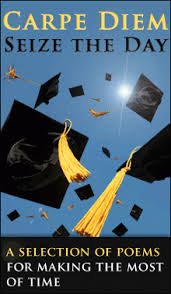
So, you just graduated from [pick one: high school, college, business school, law school, medical school, flight school, cooking school, firefighters academy, police academy] and you’re looking for a job. But here you are cruising the web instead of knocking on the doors of employers.  Carpe diem poems for making the most of time

You have come to the right place. To keep you in the flow where you need to be to get that job, let me suggest this article from the Academy of American Poets, “Carpe Diem: Poems for making the most of time.” And most especially, let me suggest the 28 poems they list there on plucking the day. The chief list of 28 you will find below the fold.

The Latin phrase and a lot of the history of the idea in poetry gets a lithe explanation in the essay there:

The Latin phrase carpe diem originated in the “Odes,” a long series of poems composed by the Roman poet Horace in 65 B.C.E., in which he writes:

Scale back your long hopes

to a short period. While we
speak, time is envious and

is running away from us.
Seize the day, trusting
little in the future.

Various permutations of the phrase appear in other ancient works of verse, including the expression “Eat, drink, and be merry, for tomorrow we die,” which is derived from the Biblical book of Isaiah. At the close of “De rosis nascentibus,” a poem attributed to both Ausonius and Virgil, the phrase “collige, virgo, rosas” appears, meaning “gather, girl, the roses.” The expression urges the young woman to enjoy life and the freedom of youth before it passes.

Since Horace, poets have regularly adapted the sentiment of carpe diem as a means to several ends, most notably for procuring the affections of a beloved by pointing out the fleeting nature of life . . .

The careful reader will find another three poems on the topic hidden in the list at the end of the article.

Graduates, you’d be happy with just a little per diem at the moment. I can’t give you that. You might find that these poets give you much more. Seize the opportunity, and see for yourself.

Read the rest of this entry »


Typewriter of the moment: W. H. Auden at Swarthmore

June 25, 2008

Poet W. H. Auden taught students at Swarthmore for three years, 1942-1945. Swarthmore’s library started rather early to collect Auden’s manuscripts and other materials, including the typewriter he used there — an Underwood, as you can see, below.

Auden's typewriter during his Swarthmore years (1942-1945).

Auden’s typewriter during his Swarthmore years (1942-1945).

The library has a detailed, on-line exhibit of Auden’s work and associations with the college, material useful for student research and in-class presentations related to his work.

Auden’s poetry was contemporary, and it reflected the fears and passions of lovers, and lovers of liberty, in the face of the fascist threat of World War II.  Auden died, aged by tobacco, alcohol and barbituates, in 1973, aged 67.

Resources:

Add to FacebookAdd to NewsvineAdd to DiggAdd to Del.icio.usAdd to StumbleuponAdd to RedditAdd to BlinklistAdd to TwitterAdd to TechnoratiAdd to Furl

Save

Save

Save

Save


More on McLeroy’s war on Texas English students

May 25, 2008

The Houston Chronicle’s coverage of the Texas State Board of Education meetings this week is not well indexed on the web. Following a couple of odd links I found Gary Sharrar’s article (he’s the Chronicle’s education reporter), though the Associated Press Story shows up for the paper’s main article on most indices I found.

Sharrar adds a few details of Kommissar McLeroy’s war on English education, but the significant thing about the story is in the comments, I think. One poster appears to have details that are unavailable even from TEA. Partisans in the fight have details that Texas law requires to be made public in advance of the meetings, while the state officials who need to advise on the regulations and carry them out, do not.

TEA has an expensive website with full capabilities of publishing these documents within moments of their passage. As of Sunday morning, TEA’s website still shows the documents from last March. Surely Texas is not getting its value from TEA on this stuff.

Sharrar wrote:

Two different outside groups offered opposite reactions. The Texas Public Policy Foundation, a free-market think tank, favored the board’s action.

“It is obvious that too many Texas public school students aren’t learning the basics with our current curriculum,” said Foundation education policy analyst Brooke Terry. “We are glad the new curriculum will emphasize grammar and writing skills.”

Texas public schools fail to adequately prepare many students for college or the workplace, she said, citing a 2006 survey by the Conference Board found that 81 percent of employers viewed recent high school graduates as “deficient in written communications” needed for letters, memos, formal reports and technical reports.

But the Texas Freedom Network, which promotes public education, religious freedom and individual liberties, called the board divisive and dysfunctional.

“College ready” generally means reading well, and reading broadly in literature. From a pedagogical standpoint, emphasizing “grammar and writing skills” over the reading that is proven to improve grammar and writing skills will be a losing battle. I hope the details of the plan will show something different when TEA ever makes them available to the taxpaying/education consuming public and English teachers. NCLB asks that such changes be backed by solid research — it will be fascinating to see whether there is any research to support the Texas plan (not that it matters; this section of NCLB has been ignored by the right wing from the moment NCLB was signed).

Prior to this week’s series of meetings, Commissar McLeroy expressed what sounds like disdain for reading in the English curriculum to the El Paso Times:

But chairman McLeroy said he would fight against some of the measures the educators want, especially the comprehension and fluency portion.

Their suggestions, he said, would have students waste time on repetitive comprehension strategies instead of actually practicing reading by taking in a rich variety of literature.

“I think that time is going to be lost because they’ll be reading some story, and they’ll just overanalyze,” he said.

By the way, calling the Texas Public Policy Foundation a “free market think tank” is misleading. The group is quite hostile to public education, and features on its board several people who have led fights to gut funding for public schools and impose bleed-the-schools voucher programs. The Foundation appears to endorse preaching in public schools and gutting science standards, among other problems.

If it’s good work, why is it done in secret? Remember that I spent years in right wing spin work in Washington. Here’s what I see: Either McLeroy’s administration at the state board is incredibly incompetent and can’t even get the good news right, and out on time, or there is another, darker and probably illegal agenda at work.

Below the fold, the full text of the comment from “WG1” at the Chronicle’s website.

Other resources:

Read the rest of this entry »


‘Twas the 18th of April in ’75 . . . (Paul Revere’s Ride)

April 19, 2008

Paul Revere — tonight’s the anniversary of his famous ride.

John Copley's painting of Paul Revere

Paul Revere, 1768, by John Singleton Copley (1738-1815)

John Copley painted all the bigwigs of revolutionary Boston, including this portrait of the famous horse-mounted alarm before he turned older and grayer.

And as April 18 is the anniversary of Revere’s ride, April 19 is the anniversary of the “shot heard ’round the world.”

Both events are celebrated in poetry; April is National Poetry Month. This could be a happy marriage for history and English classrooms.

National Poetry Month 2008 poster


Baltimore’s orgy of cartography and geography

March 22, 2008

The ad says “Come visit Utopia in Baltimore.” With an orgy of maps like that planned, it should be a Utopia for somebody: Geographers, cartographers, historians, and anyone interested in travel.

Baltimore’s Walters Art Museum hosts an outstanding exhibit of world-changing maps through June 8, a Festival of Maps; the entire town appears to have gone ga-ga on the idea. Baltimore will be Map Central for a few weeks, at least.

The Baltimore Sun (one of the truly great newspapers in America) described some of the cartographic gems on display:

Among the treasures is a huge and beautiful map of the fossil-embedded geological strata that underlie England and Wales. That masterpiece, published in 1815 by a pioneering geologist named William Smith, offered evidence used to support Darwin’s theory of evolution and set the stage for creation-vs.-evolution debates that still rage.

Then there’s the map researched by a doctor named John Snow in the 1850s. It allowed him to trace the source of a cholera outbreak in London to a well used by residents of a single neighborhood.

And there will be charts prepared by geographer Marie Tharp of the Mid-Oceanic Ridge, a mountainous rise in the mid-Atlantic seabed, based on data gathered by American submarines during World War II and later used to provide evidence of how the Earth’s crust has evolved through geological time.

The Smith and Snow maps anchor key events in science, the origin of paleontology and one of the greatest examples of public health sleuthing. To have both of those maps in one exhibition is a great coup for the Walters, and for Baltimore.

The exhibit also features a map of Utopia drawn by Sir Thomas Moore. Other maps were drawn by Benjamin Franklin, J. R. R. Tolkein, and Leonardo da Vinci.

Here’s a video description of one of the more remarkable pieces on view, a map of London, on a glove:

Vodpod videos no longer available. from www.baltimore.org posted with vodpod

♦ ♦ ♦ ♦ ♦ ♦ ♦ ♦ ♦

Surely there is material here for the Strange Maps blog.  Here’s a still of the glove, from the collection of The National Archives, UK:

Glove map, from London's 1851 Exposition

Below the fold, a partial list of some of the other exhibits and events planned in and around Baltimore, which will convince you, I hope, that it is indeed an orgy worth getting a ticket to see.

Baltimore remains one of my favorite towns, despite the loss of my Johnny Unitas-led Colts, despite the Orioles’ recent mediocrity; it’s a place of great history, great neighborhoods, and good food. Crabcakes from several sites, dinner at Sabatino’s, maps in the museums. Utopia indeed.

Read the rest of this entry »


Chairman McLeroy to Texas Hispanics: “Drop dead!”

March 20, 2008

With evidence mounting that the politically-motivated rewrite of English standards in Texas schools would harm the education of Spanish-speaking students, the Chairman of the Texas Education Agency told state legislators, English language experts and educators that he will not allow time to analyze the proposed changes to see if they are appropriate, let alone time for changes to the standards.

In short, McLeroy told Texas Hispanics to “drop dead.”

Board chairman Don McLeroy insisted that major changes to the proposed updates are no longer possible. Advocates say the standards need opinions from experts who have researched Hispanic children and understand their learning styles.

“There is no way that ignoring such a sizable chunk of this population from consideration of education policy will do anything but harm the opportunity of a generation,” Herrero said.

McLeroy said there had been plenty of time for experts to weigh in earlier on new curriculum standards. He said he was shocked by accusations that he and others board members are trying to shortchange Hispanic students.

“There’s no malice at all, none, zip, nada. There’s just no time to get another expert in,” McLeroy said. “None of us would do anything to hurt any group of children or any (individual) child. What we want is for them to be successful in the English language because it’s so important.”

In the latest of a string of politically charged bulldozings, McLeroy is pushing standards substituted at the last minute for standards Texas educators had worked on for three years. McLeroy hired a political consulting group to rewrite the standards and substituted the rewrite in a meeting earlier this year (you’ll see my bias when you read the story in the Ft. Worth Star-Telegram). Educators, parents, legislators and community leaders criticized the action for disregarding the educational needs of Texas students.

“It’s just ignorance on their part,” said Mary Helen Berlanga, a 26-year board member from Corpus Christi.

The board is set to take a preliminary vote March 27 on the new English language arts and readings standards, which will influence new textbooks for the 2009-10 school year.

A four-member board subcommittee signaled its intent Wednesday to stick with that schedule after state Rep. Abel Herrero, D-Robstown, pleaded to let Latino experts review the standards first.

McLeroy is flexing never-tried-before political muscles in a series of changes at TEA. Last year he led the SBOE to arbitrarily reject a math book by a major publisher, daring legal action, hoping he could finally win a case establishing that the board can reject books on political grounds. Biology books are due for a review in the near future, and science and biology standards will be rewritten before that process.

Moving against Hispanic students on the English standards, if successful, would tend to demonstrate that Texas educato needs to dance to the red book writings of Chairman McLeroy. While 47% of Texas public school students are Hispanic, Hispanic voters have generally packed less clout.

McLeroy appears to be counting on Obama and Clinton Democrats to demonstrate apathy again near the general election. If election numbers from the March primary hold up, McLeroy will remain chairman of the SBOE, but the legislature will be likely to shift against many of the actions he’s pushed since assuming the chair, and may turn antagonistically Democratic.

The stakes are higher for Texas students.

Critics of the process asked the subcommittee to allow an expert in Hispanic culture and language to assess the proposed new standards before a preliminary vote next week by the full education board.

The four-member subcommittee that worked on the curriculum did not include anyone of Hispanic descent, or anyone from South or West Texas, and critics said the committee did not seek advice from anyone with expertise in Hispanic language or culture.

Statewide, 47 percent of the more than 4.6 million public school students are Hispanic. Eighty-nine percent of El Paso County’s 173,000 students are Hispanic.

According to the Texas Education Agency, about 16 percent of students statewide and about 28 percent of students in El Paso County in 2006 had limited English proficiency.

Resources:


A Warren Chisum special: Bill gives Texas kids “right” to Bible classes

January 8, 2008

Cleaning up the mess left by the Texas Lege: Texas kids need help on history, Texas history, math, English and science, according to test scores. Texas colleges are fighting a wave of kids who graduate high school and head off to college without the key tools they need in writing and calculating.Texas Rep. Warren Chisum, R-Pampa

But Republican state Rep. Warren Chisum has awarded them a “right” to get a Bible class, the better to avoid preparation for college, I suppose. No kidding.

Molly Ivins’ Ghost is pounding on your door trying to get your attention. From the San Antonio Express:

A new law soon will require all Texas public school districts to offer a Bible as Literature course if 15 or more students express interest, but one San Antonio public school has been offering such a course for more than 30 years.

Churchill High School in the North East Independent School District has offered the Bible as Literature since the 1970s, when English teacher Frances Everidge pioneered the course. Last year, Reagan High School, also in the NEISD, added one. New Braunfels High School has offered the course for a year, and Seguin High School will begin offering it in the fall.

Last spring, the Legislature passed House Bill 1287, along with two other bills regarding religion in public schools. HB 1287, which Gov. Rick Perry signed into law last summer, states that all school districts must offer the course as an elective at the high school level by the 2009-10 school year.

Rep. Warren Chisum, R-Pampa, chairman of the House Appropriations Committee the bill’s author, said that if 15 or more students express interest in the Bible as Literature course, districts must offer it.

School districts may not be able to provide the mathematics instruction kids need, but — By God! — they must provide instruction in the Bible.

If Warren Chisum were not real, Norman Lear, William Faulkner, the Coen brothers and the screenwriters for “Deliverance” couldn’t dream him up.

Chisum is at least up front about his bigotry against science, math, literature and other faiths:

Because the law requires a school district to offer the Bible as literature course if 15 or more students express interest, what if 15 or more students express interest in the Koran or any other religious text?

“The bill applies to the Bible as a text that has historical and literary value,” Chisum said. “It can’t go off into other religious philosophies because then it would be teaching religion, when the course is meant to teach literature. Koran is a religious philosophy, not of historical or literary value, which is what the Bible is being taught for.”

One marvels at the coincidence that Chisum never had to take the Texas Assessment of Knowledge and Skills (TAKS) — with history chops like that, it’s unlikely he could pass the test every high school kid must. (There is neither an education nor intelligence requirement to serve in the Texas legislature.)

I was unaware of the mandatory nature happy to hear the mandatory part had been stripped from of Chisum’s Folly. Nothing like a drunken-sailor-spending unfunded mandate from the legislature. Charles Darwin at least supported Sunday school classes with his personal fortune. Warren Chisum doesn’t have such ethics — he’s stealing the money from your property tax contributions to do it, while stealing education from the kids.

We need one of those New Yorker cartoons with some sage carrying a sign, “The End is Near.”

Cynical tip of the old scrub brush to Texas Ed Spectator (the blog formerly known as TexasEd, now in a new home)


Typewriter of the moment: Flannery O’Connor

December 18, 2007

Flannery O'Connor's typewriter at her farm Andalusia, near Milledgeville, GA - NY Times photo

Photo by Susana Raab for The New York Times; caption: “The writer Flannery O’Connor’s desk and typewriter in her bedroom at Andalusia, her farm near Milledgeville, Ga. She was a master of the Southern Gothic.”

From the Travel section article of the New York Times, February 4, 2007, by Lawrence Downes:

I was met at the door by Craig R. Amason, the executive director of the Flannery O’Connor-Andalusia Foundation, the nonprofit organization set up to sustain her memory and preserve her home. When the affable Mr. Amason, the foundation’s sole employee, is not showing pilgrims around, he is raising money to fix up the place, a project that is a few million dollars short of its goal. The foundation urgently wants to restore the house and outbuildings to postcard-perfection, to insure its survival. Last year the Georgia Trust for Historic Preservation placed Andalusia on its list of most endangered places in the state.

For now, the 21-acre property is in a captivating state of decay.

There is no slow buildup on this tour; the final destination is the first doorway on your left: O’Connor’s bedroom and study, converted from a sitting room because she couldn’t climb the stairs. Mr. Amason stood back, politely granting me silence as I gathered my thoughts and drank in every detail.

This is where O’Connor wrote, for three hours every day. Her bed had a faded blue-and-white coverlet. The blue drapes, in a 1950’s pattern, were dingy, and the paint was flaking off the walls. There was a portable typewriter, a hi-fi with classical LPs, a few bookcases. Leaning against an armoire were the aluminum crutches that O’Connor used, with her rashy swollen legs and crumbling bones, to get from bedroom to kitchen to porch.

There are few opportunities for so intimate and unguarded a glimpse into the private life of a great American writer. Mr. Amason told me that visitors sometimes wept on the bedroom threshold.


More carnival: “Educational technology” is not oxymoronic

December 18, 2007

Here’s a new blog carnival you may find useful: The Educational Technology Carnival. The 6th running of that particular midway is posted at Global Citizenship in a Virtual World.

Which rather reminds me that I’ve added to my list of things I want in a technological adapted classroom: Movie lighting. I’ve lost count of the number of times I’ve been in a different classroom, and discovered that when the projector goes on, the lights must come down in order to see the image — and then discovered that when the lights go down, there’s not enough light to see to take notes, or to see for anything else.

I was filling in for a teacher who uses a lot of video (“Great!” I thought). Students picked up on the problem right away. “Another sleep lab today?” they asked.

But I digress.

I have fought in four districts to get filters off on sites that discuss evolution for biology students. In one district, it was easier to put filters on the creationism sites, IT told me, than get the filters off the sites that discussed the material the students needed. I discovered my own district now blocks this blog, which makes it difficult to refer students to specific material, at least from school. (Time to change districts?) So the discussion on who filters, and why, caught my eye. I’m not sure there is a good result.

This edition of the carnival also points to Rebecca Wallace-Segall’s Wall Street Journal opposite-editorial page piece on student competition in intellectual areas, a hot topic for me right now as I contemplate the Federal Reserve Board’s competition for economics students, the Fed Challenge.

So as you ponder why your school doesn’t give you lighting to view your projected material, why you don’t have adequate audio reproduction, where are you going to get a projector to show the PowerPoint presentation during 4th block, why can’t anyone make a non-boring, really dynamic PowerPoint, and whether your computer lab kids are downloading racy music videos to spike your bandwidth clogging problems, think that on your lunch hour you can take a look at blog carnival that at least empathizes — if it’s not blocked in your school.


Quote of the moment: How to succeed in business

November 4, 2007

Several years ago I found a quote attributed to business consulting guru Tom Peters, that ascribed success to hard work — if a lot of other things didn’t get in the way. I lost the quote, and the citation, and have sorely wanted to have it a hundred times since then when I found executives and administrators admonishing people for their failure to soar when the bosses themselves had anchored their employees to the ground.

Ah, the Glories of Google! I have found it again. Turns out it’s not Tom Peters after all; he quotes a passage from novelist Ann Beattie’s novel, Picturing Will.

It’s still worthy of noting; here is an excerpt from a Tom Peters column in 1990 featuring the passage:

Do everything right, all the time, and the child will prosper. It’s as simple as that, except for fate, luck, heredity, chance, the astrological sign under which the child was born, his order of birth, his first encounter with evil, the girl who jilts him in spite of his excellent qualities, the war that is being fought when he is a young man, the drugs he may try once or too many times, the friends he makes, how he scores on tests, how well he endures kidding about his shortcomings, how ambitious he becomes, how far he falls behind, circumstantial evidence, ironic perspective, danger when it is least expected, difficulty in triumphing over circumstance, people with hidden agendas, and animals with rabies.”

The quote is from Ann Beattie’s latest novel, Picturing Will. It speaks directly to an increasingly important corporate issue — the peril of overestimating our ability to influence outcomes. In short, the way we recruit, organize, plan and act very much depends on how much we feel that we are in control. The problem is ageless, though as the world becomes less predictable the consequences of personal or corporate hubris are increasingly severe.

Systematically review a stack of annual reports. Without fail, a good year is explained as “the fruits of the strategic planning process your management put in place five (three, seven) years ago.” A bad year, however, is invariably the result of “the unanticipated rise in interest rates (unexpected foreign competition, etc.) which upset our planning assumptions.” But our corporate chiefs are hardly alone. A sizable branch of psychology, called attribution theory, examines the way human beings explain events to themselves. In short, we attribute good outcomes to skill and hard work; bad ones to bad luck.

For centuries, Cartesian cause and effect thinking has dominated our science — and management — paradigms. The causeless, effectless, probabilistic world of quantum mechanics that informs today’s scientific thought has still not permeated our psyches — or our approach to making corporate strategy.

Beattie’s novel is listed as an academic selection now, by Random House.  Do you, or does anyone at your school, use this book?