ACLU and “Uncensored” exhibit

September 4, 2011

Special invitation just for you:

You’re invited: “Uncensored” Celebration at the Harry Ransom Center in Austin

On Friday, September 9, the Harry Ransom Center at the University of Texas announces “Uncensored,” the opening celebration for the fall exhibitions, “Banned, Burned, Seized, and Censored” and “The Greenwich Village Bookshop Door: A Portal to Bohemia, 1920-1925.”

Materials from the archive of ACLU attorney Morris Ernst, who defended James Joyce’s novel Ulysses against obscenity charges, are featured in the exhibition.

Order your tickets from the Harry Ransom Center’s website.

MORE ON THE EVENT (PDF)

From the flyer on the event:

Banned, Burned, Seized, and Censored

How did hundreds of thousands of books, pictures, plays, and magazines come to be banned, burned, seized, and censored in the span of less than 30 years? This exhibition, drawn from the Ransom Center’s holdings, reveals the rarely-seen “machinery” of American censorship from 1918 to 1941. Writers, reformers, agents, attorneys, and publishers battled publicly over obscenity and freedom of expression. Ulysses, All Quiet on the Western Front, Lady Chatterley’s Lover, and The Grapes of Wrath came under fire from would-be censors alongside classics like The Decameron and The Canterbury Tales.   This exhibition tells how the New York Society for the Suppression of Vice, the New England Watch and Ward Society, the Post Office Department, and the Customs Bureau irrevocably altered the American literary landscape.

The exhibit runs through January 22. The Harry Ransom Center is located at the corner of 21st and Guadalupe Streets on the campus of The University of Texas at Austin. For more information, including a map of parking options, visit http://www.hrc.utexas.edu/visit or 512-471-8944.


Teaching with original documents, at the 6th Floor Museum

July 29, 2011

6th Floor Museum Seminar - teachers in the Dallas Police Station, at Oswald's interrogation room

Teachers inspect the Dallas Police station, where accused assassin Lee Harvey Oswald was held. The door at left opens on the room where Oswald was interrogated by police. Panorama photo by Ed Darrell, use encouraged, with attribution; click for larger version

It’s been a good week of finding sources, for history issues across the spectrum, not just about the Kennedy assassination in Dallas.

Certainly one of the highlights was a bus tour that carried us from Dallas’s Love Field airport, along the route of Kennedy’s motorcade, to Parkland Hospital, and then through Oak Cliff along the route accused assassin Lee Oswald is believed to have traveled after the assassination to his capture at the much restored Texas Theatre on Jefferson Boulevard.

In the photo above we discuss the actions of Dallas Police after Oswald’s capture.  This room is in the old homicide division of the old Dallas Police Station, a building still in use for municipal offices and being renovated after the police department moved to a newer building a few years ago.  The door at the left leads to the room where Oswald was questioned about his actions and his knowledge of the day’s events.

Oswald's interrogation room in the old Dallas Police Department - photo by Ed Darrell, 6th Floor Museum teachers seminar

Cops and their desks departed years ago, but Oswald's interrogation room holds a fascinating, film noir atmosphere; view from inside the room, as teachers discuss events of November 22, 1963, in the larger office outside. Photo by Ed Darrell; click for larger view


Fun with Lyndon, George and Bill – and Audie

June 18, 2011

Five days on the road and we hoped to make it home Friday night.

Ed Darrell, presidents on weekends

"I've got the Presidential Seal / I'm up on the Presidential Podium. / My Mama loves me, she loves me . . ."* Playing around with the podium and teleprompter at the George H. W. Bush Presidential Library and Museum in College Station, Texas.

Air conditioning on the bus failed, and then the vacuum system failed and we lost the ability to close the door, and we started to lose brakes.  Fortunately, we were within sight of Dallas when things really came to smash.

So our Teachers Tour of Presidential Libraries came to an interesting end last night.  More good fortune — the bus stalled out in the parking lot of a gas station with a Dickey’s Barbecue attachedRoss Perot is right, at least about this:  Dickey’s food is worth the stop.

Other stops along the way provided nutrition for our minds, and for our classroom preparation.  Education experts at the 13 National Archives-related Presidential Libraries work together, and work separately, to create classroom friendly and classroom ready materials.   Beyond the museums, we were looking for history to use in our classes.  We got a lot of pointers to documents our students can use in class to learn history and how to write it.

This is the second year of this particular Teaching American History grant, from the U.S. Department of Education to the Dallas Independent School District.  It’s important that you know that, because Republicans in Congress propose to cut this program out.  This is one of the few programs I think has value way beyond the dollars spent on it.  TAH may become just one more victim of the conservatives’ War on Education.

I hope to post more about what we learned.

We toured the George H. W. Bush Presidential Library and Museum in College Station, Texas, the Lyndon Baines Johnson Presidential Library and Museum in Austin, the Audie Murphy and American Cotton Museum in Greenville, Texas, the William J. Clinton Presidential Library and Museum, and the Little Rock Central High School National Historic Site.

It was a rowdy group of teachers, of course, and we closed down every bookstore we found along the way.  The bus driver hopes never again to hear a single verse of  “99 Student Essays to Grade on the Desk.”

How’s your summer been so far?

_____________

Paul Simon, of course.


Bush I Presidential Library and Museum: Hello, Indiana Jones?

June 14, 2011

It’s not really that big — but what do you think of when you see this photo of the unindexed files at the George H. W. Bush Library and Museum (at Texas A&M at College Station, Texas)?

Unindexed files at the Bush I Library - 6-13-2011 1677-Photo by Ed Darrell, use permitted with attribution

Hello? Which row has the Arks of the Convenants?

Yeah, we all thought the same.

The big difference:  In College Station, archivists are working through these documents, indexing them for use.

They use Freedom of Information Act requests to set their agenda, which strikes me as bass ackwards, but they’re working on getting it done.


Big bone sale in Dallas, part 2: Is P. Z. Myers bidding on this one?

June 12, 2011

It’s perfect for him.  Perfect.  Bidding stands at about $2,500 at the moment:

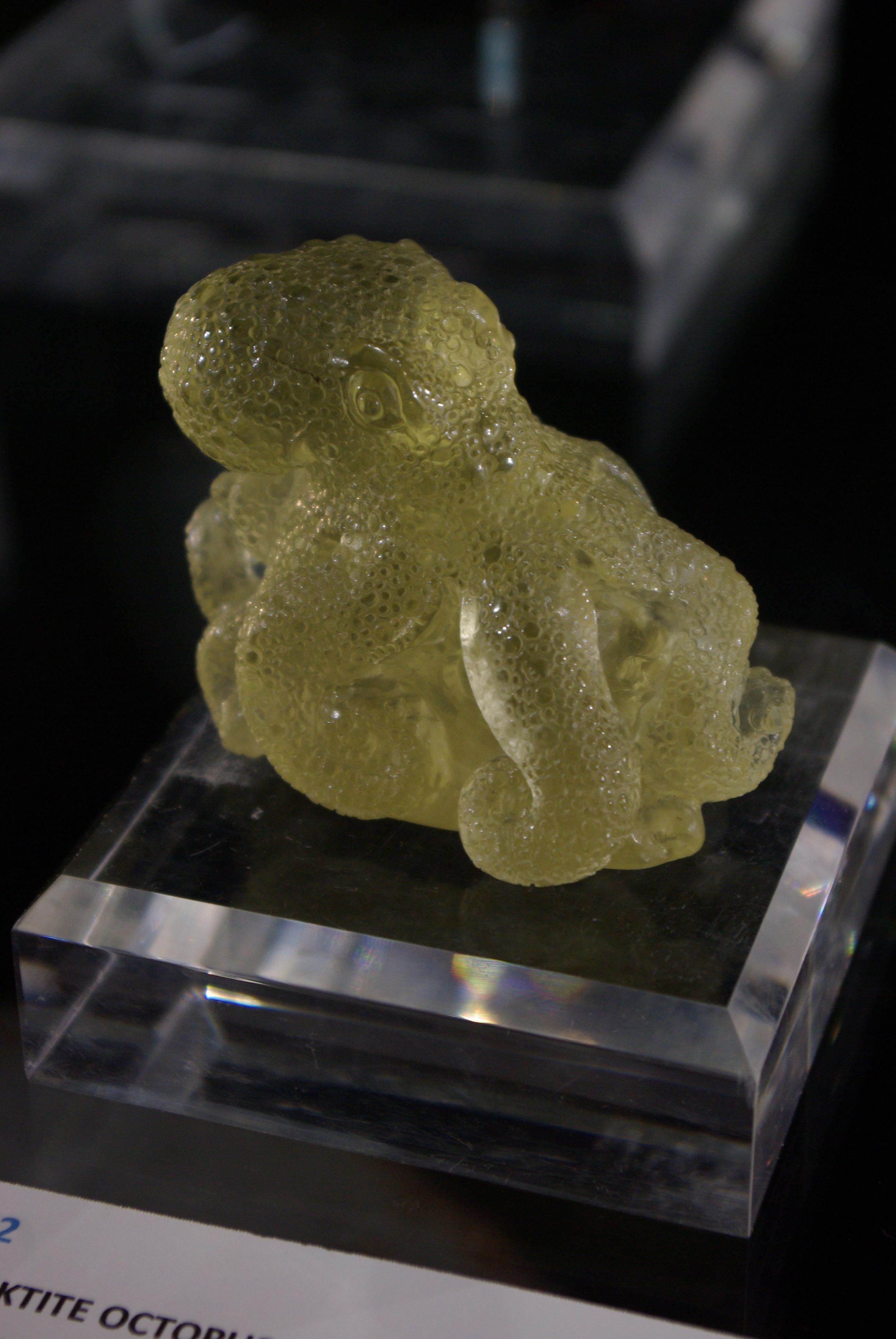
Gem tektite octopus - Heritage Auctions June 12, 2011 - IMGP6864 - copyright Ed Darrell, use permitted with attribution

Did our cephalopod overlords leave this for us, 29 million years ago? It's looking right at you, you know.

Is P. Z. Myers bidding on this thing?

According to the catalogue from Heritage Auctions, this piece of glass was formed in what is now the Libyan Sahara 29 million years ago when a meteoroid struck the sand, creating massive heat that fused sand into glass.  This light lemonade colored glass comes from only a small part of the Libyan sands.  Tektite is collectible by itself.  Some craftsman (unidentified and unplaced in time by Heritage Auctions) carved this piece into a cephalopod.

Taking an uncommonly large and clear specimen, the master lapidarist has carved the form of a malevolent-looking octopus, with superb rugose skin texture and a mass of curling tentacles. With a gorgeous translucence and lovely delicate green/yellow color, this exceptional sculpture measures 2¾ x 2 x 1¾ inches. Estimate: $2,800 – $3,200.

Compared to the giant articulated dinosaurs about 50 feet away from the display, one could easily overlook this little gem.  Still, bidding online looked to be pretty active.  Is P.Z. still in the British Isles?  Is he bidding by internet?  Is his Trophy Wife™ planning a Father’s Day surprise?

Tektites should pique your interest, Dear Reader.  Glass formed only when interplanetary objects smash into the planet, providing clues to the makeup of our solar system and universe, dating back well before recorded time, found in only a few fields around the Earth.  They are the perfect marriage-merger of geology, astronomy, geography, natural history, history and, in this case, art.   They are popular among collectors.    Who walks away with this one this afternoon?


Big bone sale in Dallas

June 11, 2011

Big bones.  Big sale.

Heritage Auction's triceratops, for Jun 12, 2011 auction

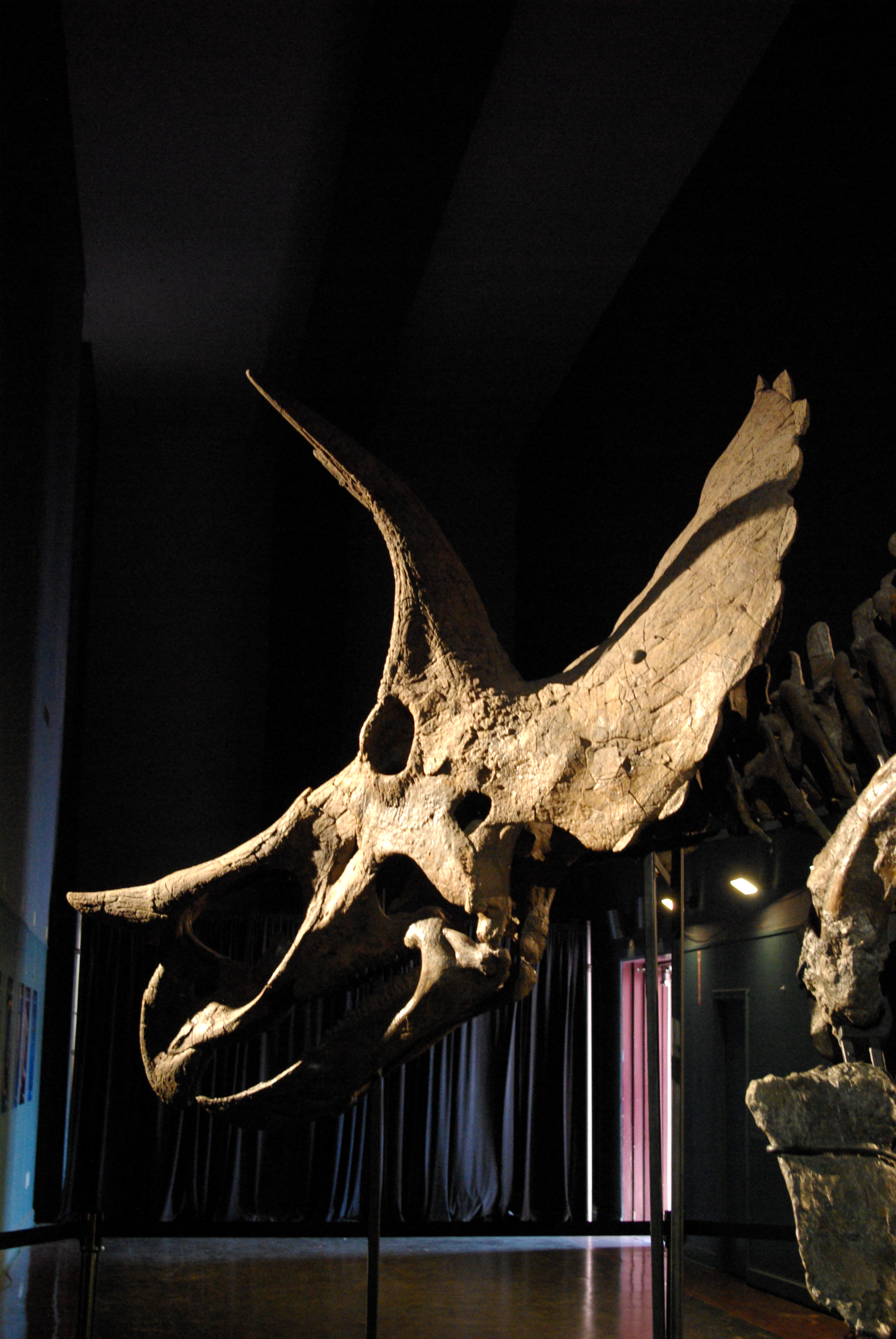
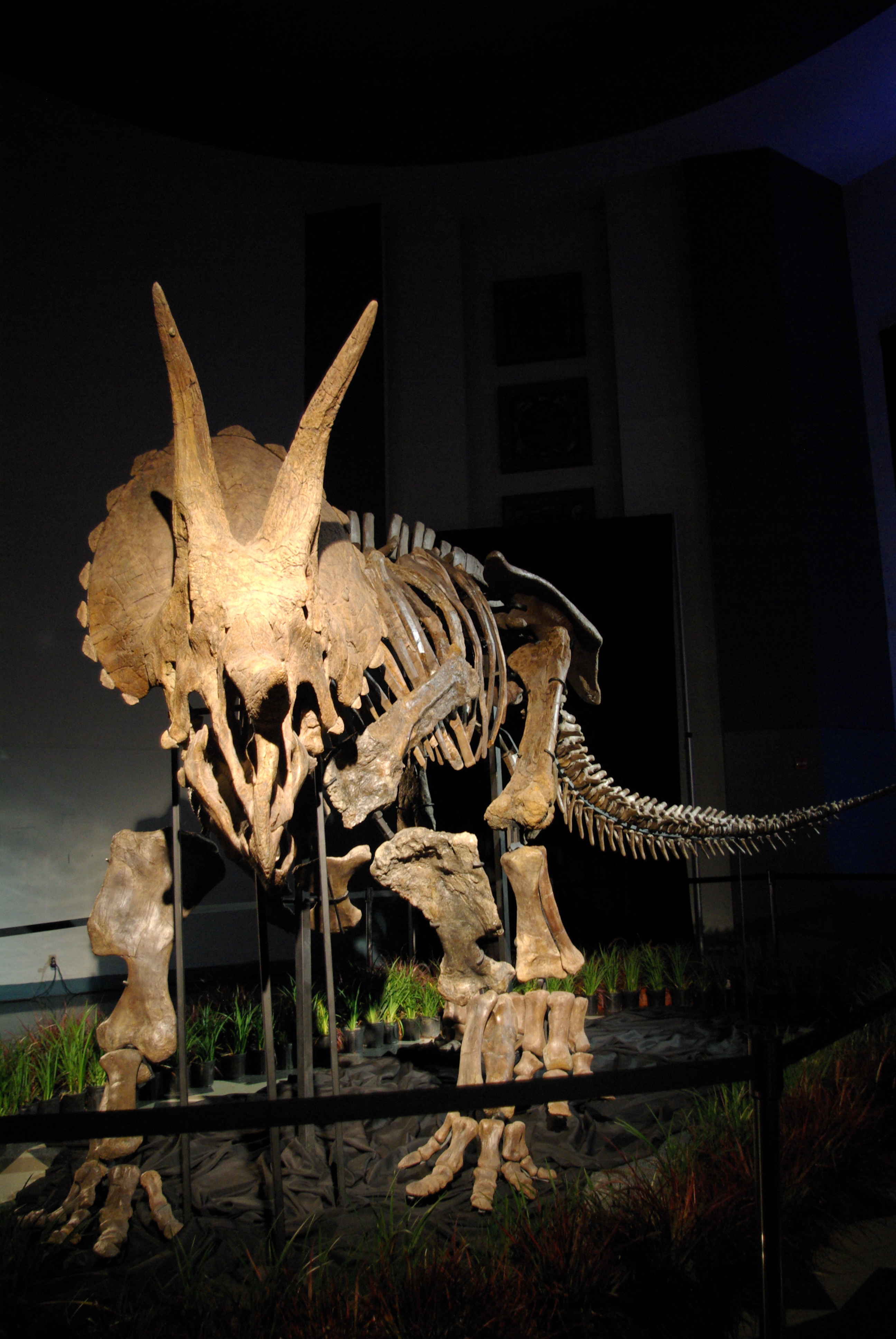
Triceratops welcomes bidders and gawkers to the Heritage Auction sale of fossils, gems, meteorites, and other national history ephemera. HA estimates this nearly-complete triceratops, mounted, to be worth about $700,000; less than 24 hours before the live auction, it has an online bid of $500,000 already.

Heritage Auctions set up a bug bunch of fossils, gems, meteorites, taxidermy, and art work from natural materials, for an auction on Sunday, June 12, 2011.

2011 June Dallas Signature Platinum Natural History Auction – Dallas, TX.  Auction #6061.

I can’t afford to bid, but they let me in to get photos.  Nice people.

Heritage Auctions' June special, a triceratops - IMGP6882 photo by Ed Darrell; use permitted with attribution

Heritage Auctions' June special, a triceratops - photo by Ed Darrell; use permitted with attribution

The triceratops greets visitors and bidders at the display site, the Tower Building at Dallas’s art deco gem, Fair Park.  (If you look at the ceiling above the triceratops, you can see where restorers have stripped away several layers of paint to reveal the original ceiling paintings — original artwork, including murals, was painted over in the years following the dramatic debut of the buildings; restoration work proceeds slowly because of lack of funding.)

Triceratops horridus
Cretaceous
Hell Creek formation, Harding County, South Dakota

Researchers dug this particular specimen out of the ground in 2004.  HA’s description just makes one’s science juices flow:

Triceratops has enjoyed much cultural publicity ever since its discovery. It is an iconic dinosaur that has appeared in movies ranging from black and white cinema to modern movies like “Jurassic Park.” It has also been in cartoons, such as the children’s classic “The Land before Time.” Triceratops is also the official state fossil of South Dakota and the official state dinosaur of Wyoming.

The present specimen was discovered in 2004 in two parts: First, the fossil hunters came upon pieces of dinosaur bone eroding down a gully. Following these bone fragments, they eventually came upon large bones that would indicate the presence of a large Ceratopsian dinosaur. While this large mass of bones was being excavated, other members of the team followed another bone trail which led them to an amazingly well preserved skull 750 feet away from the original discovery. Over the course of months, the specimens were carefully excavated in large blocks; each specimen was covered in plaster jackets and removed from the field to the lab. It was only during preparation that they discovered the dinosaur was a Triceratops, and it happened to be a Triceratops with an incredibly complete skull. The bones and skull were carefully removed from their field jackets and prepared using hand tools. Broken bones were professionally repaired and restored while a few missing elements were cast from other Triceratops skeletons. A custom made mount was created to support the bones and the skull; innovative bracket mounts were crafted for each bone so that no bones had to be damaged in order to mount them. The bones were mounted in osteologically correct position; making it comparable to and possibly surpassing the accuracy of older mounts in museum displays. Though it is impossible to say whether or not the skull is original to the specimen, being discovered 750 feet apart, it is certainly possible that the two elements are associated for a number of reasons: first, the size of the skull is consistent with the proportional size dimensions of the skeleton, and second, the surrounding matrix (host rock) was identical in composition.

The completed skeleton is enormous; measuring 19 feet long from head to tail, 11 feet across, and towering 12 feet tall. The skull itself measures 7 feet long with 3 ½ foot long horns; placing it near the top of the size range for Triceratops skulls. The leg bones stand 10 feet tall from toes to the top of the scapula; dwarfing many other Triceratops skeletons. Given that the skull represents about 30% of a dinosaur’s entire skeleton, the present specimen is about 75% original bone, with the right leg, pelvic region, several cervical vertebrae and a few tail vertebrae being cast reproductions.

Who owns the thing?  Who put it together?   Who is losing the specimen, should it go to a private collection (you got a living room that big?), and which museum really wants it?

But that’s just one of the specimens up for sale at this auction, and not necessarily the best.  Also up for bid:  A stegosaurus, and an allosaurus, posed as a “fighting pair.”

Fighting pair - allosaurus and stegosaurus, from Heritage Auctions' June 12, 2011 sale of fossils IMGP6839 - photo copyright by Ed Darrell, use permitted with attribution

The "fighting pair," an allosaurus (left) and stegosaurus (right) posed in combat positions. Photo by Ed Darrell, use permitted with attribution.

If it sells, the stegosaurus will cost a lucky bidder more than $1 million.  The allosaurus requires $1.6 million.

Am I jaded?  On the one hand you can’t look at these specimens without thinking they deserve to be seen by kids, and adults, and studied by paleontologists and biologist of all stripes — and so who has the right to sell these off?  On the other hand, this is a Second Gilded Age, and the search for prize fossil specimens is often financed by the proceeds from these auctions.  I enjoyed an hour’s browsing and photographing — a slide presentation on the wonders of America for some sleepy class next fall.

How many of these specimens will I get a chance to see again in the future?

Or, Dear Reader, how many of these will you ever get a chance to see?

HA will sell a lot more than just a few dinosaur fossils.  This same sale includes the largest shark jawbone ever found, stuffed Kodiak and polar bears (from the same hunter), gems, art from petrified wood and fossilized fish, and a large selection of meteorites, including the only meteoroid ever confirmed to have struck and killed a living creature (a cow in Argentine; you can’t toss a stone without hitting a cow in Argentina, I hear).

Giant shark jaw for Heritage Auctions' June 2011 sale

Requires a large wall and high ceilings to display

I don’t plan to go bid; there’s about an hour remaining for online bidding tonight, but if you’re interested and you’ve got your income tax refund burning a hole in your pocket, you can also bid by telephone and hotlink on the internet (go to the Heritage Auction site for details).   Frankly, I don’t think the sale will get the attention it deserves.  I hope these spectacular specimens will land where they can get  a great, admiring and studious audience.


Free bus tours to the FDR Library?

June 6, 2011

Franklin Roosevelt voting in Hyde Park, New York

Franklin Roosevelt voting in Hyde Park, New York, November 2, 1937 - FDR LIbrary image

In the Dallas district, and across much of Texas, field trips are being cut out.  Budget restraints, you know.  Rick Perry’s math is atrocious, and the “surplus” he claimed we had in the budget turned out to be a $27 billion deficit.

So, I got quite excited to read this press release from the Franklin D. Roosevelt Presidential Library and Museum in Hyde Park, New York:

FOR IMMEDIATE RELEASE

For information call:
Clifford Laube at (845) 486-7745

YOUR BUS COULD BE ON US!

New funding available for field trips to historic Hyde Park destinations

HYDE PARK – Field trips are back! The National Park Service and FDR Presidential Library and Museum are pleased to offer new transportation grants for 2011 field trips to five renowned Hyde Park destinations – FDR Presidential Library and Museum, Home of FDR National Historic Site, Eleanor Roosevelt National Historic Site, Top Cottage and Vanderbilt Mansion National Historic Site.

The new grants are managed by Teaching the Hudson Valley (THV), a nonprofit that helps educators and students discover and appreciate the natural, historical and cultural treasures of the Hudson Valley. A list of available programs and grant application form are available in the Grants section of THV’s website.

“These sites are brimming with world-class learning opportunities for local students,” said Sarah Olson, superintendant of the Roosevelt-Vanderbilt National Historic Sites. “We recognize that many school districts have cut back or eliminated field trips due to budget constraints. These grants are designed to put great field trips back in reach.”

Educators are free to create their own curriculum, and the sites have a wide variety of prepared curricula, including:

  • Pretend You are the President, grades 4-6
  • Eleanor Roosevelt: First Lady of the World, grades 4-6
  • FDR’s Boyhood Farm, grades 1-3
  • Searching for Salamanders, grades 7-12
  • Podcasts interpreting the many trails that traverse the 5 sites

“To walk in the footsteps of history, to touch and hear nature – these are the experiences that make learning vivid and memorable,” said Lynn Bassanese, director of the FDR Presidential Library & Museum. “Field trips are becoming an endangered species, but the need for them is still great. Together these sites have provided decades of great experiences for educators and students. These new grants will help us continue the tradition.”

K-12 educators in public and private schools may apply for regular, summer or after-school programs. Trips should be related to core curriculum or programs and take place by December 31, 2011. Teachers in the same school or district may apply together.

ABOUT THV

Launched in 2003, Teaching the Hudson Valley (THV) helps educators and students discover and appreciate the natural, historical, and cultural treasures of the Hudson Valley. THV programs foster collaboration between schools and informal learning sites. Our growing collection of free K-12 lessons uses significant Valley sites to teach all subjects. For details, visit http://www.TeachingtheHudsonValley.org.

THV is a program of the Hudson River Valley National Heritage Area and HRV Greenway Conservancy, Inc.; National Park Service – Roosevelt-Vanderbilt National Historic Sites; Hudson River Estuary Program/NY State Dept. of Environmental Conservation; and Hudson River Valley Institute at Marist College.

#   #   #

Alas, it turns out it’s not intended for Texas classrooms.  Drat.

I’ve taken large groups of 14-16 year-olds through those sites.  An halfway interested teenager can get eyes opened seeing how FDR grew up, in the place he grew up.  The library and museum offer spectacular displays on FDR’s presidency and the times.  It’s exactly the sort of experience a lot of my students have never had, but need.

I’ll have to see what we can do with museums and libraries a little bit closer — the George H. W. Bush Library in College Station, Texas, the Lyndon Johnson Library in Austin, and the  Bill Clinton Library in Little Rock.  Possibilities of touring close-by sites make me quiet about the odd situation at the George W. Bush Library and Center for Right-Wing Propaganda planned for Southern Methodist University.   There’s a great chance that the advantages of having the educational resources will outweigh the ignominy of the propaganda activities (though the Hoover Institute makes one appropriately wary).

Look for some reports back, soon.  While you wait, call the Texas Lege and tell them to appropriate enough money to educate the students in the American Way, will you?  The Lege is still meeting in Austin, in emergency, special session.


Scouts Shooting for the Moon: The story of twelve Moon walkers, and Scouting

April 30, 2011

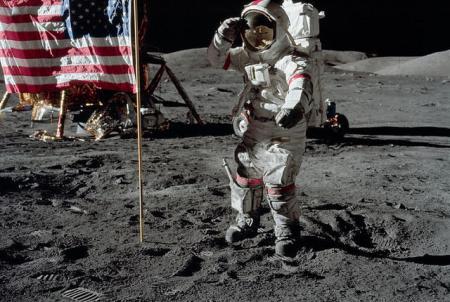
1cernan_jump_salutes_flag_-_gpn-2000-001273_0

Astronaut and 2nd Class Boy Scout Eugene Cernan saluted the U.S. flag on the Moon, on the last Apollo mission, Apollo 17. Photography by Astronaut and Tenderfoot Scout Harrison Schmitt. NASA image.

A short piece I presented this morning to the Tom Harbin Scout Museum Symposium on Scout History, a great morning organized by Bob Reitz, the curator of the Tom Harbin Scout Museum at Camp Wisdom, in Dallas, Texas. Of course the material is copyrighted, but by all means you have permission to use the material at Courts of Honor or in recounting the better history of Boy Scouting.

Scouts Shooting for the Moon:  The story of twelve Moon walkers, and Scouting

This is a recreation with modern numbers of a presentation first used a decade ago. Searching for material for a speech to honor Eagles at our District Dinner, several people suggested in a short period of time, ‘Why not talk about the astronauts who landed on the Moon. I hear they were all Eagle Scouts.’  Was that accurate?  It would have been a good story if so. Research revealed something quite different. The true story can carry just as much inspiration, however. Scouting is shown to be a program that can lead to a lifetime of adventure and accomplishment. Also, Eagles may take some inspiration in knowing they have accomplished something most of the men who walked on the Moon did not.

Speakers constantly need good material for Eagle Scout Courts of Honor and other events honoring Scouts and Scouters. For one event honoring a group of new Eagle Scouts, several people urged that I research the facts behind the story they had heard, that most, or all of the men who walked on the Moon were Eagle Scouts. New Eagles would find comfort in knowing they had soared into the midst of such company, they reasoned.

So it came to pass that, before the advent of Wikipedia and Google, I spent hours on the telephone until a press person at NASA pointed out to me a collection of information on astronauts that NASA had thoughtfully put on-line. At some high cost I printed out the few pages that dealt with the Scouting experience of astronauts, and worked to correlate it with information about which of them had gone to the moon, and which had not.

Anyone can find that book online with ease, today. The NASA Astronaut Fact Book provides information on almost every detail about NASA’s crew of astronauts, past and present. It includes one-and-a-half pages on the Scouting background of people working as astronauts and payload specialists for NASA, and others NASA has launched into manned missions. Cross-indexing that information with lists of Apollo Mission astronauts, I created four short tables showing the Apollo astronauts who went to the Moon, their missions, and the Scout rank they achieved, if any.

Lunar Astronauts and Scouting Experience

Twelve Moon Walkers

Name Mission Dates on the Moon Scout Rank
1 Neil Armstrong Apollo 11 July 21, 1969 Eagle Scout
2 Buzz Aldrin Apollo 11 July 21, 1969 Tenderfoot Scout
3 Pete Conrad Apollo 12 November 19-20, 1969 Cub Scout
4 Alan Bean Apollo 12 November 19-20, 1969 1st Class
5 Alan Shepard Apollo 14 February 5-6, 1971 1st Class
6 Edgar Mitchell Apollo 14 February 5-6, 1971 Life Scout
7 David Scott Apollo 15 July 31-August 2, 1971 Life Scout
8 James Irwin Apollo 15 July 31-August 2, 1971 None
9 John Young Apollo 16 April 21-23, 1972 2nd Class
10 Charles Duke Apollo 16 April 21-23, 1972 Eagle Scout
11 Eugene Cernan Apollo 17 December 11-14, 1972 2nd Class
12 Harrison Schmitt Apollo 17 December 11-14, 1972 Tenderfoot Scout

Apollo 13

Name Mission Dates on the Moon Scout Rank
1 Jim Lovell Apollo 13 Lunar Swingby Eagle Scout
2 Jack Swigert Apollo 13 Lunar Swingby 2nd Class
3 Fred Haise Apollo 13 Lunar Swingby Star

Lunar Missions That Did Not Land

Name Mission Dates on the Moon Scout Rank
1 Frank Borman Apollo 8 Orbited only None
2 Jim Lovell Apollo 8 (&13) Orbited only Eagle Scout
3 William Anders Apollo 8 Orbited only Life Scout
4 Tom Stafford Apollo 10 Orbited only Star Scout
5 John Young Apollo 10 (& 16) Orbited only 2nd Class
6 Eugene Cernan Apollo 10 (& 17) Orbited only 2nd Class

Others Who Did Not Land

Name Mission Dates on the Moon Scout Rank
1 Michael Collins Apollo 11 Capsule pilot None
2 Dick Gordon Apollo 12 Capsule pilot Star Scout
3 Stewart Roosa Apollo 14 Capsule pilot None
4 Al Worden Apollo 15 Capsule pilot 1st Class
5 Ken Mattingly Apollo 16 Capsule pilot Life Scout
6 Ronald Evans Apollo 17 Capsule pilot Life Scout

In all, 24 men flew to the Moon. Twelve set foot on the lunar surface. Of the twelve, eleven were Scouts, two were Eagles. Of the 24, 20 were Scouts, three were Eagles.

At the time I originally researched, about 70% of all astronauts were alumni of Scouting, men and women. Officially, BSA lists 181 NASA astronauts as being alumni, 57.4%

NASA lists the colleges and universities astronauts attended. NASA lists military service, hometowns, and states of birth. But with the possible exception of a generic category of “public schools,” no category of astronauts is larger than the category of Scouting experience. If we were advising a young person on how to get to become an astronaut, we would be remiss if we did not advise him or her to join Scouting.

What can we conclude?

Three things became apparent to me in tracking these figures down. One, I learned once again that the true stories most often carry great value, more value than the stories people make up, or assume.

Two, I learned that Scouting by itself carries great value, without a Scout’s having earned Eagle. We know that not all the Moon walkers earned the Eagle rank. But we also notice that no flight ever went to the Moon without at least two Scouts aboard. Three of the 24 lunar voyagers are Eagles, 12.5%. Two of the dozen who actually set foot on the Moon are Eagles, 16.7%. Eleven of the twelve Moon walkers were Scouts, 91.7%. 21 of 24 lunar voyagers were Scouts, 87.5%.

So, while it was not necessary to be an Eagle, it certainly seemed to help. But simply having Scouting experience seemed to be the biggest help. There may be some magic in a boy’s having taken that oath that carries through his entire life, and spurs him to do daring and great things. That is important. A trend begins to emerge. Scouting by itself, without earning the highest rank, provides great value. When a boy signs up, he signs on for the adventure of a lifetime, and often that leads to a lifetime of adventure. That venturesome spirit carries on well past his Scouting years.

The story of Jim Lovell might carry some great weight with Scouts. Lovell is the only person to have gone to the Moon twice, but never set foot on it. He was the commander of Apollo 13, whose near-disaster was chronicled in the movie of the same name. Among other lessons that might be pulled out of the story:  When your Moon-bound spaceship explodes and loses power on the way to the Moon, it is often good to have an Eagle Scout handy to help get through the experience and return safely.

Is there inspiration here?

When I first presented these figures at a Scout meeting, a parent asked me whether these numbers would discourage boys from working for any rank advancement, since just being a Scout seems to carry such weight. This should not discourage Eagles, nor discourage any Scout from working to get the Eagle rank. We should look at it this way:  Every Scout who earns an Eagle has done what ten of the twelve who walked on the Moon did not do, perhaps could not do. Nine more Moon walkers started on that path to Eagle, but did not finish, or could not finish.

Not every Eagle can go to the Moon, but every Eagle has already won an award that most of those who did go to the Moon wish they had.

Especially in the circles of corporate and government leadership, character, what it is and how to get it, concerns people. What sort of character does it take to go to the Moon? Every Scout has a glimpse of what is required, and every Eagle can say, “I know what it takes to get such character.”

Bibliography

Human Spaceflight, “The Apollo Program,” NASA, July 2, 2009; accessed April 28, 2011; http://spaceflight.nasa.gov/history/apollo/

Astronaut Fact Book, NASA,  NP-2005-01-001JSC, January 2005; accessed April 27, 2011; spaceflight.nasa.gov/spacenews/factsheets/pdfs/astro.pdf

BSA, “Facts About Scouting,” 2009; accessed April 28, 2011; http://www.scouting.org/about/factsheets/scoutingfacts.aspx

“Astronauts With Scouting Experience,” Eagle Scout Information, U.S. Scouting Service Project, April 6, 2011; accessed April 29, 2011; http://www.usscouts.org/eagle/eagleastronauts.asp

About the author:

Ed Darrell teaches U.S. History at Moises E. Molina High School in Dallas. He has taught economics, government, world history and street law in high schools; he also taught at the University of Utah, University of Arizona, and DeVry University. He is a former speech writer for politicians. His degree in Mass Communication came from the University of Utah, and his law degree from George Washington University. This was presented to the Jack Harbin Museum Symposium of Scout History, April 30, 2011.

World Scout badge carried to the Moon by Astronaut Neil Armstrong.

World Scout badge carried to the Moon by Astronaut Neil Armstrong.


Save


Bathtub reading near the end of spring break, 2011

March 18, 2011

No, they are not trying to get rid of unions, just trying to balance their budgets.  Right?

Other than Rand Paul, Republicans don’t need low-flow toilets, because when it comes to conservation, climate change and the facts, Republicans just don’t give a s—.

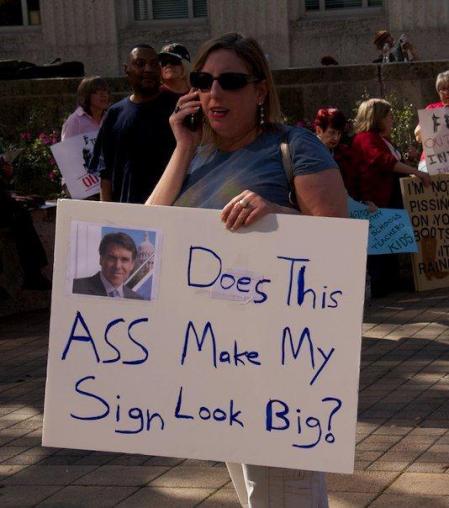
Oooh.  Signs from the teacher protests of budget cuts in Austin, Texas!

Does this ass, Rick Perry, make my sign look big?  Austin, March 2011

Protester in Austin, Texas, March 2011

Peace Corps celebrates 50 years this year.  Steve Mott tells of his first year as a Peace Corps volunteer in a remote corner of Nepal. (From the Norwell (Massachusetts) Mariner Wicked Local online.) (Suitable for a warm-up at least, teachers — maybe good for your unit on the 1960s and the Kennedy administration.  “In 1966 it was the Beach Boys and when I got back in ’68 it was Janis Joplin,” he said.  “A lot of social changes had taken place in two years.”

Oh, those jocular Tea Partiers!  Now they want to bring back child labor, in Maine, and in Missouri.  They’re serious when they say they oppose all the “progressive agenda” from the Progressive Era.  Look out Women’s Christian Temperance Union and anti-child abuse laws.  (Tea Partiers get all get their marching orders from Tea Bag Central — surely other states will follow; let us know if similar bills are in the hopper in your state legislature, eh?)

I keep finding good and interesting stuff in the Imperial War Museum.  Have you ever been there?  I wish they would do more online.  “War Shapes Lives,” a motto on their website.  An understatement of history.  This painting hangs in the museum, John Singer Sargent’s  “Gassed.”  At the museum, you may view it in its majesty, 20 feet along the wall, 7½ feet high.

Gassed, by John Singer Sargent.  Imperial War Museum

Gassed, by John Singer Sargent. Imperial War Museum


Civility? Doing lunch the rights way, North Carolina, February 1, 1960

February 1, 2011

Today is the 51st anniversary of the Greensboro sit-in. Be sure to read Howell Raines’ criticism of news media coverage of civil rights issues in last year’s New York Times: “What I am suggesting is that the one thing the South should have learned in the past 50 years is that if we are going to hell in a handbasket, we should at least be together in a basket of common purpose.”

Four young men turned a page of history on February 1, 1960, at a lunch counter in a Woolworth’s store in Greensboro, North Carolina.

Ezell A. Blair, Jr. (now Jibreel Khazan), Franklin E. McCain, Joseph A. McNeil, and David L. Richmond, sat down at the counter to order lunch. Because they were African Americans, they were refused service. Patiently, they stayed in their seats, awaiting justice.

On July 25, nearly six months later, Woolworth’s agreed to desegregate the lunch counter. One more victory for non-violent protest.


Ezell A. Blair, Jr. (now Jibreel Khazan), Franklin E. McCain, Joseph A. McNeil, and David L. Richmond leave the Woolworth store after the first sit-in on February 1, 1960. (Courtesy of Greensboro News and Record)

Ezell A. Blair, Jr. (now Jibreel Khazan), Franklin E. McCain, Joseph A. McNeil, and David L. Richmond leave the Woolworth store after the first sit-in on February 1, 1960. (Courtesy of Greensboro News and Record) (Smithsonian Institution)

News of the “sit-in” demonstration spread. Others joined in the non-violent protests from time to time, 28 students the second day, 300 the third day, and some days up to 1,000. The protests spread geographically, too, to 15 cities in 9 states.

On the second day of the Greensboro sit-in, Joseph A. McNeil and Franklin E. McCain are joined by William Smith and Clarence Henderson at the Woolworth lunch counter in Greensboro, North Carolina. (Courtesy of Greensboro News and Record)

Smithsonian caption: "On the second day of the Greensboro sit-in, Joseph A. McNeil and Franklin E. McCain are joined by William Smith and Clarence Henderson at the Woolworth lunch counter in Greensboro, North Carolina. (Courtesy of Greensboro News and Record)"

Part of the old lunch counter was salvaged, and today is on display at the Smithsonian Institution’s Museum of American History. The museum display was the site of celebratory parties during the week of the inauguration as president of Barack Obama.

Part of the lunchcounter from the Woolworths store in Greensboro, North Carolina, is now displayed at the Smithsonians Museum of American History, in Washington, D.C.

Part of the lunchcounter from the Woolworth's store in Greensboro, North Carolina, is now displayed at the Smithsonian's Museum of American History, in Washington, D.C.

Notes and resources:

Student video, American History Rules, We Were There – First person story related by Georgie N. and Greg H., with pictures:

Associated Press interview with Franklin E. McCain:

This is mostly an encore post.


The view from the seat of the pilot of the Enola Gay / Smithsonian National Air and Space Museum

December 19, 2010

Old friend and thorn in the side Gil Brassard in Baton Rouge alerted us to this wonderful marriage of modern technology and history from David Palermo Photography — an interactive, panoramic view of the cockpit of the Enola Gay, the B-29 from which the first atomic bomb used in war was dropped.

How can you use this in class, teachers?  Got a lesson plan that puts a student in the seat of the pilot?

Vodpod videos no longer available.

Enola Gay / Smithsonian National Air and Space …, posted with vodpod

For technical reasons beyond my ken, one may not make this a full screen image. No problem. Go to David Palermo’s site, and see this as big as your computer monitor. I recommend viewing it there — it’s better, really.

Palermo has a portfolio of cockpits he’s shot at the Smithsonian, including the French Concorde, Gemini VII, a Bell Huey helicopter, Mercury Friendship VII, and a Lockheed Martin X-35 — with spherical panoramas available of those and more (look for the link that says “HD360°” and look at the drop-down menu).  He sells massive prints of the cockpits — something special for aviation and space buffs.


Typewriter of the moment: William Saroyan

December 19, 2010

William Saroyan's typewriter, photo from the Bancroft Library, University of Caliornia - Berkeley

William Saroyan's typewriter, displayed at the Saroyan Museum at his home in San Francisco - photo from the Bancroft Library, University of California; Berkeley

William Saroyan’s niece, Jacqueline Kazarian, recently gifted the Bancroft Library with a significant part of the archives of Saroyan’s work.  The press release on the gift included a photo of Saroyan’s Fox typewriter, which is displayed at the Saroyan museum in San Francisco.

Saroyan came from an Armenian American family, born in Fresno, California in 1908.  His writings illuminated the experience of Californians and Armenian Americans, especially during the Great Depression.

In many ways Saroyan’s work symbolizes the uniqueness of the Armenian community in America, especially California.  [You still out there, Ben Davidian?]   Wikipedia strikes the right tone:

Saroyan’s stories celebrated optimism in the midst of the trials and tribulations of the Depression. Several of Saroyan’s works were drawn from his own experiences, although his approach to autobiographical fact contained a fair bit of poetic license.

His advice to a young writer was: “Try to learn to breathe deeply; really to taste food when you eat, and when you sleep really to sleep. Try as much as possible to be wholly alive with all your might, and when you laugh, laugh like hell.” Saroyan endeavored to create a prose style full of zest for life and seemingly impressionistic, that came to be called “Saroyanesque”.

The complete May 19, 2010,  press release from the University of California is below.

a sketch "from a Turkish admirer," a photo of the author in his youth, and a framed sketch of Saroyan

The Bancroft Library's new archival material on William Saroyan includes (left to right) a sketch "from a Turkish admirer," a photo of the author in his youth, and a framed drawing of Saroyan with a passage of his writing on Armenia. (Images courtesy of the Bancroft Library)

The Bancroft Library accepts gift of William Saroyan archives

By Kathleen Maclay, Media Relations | 19 May 2010

William Saroyan

William Saroyan (Photo courtesy of The Bancroft Library)

BERKELEY — The Bancroft Library at the University of California, Berkeley, has received a spectacular gift of hundreds of books, drawings, correspondence and other personal communications to and from one of America’s best-known writers, the Armenian-American author and playwright William Saroyan.

The rich collection includes approximately 48 cartons with 1,200 books and other archival materials assembled by his niece, Jacqueline Kazarian, of San Francisco, who also is the founder of the William Saroyan Literary Foundation International. A celebration of the gift is set for noon on Friday (May 21) at The Faculty Club on campus.

“UC Berkeley is such an incredible place of learning and growing and intellectual exploration,” said Kazarian, who earned degrees in communication and decorative arts at UC Berkeley in the early 1950s. “I know that my uncle wanted his library, manuscripts and galleys to go to Berkeley. Students will be inspired by the collection.”

Apart from this gift, The Bancroft Library already retains significant holdings of Saroyan’s work that it collected over the course of his life and career, and it continues to add to that collection. Most of the latest materials come from Saroyan’s home on San Francisco’s 15th Avenue that is now a Saroyan museum directed by Kazarian. Those materials were supplemented by Kazarian’s extensive personal collection, as well as by items of Saroyan’s that she acquired through a prominent Boston archivist and via a Saroyan friend.

“Jacqueline Kazarian’s new gift is the largest and most substantial augmentation to the Saroyan collections at Bancroft that we have ever received,” said Peter Hanff, Bancroft’s deputy director.

The author’s classic manual typewriter, as displayed at his San Francisco home

The author’s classic Fox manual typewriter, as displayed at his San Francisco home. (Photo courtesy of The Bancroft Library)

Saroyan, born in Fresno, Calif., in 1908, drew extensively on his Armenian-American heritage and childhood experiences for his books, plays and short stories. Much of his writing was considered impressionistic and reflected a hearty optimism often hard to find during the gritty Great Depression. He died in 1981 at the age of 72, with his niece at his side.When Story magazine editors Martha Foley and Whit Burnett printed Saroyan’s “The Daring Young Man on the Flying Trapeze” in 1934, it was an immediate success, triggering Saroyan’s fame and standing as one of his many literary achievements.

“Uncle Bill’s writing revolutionized the short story,” said Kazarian, adding that she has always found his work “almost spiritual and fable-like.”

His five-act play, “The Time of Your Life,” is the only American play to have won both the New York Drama Critics’ Circle Award and the Pulitzer Prize. Saroyan’s work as a screenwriter with Hollywood director Louis B. Mayer on the film “The Human Comedy” won an Academy Award in 1943, and Saroyan later wrote a widely acclaimed book with the same title.

Kazarian’s gift to The Bancroft Library includes multiple first editions of Saroyan’s works, such as “The Daring Young Man on the Flying Trapeze,” “My Name is Aram” (1940), “The Human Comedy” and “Obituaries” (1979), and many materials personally inscribed by the writer. Also among the new items according to Steven Black, the head of acquisitions for Bancroft, are letters, telegrams and notes written by Saroyan to relatives and others close to him, mostly during the 1930s and 1940s.

antiquarian book dealer Peter Howard of Berkeley, shown here poring through Saroyan materials

Antiquarian book dealer Peter Howard of Berkeley, poring through Saroyan materials. (Photo courtesy of The Bancroft Library)

“He personalized a lot of what passed through his hands,” Black said, noting that much of the material features marginalia reflecting Saroyan’s thoughts and interests.

There also is a copy of Henry Miller’s “Aller Retour New York,” an 80-page journal about a 1935 visit by Miller to New York City and his journey aboard a Dutch ship back to Europe. It is inscribed by Miller to Saroyan.

And a Saroyan scrapbook in the collection contains press announcements about the Pulitzer Prize for his book, “The Time of Your Life.” He scoffed at the award, contending that the arts should not be judged by commerce.

The new Bancroft collection also contains a pre-publication proof of “Burnt Norton,” the first poem of T.S. Eliot’s “Four Quartets,” which Black said the publisher may have given to Saroyan “when he crossed the pond” on a trip from his temporary home in France to England.

There also is a wide range of magazines, including issues of Horizon and the Partisan Review, a leading publication of the Anglo-American intelligentsia during the 1930s and ’40s, Black said.

The first major deposit at The Bancroft Library of Saroyan’s papers was recorded in October 1980, and the library agreed to organize the collection and give Saroyan a general description and an index. After Saroyan died in 1981, the Saroyan Foundation paid the library to continue assembling the papers for official archives, which the foundation ultimately decided to place at Stanford University. That happened in 1996.

William Saroyan's niece, Jacqueline Kazarian, surveys materials at his San Francisco home

William Saroyan's niece, Jacqueline Kazarian, surveys materials in his home. (Photo courtesy of The Bancroft Library)

Kazarian’s donation is in honor of Berkeley antiquarian book dealer Peter Howard, who has provided appraisal assistance to Bancroft on Saroyan materials and other collections for decades. While director of The Bancroft Library, the late James D. Hart also developed strong professional and personal ties to Saroyan over the years, according to Kazarian and Black.

“Now, the Saroyan family materials come to a place that Saroyan himself would have been happy to see accepting them,” Black said, noting that Bancroft is proud to have so much of Saroyan’s “intellectual remains” to be able to share with the public.

Scheduled to speak about the acquisition at Friday’s event are Jacqueline Kazarian; David Calonne, vice president of education for the Saroyan Literary Foundation International and a Saroyan scholar; San Francisco novelist Herbert Gold; theater director Val Hendrickson reading Saroyan’s short story, “Common Prayer,” and the credo to “The Time of Your Life”; and Charles Faulhaber, director of The Bancroft Library.

UC Berkeley already is home to an Armenian Studies Program, which is focused on contemporary Armenian history, politics, language and culture. And Bancroft, a rich, special collections library containing historical and literary documents and other materials relating to California, the West, Mexico and Latin America, is known for its strong collections on California writers, including Jack London, Robinson Jeffers, Bret Harte, Frank Norris and others.

More information about The Bancroft Library is online. Bancroft is celebrating its 150th anniversary this year.

More:

William Saroyan commemorative stamps from the U.S., and U.S.S.R.

On commemorative stamps issued in both the U.S. and the U.S.S.R., Saroyan wears the Armenian-style moustache he wore through most of his later life. For a stamp to honor a man in both the U.S. and the Soviet Union was extremely rare -- maybe unique.


Fort Worth area teachers: Amon Carter Museum workshop on art from the Gilded Age

November 29, 2010

From the Amon Carter Museum education department (in Fort Worth):

During the Gilded Age, the U.S. economy boomed, the population soared, and Americans flourished. Well, not all Americans; for some this time was not prosperous. During an educator workshop on December 9, [2010] explore both sides of this period using paintings and sculpture from the Amon Carter’s collection.  [Send a note of interest to: education@cartermuseum.org.]

Eastman Johnson, Bo-Peep (Amon Carter Museum)

Eastman Johnson (1824–1906), Bo-Peep, 1872, oil on canvas, Amon Carter Museum of American Art, Fort Worth, Texas, 1980.

Or just sign up:

Thursday, December 9, 2010 – 5:00pm – 7:00pm

The Gilded (or Not-So-Gilded) Age

Educator Workshop: $12 for museum members and $15 for nonmembers

During the Gilded Age (late 1800s to the early 1900s), the U.S. economy boomed, the population soared, and Americans prospered. Well, not all Americans; for some this time in American history was not prosperous. Explore both sides of this period using paintings and sculpture from the Amon Carter’s collection. This workshop is most appropriate for educators of all grade levels teaching English, language arts, social studies, U.S. history, and visual art, although others may benefit. Refreshments are provided from 4:30 to 5 p.m.

Download registration form


WWII veterans tell their stories – Central Florida WWII Museum

November 1, 2010

Part of the Veterans History Project, a museum in Florida interviews World War II veterans, and much of the material shows up on YouTube.

These interviews offer great resources for student projects, and are simply a grand way to capture history.

See this story about “Flying the Hump,” transporting war materiel over the Himalayas into China; it’s an interview with E. W. “Bill” Cutler, one of the fliers who survived:

This interview caught my attention for a personal reason.  My uncle, Bruce Davis, died flying the route.  His aircraft and remains were recovered more than 30 years later — someone stumbled on the wreckage accidentally.  When an aircraft went down for any reason (usually weather), the crews passed into a limbo that comprised a special hell for their families.  It was almost impossible that anyone would survive, as Cutler details.  But, with no wreckage and no remains, there were always questions.

Update: Brother Dwight informed me his father-in-law served at the last base before the airplanes went over the mountains.  We have more family Himalayan connections than I knew.

This interview has a mere 152 views as of this posting — pass it around, let’s bump the viewing total up, and get the story out.  At YouTube, the Central Florida WWII Museum has its own channel, listing several similar interviews.

I could see each student assigned to one interview, to tell the story of the interview to the class, to research the background of the theatre of war discussed, the battle, the incident, the armaments, the nations and people involved — to make a history narrative out of the interview, in other words.    What other uses do you see?

Here’s the rest of the story:  The museum has not yet been built.  This project, the video interviews, is a place-holder, a way to communicate while raising the money to build an edifice to honor the veterans more appropriately.  It’s a virtual museum — one your students may browse from the classroom.  How cool is that?


Chuck Yeager in Dallas

July 31, 2010

Brig. Gen. Chuck Yeager, C. R. Smith Museum, Ft. Worth Texas,  July 25, 2010

Can you tell at what angle his airplane was, at this moment of the story? Brig. Gen. Chuck Yeager, C. R. Smith Museum, Ft. Worth Texas, July 25, 2010 - (photo by Ed Darrell - use permitted with attribution)

Brig. Gen. Chuck Yeager accepted a donation of an old footlocker related to an old friend for the American Airlines C. R. Smith Museum, on Sunday, July 25, 2010, at the Museum in Fort Worth.  He spoke for nearly two hours, showing a film biography, and taking questions from the audience of nearly 300, including about 80 other pilots.

Do we need to introduce Yeager? He’s recognized as the first man to break the sound barrier in level flight, a veteran of flying in U.S. wars from World War II to Vietnam, and one of the most storied and respected test pilots ever, flying for low pay for the Air Force.  His exploits open the story of the Mercury Astronauts in Tom Wolfe’s The Right Stuff, and the movie that followed.

I’ve heard him speak briefly before, but this was a great treat.  I’m sure he can be caught sometime without a smile, but not on this day.  Yeager spoke about his great love, flying.   He minced no words — you won’t find an unedited video of this speech, I’ll wager.

Enthusiasm for a topic goes a long way to make a great speaker.  Yeager has enthusiasm.

In our family, we’ve always enjoyed laughing about our fighter pilot, Wes.  When he drove the delivery truck for my father’s furniture and appliance store, he’d vocalize the way he wished the engine sounded in a five-speed racer, and not the three-speed manual, six-cylinder 1955 GMC he was driving.  It was charming way back then, in the GMC.

We suspected he did the same thing when he was flying jets.  His co-pilots would never deny it.

I think all great pilots do little things they are not aware of when they really enjoy the flying, or the story about the flying.

See Gen. Yeager’s left hand in the photo above?  He’s talking about flying.  From his hand, you can tell the attitude of the airplane at that point of the story.

And in the photo below?  I think that’s the one where he’s explaining a dog fight.

See the story in his hands?

Yeager, explaining a dogfight - photo by Ed Darrell, use permitted with attribution

Chuck Yeager explains a dogfight to a DFW audience - photo by Ed Darrell, use permitted with attribution