It’s either a sign of how old wounds have healed, or it’s another step in the cryptic and slow, cold war in which the South works to overcome the victory of the Union in the Civil War.
Ulysses S Grant as a Lt. General; photo by Alexander Gardner, Library of Congress image
The fact that a collection about a Union hero who helped topple the Confederacy has wound up in Dixie is not lost on [John Marszalek, a Civil War scholar and Mississippi State history professor emeritus who’s now shepherding the collection].
“There’s an irony in it,” he said with a laugh. “People recognize this for its scholarly worth, and I think what has happened over time is that people have come to realize that the Civil War is over and we’re a united nation again.”
Still, Grant’s return to the South doesn’t thrill Cecil Fayard Jr., the Mississippi-based leader of the Sons of Confederate Veterans.
“U.S. Grant is not beloved in the state of Mississippi. Southern folks remember well his brutal and bloody tactics of war, and the South will never forget the siege of Vicksburg,” he said.
The Ulysses S. Grant Association, which owns the papers, decided to move them at the request of Marzsalek, who was named conservator after the death of John Y. Simon, the historian who had curated the collection during the publication of more than 30 volumes of Grants papers, beginning in 1962. Simon lost his professorship at SIU last year, and died in July 2008.
George Washington and Abraham Lincoln are honored with institutions, too. Washington’s home at Mount Vernon, Virginia, is held by the Ladies of Mount Vernon Association, which originally saved the mansion; the Abraham Lincoln Presidential Library and Museum is in Springfield, Illinois. Neither of those institutions has much formal tie to the federal library system.
Because of their places in history, even at the risk of enlarging the institutionalness and management problems of these libraries, I would like to see libraries established for Theodore Roosevelt, perhaps in South Dakota; for Woodrow Wilson; For Andrew Jackson, probably near his home in Tennessee; and for John Adams and/or John Quincy Adams, outside of Boston. These institutions could bolster the spread of knowledge and preservation of history of our freedoms and liberties; if we were rich, it would be useful and productive to put libraries in Ohio — for William Howard Taft, or for Taft and Garfield and Buchanan — and far upstate New York for Millard Fillmore, perhaps at the University of Buffalo. Libraries honoring James Madison and James Monroe could be useful, too, but would put a great concentration of such institutions close to Charlottesville, Virginia.
Ultraviolet image of the Andromeda Galaxy, first known to be a galaxy by Edwin Hubble on December 30, 1924 - Galaxy Evolution Explorer image courtesy NASA
Today is a good day to celebrate the universe in all it’s glory – December 30. Below, mostly an encore post.
This year for Hubble Day, Wired picked up on the story (with a gracious link to last year’s post here at the Bathtub). Wired includes several links to even more information, a good source of information.
Hubble was the guy who showed us the universe is not only bigger than we imagined, it’s probably much bigger and much more fantastic than we can imagine. Hubble is the guy who opened our imaginations to the vastness of all creation.
How does one celebrate Hubble Day? Here are some suggestions:
Easier than Christmas cards: Send a thank-you note to your junior high school science teacher, or whoever it was who inspired your interest in science. Mrs. Hedburg, Mrs. Andrews, Elizabeth K. Driggs, Herbert Gilbert, Mr. Willis, and Stephen McNeal, thank you.
Rearrange your Christmas/Hanukkah/KWANZAA lights in the shape of the Andromeda Galaxy — or in the shape of any of the great photos from the Hubble Telescope (Andromeda Galaxy pictured above; Hubble images here)
A few of the images from the Hubble Telescope
Go visit your local science museum; take your kids along – borrow somebody else’s kids if you have to (take them along, too)
Spend two hours in your local library, just looking through the books on astronomy and the universe
Anybody got a good recipe for a cocktail called “The Hubble?” “The Andromeda?” Put it in the comments, please
In 1924, he announced the discovery of a Cepheid, or variable star, in the Andromeda Nebulae. Since the work of Henrietta Leavitt had made it possible to calculate the distance to Cepheids, he calculated that this Cepheid was much further away than anyone had thought and that therefore the nebulae was not a gaseous cloud inside our galaxy, like so many nebulae, but in fact, a galaxy of stars just like the Milky Way. Only much further away. Until now, people believed that the only thing existing ouside the Milky Way were the Magellanic Clouds. The Universe was much bigger than had been previously presumed.
Later Hubble noted that the universe demonstrates a “red-shift phenomenon.” The universe is expanding. This led to the idea of an initial expansion event, and the theory eventually known as Big Bang.
Hubble’s life offered several surprises, and firsts:
Hubble was a tall, elegant, athletic, man who at age 30 had an undergraduate degree in astronomy and mathematics, a legal degree as a Rhodes scholar, followed by a PhD in astronomy. He was an attorney in Kentucky (joined its bar in 1913), and had served in WWI, rising to the rank of major. He was bored with law and decided to go back to his studies in astronomy.
In 1919 he began to work at Mt. Wilson Observatory in California, where he would work for the rest of his life. . . .
Hubble wanted to classify the galaxies according to their content, distance, shape, and brightness patterns, and in his observations he made another momentous discovery: By observing redshifts in the light wavelengths emitted by the galaxies, he saw that galaxies were moving away from each other at a rate constant to the distance between them (Hubble’s Law). The further away they were, the faster they receded. This led to the calculation of the point where the expansion began, and confirmation of the big bang theory. Hubble calculated it to be about 2 billion years ago, but more recent estimates have revised that to 20 billion years ago.
An active anti-fascist, Hubble wanted to joined the armed forces again during World War II, but was convinced he could contribute more as a scientist on the homefront. When the 200-inch telescope was completed on Mt. Palomar, Hubble was given the honor of first use. He died in 1953.
“Equipped with his five senses, man explores the universe around him and calls the adventure Science.”
(Does anyone have a suitable citation for that video? Where did it come from? Who produced it? Is there more somewhere?)
Happy Hubble Day! Look up!
Resources:
Journey to Palomar site (production currently being broadcast on PBS affiliates – wonderful story of George Ellery Hale and the origins of modern astronomy at Palomar; that’s where Hubble worked)
1930s era typewriter that accompanied Australian journalist Ron Boland through his journalistic career, a Remington Portable - State Library of South Australia (on loan from Jasin Boland)
For nearly 50 years, this typewriter was the peak of technology, for a world class journalist.
Boland’s life and timeline could make for some interesting projects or study assignments — see Boland’s campaign for topless swimming on Australia’s beaches. Topless swimming for men.
Boland’s work is probably mostly invisible to American students, but it should provide some good enrichment for students of world history.
The case for Australian journalist Ron Boland's Remington Portable typewriter, testifying to the globe trotting done by the typewriter, and Boland. State Library of South Australia
Tugster is an outstanding repository of images of tugboats, ships and other things related to the commerce of Greater New York Harbor, and boats on the water generally. Tugster’s collection of images should be regular source material for teachers of history, economics, geography and government.
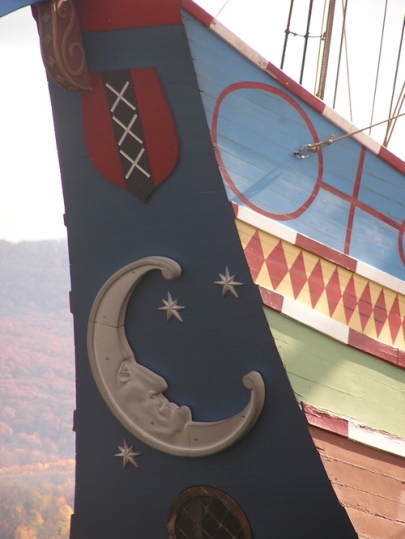
Stern of Half Moon, Henry Hudson's ship; from Tugster: A Waterblog
Notice how the figurehead frightens even the trees to blazing red.
Bowsprite of Henry Hudson's Half Moon, via Tugster: A Waterblog
Tugster tells us that Henry Hudson himself is blogging, channeling across 400 years — perhaps tired of duckpins with his crew in the Adirondacks (hello, Rip van Winkel!). Can your students correspond with Henry Hudson?
Saint Louis Art Museum, St. Louis, Missouri George Caleb Bingham (American, 1811–1879). The County Election, 1852. Oil on canvas. 38 x 52 in. (96.5 x 132.1 cm). Gift of Bank of America.
Every polling place should be flying the U.S. flag today. You may fly yours, too. In any case, if you have not voted already, go vote today as if our future depends upon it, as if our nation expects every voter to do her or his duty.
Today the nation and world listen to the most humble of citizens. Speak up, at the ballot box.
The whole world is watching.
Spread the word; friends don't allow friends to repeat history.
You’ve seen it before — the letter saying toodle-oo to the red states, as the blue states muster the courage to let them go. Somebody passed it along, I forwarded it to a few people I thought hadn’t seen it.
A discussion broke out. Part of the discussion centered on Texas’s second secession from the U.S., and how nasty things can be in Texas (“It’s not the heat and humidity; it’s the hate and stupidity”).
A couple of exchanges in, I started to wince. God knows Texas has its problems. I haven’t even started in on the latest three months of lunacy at the State Board of Education where Creationist-in-Chief Don McLeroy is loosening his belt to drop his pants (figuratively, of course) and moon every kid in Texas before he eviscerates science education.
But — you know? — Texas has a couple of things going for it, reasons to smile while you’re stuck here.
Below the fold, the “So long, Red States” letter — but before that, a modest defense of Texas, as I wrote back:
I do regret that [y’all have] had such a difficult and unhappy time in Texas. Texas is far from my ideal place, especially for the weather and lack of mountains (I appear to be losing the retirement fight – I wanted Jackson Hole, Kathryn wants Kanab. Red rock wins with the family.)
And Yellowstone is a part of my soul, especially after we (probably illegally) scattered my brother’s ashes there in the last great family reunion before this past summer.
But, you know, Texas has some fine points that shouldn’t get overlooked. Especially, it doesn’t deserve to get every redneck.
Dallas Symphony, and Jaap Van Zweden (the premiere of “August 4, 1964” last month was fantastic; Van Zweden has a magic wand instead of a baton); and the Meyerson Symphony Center, which is a vastly superior hall in my mind to Carnegie, Avery Fisher, or anything at the Kennedy Center.
It’s the origin of Walter Cronkite, Bob Schieffer, Jim Lehrer, and lots of others
A dozen other things I’m forgetting for the moment
It’s been a rather miserable 21 years in Texas for us, for a lot of reasons. There are good things and good people in Texas. It ain’t all gloomy.
Wildflowers not only do blossom where they grow: They must blossom there.
Which reminds me, there are a dozen other wildflowers better than bluebonnets, and we haven’t even started on the magnificent grasses like big bluestem, little bluestem and side-oats grama.
Will Rogers and his Remington typewriter, Will Rogers Memorial Museums, Claremore-Oolagah, Oklahoma
Caption from the Will Rogers Museums:
Daily writing
It didn’t matter where Will Rogers was when it was time to type his daily telegram. He just pulled out his trusty typewriter — in the car, on the movie set or in his home office overlooking the mountains of his Santa Monica ranch.
Rogers’ newspaper columns were carried by newspapers across America — 500 of them. His influence as an observer of the American condition was wide and deep.
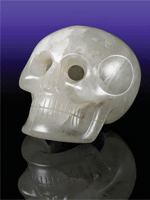
Caption from AIA's Archaeology: "In 1992, this hollow rock-crystal skull was sent to the Smithsonian anonymously. A letter accompanying the 30-pound, 10-inch-high artifact suggested it was of Aztec origin. (James Di Loreto & Donald Hurlburt/Courtesy Smithsonian Institution)"
The Archaeological Institute of America is North America’s oldest and largest non-profit organization devoted to archaeology. With more nearly a quarter of a million members and subscribers and 105 local chapters, it promotes archaeological excavation, research, education, and preservation on a global basis. At the core of its mission is the belief that an understanding of the past enhances our shared sense of humanity and enriches our existence. As archaeological finds are a non-renewable resource, the AIA’s work benefits not only the current generation, but also those yet to come in the future.
“Harrison Ford has played a significant role in stimulating the public’s interest in archaeological exploration,” said Brian Rose, President of the AIA. “We are all delighted that he has agreed to join the AIA’s Governing Board.”
AIA was chartered by Congress in 1906 — a full decade before the Boy Scouts of America, for comparison — with a charge to help enforce the Antiquities Act (16 U.S.C.§ 431).
More interesting, and more useful in the classroom, are the story and sidebar in the online magazine of the Institute, which notes that the crystal skull stories involve faked artifacts — and even that the idol in the opening scene of the very first Indy movie involves a faked artifact.
Sixteen years ago, a heavy package addressed to the nonexistent “Smithsonian Inst. Curator, MezoAmerican Museum, Washington, D.C.” was delivered to the National Museum of American History. It was accompanied by an unsigned letter stating: “This Aztec crystal skull, purported to be part of the Porfirio Díaz collection, was purchased in Mexico in 1960…. I am offering it to the Smithsonian without consideration.” Richard Ahlborn, then curator of the Hispanic-American collections, knew of my expertise in Mexican archaeology and called me to ask whether I knew anything about the object–an eerie, milky-white crystal skull considerably larger than a human head.
I told him I knew of a life-sized crystal skull on display at the British Museum, and had seen a smaller version the Smithsonian had once exhibited as a fake. After we spent a few minutes puzzling over the meaning and significance of this unusual artifact, he asked whether the department of anthropology would be interested in accepting it for the national collections. I said yes without hesitation. If the skull turned out to be a genuine pre-Columbian Mesoamerican artifact, such a rare object should definitely become part of the national collections.
I couldn’t have imagined then that this unsolicited donation would open an entirely new avenue of research for me.
Great story. In the classroom, it shows the methods of archaeologists and historians. Walsh reveals how archaeologists work, and along the way she details a lot of the history that prompts adventure stories like the Indiana Jones series.
File these links and this article away. The new movie in the “Mummy” series with Brendan Fraser in the starring role, is due out August 1, “The Mummy: Tomb of the Dragon Emperor.” The new movie is set on a dig in China, presenting more opportunities to use popular entertainment as an entré to real history, and real science (and probably all sorts of historical errors to correct).
Coming out of the display on Lucy at the Houston Museum of Natural Science, coming back down the staircase, this is the painting on the wall. In my imagination, this is what Lucy saw will see as they carried carry her, crated up, out of the building. In reality they probably took will carry her down a freight elevator.
This one’s for you, P.Z. — drop into the Houston museum next time you’re down there:
Spread the word; friends don't allow friends to repeat history.
San Jacinto Day? April 21 is the anniversary of the Battle of San Jacinto, where Sam Houston and the Texian Army got the drop on Gen. Santa Anna and his much larger force, and in the course of a half-hour put the well-trained Mexican regulars on the run, and won Texas independence.
Unfortunately, it’s also a day most Texas students get smothered with reviews from their teachers for the Texas Assessment of Knowledge and Skills (TAKS), the state exam that had just ended last year on this date, and looms in the future this year. Instead of learning Texas history, Texas seventh graders spend this great day reviewing what educators are supposed to teach them. Nuts.
Well worth it. The entire exhibit is a travelogue about Ethiopia, really — but I got chills looking at real bones. You will, too, I suspect.
The exhibit closes in Houston on April 27. Wouldn’t it be great if the demand were so high that they had to hold it over a few months? If you’re in Houston, you owe it to yourself to see the bones. If you’re near Houston, if you’re within a half-day’s drive, go see. If you’re within a day’s drive, plan some other activity (there are other special exhibits at the Houston Museum of Natural History, on Leonardo DaVinci, on CSI and forensic science, marshes, and cowboys in Texas; there are regular exhibits, including one on gemstones that is better than anything similar at the Smithsonian in Washington, D.C.) — but go to Houston.
This exhibit was controversial, taking such a treasure out of Africa at all. You owe it to yourself, to your children, to Ethiopia, and to future policy, to see the exhibit if you can.
Science, arts and social studies teachers especially, go look. What local museums are you overlooking? Which museums should you plan a long-distance trip to see?
Duncanville ISD teachers sometimes require “field experience” for students, including visits to local museums. I doubt we’d have gotten our kids into the African American Museum otherwise; I think too few kids bother with the Frontiers of Flight Museum (or the C. R. Smith Museum closer to DFW Airport), and I know way too few bother with the Jack Harbin Museum of Scouting, a great shining gem obscured by its working class, Scout camp location and the proximity of the National Scouting Museum in Irving, Texas.
The Times’s section makes me lust for Star Trek™-style transporters that take a whole classroom of kids, cheaply, to see the real stuff. Be sure to check out the on-line videos and slide shows, too.
Spread the word; friends don't allow friends to repeat history.
Or, until that account is unsuspended by the forces supporting Donald Trump: Follow @FillmoreWhite, the account of the Millard Fillmore White House Library
We've been soaking in the Bathtub for several months, long enough that some of the links we've used have gone to the Great Internet in the Sky.
If you find a dead link, please leave a comment to that post, and tell us what link has expired.
Thanks!
Retired teacher of law, economics, history, AP government, psychology and science. Former speechwriter, press guy and legislative aide in U.S. Senate. Former Department of Education. Former airline real estate, telecom towers, Big 6 (that old!) consultant. Lab and field research in air pollution control.
My blog, Millard Fillmore's Bathtub, is a continuing experiment to test how to use blogs to improve and speed up learning processes for students, perhaps by making some of the courses actually interesting. It is a blog for teachers, to see if we can use blogs. It is for people interested in social studies and social studies education, to see if we can learn to get it right. It's a blog for science fans, to promote good science and good science policy. It's a blog for people interested in good government and how to achieve it.
BS in Mass Communication, University of Utah
Graduate study in Rhetoric and Speech Communication, University of Arizona
JD from the National Law Center, George Washington University


 Posted by Ed Darrell









 Millard Fillmore's Bathtub
