Bear facts

September 18, 2009

A grizzly mauled a sheepherder and killed some sheep and dogs, along the Upper Green River in Wyoming.

Ralph Maughn’s blog has a lively and informative discussion on the incident, and on bears and bear protection in general.

For all the hard work they do, North American sheepherders sure seem to me to get short shrift in U.S. markets.  When was the last time you could find anything but New Zealand lamb at your supermarket?  And I ask this from Texas, the largest sheep producing state in the U.S. (with very few grizzlies).

While you’re at Maughn’s blog, look at this piece of good news:  You don’t have to eat ’em.


Products of intelligent design

September 12, 2009

Polychaete worm, 4-foot long version.  A product of intelligent design?

Polychaete worm, 4-foot long version. A product of intelligent design?

Fish and coral-eating polychaete worms can cause destruction in otherwise peaceful fish tanks.  Read about it here.

Fish tongue-eating isopod parasite.  Image from Pharyngula, borrowed from someone else

Fish tongue-eating isopod parasite. Image from Pharyngula, borrowed from someone else

Read about that one here.

Does William Dembski really explain these things with his maths?  What was God thinking then?

Tip of the old scrub brush and a shake of the old lobster trap to Pharyngula.

Share the word:

Add to FacebookAdd to NewsvineAdd to DiggAdd to Del.icio.usAdd to StumbleuponAdd to RedditAdd to BlinklistAdd to TwitterAdd to TechnoratiAdd to Furl


Rasberry Crazy Ants – where’s Godzilla when you need him?

September 12, 2009

Texas holds more than its share of nasty pests:  Imported Argentine Fire Ants, Canadian thistle, zebra mussels, creationists — and now, Rasberry Crazy Ants, Paratrechina sp. nr. pubens.

(Hey, Texas A&M spells it “Rasberry” without a “p,” so do I.  It’s named after Pearland, Texas, exterminator Tom Rasberry, who first identified the Texas pest.)

Remember the wonderful old Japanese monster movies, where monsters from past Tokyo ransackings would return to fight the new monsters?  Texas could use a good Godzilla or two.

Texas A&M’s Center for Urban and Structural Entomology has an extensive information and warning piece out on the beasts — reprinted for you below the fold.

Look what else you can find:

Read the rest of this entry »


Poachers kill massive grizzly in Montana

August 24, 2009

Ralph Maughan’s Wildlife News reports that Maximus, an 800-pound grizzly bear thought to be Montana’s second largest, was illegally killed recently.

The poacher shot the bear about four weeks ago.  A reward has been offered for information leading to the capture of the poacher.

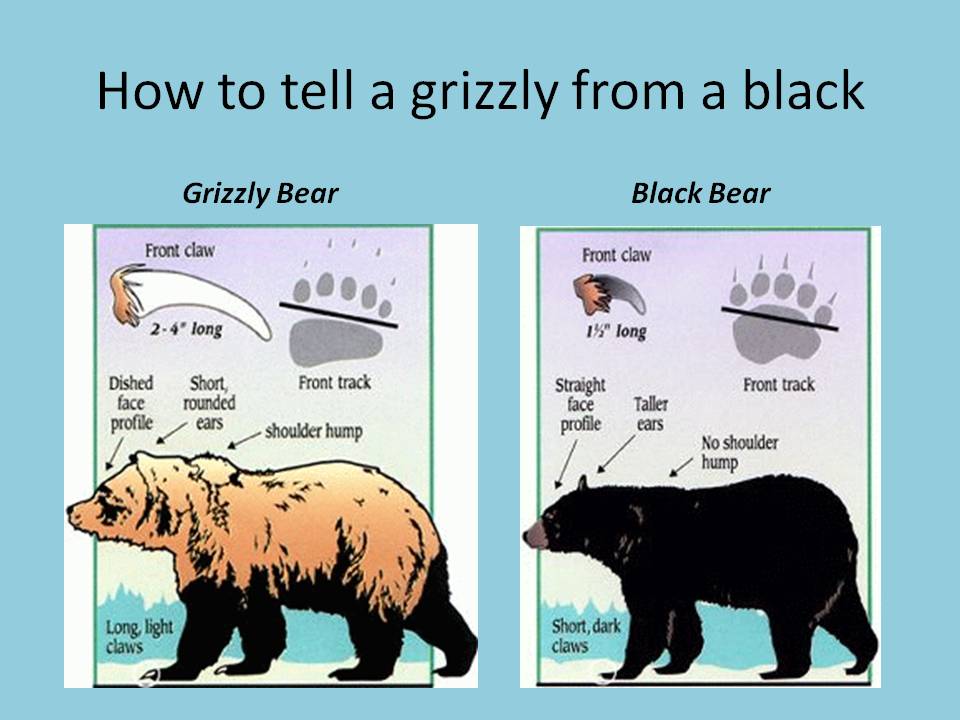
Can you tell a grizzly from a brown bear?  Chart from U.S. Fish and Wildlife Service

Can you tell a grizzly from a brown bear? Chart from U.S. Fish and Wildlife Service

Update, 1-30-2010: The chart linked to above has disappeared in a website redesign.  Below is a crude representation of the chart I made from a U.S. Fish and Wildlife information sheet on grizzlies, here.

How to tell a grizzly from a black (.pdf download)

Grizzly bear/black bear identification chart, adapted from USFWS by Ed Darrell, Millard Fillmore's Bathtub

Grizzly bear/black bear identification chart, adapted from USFWS by Ed Darrell, Millard Fillmore's Bathtub


Climate skeptic shell game: ‘Please don’t read how CO2 amplifies warming’

August 8, 2009

In heated political discussions, I’ve discovered that when people stretch the facts, sometimes they do it to protect their interests; but if they exaggerate and stretch things when the facts are on their side, it’s pathological and you can’t trust them on anything.

As the old joke goes, ‘I once knew a guy who cheated at golf so bad that when he got a hole-in-one, he wrote down “zero” on the score card.’

Scientists at Oregon State University released a study that shows the tilt and wobble of the Earth can trigger ice ages and the ends of ice ages. As you can imagine, climate change skeptics and denialist will jump on this study to say we don’t need to worry about carbon dioxide — ‘warming can’t be blamed on carbon dioxide.’

In fact, Anthony Watts has already done that.

Read the entire press release, and don’t skip over the parts that are important to policy on air pollution and climate change.  The paper indeed says that planetary wobble causes ice ages, and warming between ice ages.  That’s part of the climate change debate, probably a sizable win for climate skeptics.

But they can’t leave well enough alone; the study explicitly warns of the warming effects of human-released CO2.  Watts left out this paragraph:

“Solar radiation was the trigger that started the ice melting, that’s now pretty certain,” said Peter Clark, a professor of geosciences at OSU. “There were also changes in atmospheric carbon dioxide levels and ocean circulation, but those happened later and amplified a process that had already begun.”

Watts left this out, too, and this qualifies the Oregon State study as “alarmist” under usual skeptic rubrics:

Sometime around now, scientists say, the Earth should be changing from a long interglacial period that has lasted the past 10,000 years and shifting back towards conditions that will ultimately lead to another ice age – unless some other forces stop or slow it. But these are processes that literally move with glacial slowness, and due to greenhouse gas emissions the Earth has already warmed as much in about the past 200 years as it ordinarily might in several thousand years, Clark said.

“One of the biggest concerns right now is how the Greenland and Antarctic ice sheets will respond to global warming and contribute to sea level rise,” Clark said. “This study will help us better understand that process, and improve the validity of our models.”

Peter Clark of Oregon State and his associates published an important study in Science on Friday.  The study points to variations in the usual 23-degree tilt of the Earth’s access as triggers for glaciation and retreat of glaciers, over time.  The study poses important questions, such as:  Has human contribution to greenhouse gases prevented cooling in the past two centuries?  The study offers potential insights into research into climate change and human contributions to climate change.

The study in no way exonerates carbon dioxide from implication as a major, human-contributed component to the mix of factors driving climate change in the 21st century.  The study is really pretty cool; it should be fodder for geography and environmental science classes this fall, and it should be one factor in the discussion over warming and what we need to do about it.

Watch:  Some will try to make it the latest political shuttlecock instead.

Here’s the full press release:

8-6-09

Media Release

Long debate ended over cause, demise of ice ages – may also help predict future

CORVALLIS, Ore. – A team of researchers says it has largely put to rest a long debate on the underlying mechanism that has caused periodic ice ages on Earth for the past 2.5 million years – they are ultimately linked to slight shifts in solar radiation caused by predictable changes in Earth’s rotation and axis.

In a publication to be released Friday in the journal Science, researchers from Oregon State University and other institutions conclude that the known wobbles in Earth’s rotation caused global ice levels to reach their peak about 26,000 years ago, stabilize for 7,000 years and then begin melting 19,000 years ago, eventually bringing to an end the last ice age.

The melting was first caused by more solar radiation, not changes in carbon dioxide levels or ocean temperatures, as some scientists have suggested in recent years.

“Solar radiation was the trigger that started the ice melting, that’s now pretty certain,” said Peter Clark, a professor of geosciences at OSU. “There were also changes in atmospheric carbon dioxide levels and ocean circulation, but those happened later and amplified a process that had already begun.”

The findings are important, the scientists said, because they will give researchers a more precise understanding of how ice sheets melt in response to radiative forcing mechanisms. And even though the changes that occurred 19,000 years ago were due to increased solar radiation, that amount of heating can be translated into what is expected from current increases in greenhouse gas levels, and help scientists more accurately project how Earth’s existing ice sheets will react in the future.

“We now know with much more certainty how ancient ice sheets responded to solar radiation, and that will be very useful in better understanding what the future holds,” Clark said. “It’s good to get this pinned down.”

The researchers used an analysis of 6,000 dates and locations of ice sheets to define, with a high level of accuracy, when they started to melt. In doing this, they confirmed a theory that was first developed more than 50 years ago that pointed to small but definable changes in Earth’s rotation as the trigger for ice ages.

“We can calculate changes in the Earth’s axis and rotation that go back 50 million years,” Clark said. “These are caused primarily by the gravitational influences of the larger planets, such as Jupiter and Saturn, which pull and tug on the Earth in slightly different ways over periods of thousands of years.”

That, in turn, can change the Earth’s axis – the way it tilts towards the sun – about two degrees over long periods of time, which changes the way sunlight strikes the planet. And those small shifts in solar radiation were all it took to cause multiple ice ages during about the past 2.5 million years on Earth, which reach their extremes every 100,000 years or so.

Sometime around now, scientists say, the Earth should be changing from a long interglacial period that has lasted the past 10,000 years and shifting back towards conditions that will ultimately lead to another ice age – unless some other forces stop or slow it. But these are processes that literally move with glacial slowness, and due to greenhouse gas emissions the Earth has already warmed as much in about the past 200 years as it ordinarily might in several thousand years, Clark said.

“One of the biggest concerns right now is how the Greenland and Antarctic ice sheets will respond to global warming and contribute to sea level rise,” Clark said. “This study will help us better understand that process, and improve the validity of our models.”

The research was done in collaboration with scientists from the Geological Survey of Canada, University of Wisconsin, Stockholm University, Harvard University, the U.S. Geological Survey and University of Ulster. It was supported by the National Science Foundation and other agencies.

About the OSU College of Science: As one of the largest academic units at OSU, the College of Science has 14 departments and programs, 13 pre-professional programs, and provides the basic science courses essential to the education of every OSU student. Its faculty are international leaders in scientific research.

Watts did note the abstract of the paper, at Science (to get the full text, you must be a subscriber or pay a high fee for the one article):

Science 7 August 2009:
Vol. 325. no. 5941, pp. 710 – 714
DOI: 10.1126/science.1172873

Research Articles

The Last Glacial Maximum

Peter U. Clark,1,* Arthur S. Dyke,2 Jeremy D. Shakun,1 Anders E. Carlson,3 Jorie Clark,1 Barbara Wohlfarth,4 Jerry X. Mitrovica,5 Steven W. Hostetler,6 A. Marshall McCabe7

We used 5704 14C, 10Be, and 3He ages that span the interval from 10,000 to 50,000 years ago (10 to 50 ka) to constrain the timing of the Last Glacial Maximum (LGM) in terms of global ice-sheet and mountain-glacier extent. Growth of the ice sheets to their maximum positions occurred between 33.0 and 26.5 ka in response to climate forcing from decreases in northern summer insolation, tropical Pacific sea surface temperatures, and atmospheric CO2. Nearly all ice sheets were at their LGM positions from 26.5 ka to 19 to 20 ka, corresponding to minima in these forcings. The onset of Northern Hemisphere deglaciation 19 to 20 ka was induced by an increase in northern summer insolation, providing the source for an abrupt rise in sea level. The onset of deglaciation of the West Antarctic Ice Sheet occurred between 14 and 15 ka, consistent with evidence that this was the primary source for an abrupt rise in sea level ~14.5 ka.
1 Department of Geosciences, Oregon State University, Corvallis, OR 97331, USA.
2 Geological Survey of Canada, 601 Booth Street, Ottawa, Ontario K1A 0E8, Canada.
3 Department of Geology and Geophysics, University of Wisconsin, Madison, WI 53706, USA.
4 Department of Geology and Geochemistry, Stockholm University, SE-10691, Stockholm, Sweden.
5 Department of Earth and Planetary Sciences, Harvard University, Cambridge, MA 02138, USA.
6 U.S. Geological Survey, Department of Geosciences, Oregon State University, Corvallis, OR 97331, USA.
7 School of Environmental Science, University of Ulster, Coleraine, County Londonderry, BT52 1SA, UK.

Supporting online material, including a solid discussion of methods and several charts that are not contained in the full publication, is available, free, in .pdf form.  Warning to creationists:  This is heavy on science using radioactive isotopes for dating.  For that matter, it’s loaded with a lot of other science that climate change skeptics generally dismiss as “computer simulation” instead of hard data.  How will they treat this study?  Skeptically?  Don’t bet on it.

Resources:

Share this story and the science:

Add to FacebookAdd to NewsvineAdd to DiggAdd to Del.icio.usAdd to StumbleuponAdd to RedditAdd to BlinklistAdd to TwitterAdd to TechnoratiAdd to Furl


Why a campfire?

August 7, 2009

Training adult Scout leaders always produces a few puzzled looks, and occasional passionate, fearful rebukes, when I note that a campfire gives a boy or a girl an opportunity to play with fire.

No, I don’t mean, exactly, that we should let kids play with fire.  There are rules — what’s burning must be in the fire pit, is the chief rule.

There is some primal need to watch a fire, to study it, to experiment with it, and finally just to watch it go. If you camped as a kid, you probably know what I mean.

Camp fires are universal.  This one was outside Bangalore.

Camp fires are universal. This one was outside Bangalore.

Every kid needs to do that.  It’s a part of growing up.  It’s a necessary memory for healthy and sane adults.

Start a fire, and a kid will get a stick and poke the burning logs and, especially, the red-, yellow- and white-hot coals after the fire burns a while.  They’ll start the stick on fire, put it out, and light it again.  They’ll pull the stick out of the fire and watch the flame consume the stick.  Kids will experiment with different things on the fire, to see whether, how fast, and how they burn.

Just keep it in the fire pit.

A Scoutmaster can tell which kids have been camping. A Scoutmaster knows which kids have been able to sit around a campfire and play with fire in that way.  Kids who know fire are more mature, generally, more relaxed about the excitement of the stuff, and much more careful with it.  Scouts who have dabbled in the campfire respect fire for what it is and for what it can do, good and bad.

What you’ll remember 20 years later, or 30 years, or (God bless me!) 40 years, and I hope 50 and 60 years, is the watching of the fire as the flames die down to a red and pulsing bed of coals.

You’ll remember some of the stories — Freddy Jonas’s often-told story of racing down the Champs Elysee in horse-drawn carriages, bribing the driver of the other carriage to go slower to win the race; the story of Rulon Skinner, the best non-swimming canoe instructor on Earth, and the big canoe race in which his opponent finally tipped Skinner’s canoe, and then yelled “snake!” to appeal to Skinner’s other great fear; the night the bear invaded the camp at Ben de la Tour, a bear later found to have antlers and four hooves.  You’ll remember the s’mores, and you’ll forget how messy they are.  You’ll remember the time you waited for the cobbler to cook after someone forgot to start the charcoal, or the the time the story got so good you forgot to take the cobbler off the fire, and how the Dutch oven had to be thrown away because it never would come clean.

You may remember that little fox at Camp Carter, sneaking just beyond the light of the fire and carefully circling every chair, looking for something good to eat, to steal.  Or that stupid porcupine that, now that you think of it must have been rabid, heading straight for the fire there in the only stand of Ponderosa pine in Utah County, up Payson Canyon.  And that will trigger the story of the night the fire wouldn’t start in the Catskills, and what seemed like hundreds of giant porcupines convened in bacchanalian festivities while campers dared not sleep in their tents.

Someone will mention retiring U.S. flags, and you’ll remember the retirement ceremony for the flag from the widow of the veteran, how she insisted that you promise the flag would be burned completely and honorably, and warned “he’ll be watching!”  You’ll remember the mass flag retirement after the lifting of the burn ban at Wisdom, and how you suddenly realized lots of flags put out lots of toxic fumes — but somebody ad libbed a part to the ceremony to add time to let the fumes clear, and no Scout noticed (you hope!).

We haven’t even gotten to the singing.

I was put in mind of the power of the campfire with a remembrance from Real Live Preacher writing at High Calling:

I remember how worried we were the first time we tried to set one of those brush piles on fire. We nervously stood before a ten-foot high, fifteen-foot wide mound with a can of lighter fluid and a couple of matches. I squirted a modest amount around the bottom of the pile and stood back while Michael threw the match. That’s when we discovered that it’s surprisingly difficult to set things on fire. Now I marvel at stories of people casually throwing cigarettes out of their cars and setting whole forests ablaze. Michael and I had a hard time starting fires even when we used diesel fuel and a blowtorch.

It takes about five hours to burn a giant pile of brush and cedar, so Michael and I would start a fire, then sit on the tailgate of the brown pickup truck and talk while we kept an eye on it. Apart from the searing heat and looking like chimney sweeps, it was fun. I’m always looking for guilt-free reasons to sit around and talk with friends. I don’t suppose I’ll ever have as good an excuse as I did back then.

A guilt-free reason to sit around and talk with friends?  A campfire is an automatic reason — guilt only obtains if there’s a ban on burning where you’re making the fire.

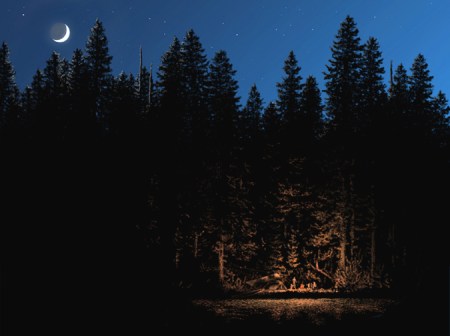
Carl Buell painted another one that took my breath away the first time I saw it.  Go see it. (I’m asking permission on this one; it may take a little while. Posted below with permission.)

That’s not a photograph, you can tell because it so well preserves what you remember — better than any photograph ever could —  it preserves what you remember from that campout up in the San Franciscos the night the sky was so blue so late and you could see the whole moon from the earthglow — or was it in New Mexico?  Probably not Colorado because there aren’t any mountains — oh, but if he’s looking east, it could have been south of Pueblo . . . no, maybe near Albion in the Sawtooths . . . Buell works in the east; it’s probably up in Maine . . . but he lived and painted in Marin County.

Didn’t he perfectly capture that night?

Campfire, by Carl Buell. Copyright Carl Buell, all rights reserved; used with permission

Campfire, by Carl Buell. Copyright Carl Buell, all rights reserved; used with permission


Blue jay, purple pepper

July 23, 2009

We’ve been bumping around 100° F for about a month now.  It’s Texas.  It’s hot.

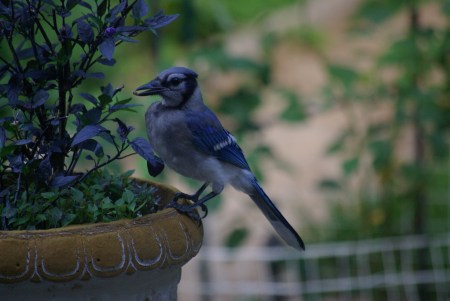
Sometimes the blue jays do all they can to stay out of the sun — like this guy, who was bent on getting some of Kathryn’s weird purple peppers.

Blue jay working to get a purple pepper

Blue jay working to get a purple pepper

Considering these shots were done in the shade, with just a 200 mm zoom, through a foggy window, they came out pretty well.

Blue Jay wrestles the pepper from the plant

Blue Jay wrestles the pepper, or something, from the plant.

The peppers eventually grow to be the size of a Bing cherry — too big for the jays, then.  They go after these peppers before they mature, and after they dry.

With her prize, the blue jay heads for its dining area in the live oak.

With her prize, the blue jay heads for its dining area in the live oak.

Mary K left us with her old bird feeder when she moved.  This year we’ve kept feeders in both the front and back yards.  Blue jays appear to have recovered from their West Nile devastation three years ago — we had one family nesting in the live oak earlier, in the spring — and Kathryn learned that the jays like peanuts still in the shell.

It’s been a good year for watching birds in our yard.  Still haven’t captured that little green hummer in a camera, though.


Maggie rose

July 22, 2009

Exquisite blooms of the "Maggie" rose (bourbon class) - in Kathryn Knowles' garden, summer 2009

Exquisite blooms of the "Maggie" rose (bourbon class) - in Kathryn Knowles' garden, summer 2009

Yes, I intended to leave the spent blossom there.  This is a real garden, where the flowers grow and fade.

Maggie is a “found” rose, robust in much of Texas, and a favorite of my wife’s.  The blossoms tend to glow, even at mid-day.  It will blossom all summer when it’s happy.  Maggie’s fragrance earns it a spot in Kathryn’s garden.

Maggie was one of five roses designated by Texas A&M’s horticulturists in 2005 for testing as one of a handful of roses easy to grow (read:  “difficult to kill, really”) in Texas.  Many rose varieties do not do well in southern heat and humidity — Maggie is one exception.

Maggie is a “found” Bourbon rose. It was collected in Louisiana by Dr. William Welch, Extension horticulturist from College Station. Maggie reaches 8 feet in height and 4 feet in width. Its flowers are medium red, very double, very fragrant, and it is a repeat bloomer. Researchers have found Maggie does best when trained on a pillar or fence. It is designated for zones 6-9.

“Arethusa, Jaune Desprez and Maggie are winter hardy throughout the entire state,” George said. “Bon Silene and Comtesse du Cayla, however, are winter hardy across most of the state except for Amarillo and the northern Panhandle area.”


Birds plant their favorite flowers

July 6, 2009

In our yard, after Mrs. Bathtub (Trophy Wife™) works her wonders in the garden, the soil will grow almost anything.

Birds, even, take advantage of that fact, seeding their favorite plants all over.  They are especially fond of sunflowers and pequin peppers.

If we didn’t use cooked peanuts, the blue jays would make this neighborhood one of the largest peanut fields in the world.

A bird-planted sunflower in Kathryn's garden - copyright 2009, Ed Darrell

A bird-planted sunflower in Kathryn's garden - copyright 2009, Ed Darrell


See? Cicada killer wasp

July 5, 2009

Got one in the camera sites this morning:

Cicada killer wasp and rose, Dallas, Texas, 7-5-2009 - image copyright 2009, Ed Darrell

Cicada killer wasp and rose, Dallas, Texas, 7-5-2009 - image copyright 2009, Ed Darrell (free use with attribution)


Cicada hawks a month early – another sign of climate change?

July 2, 2009

Well I remember summer camp as a Boy Scout, annually at Maple Dell, a few miles up Payson Canyon, Utah.  Troop 17 camped the week of July 4th, by tradition.  Most other troops avoided that week so families could get together on the holiday — there would be half the usual number of Scouts, and we had a lot more opportunities to hit the rifle range, archery range, rowboats and canoes.  Over four years, we noticed that the annual cicada invasion would usually start near the end of that week, as the Utah heat started its march toward August records.  It was a good week to camp, to avoid the heat and the astounding noise of those insects.

As an Explorer, and junior camp staff member later, I spent entire summers at Maple Dell.  We’d start in early June, when the Payson River still ran icy from the snow runoff, and when our sleeping bags would be coated with frost in the morning.  Cicadas in July said it was warming.  Cicadas in August screamed it was hot — sometimes near 100° F, a dramatic shift from the frost just eight weeks earlier.

In Maryland, one year we lived through the confluence of the 13-year and 17-year locusts, which are related to cicadas. (Bug Girl?  You out there?  Help me out on these details.)  The adults would literally coat trees.  They’d mate and die, and fall to the street, where cars would smush them — driving was more treacherous than driving on ice.  What few predators there were — and the predators seemed awfully few in relation to the billion locusts per acre — would eat their fill, and then ignore the rest of the mob.  The locusts came earlier than the cicadas, as I recall — but still later in the summer.

A post I wrote two years ago has been getting a lot of hits. In late July 2007 I wrote of the return of the cicada hawks, here in Dallas.  Each summer since, about the time the cicada hawks return, people start cruising the web to find out how to get rid of them, mostly (don’t, they’re practically harmless).   As I watched the traffic counts, I noticed that I had posted it on July 20 back in 2007.  I wrote that the wasps had been around for about ten days, then.  Last year I posted a welcome to the wasps on July 8.

Cicada killers at Boisenberry Lane, Dallas

Cicada killer wasps on Boisenberry Lane, Dallas, 2008 - copyright Ed Darrell

I saw my first cicada-killer wasp in 2009 about  June 10.  We didn’t have cicadas, then, that I could find.  The cicadas started buzzing on June 21, the first day of summer.  Our backyard is quite busy with cicada hawks right now, tracking down the cicadas and digging the holes in which to store the cicada zombies.

I hate to crash the denialists’ parties, but it sure seems to me that this cicada season thing is moving up.  The tilt of the Earth is still 23°.  The amount of daylight is the same.  What factors other than climate warming would cause these insects to come earlier each year?  What’s your experience?

More information:


A rainbow fell on Brooklyn

June 30, 2009

Stars on Alabama, a rainbow fell on Brooklyn — somebody ought to write a song about it.

Rainbow over Brooklyn, June 29, 2009 - photo by JOKelly

Rainbow over Brooklyn, June 29, 2009 - photo by JOKelly

Photo by JimmyOKelly.  Go see the stuff Kelly has posted at FLICKR, before he gets famous.  Poetry in photography.  Nice collection of others’ shots, too.


Godwin’s Law overload: Warming denialist calls water conservation “Nazi”

June 30, 2009

You couldn’t sell a fictional story where people are this nutty.

Go see. The abominable Steve Milloy — a guy so wacky he cannot be parodied (take that, Poe!) — calls water conservation “Nazi.” He complains about a provision in the Waxman-Markey Clean Energy Act that encourages innovation in water conservation devices.

Milloy flouts Godwin’s Law right off the bat.  You can’t make this stuff up.

And — may God save us from these people — Milloy has followers.  Check out the graphic here, with Obama portrayed as a marching Brownshirt.  It’s almost too stupid to be racist, but it’s certainly incendiary.  He even admits he thinks saving water is a good idea, and he’d like to have one of the devices complained about. (This guy knows he’s in error — he censors posts that question any part of his rant.) See the ugly meme expand, here.

Girl Scout/EPA water conservation badge -EPA image

Girl Scout/EPA water conservation badge -EPA image

Water conservation equals flag-waving in America, and has done so for a at least a hundred years. Those of us who grew up in the Intermountain West may be a little more attuned to the drive — Hoover Dam, Glen Canyon Dam, Flaming Gorge Dam, the Central Arizona Project, the Central Utah Project, the Colorado River aqueduct that carries water to Los Angeles, it’s impossible to live in the West and not be conscious of water’s value, its precious qualities.

Today, the many benefits of controlling water in this way are evident in the extensive development that has taken place throughout the West over the past 100 years.  Huge cities have been created and millions of people live, work, and recreate in this desert region.  But, as the West continues to grow, we must face the problem of continually increasing demands on a finite supply of water.  This includes human population needs and the needs of the environment.

But one doesn’t need to be from the cold northern desert of southern Idaho to figure out that saving water is a good idea.

Most homeowners would like to save money.  Americans spend between $600 and $1600 for washing machines that cut water usage by up to 75% (we just replaced our two-decades-old Maytag with a water conserving front-loader).  Go to the appliance stores and listen to the conversations.  People who could better afford the $200 models discuss how they will cut costs elsewhere to get the water saving versions — because their water bills are so high.

Much of of the rest of America works to conserve water out of necessity. Texas cities have mandatory water conservation laws, like Temple, Richwood, Austin and Dallas.  Texas rural areas fight to save water, too.  California cities demonstrate that water conservation works, saving investments in ever-grander and more environmentally-damaging water importation schemes, and allowing for population growth where water shortages would otherwise prohibit new homes.  Water conservation is a big deal across the nation:  In Raleigh, North Carolina; in Seminole County, Florida;  in Nebraska; in the State of Maryland.  An April drive across Wisconsin a few years ago convinced me it is the most waterlogged state in the nation, Louisiana notwithstanding — but even in Wisconsin, wise people work to conserve water for agriculture, one of the state’s leading industries and employers.

What’s the next step up from Godwin’s Law?  These guys like Milloy and his camp followers can only get crazier, benignly, if they head to the meadow and graze with the cattle.  Crazier non-benignly?  Let’s not go there.

But let us address the odious comparison to Nazis directly.  In World War II, when freedom was on the line, there was a drive to conserve resources in America.  Americans grew their own vegetables in Victory Gardens.

Poster encouraging patriotic conservation, for the war effort in World War II

Poster encouraging patriotic conservation, for the war effort in World War II

Americans collected scrap metal, iron, copper and aluminum, to be made into war machines to save the world.  Americans conserved rubber and gasoline by restricting automobile use.  There was the famous poster, “When you ride alone, you ride with Hitler.”  Conservation was understood to be a patriotic response to the challenges the nation faced.

Bill Maher updated the poster with his 2005 book, When You Ride Alone You Ride With Bin Laden. Maher urged civic actions like those that helped the U.S. during World War II, including conservation of gasoline and other resources.   Maher understands that wise use of resources is something a people should strive for, especially when in competition with other nations, either in a hot war or in trade or influence.  Conservation remains a patriotic behavior, and opposing conservation remains a call to support the enemies of America, in war, in trade, in policies.

Update of the World War II poster, for our times.  Image from Barnes and Noble

Update of the World War II poster, for our times. Image from Barnes and Noble

It’s not just a coincidence that Boy Scouts and Girl Scouts (in conjunction with the U.S. EPA for the past several years) learn water conservation as integral parts of their programs, chartered by Congress, to promote civic leadership in America’s youth.  Those groups charged with teaching actual patriotism understand conservation to be a high duty, a high calling, something that all patriots do.

So, let’s face it.  If you crap on a 6-gallon flushing toilet, you crap with Bin Laden.  When you shower with a non-flow restricting shower head, you shower with Bin Laden.

Yes, it sounds creepy.  It is.

You hope Milloy and the other Neobrownshirts* have parents or other family to pull them back from the brink, but then you see Congress.

Yeah, the Nazis were the Brownshirts, in Germany.  In Italy the fascists wore black shirts.  Brown is generally the opposite of green, in political and business parlance — for example, development of a previously undeveloped piece of property is “greenfield development,” while redevelopment of a previously-developed parcel is “brownfield development.”  Since Milloy is opposed to anything “green,” I think it only fair that his shirt color match his politics.  It’s his choice, after all.

Well, what about you, Climate Change Skeptics?

"Well, what about you, Climate Change 'Skeptics?'"


$36 million to clean up DDT mess

June 12, 2009

One more reminder that DDT is a deadly substance:  EPA announced a program to cap render harmless the largest DDT dump, off the coast of California.

Jeff Gottlieb writes in The Los Angeles Times:

The federal Environmental Protection Agency on Thursday proposed spending at least $36 million to clean up the world’s largest deposit of banned pesticide DDT, which lies 200 feet underwater off the Palos Verdes Peninsula.

Montrose Chemical Corp., which was based near Torrance, released 110 tons of DDT and 10 tons of toxic PCBs into the sewers from 1947 through 1971. The chemicals then flowed into the Pacific.

What do you think?  A substance that is deadly, makes one of the largest and deadliest Superfund sites in America, and costs $36 million in taxpayer smackaroons just to seal up so it won’t kill again — is it “perfectly safe” as the advocates claim?

This is one subject you will not see discussed at Steven Milloy’s sites, Junk Science, nor Green Hell.  You won’t find the Chronically Obsessed with Rachel Carson (COWRC) mentioning this clean-up.

Remind them.

Public hearings on this plan are scheduled for June 23 and 25.

Tip of the old scrub brush to Audublog.


Desperation in AGW denial ranks?

May 17, 2009

One might hope it is a sign of desperation, and not just one more ratcheting up on the dishonesty scale.

Anthony Watts has a post that looks at Boston Harbor, a post borrowed from a sleepy blog called Climate Sanity, by Tom Moriarty.  Watts, a leader among denialists, notes the warnings about sea level rising, and then offers maps of Boston as evidence everyone is safe.

The maps show the shoreline expanding around the peninsula where the main part of Boston sits.

Consequently, the authors claim, rising sea levels won’t do damage anyone should worry about.

Changes in Boston Harbor, from the denialist blog Climate Sanity

Changes in Boston Harbor, animation from the denialist blog Climate Sanity

It’s an odd sort of claim.  Anyone with any knowledge of the growth of harbor cities will look at the maps and notice the extension of lands from fill. Watts and Moriarty do not specifically claim that ocean levels have no effect, though some reading the headlines alone may get that idea.  They argue that humans will respond to negate the bad effects of climate change. 

That’s not what the maps show at all. The maps show that, in the absence of wetlands protection, people will use fill to expand commercial opportunities at a busy harbor.  That is true whether the fill requires the destruction of local landmarks, or whether the fill arrives accidentally from other major natural events.

The climate change denialists’ claims make an argument based in deception.  Harbor areas are always better fortified against sea and weather changes than other areas.  Boston Harbor is a comparatively small area, when contrasted with the Atlantic coastline of North America.

Do they know they’re just pulling our leg?  Or is this one more sign of the desperation denialists get over the realization the facts are against them?

At root the argument fails, and fails offensively: Watts and company argue that climate change and rising sea levels are not a problem, if we have enough concrete and fill to expand land close to the water and harden seawalls.  We also would need a lot of commercial development to make it cost effective to fill in the threatened lands.  That sort of development will involve only a very small area of any nation’s coastline.

Of course, that sort of hardening of sites is exactly what the wetlands protection under Section 404 of the Clean Water Act aimed to slow or stop, and it is part of the cause of trouble in the Mississippi Delta and other places unhardened, where the effects of hardening ports are pushed.

Watts also fails to account for the more serious immediate issues:  It’s not permanent inundation that we need to worry about with ports, but rather, the effects of stronger storms with higher sea levels.  The U.S. Environmental Protection Agency has been on that issue for years.  Boston Harbor is an example of a place that we need to protect from effects of climate change, at great expense, in order to preserve the filling done in the past and the development on that filled-in land that once was sea.

For examples, consult the white paper from EPA in July 2008, “Planning for Climate Change Impacts at U.S. Ports.  From the very first lines, you can begin to see why the denialists’s claims don’t wash:

Over the coming decades, climate change is likely to cause sea levels to rise, lake levels to drop, more frequent and severe storms, and increases in extreme high temperatures. These effects can have mild to severe impacts on port infrastructure and operations, depending on their geographical setting and design. Ports are critical to the trade and transportation networks of the United States. Specifically, ports handle 78% of all U.S. foreign trade by weight and 44% by value.1 The United States’ ports also represent billions of dollars in capital improvements and new investments. While the risk that climate change poses to ports is unclear, what is clear is that ports need to better understand climate change, how it may impact them, and what they can do to ensure reliable services for their customers.

Stakes are too high for analysis so shallow as simple map overlays.  In reality many factors mean that ports and harbors are threatened from many different problems arising from climate change.  The EPA white paper lists specifics.

Changes in water level:

The most immediate concern related to rising sea levels is the need to raise the level of infrastructure to prevent flooding. Ports will need to consider anticipated sea levels when building new infrastructure. In cases where current infrastructure may not be high enough for its useful lifespan, ports will need to increase infrastructure heights.

Higher sea levels may threaten ports’ environmental mitigation projects. Also, many ports have contaminated or potentially contaminated industrial land on their premises.17 Higher water levels may require new containment methods to prevent leeching of contaminants.

Many climate models predict that climate change will cause water levels to drop in the Great Lakes and the Mississippi River Basin, which would make shipping there more difficult. When lake levels decreased from 1997-2001, ships in the Great Lakes were forced to carry less cargo. Future decreases in water level would again require cargo restrictions or perhaps the redesign of vessels. Either one would increase the cost of shipping on interior waterways. Decreased depths could be mitigated by increased dredging, but at a financial and environmental cost.

Storm events and precipitation:

Globally, extreme precipitation events are expected to become more frequent, and severe storms are expected to become more intense. Stronger wave action and higher storm surges, especially when coupled with higher sea levels, are the primary threat to ports. These impacts can damage bridges, wharfs, and piers, terminal buildings, ships, and cargo. Harbor infrastructure may need to be raised or reinforced to withstand these impacts.

In addition to contributing to storm surge, wind can also have its own damaging impacts. High winds particularly threaten unreinforced terminal structures. For example, Hurricane Katrina tore roofs and doors off warehouses at the Port of New Orleans. One possible response to these threats is to change design standards for terminals, cranes, lighting systems, and other infrastructure to incorporate the risk of stronger storms.

Higher temperatures:

Higher incidences of extreme high temperatures could also affect some auxiliary port infrastructure. For example, paved surfaces may deteriorate more quickly in hotter conditions. Cranes and warehouses made of metal may require design changes to withstand higher temperatures. Higher temperatures may also require more energy for cooling of goods stored at ports.

Higher temperatures could impact the human and natural environments associated with ports as well. Many employees at ports work primarily outdoors. Operational changes may be required to protect workers from extreme heat. Warmer temperatures may also increase the risk of transferring invasive species from region to region on cargo vessels.

For ports in northern states, including Alaska, higher temperatures could provide some benefits. Operating conditions may improve as ice accumulation on port infrastructure decreases. Shipping seasons would lengthen as more ports and waterways become ice free for more of the year. These effects could increase volume and reduce costs for northern shipping.

Indirect impacts, including insurance:

Ports are also likely to face changes in insurance coverage and possible higher insurance premiums because of climate change. The insurance industry is one of the leading commercial sectors expressing concern about and exploring adaptive responses to climate change. Several large companies that provide business insurance services are incorporating risk from climate change into insurance offerings. Strategies include shifting a greater share of risk onto customers and providing technical support and pricing incentives for customers to reduce their exposure to climate-related risks.

Denialist arguments frequently come with unintended irony.  Part of Boston Harbor was filled in by a the New England hurricane of 1938.  Castle Island, one of the areas the animation highlights as being filled out, ostensibly by humans, is connected to the mainland now as a testament, a warning of the potential for nature to change the place quickly, contrary to the plans of humans.  One day in 1938 a hurricane converted the place from an island to a peninsula.  Is this really the best the denialists have to persuade us that we shouldn’t be concerned about the power of nature now?

Climate warming is real.  The effects of warming are real and quite problematic already.  Filling in wetlands around busy harbors, even just to raise elevation, is not a viable solution to the problems, regardless their cause.

Resources: