Don’t trust what you read — on blogs, as well as in the news

August 6, 2007

The CEO of Fark suggests people turn off the newsfeeds for a while, and ignore the constant chatter of the internet.

Happy to be a Rock n’ Roller carries an excerpt of an interview with Drew Curtis:

Q: Which media patterns do you find most annoying, and which media patterns do you think are the most dangerous without being obviously so?

Equal time for nutjobs. It’s all funny when you talk about people not believing in moon landings, or who think an alien crash-landed in Texas in 1897, or who believe that there was once an ancient mediterranean civilization in Florida. It’s another thing entirely when people start to believe that denying the holocaust is a valid opinion.

Curtis wrote a book, It’s Not News, It’s Fark: How Mass Media Tries to Pass Off Crap As News .  It should be required reading for students doing research on the internet, I suspect. 

(I wonder what the original venue of that interview is — anybody know?)


Nonqoute of the Moment: What Ben Bradlee did NOT say

July 27, 2007

My respect for Fred Gielow rose when I found this on-line erratum notice, correcting a vicious misquoting of former Newsweek columnist and Washington Post editor Ben Bradlee.

This is one way a responsible author corrects a misquoting of someone, particularly one that puts words in the person’s mouth that convey a message opposite to the message they delivered:

____________________________________

I have been advised by the assistant counsel at The Washington Post that Mr. Benjamin C. Bradlee, vice-president at-large of The Washington Post, never made the statement attributed to him on page 117 of my book, You Don’t Say. The principal source of that quotation is the book Trashing the Planet, by Dixy Lee Ray with Lou Guzzo, Regnery Gateway, 1990, page 76. The assistant counsel states the quote is a fabrication.

The assistant counsel tells me Mr. Bradlee says he was discussing a matter at an environmental conference with fellow panelists and had no problem with what the panelists were saying, but he warned that there was

“a minor danger in saying it, because as soon as you say, ‘To hell with the news, I’m no longer interested in the news, I’m interested in causes,’ you’ve got a whole kooky constituency to respond to, which you can waste a lot of time on.”

That statement is indeed significantly different in meaning from the statement I quoted from Trashing the Planet, which said,

“To hell with the news. I’m no longer interested in the news. I’m interested in causes. We don’t print the truth. We don’t pretend to print the truth . . .”

Inasmuch as Trashing the Planet cites as a reference for its quotation an article by David Brooks in the October 5, 1989 Wall Street Journal, and inasmuch as I now find that Wall Street Journal article contains wording wholly consistent with the first quotation (above), not the second, I’m led to believe the second quotation is in error. This is a difficult conclusion for me to reach because I greatly respect Dixy Lee Ray and Regnery Gateway, and I have great confidence in their integrity.

Nevertheless, I must now apologize to Mr. Bradlee and I must apologize to all readers of my book who have depended on the correctness of the quote I obtained from Trashing the Planet. As I have stated to the assistant counsel, I’m interested only in the truth. When it can be shown that I have relied on information or a quotation that is shown to be incorrect or improper, I am anxious to correct the record.

Once again, let my extend my most sincere and genuine apologies to Mr. Bradlee. It was never my intention to attribute to him something he did not say. I know how painful it is to be accused of something you did not do or say. I would not wish that pain on anyone. And to demonstrate my desire to disseminate this information to set the record straight, I will post this message on my website for an indefinite period of time and will highlight access to it.

Fred Gielow_____________________________[end quote from Gielow]

Mr. Gielow’s faith in the Regnery publishing house is misplaced, in my experience.

Now, perhaps Mr. Gielow will correct his misquoting of Charles Wurster at his website. [Update, 7-29-2007:  Mr. Gielow responds by e-mail that he will check out the citations of the Wurster misquote.  Good news.]


News from Texas: Tech Meat Team wins national championship

July 19, 2007

Traveling Texas produces its own joys. In the past couple of weeks I’ve been through Wichita Falls, Amarillo, Dalhart, Eastland, Weatherford, Abilene and Lubbock, and a couple score of towns in between.

I loved this headline last week in Texas Tech’s newspaper, The Daily Toreador: “Meat Team wins national championship.”

Who knew there is intercollegiate competition in meat judging? Why isn’t this on ABC or ESPN?

Humor aside, in beef states such skills are critical. Since I love a good steak more than the average person — and I love a good roast beef at least as well — this is the sort of competition I would probably take some interest in, were it covered in daily media outside the affected universities. The team from Tech deserves wider recognition, it seems to me, and I wish Texas newspapers like the Dallas Morning News and Houston Chronicle would give regular coverage to such achievements — not to mention the Lubbock Avalanche-Journal (is that a great name for daily newspaper, or what?)

The competition was held at the 60th annual Reciprocal Meats Conference, at South Dakota State University. Tech’s winning team had to beat another Tech team to get to the championship round, and there they faced another Texas team from Angelo State University in San Angelo (I haven’t made it there yet, this year).

Tech’s two three-person teams began the competition strong, neither losing a round until they faced each other. The team of Megan Mitchell, Travis Chapin and Austin Voyles came out on top, with O’Quinn, Landi Woolley and Matt Sellers falling into the consolation bracket. Because it was a double-elimination competition, each team had to lose twice to be out of the contest.

The Mitchell, Chapin and Voyles team lost one of their rounds later, leaving both teams in the consolation bracket. Winning their way through the consolation bracket, the two teams eventually faced each other once again, and this time O’Quinn, Woolley and Sellers won. They ended up competing against Angelo State University in the finals and emerged victorious.

“It wasn’t really like two teams,” O’Quinn said. “It wasn’t like one Tech team won and the other Tech team lost. It’s just a matter of formality. If all six of us could have been on one team, we would have. We consider ourselves all one team. The Tech team won.”

Rogers noted that combined the teams only lost three rounds.

“Two of our losses were to our own team,” she said. “It really was a group win.”

It was the third national championship for Tech in the competition in the past six years.

Don’t laugh.  Does your university even have a meat judging team?

And while in Lubbock, I had a great chicken-fried steak at River Smith’s. Eat the local fruits, I always say.


Encore post: Ernie Pyle’s typewriter

July 16, 2007


PBS’s series, “History Detectives,” featured a mystery involving a typewriter alleged to have belonged to World War II reporter-hero Ernie Pyle. This is an encore post from May 1, 2007, originally entitled “Typewriter of the moment: Ernie Pyle.” Extra links are posted at the end.

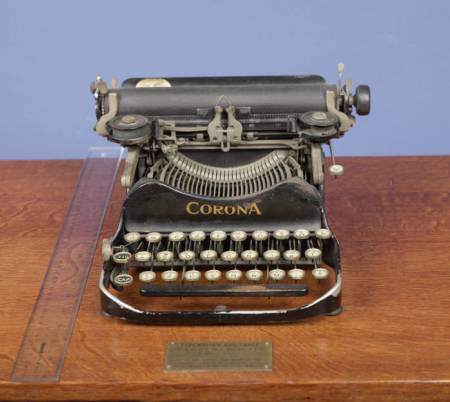
This typewriter, a Corona (before the merger made Smith-Corona), belonged to Ernie Pyle, the columnist famous for traveling with the the foot soldiers of all services in World War II. Pyle won a Pulitzer Prize in 1944 for his columns in 1943, published collectively in the books Here is Your War and Brave Men. Pyle was killed covering the end of World War II in the Pacific, on an island named Ie Shima, on April 18, 1945.

The typewriter rests in the Albuquerque Museum. It comes with a story.

Ernie Pyle's typewriter, rescued from a foxhole in Italy in 1944; Albuquerque Museum From the Albuquerque Museum’s exhibit, “America’s Most Loved Reporter”:

[Quote] Ernie Pyle interviewed Sergeant Don Bell, a rodeo rider, in June or July 1944 outside of St. Lo, France. Bell recalled that the foxhole they shared caved in during German shelling. Pyle said, “I have my notes, but my little portable typewriter is buried in that hole.” They hurriedly abandoned the foxhole, leaving the typewriter behind.

Sgt. Bell later salvaged it, kept it through the war, and donated it to the Museum in 1990. A photograph of Pyle in Normandy, typing on an Underwood, may have been taken after this event.

Bell recalled the interview as comforting. He wrote, “…Ernie had taken my ma’s wisdom and turned it into a soldier’s lesson: to find strength in battle you take hold of strength you’ve known at home…and of the faith that underlies it.” [End quote]


Additional on-line sources about Ernie Pyle and his typewriters, July 16, 2007:


Japanese-American internment: Statesman-Journal web special

June 29, 2007

Looking for good sources on Japanese internment?

Editor & Publisher highlights the web version of a special series on Japanese internment during World War II, put together by the Statesman-Journal in Salem, Oregon. The series is featured in “Pauline’s Picks,” a feature by Pauline Millard showing off the best use of the web by old-line print publications.

Beyond Barbed Wire, photo by Salem Statesman-Journal

The Statesman-Journal’s web piece is “Beyond Barbed Wire,” featuring timelines, maps of the Tule Lake internment facility (closest to Oregon), stories about Japanese Americans in Oregon, especially in Salem, photos, video interviews, and a significant collection of original documents perfectly suited for document-based studies.

Texas kids test particularly badly in this part of U.S. history. Several districts ask U.S. history teachers and other social studies groups to shore up student knowledge in the area to overcome gaps pointed out in testing in the past three years, on the Texas Assessment of Knowledge and Skills (TAKS). In teacher training, I’ve noted a lot of Texas social studies teachers are a bit shaky on the history.

The Korematsu decision was drummed into my conscious working on civil rights issues at the Senate Labor and Human Resources Committee, and complemented by Constitutional Law (thank you, Mary Cheh) and other courses I was taking at the same time at George Washington University. It helped that Utah has a significant Japanese population and had “hosted” one of the internment camps; one of my tasks was to be sure committee Chairman Orrin Hatch was up on issues and concerns when he met with Japanese descendants in his constituencies in Utah. Hatch was a cosponsor of the bills to study the internment, and then to apologize to Japanese Americans affected, and pay reparations.
The internment was also a sore spot with my father, G. Paul Darrell, who witnessed the rounding up of American citizens in California. Many of those arrested were his friends, business associates and acquaintances. Those events formed a standard against which he measured almost all other claims of civil rights violations.

Because children were imprisoned with their parents, because a lot of teenagers were imprisoned, this chunk of American history strikes particular sympathetic chords with students of any conscience.  Dorothea Lange’s having photographed some of the events and places, as well as Ansel Adams and others, also leaves a rich pictorial history.

(I found this thanks to the RSS feed of headlines from Editor & Publisher at the Scholars & Rogues site.)


Who is reporting from National History Day?

May 30, 2007

Are you planning to be at the National History Day festivities in Maryland, June 10 through 14?

Did any of your kids put an entry into the National History Day Contest?

It may not be a national spelling bee, but I hope it gets some news coverage. If nothing else, go check out the collections of lesson plans and resources that come out of this competition.


Cartoon of note: Berryman on TR and fair play

May 24, 2007

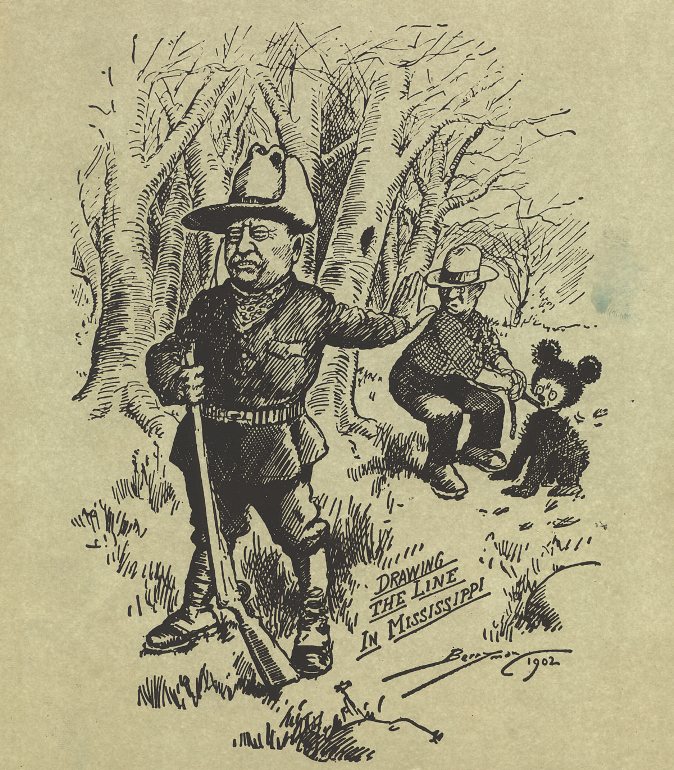
Clifford Berryman cartoon, "Drawing the Line in Mississippi, 1902"

Clifford Berryman cartoon, “Drawing the Line in Mississippi, 1902”

Berryman’s Bear: “Drawing the line in Mississippi.”

In 1902 Teddy Roosevelt hunted bear near Smedes, Mississippi. He didn’t get a bear, as he had hoped. Trip guides tracked a bear with dogs, clubbed it, and tied it up. The bear was offered to TR to shoot.

Teddy refused to shoot it, of course. It was tied up. It was not sporting, not fair, not a match — not the vigorous hunting Roosevelt wanted.

Clifford K. Berryman, a cartoonist for the Washington Post newspaper (he moved to the Washington Star in 1907), captured the moment in a drawing published November 16, 1902. This 1902 cartoon is among the most famous political cartoons ever done.

The good sportsmanship Roosevelt demonstrated echoed long and hard among Americans. His reputation for fair dealing and good sportsmanship increased his popularity immensely.

Candy store owners in New York City, Morris and Rose Michtom, made a stuffed bear, a “Teddy bear,” to commemorate the event. We still call them Teddy bears, today.

Berryman continued to use the bear cub in cartoons for the rest of his career.

Teddy Roosevelt cartoon sources:


Willow death

May 12, 2007

Hundreds of thousands, perhaps millions, of trees have died in spring storms this year, from dramatically powerful wind bursts, tornadoes, or drowning or uprooting in floods. We lost only a small branch from our greatest red oak, but locally we lost hundred-year-old eastern red cedars, sizable live oaks, and dozens of hackberries (good riddance in most cases there!).

P. Z. Myers lost a massive branch from an even more massive weeping willow, up in Morris, Minnesota. In fear of the entire tree crashing down, with some sadness Myers had the tree removed. Willows are pretty trees in full health, but they are generally soft wood and a mess to have in an average yard. That the Myers willow grew so large is probably rare among willows. We should mourn such losses.

Trees are great things, providing us with shade and cooler microclimates in the summer, windbreaks, beauty in autumn and winter, sinks for our pollution, habitat for birds, etc., etc. I couldn’t help but think of Myers’ tree when I stumbled on this children’s book Regarding the Trees: A splintered saga rooted in secrets. The cover shows what must be a willow, under which a hundred people enjoy a grand party (click the image for a larger view from Amazon.com). Cover of Regarding the Trees

This book and others by the same author and illustrator, the Klises, offer fine mysteries for elementary level readers to solve. They look like fun.

Arbor Day Foundation logo with Jefferson Quote


Dying to get the news in Iraq

May 11, 2007

74 journalists have died trying to get the news in Iraq since the U.S. invasion four years ago.  Has any other war produced so many dead journalists, so fast?  That number is about 16 per year.

The Newseum has a memorial to journalists who died trying to get the story.  It contains just over 1,500 names, for wars from the War of 1812 to the present.

Each year, the Freedom Forum commemorates World Press Freedom Day by rededicating the Journalists Memorial, which pays tribute to reporters, editors, photographers and broadcasters who gave their lives reporting the news. On May 3, 2006, the names of 59 journalists who died or were killed while on assignment in 2005 were added to the glass panels of the memorial. The rededication ceremony featured remarks by David Westin, president of ABC News. The Journalists Memorial now honors 1,665 journalists who died covering the news from 1812 through 2005.

What is it about this war that makes it so much more deadly than other wars, for journalists?  What does that say about the state of our world today, and the respect traditionally show to people who simply report what happens?


News on trial: Newseum makes grand plans

May 11, 2007

Newshounds, newsmakers and news writers ought to salivate at the idea of a grand museum to the First Amendment on Pennsylvania Avenue, N.W., in Washington, D.C.  Organizers of the Newseum plan exactly that, with a grand opening in October 2007.

It promises serious analysis, not just cheerleading, for news media, according to the New York Times:

The Newseum’s goal is to present the “first rough draft of history” in all its glory and some of its shame, impressing upon visitors the importance of the First Amendment’s protections of a free press. In the glory department are Edward R. Murrow’s rooftop broadcasts from London during the Blitz; he is among the heroes of a short movie to be shown in the Newseum’s 4-D theater, where the seats will literally shake as German planes roar overhead.

The shame is evident in exhibits examining, among other things, Jayson Blair’s manufactured articles in The New York Times and Jack Kelley’s fabrications in USA Today. Videos address the use of anonymous sources and how bias can find its way into news accounts.

One of the museum’s major challenges will be to attract visitors at a time when surveys show that public respect for the news media has been ebbing. Charles L. Overby, chief executive of the Freedom Forum, the nonprofit organization that underwrites the Newseum, discussed the problem in an interview in his temporary office adjacent to the construction site.

“Our annual survey shows that 40 percent of the American public believes the press has too much freedom,” he said, adding that the museum’s job is to educate — in an engaging way.

The Newseum, he emphasized, is not meant to be a monument to the press, but to its freedom.

Because of the building’s location, one could do a tour of the FBI building, and close out the day with a tour of the Newseum, probably from the same bus stop.


Typewriter of the moment: Ernie Pyle

May 1, 2007

This typewriter, a Corona (before the merger made Smith-Corona), belonged to Ernie Pyle, the columnist famous for traveling with the the foot soldiers of all services in World War II. Pyle won a Pulitzer Prize in 1944 for his columns in 1943, published collectively in the books Here is Your War and Brave Men. Pyle was killed covering the end of World War II in the Pacific, on an island named Ie Shima, on April 18, 1945.

The typewriter rests in the Albuquerque Museum. It comes with a story.

Ernie Pyle's typewriter, rescued from a foxhole in Italy in 1944; Albuquerque Museum From the Albuquerque Museum’s exhibit, “America’s Most Loved Reporter”:

[Quote] Ernie Pyle interviewed Sergeant Don Bell, a rodeo rider, in June or July 1944 outside of St. Lo, France. Bell recalled that the foxhole they shared caved in during German shelling. Pyle said, “I have my notes, but my little portable typewriter is buried in that hole.” They hurriedly abandoned the foxhole, leaving the typewriter behind.

Sgt. Bell later salvaged it, kept it through the war, and donated it to the Museum in 1990. A photograph of Pyle in Normandy, typing on an Underwood, may have been taken after this event.

Bell recalled the interview as comforting. He wrote, “…Ernie had taken my ma’s wisdom and turned it into a soldier’s lesson: to find strength in battle you take hold of strength you’ve known at home…and of the faith that underlies it.” [End quote]


Want the facts? Go buy a newspaper

March 21, 2007

Truman showing incorrect headline

President Harry S Truman shows a headline from the Chicago Tribune, a headline incorrectly calling the previous day’s election for Truman’s opponent.

If textbook fights, school curricula litigation and constant internet sniping got you thinking the clash between science and religion is a tough problem to work on, you should look at the clash between news gathering organizations and their financiers who argue that economics says news should be dead.

Not all should be doom and gloom in the news biz. Tim J. McGuire, dean of the Cronkite School of Journalism at Arizona State University, argues that the delivery of the news still needs newspapers, and that newspaper economics show that profits can be produced by good, mainstream news outlets: “Writing off newspapers is premature, irresponsible.”

McGuire doesn’t ignore the bad news:

The circulation declines are undeniable. Some metropolitan newspapers have lost 10 percent of their circulation in the past three years. Classified revenues at some big newspapers are off by $50 million to $100 million in the same period. Layoffs and news-hole reductions are breathtaking. Short-sighted corporations are trying to cut their way to better profit margins.

He points to a different view:   Read the rest of this entry »


Millard Fillmore: Still dead, still misquoted, 133 years later

March 8, 2007

Millard Fillmore wax head A wax likeness of Millard Fillmore’s head, appearing to be for sale for $950.00.

March 8, 2007, is the 133rd anniversary of Millard Fillmore’s death.

Manus reprints the text from the New York Times story a few days later:

Buffalo, N.Y., March 8 — 12 o’clock, midnight. — Ex-President Millard Fillmore died at his residence in this city at 11:10 to-night. He was conscious up to the time. At 8 o’clock, in reply to a question by his physician, he said the nourishment was palatable; these were his last words. His death was painless.

First, I wonder how the devil the writer could possibly know whether Fillmore’s death was painless?

And second, accuracy obsessed as I am, I wonder whether this is the source of the often-attributed to Fillmore quote, “The nourishment is palatable.” Several sources that one might hope would be more careful attribute the quote to Fillmore as accurate — none with any citation that I can find. Thinkexist and Brainyquote charge ahead full speed. Wikipedia lists it. Snopes.com says the quote is “alleged,” in a discussion thread.

I’ll wager no one can offer a citation for the quote. I’ll wager Fillmore didn’t say it.

Millard Fillmore: We’d protect his legacy, if only anyone could figure out what it is.


Mencken’s typewriter

January 10, 2007

Mencken's Corona Typewriter, Enoch Pratt Library

Mencken's Corona Typewriter, at the Mencken Room in the Enoch Pratt Library, Baltimore, Maryland

The typewriter that belonged to H. L. Mencken. Photo by the Enoch Pratt Free Library, Baltimore, Maryland. [Update, April 15, 2007: The photo has moved, and is restricted by copyright; you may follow the links to view the original photo of the typewriter, at the site of the Enoch Pratt Free Library. E.D.]

Was this the machine upon which Mencken composed the Millard Fillmore/Bathtub hoax?  Perhaps.  It was used prior to 1930.


Ranan Lurie cartoon competition: Sabat, African tsunami

December 22, 2006

Most readers here are from the United States. I wager you didn’t see this cartoon when it was first published:

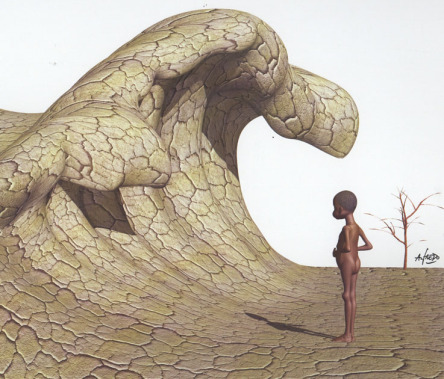
"Tsunami," by Alberto Sabat, La Nacion in Argentina. Winner of the Lurie-UN Cartoon award, 2007.

“Tsunami,” by Alberto Sabat, La Nacion in Argentina

This cartoon won the 2006 Ranan Lurie Award for editorial cartooning, an international competition supported by the United Nations Correspondents Association (other 2006 winners here). The title of the cartoon is “African Tsunami.”

The cartoonist is Alberto Sabat, the cartoon was published in La Nacion in Argentina. The award is named after the outstanding cartoonist Ranan Lurie, who himself was once nominated for a Nobel Peace Prize for his cartoons that promoted peace and understanding.

Political cartoons make classrooms interesting, and often provoke students to think hard and talk a lot about things they should be thinking and talking about. These links provide more sources of classroom material — please remember to note copyright information.

Tip of the old scrub brush to Reclaiming Space.

Update, December 2007: 2007 Lurie Awards announced; my post here, all the 2007 winners at the Lurie Awards site here.

Update, December 2008:  2008 awards post.

Update December 2009:  2009 awards listed here.

Share this post:

Add to FacebookAdd to NewsvineAdd to DiggAdd to Del.icio.usAdd to StumbleuponAdd to RedditAdd to BlinklistAdd to TwitterAdd to TechnoratiAdd to Furl