July 4, 2010 – Fly your flag today

July 4, 2010

Fourth of July:  NPR has already read the Declaration of Independence, PBS has the Capitol Fourth concert this evening (8:00 p.m. Eastern — check your local listings), your town has a parade somewhere this weekend, and fireworks are everywhere.

Remember to put your flag up today.

Astronaut Eugene Cernan and the U.S. Flag -- Apollo 17 on the Moon (NASA photo)

Last flag on the Moon: Astronaut Eugene Cernan and the U.S. Flag -- Apollo 17 on the Moon (NASA photo)

Also:

Lunar Reconnaissance Orbiter photo of Apollo 17 landing site

Lunar Reconnaissance Orbiter photo of Apollo 17 landing site


Patriotic shame of Corpus Christi, Texas

July 2, 2010

Flag in Corpus Christi, Texas, at corner of Staples and Craig - photo by Ed Darrell - IMGP4383

This flag needs to be retired. Will some patriot step up to the job?

Leaving Corpus Christi can be a trial.  It’s at least a 15 mile drive from the American Banking Center to Interstate 37, if you go by the Starbucks on Staples to get coffee for the drive back to Dallas.  (It’s a 100-yard drive otherwise.)

Tourist that I am I drove Staples all the way back, to see the nitty-gritty of the town.

Must it be this gritty?

The flag above, if it can still be considered a flag, struggles to honor our nation at the corner of Staples and Craig Streets.  Clearly this is not a flag that is retired at sundown, as the U.S. flag code urges.  It looks as though it has been flying there for at least a year.  Perhaps it has flown since September 11, 2001.  Perhaps it has flown since the War of 1812.

When a flag becomes tattered, it should be mended, appropriate for a symbol of our nation.  When it can no longer be repaired, it should be retired, according to the Congressional Research Service Report for Congress — The United States Flag:  Federal Law Related to Display and Associated Questions (pages 11 and 12):

Destruction of Worn Flags

The Flag Code states:

The flag, when it is in such condition that it is no longer a fitting emblem for display, should be destroyed in a dignified way, preferably by burning.*  The act is silent on procedures for burning a flag. It would seem that any procedure which is in good taste and shows no disrespect to the flag would be appropriate. The Flag Protection Act of 1989,38 struck down albeit on grounds unrelated to this specific point,39 prohibited inter alia “knowingly” burning of a flag of the United States, but excepted from prohibition “any conduct consisting of disposal of a flag when it has become worn or soiled.”

4 U.S.C. § 8(k).

Do we have any readers in Corpus Christi?  Could you drop by the shop where this flag is flown sometime through the week, and ask them to retire the flag, as an act of honor for our nation?

Thank you.


1943 conflict: Flag, First Amendment’s Establishment Clause

June 14, 2010

Historic irony: On Flag Day in 1943, the U.S. Supreme Court issued its decision in the case of West Virginia vs. Barnette.

Billy Gobitis explained why he would not salute the U.S. flag, November 5, 1935 - Library of Congress collection

Image 1 - Billy Gobitas explained why he would not salute the U.S. flag, November 5, 1935 - Library of Congress collection

The case started earlier, in 1935, when a 10-year-old student in West Virginia, sticking to his Jehovah’s Witness principles, refused to salute the U.S. flag in a state-required pledge of allegiance. From the Library of Congress:

“I do not salute the flag because I have promised to do the will of God,” wrote ten-year-old Billy Gobitas (1925-1989) to the Minersville, Pennsylvania, school board in 1935. His refusal, and that of his sister Lillian (age twelve), touched off one of several constitutional legal cases delineating the tension between the state’s authority to require respect for national symbols and an individual’s right to freedom of speech and religion.

The Gobitas children attended a public school which, as did most public schools at that time, required all students to salute and pledge allegiance to the flag of the United States. The Gobitas children were members of the Jehovah’s Witnesses, a church that in 1935 believed that the ceremonial saluting of a national flag was a form of idolatry, a violation of the commandment in Exodus 20:4-6 that “thou shalt not make unto thee any graven image, nor bow down to them. . . .” and forbidden as well by John 5:21 and Matthew 22:21. On 22 October 1935, Billy Gobitas acted on this belief and refused to participate in the daily flag and pledge ceremony. The next day Lillian Gobitas did the same. In this letter Billy Gobitas in his own hand explained his reasons to the school board, but on 6 November 1935, the directors of the Minersville School District voted to expel the two children for insubordination.

The Watch Tower Society of the Jehovah’s Witnesses sued on behalf of the children. The decisions of both the United States district court and court of appeals was in favor of the right of the children to refuse to salute. But in 1940 the United States Supreme Court by an eight-to-one vote reversed these lower court decisions and ruled that the government had the authority to compel respect for the flag as a key symbol of national unity. Minersville v. Gobitis [a printer’s error has enshrined a misspelling of the Gobitas name in legal records] was not, however, the last legal word on the subject. In 1943 the Supreme Court by a six-to-three vote in West Virginia State Board of Education v. Barnette, another case involving the Jehovah’s Witnesses, reconsidered its decision in Gobitis and held that the right of free speech guaranteed in the First Amendment to the Constitution denies the government the authority to compel the saluting of the American flag or the recitation of the pledge of allegiance.

There had been strong public reaction against the Gobitis decision, which had been written by Justice Felix Frankfurter (1882-1965). In the court term immediately following the decision, Frankfurter noted in his scrapbook that Justice William O. Douglas (1898-1980) told him that Justice Hugo LaFayette Black (1886-1971) had changed his mind about the Gobitis case. Frankfurter asked, “Has Hugo been re-reading the Constitution during the summer?” Douglas replied, “No–he has been reading the papers.”1 The Library’s William Gobitas Papers showcase the perspective of a litigant, whereas the abstract legal considerations raised by Gobitis and other cases are represented in the papers of numerous Supreme Court justices held by the Manuscript Division.

1. Quoted in H. N. Hirsch, The Enigma of Felix Frankfurter (New York: Basic Books, 1981), 152.

John E. Haynes and David Wigdor, Manuscript Division

Second page, Billy Gobitiss explanation of why he will not salute the U.S. flag - Library of Congress

Second page, Billy Gobitas's explanation of why he will not salute the U.S. flag: "I do not salute the flag not because I do not love my country but I love my country and I love God more and I must obey His commandments." - Library of Congress

Supreme Court justices do not often get a chance to reconsider their decisions. For example, overturning Plessy vs. Ferguson from 1896 took until 1954 in Brown v. Topeka Board of Education. In the flag salute/pledge of allegiance cases Justice Hugo Black had a change of mind, and when a similar case from West Virginia fell on the Court’s doorstep in 1943, the earlier Gobitis decision was reversed.

Writing for the majority, Justice Robert H. Jackson said:

If there is any fixed star in our constitutional constellation, it is that no official, high or petty, can prescribe what shall be orthodox in politics, nationalism, religion, or other matters of opinion, or force citizens to confess by word or act their faith therein. If there are any circumstances which permit an exception, they do not now occur to us.

Jehovah’s Witnesses, and all other Americans, thereby have the right to refuse to say what they and their faith consider to be a vain oath.

And that, boys and girls, is what the First Amendment means.

Resources:


Flag Day 2010 – Wave those stars and stripes

June 14, 2010

June 14th marks the anniversary of the resolution passed by the Second Continental Congress in 1777, adopting the Stars and Stripes as the national flag.

Fly your flag today. This is one of the score of dates upon which Congress suggests we fly our flags.

Flag Day 1916, parade in Washington, D.C. - employees of National Geographic Society march - photo by Gilbert Grosvenor

Flag Day 1916, parade in Washington, D.C. - employees of National Geographic Society march - photo by Gilbert Grosvenor

The photo above drips with history. Here’s the description from the National Geographic Society site:

One hundred and fifty National Geographic Society employees march in the Preparedness Parade on Flag Day, June 14, in 1916. With WWI underway in Europe and increasing tensions along the Mexican border, President Woodrow Wilson marched alongside 60,000 participants in the parade, just one event of many around the country intended to rededicate the American people to the ideals of the nation.

Not only the anniversary of the day the flag was adopted by Congress, Flag Day is also the anniversary of President Dwight Eisenhower’s controversial addition of the words “under God” to the Pledge of Allegiance in 1954.

(Text adapted from “:Culture: Allegiance to the Pledge?” June 2006, National Geographic magazine)

The first presidential declaration of Flag Day was 1916, by President Woodrow Wilson. Wilson won re-election the following November with his pledge to keep America out of World War I, but by April of 1917 he would ask for a declaration of war after Germany resumed torpedoing of U.S. ships. The photo shows an America dedicated to peace but closer to war than anyone imagined. Because the suffragettes supported Wilson so strongly, he returned the favor, supporting an amendment to the Constitution to grant women a Constitutional right to vote. The amendment passed Congress with Wilson’s support and was ratified by the states.

The flags of 1916 should have carried 48 stars. New Mexico and Arizona were the 47th and 48th states, Arizona joining the union in 1913. No new states would be added until Alaska and Hawaii in 1959. That 46-year period marked the longest time the U.S. had gone without adding states, until today. No new states have been added since Hawaii, more than 49 years ago. (U.S. history students: Have ever heard of an essay, “Manifest destiny fulfilled?”)

150 employees of the National Geographic Society marched, and as the proud CEO of any organization, Society founder Gilbert H. Grosvenor wanted a photo of his organization’s contribution to the parade. Notice that Grosvenor himself is the photographer.

I wonder if Woodrow Wilson took any photos that day, and where they might be hidden.

History of Flag Day from a larger perspective, from the Library of Congress:

Since 1916, when President Woodrow Wilson issued a presidential proclamation establishing a national Flag Day on June 14, Americans have commemorated the adoption of the Stars and Stripes by celebrating June 14 as Flag Day. Prior to 1916, many localities and a few states had been celebrating the day for years. Congressional legislation designating that date as the national Flag Day was signed into law by President Harry Truman in 1949; the legislation also called upon the president to issue a flag day proclamation every year.

According to legend, in 1776, George Washington commissioned Philadelphia seamstress Betsy Ross to create a flag for the new nation. Scholars debate this legend, but agree that Mrs. Ross most likely knew Washington and sewed flags. To date, there have been twenty-seven official versions of the flag, but the arrangement of the stars varied according to the flag-makers’ preferences until 1912 when President Taft standardized the then-new flag’s forty-eight stars into six rows of eight. The forty-nine-star flag (1959-60), as well as the fifty-star flag, also have standardized star patterns. The current version of the flag dates to July 4, 1960, after Hawaii became the fiftieth state on August 21, 1959.

Fly your flag with pride today.

Elmhurst Flag Day 1939, DuPage County Centennial - Posters From the WPA

Elmhurst Flag Day 1939, DuPage County Centennial - Posters From the WPA

Elmhurst flag day, June 18, 1939, Du Page County centennial / Beauparlant.
Chicago, Ill.: WPA Federal Art Project, 1939.
By the People, For the People: Posters from the WPA, 1936-1943

This is an encore post, from June 14, 2009


Dan Valentine – “Call me anti-American”

June 7, 2010

By Dan Valentine

Dear Hattip:

Call me anti-American.

When I was in high school, I entered an essay contest, sponsored by the Veterans of Foreign Wars, called Voice of Democracy.  I wrote about socialism, communism, and capitalism, and how all three were good systems.  With a hundred-or-so people!  Add five or ten more folks to the mix and all three tend to get corrupted.  All three have little or nothing to do with democracy.  I was awarded a prize.

Call me anti-American.

I joined the Navy to avoid going to Vietnam.  My three good friends at the time joined the Army.  They were sent to New Jersey.  The Almighty, She’s got a sense of humor.  I was sent to ‘Nam.

After boot camp, I caught a flight to Guam to catch my assigned ship, the USS Tanner, a survey ship.  It was at sea at the time, steaming from Pearl Harbor.  I caught pneumonia, killing time, in a sudden downpour on Gab-Gab Beach waiting for it.  Sent to the Naval Hospital to recoup.  The wards were filled with Marines, soldiers, sailors, and the like, with major combat wounds.  Some missing an arm; others, a leg.  Pneumonia or not, I was well enough to swing a mop.  So I was given the duty to sweep, swab, and buff the corridors and rooms.  The least I could do.

Call me anti-American.

I recovered, caught my ship.  To Vietnam.  Assigned to deck force.  Hell on earth, in small quarters.  If there’s a Devil, he or she taught boatswain mates all he or she knows.  And then some.

“Just out of boot camp?”  There were a handful of us.  “Welcome to the fleet!”  Initiation time.  One seaman apprentice, while chipping, sanding, and painting the side of the ship, was repeatedly lowered by chortling boatswain mates, down and up, down and up, repeatedly, into the water below, swarming with barracudas.  From that day forward, he was called Screamin’ Wiley.  Another was stripped naked and smeared with butter all over his exposed body, private parts included.  He was forever-after called Butterball.

I was assigned to stand mid-watch in the crow’s nest.  In a wind-storm.  I’m afraid of heights.  How did they know?  Their kind always knows.  Clouds fast-approaching were grumbling, lightning streaks flashing.  I was scared to death.  When the winds got to be too much, they brought me down.  I planted my feet firmly on the deck, smiling, happy as hell.  From then on, I was known as Smiley Face.  When I was first learning to man the helm (it was part of our duties, among others), a boatswain mate would stand nearby and kick me in the butt with his boot–wham!–whenever I went off course the slightest.  “Keep it on course, Smiley Face.”  Wham!  You soon learn to keep on course.

Call me anti-American.

I served two tours in Vietnam.  I was there the night the Tet Offensive began.  Tracer rounds flying.  One night I was standing the starboard or port watch when I thought I saw a swimmer in the water getting closer and closer to the ship.  With explosives?  General quarters!  Boats were lowered and percussion bombs were tossed all night long.  They never found a body.  If there was a swimmer, I like to think he or she is escorting American tourists around, telling them war stories, just as Americans in his or her shoes would.

Call me anti-American.

Another time I was on day-watch when a Vietnamese junk approached.  The Officer of the Deck, bullhorn in hand, warned those on aboard the junk to turn away.  I was told, if need be, to shoot the fellow at the helm, dead, on command.  The junk turned around.  To this day, I don’t know if I could have carried out the order.

Call me anti-American.

In Vietnam I wrote a book of short essays in my off-hours called Military Moods.  (Moments of Truth; Ports of Call; Christmas:  The Loneliest Day of the Year; etc.  One was:  Love Letter to a Country.)

Call me anti-American.

When the Tanner was decommissioned–my book of essays my ticket “outta here!”–I got assigned to the USS Canopus, a submarine tender, which supplied nuclear attack submarines with nuclear missiles to attack with.

I met the ship in Bremerton, WA, and we sailed to GITMO for a month-long series of sea exercises, preparing for future possible attacks, both chemical and nuclear.  As the ship’s journalist, with no duties other than to put out the ship’s newspaper, cruise book, and hometown news releases, I was assigned to save the Old Glory from radiation or chemical exposure.  Officers timed us with a clock-watch.  Drill after drill, I was killed, and I told myself if there ever was an attack, I was not going to die retrieving a piece of cloth.  But, being young at the time, I probably would have.  That’s why they draft nineteen-year olds.  When there is a draft.

Call me anti-American.

In the 80s, I worked for Sen. Orrin Hatch (R-Utah), in Washington, D.C., for half a decade.  Whenever there was a speech to be written “from the heart” (Flag Day, Memorial Day, Fourth of July, Veterans Day, both Washington’s and Lincoln’s birthdays, I was the one called upon to write it.

When a Senate colleague died, Republican or Democrat, I was the one called upon to write the floor statement “from the heart”.  The New York Times picked up one and reprinted parts of it, saying, “Such eloquence is seldom heard on the Chamber floor.”

Call me anti-American.

In the 90s, when my dad died and, later, when my mom died, I had their sealed-ashes placed in Arlington National Cemetery.  My dad–he was wounded on Guadalcanal–would have liked that.

Call me anti-American.

I was in Salt Lake when 9/11 happened.  I had canceled my flight back to New York to see a touring musical at the Capitol Theatre, or I would have been there when it happened.  When I did return, a week later, it just so happened to be the first day the subways were running again.  I caught one into town from the airport.  Dead silence all the way.  No one spoke a word.  Everyone was stunned.

I had moved up to the Upper West Side, two blocks from Lincoln Center, a couple of blocks to Central Park.  My New York ID, though, still listed my first home address there.  On Duane Street in Tribeca, only a stone’s throw away from the Towers.

I showed an armed National Guardsman my ID and walked to where the Towers once stood.  On the way, I stopped to take a look at my former residence.  There was a National Guardsman standing close by the entrance, armed and ready.

Across the street was a firehouse.  The firefighters there were the first to be called to the scene after the first plane hit the first building.  They were lucky.  They didn’t lose a single man or woman.

Further down the street, by Ground Zero, women were having their photos taken, hugging firemen, the nation’s new heroes.

The next day, I seriously thought about going to see an eye doctor.  I could barely see.  It was due to the debris in the air.

One day, shortly after, I paused on a street corner before crossing and motioned for a cabbie, speeding to catch the light before it turned, to continue on by.  He put his foot on the brake and motioned for me to cross.  I motioned for him to drive by.  He motioned for me cross.  Etc.  He was mid-eastern.

Call me anti-American.

Such courtesy between strangers and nationalities lasted, I’d say, less than a week.

Later on, one evening, I stopped for a drink at the Russian Tea Room.  Took a seat at the bar by a couple, sitting speechless and stunned, as everyone in town was.  The two paid their tab and left.  The bartender said, “That was Mel Brooks and Anne Bancroft.”  Elbow to elbow and I hadn’t even noticed.

Now paying some attention, I glanced around to see two older ladies at the end of the bar, enjoying themselves, laughing, drinking champagne.  They looked rather bedraggled.  But lots of folks did that first week or so.  That, and you never know who’s got money and who doesn’t in New York.  They could very well have been ga-zillionaires.

They weren’t.

They didn’t have a dime on ’em.  When they began to depart, without paying, a cocktail waitress blocked their path.  The bartender called the cops.  Two were there just like that!  There was a battle of wills.  Both women started kicking and scratching.  One of the cops had to physically throw one to the floor, cuffing her hands behind her.  He came over to me and asked if he could have my drink.  Sure!  He poured the contents on the scratches on his arm.

Call me anti-American.

March or April, 2010.  In Houston at an ATM drive-thru.  My dearest friend and I.  Waiting behind a souped-up pick-up with dark tinted windows.  On the back bumper, a sticker that read:  f-Obama.

I told my friend, Quick, get a pic of it, along with the license plate, on her cell camera, so we could call some city or county or state or federal agency.  But the vehicle zoomed off.  Scary stuff.  I fear for Obama’s life.

Call me anti-American.

Call me a little twerp, too.  Childish, self-hating, revolting, juvenile, and beyond shame.

I’ve been called worse.  When my son was four or so, he called me a bastard.  Out of the blue.  He’d heard it from his mother’s mum.  A truer statement has probably never been said about me.  I’ve done some terrible things in my life, looking back.  One or two beyond shame.  A good many of us, by the time we reach our 60s, have.

My dearest friend’s step-dad once called me “the stupidest person” he had “ever known” in his “entire life”, glaring at me with pure hatred from across a table at an International Pancake House one morning near NASA.  He was so mad I could see he wanted to take me by the neck and strangle me to death right then and there.  If Bin Laden had been eating pancakes in the booth next to us, her step-dead would have killed me first.  We were talking politics.  He’s a Republican.

But enough already.

Hattip, I wish you well.

Call me anti-American.

[Editor’s note:  View Hattip’s comment here.]


Memorial Day 2010: Fly your flag, study history, honor the dead

May 29, 2010

(Much of this post is encore material, from Memorial Day 2009.)

Please fly your flag this weekend, and especially Monday, to honor those who gave up their lives in defense of the nation and our freedoms.

Memorial Day, traditionally observed on May 30, now observed the last Monday in May, honors fallen veterans of wars. Traditionally, family members visit the cemetery where loved ones are interred and leave flowers on the grave.

Memorial Day honors people who died in defense of the nation.  Armed Forces Day honors those who serve currently, celebrated  the third Saturday in May.  Veterans Day honors the veterans who returned.

On Memorial Day itself, flags on poles or masts should be flown at half-staff from sunrise to noon. At noon, flags should be raised to full-staff position.

When posting a flag at half-staff, the flag should be raised to the full-staff position first, with vigor, then slowly lowered to half-staff; when retiring a flag posted at half-staff, it should be raised to the full staff position first, with vigor, and then be slowly lowered. Some people attach black streamers to stationary flags, though this is not officially recognized by the U.S. Flag Code.

On Memorial Day, 3:00 p.m. local time is designated as the National Moment of Remembrance.

Got another week of school? Here’s a quiz about the history of Memorial Day that might make a warm-up, provided by Carolyn Abell writing in the Tifton (Georgia) Gazette:

1. Memorial Day was first officially proclaimed by a general officer. His name was: A. Robert E. Lee; B. John A. Logan; C. Douglas MacArthur D. George Washington.

2. The first state to officially recognize Memorial Day was A. Virginia; B. Rhode Island; C. New York; D. Georgia.

3. The use of poppies to commemorate Memorial Day started in A. 1870 B. 1915 C. 1948; D. 1967.

4. The original date of Memorial Day was A. May 30; B. July 4; C. May 28; D. Nov 11.

5. Which U.S. Senator has tried repeatedly to pass legislation that would restore the traditional day of Memorial Day observance? A. John McCain B. Ted Kennedy C. Saxby Chambliss D. Daniel Inouye.

The answers, again provided by the Tifton Gazette:

OK, now for the answers. General John Logan, national commander of the Grand Army of the Republic, proclaimed May 30, 1968 as Memorial Day in his General Order Number 11, issued on May 5, 1868. The purpose was to honor the dead from both sides in the War Between the States. Subsequently flowers were placed on the graves of both Union and Confederate soldiers in Arlington National Cemetery on May 30 of that year.

New York was the first state to officially recognize the Memorial Day, in 1873. Southern states, though paying tribute to their dead on separate dates, refused to use May 30 as the official date until after World War I, when the holiday was broadened to honor those who died in any war.

In 1915 a woman named Moina Michael, inspired by the poem, “In Flanders Fields,” (by Canadian Colonel John McRae) began wearing red poppies on Memorial Day to honor our nation’s war dead. The tradition grew and even spread to other countries. In 1922 the VFW became the first veterans’ organization to sell the poppies made by disabled veterans as a national effort to raise funds in support of programs for veterans and their dependents. In 1948 the US Post Office issued a red 3-cent stamp honoring Michael for her role in founding the national poppy movement.

As stated above, May 30 was the original Memorial Day. In 1971, with the passage of the national Holiday Act, Congress changed it so that Memorial Day would be celebrated on the last Monday of May. Some citizens feel that turning it into a “three-day weekend” has devalued the importance and significance of this special holiday. In fact, every time a new Congress has convened since 1989, Senator Daniel Inouye of Hawaii has introduced a bill to the Senate calling for the restoration of May 30th as the day to celebrate Memorial Day.

In his 1999 introductory remarks to the bill, Senator Inouye declared:

“Mr. President, in our effort to accommodate many Americans by making the last Monday in May, Memorial Day, we have lost sight of the significance of this day to our nation. Instead of using Memorial Day as a time to honor and reflect on the sacrifices made by Americans in combat, many Americans use the day as a celebration of the beginning of summer. My bill would restore Memorial Day to May 30 and authorize the flag to fly at half mast on that day.

In addition, this legislation would authorize the President to issue a proclamation designating Memorial Day and Veterans Day as days for prayer and ceremonies honoring American veterans. This legislation would help restore the recognition our veterans deserve for the sacrifices they have made on behalf of our nation.” (from the 1999 U.S. Congressional Record).

Flat at half-staff, U.S.Capitol in background - from Flag Bay

Other sources:

Image of flag and U.S. Capitol from Flags Bay.


Query

March 26, 2010

Jim Demint, how’s that “break this president” thing working for you?

When one agrees to do battle at Waterloo, perhaps one should pay more careful attention to whether one is on the side of Napoleon, or on the side of Wellington.


Christian pastor “wants his country back”

December 21, 2009

I get e-mail — sometimes because I belong to a list-serv.  Some of those provoke thought.

Bill Longman sent some thoughts from Jan Linn, a Disciples of Christ pastor and author of The Jesus Connection and What’s Wrong With the Christian Right.

Bill wrote, “I’m going to foward this seasonal meditation from pastor Jan Linn reflecting thoughts about our lack of concern for the common good as seen in the battle for health care legislation.”

A Christmas Wish

By Jan Linn

This past summer I heard a woman attending a town hall meeting tearfully say, “I want my country back.” So do I. That is my Christmas wish this year. I want my country back.

I want to experience the pride I used to feel at the sight of the American flag being raised as a sign of victory as a proud American athlete stood tall on the center platform at the Olympics.

I want to feel that catch in my throat I used to feel when the star spangled banner was played just before the start of a football game.

I want to experience again the excitement I felt when our college team had the chance to meet the governor of our state before the season started and to hear him speak about his pride in the kind of university we were representing.

I want to see the workers of our nation valued as they once were for all they do to make their companies a success.

I want to take my grandson fishing so he can enjoy the excitement and fun of  telling everyone about the fish he caught that gets bigger every time he tells it.

I want to go to church on Christmas Eve and give thanks to God for all people who come to the Communion Table, regardless of creed, nationality, or sexual orientation.

I want to be able to tell children of all different races, religion, sizes and shapes, that all of them have an equal chance to do whatever they can with the abilities they have

I want the rest of the world to know that we appreciate who they are just as we want them to appreciate who we are.

Yes, my Christmas wish this year is to have my country back, too, only I know based on what this woman said before she said she wanted her country back that her reasons and mine are very different.

You see, I want my country back so our nation’s top athletes will once again want to compete fairly and live up to the responsibilities of being the role models they are to our youth.

I want my country back so that the loyal opposition will once again be part of how we understand the meaning of patriotism.

This Christmas my wish is to have my country back so that politicians from opposing parties and ideologies will stop demonizing one another and respectfully disagree about what is best for our country.

I want my country back so that honest work is rewarded rather than exploited by those for whom enough is never enough.

I want my country back so the water I take my grandson to fish in will not be contaminated by toxic runoff, and that companies with chemical and nuclear waste will know they will be shown no mercy if they do not ensure it is stored safely.

I want my country back so all Christians can know that our faith has a place among the religions of the world without having to prove they are wrong and we are right.

I want my country back so every child in this nation will know he or she is loved and valued, secure and protected as every child should be.

My Christmas wish is to have my country back so that America can once again be a beacon of hope and light to other nations, not because we think we are better than they are, but because we understand the responsibilities that go with being the heirs of those who have sacrificed so much to give us the land we now have.

I want my country back so I can help make room for everyone who agrees with me and everyone who does not, knowing that it is only when we keep our differences from becoming divisions that we can be a strong and enduring democracy.

Most of all, my Christmas wish is to have my country back so we can be a people who don’t just talk about justice and peace, but work for both, and to do everything we can to preserve our nation, make it better, and pass on its enduring values to the next generation.

So, yes, my wish this Christmas is to have my country back, because for me what that means to me goes to the heart of how I understand what celebrating the birth of Jesus is truly means.

Amen.


Palin: Ignore the woman abusing the flag and look at those gams!

November 18, 2009

Newsweek features Sarah Palin on the cover this week, a couple of weeks after featuring Al Gore.  I thought the Gore cover was interesting, but could be interpreted to make him look sinister.

Palin on the cover of Newsweek

Sexist? Or sac-patriotic?

Palin, on the other hand, is featured in a full photo she posed for Runners World last year.  A flattering photo, it also features a U.S. flag, which we’ll get back to in a moment.

Palin complains that the cover is “sexist.”

Yahoo! News has the story, featuring Palin’s Facebook complaint.

“The choice of photo for the cover of this week’s Newsweek is unfortunate. When it comes to Sarah Palin, this “news” magazine has relished focusing on the irrelevant rather than the relevant. The Runner’s World magazine one-page profile for which this photo was taken was all about health and fitness — a subject to which I am devoted and which is critically important to this nation. The out-of-context Newsweek approach is sexist and oh-so-expected by now. If anyone can learn anything from it: it shows why you shouldn’t judge a book by its cover, gender, or color of skin. The media will do anything to draw attention — even if out of context.

But look at the cover.  Newsweek brands Palin as a problem — for Republicans. Is the sexism charge designed to divert attention from what Newsweek is saying, editorially?

Look at the display of the flag.  Clearly out of flag code on all scores, it appears as if she’s using the flag much as an athletic towel.  Now think of the rage the right worked up to when candidate Obama didn’t wear a flag lapel pin.  Can you imagine the rage had any Democrat posed for a picture, leaning on the flag like that?

The photo reveals Palin and her handlers as ill-informed on the flag code, and willing to do almost anything to get a camera.  I find it interesting that now, more than a year after she posed for the picture, she’s concerned about her showing of leg and not about the political issues raised by Newsweek.

Almost no one worries about the disrespect for the U.S. flag.

_____________

Update: Good commentary at Obsidian Wings — and note the first five or so comments.  Smart readers there!  Much the same at Majikthise.


Brave 10-year-old Arkansas boy refuses to say the Pledge of Allegiance, on principle

November 17, 2009

Adults worry about peer pressure.  Kids can goad other kids into doing stupid things, dangerous things, illegal things, and immoral things.

Pressure from adults on kids might be just as strong.

What about a 10-year-old kid who stands up to peer pressure, and stands for principle against adults who use all sorts of inducements to get him to do something he believes is wrong?

I offer a salute to Will Phillips of  West Fork School District, in Washington County, Arkansas.

Will believes homosexuals in America are not beneficiaries of  liberty and justice for all.  Will now refuses to stand and say the Pledge of Allegiance for that reason.

It’s probably not what I’d advise the young man to do to protest, but he has every right.  He’s thought it through, which may not be said for the substitute teacher and the school administrator who tried to pressure him into giving up on his principles.

In the Arkansas Times, David Koon writes the story:

A boy and his flag

Why Will won’t pledge.

David Koon
Updated: 11/5/2009

WILL PHILLIPS: Freedom lover.

Will Phillips, freedom lover, in Arkansas (Arkansas Times photo)

Will Phillips isn’t like other boys his age.

For one thing, he’s smart. Scary smart. A student in the West Fork School District in Washington County, he skipped a grade this year, going directly from the third to the fifth. When his family goes for a drive, discussions are much more apt to be about Teddy Roosevelt and terraforming Mars than they are about Spongebob Squarepants and what’s playing on Radio Disney.

It was during one of those drives that the discussion turned to the pledge of allegiance and what it means. Laura Phillips is Will’s mother. “Yes, my son is 10,” she said. “But he’s probably more aware of the meaning of the pledge than a lot of adults. He’s not just doing it rote recitation. We raised him to be aware of what’s right, what’s wrong, and what’s fair.”

Will’s family has a number of gay friends. In recent years, Laura Phillips said, they’ve been trying to be a straight ally to the gay community, going to the pride parades and standing up for the rights of their gay and lesbian neighbors. They’ve been especially dismayed by the effort to take away the rights of homosexuals – the right to marry, and the right to adopt. Given that, Will immediately saw a problem with the pledge of allegiance.

“I’ve always tried to analyze things because I want to be lawyer,” Will said. “I really don’t feel that there’s currently liberty and justice for all.”

After asking his parents whether it was against the law not to stand for the pledge, Will decided to do something. On Monday, Oct. 5, when the other kids in his class stood up to recite the pledge of allegiance, he remained sitting down. The class had a substitute teacher that week, a retired educator from the district, who knew Will’s mother and grandmother. Though the substitute tried to make him stand up, he respectfully refused. He did it again the next day, and the next day. Each day, the substitute got a little more cross with him. On Thursday, it finally came to a head. The teacher, Will said, told him that she knew his mother and grandmother, and they would want him to stand and say the pledge.

“She got a lot more angry and raised her voice and brought my mom and my grandma up,” Will said. “I was fuming and was too furious to really pay attention to what she was saying. After a few minutes, I said, ‘With all due respect, ma’am, you can go jump off a bridge.’ ”

Will was sent to the office, where he was given an assignment to look up information about the flag and what it represents. Meanwhile, the principal called his mother.

“She said we have to talk about Will, because he told a sub to jump off a bridge,” Laura Phillips said. “My first response was: Why? He’s not just going to say this because he doesn’t want to do his math work.”

Eventually, Phillips said, the principal told her that the altercation was over Will’s refusal to stand for the pledge of allegiance, and admitted that it was Will’s right not to stand. Given that, Laura Phillips asked the principal when they could expect an apology from the teacher. “She said, ‘Well I don’t think that’s necessary at this point,’ ” Phillips said.

After Phillips put a post on the instant-blogging site twitter.com about the incident, several of her friends got angry and alerted the news media. Meanwhile, Will Phillips still refuses to stand during the pledge of allegiance. Though many of his friends at school have told him they support his decision, those who don’t have been unkind, and louder.

“They [the kids who don’t support him] are much more crazy, and out of control and vocal about it than supporters are.”

Given that his protest is over the rights of gays and lesbians, the taunts have taken a predictable bent. “In the lunchroom and in the hallway, they’ve been making comments and doing pranks, and calling me gay,” he said. “It’s always the same people, walking up and calling me a gaywad.”

Even so, Will said that he can’t foresee anything in the near future that will make him stand for the pledge. To help him deal with the peer pressure, his parents have printed off posts in his support on blogs and websites. “We’ve told him that people here might not support you, but we’ve shown him there are people all over that support you,” Phillips said. “It’s really frustrating to him that people are being so immature.”

At the end of our interview, I ask young Will a question that might be a civics test nightmare for your average 10-year-old. Will’s answer, though, is good enough — simple enough, true enough — to give me a little rush of goose pimples.  What does being an American mean?

“Freedom of speech,” Will says, without even stopping to think. “The freedom to disagree. That’s what I think pretty much being an American represents.”

Somewhere, Thomas Jefferson smiles.


Don’t “dip” the American flag

August 14, 2009

So far I’ve been able to learn that Joe Bruni is a firefighter.  Beyond that, I don’t know much other than his YouTube series on flag etiquette is very good — not perfect, but very, very good.

In this episode he talks about carrying a flag.  I wish he’d discussed it in terms of a flag ceremony, but he gets the basics right.

Younger Scouts, Cub Scouts, Brownies and Bluebirds will have difficulty holding a large flag and pole vertical — get a flag harness to help them out (usually less than $25.00 at Scout supply shops).

He’s got a bunch of these.  I’ll pass them along as I get a chance to view them.

(Joe Bruni — who are you?)


Star-spangled voodoo history

July 16, 2009

Star-spangled Banner and the War of 1812 - The original Star-Spangled Banner, the flag that inspired Francis Scott Key to write the song that would become our national anthem, is among the most treasured artifacts in the collections of the Smithsonian’s National Museum of American History in Washington, D.C.

Star-spangled Banner and the War of 1812 – The original Star-Spangled Banner, the flag that inspired Francis Scott Key to write the song that would become our national anthem, is among the most treasured artifacts in the collections of the Smithsonian’s National Museum of American History in Washington, D.C.

(Hey, Dear Reader; this post got an update many months later — you may want to check it out for better links and more information.)

Every school kid learns the story of the “Star-Spangled Banner,” or should.

During the War of 1812, Georgetown lawyer Francis Scott Key, stood aboard a British ship in Baltimore Harbor to negotiate the release of his friend, Dr. William Beanes, who had been taken prisoner while the British stormed through Bladensburg, Maryland, after burning Washington, D.C.  Key witnessed the British shelling of Fort McHenry, the guardian of Baltimore’s harbor.  Inspired when he saw the U.S. flag still waving at dawn after a night of constant shelling, Key wrote a poem.

Key published the poem, suggested it might be put to the tune of “Anachreon in Heaven” (a tavern tune popular at the time) — and the popularity of the song grew until Congress designated it the national anthem in 1931.  In telling the story of the latest restoration of that garrison flag now housed at the Smithsonian Museum of American History, Smithsonian Magazine repeated the story in the July 2000 issue:  “Our Flag Was Still There.”

It’s a wonderful history with lots of splendid, interesting details (Dolley Madison fleeing the Executive Mansion clutching the Gilbert Stuart portrait of George Washington, the guy who had introduced Dolley to James Madison and then snubbed them after they were married; the British troops eating the White House dinner the Madisons left in their haste; the gigantic, 42 by 30 foot flag sewn by Mary Pickersgill, a Baltimore widow trying to support her family; the rag-tag Baltimore militia stopping cold “Wellington’s Invicibles;” the British massing of 50 boats and gunships; and much more).

It’s a grand and glorious history that stirs the patriotic embers of the most cynical Americans.

And it’s all true.

So it doesn’t deserve the voodoo history version, the bogus history created by some person preaching in a church (I gather from the “amens”) that is making the rounds of the internet, stripped of attribution so we cannot hunt down the fool who is at fault.

We got this in an e-mail yesterday; patriots save us, there must be a hundred repetitions that turn up on Google, not one correcting this horrible distortion of American history.

Horrible distortion of American history

(The full version is a mind-numbing 11 minutes plus.  Some people have put it on other sites.)

Why do I complain?

  1. It was the War of 1812, not the Revolutionary War — there were 15 states, not 13 colonies.
  2. There was no ultimatum to to Baltimore, nor to the U.S., as this fellow describes it.
  3. Key negotiated for the release of one man, Dr. Beanes.  There was no brig full of U.S. prisoners.
  4. It’s Fort McHenry, not “Henry.”  The fort was named after James McHenry, a physician who was one of the foreign-born signers of the Constitution, who had assisted Generals Washington and Lafayette during the American Revolution, and who had served as Secretary of War to Presidents Washington and Adams.
  5. Fort McHenry was a military institution, a fort defending Baltimore Harbor.  It was not a refuge for women and children.
  6. The nation would not have reverted to British rule had Fort McHenry fallen.
  7. There were 50 ships, not hundreds.  Most of them were rafts with guns on them.  Baltimore Harbor is an arm of Chesapeake Bay; Fort McHenry is not on the ocean.
  8. The battle started in daylight.
  9. Bogus quote:  George Washington never said “What sets the American Christian apart from all other people in this world is he will die on his feet before he will live on his knees.”  Tough words.  Spanish Civil War.  Not George Washington.  I particularly hate it when people make up stuff to put in the mouths of great men.  Washington left his diaries and considerably more — we don’t have to make up inspiring stuff, and when we do, we get it wrong.
  10. The battle was not over the flag; the British were trying to take Baltimore, one of America’s great ports.  At this point, they rather needed to since the Baltimore militia had stunned and stopped the ground troops east of the city.  There’s enough American bravery and pluck in this part of the story to merit no exaggerations.
  11. To the best of our knowledge, the British did not specifically target the flag.
  12. There were about 25 American casualties.  Bodies of the dead were not used to hold up the flag pole — a 42 by 30 foot flag has to be on a well-anchored pole, not held up by a few dead bodies stacked around it.

You can probably find even more inaccuracies (please note them in comments if you do).

The entire enterprise is voodoo history.  The name of Key is right; the flag is right; almost everything else is wrong.

Please help:  Can you find who wrote this piece of crap?  Can you learn who the narrator is, and where it was recorded?

I keep finding troubling notes with this on the internet: ‘My school kids are going to see this to get the real story.’  ‘Why are the libs suppressing the truth?’  ‘I didn’t know this true story before, and now I wonder why my teachers wouldn’t tell it.’

It’s voodoo history, folks.  It’s a hoax.  The real story is much better.

If Peter Marshall and David Barton gave a gosh darn about American history, they would muster their mighty “ministries” to correct the inaccuracies in this piece.  But they are silent.

Clearly, it’s not the glorious history of this nation they love.

More:

Please share that voodoo, as you do so well:

Add to FacebookAdd to NewsvineAdd to DiggAdd to Del.icio.usAdd to StumbleuponAdd to RedditAdd to BlinklistAdd to TwitterAdd to TechnoratiAdd to Furl

Save

Save


Godwin’s Law overload: Warming denialist calls water conservation “Nazi”

June 30, 2009

You couldn’t sell a fictional story where people are this nutty.

Go see. The abominable Steve Milloy — a guy so wacky he cannot be parodied (take that, Poe!) — calls water conservation “Nazi.” He complains about a provision in the Waxman-Markey Clean Energy Act that encourages innovation in water conservation devices.

Milloy flouts Godwin’s Law right off the bat.  You can’t make this stuff up.

And — may God save us from these people — Milloy has followers.  Check out the graphic here, with Obama portrayed as a marching Brownshirt.  It’s almost too stupid to be racist, but it’s certainly incendiary.  He even admits he thinks saving water is a good idea, and he’d like to have one of the devices complained about. (This guy knows he’s in error — he censors posts that question any part of his rant.) See the ugly meme expand, here.

Girl Scout/EPA water conservation badge -EPA image

Girl Scout/EPA water conservation badge -EPA image

Water conservation equals flag-waving in America, and has done so for a at least a hundred years. Those of us who grew up in the Intermountain West may be a little more attuned to the drive — Hoover Dam, Glen Canyon Dam, Flaming Gorge Dam, the Central Arizona Project, the Central Utah Project, the Colorado River aqueduct that carries water to Los Angeles, it’s impossible to live in the West and not be conscious of water’s value, its precious qualities.

Today, the many benefits of controlling water in this way are evident in the extensive development that has taken place throughout the West over the past 100 years.  Huge cities have been created and millions of people live, work, and recreate in this desert region.  But, as the West continues to grow, we must face the problem of continually increasing demands on a finite supply of water.  This includes human population needs and the needs of the environment.

But one doesn’t need to be from the cold northern desert of southern Idaho to figure out that saving water is a good idea.

Most homeowners would like to save money.  Americans spend between $600 and $1600 for washing machines that cut water usage by up to 75% (we just replaced our two-decades-old Maytag with a water conserving front-loader).  Go to the appliance stores and listen to the conversations.  People who could better afford the $200 models discuss how they will cut costs elsewhere to get the water saving versions — because their water bills are so high.

Much of of the rest of America works to conserve water out of necessity. Texas cities have mandatory water conservation laws, like Temple, Richwood, Austin and Dallas.  Texas rural areas fight to save water, too.  California cities demonstrate that water conservation works, saving investments in ever-grander and more environmentally-damaging water importation schemes, and allowing for population growth where water shortages would otherwise prohibit new homes.  Water conservation is a big deal across the nation:  In Raleigh, North Carolina; in Seminole County, Florida;  in Nebraska; in the State of Maryland.  An April drive across Wisconsin a few years ago convinced me it is the most waterlogged state in the nation, Louisiana notwithstanding — but even in Wisconsin, wise people work to conserve water for agriculture, one of the state’s leading industries and employers.

What’s the next step up from Godwin’s Law?  These guys like Milloy and his camp followers can only get crazier, benignly, if they head to the meadow and graze with the cattle.  Crazier non-benignly?  Let’s not go there.

But let us address the odious comparison to Nazis directly.  In World War II, when freedom was on the line, there was a drive to conserve resources in America.  Americans grew their own vegetables in Victory Gardens.

Poster encouraging patriotic conservation, for the war effort in World War II

Poster encouraging patriotic conservation, for the war effort in World War II

Americans collected scrap metal, iron, copper and aluminum, to be made into war machines to save the world.  Americans conserved rubber and gasoline by restricting automobile use.  There was the famous poster, “When you ride alone, you ride with Hitler.”  Conservation was understood to be a patriotic response to the challenges the nation faced.

Bill Maher updated the poster with his 2005 book, When You Ride Alone You Ride With Bin Laden. Maher urged civic actions like those that helped the U.S. during World War II, including conservation of gasoline and other resources.   Maher understands that wise use of resources is something a people should strive for, especially when in competition with other nations, either in a hot war or in trade or influence.  Conservation remains a patriotic behavior, and opposing conservation remains a call to support the enemies of America, in war, in trade, in policies.

Update of the World War II poster, for our times.  Image from Barnes and Noble

Update of the World War II poster, for our times. Image from Barnes and Noble

It’s not just a coincidence that Boy Scouts and Girl Scouts (in conjunction with the U.S. EPA for the past several years) learn water conservation as integral parts of their programs, chartered by Congress, to promote civic leadership in America’s youth.  Those groups charged with teaching actual patriotism understand conservation to be a high duty, a high calling, something that all patriots do.

So, let’s face it.  If you crap on a 6-gallon flushing toilet, you crap with Bin Laden.  When you shower with a non-flow restricting shower head, you shower with Bin Laden.

Yes, it sounds creepy.  It is.

You hope Milloy and the other Neobrownshirts* have parents or other family to pull them back from the brink, but then you see Congress.

Yeah, the Nazis were the Brownshirts, in Germany.  In Italy the fascists wore black shirts.  Brown is generally the opposite of green, in political and business parlance — for example, development of a previously undeveloped piece of property is “greenfield development,” while redevelopment of a previously-developed parcel is “brownfield development.”  Since Milloy is opposed to anything “green,” I think it only fair that his shirt color match his politics.  It’s his choice, after all.

Well, what about you, Climate Change Skeptics?

"Well, what about you, Climate Change 'Skeptics?'"


Two million Eagle Scouts

June 18, 2009

Without editing, here’s the press release from Boy Scouts of America:

Minnesota Teen Named 2 Millionth Eagle Scout

Anthony Thomas to Represent 97 Years of Scouting Tradition and Honor, Serve as Youth Representative at BSA 100th Anniversary Events

Eagle Scout Anthony Thomas, Lakeville, Minn.

MINNEAPOLIS – June 17, 2009 – To describe one Minnesota teenager as “one in a million” is an understatement – by half. The Boy Scouts of America (BSA) today announced that Anthony Thomas, 16, of Lakeville, Minn., has been named the 2 millionth Eagle Scout since the first Eagle badge was awarded in 1912.

Eagle Scout is the highest attainable rank in Boy Scouting and requires years of dedication and hard work. Scouts must demonstrate proficiency in leadership, service, and outdoor skills at multiple levels before achieving the Eagle rank. Fewer than 5 percent of Boy Scouts earn the Eagle badge.

Anthony, who will be a junior at Academy of Holy Angels in Richfield, Minn., has been involved in Scouting since age 7. A member of the Northern Star Council’s Troop 471 at Prince of Peace Lutheran Church in Burnsville, Minn., he credits Scouting for his love of the outdoors and commitment to service. Adopted from Korea, Anthony volunteers as a counselor to Korean adoptees at Camp Choson. He also is active in his church and recently lettered in Service at his school. Anthony will spend part of his summer in New Orleans to help with ongoing cleanup work from Hurricane Katrina.

“Anthony represents everything that the Eagle badge stands for: character, integrity, leadership, and service to others,” said Bob Mazzuca, Chief Scout Executive, Boy Scouts of America. “It is fitting that we honor the 2 millionth Eagle as we prepare to celebrate 100 years of service to the nation.”

As the 2 millionth Eagle Scout, Anthony will serve as a youth ambassador for Scouting by participating in upcoming BSA’s 100th Anniversary events such as the Tournament of Roses Parade in Pasadena, Calif.; the BSA’s annual Report to the Nation in Washington, D.C.; and the National Scout Jamboree in 2010.

“I’m honored and humbled to be selected as the 2 millionth Eagle Scout,” Anthony said. “The Eagle rank represents excellence and leadership at every stage of life, and I will do my best to honor those Eagles who have come before me and to encourage other Scouts to pursue the Eagle Award.”

In addition to the 21 merit badges required to earn Eagle rank, each Scout must complete an extensive service project that he plans, organizes, leads, and manages before his 18th birthday. For his project, Anthony designed and constructed devices to help train service dogs for Helping Paws of Minnesota, which provides dogs for disabled persons to further their independence. A key component of his project was to raise awareness for the organization and its mission. He accomplished this by arranging a service dog demonstration for his troop and coordinating a kick-off drive to encourage his fellow Scouts to earn their Disabilities Awareness merit badge.

Anthony’s parents, Jim and Cheryl Thomas, are active Scouting volunteers. Anthony also has a younger sister, Allison. In addition to Scouting, Anthony enjoys snowboarding, track, soccer, and playing the guitar.

“The fellowship of Eagles celebrates the milestone of the 2 millionth Eagle Scout,” said Glenn Adams, president of the National Eagle Scout Association. “Each Eagle represents a life of service to others and to the communities where Eagles live and work. We congratulate Anthony Thomas and look forward to working with him to help encourage other Scouts to pursue their Eagle.”

About the Boy Scouts of America
Serving nearly 4.1 million young people between the ages of 7 and 20 with more than 300 local councils throughout the United States and its territories, the Boy Scouts of America is the nation’s foremost youth program of character development and values-based leadership training. For more information on the Boy Scouts of America, please visit www.scouting.org.

###

Facts about Eagle Scouts

  • The first Eagle badge was awarded in 1912.
  • Fewer than 5 percent of all Boy Scouts earn the Eagle rank.
  • The 1 millionth Eagle Scout milestone was reached in 1982.
  • In 2008, a record-high 52,025 Scouts earned the Eagle badge.
  • In 2008, Eagle Scout service projects provided $16 million in service to communities across the nation (based on national volunteer hour value of $19.51).

  • D-Day: 65 years ago today

    June 6, 2009

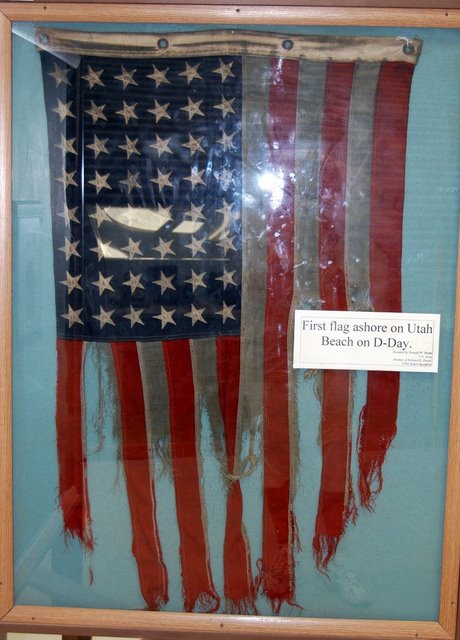
    First Flag on Utah Beach, June 6, 1944

    First U.S. flag on Utah Beach, Normandy, D-Day, June 6, 1944; Pima Air Museum, Tucson, Arizona

    This mostly an encore post.  A reader sent an e-mail with a question:  Does U.S. law suggest the flying of the U.S. flag on the anniversary of D-Day?

    Today is the 65th anniversary of the Invasion of Normandy in World War II, a date generally called D-DayNo, you don’t have to fly your flag. This is not one of the days designated by Congress for flag-flying.

    But you may, and probably, you should fly your flag.  If you have any D-Day veterans in your town, they will be grateful, as will their spouses, children, widows and survivors. A 22-year-old soldier on the beach in 1944 would be 87 today, if alive.  These men and their memories of history fade increasingly fast.  Put your flag up.  You may be surprised at the reaction.

    If you do run into a D-Day veteran, ask him about it.  Keep a record of what he says.

    First Wave at Omaha:  The Ordeal of the Blue and the Gray by Ken Riley:  Behind them was a great invasion armada and the powerful sinews of war. But in the first wave of assault troops of the 29th (Blue and Gray) Infantry Division, it was four rifle companies landing on a hostile shore at H-hour, D-Day -- 6:30 a.m., on June 6, 1944. The long-awaited liberation of France was underway. After long months in England, National Guardsmen from Virginia, Maryland and the District of Columbia found themselves in the vanguard of the Allied attack. In those early hours on the fire-swept beach the 116th Infantry Combat Team, the old Stonewall Brigade of Virginia, clawed its way through Les Moulins draw toward its objective, Vierville-sur-Mer. It was during the movement from Les Moulins that the battered but gallant 2d Battalion broke loose from the beach, clambered over the embankment, and a small party, led by the battalion commander, fought its way to a farmhouse which became its first Command post in France. The 116th suffered more than 800 casualties this day -- a day which will long be remembered as the beginning of the Allies Great Crusade to rekindle the lamp of liberty and freedom on the continent of Europe.  Image from National Guard Heritage series, from which the caption was borrowed.

    "First Wave at Omaha: The Ordeal of the Blue and the Gray" by Ken Riley: Behind them was a great invasion armada and the powerful sinews of war. But in the first wave of assault troops of the 29th (Blue and Gray) Infantry Division, it was four rifle companies landing on a hostile shore at H-hour, D-Day -- 6:30 a.m., on June 6, 1944. The long-awaited liberation of France was underway. After long months in England, National Guardsmen from Virginia, Maryland and the District of Columbia found themselves in the vanguard of the Allied attack. In those early hours on the fire-swept beach the 116th Infantry Combat Team, the old Stonewall Brigade of Virginia, clawed its way through Les Moulins draw toward its objective, Vierville-sur-Mer. It was during the movement from Les Moulins that the battered but gallant 2d Battalion broke loose from the beach, clambered over the embankment, and a small party, led by the battalion commander, fought its way to a farmhouse which became its first Command post in France. The 116th suffered more than 800 casualties this day -- a day which will long be remembered as the beginning of the Allies' "Great Crusade" to rekindle the lamp of liberty and freedom on the continent of Europe. Image from National Guard Heritage series, from which the caption was borrowed.