456 days of stonewall; Trump’s not a good neighbor

September 16, 2016

Couldn't believe the Germans were so upset about Trump not releasing his taxes for 456 days! Oh, Bundesstraße 456. Wikipedia image

Couldn’t believe the Germans were so upset about Trump not releasing his taxes for 456 days! Oh, Bundesstraße 456. Wikipedia image

Today September 15 is the 456th day since Donald Trump announced his candidacy for president, having promised to release his tax returns so American voters could discern and judge his openness, that Trump failed to deliver on that promise.

Word out of the Trump campaign today is Trump doesn’t want to release his taxes because he’s afraid people will look at them.

Sadly, that is not made up.

More:

By Scott5114 - Own work, CC BY-SA 3.0, https://commons.wikimedia.org/w/index.php?curid=3518260

Don’t give us that garbage, Don! New Mexico Highway 456. Wikimedia Commons photo; By Scott5114 – Own work, CC BY-SA 3.0

Save


455 with a rocket: Trump stonewalls American voters on taxes for 455 days

September 14, 2016

Rocket 455, an obscure band whose record cover reminds American voters Donald Trump failed to release his taxes for a world record 455th day. Did his dog eat them? (Image from Amoeba Records)

Rocket 455, an obscure band whose record cover reminds American voters Donald Trump failed to release his taxes for a world record 455th day. Did his dog eat them? (If only Trump were “safe, harmless.”) (Image from Amoeba Records)

Today is the 455th day since Donald Trump announced his candidacy for president, having promised to release his tax returns so American voters could discern and judge his openness, that Trump failed to deliver on that promise.

We may have clear indications of why Trump does not want Americans to see his taxes. Newsweek today published a story detailing Trump’s business dealings with crooked Russian oligarchs and other shady people, foreign interests which would probably scare away honest American voters, and quite a few in his handbasket of deplorable supporters as well. Trump’s foreign  businesses pose threats to U.S. national security.

Trump makes the

Trump makes the “cover” of electronic Newsweek, but he’s not happy. See the blurb, lower right, saying Trump’s business dealings threaten U.S. national security. BoingBoing image

So, American voters, you know now WHY Trump doesn’t want to release his taxes, and why it’s more important than ever to get him to release them. A man who wishes to follow the footsteps of FDR, Truman, Eisenhower, Reagan and Obama, needs to be transparent in dealings with foreign powers.

In contrast with Rocket 455, Trump is a complete cipher. Rocket 455 are better qualified to be president than Donald Trump, from their tax returns.

Poster for a concert by Rocket 455 and others; they lay out their souls in public. Trump should at least release his taxes. (His soul might darken the day; let's not go there.) Chris*Kro image

Poster for a concert by Rocket 455 and others; they lay out their souls in public. Trump should at least release his taxes. (His soul might darken the day; let’s not go there.) Chris*Kro image

More:


July 15, 1848, economist Vilfredo Pareto born

July 15, 2016

Happy 80/20 Day!

Italian economist, engineer and political activist Vilfredo Pareto was born on July 15, 1848, in Paris, where his father had fled due to political difficulties.

Pareto should be more famous, for his explanation of the 80/20 rule, and for his contribution to making better things, the Pareto chart.  Many economic texts ignore his work almost completely.  Quality management texts ignore his life, too — generally mentioning the principles they borrow, but offering no explanation.

Vilifred Pareto, Wikipedia image

Vilfredo Pareto, Wikipedia image; why are there so few photographs of the man, who died in 1923?

His contributions, as accounted at Wikipedia:

A few economic rules are based on his work:

And now you, dear reader, having just skimmed the surface of the pool of information on Vilfredo Pareto, know more about the man than 99.99% of the rest of the people on the planet.  Welcome to the tip-top 0.01%.

A mystery I attribute to low readership: I’ve posted much of this information before. In several years, not once has anyone criticized these posts as supporting fascism, the most common mis-directed criticism of Pareto.

Resources:

Portrait drawing of Vilfredo Pareto, from one of the few photographs of the man available. Image at Alchetron. Artist?

Portrait drawing of Vilfredo Pareto, from one of the few photographs of the man available. Image at Alchetron, by Artigas at Deviant Art.


You’ll be shocked to learn what Hillary Clinton REALLY told Goldman Sachs leaders

May 4, 2016

Hillary Clinton secretly filmed at a Goldman Sachs event, speaking to Goldman Sachs executives.   Okay, not secretly filmed. But you didn't see this on the news, did you.

Hillary Clinton secretly filmed at a Goldman Sachs event, speaking to Goldman Sachs executives. Okay, not secretly filmed. But you didn’t see this on the news, did you.

You want a transcript?

We can do better than that: How about a secret video of Hillary Clinton talking to the executives at Goldman Sachs, one of the world’s leading investment firms?

After all the hoo-haw, you’ll be shocked at the content.

Here’s how Goldman Sachs described it:

Published on Oct 22, 2014

Learn more: http://www.goldmansachs.com/citizensh…

On September 23, 2014, Goldman Sachs 10,000 Women hosted its annual dinner at the Clinton Global Initiative.

The event featured a keynote address from former Secretary of State Hillary Clinton on the business case for empowering women to ensure future economic growth.

Here’s the video:

True to Clinton’s history, she tells people with power and money they have to do a much better job of empowering and hiring from groups known to lack power and money, for the sake of capitalism, for the sake of our nation, for the sake of the world.

Okay, so it’s not secret. People who complain about these speeches pretend she said something different, and they certainly don’t want you to know what Clinton actually said. Clinton’s opponents hope this video remains close to secret.

Shocking that these speeches continue as an issue.  Maybe they should be campaign ads, for Clinton.

More:

Tip of the old scrub brush to Leslie Salzillo and DailyKos.


No, Earth Day 2016 does not celebrate Lenin, who was anti-environmentalist – annual debunking of the annual Earth Day/Lenin hoax

April 20, 2016

This is mostly an encore post, repeated each year for April 22 and Earth Day — sad that it needs repeating; anti-environmentalists don’t appear to learn much, year to year.  (Yes, some of the links may be dated; if you find one not working, please let me know in comments.)

You could write it off to pareidolia, once.

Like faces in clouds, some people claimed to see a link. The first Earth Day, on April 22, 1970, coincided with Lenin’s birthday. There was no link — Earth Day was scheduled for a spring Wednesday, when the greatest number of college students would be on campus.

Link to permanent Earth Day site, at EarthDay.org

Link to permanent Earth Day site, at EarthDay.org

Now, years later, with almost-annual repeats of the claim from the braying right wing, it’s just a cruel hoax.  It’s as much a hoax on the ill-informed of the right, as anyone else. Many of them believe it.

No, there’s no link between Earth Day and the birthday of V. I. Lenin:

One surefire way to tell an Earth Day post is done by an Earth Day denialist: They’ll note that the first Earth Day, on April 22, 1970, was an anniversary of the birth of Lenin.

Coincidentally, yes, Lenin was born on April 22, on the new style calendar; it was April 10 on the calendar when he was born — one might accurately note that Lenin’s mother always said he was born on April 10.

It’s a hoax. There is no meaning to the first Earth Day’s falling on Lenin’s birthday — Lenin was not prescient enough to plan his birthday to fall in the middle of Earth Week, a hundred years before Earth Week was even planned.

About.com explains why the idea of a link between Earth Day and Lenin is silly:

Does Earth Day Promote Communism?
Earth Day 1970 was initially conceived as a teach-in, modeled on the teach-ins used successfully by Vietnam War protesters to spread their message and generate support on U.S. college campuses. It is generally believed that April 22 was chosen for Earth Day because it was a Wednesday that fell between spring break and final exams—a day when a majority of college students would be able to participate.

U.S. Sen. Gaylord Nelson, the guy who dreamed up the nationwide teach-in that became Earth Day, once tried to put the whole “Earth Day as communist plot” idea into perspective.

“On any given day, a lot of both good and bad people were born,” Nelson said. “A person many consider the world’s first environmentalist, Saint Francis of Assisi, was born on April 22. So was Queen Isabella. More importantly, so was my Aunt Tillie.”

April 22 is also the birthday of J. Sterling Morton, the Nebraska newspaper editor who founded Arbor Day (a national holiday devoted to planting trees) on April 22, 1872, when Lenin was still in diapers. Maybe April 22 was chosen to honor Morton and nobody knew. Maybe environmentalists were trying to send a subliminal message to the national subconscious that would transform people into tree-planting zombies. One birthday “plot” seems just about as likely as the other. What’s the chance that one person in a thousand could tell you when either of these guys were born.

My guess is that only a few really wacko conservatives know that April 22 is Lenin’s birthday (was it ever celebrated in the Soviet Union?). No one else bothers to think about it, or say anything about it, nor especially, to celebrate it.

Certainly, the Soviet Union never celebrated Earth Day. Nor was Lenin any great friend of the environment.  He stood instead with the oil-drillers-without-clean-up, with the strip-miners-without-reclamation, with the dirty-smokestack guys.  You’d think someone with a bit of logic and a rudimentary knowledge of history could put that together.

Gaylord Nelson, Living Green image

Inventor of Earth Day teach-ins, former Wisconsin Governor and U.S. Senator Gaylord Nelson

The REAL founder of Earth Day, Wisconsin’s U.S. Sen. Gaylord Nelson, usually recognized as the founder and father of Earth Day, told how and why the organizers came to pick April 22:

Senator Nelson chose the date in order to maximize participation on college campuses for what he conceived as an “environmental teach-in.” He determined the week of April 19–25 was the best bet; it did not fall during exams or spring breaks, did not conflict with religious holidays such as Easter or Passover, and was late enough in spring to have decent weather. More students were likely to be in class, and there would be less competition with other mid-week events—so he chose Wednesday, April 22.

In his own words, Nelson spoke of what he was trying to do:

After President Kennedy’s [conservation] tour, I still hoped for some idea that would thrust the environment into the political mainstream. Six years would pass before the idea that became Earth Day occurred to me while on a conservation speaking tour out West in the summer of 1969. At the time, anti-Vietnam War demonstrations, called “teach-ins,” had spread to college campuses all across the nation. Suddenly, the idea occurred to me – why not organize a huge grassroots protest over what was happening to our environment?

I was satisfied that if we could tap into the environmental concerns of the general public and infuse the student anti-war energy into the environmental cause, we could generate a demonstration that would force this issue onto the political agenda. It was a big gamble, but worth a try.

At a conference in Seattle in September 1969, I announced that in the spring of 1970 there would be a nationwide grassroots demonstration on behalf of the environment and invited everyone to participate. The wire services carried the story from coast to coast. The response was electric. It took off like gangbusters. Telegrams, letters, and telephone inquiries poured in from all across the country. The American people finally had a forum to express its concern about what was happening to the land, rivers, lakes, and air – and they did so with spectacular exuberance. For the next four months, two members of my Senate staff, Linda Billings and John Heritage, managed Earth Day affairs out of my Senate office.

Five months before Earth Day, on Sunday, November 30, 1969, The New York Times carried a lengthy article by Gladwin Hill reporting on the astonishing proliferation of environmental events:

“Rising concern about the environmental crisis is sweeping the nation’s campuses with an intensity that may be on its way to eclipsing student discontent over the war in Vietnam…a national day of observance of environmental problems…is being planned for next spring…when a nationwide environmental ‘teach-in’…coordinated from the office of Senator Gaylord Nelson is planned….”

Nelson, a veteran of the U.S. armed services (Okinawa campaign), flag-waving ex-governor of Wisconsin (Sen. Joe McCarthy’s home state, but also the home of Aldo Leopold and birthplace of John Muir), was working to raise America’s consciousness and conscience about environmental issues.

Lenin on the environment? Think of the Aral Sea disaster, the horrible pollution from Soviet mines and mills, and the dreadful record of the Soviet Union on protecting any resource. Lenin believed in exploiting resources and leaving the spoils to rot in the sun, not conservation; in practice there was no environmental protection, but instead a war on nature, in the Soviet Union.

So, why are all these conservative denialists claiming, against history and politics, that Lenin’s birthday has anything to do with Earth Day?

Can you say “propaganda?” Can you say “political smear?”

2015 Resources and Good News:

2014 Resources and Good News:

2013 Resources and Good News:

Good information for 2012:

Good information from 2011:

Good information from 2010:

2014’s Wall of Shame:

2013 Wall of Shame:

Wall of Lenin’s Birthday Propaganda Shame from 2012:

Wall of Lenin’s Birthday Propaganda Shame from 2011:

Wall of Lenin’s Birthday Propaganda Shame from 2010:

Spread the word. Have you found someone spreading the hoax, claiming Earth Day honors Lenin instead? Give us the link in comments.


March 4, 1801: Thomas Jefferson’s inauguration as 3rd president

March 4, 2016

Words to be sung at a service honoring the inauguration of Thomas Jefferson as President. Image from the Treasures of the Library of Congress.

Words to be sung at a service honoring the inauguration of Thomas Jefferson as President. Image from the Treasures of the Library of Congress. (If we only knew the music . . .)

Thomas Jefferson ascended the the presidency to save the American Revolution, and to celebrate American arts and sciences, his friends and supporters said. The lyrics to be sung at the service at the German Reformed Church reflect those views.

What joyful prospects rise before!
Peace, Arts, and Science hale our shore
      And thro’ the country spread.
Long may these blessings be preserv’d,
And by a virtuous land deserv’d
      With JEFFERSON our head.

1800’s election campaign was a bitter one. Because balloting was not for president and vice president, but instead with the second-leading vote-getter taking the vice presidency, the Electoral College deadlocked on Jefferson and his vice president running mate, Aaron Burr. The election then went to the House of Representatives — the holdover House, dominated by Federalists who supported the vanquished John Adams. The House had great difficulty choosing between Jefferson and Burr, but at length picked Jefferson when Alexander Hamilton pushed his influence, favoring his once-friend Jefferson, and snubbing his enemy and eventual killer, Burr.

The Library of Congress briefly described Jefferson’s inauguration:

Thomas Jefferson, the third president of the United States, was the first to be inaugurated in the capital city of Washington, D.C. The ceremonies took place on March 4, 1801, in the Senate wing of the not yet finished Capitol building. Chief Justice John Marshall administered the oath of office to Jefferson, the first of five presidents-elect he would induct. In his speech Jefferson attempted to assuage the bitter rivalry between the Federalist and Republicans that had culminated in a deadlock election broken by Congress’s election of Jefferson on the 36th ballot. Jefferson remarked: “but every difference of opinion is not a difference of principle. We have called by different names brethren of the same principles. We are all Republicans. We are all Federalists.” Jefferson’s sentiments notwithstanding, his predecessor, former president John Adams, did not attend the ceremony — the first president to do so.

Mathematicians and scientists celebrate the election of Jefferson as a triumph for reason and science in politics. Jefferson was an accomplished and proud American naturalist, and often turned to scientists for advice on issues. Ironically perhaps, he never did reconcile his belief that rocks could not “fall from the sky,” doubting the provenance of meteoroids; skeptic to the end.

Tip of the old scrub brush to Pat’s Blog.


Darwin and Lincoln and February 12: Cool coincidence or divine intervention?

February 12, 2016

Is it an unprecedented coincidence?  207 years ago today, just minutes (probably hours) apart according to unconfirmed accounts, Abraham Lincoln was born in a rude log cabin on Nolin Creek, in Kentucky, and Charles Darwin was born into a wealthy family at his family’s home  in Shrewsbury, England.

Gutzon Borglums 1908 bust of Abraham Lincoln in the Crypt of the U.S. Capitol - AOC photo

Gutzon Borglum’s 1908 bust of Abraham Lincoln in the Crypt of the U.S. Capitol – Architect of the Capitol photo

Lincoln would become one of our most endeared presidents, though endearment would come after his assassination.  Lincoln’s bust rides the crest of Mt. Rushmore (next to two slaveholders), with George Washington, the Father of His Country, Thomas Jefferson, the author of the Declaration of Independence, and Theodore Roosevelt, the man who made the modern presidency, and the only man ever to have won both a Congressional Medal of Honor and a Nobel Prize, the only president to have won the Medal of Honor. 

In his effort to keep the Union together, Lincoln freed the slaves of the states in rebellion during the civil war, becoming an icon to freedom and human rights for all history.  Upon his death the entire nation mourned; his funeral procession from Washington, D.C., to his tomb in Springfield, Illinois, stopped twelve times along the way for full funeral services.  Lying in state in the Illinois House of Representatives, beneath a two-times lifesize portrait of George Washington, a banner proclaimed, “Washington the Father, Lincoln the Savior.”

Charles Darwin statue, Natural History Museum, London - NHM photo

Charles Darwin statue, Natural History Museum, London – NHM photo

Darwin would become one of the greatest scientists of all time.  He would be credited with discovering the theory of evolution by natural and sexual selection.  His meticulous footnoting and careful observations formed the data for ground-breaking papers in geology (the creation of coral atolls), zoology (barnacles, and the expression of emotions in animals and man), botany (climbing vines and insectivorous plants), ecology (worms and leaf mould), and travel (the voyage of H.M.S. Beagle).  At his death he was honored with a state funeral, attended by the great scientists and statesmen of London in his day.  Hymns were specially written for the occasion.  Darwin is interred in Westminster Abbey near Sir Isaac Newton, England’s other great scientist, who knocked God out of the heavens.

Lincoln would be known as the man who saved the Union of the United States and set the standard for civil and human rights, vindicating the religious beliefs of many and challenging the beliefs of many more.  Darwin’s theory would become one of the greatest ideas of western civilization, changing forever all the sciences, and especially agriculture, animal husbandry, and the rest of biology, while also provoking crises in religious sects.

Lincoln, the politician known for freeing the slaves, also was the first U.S. president to formally consult with scientists, calling on the National Science Foundation (whose creation he oversaw) to advise his administration.  Darwin, the scientist, advocated that his family put the weight of its fortune behind the effort to abolish slavery in the British Empire.  Each held an interest in the other’s disciplines.

Both men were catapulted to fame in 1858. Lincoln’s notoriety came from a series of debates on the nation’s dealing with slavery, in his losing campaign against Stephen A. Douglas to represent Illinois in the U.S. Senate.  On the fame of that campaign, he won the nomination to the presidency of the fledgling Republican Party in 1860.  Darwin was spurred to publicly reveal his ideas about the power of natural and sexual selection as the force behind evolution, in a paper co-authored by Alfred Russel Wallace, presented to the Linnean Society in London on July 1, 1858.   On the strength of that paper, barely noticed at the time, Darwin published his most famous work, On the Origin of Species, in November 1859.

Darwin and Lincoln might have got along well, but they never met.

What unusual coincidences.

Go celebrate human rights, good science, and the stories about these men.

A school kid could do much worse than to study the history of these two great men.  We study them far too little, it seems to me.

Resources:

Charles Darwin:

Abraham Lincoln:

More:

Anybody know what hour of the day either of these men was born?

Yes, you may fly your flag today for Lincoln’s birthday, according to the Flag Code; the official holiday, Washington’s Birthday, is next Monday, February 15th — and yes, it’s usually called “Presidents Day” by merchants and calendar makers. You want to fly your flag for Charles Darwin? Darwin never set foot in North America, remained a loyal subject of Her Majesty, Queen Victoria, to the end of his days. But go ahead. Who would know?

Yes, this is mostly an encore post. Fighting ignorance requires patience.

Yes, this is mostly an encore post. Fighting ignorance requires patience.


Texans! Last day to register to vote in March primary elections, February 1

February 1, 2016

Texas Democrats send me e-mail, trying to make democracy in America stronger, and work better, especially in Texas:

Ed,

Today is the absolute LAST DAY to register to vote for the March 1 Presidential Primary.

If you or someone you know wants to vote for Bernie Sanders, Hillary Clinton, or Martin O’Malley in the Democratic Primary but they aren’t registered to vote yet, today is the last day to get registered.

Fill out your voter registration application online — then print it, sign it, and make sure to get it in the mail before the post office closes.

http://act.txdemocrats.org/RegisterToVote

If you are already registered to vote, forward this email to any friends and family members that you think haven’t registered to vote. 

Let’s do this,

Crystal Perkins
Executive Director, Texas Democratic Party

Paid for by the Texas Democratic Party (www.txdemocrats.org)
and not authorized by any candidate or candidate’s committee.

I do not know why Texas Republicans did not send me a similar e-mail. I’m on their lists, too.

Excluding run-off elections where no candidate received 50%+1 in the primary, here is Texas’s election calendar for 2016, from the Texas Secretary of State:

Last Day to Register to Vote Monday, February 1, 2016
First Day of Early Voting Tuesday, February 16, 2016*
*First business day after Presidents’ Day
Last Day to Apply for Ballot by Mail
(Received, not Postmarked)
Friday, February 19, 2016
(NEW LAW: 11th day before election day; Application for Ballot By Mail (ABBM) and Federal Postcard Application (FPCA))
Last Day of Early Voting Friday, February 26, 2016
Last day to Receive Ballot by Mail Tuesday, March 1, 2016 (election day) at 7:00 p.m. (unless overseas deadline applies)

Democratic socialism’s darkest secret: More democracy than socialism

January 26, 2016

Fans of irony will find interesting this depiction of the of the greatest achievements in history of democratic socialism: The U.S. National Defense Highway System, better known as the Interstate Highway System.  Irony is that it is a key driver of the U.S. economy and has made possible great economic expansion that enriches capitalists greatly.

Fans of irony will find interesting this depiction of one of the greatest achievements in history of democratic socialism: The U.S. National Defense Highway System, better known as the Interstate Highway System. Irony is that it is a key driver of the U.S. economy and has made possible great economic expansion that enriches capitalists greatly. From the Online Atlas.

Stunning how some people will say Bernie Sanders makes sense in one breath, then when hearing he calls himself a socialist, claim Bernie is nuts and a threat to America.

Sanders’s supporters fight back, some. The phenomenon I describe is strongest among self-proclaimed extreme conservatives, and so is not such a huge issue in the primaries as it would be in the general election, if it is an issue at all.  A wise political strategist would not wait to confront the issue. It’s not an argument that can be answered with a bumper sticker.

Right wing publications take great pains to link any use of the word “socialism” with the now-repulsive violence of the Bolshevik Revolution and the autocratic nightmares of bureaucracy under the old Soviet-style government system, that even the Soviets abandoned. Right wingers don’t even pause to avoid saying socialism cares for people over corporations, in their blind striking out to smear anyone brave enough to take on the name.

We shouldn’t be surprised if Democrats generally defend the philosophy of democratic socialism from such demonizing.

This Tweet from one of Bernie’s guys offers to define democratic socialism rather as mother’s milk, apple pie and saluting the flag.

Is it correct? Does it persuade you?

http://twitter.com/IanMolony/status/690076734859919360

The poster says*:

Democratic Socialism

Of the People, By the People, For the People

A political ideology which balances a democratic political system alongside a socialist economic system, involving a combination of political democracy with social ownership fo the means of production, free-market capitalism in the form of business receiving reasonable profits for goods and services while at the same time providing fair compensation to labor with a shared responsibility for civil societal needs such, but not limited to, emergency services, military, publicly-owned utilities and services, and infrastructure in the form of maintenance and management of public roadways, providing water and waste-water treatment, public parks and recreation, resource management and wildlife conservation, public ports, airports, rail lines and interstates, and in providing programs within a publicly elected representatives state and federal government.

Were I advising the Sanders campaign, I’d advise that the language in that statement be made much more reader friendly, and formatted to aid reading. But in the main, it doesn’t differ much from the Wikipedia definition.  See if you can find any critical differences:

Democratic socialism is a political ideology advocating a democratic political system alongside a socialist economic system, involving a combination of political democracy with social ownership of the means of production. Although sometimes used synonymously with “socialism”, the adjective “democratic” is often added to distinguish itself from Leninist and Stalinist brand of socialism, which is widely viewed as being non-democratic. In all, democratic socialists don’t support single-party system and centralism.[1]

Democratic socialism is usually distinguished from both the Soviet model of centralized socialism and social democracy, where “social democracy” refers to support for political democracy, regulation of the capitalist economy, and a welfare state.[2] The distinction with the former is made on the basis of the authoritarian form of government and centralized economic system that emerged in the Soviet Union during the 20th century,[3] while the distinction with the latter is made in that democratic socialism is committed to systemic transformation of the economy while social democracy is not.[4] That is, whereas social democrats seek only to “humanize” capitalism through state intervention, democratic socialists see capitalism as being inherently incompatible with the democratic values of freedom, equality, and solidarity; and believe that the issues inherent to capitalism can only be solved by superseding private ownership with some form of social ownership. Ultimately democratic socialists believe that reforms aimed at addressing the economic contradictions of capitalism will only cause more problems to emerge elsewhere in the economy, so that capitalism can never be sufficiently “humanized” and must ultimately be replaced by socialism.[5][6]

Democratic socialism is not specifically revolutionary or reformist, as many types of democratic socialism can fall into either category, with some forms overlapping with social democracy.[7] Some forms of democratic socialism accept social democratic reformism to gradually convert the capitalist economy to a socialist one using the pre-existing political democracy, while other forms are revolutionary in their political orientation and advocate for the overthrow of the bourgeoisie and the capitalist economy.[8]

Few people want to debate what “democratic socialism” really means, chiefly because socialism is such a loaded word and concept. There are two camps, one which wants people to rationally look at cooperative activities of the world’s great democratic republics and smile at their virtues, and continue them, the Bernie Sanders camp. The other camp holds strictly to the philosophy expressed in Friedrich von Hayek’s cartoon of socialism in The Road To Serfdom**, which indicts authoritarianism, and makes an unevidenced claim that any move towards socialism inherently leads to dictatorship.

We should give Sanders and his supporters credit for trying to open discussion. But we should be ready with first aid kits when they discover it’s not an open door to discussion with conservatives, but a tempered glass window posing as a door — and administer to their contusions as they smash into it.

If you find a tempered discussion of modern democratic socialism anywhere, will you let us know?

In comments, let us know what you think even if you don’t find the perfect, tempered discussion.

Matt Wuerker's classic cartoon from the 2008 campaign, when Barack Obama was accused of socialism for proposing to increase health care coverage. Perhaps ironically, Obama's plan ended up with powerful capitalist institutions entrenched in it. Critics of socialism sill haven't noticed.

Matt Wuerker’s classic cartoon from the 2009 campaign for the Affordable Care Act, when Barack Obama was accused of socialism for proposing to increase health care coverage. Perhaps ironically, Obama’s plan ended up with powerful capitalist institutions entrenched in it. Critics of socialism sill haven’t noticed.

More:

_____________

* I list the text here to aid in indexing for search sites.

** Link is to the version at the Mises Institute, which is generally a biased source; in this case, their biases help to make sure the cartoon version presented is faithful to Hayek’s original; otherwise, discussion there on “democratic socialism” is probably fruitless.


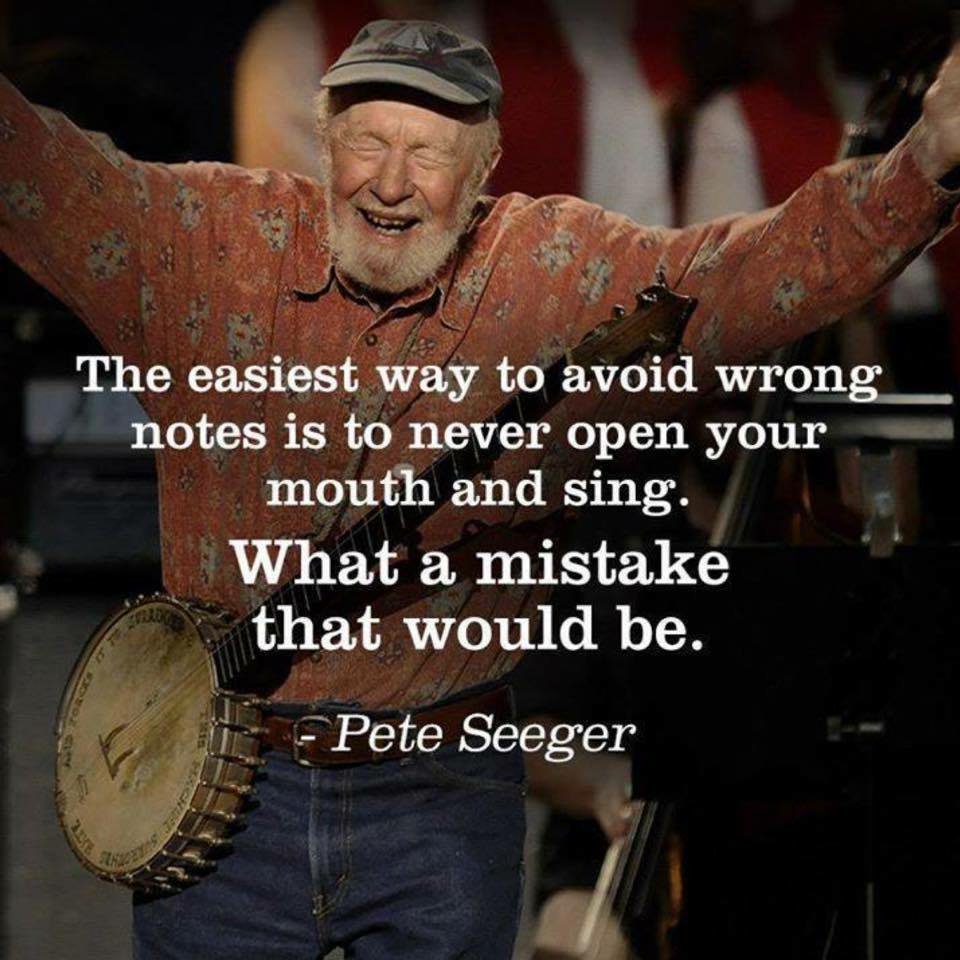
Quote of the Moment – Pete Seeger: Not singing is a big mistake

January 18, 2016

I don’t have a citation for where Pete Seeger said this, but it’s wholly within his character and mission. Anyone got a cite?

@Area9Handbells said:  Pete Seeger got it right with the exception of one word –

A Tweet from @Area9Handbells: Pete Seeger got it right with the exception of one word – “sing.” We think he meant “ring.”

“The easiest way to avoid wrong notes is to never open your mouth and sing. What a mistake that would be.”

∇ Pete Seeger

I’ve asked for a citation, for accuracy and to keep the anti-plagiarism and accuracy mavens happy, but don’t have one yet. Nor do I know to whom goes credit for the poster and photo. Can you help?


January 5, 1949: Truman launches the “Fair Deal”

January 5, 2016

Front page of the New York Times on January 6, 1949, with news of President Truman's State of the Union message. Oddly, via Conservapedia

Front page of the New York Times on January 6, 1949, with news of President Truman’s State of the Union message. Oddly, via Conservapedia

President Harry Truman delivered his State of the Union address to Congress on January 5, 1949, the first after he’d won election to the presidency in his own right (he succeeded to the presidency on the death of Franklin Roosevelt on April 12, 1945, remember).

Campaign button from the 1948 presidential campaign; on January 5, 1949, Truman presented a more detailed program backing the slogan, in his State of the Union Address

Campaign button from the 1948 presidential campaign; on January 5, 1949, Truman presented a more detailed program backing the slogan, in his State of the Union Address

Not a barn-burner of a speech, but an important one.  He appealed to history and the Square Deal of Teddy Roosevelt and the New Deal of Franklin Roosevelt; he appealed to Americans’ innate patriotism, and he appealed to a nation grateful to the soldiers who had defended freedom and democracy in World War II.  Truman called for a Fair Deal for all Americans, because they’d earned it, and it was the American thing to do.

This was barely eight weeks since Truman pulled out a stunning re-election win against the “do-nothing Congress.”  In many, many ways, the problems of 1949 look stunningly familiar to us today.  He spoke of the successes of the country in World War II, and the successes in business and finance since the war.  Truman said:

Reinforced by these policies, our private enterprise system has reached new heights of production. Since the boom year of 1929, while our population has increased by only 20 percent, our agricultural production has increased by 45 percent, and our industrial production has increased by 75 percent. We are turning out far more goods and more wealth per worker than we have ever done before.

This progress has confounded the gloomy prophets–at home and abroad who predicted the downfall of American capitalism. The people of the United States, going their own way, confident in their own powers, have achieved the greatest prosperity the world has even seen.

But, great as our progress has been, we still have a long way to go.

As we look around the country, many of our shortcomings stand out in bold relief.

We are suffering from excessively high prices.

Our production is still not large enough to satisfy our demands.

Our minimum wages are far too low.

Small business is losing ground to growing monopoly.

Our farmers still face an uncertain future. And too many of them lack the benefits of our modern civilization.

Some of our natural resources are still being wasted.

We are acutely short of electric power, although the means for developing such power are abundant.

Five million families are still living in slums and firetraps. Three million families share their homes with others.

Our health is far behind the progress of medical science. Proper medical care is so expensive that it is out of the reach of the great majority of our citizens.

Our schools, in many localities, are utterly inadequate.

Our democratic ideals are often thwarted by prejudice and intolerance.

Each of these shortcomings is also an opportunity-an opportunity for the Congress and the President to work for the good of the people.

Hello, boy howdy!  Prices aren’t so stifling as they were considered to be, then, and inflation is far from the plate of problems we face.

But the rest?

Perhaps we should look back to see what Congress, and the nation, did in 1949, as instructive to us in 2014.  Did Americans get a Fair Deal then?  Do they deserve one now?

From “Today in History” at American Memory, the Library of Congress:

On January 5, 1949, President Harry Truman used his State of the Union address to recommend measures including national health insurance, raising the minimum wage, strengthening the position of organized labor, and guaranteeing the civil rights of all Americans. Referencing the popular “New Deal” programs of his predecessor, Franklin Delano Roosevelt, Truman styled his reform package the “Fair Deal.”

A few months earlier the president’s career seemed over.  Political pundits of the time agreed that Truman needed a miracle to win his 1948 bid for reelection against the popular Republican governor from New York, Thomas E. Dewey. Adding to the incumbent’s troubles, a revived Progressive Party attempted to attract left-leaning Democrats, while segregationist “Dixiecrats” broke with the Democrats to run South Carolina Governor Strom Thurmond for president. Responding to the competition, Truman embarked on a campaign tour by train, delivering “whistle-stop” speeches to thousands of voters in small communities throughout the United States. This tactic proved effective, and President Truman was reelected by a slim margin. Still, the Chicago Daily Tribune was so confident of the president’s defeat it went to press with the November 3, 1948 headline “DEWEY DEFEATS TRUMAN.”

Truman had begun to push for Fair Deal-type legislation following the end of World War II in 1945. However, Congress resisted his plans for the extension of federal social and economic programs. Concerned about the transition from a wartime to a peacetime economy, lawmakers ultimately accepted the role of government in maintaining full employment and stabilizing the economy, but rejected Truman’s proposals for national health insurance, educational aid, and federally-supported housing programs. Even after Truman’s successful 1948 campaign, the mandate for expanded social programs remained weak. The minimum wage rose and social security coverage broadened, but few Fair Deal programs were enacted.

On July 26, 1948, President Harry Truman issued two executive orders. One instituted fair employment practices in the civilian agencies of the federal government; the other provided for “equality of treatment and opportunity in the armed services without regard to race, color, religion, or national origin.”

Gib Crockett cartoon on Truman's Fair Deal, 1949. May still be under copyright

Gib Crockett cartoon on Truman’s Fair Deal, 1949. May still be under copyright

We could use a Fair Deal for America today, in 2016. GOP wouldn’t stand for it, though.

More:

Yes, this is mostly an encore post. Fighting ignorance requires patience.

Yes, this is mostly an encore post. Fighting ignorance requires patience. Heaven knows this nation needs good news of great turnarounds in history.


Banksy’s modern Nativity, revisited in 2015: Trump’s wall, and Jesus

December 25, 2015

Those who cannot remember the past are condemned to repeat it.
==> Georges Santayana,
The Life of Reason, vol. 1: Reason in Common Sense)

Those who don’t pay attention to history are condemned to repeat it? Then, gods forbid we should have leaders among the condemned, and heaven keep us from joining their folly.

Has there ever been a good wall that actually worked to keep trouble away? Do we need to rebuild the Berlin Wall in the Americas?

Thomas Nast helped bring down the crooks at Tammany Hall with cartoons. Boss Tweed, the chief antagonist of Nast, crook and leader of the Tammany Gang, understood that Nast’s drawings could do him in better than just hard hitting reporting — the pictures were clear to people who couldn’t read.

But a cartoon has to get to an audience to have an effect.

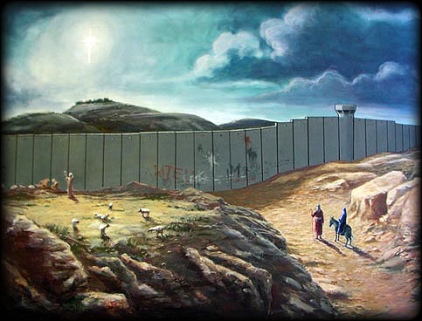
Here’s a cartoon below, a comment on the security wall being built in Israel, that got very little circulation in the west at Christmas time. Can you imagine the impact had this drawing run in newspapers in Europe, the U.S., and Canada?

It’s a mashup of a famous oil painting* related to the Christian Nativity, from a London-based artist who goes by the name Banksy. (Warning: Banksy pulls no punches; views shown are quite strong, often very funny, always provocative, generally safe for work unless you work for an authoritarian like Dick Cheney who wants no counter opinions.)

banksy-israels-wall-77721975_fda236f91a.jpg

Banksy’s modern nativity — does he ever bother to copyright his stuff, or would he rather you broadcast it?

*  At least I thought so in 2008.  I can’t find the painting now.  Anybody recognize a work underneath Banksy’s re-imagining?  Let us know in comments, eh?  Perhaps this one, by David Roberts?  Perhaps this engraving after Joseph M. W. TurnerTurner’s original? Plus, in 2008, most people said “Banksy who?”

Tip of the old scrub brush to Peoples Geography.

More, in 2011: 

More in 2012:

Yes, this is mostly an encore post. Fighting ignorance requires patience.

Yes, this is mostly an encore post. Fighting ignorance requires patience.


Scrooge’s 2015 Christmas gift to GOP: Their platform reduced to three words

December 20, 2015

Roberto Innocenti, Scrooge on a dark staircase

Ebenezer Scrooge, up a dark staircase; “Darkness was cheap, and Scrooge liked it.” Illustration by Roberto Innocenti, via Pinterest.

It’s a Quote of the Moment (an encore post for the season, with a bit of context thrown in later), the GOP platform edited down to three words, in green:

Darkness is cheap,
and Scrooge liked it.

– Charles Dickens, A Christmas Carol, Stave 1

Isn’t that the entire GOP platform in three words? “Darkness is cheap.”

I think of that line of Dickens’s often when  I read of the celebrations of calumny that pass as discourse in Republican politics these days. Although, with the 2008 renewing of Limbaugh’s contract, it may no longer be true that his particular brand of darkness is cheap. With the advent of Donald Trump’s insult politics, offending America’s allies and all American ethnic groups possible, with un-ironic calls to drop nuclear weapons, GOP politics is even darker than ever.

Cheap or not, darkness remains dark.

John Leach, Scrooge meets Ignorance and Want

Scrooge meets Ignorance and Want, the products of his stinginess (drawing by John Leech, 1809-1870)


Here is the sentence Dickens put before the quote, to add a little context; Scrooge was climbing a very large, very dark staircase.

Half-a-dozen gas-lamps out of the street wouldn’t have lighted the entry too well, so you may suppose that it was pretty dark with Scrooge’s dip.

Up Scrooge went, not caring a button for that. Darkness is cheap, and Scrooge liked it.

Speaking of darkness, a longer excerpt from a bit later in Dickens’s story:

‘Forgive me if I am not justified in what I ask,’ said Scrooge, looking intently at the Spirit’s robe, ‘but I see something strange, and not belonging to yourself, protruding from your skirts. Is it a foot or a claw?’

‘It might be a claw, for the flesh there is upon it,’ was the Spirit’s sorrowful reply. ‘Look here.’

From the foldings of its robe, it brought two children; wretched, abject, frightful, hideous, miserable. They knelt down at its feet, and clung upon the outside of its garment.

‘Oh, Man! look here. Look, look, down here!’ exclaimed the Ghost.

They were a boy and girl. Yellow, meagre, ragged, scowling, wolfish; but prostrate, too, in their humility. Where graceful youth should have filled their features out, and touched them with its freshest tints, a stale and shrivelled hand, like that of age, had pinched, and twisted them, and pulled them into shreds. Where angels might have sat enthroned, devils lurked, and glared out menacing. No change, no degradation, no perversion of humanity, in any grade, through all the mysteries of wonderful creation, has monsters half so horrible and dread.

Scrooge started back, appalled. Having them shown to him in this way, he tried to say they were fine children, but the words choked themselves, rather than be parties to a lie of such enormous magnitude.

‘Spirit! are they yours?’ Scrooge could say no more.

‘They are Man’s,’ said the Spirit, looking down upon them. ‘And they cling to me, appealing from their fathers. This boy is Ignorance. This girl is Want. Beware them both, and all of their degree, but most of all beware this boy, for on his brow I see that written which is Doom, unless the writing be erased. Deny it!’ cried the Spirit, stretching out its hand towards the city. ‘Slander those who tell it ye! Admit it for your factious purposes, and make it worse. And bide the end!’

‘Have they no refuge or resource?’ cried Scrooge.

‘Are there no prisons?’ said the Spirit, turning on him for the last time with his own words. ‘Are there no workhouses?’ The bell struck twelve.

Scrooge looked about him for the Ghost, and saw it not. As the last stroke ceased to vibrate, he remembered the prediction of old Jacob Marley, and lifting up his eyes, beheld a solemn Phantom, draped and hooded, coming, like a mist along the ground, towards him.

A Christmas Carol, Stave 3

Think of 2014 and 2015, children abused in Central America and in the Middle East, fleeing as best they can, only to die off the shores of Greece, on the southern deserts of the U.S., or be cast into incarceration after having achieved a nation whose very name promised them refuge, the United States. “Two children; wretched, abject, frightful, hideous, miserable,” Dickens described. Whose children? “Man’s.” Yours, and mine.

Christmas is a festival to celebrate light, what many Christians call “the light of the world?” If so, let us work to stamp out the darkness which the unrepentant Scrooge so dearly loved.

Darkness may be cheap, but it is not good.  Light a candle, and run into the darkness, spreading light. We need more light.

Merry Christmas 2015. Let us remember, as Tom and the late Ray Magliozzi always reminded us, the cheapskate pays more in the end, and usually along the way. Is Darkness cheap? Let us then eschew it as too costly for a moral nation, too costly for a moral people.

More:


25 most-viewed presidents’ documents at the American Presidency Project

December 4, 2015

Every U.S. history teacher is familiar with a great on-line resource assembled by John Woolley and Gerhard Peters at the University of California – Santa Barbara, The American Presidency Project.  Or, if by some oversight any teacher is not familiar with it, someone should do them a favor and let them know.

It’s an ambitious project of cataloging and making available in one place all the official papers of the presidents of the United States, speeches, press conferences, executive orders, and miscellaneous material including election speeches. The project started in 1999, and as of today contains more than 111,000 documents.

Masthead photo collage from the American Presidency Project at the University of California - Santa Barbara

Masthead photo collage from the American Presidency Project at the University of California – Santa Barbara

In 2008, the project started counting access to the documents, and can now give us seven years of data as to which documents of presidents, from George Washington to Barack Obama, are the most popularly accessed.

Before you read further, ponder this question: Which presidential speeches, documents and miscellanea do you think should be in the top 25 documents people look in a decade? Surely students and scholars, and policy wonks, would be interested in Lincoln’s inspiring words at Gettysburg, perhaps his two inaugural addresses, or the Emancipation Proclamation. FDR’s first inaugural address, “nothing to fear but fear itself,” ought to be among the top. Wilson’s 14 Points, perhaps? Washington’s Farewell? John Kennedy’s inaugural? Lyndon Johnson’s Great Society speech? Eisenhower’s farewell, warning of the “military-industrial complex?”

Now look at the list. What does it tell us that these are the top 25 sought-after documents from the American Presidency Project? What does it tell us that what we might expect to be in the top 25, are not? Tell us in comments what you think.

Here’s the top 25 Most Viewed Documents since 2008 at the American History Project; hotlinks go to the document at AHP:

The 25 Most Viewed Documents Since 2008
#1 John F. Kennedy
Inaugural Address
#2 Republican Party Platforms
Republican Party Platform of 1956
#3 Democratic Party Platforms
2008 Democratic Party Platform
#4 Republican Party Platforms
2008 Republican Party Platform
#5 John F. Kennedy
Executive Order 10990 – Reestablishing the Federal Safety Council
#6 Democratic Party Platforms
2012 Democratic Party Platform
#7 Republican Party Platforms
2012 Republican Party Platform
#8 George W. Bush
Address to the Nation on the Terrorist Attacks
#9 Ronald Reagan
Inaugural Address
#10 John F. Kennedy
Executive Order 11110 – Amendment of Executive Order No. 10289 as Amended, Relating to the Performance of Certain Functions Affecting the Department of the Treasury
#11 Franklin D. Roosevelt
Fireside Chat on Banking
#12 Barack Obama
Inaugural Address
#13 Franklin D. Roosevelt
Letter on the Resolution of Federation of Federal Employees Against Strikes in Federal Service
#14 John F. Kennedy
Remarks at a Dinner Honoring Nobel Prize Winners of the Western Hemisphere
#15 Franklin D. Roosevelt
1944 State of the Union Message to Congress
#16 Franklin D. Roosevelt
Inaugural Address
#17 Barack Obama
Executive Order 13603 – National Defense Resources Preparedness
#18 Franklin D. Roosevelt
Executive Order 6102 – Requiring Gold Coin, Gold Bullion and Gold Certificates to Be Delivered to the Government
#19 Republican Party Platforms
Republican Party Platform of 1860
#20 George Bush
Executive Order 12803 – Infrastructure Privatization
#21 Abraham Lincoln
Inaugural Address
#22 George Washington
First Annual Message to Congress on the State of the Union
#23 William J. Clinton
Inaugural Address
#24 Democratic Party Platforms
Democratic Party Platform of 1960
#25 John F. Kennedy
Address of Senator John F. Kennedy Accepting the Democratic Party Nomination for the Presidency of the United States – Memorial Coliseum, Los Angeles

Why not a price on carbon, a tax with cap-and-trade capabilities?

October 29, 2015

Tax on air pollutants with a cap-and-trade process worked wonders cleaning up acid rain in the U.S.  Is there any rational reason to oppose such a plan, in the U.S. or anywhere else, to help clean up carbon air pollution to slow or stop global warming?

Germany’s Chancellor Angela Merkel issued a call for a carbon pricing system. Who will listen?

It’s a feature story from World Bank, who seems to have figured out that global warming poses great threats to commerce and growing the world’s economies.

Heads of State, City, Regional and Business Leaders Unite to Call for Price on Carbon

October 19, 2015

For the first time Heads of State, city and provincial leaders have come together with the support of leading companies to urge countries and companies around the world to put a price on carbon pollution.

For the first time Heads of State, city and provincial leaders have come together with the support of leading companies to urge countries and companies around the world to put a price on carbon pollution.


STORY HIGHLIGHTS
  • Carbon pricing is a key building block to tackle climate change and drive investment in a low carbon future.
  • Launched today, the Carbon Pricing Panel is an unprecedented alliance of Global Leaders united to put a price on carbon pollution.
  • The number of implemented or scheduled carbon pricing instruments has nearly doubled since 2012, reaching an aggregate market value of about $50 billion.

What can be done to reduce greenhouse gas emissions, protect our environment, and help support people most vulnerable to climate change?

The answer is simple: A key element for any strategy to tackle climate change must be to put a price on carbon pollution. The transition to a cleaner future requires government action and the right incentives. Carbon pricing is a key building block to help cut pollution and drive investment in a low carbon future.

It’s a point recognized by leaders from Europe, across to Africa and Asia, who have today – for the first time – come together with the support of leading private companies to urge countries and businesses around the world to put a price on carbon.

Convened by World Bank Group President Jim Yong Kim and the International Monetary Fund’s Managing Director Christine Lagarde, the high-level Carbon Pricing Panel is calling on their peers to follow their lead and put a price on carbon. They are joined in this effort by OECD Secretary General Angel Gurria.

The call by the leaders comes on the first day of the last round of negotiations ahead of the Paris climate talks in December. The leaders aim to seize the momentum generated by the Paris talks to spur further, faster action towards carbon pricing, as a necessary path to a low carbon, productive, competitive economy of the future.

Members of the Carbon Pricing Panel include German Chancellor Angela Merkel, Chilean President Michelle Bachelet, French President François Hollande, Ethiopian Prime Minister Hailemariam Desalegn, Philippines President Benigno Aquino III, Mexican President Enrique Peña Nieto, Governor Jerry Brown of California, and Mayor Eduardo Paes of Rio de Janeiro.

Private sector support is spearheaded by Anne Stausboll, CEO of US Institutional Investor CalPERS, Gérard Mestrallet, CEO of ENGIE of France, Anand Mahindra, Chairman and Managing Director of Mahindra Group of India, and Feike Sijbesma, Chairman and CEO of Netherlands-based Royal DSM.


” There has never been a global movement to put a price on carbon at this level and with this degree of unison. It marks a turning point from the debate on the economic systems needed for low carbon growth to the implementation of policies and pricing mechanisms to deliver jobs, clean growth and prosperity. The science is clear, the economics compelling and we now see political leadership emerging to take green investment to scale at a speed commensurate with the climate challenge. “

ImageJim Yong Kim
World Bank Group President

Summary map of existing, emerging and potential regional, national and sub-national carbon pricing instruments (ETS and tax)

Summary map of existing, emerging and potential regional, national and sub-national carbon pricing instruments (ETS and tax)


Around the world, about 40 nations and 23 cities, states and regions have implemented or are putting a price on carbon with programs and mechanisms covering about 12 percent of global greenhouse gas emissions.

The number of implemented or scheduled carbon pricing instruments has nearly doubled since 2012, reaching an aggregate market value of about $50 billion.

And already more than 400 businesses around the world are using a voluntary, internal price on carbon as part of their investment strategies, with prices ranging from US$4 to over US$100 per ton of CO2. This is a tripling in the number of companies compared with last year reporting that they price their emissions.

Carbon pricing delivers a triple dividend.

Firstly, it is good for the environment and it reduces emissions – lowering social costs of health impacts on people, as well as tackling the global warming.  A price on carbon can help alleviate health and environmental problems like premature deaths from exposure to outdoor air pollution. According to the World health Organization, an estimated 3.7 million people die prematurely from outdoor air pollution.

Secondly, carbon pricing is an essential part of getting prices right for the move to a low carbon more resilient growth. It raises revenue efficiently, making it possible to reduce more distortionary taxes, and it allows for targeted support for clean energy solutions rather than harmful subsidies that do little for poor people or the environment.

And thirdly, it drives innovation and critically needed investments in low-carbon solutions, boosting private sector investment in clean tech research and development, and offering the prospect of job creation in the sectors of the future.

Why is is it important to act now on carbon pricing? Because strong public policy gives the private sector the certainty and predictability to make the necessary long-term investments in climate-smart development and prevent catastrophic impacts from climate change. Carbon pricing is the cornerstone of a package of policy measures designed to achieve emission reductions at lowest cost.

Today, countries and regions are learning from one another and creating a set of successful approaches to pricing carbon. Some early lessons are described in the World Bank Group publication The FASTER Principles for Successful Carbon Pricing – which lays out principles for effective, efficient and fair pricing of carbon.

Some examples include:

  • The Canadian province of British Columbia was an early mover on carbon pricing, with the creation of a carbon tax in 2008, with the tax used to cut income taxes and fund tax credits. Also, British Columbia is home to a growing clean technology sector, with more than 150 firms in 2013, accounting for 22% of Canada’s clean tech presence in a province with only 12% of Canada’s GDP. Several experts attribute this growth to the carbon tax.
  • California, Quebec and the European Union allocate a portion of their emissions trading scheme (ETS) auction revenues to designated green technology funds and innovation, to support sectors affected directly or indirectly by higher carbon costs.
  • In Chile, the government has passed legislation on a carbon tax – effective as of 2017 – as part of a much larger tax reform package with the explicit aim of providing additional resources for education and other social protection programs.
  • In Northeastern United States, the Regional Greenhouse Gas Initiative is expected to save people money on energy bills. The RGGI states have invested over $1 billion from ETS proceeds in energy-efficiency program, which are expected to return more than $2.3 billion in lifetime energy bills savings to 1.2 million participating households. Also, from 2008-2012, RGGI invested more than $130 million to help energy and electricity customers in need.

The high level panel provides political momentum to complement the voices of government and industry leaders in the Carbon Pricing Leadership Coalition (CPLC), a working coalition that is being formed on the back of support for carbon pricing from 74 countries and 1,000 companies, at the 20014 UN summit on climate change.

Putting a price on carbon can be done in many ways: using an emissions trading system (ETS), like the one in Europe, or introducing carbon taxes and fees, like in Sweden and Norway. Most importantly, the “polluter pays” principle applies – those who are responsible for the pollution face the cost of it.