When do we reach the “never” in “Never again?”

November 4, 2007

You won’t find this in your world history text.

Events in Congo trouble at so many levels. Reports in The New York Times and other places document unspeakable violence: 27,000 sexual assaults in South Kivu Province in 2006, just a fraction of the total number across the nation of 66 million people. The assaults are brutal. Women assaulted are often left so badly injured internally, they may never heal.

  • Map of Congo, showing area of high violence in east, from New York Times Map of Congo, highlighting province of Bukavu where violence against women is epidemic, from New York Times

Genocide you say? Many assaults appear to be spillover from the Hutu-Tutsi conflict in next-door Rwanda. But assaults by husbands on wives also are epidemic. Result of civil war? Then how to explain the “Rasta” gang, dreadlocked fugitives who live in the forest, wear tracksuits and Los Angeles Lakers jerseys, and who commit unspeakable crimes against women and children? What nation are they from, and against whom do they fight, if anyone — and for what?

The facts cry out for action:

  • Nightly rapes of women and girls. The violence appears to be a problem across the nation.
  • Huge chunks of Congo have no effective government to even contend against the violence.
  • Killers with experience in genocide in their native Rwanda moved into Congo; they live by kidnapping women for ransom. The women are assaulted while held captive. Sometimes husbands do not take back their wives.
  • The oldest rape victim recorded by one Congo physician is 75; the youngest, 3.

Surely intervention by an international group would help, no? However

  • Congo hosts the largest single peacekeeping mission of the United Nations right now, with 17,000 troops. Congo is a big nation, bordered by nine other nations. How many troops would it take to secure the entire nation, or the entire border? No one knows.
  • 2006 saw an election that was supposed to remake history, end the violence and start Congo on the road to recovery; but was the $500 million it cost enough to change Congo’s history of a string of bad governments?
  • International attention focuses on other crises: Iraq, Afghanistan, Sudan and Darfur, Iran, Korea, Chechnya, Turkey and the Kurds, Palestine and Israel. Congo, constantly roiling since the 1960s, is way down the list of world concerns, no matter how bad the violence.

Americans looking for a quick resolution to the situation in Iraq might do well to study Congo. At Congo’s independence in the 1960s, there was hope of prosperity and greater peace. Foreign intervention, including meddling from the U.S., regional civil wars, bad government and long international neglect, ate up the hope. Achieving what a nation could be is difficult, when so many forces align to prevent it from being anything other than a violent backwater. Pandora’s box resists attempts to shut it. Quick resolution is unlikely.

So the violence in Congo continues. In this world, when is the “never” in “never again?”

How many other such cases fall outside our textbooks, and off the state tests?

Resources:


Hoaxes as campaign tools

November 2, 2007

Barack Obama is a Christian, a Protestant.

Hillary Clinton met with the Gold Star Mothers, and the Gold Star Mothers were happy with the meeting.

But I’ll bet you get an e-mail soon saying otherwise.

Here, more debunking, this time from the venerable, and clearly biased, The Nation: “The New Right-Wing Smear Machine.”

Read it, and be inoculated with the facts, against the hoaxes.


Concise case against Utah voucher proposal

October 31, 2007

This site has about the most nearly complete, concise case against the Utah school voucher proposal I have found. Is there any chance the voters in Utah still need to be swayed to reason on this issue? Send them to this site, after you have them view the real story about Oreos.


Utah voucher referendum: Slapping the hand in the cookie jar

October 30, 2007

A Utah school teacher made his own video, in his home it appears, with a non-professional camera and crew — and it eviscerates the points Richard Eyre was trying to make in his slick, professionally-produced, commercial version.

The Truth about Cookies Utah Vouchers:

Tip of the old scrub brush to a reader and commenter named Brack.

Update, November  7, 2007:

Utah voters soundly rejected vouchers in the election November 6.  Here’s my version of the story.


Fighting malaria with reason

October 29, 2007

We can beat malaria without DDT; we can’t beat malaria without bednets.

Editorial from BMJ (née British Medical Journal?) points out that bednets really work, and they work better when distributed free of charge.  Nets cost about $5.00 each, but in nations where a good day’s pay is about $1.00, charging for them merely means they won’t be purchased and can’t be used.

Time for Sen. Tom Coburn, R-Oklahoma, and Steve Milloy, to listen to reason, stop bashing Rachel Carson, and start fighting malaria.

Update, February 2009; the original link seems irrecoverable; see also this research, BMJ 2007;335:1023 ( 17 November), doi:10.1136/bmj.39356.574641.55 (published 16 October 2007


Writing the history texts: What is history?

October 29, 2007

History textbook controversies abound, really. Just a list to pull some sources together:


Global warming a piffle by comparison

October 26, 2007

Plant in drought-riven soil

Here’s the word from Bob Parks’ great e-letter, “What’s New,”October 26, 2007 edition; I’ve highlighted some stuff:

2. ENVIRONMENT: MAJOR U.N. REPORT SAYS IT’S “UNSUSTAINABLE.” According to a story in the New York Times this morning, a report issued by the United Nations yesterday in Paris is so frightening that French President Nicolas Sarkozy immediately put $1.4 billion into new energy sources and biodiversity. Unsustainable consumption of resources and population growth is taking Earth beyond the point of no return. As an example, the report says, two and a half times as many fish are being caught as the oceans can produce in a sustainable manner. No word yet from Washington on the U.S. response. No steps taken to protect the environment will help in the long run if population continues to grow.

Denialists will start whining in just a few seconds. Three . . . two . . . one . . .

Considering the weather (everywhere), fires in California, droughts in Georgia, the Nobel Peace Prize this year, you’d think this would be front page news.  Where did it run in your local paper?

Sources:


NY Times backs overhaul of mining law

October 26, 2007

Congress seriously considers changes in mining laws in the U.S. — the General Mining Act of 1872 is 135 years old with no serious changes since its passage. President Ulysses S Grant signed the law.

The law affected much of the development of the U.S. west of the Mississippi River, but this issue is generally ignored. The New York Times editorial page endorses the change process in an editorial today.

Originally enacted to encourage economic development in the West, the law gives precedence above all other land uses to mining for hard-rock minerals like gold, uranium and copper. It requires no royalties from companies that mine on public lands and contains no environmental safeguards. It has left a sad legacy of abandoned mines, poisoned streams and damaged landscapes throughout the West.

Now, at last, there is real hope for reform. Representative Nick Rahall, a West Virginia Democrat who has been trying to modernize this law for two decades, has persuaded the Natural Resources Committee to approve a major rewrite.

The law is a major study in economics, government intervention and free markets. It would make a good topic for warm-ups or government intervention lesson plans in high school economics classes.


Bring back the OTA, stop the War on Science

October 25, 2007

Bush administration officials make the case more powerfully that we need to resurrect the Office of Technology Assessment (OTA).

Bushies, going against their earlier claims that they accept that the nation needs to do something about changing climate, “eviscerated” testimony of a government official designed to protect public health. More voodoo science from Bush. According to The Carpetbagger Report:

Dr. Julie Gerberding, director of the Centers for Disease Control and Prevention, told a Senate panel yesterday that climate change “is anticipated to have a broad range of impacts on the health of Americans.” If that sounds a little vague and non-specific, there’s a good reason — the White House refused to let her say what she wanted to say.

Sadly, Carpetbagger Report lists several other instances in which White House officials have gutted the release of important information on global warming’s dangers.

If Osama bin Laden did something like that, we’d invade a smaller nation to stop it. Preventing Americans from being prepared for disaster is a terroristic threat under the Homeland Security Act, isn’t it? Is there a clause for citizen suits in there somewhere? Who will stand up to the abuses by George Bush?

Here’s the Washington Post story on the event. Here’s my previous post, with links to Denialism and Pharyngula, and even John Wilkins (love that picture of Snowflake!).

Hillary Clinton specifically calls for the recreation of OTA, a clue some of us politicos use to indicate she really does know what government under the Constitution should be doing. Other Democrats are friendly to the idea, but so far I’ve not heard a peep from any of the Republican presidential candidates. Orrin? What about you?

Bring back the OTA. Exorcise the demons of totalitarian Bushism.


Spinning the hoax, saucing the gander

October 22, 2007

Bloggers who made the Dishonor Roll for mindlessly passing along a hoax quiz designed to pillory Hillary Clinton failed to make amends. So far as I can tell, not a one has apologized for the hoax, and a couple have their backs arched to hiss that they won’t change until or unless . . . well, they say the hoax is fair.

Really? Hoaxes are good things? Politicians make fair game?

Nuts.

Part of the problem comes from the way the questions plop out at people on that quiz. Any national polling firm can give us chapter and verse on the need to phrase questions and potential answers just so, so that they do not mislead the people questioned into making an answer choice they would not normally make. Any teacher can tell you that phrasing of questions and answer choices can affect the way students perform on a test.

So, let’s rephrase the quiz. How about a hoax quiz that makes Hillary look good? I’ll wager not one of the blogs that runs the earlier hoax would dare to run this quiz:

_________________________

American Free Enterprise: Who said it?

A little history lesson: If you don’t know the answer make your best guess. Answer all the questions before looking at the answers. Who said it?

1) “We’re going to take things away from you on behalf of the common good.”

A. Abraham Lincoln
B. Alexander Hamilton
C. Andrew Jackson
D. None of the above

2) “It’s time for a new beginning, for an end to government of the few, by the few, and for the few…and to replace it with shared responsibility for shared prosperity.”

A. Ronald Reagan
B. Franklin D. Roosevelt
C. Jesus
D. None of the Above

3) “(We)…can’t just let business as usual go on, and that means something has to be taken away from some people.”

A. Herbert Hoover
B. Theodore Roosevelt
C. Rudolph Giuliani
D. None of the above

4) “We have to build a political consensus and that requires people to give up a little bit of their own…in order to create this common ground.”

A. Winston Churchill
B. Sam Houston
C. Lincoln
D. None of the above

5) “I certainly think the free-market has failed.”

A. Ludwig von Mises
B. Milton Friedman
C. Herbert Hoover
D. None of the above

6) “I think it’s time to send a clear message to what has become the most profitable sector in (the) entire economy that they are being watched.”

A. Alan Greenspan
B. Ben Bernanke
C. Teddy Roosevelt
D. None of the above

Answers below the fold. Read the rest of this entry »


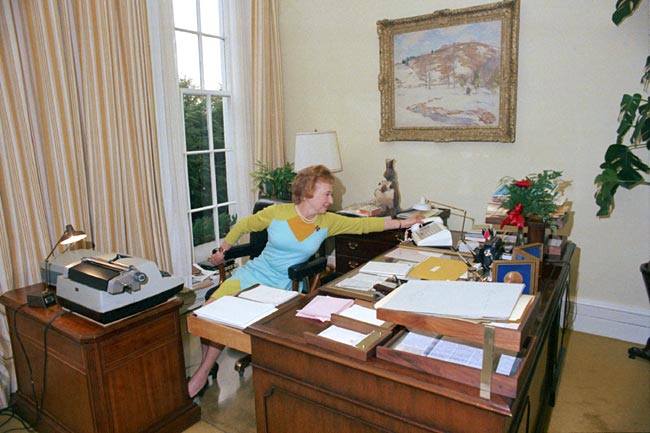
Typewriter of the moment: White House, Rosemary Woods

October 22, 2007

Rosmary Woods shows how she might have erased Nixon tapes

President Richard Nixon’s secretary, Rosemary Woods, demonstrates how she thought she might have accidentally erased 18-1/2 minutes of tape, when she reached to answer her phone and her foot extended to the “erase” footpedal, in 1974.

Ms. Woods’s typewriter is an electric, as best I can make out, an IBM. (Update, May 21, 2008: Ben Batchelor of etypewriters.com dropped by in comments to say it’s an IBM Model D Executive. Thanks, Ben!)

Good resource discovered in getting this image: The Watergate Files, presented by the Gerald R. Ford Presidential Library (at the University of Texas site). Image from the Gerald R. Ford Presidential Library.

Tip of the old scrub brush to Dr. Pamela Bumsted.


Vouchers as Oreos: Crumbs for the kids

October 21, 2007

Here’s the infamous “Oreo® cookie” ad by the pro-voucher Richard and Linda Eyre, in the 30-second version:

I have a few questions for the Eyres and their Modified Vampire Voucher program:

1. Private schools are few and far between in Utah — where is a kid supposed to find a school?

2. National statistics tracked by the Department of Education show Utah at the bottom of the per-student spending list. Were Utah spending $7,500/year/student, Utah would rank comfortably near the top. Where did you get your figures for spending in Utah, and why do they differ from the national statistics?

3. Are you saying that, if vouchers cut student loads at public schools, no teachers or classrooms would be cut? I don’t see that guarantee in the law, and I’m wondering why you’re claiming something like that will occur.

4. How many kids need to leave the average public school classroom before there is a significant increase in money left over for the rest of the kids, under your formula? By “significant,” I mean at least 10% increases, or with your statistics, $750/pupil. My quick, in-my-head calculations show that, if only rich kids leave, we need to get 5 rich students , with the lowest vouchers, out of that 30-student class in order to get a significant increase in spending. That’s 17% of the students.

If 17% of the students left Utah’s public schools, how much would your program cost? How many private schools would need to be created to accommodate that percentage?

5. You say Utah spends about $7,000/student, and you suggest that Utah should be spending nearly $10,000/student. In order to get a $3,000/student increase in that classroom, you’d need to get 10 rich students to leave, or 33%. How soon do you think you can get a third of the students to leave Utah’s public schools?

6. You say teachers should lose their jobs if students leave public schools for private schools. Why? Studies show that generally it is the best students who leave public schools for private schools. If their teachers are punished . . . well, explain just what it is you really advocate?

7. When I published the research studies at the U.S. Department of Education, we published studies showing that reduction in classroom size helped student achievement — a measurable amount once classroom size got down to 18 students, and significantly once classroom size got down to 15 students per class. By your figures, we’d need to get half of all students to leave Utah’s public schools to get down to 15 kids per class — without firing any of the bad teachers. How long will it take to get that reduction? How much will it cost?

8. If we can’t get a third of all students to leave the public schools, we’re still stuck with a massive shortfall in funding. What’s your backup plan, since getting a third of all students to leave is a stupid idea with zero chance of success? When you’re done hammering at the foundations of public education, what then?

9. Do the good people at Nabisco approve of your abuse of their cookies?

Eyre’s program may look neat as Oreos, but it leaves only crumbs for the kids. Taking money out for vouchers does almost nothing to contribute to solutions for Utah’s education problems.

Below the fold: The longer version of the ad.

Read the rest of this entry »


Pro voucher forces panic in Utah

October 20, 2007

With the nation’s first state-wide voucher on the ballot in Utah this November, and with the polls showing a large majority ready to vote the idea down, voucher supporters push every button they can find, hoping one of them is the real “panic” button. Panic button, from iWantOneofThose

But, legislators recruiting lobbyists into a referendum? A new blog dedicated to the Utah referendum, Accountability, carries the story with links to local Utah news media.

. . . I know there’s a whole industry built up now to protect the will of lawmakers from their constituents.

But I didn’t think that was the prevailing wisdom here. We hadn’t fallen victim to the political industry like folks have back East.

Then I read articles like Paul Rolly’s column in this morning’s Trib and I wonder if we’re not so far away from succumbing to it, too.

“Lawmakers stack the deck on vouchers” is the headline, and the first sentence tells the whole story. “About 20 lobbyists were summoned to a meeting Monday by legislative leaders who urged them to roll up their sleeves and help save the voucher law.”

Isn’t a ballot referendum supposed to be the voice of the people? In fact, isn’t it the last chance the people have to have their say on a law, after the legislature has had its way? That’s what the Constitution provides. So what’s wrong with informing every Utahn man and woman of voting age what the referendum says, answer any questions they have, then let them vote on whether to keep this law or discard it?

The story as related at Accountability would be a road map for a corruption investigation into the Republican leaders of the Utah legislature for a state attorney general out to defend the electoral process from graft and the legislative process from corruption. Does Utah have such an attorney general? Utah’s relatively clean and open political processes, artificially bipartisan by LDS Church decree in the 19th century, appears to be going the way of all political flesh.

Cash is provided from interest groups far outside Utah, groups that have never considered the effects of a voucher bill on a kid in San Juan County, Utah, who has a 50-mile, one-way bus ride just to get to the nearest public school.

Later stories at Accountability detail the cash flow from outside, and the folly out-of-state and out-of-their-mind interests create in local elections. (I have not found any identification for the author of that blog — does anyone know who it is?)

Maybe it’s time we took a more historic view of this fight, and labeled it for what it is: As Chris Mooney has documented the Republican War on Science, this Utah skirmish is part of the larger War on Education; whether it’s an exclusively Republican declaration of war is not yet clear. It doesn’t bode well for peace, progress and prosperity that the Republican leaders of the Utah legislature are the ones commanding the gun batteries shooting at Utah’s schools.


Hoax quote collections: Quote mining Hillary Clinton

October 17, 2007

We’re past the political equinox in the political hemisphere (not to be confused with any real equinox anywhere), and we’re coming down to silly season in the presidential race. Soon the hoax quotes will start appearing in full breeding plumage, to be beaten to death by unsuspecting candidates who wish to instill fear in voters, and by partisans who would rather give a tweak to someone they don’t like, rather than get their facts straight.

Remember when the oral faux pas of former Vice President Dan Quayle went around the internet — attributed instead to Al Gore? Yeah, that’s the sort of bird we’ll see. (To be fair, we should note that some of the Quayle quotes are invented, and they were also attributed to George W. Bush, and then to John Kerry; watch for them sometime in 2008.)

How do I know the misquote mocking birds will sing? I’ve already seen one bird, with sightings claimed by dozens of non-thinkers in the blogside. Hillary Clinton’s victory at the 2008 Democratic Convention is so much assumed that people are already staking claims on quote mines, pulling out nuggets of disinformation. In one “quiz,” quotes are listed, and the reader — that would be you or me, Dear Reader — is asked to select who might have said the disgusting thought, Hitler, Stalin, Idi Amin, Nikita Kruschev, the Devil Himself (just kidding), or “None of the above.” Each quote’ s “correct” answer is then revealed to be “none of the above,” because Hillary Clinton said it.

SEn. Clinton at Iowa rally, January 2007 - Reuters photo

For those who may doubt, a date is attached to each “quote.”

  • Photo: Sen. Hillary Clinton at a campaign rally in Iowa, January 2007 – Reuters photo.

You can see this one coming from miles away: Clinton’s quotes are true quote mine nuggets, ripped out of context, disguised with odd dates and no other details, and edited so a discerning reader cannot track them down to expose the fraud by the makers of the quiz (who was identified as Neal Boortz in one piece I saw but I haven’t been able to find his version).

We’ll take a more rational, hoax-debunking view below the fold. You can bet that Hillary Clinton didn’t take the Idi Amin-Stalin-Mao-Hitler view. You can take that to the bank.

Read the rest of this entry »


White House refuses anti-war petition from Christians

October 13, 2007

Two Christian leaders were arrested after they held up copies of anti-war petitions they were trying to deliver to the White House.

Earlier in the day they had delivered the petitions to leaders in Congress, in both the House of Representatives and Senate.

In unrelated news, surgery to remove George Bush’s fingers from his ears was unsuccessful.

(Would it hurt Bush to just gracefully accept the petitions and deprive these people of a chance to be arrested?)

[Video of the arrest is posted with the press release.  Thanks to those who wrote to let me know whether my attempt to embed the video here worked (it didn’t).]