Stone of Destiny and Ian Hamilton

September 17, 2007

For U.S. students there is an uncomfortable nexus between mythology of the Arthurian style legend, Biblical mythology and history, and British history that fascinates me. The Stone of Destiny has a provenance stretching back 5,000 years to the Jewish patriarch Jacob, and which features a blog by one of the last men to steal the stone — with several stops along the way to open the story to trickery, hoaxes and uncertainty. It’s a fabulous story that too few people know.

Ian Hamilton, as pictured in his blog's masthead

And, as I noted, one of the last men to steal the thing is blogging away on politics today — on the topic of Iraq and how we treat our veterans, for example. Is history great, or what?

This is a long way of getting to recommending Ian Hamilton’s blog for an interesting read, which we’ll do below the fold, after a bit of history.

Read the rest of this entry »


Bring back the OTA!

September 14, 2007

Imagine the United States government had an agency that was staffed with experts who were respected by scientists and policy makers of all political stripes.

Imagine this agency did studies on serious issues that would affect the nation in the future, and recommend policies that would allow our nation to take advantage of technology to promote human welfare and our economy, and that would allow our nation to resolve issues that threaten our health, domestic welfare and national security.

Imagine that, because the agency had such strong support and credibility, policy makers would enact recommendations the agency made.

Imagine!?! No, all you need to do is remember the Office of Technology Assessment (OTA), an arm of Congress that provided powerful information, insight and recommendations on technology policies for about two decades, from about 1974 to 1995.

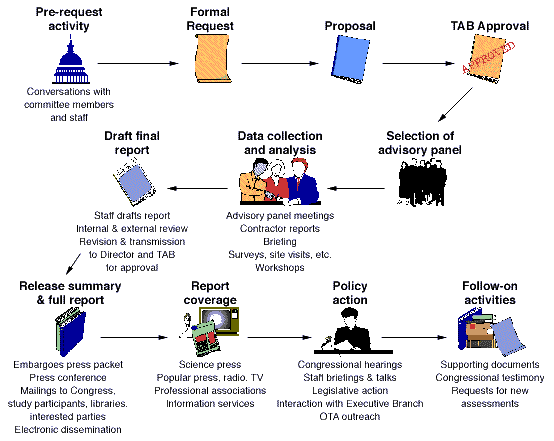
OTA assessment steps Click on thumbnail for chart of the assessment process used by the Office of Technology Assessment to advise Congress on important technology issues.

Now, think about how useful it would be to have such an agency back, to advise our nation on climate change, emergency preparedness, weapons of mass destruction in the post-Soviet era, malaria eradication policies, internet safety and security, and other key issues.

It’s time to bring back the OTA.

Mark Hoofnagle at the Denialism Blog started sounding the conch:

The fact of the matter is that our government is currently operating without any real scientific analysis of policy. Any member can introduce whatever set of facts they want, by employing some crank think tank to cherry-pick the scientific literature to suit any ideological agenda. This is truly should be a non-partisan issue. Everybody should want the government to be operating from one set of facts, ideally facts investigated by an independent body within the congress that is fiercely non-partisan, to set the bounds of legitimate debate. Everybody should want policy and policy debates to be based upon sound scientific ground. Everybody should want evidence-based government.

Go read what he said. Check in with P. Z. Myers’ view. See what John Wilkins says. Hoofnagle lists actions you can take, today, to get the ball rolling.

In the meantime, wander over to the Princeton University site where the OTA’s reports are now archived (I understand the government was going to take it offline, sort of a latter-day burning of the library at Alexandria). Noodle around and look at the report titles. Notice that, though the agency was killed dead by 1995, the agency had reports on climate change. Notice that the agency was a decade or two ahead in urging policies to encourage the internet. Look at the other issues the agency dealt with, look at the legislation that resulted — and you’ll lament with me that we don’t have the agency around today, when the issues are tougher, the technology more difficult to understand, and politics more driven by rumor than fact.

Killing the OTA was the Pearl Harbor of the present war on science. It’s time we started to fight back, to take back the scientific Pacific — our nation’s future is no less in peril now from the war on science, than it was then from hostile nations.

Resources:


Academic freedom: No liberals need apply?

September 13, 2007

(No, this isn’t a proper academic freedom issue; disgraceful, but not an issue of viewpoint suppression. Conservatives who claim such things when the shoe is on the right foot still won’t complain, though, I’ll bet.)

The University of California at Irvine is in the process of setting up a new law school. They had asked distinguished law scholar Erwin Chemerinsky of Duke to be dean, and he’d agreed.

Then, abruptly, UC-Irvine asked to cancel the contractconservatives opposed Chemerinsky, according to one claim.

Sources and commentary:

(Waiting for conservatives who complained about breaches of academic freedom for conservatives to explain the injustice . . . still waiting . . . still waiting . . .)
Not waiting any more. Instapundit links to a bunch of conservatives who have sprung to Chemerinsky’s defense. Great news that they’d do it at all!


Blog for the environment: Blog Action Day, October 15

September 8, 2007

Blog Action Day, October 15: Organizers hope to have as many as 10,000 blogs writing about environmental issues and environmental action.

Blog Action Day 2007, the environment

If you blog, perhaps you could join in. If you read and comment only, feel free to urge others to join in.

It’s headed up by a bunch from downunder. U.S., Canadian and Mexican bloggers haven’t got on the bandwagon a lot, yet. As the organizers describe it:

On October 15th – Blog Action Day, bloggers around the web will unite to put a single important issue on everyone’s mind.

In its inaugural year, Blog Action Day will be co-ordinating bloggers to tackle the issue of the environment.

What Each Blogger Will Do

Bloggers can participate on Blog Action Day in one of two ways:

  1. Publish a post on their blog which relates to an issue of their own choice pertaining to the environment.For example: A blog about money might write about how to save around the home by using environmentally friendly ideas. Similarly a blog about politics might examine what weight environmental policy holds in the political arena.Posts do not need to have any specific agenda, they simply need to relate to the larger issue in whatever way suits the blogger and readership. Our aim is not to promote one particular viewpoint, only to push the issue to the table for discussion.
  2. Commit to donating their day’s advertising earnings to an environmental charity of their choice. There is a list of “official” Blog Action Day charities on the site, however bloggers are also free to choose an alternate environmental charity to donate to if they wish.

And that’s it.

A gentle nudge to a better planet. Seems like a good idea to me.

Tip of the old scrub brush to Meeyauw.


One Texas, under God

August 29, 2007

A federal district court judge dismissed a challenge to the new law in Texas which adds “under God” to the Texas pledge, on top of the Texas law which requires all kids to say the pledge every day.

The Texas Lege, long the foil of Molly Ivins, was in particularly fine form this year, writing commandments from God and curtsies to God into several state activities. While I’m way behind on railing about these requirements, our Texas State Attorney General, Greg Abbott, has little more to do than make sure God gets his due — God being incapable of doing that himself, I suppose. Houston’s being over-run with storm refugees who disproportionately brought their guns, drug and gambling habits with them, juries in East Texas being under fire for being racially imbalanced and sentencing way more blacks to death than would seem reasonably by any statistical measure, and millions of school dollars disappearing in charter school scams and other scandals across the state, and Texas having the highest number and highest percentage of kids without health insurance, all pale by comparison to the Texas Lege’s and Mr. Abbott’s calls to make sure Texas kids pledge allegiance to the correct deity in the correct way.

Abbott’s opposite-editorial-page opinion ran in this morning’s Dallas Morning News. He gets his full say, below the fold.

Read the rest of this entry »


Alberto Gonzales resigned . . .

August 27, 2007

. . . Friday, but the president didn’t tell us about it until today.

According to the the New York Times (which broke the story):

“The unfair treatment that he’s been on the receiving end of has been a distraction for the department,” the official said.

Injustice even as he leaves. It’s the fair treatment Gonzales received that should have forced him out. The U.S. Justice Department is a mess above the political appointee level, with serious mismanagement, mal-management and lack of management threatening justice and the administration of law at several levels.

Other notable coverage: The Washington Post story now includes notes to Gonzales’s terse announcement, and links to recent stories in the Post which lend perspective and a lot of information.


Instapundit supports pollution, but with a smile

August 23, 2007

DDT follows the same path as PCBs in the environment, both persistent organic pollutants. From World Ocean Review:  Bioaccumulation of toxins in the marine food chain has long been recognized as a problem. The process illustrated here relates to polychlorinated biphenyls (PCBs), a typical environ-mental toxin.

DDT follows the same path as PCBs in the environment, both persistent organic pollutants. This illustration from World Ocean Review: Bioaccumulation of toxins in the marine food chain has long been recognized as a problem. The process illustrated here relates to polychlorinated biphenyls (PCBs), a typical environmental toxin.

Instapundit is happy to promote the use of poison:

SOME KIND WORDS FOR DDT — in the New York Times, no less. “Today, indoor DDT spraying to control malaria in Africa is supported by the World Health Organization; the Global Fund to Fight AIDS, Tuberculosis and Malaria; and the United States Agency for International Development. . . . Even those mosquitoes already resistant to poisoning by DDT are repelled by it.”

The debate over DDT is over. There’s scientific consensus. Anyone who disagrees is a DDT denialist and a mouthpiece for Big Mosquito.

posted at 10:18 AM by Glenn Reynolds

No, Glenn, the debate is not over so long as people continue to deny the harmful effects of DDT and act as mouthpieces for Big Poison, Big Garbage, Big Cancer, Big Pollution, voodoo science and Big Stupid.

There is a scientific consensus, but Reynolds misstates it. Scientists agree that DDT kills birds, bats, reptiles and beneficial insects that prey on malaria-bearing mosquitoes, making control of malaria more difficult (among many other harms). Consequently, DDT use under the rules laid down by the U.S. EPA in 1972 make a lot of sense. Those rules are the same as agreed to in the Persistent Organic Pollutants Treaty (POPs) — no DDT use in broadcast spraying, especially on crops; DDT use is allowed when necessary to fight disease; alternatives to DDT must be researched and created. The POPs Treaty lists DDT as one of the “Dirty Dozen” persistent pollutants.

POPs are a set of chemicals that are toxic, persist in the environment for long periods of time, and biomagnify as they move up through the food chain. POPs have been linked to adverse effects on human health and animals, such as cancer, damage to the nervous system, reproductive disorders, and disruption of the immune system. Because they circulate globally via the atmosphere, oceans, and other pathways, POPs released in one part of the world can travel to regions far from their source of origin.

Reynolds appears not to have read the treaty, nor even the article he cites, by Donald Roberts, from the odd, industry-funded Africa Fighting Malaria; even the most optimistic DDT fanatics generally nod in the direction of the dangers. Roberts wrote:

It would be a mistake to think we could rely on DDT alone to fight mosquitoes in Africa. Fortunately, research aimed at developing new and better insecticides continues — thanks especially to the work of the international Innovative Vector Control Consortium. Until a suitable alternative is found, however, DDT remains the cheapest and most effective long-term malaria fighter we have.

Africa Fighting Malaria is apoplectically happy to have one study that shows some repellent effects of DDT. As Bug Girl and Deltoid note, AFM urged unreasonable responses from many of us (I got their request, too). The study is encouraging, but it fails to make DDT the panacea Roberts paints it, and the study completely ignores the dangers of DDT, which have not changed a whit.

The best solutions to fighting malaria do not require DDT. Other new studies show that simple mosquito netting is amazingly effective — in Kenya, a switch in policy to give the nets out for free reduced malaria incidence by 44%. Under policies urged by U.S. conservatives, Kenyans had been required to pay for the nets previously. Reducing the cost of the nets left them beyond the means of many poor Kenyans.

Where is Glenn Reynolds’ promotion of non-poisonous and non-polluting, effective means to fight malaria. Why does he only go for the damaging solutions?

Perhaps Glenn Reynolds and Donald Roberts could make a showing of good faith in this case. Since this one study did tend to break their way, perhaps they could show their gratitude by calling on Sen. Tom Coburn to stop acting like a brat throwing a tantrum and remove his holds on the bill that would name a post office in Pennsylvania for Rachel Carson, honoring her work against pollution.  (Coburn cites junk science and voodoo science as his justification — and he’s an M.D.!)
Or, would making a statement against pollution be contrary to their politics?

To the chronically science challenged, DDT is an answer to more ills than you can imagine. We face new infestations of bed bugs — how long before AFM’s editorial ghosts have people urging DDT spraying wholesale to fight bed bugs? West Nile virus continues to plague the U.S., and already articles have appeared calling for broadcast spraying of towns and marshes to fight it, though that would probably be exactly the wrong thing to do.

The fight against ignorance goes on, but some wear ignorance like a badge of honor.


Nightmare at 1600 Pennsylvania Ave: Socialized medicine! (it works well)

August 16, 2007

Rep. Ron Paul, who wants to be president, made a speech recently on the floor of the House of Representatives where he suggested that Americans are mad at their government because the government tries to do stuff for them that they’d rather do themselves. Having recently spent two nights in the medical brig, I immediately thought that Paul is completely out of his mind — who in their right mind would want to do their own health care?

(Old joke: You know what they told the guy who wanted to do his own appendectomy? His doctor said, “Whatever! Suture self!”)

It seems to me people are upset because they can’t get health care at reasonable cost, and the government is doing absolutely nothing to fix most of those problems.

Then I read somewhere that Karl Rove urged his clients to bring up the bogey word “socialized” to describe programs their opponents advocate, since everybody hates anything that is socialized? Oh, yeah? You mean like people hate socialized roads, socialized water delivery systems, socialized sewer systems, and socialized airports?

So I was ready when Jim Wallis’s e-mail hit my in box this morning. His story about his experience with “socialized medicine” in London — a horror story that George Bush will use in his next State of the Union?

It’s a nightmare for sure — for the critics of “socialized medicine.” Read it for yourself, below the fold.

Here’s the usual, Republican view of “socialized medicine” (click on thumbnail for a larger view:

Government Optical

Pretty funny, eh? It’s totally groundless. Think about the government’s program of eye care for soldiers. Pilots and sharpshooters need great eye care. They get the best. They also get stylish glasses. And, though budgeted, you can get some style on Medicare and Medicaid, too — lots of styles, not just one. Our government operated eye care is socialized almost not at all in the classic, socialism definition of its being a planned output and planned outcomes system. Neither output nor outcomes are planned.

Socialized medicine really works. It’s a nightmare for the crowd that thinks bad health care or no health care is cheap, and the socialized medicine can’t work. Read Jim Wallis’s story, below the fold:

Read the rest of this entry »


Teacher pay, Teacher unions — What teacher would switch places with Richard Cohen?

August 14, 2007

Richard Cohen, whom I regarded a good columnist when we lived in Washington, D.C., had made an odd turn in the past decade or so. Where normally he’d stand up for public institutions and the people who run them, he just sounds cranky lately. In short, he’s turned into a person who likes Bush Republicans. Oh, my, it erupted in his recent column which is just grousing about how much education costs in the District of Columbia, with an ambiguous, implicit claim that maybe there’s too much money going into education there.

(Well, maybe too much for the results gotten compared with a few suburban districts; not enough to boost performance on the tests.)

Jason Rosenhouse at Evolutionblog Fisks the column, Fisks Cohen, and generally supports teachers — it’s worth a read.

It’s worth a read especially if you’re one of those who, like Richard Cohen, think we should suppress the pay for teachers until they improve, ignoring all the lessons you might ever have learned about getting what you pay for, and about the economics of hiring the best, the brightest, or just the heroes necessary to make a change. Here’s part of Rosenhouse’s commentary:

But that is not the main subject of this post. Instead it’s that gratuitous slap at the unions that struck me. Cohen, like a trained seal, has learned that mindlessly bashing teacher’s unions will never get you into trouble. That is why he feels no need to provide any specifics about what, exactly, the unions are doing wrong. Instead, when it comes time to reveal those subtleties of the education problem about which Democrats need to be instructed, Cohen only produces this:

Only one candidate, Barack Obama, suggested that maybe money was not all that was lacking when it comes to educating America’s poor and minority children. Parents had a role to play, too. “It is absolutely critical for us to recognize that there are going to be responsibilities on the part of African American and other groups to take personal responsibility to rise up out of the problems we face,” he said. What? It’s not just a question of funding?

Parents! Of course! How could those money grubbing teacher’s unions and their slavish Democratic puppets have overlooked such a thing? All this focus on making sure schools have the funds to heat their buildings in the winter and patch the roof when it leaks, this crazy idea that a school using twenty year old textbooks needs money if they are to procure new ones or that science labs are not exactly inexpensive, and they simply overlooked that parents have a role to play in their children’s education. One can only hope the Democrat’s pay attention to someone as perceptive as Cohen.

::heavy sigh::

The U.S. is not alone.  Australia has some teacher pay and facility issues, too, according to Matt’s Notepad.  Another interesting read.


Ardeatine Massacre: Bombers were soldiers, not terrorists

August 13, 2007

Our Italian physicist friend, Dorigo, at A Quantum Diaries Survivor reports that an Italian court ruled against a newspaper that started a campaign to deny the history of the Ardeatine Massacre.

Good news today. The supreme court of Cassazione in Italy has ruled that the press campaign labeling “terrorists” the GAP partisans who organized the bombing of Via Rasella in nazi-occupied Rome in 1944, launched by the national newspaper “Il Giornale”, was a striking example of manipulation of historic truth for political means. The newspaper is owned by Paolo Berlusconi (brother of Silvio, formerly premier of Italy in 1994 and 2001-2006), and was directed by Vittorio Feltri . . . a journalist who never hid his sympathy for the extreme right.

What was the Ardeatine Massacre?

Statue memorial to the victims of the Ardeatine Massacre, Italy Wikipedia:

The massacre of Fosse Ardeatine (Italian: Eccidio delle Fosse Ardeatine) took place in Rome, Italy during World War II. On 23 March 1944, 2 German soldiers, 31 Italian soldiers of Battaglione Bozen and a few Italian civilians passing along the road, were killed when members of the Italian Resistance set off a bomb close to a column of German soldiers who were marching on via Rasella[1]. This terrorist attack was led by the Gruppi di Azione Patriottica, of Rosario Bentivegna, Carla Capponi, Antonello Trombadori (Head of GAP in Roma) and the approval of Sandro Pertini (later President of Italian Republic), in order to provocate the reaction of SS troops.

Adolf Hitler is reported but never confirmed to have ordered that within 24 hours, one-hundred Italians were to be shot for each dead German. Commander Herbert Kappler in Rome concluded that ten Italians for each dead German would be sufficient and quickly compiled a list of 320 civilians who were to be killed. Kappler voluntarily added ten more names to the list when the 33rd German/Italian died after the Partisan attack. The total number of people murdered at the Fosse Ardeatine was 335, most Italians. The largest cohesive group among the murdered were the members of Bandiera Rossa, a Communist military Resistance group.

Why is there controversy 60 years later? Read the rest of this entry »


DDT’s disruption of hormone activities

August 12, 2007

Critics of Rachel Carson and sponsors of the anti-science, anti-environmentalist campaign to bring back DDT as a major killer, frequently misinform in very selective ways. For example, they like to mention DDT’s role in causing human cancers, because, they claim Rachel Carson was dead wrong about that link. Therefore, they say, DDT is a nice chemical and bans should be lifted.

In reality, carcinogenicity played a very small role in banning DDT. DDT was banned because it kills indiscriminately, killing beneficial insects along with the bad, killing untargeted species, like songbirds, along with the insect targets; and DDT was banned because once released into the wild, it is very long-lived, and its ultimate destructive effects cannot be known or controlled — though some harms, such as the devestation of America’s birds of prey, are extremely well documented.

Similarly, the anti-science crowd doesn’t like to talk about the third big area where DDT produces harms: Hormone disruption. In fact, Steven Milloy’s “100 things you should know about DDT” at the site that peddles junk science, JunkScience.com, does not even contain the word “hormone.”

They play down the fact that DDT and its by-products disrupt reproductive processes, and sometimes disrupt and deform reproductive organs, of nearly every animal it touches. They don’t want you to know about the hormonal effects of DDT and its breakdown products.

So, they never mention books like the National Academy of Sciences’ compilation of the harms of such chemicals, Hormonally Active Agents in the Environment.

Milloy will misquote the NAS when NAS mentions slightly the benefits of DDT; Milloy will not quote NAS when they cite the dangers of DDT. So this book on hormonally active agents, which mentions DDT specifically in 16 chapters for a total of 309 times, will never be mentioned in a discussion of DDT’s dangers — unless you bring it up.

Go see what the book says in the Executive Summary. If you debate the anti-Rachel Carson crowd, use this book frequently — they will have no answers.

And, Sen. Tom Coburn, are you listening? Since when do your constituents want you to defend a chemical which will ruin their farm animals, and especially the ducks they want to hunt? It’s time to quit trying to tarnish the memory of Rachel Carson, Sen. Coburn, and let that post office in Pennsylvania be named after her.


Disturbed congressman

August 10, 2007

Idaho’s Rep. Bill Sali is disturbed. But will he seek treatment?

Idaho Rep. Bill Sali - photo from Spokane Spokesman-Review

Better, might he read the Constitution if we give him the link?

Tip of the old scrub brush to Pharyngula, and to Dispatches on the Culture Wars.

Photo probably from the Spokane, Washington, Spokesman-Review


Serious indictment of media fetishes . . .

August 8, 2007

 . . . that will drive the “mainstream media (MSM)” critics to distraction.  Are we sure it’s a good idea to let Rupert Murdoch own the Wall Street Journal?

Orcinus tells conservative commentators to grow up:

Remember the fuss over Jet Pilot Action Figure Bush’s “package”? Damn fool didn’t loosen his straps before getting out of the jet. Nobody else on the deck had his crotch trussed up like a Christmas goose; and to them, he looked like a rookie idiot. But Chris Matthews practically had an orgasm on-air while watching him prance and strut.) The fact that so many mainstream and conservative media guys are suckered by this posturing shows that they don’t really have a clue about what a Real Man looks like — though, somewhere deep down inside, they’re pretty sure they don’t qualify. That’s why they’re so easily wowed by men who can put on the costume and make it look good.

But they’re even more easily cowed by men who can actually fill the boots. John Kerry. John McCain. Colin Powell. Bill Clinton. (You don’t have to agree with their politics; but nobody can say these men haven’t comfortably worn the full measure of male power and responsibility for some critical stretch of their lives.) Like little boys, the media guys are so awed by the outward forms of masculinity that they eagerly make a fetish out of them; but they also actively fear and resent men who display the authentic internal goods that make an honest-to-God man. These guys’ very presence incites such a strong sense of personal inadequacy that the Boys On The Bus can only resort to attacking them in ways that are openly calculated to feminize them — that is, to bring them down to their own level. He look French. He’s whipped by his powerful wife. He’s preoccupied with his hair. Translation: This guy has more balls and more maturity than we do — and we need to take him down before everybody figures out how inadequate that makes us feel.

And this:

 . . . the first rule of real macho was that those who possess it never need to prove it to anyone. If you have to prove it or put it out on display, you don’t have it in the first place. And if you are intimidated by seeing it in others, you aren’t even in the ballpark. The truth of that should come home to all of us every time we hear an MSM or conservative talking head going on in breathless awe about some public figure’s “manhood,” or asking leering, creepy questions about other people’s sex lives.

In a time when we need thought leaders who can help us sort out the issues and navigate the national crisis, we’ve got a media staffed by sniggering, leering first-graders who exhibit every regressive intellectual, moral, emotional, and sexual characteristic of right-wing authoritarian followers. It’s time to clean house — and to demand new media voices who aren’t in business to make fun of the grownups, or shamed by people who show the attributes of true maturity and power. It’s time to send the scared little boys home, and put some authentic adults in charge.


Dodd, 1, O’Reilly, 0

August 6, 2007

Bloggernista linked to a video where Sen. Chris Dodd, D-Conn., pins Bill O’Reilly for his scurrilous attacks on bloggers.  O’Reilly fans shouldn’t watch.


Cool tool: Tag clouds of presidents’ thoughts

August 5, 2007

Only Crook pointed this out in a comment — and it’s neat enough to raise to a headline:

 . . . have you seen the U.S. Presidential Speeches Tag Cloud http://chir.ag/phernalia/preztags/ I happened upon a speech by Millard Fillmore, so naturally I thought of this blog. I can’t link you directly to the speech I looked at, which was his 1850 State of the Union Address, (you have to use the slider to get there) but these were the most common words in that speech according to the tag cloud:

appropriations california constitution negotiation pacific ports revenue territory treasury treaty war

Go try it out.   It’s a very interesting tool for the visual portrayal of information — visual portrayals that I don’t know how to copy for display here.

For example, notice the arrival of the word “California” in presidential speeches, circa 1848.  Note how the word grows over the next few years, but then disappears just prior to the Civil War — what might that suggest to students about events in California, compared to events in the rest of the U.S.?  Or, track the word “Constitution” from the earliest speeches/writings listed to the latest.  Or track the use of the word “Iraq” in President Bush’s speeches, between 2000 and 2007.

The tool is ahead of its time, a fun device now.  The key question is, how should we be using such information?

Chirag Mehta created the program. Browsing his site will give teachers good ideas about what can be done by a decent programmer.  Does any school have a programmer to make such things for the classroom?  And we’re supposed to be using technology?  (Mehta’s stuff may be as good as it looks — see this article about the tag cloud device, in the Wall Street Journal, no less.)