Quote of the moment: Immigration and economic growth

July 15, 2007

Immigrants’ Contribution to Economic Growth
“The pace of recent U.S. economic growth would have been impossible without immigration. Since 1990, immigrants have contributed to job growth in three main ways: They fill an increasing share of jobs overall, they take jobs in labor-scarce regions, and they fill the types of jobs native workers often shun. The foreign-born make up only 11.3 percent of the U.S. population and 14 percent of the labor force. But amazingly, the flow of foreign-born is so large that immigrants currently account for a larger share of labor force growth than natives (Chart 1).”

Foreign-born share of U.S. Labor Force and Labor Force Growth; Orrenius, Dallas FRB

Foreign-born share of U.S. Labor Force and Labor Force Growth; Orrenius, Dallas FRB

Foreign-born share of U.S. labor force and labor force growth

Pia M. Orrenius, senior economist in the Research Department of the Federal Reserve Bank of Dallas, Southwest Economy, Issue 6, November/December 2003, Federal Reserve Bank of Dallas


Lady Bird Johnson, 94

July 12, 2007

Did I mention that we considered Lady Bird Johnson to be a family friend?

Ladybird Johnson among wildflowers

  • Ladybird Johnson in a field of Texas wildflowers, gaillardia and probably coriopsis, 2001; photo by Frank Wolfe, MacNeil/Lehrer Productions and KLRU-TV production, “Lady Bird”

We didn’t know her that well, really. But for the two years prior to our move to Texas, when I staffed the President’s Commission on Americans Outdoors, she was a solid presence. A passionate advocate of wildflowers, she was well aware of the possibilities that the commission might make recommendations regarding gardening and walking and hiking, and preserving natural beauty. She had already convered Tennessee Gov. Lamar Alexander to the cause — he issued an executive order that Tennessee should not cut down wildflowers along roadsides, saving the state a bunch of money on mowing and adding to the beauty of the state’s roads all at once. Alexander chaired the commission.

But she went to work on the vice chair, too — Gil Grosvenor, the president of the National Geographic Society. And she worked on the commission director, Victor Ashe, who had recently lost a U.S. Senate campaign to Al Gore and would go on to be mayor of Knoxville and chairman of the National Conference of Mayors. Lady Bird did not want to let any potential ally go unpersuaded. She had the phone numbers, and she made the calls, especially the late-in-the-day-catch-the-big-fish-without-a-secretary calls. Some of the people who go out of channels that way are very obnoxious. Lady Bird always produced smiles.

She persuaded them and the other commissioners to her cause, the commission staff, and probably anyone who ever bothered to read the reports of the commission or who attended any of the several public hearings where the joys and value of wildflowers was discussed.

And then we moved to Texas, and in the spring time we could see what Lady Bird’s passion was all about. It helped that Kathryn decided to chase her own passion for horticulture, and fell in with a great bunch of landscape designers and nursery people who emphasized Texas native plants. We joined the wildflower center Lady Bird set up in Austin, and actually met her on a couple of occasions. Kathryn and I both worked in the U.S. Senate, and we know stuffy people. Lady Bird was not stuffy, but always a woman of infinite charm and grace.

Most recently, when our son James earned his Eagle rank in Scouting, Lady Bird’s name was on the list of those public figures who would be gracious enough to drop a note of congratulations if asked. We know how to recognize the letters signed by machines, and we know how to recognize letters written by software that mimics handwriting. So it was a pleasant surprise to get a hand-addressed note from Austin, and see that the handwriting on the note matched the envelope. That’s the way a lady does it.

In Texas now, in the spring time there are bluebonnet watches, maps in newspapers showing a path to drive to see the best blooms, festivals, and trinkets galore. An entire industry of photographers revolves around getting families to sit among the flowers at the side of the road for a portrait. The flowers, other than the bluebonnets, show brilliantly to incoming airplanes. A flight from Houston or Austin to Dallas gives a passenger a floral sendoff and a floral welcome at the other end.

You can read the stories. Lady Bird was the financial manager of the Lyndon Johnson family fortune. She was also the peacemaker, the one who got LBJ calmed down from his frequent flights of passion, calm enough that he could be the best legislator our nation ever had, including James Madison, and a great legislative master even as president, as no president before or since.

Steel magnolias have nothing on Lady Bird Johnson, who understood the power of a blanket of flowers, the importance of roots and family, and how much grace can mean to those who get it.

Teachers in Texas should hit the newstands today and get the papers with the special features — the Dallas Morning News front page and front section are full of good stories. Teachers should get to the news websites and get the stories that will disappear in a week downloaded for later use. U.S. history teachers would do well to do the same, to get the information about the American environmental movement, and to pick up additional history on Lyndon Johnson, Vietnam, the successes of the civil rights movement, and the amazing decade of the 1960s.

America is better because of Lady Bird Johnson. She worked to be, and was, a family friend to the entire nation.

Here are sources you can check from contemporary news:

Dallas Morning News coverage


Former first lady dies at 94

LBJ trusted Lady Bird with his true self, warts and all

Lady Bird cultivated natural beauty from Western wilderness to inner cities

Journalist remembers her friend

Remembering Lady Bird

Editorial: She showed world grace, gentleness

Timeline: Her life and times

Services planned for Lady Bird Johnson

Statement from President George W. Bush

Statement from former President Bill Clinton and Sen. Hillary Clinton

Submit: Sign the online guestbook

Photos: The life of Lady Bird Johnson

Video:
Remembering Lady Bird Johnson (WFAA-TV)
Kay Bailey Hutchison on Lady Bird Johnson (WFAA-TV)
John Cornyn on Lady Bird Johnson (WFAA-TV)
Mrs. Johnson’s impact on Central Texas (KVUE-TV)
Lady Bird Johnson’s Legacy (KVUE-TV)
Family friend and spokesman Neal Spelce shares his memories of Mrs. Johnson (KVUE-TV)
Reaction from the LBJ Library and Museum staff (KVUE-TV)

Links
Lady Bird Johnson Final Tribute
Lady Bird Johnson Wildflower Center
Lady Bird Johnson biography
Lyndon Baines Johnson Library and Museum

Tip of the old scrub brush to O’Folks.


Buy a piece of a National Forest, help fund schools

July 8, 2007

I’m trying to figure out how to use this amazing spectrum of maps in class.

But, one set can do something good for schools:  You can buy a piece of a national forest, and thereby contribute to a fund to help schools.  It’s a bit of a crackpot idea, really — selling off the national forests to provide a minuscule amount of money for schools.  But there may be some gems of land out there that could be used for  .  .  . decreasing global warming by creating a preserve for trees.

Davey Crockett National Forest, parcels for sale:  This map shows land in Texas for sale.

Your local National Forest may be represented, too.  Get there before the developers?  Not likely — but you can dream, can’t you?

Please be warned, though, I find the site a real memory hog.  If you’re running several programs, and you’re memory deficient as I appear to be for this set of maps, be careful.

Seriously, the site offers a variety of maps of public lands under the jurisdiction of the Bureau of Land Management and National Forest Service.  Mineral leasing, oil and gas, coal, and other resources are mapped.  This affects the western public lands states mostly, but it could be a great source for a geography project on energy or mineral or timber resources for the nation.

What do you think?


Resources for new teachers, change provocateurs

June 22, 2007

New teachers, especially teachers from alternative certification programs, have all sorts of stories about people who observe and supervise their training and work.

There is the guy whose district bought laptops for every high school student and insisted teachers use the computers daily, but whose principal refused to look at the on-line courses he had developed to meet the district’s guidelines (and whom the principal subsequently rated down for not having the lesson plans the principal refused to look at).  There is the drama coach whose supervisor complained the students shouldn’t have been out of school for the state competition, which they won.  There is the mathematician from the telecommunications industry whose supervisor didn’t know geometry, or algebra, or calculus, and insisted the teacher should be offering multiplication table timed quizzes to advanced math classes.  The guy whose principal thought history documentaries selected from the school’s libraries were just Hollywood movies, and therefore inappropriate for history classes.

More than enough horror stories to go around.

One teacher tells a few horror stories from his student teaching days, but tells us he went on to get his school’s distinguished alumnus award.  And so, he shares some of his best material, here:  Horace Mann Educated Financial Solutions, “Reach Every Child.”

Go make change.

Tip of the old scrub brush to Car Family, which is really the same guy.


Gov. Perry to Texas community colleges: “Drop dead”

June 19, 2007

Drop Dead

That headline was pre-Murdoch, wasn’t it?

It fits this situation, too. Just read. I’m too steamed to comment.

At TexasEd .


Quote of the Moment: James Madison, on the growth of education

June 18, 2007

Two Madison quotes today: James Madison dollar, as struck for circulation

I congratulate you on the foundation thus laid for a general System of Education, and hope it presages a superstructure, worthy of the patriotic forecast which has commenced the Work. The best service that can be rendered to a Country, next to that of giving it liberty, is in diffusing the mental improvement equally essential to the preservation, and the enjoyment of the blessing.

James Madison letter to Littleton Dennis Teackle, March 29, 1826; from the Madison Papers at the University of Virginia

No feature in the aspect of our Country is more gratifying, than the increase and variety of Institutions for educating the several ages and classes of the rising generation, and the meritorious patriotism which improving on their most improved forms extends the benefit of them to the sex heretofore, sharing too little of it. Considered as at once the fruits of our free System of Government, and the true means of sustaining and recommending it, such establishments are entitled to the best praise that can be offered.

James Madison letter to Gulian C. Verplanck, February 14, 1828; from the Madison Papers at the University of Virginia

Both quotes are contained in James Madison’s “Advice to My Country,” edited by David B. Mattern, University Press of Virginia, 1997

Image: James Madison Presidential Dollar as struck, image from the U.S. Mint (Department of the Treasury) via About.com


What’s the difference between school and prison?

June 5, 2007

Kevin Siers of the Charlotte Observer, in the Star-Courier, Highlands-Crosby, Texas, March 11, 2004

Give up?

Yeah, often the students give up, too. If you don’t know the answer, your school may resemble a prison.

Gary Stager’s post with jarring comparisons is here, at District Administration’s Pulse! blog. [District Administration purges its archives about every three years, it turns out; here is a copy of Mr. Stager’s column courtesy the Wayback Machine – Internet Archive.]

When the elder Fillmore’s Bathtub son attended intermediate school, he complained of the discipline. So did a lot of other good kids. We got a call from a parent asking if we’d join in a meeting with the new principal, and hoping to learn things were really hunky dory and offer assurances to our son, we went.

Read the rest of this entry »

Voting for cancer, against prevention

May 31, 2007

Yeah, it was a bit tacky of Merck to create a campaign to get government officials to require inoculations against human papilloma viruses that cause cancer — but, people!, we’re talking about preventing cancer here.

The Texas legislature voted for cancer, overturning Gov. Rick Perry’s ill-considered good idea to require vaccinations for school kids in Texas. In a state with top-notch anti-cancer research at M. D. Anderson Cancer Center in Houston and UT’s Southwest Medical Center in Dallas, it was an odd, odd thing to witness.

The debates are skewed by a general distrust and dislike of big pharmaceutical companies, and by the religious right’s view that it’s better that a young mother die of cancer than she should get even the faintest idea that might in only the most perverse mind promote pre-marital sex. Still, we shouldn’t fall victim to voodoo science claims against vaccines.

Are my views, tempered by years of work promoting public health and fighting disease, clear enough for you?

Owlhaven wins popularity contests among mothers who read blogs, and it often is tender and touching — hey, I read it from time to time. But recently Mary, Owlhaven’s author, fell victim to a propaganda campaign from Judicial Watch, a far-right-wing bunch that campaigns against the U.S. justice system and generally makes a conservative-gratuitous-poke-in-the-butt out of itself. Judicial Watch claims to have some secrets from having filed a Freedom of Information Act Request with FDA to get Merck’s reports to FDA of adverse events known about Gardasil, Merck’s proprietary anti-cancer vaccine.

I responded, of course — but my response didn’t show on Owlhaven’s comments. Blackballed? Spam filtered due to the number or length of links? I can’t tell. Mary said she emptied the spam filter without checking. So, I repost my response, below the fold, for your benefit. Read the rest of this entry »


Looking up to Finland

May 30, 2007

Commenter Bernarda sent a link to a Washington Post story by Robert Kaiser about Finland, a nation who redesigned its education system with rather dramatic, beneficial results. Among other things, the Finns treat teachers as valuable members of society, with high pay, great support, and heavy training.

Finland is a leading example of the northern European view that a successful, competitive society should provide basic social services to all its citizens at affordable prices or at no cost at all. This isn’t controversial in Finland; it is taken for granted. For a patriotic American like me, the Finns present a difficult challenge: If we Americans are so rich and so smart, why can’t we treat our citizens as well as the Finns do?

Why not? Why can’t we treat our citizens as well as the Finns? Their system boosts their economy and leads to great social progress — which part of that do we not want?


West High best in Utah

May 28, 2007

West High School, Salt Lake City, Utah

Main entrance to West High School, Salt Lake City, Utah. Wikipedia image

I coulda told you that. It’s my mother’s high school. (Class of ’32)

(My old school, Pleasant Grove High, didn’t make the list.)


Mining the Internet Archive: Education reform

May 22, 2007

Do we use enough different media in our classrooms?

In my continuing search for sources of useful and inspiring video and audio stuff, I keep running into the Internet Archive. A few of Dorothy Fadiman’s thought-provoking films can be viewed there, including this one some of us may recall from past PBS broadcasts, which features nine schools that appear to work well: “Why Do These Kids Love School?” (1990)

Now I have two questions: First, since 1990, how have these schools fared? Second, since 1990, have we learned anything really significant about how students learn that would change our views of what goes on in these schools?


Getting evolution right

May 13, 2007

Odd thing happened the other day: The Philadelphia Inquirer carried an editorial that rather accurately described evolution theory. Just when I’m ready to lambaste my colleagues in print media, they come through.

The editorial’s point of departure was the Republican “debate” among presidential contenders, in which they were asked whether they support evolution or creationism. Three of the candidates confessed they don’t “believe” in evolution.

Why did these three, all of whom wish to be the leader of the most powerful country in history, say they did not believe in evolution? There might be thousands of reasons. Perhaps they misheard: “I’m just curious: Is there anyone on this stage who doesn’t believe in elocution?” But two reasons are more likely:

(1) They really don’t think evolution exists. As in, it’s not happening and never did. We got here some other way. There’s no evidence for it.

Uh, yeah, there is. Although technically a theory, Charles Darwin’s version of the evolution of species is a theory-with-the-status-of-fact, robust and vigorous, demonstrated in living color each and every day in field and laboratory everywhere. No jury is “out.” The verdict’s in and everybody’s gone home. Way home.

And,

(2) These men raised their hands because they knew it would get them votes from religious conservatives.

Tancredo, Huckabee and Brownback know they need the Christian conservative vote to win the Republican nomination. Christian conservatives don’t like Rudy Giuliani. They’re lukewarm on John McCain, perplexed by Mitt Romney.

But any candidate who would ignore science to attract conservative votes has made a lousy calculation.

The newspaper’s editorial board concluded:

So, while pundits are calling the evolution flap an embarrassment to the GOP, what it really is is a call to the Republican faithful: “We’re in trouble. If we don’t rally on the wedge issues now, by 2008, a Republican majority may seem as far away as the Planet of the Apes.”

Click here to find out more!


Carnival still in town? We didn’t miss it?

May 13, 2007

History Carnival 52 was up on May 1 at Clioweb. What sort of a fog have I been in? Check out especially this post at Food History, demonstrating several uses of critical thinking tools as they might analyze the bizarre idea that most meat in Middle Ages Europe was rancid, thereby leading to a rise in the use of spices. Spices don’t make up for stomach cramps, for example. There must be some sort of critical thinking exercise in there for a world history class.

Carnival of the Liberals 38 came online earlier this week, at This Is So Queer. With fires raging in the hills around Burbank — documented with eerily beautiful photography — a fire of war in Iraq, and a fire around the Second Amendment, posts collected at the carnival offer fuel for intellectual fires on big issues.

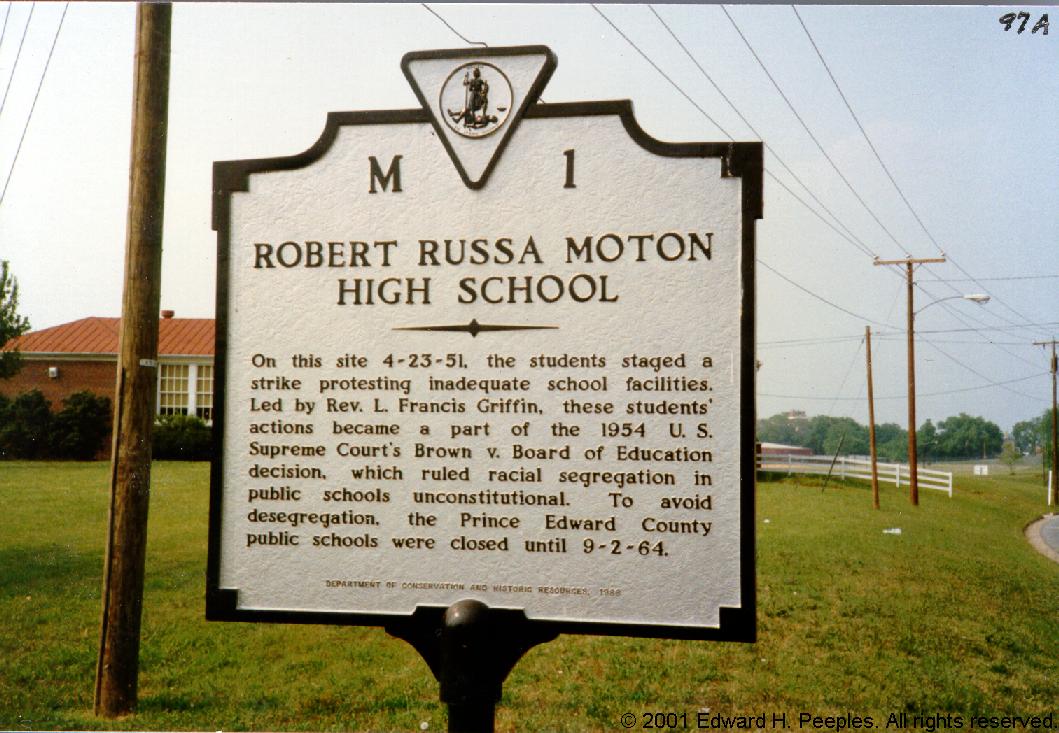
Moton HS historical markerAnd, the venerable Carnival of Education, issue 118, was up earlier at NYC Educator, with good posts on laptops in school, parenting, administering, enduring, and everything else related to education. (Click on the photo for a larger image — it’s the historical marker at the former Robert R. Moton High School, in Prince Edward County, Virginia — where one of the most poignant of the cases against school segregation began, Davis vs. Prince Edwards County Schools — part of the Brown vs. Topeka Board of Education case decided in 1954. Photo from Virginia Commonwealth University.)

Carnival of Homeschooling 71 lolls, at On The Company Porch.

And, of course, if you wish to nominate a post for the next Fiesta de Tejas!, scheduled for June 2, just use this button:


Blog Carnival submission form - fiesta de tejas!

Have a good Mother’s Day — call all the mothers you know. Why be picky?


Inherent evils of public education

May 11, 2007

Public schools have serious problems.  Regular readers here should know me as a defender of public education, especially in the Thomas Jefferson/James Madison model of a foundation stone for a free people and essential tool for good government in a democratic republic.

Can you take another view?  Here’s one that should offer serious material for thought:  How the Public School System Crushes Souls.

Tip of the old scrub brush to Pick the Brain.


Why we miss Molly Ivins

April 29, 2007

Molly Ivins’ ghost works overtime (link not safe for work, or school), but ghosts have reduced influence in the land of the living. Exactly how great a tragedy that Ivins died just as the Texas Lege was coming into session and the Bush Administration scandals began their geometric expansion, will never be fully comprehended.

But we can catch glimpses.

Would you believe Warren Chisum cutting off debate on a free speech bill? The Burnt Orange Report makes a commendable effort to channel Ivins, and it’s well worth the read. One of the reasons Texas produces great writers, and great humorists, is the simple fact that there are so many unbelievable stories happening in Texas all the time, stories so breathtaking in their inanity (usually) that the only rational response is laughter.

Chisum and his friends got an idea from somewhere that kids in Texas have a difficult time expressing their Christian faith.  Chisum, it appears, has not been in a Texas school room since at least 1900, or he’d know better — but he is a powerful legislator and so his particular flights from reality often end up written out as legislation.

It’s unusual, I know, that in a state where millions of kids don’t have a prayer of getting health care because they don’t have a prayer of getting health insurance, and where kids from poorer school districts have little more than a prayer of getting an equal education, the legislature focuses on the prayer part of the deficits, instead of fixing anything else fixable.

It’s not that the kids don’t pray — it’s that few in the state legislature listen.  The kids don’t need a bill to make it legal to do what they already do that is already legal; the kids need a bill that would make the Lege pay attention and do something about the problems.

Blogging has been limited lately; there is much to blog about.  Is there enough time to catch up?