Malaria fight, February 2015

February 20, 2015

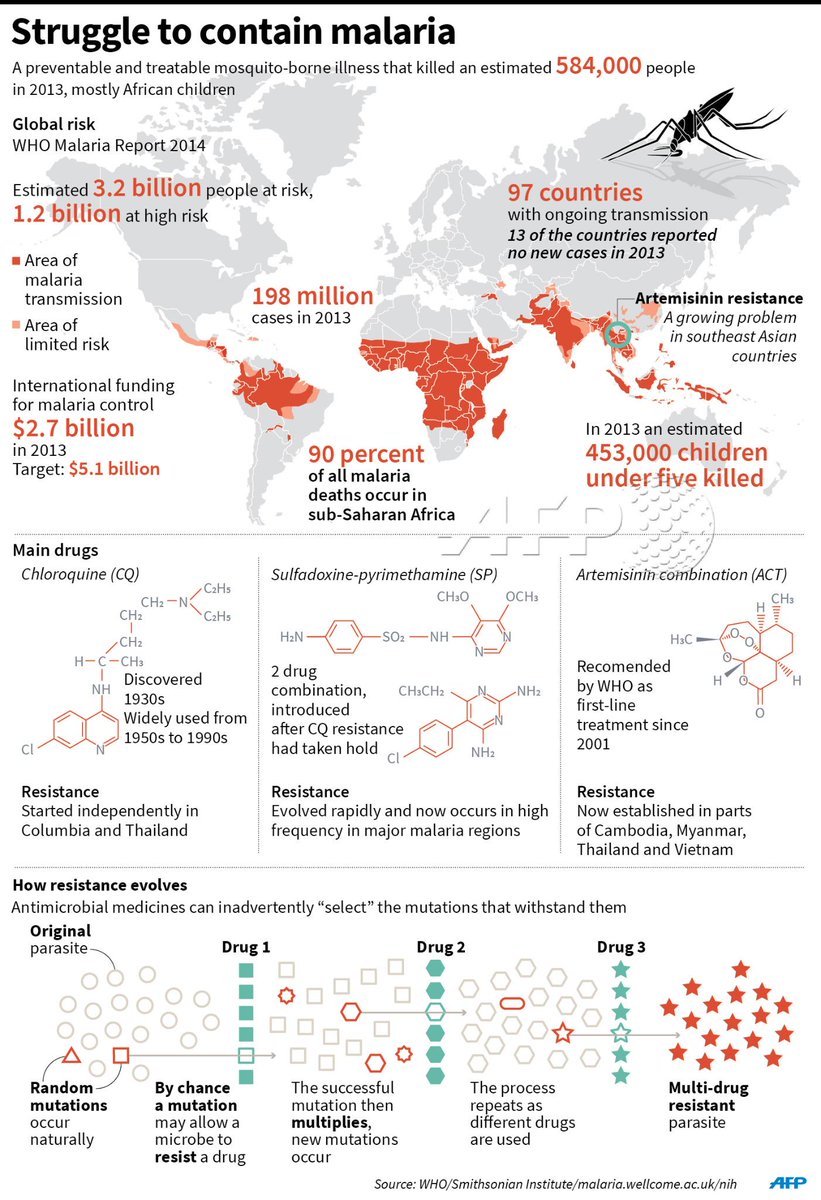
Timely infographic from Agence France Presse.

Some background:  The newly-formed World Health Organization (WHO) estimated worldwide malaria deaths at more than 5 million per year, when it kicked off the ambitious but ultimately unsuccessful malaria eradication program in 1955.  Eradication hopes hung on the use of DDT, sprayed on the walls of homes in affected areas (Indoor Residual Spraying, or IRS), to temporarily knock down mosquito populations so that humans infected with malaria could be cured.  After early successes in temperate zones, malaria fighters took the fight to tropical Africa in 1963.  There they discovered that overuse and abuse of DDT had already bred mosquitoes resistant to the pesticide.  With no substitute for DDT available, WHO wound down the campaign on the ground by 1965, and officially abandoned it in 1969.

Nations who had pledged money for the fight early, cut back when DDT failed.  In 1963, about 4 million people died from malaria, worldwide.

Despite the lack of an international, worldwide fight against malaria, malaria fighters soldiered on.  Better housing and better medicines made gains.  By the time the U.S. banned DDT use on crops in 1972, pledging all U.S. production of DDT to fight disease elsewhere, annual malaria deaths had fallen to just over 2 million per year. By 1990, the annual death toll was cut to about a million per year.  Through the 1980s, malaria parasites themselves developed resistance to the main pharmaceuticals used to cure humans.

By the end of the 1990s, international agencies and especially NGOs like the Bill and Melinda Gates Foundation brought new funding and new urgency to the fight against malaria.  Expansion of production of artemisinin-based pharmaceuticals provided a new tool for health workers.  Funding from the U.S., through the President’s Malaria Initiative, helped a lot.  In 2000, about a million people died from malaria.  By 2014, malaria deaths fell to under 600,000.

Parasite resistance to the new pharmaceuticals poses a new threat to continued progress.  Funding is still far short of what experts estimate to be needed, and short of pledges from developed nations.  Mosquitoes that carry malaria parasites from human to human (after a step of the life cycle in infected mosquitoes) quickly evolve resistance to pesticides; malaria parasites develop resistance to pharmaceuticals used to treat humans.  Funding to rotate pesticides and drugs falls short, causing improper use of both, and quicker evolution of resistance in mosquitoes, and parasites.

Infgraphic from Agence France Presse, on the fight against malaria, February 2015.

Infgraphic from Agence France Presse, on the fight against malaria, February 2015.


Curing malaria in the USA, 1938

September 26, 2014

Photo from the collections of the Library of Congress:

“Groves Bromo Quinine,” sign on a shack advertises a treatment for malaria, and other products; near Summerville, South Carolina. Photo by Marion Post Wolcott, December 1938. Library of Congress.

This photo was taken by Marion Post Wolcott for the Farm Security Administration, documenting how farmers and other Americans lived during the Great Depression.

1938 was a year before DDT’s insecticidal properties were discovered, and at least six years before DDT became available for civilian work against malaria and the mosquitoes who spread the parasites.


World Malaria Day 2014 – How can you help beat the disease?

April 25, 2014

Poster from BioMed Central:

Poster from BioMed Central for World Malaria Day 2014

Poster from BioMed Central for World Malaria Day 2014

Time for a big push to smash the disease’s hold on humanity, maybe eradicate it.  Are you in?

No, DDT is not the answer, not even much of AN answer.

How can you help, right now?

  1. Send $10 to Nothing But Nets. Bednets are dramatically more effective than just insecticides, in preventing malaria infections and saving lives.  Your $10 donation will save at least one life.
  2. Write to your Congressional delegation, and urge them to increase funding to the President’s Malaria Initiative. Malaria does well when people in non-malaria regions turn their backs on the problem.  Malaria declines with constant attention to nation-wide and continent-wide programs to prevent the disease, by diminishing habitat for mosquitoes, curing the disease in humans so mosquitoes have no well of disease to draw from, and preventing mosquitoes from biting humans, with window screens, education on when to stay indoors, and bednets.

More:


Legacy of DDT abuse: Cleaning up old pesticide dumps

February 15, 2014

Contrary to science denialist claims, DDT is not harmless.  Users and abusers of DDT, abandoned stocks of DDT and other pesticides around the world, after the stuff had become essentially useless against insect or other pests originally targeted.

In the U.S., EPA moves in to clean up DDT dumps, under the Comprehensive Environmental Response, Compensation and Liability Act of 1980 (CERCLA), or Superfund.  In much of the world, various UN agencies find the old pesticides, and clean them up as funding allows.

The Food and Agricultural Organization (FAO) documents its cleanup efforts with photos of sessions training technicians to find and catalog dump sites, repackaging of old drums when necessary, extraction, packing and shipping to a disposal site.

Photos tell a story words on paper cannot.

Caption from FAO: TN (Tanzania) before: 40 tonnes of 50 year old DDT were found in Menzel Bourguiba Hospital, TN - : M. Davis

Caption from FAO: TN (Tanzania) before: 40 tonnes of 50 year old DDT were found in Menzel Bourguiba Hospital, TN – : M. Davis

Sometimes the toxic wastes did not stay neatly stacked.

FAO caption:  TN before: 40 tonnes of 50 year old DDT were found in Menzel Bourguiba Hospital, TN

FAO caption: TN before: 40 tonnes of 50 year old DDT were found in Menzel Bourguiba Hospital, TN View real size

DDT use against insect vectors of disease essentially halted in the mid-1960s.  The Rockefeller Foundation’s and UN’s ace mosquito fighter, Fred Soper, ran into mosquitoes in central Africa that were resistant and immune to DDT. Farmers and businesses had seized on DDT as the pesticide of choice against all crop pests, or pests in buildings.  By the time the UN’s malaria-fighting mosquito killers got there, the bugs had evolved to the point DDT didn’t work the malaria eradication campaign.

Also, there were a few DDT accidents that soured many Africans on the stuff.  Around lakes where local populations caught the fish that comprised the key protein in their diet, farmers used DDT, and the runoff killed the fish.

Use of DDT ended rather abruptly in several nations.  Stocks of DDT that had been shipped were abandoned where they were stored.

For decades.

FAO caption:    Obsolete DDT in Luanda, Angola - July 2008 -  : K. Cassam

FAO caption: Obsolete DDT in Luanda, Angola – July 2008 – : K. Cassam

Prevention and disposal of obsolete chemicals remains as a thorny problem throughout much of the world.  Since 2001, under the Persistent Organic Pollutants Treaty, (POPs), the UN’s World Health Organization (WHO) has coordinated work by WHO and a variety of non-governmental organizations (NGOs), as well as governments, to make safe the abandoned pesticides, and detoxify or destroy them to prevent more damage.  FAOs efforts, with photos and explanation, is a history we should work to preserve.

DDT provided powerful insect killing tools for a relatively short period of time, from about 1945 to 1965.  In that short period, DDT proved to be a deadly killer of ecosystems to which it was introduced, taking out a variety of insects and other small animals, on up the food chain, with astonishing power.  One of DDT’s characteristics is a long half-life — it keeps on killing, for months or years. Once that was thought to be an advantage.

Now it’s a worldwide problem.


Texas researchers tease out correlation between DDT exposure and late-onset Alzheimer’s

February 12, 2014

Press release from the University of Texas-Southwestern Medical Center in Dallas:

Research finds elevated levels of DDT metabolite in Alzheimer’s patients

Dr. Dwight German, Professor of Psychiatry

Dr. Dwight German, Professor of Psychiatry – UT-Southwestern photo

DALLAS – January 29, 2014 – Exposure to DDT may increase the likelihood of developing Alzheimer’s disease later in life, a study with researchers at UT Southwestern Medical Center suggests. While previous studies have linked chronic diseases such as cancer and diabetes to DDT, this is the first clinical study to link the U.S.-banned pesticide to Alzheimer’s disease.

The study, published online in JAMA Neurology, found elevated levels of the DDT metabolite, DDE, that were 3.8 times higher in patients diagnosed with Alzheimer’s disease in comparison to control subjects. The studies were conducted in partnership with researchers at Emory University School of Medicine and Rutgers Robert Wood Johnson Medical School.

“We have additional studies underway that will seek to directly link DDT exposure to Alzheimer’s disease,” said co-author Dr. Dwight German, Professor of Psychiatry at UT Southwestern. “If a direct link is made, our hope is to then identify the presence of DDE in blood samples from people at an early age and administer treatments to remove it.”

The study found elevated levels of DDE in blood samples of 86 patients with Alzheimer’s disease as compared to 79 control patients from the UT Southwestern Alzheimer’s Disease Center and the Emory University Alzheimer’s Disease Center.

Researchers made the link between DDE and Alzheimer’s by measuring three components – blood serum levels, severity of the patient’s Alzheimer’s disease as measured by the Mini-Mental State Examination (MMSE) and its relation to serum DDE levels, and the reaction of isolated nerve cells to DDE. Treatment of human nerve cells with DDE caused them to increase the production of the amyloid precursor protein that is directly linked to Alzheimer’s disease.

Participants in the study underwent preliminary testing to ensure that they didn’t have symptoms of other dementia-related diseases, and were an average age of 74, while the control subjects were on average 70 years old. These findings may help lead to the development of early biomarkers that can determine whether a person will develop Alzheimer’s disease later in life due to DDT exposure.

Alzheimer’s disease is the most common neurodegenerative disease worldwide and is expected to increase three-fold over the next 40 years, according to the researchers.

DDT (dichloro-diphenyl-trichloroethane) was used extensively as an insecticide in the 1940s, but has been banned in the United States since 1972 after scientists linked the compound to wildlife health and environmental concerns. DDT is still used in other countries to combat the spread of malaria.

About UT Southwestern Medical Center
UT Southwestern, one of the premier academic medical centers in the nation, integrates pioneering biomedical research with exceptional clinical care and education. The institution’s faculty includes many distinguished members, including five who have been awarded Nobel Prizes since 1985. Numbering more than 2,700, the faculty is responsible for groundbreaking medical advances and is committed to translating science-driven research quickly to new clinical treatments. UT Southwestern physicians provide medical care in 40 specialties to nearly 91,000 hospitalized patients and oversee more than 2 million outpatient visits a year.

###

Once again, research seems to demonstrates the wisdom of Rachel Carson, who warned us that we could not know the long-term damage done by untested pesticides applied with abandon in great abundance as if it were a solution to everything.

Carson’s book indicting pesticides regulation, Silent Spring, was published in 1962, with more than 50 pages of footnotes and citations to scientific studies.  In the 52 years since, none of that research has been rebutted by any further research.  Instead, more harms have been discovered, greater questions raised about the damage done by pesticides applied indiscriminantly.


How’s that “defund the EPA” working for you now? West Virginia edition

January 10, 2014

Rite-Aid store in Charleston, West Virginia, out of bottled drinking water.

Rite-Aid store in Charleston, West Virginia, out of bottled drinking water. Eyewitness report and photo via Twitter

West Virginia’s water woes might look like a political campaign ad from God to some people.

If you’re watching closely, you may already understand some of the morals of this story.

Last night West Virginia Gov. Earl Ray Tomblin declared an emergency in six counties, telling about 300,000 people to avoid touching their tapwater — no drinking, mixing infant formula, cooking, or bathing; flushing toilets was okay.  NBC reported:

A chemical spill into a West Virginia river has led to a tap water ban for up to 300,000 people, shut down bars and restaurants and led to a run on bottled water in some stores as people looked to stock up.

The federal government joined West Virginia Gov. Earl Ray Tomblin in declaring a disaster as the West Virginia National Guard arranged to dispense bottled drinking water to emergency services agencies in the counties hit by the chemical spill into the Elk River.

Federal authorities are also opening an investigation into the circumstances surrounding the leak and what triggered it, U.S. Attorney Booth Goodwin said Friday.

The advisory was expanded at night to nine counties and includes West Virginia American Water customers in Boone, Cabell, Clay, Jackson, Kanawha, Lincoln, Logan, Putnam and Roane counties.

Several thousand gallons of an industrial chemical had leaked out, into a tributary to the Kanawha River above Charleston, upstream from the city’s culinary water intake.  While the company responsible for the leak, Freedom Industries, assured the governor and other authorities that the spill is not threat to human health, officials took the more cautious path.

This case illustrates troubles we have with food and water supplies, protecting public health, and the rapid proliferation and spread of modern technology and chemical innovation.

  • Why did the company say the spill is no threat?  No research has pinned any particular health effect to the chemical involved. But you, you sneaky, suspicious person, you want to know just what chemical is involved, don’t you?
  • What’s the chemical involved? 4-Methylcyclohexane Methanol (MCHM) spilled out of a tank into the Elk River, which flows into the Kanawha River, from which Charleston gets its water.  Charleston, West Virginia’s capital, is also the state’s largest city.  You’re still suspicious?
  • What are the health effects of the stuff? Now you ask questions for which there are not great answers.  The chemical, with the methylcyclohexane linked to an alcohol molecule, is new enough, and rare enough in industry, that there are not a lot of studies on what it does.  It’s known to irritate skin and mucous membranes; breathing a lot of it can cause pneumonia.  Only rats have been exposed to the stuff enough to know what it does, and only a few rats for only short periods of time and not massive doses. In other words, we don’t know the health effects.
  • What’s the stuff used for? Freedom Industries uses it to wash coal.  Heck, I didn’t even know coal was washed other than a water spray to hold down dust in crushing, loading and unloading the stuff.  [if you missed the link in this post, let call your attention again to the story at WOWK-TV, which is quite thorough in discussing MCHM and its effects.  WOWK-TV is more thorough than the federal regulating agencies.]
  • But wait! If there are no known health effects, why the caution? It’s not that the stuff has been tested and found safe to humans.  MCHM simply hasn’t been tested to see what the health effects are.  The toxic profile for the compound at CDC’s ATDSR does not exist.  NIOSH doesn’t have much  more information on it. The most thorough analysis of what it might do is populated by small studies, or none at all.
  • What do you mean the stuff hasn’t been tested!!!???? Welcome to to Grover Norquist’s “smaller government,” to John Boehner’s and Mitch McConnell’s “reduced regulation,” to Rick Perry’s “states’ rights” world.  Way back in 1962 Rachel Carson warned about the proliferation of newly-devised chemicals being loosed into the environment, when we really had no historical knowledge of what the stuff would do to humans who ran into it, nor to other life forms, nor even inanimate things like rocks, wood and metal.  A decade later, the founders of the Environmental Protection Agency entertained the idea that a federal agency would be responsible for assuring that chemical substances would be tested for safety, both old substances and new.  For a couple of decades Congress supported that mission, until it became clear that there are simply too many new compounds and too great a backlog to test all, thoroughly.That world of making chemists and big companies responsible for their chemical children began to crumble in the Reagan administration, and is mostly abandoned now.  Chemical juveniles may run as delinquent as they would, with EPA and all other agencies essentially powerless to do anything — unless and until tragedy.  Even where EPA, and the Bureau of Alcohol Tobacco and Firearms (ATF) and all branches and twigs of the Department of Homeland Security, designate something as hazardous and deserving of care in handling, a state like Texas will ignore the rules on a substance until an accident blows half of West, Texas, to Hell, Michigan, with loss of life and enormous property destruction.  Afterward, victims get left bereft of aid to rebuild, and wondering who they might look to, to look out for them, to prevent such a horrible occurrence in the future.

So it goes, the nation blundering along from one tragedy, until the next.

Through most of American history, great tragedies produced great reforms.  No longer.  The Great Red State of West Virginia is dependent on federal largesse to get water to drink, at enormous expense and waste of time, talent and money.  Meanwhile, West Virginia’s Members of Congress conspire in Washington, D.C., to strip federal agencies from any power to even worry about what may be poisoning West Virginians.

Gov. Tomblin’s speedy action may seem out of place, not because there is great danger, but because he’s acting to protect public health without a mass of dead bodies in view to justify his actions.  We don’t see that much anymore (Texas Gov. Rick Perry and Attorney General Greg Abbott didn’t cancel appointments to get to West, Texas to even offer sympathy, but instead scheduled weekend jaunts after it was clear the fire was out and there was no danger.  The good people of West did not greet them with a hail of rotten tomatoes, but thanked them for their concern.  Americans are nothing if not polite.)

I was struck with the news last night because I could find no report of just what was the chemical that leaked into the rivers.  This morning we finally learned it was MCHM.  In the depths of some of those stories, we also learn that the leak may have been going on for some time.  Though thousands of gallons of the stuff are missing, the concentrations in the river suggest not much is leaking now . . . the rest leaked earlier, and is already water under the bridge south of Charleston.

What do you think state and federal authorities should do in this case?  What do you think will actually happen?

More:

Update January 12, 2014:  JRehling got it right:

http://twitter.com/JRehling/status/422253679823970304


World Malaria Report 2012: Malaria still declining, but more resources needed fast

January 4, 2013

Significant gains against malaria could be lost because funding for insecticide-treated bednets has dropped, and malaria parasites appear to be developing resistance to the pharmaceuticals used to clear the disease from humans, while insects that transmit the parasites develop resistance to insecticides used to hold their populations down.

Malaria room

African bedroom equipped with LLINs (insecticidal bednets) Photo: YoHandy/Flickr

UN’s World Health Organization (WHO) published its annual report on the fight against malaria last month, December 2012.  Accompanying the many page World Malaria Report 2012  were a press release and a FAQ; the fact-sheet appears unedited below.

Insecticidal bednets have proven to be a major, effective tool in reducing malaria infections.  Careful studies of several different projects produced a consensus that distributing the nets for free works best; people in malaria-infected areas simply cannot afford to pay even for life-saving devices, but they use the devices wisely when they get them.  Nets often get abbreviated in official documents to “LLINs,” an acronym for “long-lasting insecticidal nets.”

Generally, the report is good news.

Dramatic facts emerge from the report:  The “million-a-year” death toll from malaria has been whacked to fewer than 700,000, the lowest level in recorded human history.  More people may die, and soon, if aid does not come to replace worn bednets, distribute new ones, and if the drugs that cure the disease in humans, lose effectiveness.  Many nations where the disease is endemic cannot afford to wage the fight on their own.

Links in the Fact Sheet were added here, and do not come from the original report — except for the link to the WHO site itself.

Logo for World Health Organization

17 December 2012

World Malaria Report 2012

FACT SHEET

Malaria is a preventable and treatable mosquito-borne disease, whose main victims are children under five years of age in Africa.

The World Malaria Report 2012 summarizes data received from 104 malaria-endemic countries and territories for 2011. Ninety-nine of these countries had on-going malaria transmission.

According to the latest WHO estimates, there were about 219 million cases of malaria in 2010 and an estimated 660,000 deaths. Africa is the most affected continent: about 90% of all malaria deaths occur there.

Between 2000 and 2010, malaria mortality rates fell by 26% around the world. In the WHO African Region the decrease was 33%. During this period, an estimated 1.1 million malaria deaths were averted globally, primarily as a result of a scale-up of interventions.

Funding situation

International disbursements for malaria control rose steeply during the past eight years and were estimated to be US$ 1.66 billion in 2011 and US$ 1.84 billion in 2012. National government funding for malaria programmes has also been increasing in recent years, and stood at an estimated US$ 625 million in 2011.

However, the currently available funding for malaria prevention and control is far below the resources required to reach global malaria targets. An estimated US$ 5.1 billion is needed every year between 2011 and 2020 to achieve universal access to malaria interventions. In 2011, only US$ 2.3 billion was available, less than half of what is needed.

Disease burden

Malaria remains inextricably linked with poverty. The highest malaria mortality rates are being seen in countries that have the highest rates of extreme poverty (proportion of population living on less than US$1.25 per day).

International targets for reducing malaria cases and deaths will not be attained unless considerable progress can be made in the 17 most affected countries, which account for an estimated 80% of malaria cases.

  • The six highest burden countries in the WHO African region (in order of estimated number of cases) are: Nigeria, Democratic Republic of the Congo, United Republic of Tanzania, Uganda, Mozambique and Cote d’Ivoire. These six countries account for an estimated 103 million (or 47%) of malaria cases.
  • In South East Asia, the second most affected region in the world, India has the highest malaria burden (with an estimated 24 million cases per year), followed by Indonesia and Myanmar.  50 countries are on track to reduce their malaria case incidence rates by 75%, in line with World Health Assembly and Roll Back Malaria targets for 2015. These 50 countries only account for 3% (7 million) of the total estimated malaria cases.

At present, malaria surveillance systems detect only around 10% of the estimated global number of cases.  In 41 countries around the world, it is not possible to make a reliable assessment of malaria trends due to incompleteness or inconsistency of reporting over time.

This year, the World Malaria Report 2012 publishes country-based malaria case and mortality estimates (see Annex 6A). The next update on global and regional burden estimates will be issued in December 2013.

Malaria interventions

To achieve universal access to long-lasting insecticidal nets (LLINs), 780 million people at risk would need to have access to LLINs in sub-Saharan Africa, and approximately 150 million bed nets would need to be delivered each year.

The number of LLINs delivered to endemic countries in sub-Saharan Africa dropped from a peak of 145 million in 2010 to an estimated 66 million in 2012. This will not be enough to fully replace the LLINs delivered 3 years earlier, indicating that total bed net coverage will decrease unless there is a massive scale-up in 2013. A decrease in LLIN coverage is likely to lead to major resurgences in the disease.

In 2011, 153 million people were protected by indoor residual spraying (IRS) around the world, or 5% of the total global population at risk. In the WHO African Region, 77 million people, or 11% of the population at risk were protected through IRS in 2011.

The number of rapid diagnostic tests delivered to endemic countries increased dramatically from 88 million in 2010 to 155 million in 2011. This was complemented by a significant improvement in the quality of tests over time.

In 2011, 278 million courses of artemisinin-based combination therapies (ACTs) were procured by the public and private sectors in endemic countries – up from 182 million in 2010, and just 11 million in 2005. ACTs are recommended as the first-line treatment for malaria caused by Plasmodium falciparum, the most deadly Plasmodium species that infects humans. This increase was largely driven by the scale-up of subsidized ACTs in the private sector through the AMFm initiative, managed by the Global Fund to Fight AIDS, Tuberculosis and Malaria.

Drug and insecticide resistance

Antimalarial drug resistance is a major concern for the global effort to control malaria. P. falciparum resistance to artemisinins has been detected in four countries in South East Asia: in Cambodia, Myanmar, Thailand and Viet Nam. There is an urgent need to expand containment efforts in affected countries. For now, ACTs remain highly effective in almost all settings, so long as the partner drug in the combination is locally effective.

Mosquito resistance to at least one insecticide used for malaria control has been identified in 64 countries around the world. In May 2012, WHO and the Roll Back Malaria Partnership released the Global Plan for Insecticide Resistance Management in malaria vectors, a five-pillar strategy for managing the threat of insecticide resistance.

www.who.int/malaria

You were perceptive.  You noted there is no call from malaria fighters for more DDT, nor for any change in DDT policy.  This is a report from medical personnel, from public health experts, the real malaria fighters.  It’s not a political screed.

More, and related articles:


Still no ban on DDT: Treaty monitors allow DDT use to continue

December 16, 2012

Real news on a topic like DDT takes a while to filter into the public sphere, especially with interest groups, lobbyists and Astro-Turf groups working hard to fuzz up the messages.

News from the DDT Expert Group of the Conference of the Parties to the Stockholm Convention was posted recently at the Stockholm Convention website — the meeting was held in early December in Geneva, Switzerland.

Stockholm Convention on Persistent Organic Pol...

Logo of the Stockholm Convention on Persistent Organic Pollutants (POPs Treaty) Wikipedia image

In the stuffy talk of international relations, the Stockholm Convention in this case refers to a treaty put into effect in 2001, sometimes known as the Persistent Organic Pollutants Treaty (POPs).  Now with more than 152 signatory nations and 178 entities offering some sort of ratification (not the U.S., sadly), the treaty urges control of chemicals that do not quickly break down once released into the environment, and which often end up as pollutants.  In setting up the agreement, there was a list of a dozen particularly nasty chemicals branded the “Dirty Dozen” particularly targeted for control due to their perniciousness — DDT was one of that group.

DDT can still play a role in fighting some insect-carried diseases, like malaria.  Since the treaty was worked out through the UN’s health arm, the World Health Organization (WHO), it holds a special reservation for DDT, keeping DDT available for use to fight disease.   Six years ago WHO developed a group to monitor DDT specifically, looking at whether it is still needed or whether its special provisions should be dropped.  The DDT Expert Group meets every two years.

Here’s the press release on the most recent meeting:

Stockholm Convention continues to allow DDT use for disease vector control

Fourth meeting of the DDT Expert Group assesses continued need for DDT, 3–5 December 2012, Geneva

Mosqutio larvae, image from WHO

Mosqutio larvae, WHO image

The Conference of the Parties to the Stockholm Convention, under the guidance of the World Health Organization (WHO), allows the use of the insecticide DDT in disease vector control to protect public health.

Mosquito larvae

The Stockholm Convention lists dichlorodiphenyltrichloroethane, better known at DDT, in its Annex B to restrict its production and use except for Parties that have notified the Secretariat of their intention to produce and /or use it for disease vector control. With the goal of reducing and ultimately eliminating the use of DDT, the Convention requires that the Conference of the Parties shall encourage each Party using DDT to develop and implement an action plan as part of the implementation plan of its obligation of the Convention.

At its fifth meeting held in April 2011, the Conference of the Parties to the Convention concluded that “countries that are relying on DDT for disease vector control may need to continue such use until locally appropriate and cost-effective alternatives are available for a sustainable transition away from DDT.” It also decided to evaluate the continued need for DDT for disease vector control at the sixth meeting of the Conference of the Parties “with the objective of accelerating the identification and development of locally appropriate cost-effective and safe alternatives.”

The DDT Expert Group was established in 2006 by the Conference of the Parties. The Group is mandated to assess, every two years, in consultation with the World Health Organization, the available scientific, technical, environmental and economic information related to production and use of DDT for consideration by the Conference of the Parties to the Stockholm Convention in its evaluation of continued need for DDT for disease vector control.

The fourth meeting of the DDT Expert Group reviewed as part of this ongoing assessment:

  1. Insecticide resistance (DDT and alternatives)
  2. New alternative products, including the work of the Persistent Organic Pollutants Review Committee
  3. Transition from DDT in disease vector control
  4. Decision support tool for vector control.

The DDT expert group recognized that there is a continued need for DDT in specific settings for disease vector control where effective or safer alternatives are still lacking. It recommended that the use of DDT in Indoor Residual Spray should be limited only to the most appropriate situations based on operational feasibility, epidemiological impact of disease transmission, entomological data and insecticide resistance management. It also recommended that countries should undertake further research and implementation of non-chemical methods and strategies for disease vector control to supplement reduced reliance on DDT.

The findings of the DDT Expert Group’s will be presented at the sixth meeting of the Conference of the Parties, being held back-to-back with the meetings of the conferences of the parties to the Rotterdam and Basel conventions, from 28 April to 11 May 2013, in Geneva.

Nothing too exciting.  Environmentalists should note DDT is still available for use, where need is great.  Use should be carefully controlled.  Pro-DDT propagandists should note, but won’t, that there is no ban on DDT yet, and that DDT is still available to fight malaria, wherever health workers make a determination it can work.  If anyone is really paying attention, this is one more complete and total refutation of the DDT Ban Hoax.

Rachel Carson’s ghost expresses concern that there is not yet a safe substitute for DDT to fight malaria, but is gratified that disease fighters and serious scientists now follow the concepts of safe chemical use she urged in 1962.

More:


Clean Water Act at 40

October 18, 2012

Today is the 40th anniversary of the Clean Water Act.

In this photo, an entry in the 2012 Rachel Carson Sense of Wonder Photography Contest, can you tell the answer to Ben  Franklin’s not-rhetorical question:  “Is this a rising, or setting sun?”

Sun and ocean, entry in 2012 Rachel Carson Sense of Wonder Photo Contest

Sun and ocean, entry in 2012 Rachel Carson Sense of Wonder Photo Contest – click to contest site to see whether it is a rising or setting sun.  Photo by Ramsay age 14,
and Kyle age 43

We’re in the home stretch for the 2012 elections.  Are your congressional representatives among those who have pledged to cut funding for enforcement of the Clean Water Act?  Are they among those who have pledged to kill EPA?

How would that affect beaches like the one pictured above, by Ramsay and Kyle?

Nancy Stoner wrote at an EPA blog:

I am proud to be at EPA in 2012 for the 40th anniversary of the Clean Water Act, the nation’s foremost law for protecting our most irreplaceable resource. I often think about how a generation ago, the American people faced health and environmental threats in their waters that are almost unimaginable today.

Municipal and household wastes flowed untreated into our rivers, lakes and streams. Harmful chemicals were poured into the water from factories, chemical manufacturers, power plants and other facilities. Two-thirds of waterways were unsafe for swimming or fishing. Polluters weren’t held responsible. We lacked the science, technology and funding to address the problems.

Then on October 18, 1972, the Clean Water Act became law.

In the 40 years since, the Clean Water Act has kept tens of billions of pounds of sewage, chemicals and trash out of our waterways. Urban waterways have gone from wastelands to centers of redevelopment and activity, and we have doubled the number of American waters that meet standards for swimming and fishing. We’ve developed incredible science and spurred countless innovations in technology.

But I realize that despite the progress, there is still much, much more work to be done. And there are many challenges to clean water.

Today one-third of America’s assessed waterways still don’t meet water quality standards. Our nation’s water infrastructure is in tremendous need of improvement – the American Society of Civil Engineers gave it a D-, the lowest grade given to any public infrastructure. The population will grow 55 percent from 2000 and 2050, which will put added strain on water resources. Nitrogen and phosphorus pollution is increasingly harming streams, rivers, lakes, bays and coastal waters. Climate change is predicted to bring warmer temperatures, sea level rise, stronger storms, more droughts and changes to water chemistry. And we face less conventional pollutants – so-called emerging contaminants – that we’ve only recently had the science to detect.

The absolute best path forward is partnership – among all levels of government, the private sector, non-profits and the public. It is only because of partnership that we made so much progress during the past 40 years, and it is partnership that will lead to more progress over the next 40 years.

Lastly, I want to thank everyone who has been part of protecting water and for working to ensure that this vital resource our families, communities and economy depends on is safeguarded for generations to come.

About the author: Nancy Stoner is the Acting Assistant Administrator for EPA’s Office of Water

Tell us about your favorite stretch of clean water, in comments.

More:


Hey, Dallas: Warning labels for the pesticides being sprayed on you

August 18, 2012

Clarke Mosquito Control Co. kindly put up a .pdf of the sample warning label that accompanies Duet, the pesticide the company is spraying to cover all of the City of Dallas and most of Dallas County, in the continuing fight against West Nile virusRead the label at their site, here.

Duet pesticide warning label, from Clarke Mosquito Control Co.

Key information from the label (all links added here):

Active Ingredients

  • Prallethrin: (RS)-2-methyl-4-oxo-3-(2-propynyl) cyclopent-2-enyl-(1RS)-cis,trans-chrysanthemate……………………………………….1.00%
  • Sumithrin®: 3-Phenoxybenzyl-(1RS, 3RS; 1RS, 3SR)-2,2-dimethyl-3-(2-methylprop-1-enyl) cyclopropanecarboxylate ……..5.00%
  • Piperonyl Butoxide, Technical * ………………………………………………..5.00%
  • Other Ingredients ** …………………………………………………………….89.00%
  • 100.00%

Contains 0.085 pounds of Technical Prallethrin/Gallon, 0.37 pounds of Technical Sumithrin®/Gallon, and 0.37 pounds Technical Piperonyl Butoxide/Gallon
* Equivalent to 4.00% (butylcarbityl) (6-propylpiperonyl) ether and 1.00% related compounds.
** Contains petroleumdistillate

CAUTION
KEEP OUT OF REACH OF CHILDREN
PRECAUCION AL USUARIO: Si usted no lee ingles, no use este producto hasta que la etiqueta haya sido explicado ampliamente

FIRST AID
IF SWALLOWED: Immediately call a poison control center or doctor. Do not induce vomiting unless told to do so by a poison control center or a doctor. Do not give any liquid to the person. Do not give anything by mouth to an unconscious person. Have the product container or label with you when calling a poison control center or doctor, or going for treatment. For information regarding medical emergencies or pesticide incidents, call 1-888-740-8712.
NOTE TO PHYSICIAN: Contains petroleum distillate – vomiting may cause aspiration pneumonia.

PRECAUTIONARY STATEMENTS
HAZARDS TO HUMANS AND DOMESTIC ANIMALS
CAUTION. Harmful if swallowed. Wash thoroughly with soap and water after handling and before eating, drinking, chewing gum, or using tobacco. Remove and wash contaminated clothing before reuse.

ENVIRONMENTAL HAZARDS
This product is toxic to aquatic organisms, including fish and aquatic invertebrates. Runoff from treated areas or deposition of spray droplets into a body of water may be hazardous to fish and aquatic invertebrates. Do not apply over bodies of water (lakes, rivers, permanent streams, natural ponds, commercial fish ponds, swamps, marshes or estuaries), except when necessary to target areas where adult mosquitoes are present, and weather conditions will facilitate movement of applied material beyond the body of water in order to minimize incidental deposition into the water body. Do not contaminate bodies of water when disposing of equipment rinsate or wash waters.

BEE WARNING: This product is toxic to bees exposed to direct treatment on blooming crops or weeds. Do not apply to or allow drift onto blooming crops or weeds when bees are visiting the treatment area, except when applications are made to prevent or control a threat to public and/or animal health determined by a state, tribal or local health or vector control agency on the basis of documented evidence of disease causing agents in vector mosquitoes or the occurrence of mosquito-borne disease in animal or human populations, or if specifically approved by the state or tribe during a natural disaster recovery effort.

PHYSICAL OR CHEMICAL HAZARDS
Do not use or store near heat or open flame.

DIRECTIONS FOR USE
It is a violation of Federal Law to use this product in a manner inconsistent with its labeling.

For use only by federal, state, tribal or local government officials responsible for public health or vector control, or by persons certified in the appropriate category or otherwise authorized by the state or tribal lead pesticide regulatory agency to perform adult mosquito control applications, or by persons under their direct supervision.  Before making the first application in a season, it is advisable to consult with the state or tribal agency with primary responsibility for pesticide regulation to determine if other regulatory requirements exist.

IN CALIFORNIA: This product is to be applied by County Health Department, State Department of Health Services, Mosquito and Vector Control or Mosquito Abatement District personnel only.

PROHIBITION ON AERIAL USE: Not for aerial application in Florida unless specifically authorized by the Bureau of Entomology, Florida Department of Agriculture and Consumer Services. Do not contaminate food, feed or drinking water. Do not spray this product on or allow it to drift on pastureland, rangeland, cropland, poultry ranges, or potable water supplies. In treatment of corrals, feed lots, swine lots and zoos, cover any exposed drinking water, drinking water fountains and animal feed before application. Wear long sleeved shirt and long pants, socks and shoes.

DUET™ Dual-action Adulticide cannot be diluted in water. Dilute this product with light mineral oil if dilution is preferred.

USE AREAS: For use in mosquito adulticiding programs involving outdoor residential and recreational areas where adult mosquitoes are present in annoying numbers, and in vegetation surrounding parks, woodlands, swamps, marshes, overgrown areas and golf courses. For best results, apply when mosquitoes are most active and meteorological conditions are conducive to keeping the spray cloud close to the ground. Application in calm air conditions is to be avoided. Apply only when ground wind speed is greater than 1 mph. Air temperature should be greater than 50 F when conducting all types of applications. Do not treat a site with more than 0.0036 pounds of sumithrin or 0.0008 pounds of prallethrin per acre in a 7-day period. More frequent applications may be made if adult mosquitoes have reinfested the treatment area and to prevent or control a threat to public and/or animal health determined by a state, tribal, or local health or vector control agency on the basis of documented evidence of disease causing agents in vector mosquitoes or the occurrence of mosquito-borne disease in animal or human populations, or if specifically approved by the state or tribe during a natural disaster recovery effort. Do not exceed 0.094 pounds of sumithrin or 0.021 pounds of prallethrin in any site in a year.

SPRAY DROPLET SIZE DETERMINATION
Ground-based Application: Spray equipment must be adjusted so that the volume median diameter (VMD) is between 8 and 30 microns (Dv 0.5 < 30 um) and that 90% of the spray is contained in droplets smaller than 50 microns (Dv 0.9 < 50 um). Directions from the equipment manufacturer or vendor, pesticide registrant or a test facility using a laser-based measurement instrument must be used to adjust equipment to produce acceptable droplet size spectra. Application equipment must be tested at least annually to confirm that pressure at the nozzle and nozzle flow rate(s) are properly calibrated.

Aerial Application: Spray equipment must be adjusted so that the volume median diameter produced is less than 60 microns (Dv 0.5 < 60 um) and that 90% of the spray is contained in droplets smaller than 115 microns (Dv 0.9 < 115 um). The effects of flight speed and, for non-rotary nozzles, nozzle angle on the droplet size spectrum must be considered. Directions from the equipment manufacturer or vendor, pesticide registrant, or a test facility using a wind tunnel and laser-based measurement instrument must be used to adjust equipment to produce acceptable droplet size spectra. Application equipment must be tested at least annually to confirm that pressure at the nozzle and nozzle flow rate(s) are properly calibrated.

GROUND ULV APPLICATION
To control Mosquitoes and other listed insects, apply DUET™ Dual-action Adulticide at a flow rate of 2.5 to 7.5 fluid ounces per minute at an average vehicle speed of 10 mph using a swath width of 300 feet for acreage calculations (see chart below). Under normal residential conditions a flow rate of 4.5 fluid ounces per minute is recommended. If a different vehicle speed is used, adjust rate accordingly. These rates are equivalent to 0.0003 to 0.0008 pounds of Prallethrin and 0.0012 to 0.0036 pounds of Sumithrin® and piperonyl butoxide per acre. Vary flow rate according to vegetation density and mosquito population. Use higher flow rate in heavy vegetation or when populations are high. For proper application, mount the applicator so the nozzle is at least 41/2 feet above ground level and directed out the back of the vehicle. Failure to follow the above directions may result in reduced effectiveness. DUET™ Dual-action Adulticide may also be diluted with a suitable solvent such as mineral oil and applied by GROUND U.L.V. equipment so long as 1.24 fluid ounces per acre of DUET™ Dual-action Adulticide is not exceeded. Refer to the tables below for flow rate calculations for diluted end-use formulations of DUET™ Dual-action Adulticide.

Use the following table to calculate application rates:

[table viewable on the .pdf document]

DUET Dual-action Adulticide may also be applied undiluted with non-thermal, portable, motorized backpack equipment adjusted to deliver ULV particles of 50 to 100 microns VMD. Use 0.41 to 1.24 fl.oz. of the undiluted spray per acre (equal to 0.0012 to 0.0036 lb. sumithrin/acre) as a 50 ft (15.2 m) swath while walking at a speed of 2 mph (3.2 kph).

DUET Dual-action Adulticide may be applied for urban ULV mosquito control. For control of resting or flying adult mosquitoes, biting flies and biting midges in areas such as utility tunnels, sewers, storm drains and catch basins, pipe chases, underground basements, underground passages, parking decks, crawl spaces or uninhabited buildings. DUET Dual-action Adulticide may be applied using mechanical foggers, hand-held or truck mounted ULV equipment, non-thermal foggers or other spray equipment suitable for this application. Apply DUET Dual-action Adulticide at rates up to but not exceeding 0.0036 pounds sumithrin per acre in a 7-day period (not to exceed 0.094 pounds sumithrin per acre in any site in any  year).

AERIAL APPLICATION
Application shall be made when ground wind speed is equal to or greater than 1 mph. Applications shall be made when surface temperature exceeds 50ºF. Application shall be made at 75 feet to 300 feet for rotary aircraft and 100 to 300 feet for fixed-wing aircraft. Flow rate and swath width shall be set so as to achieve 0.41 to 1.24 fluid ounces of DUET™ Dual-action Adulticide per acre.  Appropriate spray systems include rotary atomizers, flat fan, high pressure, and high pressure impaction nozzles characterized and oriented to achieve the droplet characteristics above.
DUET™ Dual-action Adulticide may also be diluted with a suitable solvent such as mineral oil and applied by aerial U.L.V. equipment so long as 1.24 fluid ounces per acre of DUET™ Dual-action Adulticide is not exceeded. Refer to the tables below [on .pdf] for flow rate calculations for diluted end-use formulations of DUET™ Dual-action Adulticide.
* based on Sumithrin Concentration

[Dosage table at .pdf site]

DDILUTION CALCULATIONS
DUET™ Dual-action Adulticide (Prallethrin + Sumithrin® + PBO) Formulation Dilution Table
UNDILUTED DUET™ DUAL-ACTION ADULTICIDE

[See .pdf for dilution table]

STORAGE & DISPOSAL

Do not contaminate water, food or feed by storage or disposal.

PESTICIDE STORAGE: Store in a cool, dry place. Keep container closed.

PESTICIDE DISPOSAL:Wastes resulting from the use of this product may be disposed of on site or at an approved waste disposal facility.

CONTAINER DISPOSAL: Triple rinse (or equivalent). Then offer for recycling or reconditioning, or puncture and dispose of container in a sanitary landfill, or by other procedures approved by state and local authorities.

NOTICE: To the extent provided by law, seller makes no warranty, expressed or implied concerning the use of this product other than as indicated on the label. Buyer assumes all risk of use and/or handling of this material when use and/or handling is contrary to label instructions.

DUET™ is a Trademark of Clarke Mosquito Control Products, Inc.
Sumithrin™ is a Trademark of Sumitomo Company, Ltd.
FOR MORE INFORMATION CALL: 1-800-323-5727

Manufactured For
CLARKE MOSQUITO CONTROL PRODUCTS, INC.
Roselle, Illinois 60172 U.S.A.
EPA Reg. No.: 1021-1795-8329 Net Contents: 55 GAL
EPA Est. No.: 1021-MN-2 Lot/Batch:
Just FYI.

More:


National Radon Action Month: Test to see whether your home is safe

January 5, 2012

Press release from EPA today:

January 4, 2012

EPA Recognizes National Radon Action Month: Test for Radon Gas to Protect Health

21,000 Americans die from radon related lung cancer each year

WASHINGTON
– The U.S. Environmental Protection Agency (EPA) is encouraging Americans this January, as part of National Radon Action Month, to take simple and affordable steps to test their homes for harmful levels of radon gas. Radon, a colorless odorless gas, is the leading cause of lung cancer among non-smokers. Radon can seep into a home from underground and if left to accumulate, high levels of radon can cause lung cancer. Improving indoor air quality by increasing awareness of environmental health risks, such as radon gas, supports healthier homes and communities.

“Testing for radon is an easy and important step in protecting the health of your family,” said Gina McCarthy, EPA Assistant Administrator for the Office of Air and Radiation. “Radon can be found in every single state. Nationally, elevated radon levels are in as many as one in 15 homes – a statistic that is even higher in some communities.”

Approximately 21,000 people die from radon related lung cancer each year in the United States, yet elevated levels of this health hazard can be prevented through these simple steps:

  • Test: EPA and the U.S. Surgeon General recommend that all homes, both with and without basements, be tested for radon. Affordable Do-It-Yourself radon test kits are available at home improvement and hardware stores and online or a qualified radon tester can be hired.
  • Fix: EPA recommends taking action to fix radon levels above 4 Picocuries per Liter (pCi/L). Addressing high radon levels often costs the same as other minor home repairs.
  • Save a Life: By testing and fixing for elevated levels of radon in your home, you can help prevent lung cancer while creating a healthier home and community.

Radon is a natural, radioactive gas that comes from the breakdown of uranium in soil, rock and water. It can enter homes through cracks in the foundation or other openings such as holes or pipes. In addition to testing for radon, there now are safer and healthier radon-resistant construction techniques that home buyers can discuss with builders to prevent this health hazard.

In 2011, EPA announced the Federal Radon Action Plan, along with General Services Administration and the Departments of Agriculture; Defense; Energy; Health and Human Services; Housing and Urban Development; Interior; and Veterans Affairs. This action plan will demonstrate the importance of radon risk reduction, address finance and incentive issues to drive testing and mitigation, and build demand for services from industry professionals.

More information on how to Test, Fix, Save a Life, obtain a text kit, or contact your state radon office: http://www.epa.gov/radon or call 1-800-SOS-RADON

More information on the Federal Radon Action Plan: http://www.epa.gov/radon/action_plan.html

R001


Why you should be concerned about mercury pollution

December 28, 2011

Mercury poisoning marches through our culture with a 400-year-old trail, at least.  “Mad as a hatter” refers to the nerve damage hatmakers in Europe demonstrated, nerve damage we now know came from mercury poisoning.

In the 20th century annals of pollution control, the Minimata disaster stands as a monument to unintended grotesque consequences of pollution, of mercury poisoning.

A key Japanese documentary on the disaster is now available from Zakka Films on DVD, with English subtitles.

Anyone who scoffs at EPA’s four-decades of work to reduce mercury pollution should watch this film before bellyaching about damage to industry if we don’t allow industry to kill babies and kittens in blind, immoral pursuit of profit at public expense.

American Elephants, for example, is both shameless and reckless  in concocting lies about mercury pollution regulation (that site will not allow comments that do not sing in harmony with the pro-pollution campaign (I’d love for someone to prove me wrong)).  Almost every claim made at that post is false.  Mercury is not harmless; mercury from broken CFL bulbs cannot begin to compare to mercury in fish and other animals; mercury pollution is not minuscule (mercury warnings stand in all 48 contiguous states, warning against consumption of certain fish).  President Obama has never urged anything but support for the coal-fired power industry — although he has expressed concerns about pollution, as any sane human would.

Republicans have lost their moral compass, and that loss is demonstrated in the unholy campaign for pollution, the campaign against reducing mercury emissions.  It’s tragic.  Action will be required in November to stop the tragedy from spreading.  Will Americans respond as they should at the ballot boxes?

Can you watch “Minimata:  The Victims and Their World,” and not urge stronger controls on mercury emissions?  Can you support the murder of children and workers, for profit?


Radiation dose comparison charts from XKCD

March 20, 2011

No, there’s no humor in this thing — just good, solid information.

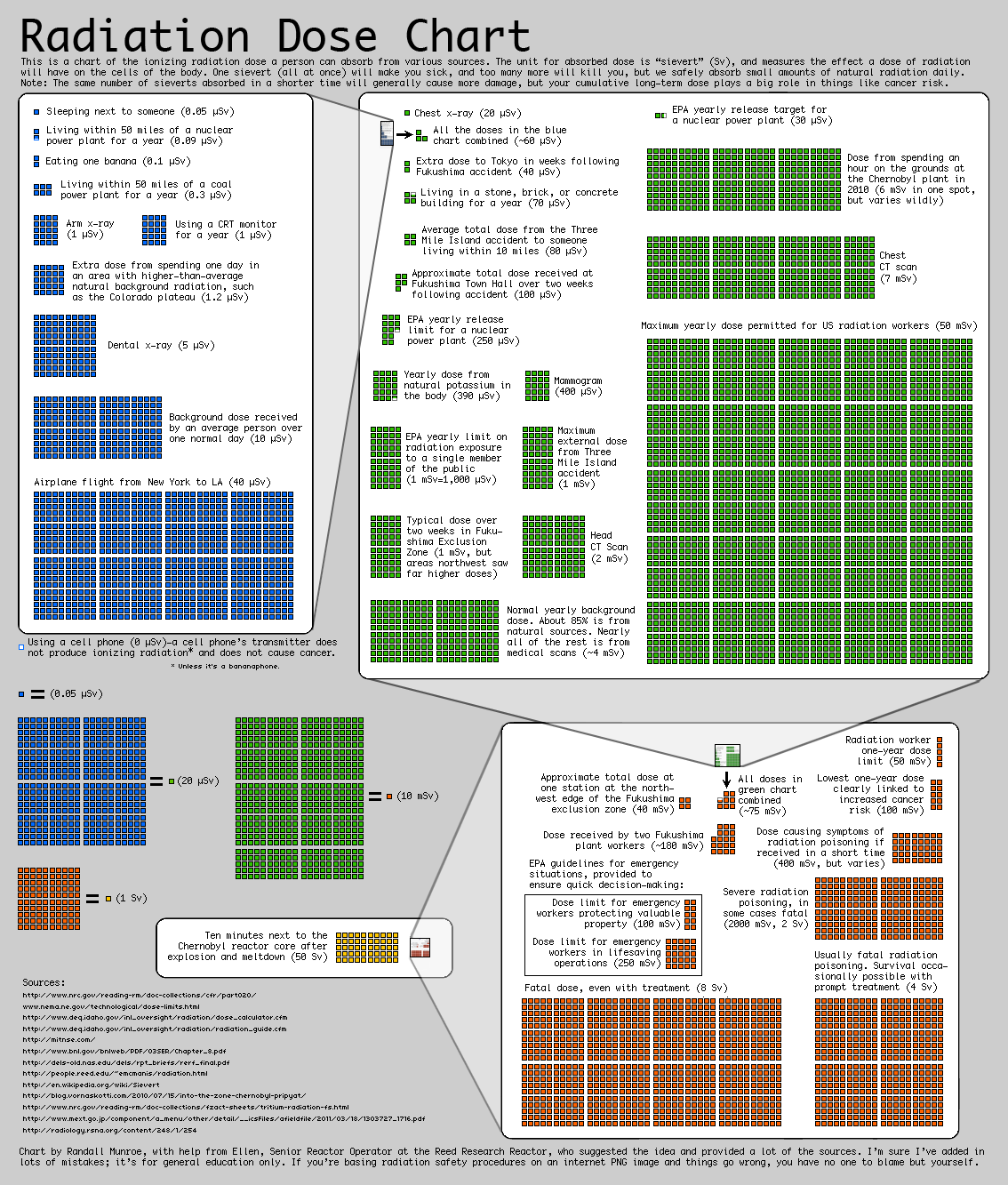
XKCD put together a chart that shows in geometric terms how various radiation doses work. With a tip of the pen to Bob Parks, the chart notes that cell phones don’t count here because cell phones don’t put out ionizing radiation, the type that causes cancer, but just radio waves.

The chart won’t be easy to read here — click on the image and go to the XKCD site for a bigger, more readable image:

Radiation Dose Chart from XKCD

Radiation Dose Chart from XKCD

It’s a good, clear graphic in its full size.  Go see.


World Blog – The race to contain drug-resistant malaria

January 23, 2011

NBC News’s World Blog carried a series on malaria and fighting it around the world.  Here’s part I:

PAILIN, Cambodia – The border crossing between Thailand and Cambodia at Pailin has a rather bleak feel about it at the best of times. In the heavy monsoon rain, the dingy checkpoints are reduced to gray smudges.

Vodpod videos no longer available.

World Blog – The race to contain drug-resistant…, posted with vodpod


See more video information from NBC, here.


President’s Malaria Initiative: Plans for FY 2011

December 14, 2010

Barack Obama continued George W. Bush’s Africa-oriented fight against malaria.  The President’s Malaria Initiative (PMI)continues to target malaria for control and, if possible, eradication.

PMI announced today plans for work in 2011, country by country:

Malaria Operational Plans for Fiscal Year 2011

These Malaria Operational Plans have been endorsed by the U.S. Global Malaria Coordinator and reflect collaborative discussions with the national malaria control programs and partners in country. If any further changes are made to these plans, it will be reflected in revised postings.

How long before some wag complains that Obama’s program is anti-Africa because it doesn’t propose enough poisoning of the place?  “Not enough DDT!” they will complain, I wager.  And, for the record, I make this prediction not having read any of the country operational plans — in nearly complete ignorance of what the plans actually propose.  Can you find “enough” DDT in any country’s plan?

More: