Quote of the moment: Calvin Coolidge, on building America: “Look to service, not selfishness”

March 3, 2015

Calvin Coolidge, 30th president of the United States (elected vice president in 1920, and succeeding to the presidency upon the death of Warren G. Harding).  History.com image

Calvin Coolidge, 30th president of the United States (elected vice president in 1920, and succeeding to the presidency upon the death of Warren G. Harding). History.com image

Referring to progress in the U.S. after World War I, Coolidge said:

With peace has come prosperity. Burdens have been great, but the strength to bear them has been greater. The condition of those who toil is higher, better, more secure than in all the ages past. Out of the darkness of a great conflict has appeared the vision, nearer, clearer than ever before, of a life on earth less and less under the deadening restraint of force, more and more under the vitalizing influence of reason. Moral power has been triumphing over physical power. With peace has come prosperity. Burdens have been great, but the strength to bear them has been greater. The condition of those who toil is higher, better, more secure than in all the ages past. Out of the darkness of a great conflict has appeared the vision of a nearer, clearer than ever before, the  [of] life on earth less and less under the deadening restraint of force, more and more under the vitalizing influence of reason. Moral power has been triumphing over physical power. Education will tend to bring reason and experience of the past into the solution of the problems of the future. We must look to service and not selfishness, for service is the foundation of progress. The greatest lesson that we have to learn is to seek ever the public welfare, to build up, to maintain our American heritage.

Candidate for vice president Calvin Coolidge, “America and the War,” 1920

Digging a little deeper, I discover that the first part of this quote also appeared in Coolidge’s Thanksgiving Proclamation on November 27, 1919, when he was  Governor of Massachusetts.  Knowing a good turn of words when he wrote it (I’m assuming he didn’t have ghost writers then), he used the same words in making phonograph recordings of speeches to be distributed in the election campaign of 1920, before radio was available to carry speeches to voters.  I have made minor corrections in the transcript, from the earlier text and the audio delivery.

According to Talking History, the 78 rpm record and audio version were saved and made available by the Library of Congress.

You may want to listen to Coolidge say the words himself. Mp3  RealPlayer


Quote of the moment: FDR on government shutdowns

February 24, 2015

One wag, who didn’t want to discuss things after all, referred me to President Franklin Roosevelt’s message to the National Federal of Federal Employees (NFFE), of August 16, 1937 (from the American Presidency Project at the University of California – Santa Barbara (UCSB)).  The wag asked me to confess that FDR was anti-union, and that Wisconsin Gov. Scott “Ahab” Walker had acted in Roosevelt’s path in Walker’s assaults on the unions of policemen, firefighters and teachers in Wisconsin.

I demurred, and pointed out instead that Walker went after the unions despite their having NOT struck, that Walker refused to bargain in good faith, or bargain at all.  I pointed out that Walker had failed in his duty, in the view of FDR.

President Franklin Delano Roosevelt

President Franklin Delano Roosevelt, in 1936 (Checking to see whether, when and where FDR said that; Robert Reich says he did.)

It’s a good way to send wags packing on Twitter, I’ve learned.  They don’t like to read or think, and they certainly don’t want anyone pointing out that they may have misinterpreted something. Anything.

NFFE had invited Roosevelt to speak at their Twentieth Jubilee Convention; Roosevelt sent a letter declining the invitation. In declining, Roosevelt noted he opposed strikes by government employees.  No doubt there is more history there that deserves our attention.  We can get to it later.

Here’s the meat of FDR’s letter:

Particularly, I want to emphasize my conviction that militant tactics have no place in the functions of any organization of Government employees. Upon employees in the Federal service rests the obligation to serve the whole people, whose interests and welfare require orderliness and continuity in the conduct of Government activities. This obligation is paramount. Since their own services have to do with the functioning of the Government, a strike of public employees manifests nothing less than an intent on their part to prevent or obstruct the operations of Government until their demands are satisfied. Such action, looking toward the paralysis of Government by those who have sworn to support it, is unthinkable and intolerable. It is, therefore, with a feeling of gratification that I have noted in the constitution of the National Federation of Federal Employees the provision that “under no circumstances shall this Federation engage in or support strikes against the United States Government.”

What do you think Roosevelt would have made of the current and last “do nothing” GOP blocs in Congress?  (Or should we say “blocks?”)

Doesn’t this describe Republicans in Congress today?

” . . . intent on their part to prevent or obstruct the operations of government until their demands are satisfied. Such action, looking toward the paralysis of Government by those who have sworn to support it, is unthinkable and intolerable.”

Is it too much to ask Republicans in Congress to be at least as loyal to the U.S. as the unionized government employees who pledged not to shut down the government?

More:


Quote of the moment: Gen. Patton’s oddly non-profane explanation of profanity

February 18, 2015

Lt. Gen. George Patton with the signal corps, July 11th 1943, Sicily. (General George Patton Museum) - See more at: http://ww2today.com/10th-august-1943-general-george-s-patton-slaps-another-soldier#sthash.dVuHaPeg.dpuf

Lt. Gen. George Patton with the signal corps, July 11th 1943, Sicily. (General George Patton Museum) – See more at: http://ww2today.com/10th-august-1943-general-george-s-patton-slaps-another-soldier#sthash.dVuHaPeg.dpuf

  • When I want my men to remember something important, to really make it stick, I give it to them double dirty. It may not sound nice to some bunch of little old ladies at an afternoon tea party, but it helps my soldiers to remember. You can’t run an army without profanity; and it has to be eloquent profanity. An army without profanity couldn’t fight its way out of a piss-soaked paper bag. … As for the types of comments I make, sometimes I just, By God, get carried away with my own eloquence.
    • Remark to his nephew about his copious profanity, quoted in “The Unknown Patton” (1983) by Charles M. Province, p. 184 (here, via Wikiquote)

One:

One glorious summer, after a couple of months of Scouting, I signed on to do air pollution research for several weeks in the field, in and around Farmington, New Mexico.  Hours were long, and the driving between sampling sites was more than 120 miles a day, between Farmington and Teec Nos Pos, Arizona.  Driving through the desert, passing the Shiprock every day, is rough duty, but somebody had to do it.

My mother’s brother, Harry Stewart, lived in Farmington.  Weekends I was royally dined and liquored, and got the opportunity to meet Uncle Harry’s friends, who included C. M. Woodbury, then city manager of Farmington.  Woodbury’s exploits on the golf course provided constant entertainment.  His opinions about having to measure air pollution from the Four Corners Power Plant and the then-under-construction San Juan Generating Station gave me great insight into local views on regional and national issues, as the Clean Air Act wended its way through Congress.

Woodbury had been an aide of some sort to General George Patton in Europe, as I understood it.  Sadly, I never did get back to Farmington to debrief him in detail about World War II, a loss of information that still stings from time to time.  I think he was with the 752nd Tank BattalionWoodbury retired in 1976.

The movie, Patton, still played in theaters, and one Sunday, over dinner, conversation turned to great leadership and whether I thought Patton was such a leader.  I hadn’t seen the movie.  I didn’t know much about Patton.  I asked what a definition of a good leader might be.  Uncle Harry and Woodbury settled on this criterion:  A good leader is someone whose followers will go to hell and back for her, or him.  Why did Patton inspire that sort of followership, I asked.

Woodbury rambled on about Patton getting gasoline for his tanks and trucks on a run through German lines that became legendary, and was portrayed in the movie.  He talked about how Patton’s troops always could count on a good, warm meal when they got a break from battle.  He talked about how proud every soldier was to be a part of that unit under Patton’s command.  He stopped, his eyes welled up and a tear, or maybe more, rolled down his cheek.

“We would have gone to hell for Patton because we knew he would have gone to hell for us. And he did.”

William Manchester once noted that, in battle, soldiers don’t die for great causes.  They fight to defend and save the friend to the right and the friend to the left.

It would have been interesting to know Patton.

Two:

We moved to Texas in 1987. Texas is a culture shock, I think, regardless where one comes from, even sometimes if one comes from Texas.  We moved directly from Cheverly, Maryland, outside of Washington, D.C.

Describing the conservative, goody-two-shoes aspects of Texas culture of that time can’t be done in shorthand.  A couple of examples:  Duncanville at the time had about 35,000 residents, and 44 churches.  Bordering Duncanville were three or five megachurches, among the largest in the nation, which drew heavily from Duncanville residents.  It was rare to meet someone who wouldn’t ask early in any conversation, “And where do you go to church?” A great, personal and close relationship to Jesus is expected to be a feature of any “normal” person’s life in Texas.  The day I drove out of Utah, I remember thinking as I rose above the fog heading up Parley’s Canyon that I would probably never again live in a place where it was so difficult to get a drink with dinner.  Then we moved to Texas.  On the surface, and often below the surface, Texans worked hard (and still do) to demonstrate that they are straighter than Mormons, and blessed because of their lack of sinning.  We don’t need to get into the ironies and incongruities of country music, Dallas culture and other now-well-identified sins of the Bible Belt.

Let’s just say, profanity was not something one publicly assented to.

I came down here to work with American Airlines, which was headed at the time by Robert Crandall.  Crandall’s use of profanity was legendary among AA executives and workers — executives, especially.  Crandall ran a tight operation with high expectations of worker achievement, especially in competition with other airlines.  “Competitive anger,” Crandall called it — and he expected all employees to demonstrate that, in appropriate, customer-serving, money-making ways.  Failures were noted, and often enough one might expect to be in a meeting with Crandall where an explanation of how and why things went wrong would be cut off with an expletive-filled dressing down that both made the victim subject understand the nature and severity of the error and pledge never to make that nor any other error ever again.

Talking about these events later, witnesses almost never said anything about the profanity.  Living in Texas where profanity was thought to make even strong men faint and swoon, Crandall’s expletives were considered instead indications of the importance of his thought, and speech, and markers that he was to be listened to.  I remember one young MBA rattled by the profanity; he left the company within a few weeks, and he wasn’t even the subject of the discussion.  But among others, especially successful managers and executives, discussion of content of meetings focused on the subject of the meetings, what was said about that subject, with unconscious excising of the profanity.

One famous meeting involved cutting costs, and the subject was security for a warehouse in San Juan, Puerto Rico.  Complaints about the cost for security the previous year led the local manager to beef up fences, get rid of the security company, and get dogs to roam the area at night.  Crandall pushed harder, and discussion turned to whether it would be even cheaper than dog food to get a sound system that would randomly play the sounds of big, vicious dogs’ barking instead.  I wasn’t in that meeting, but I heard several different accounts, all of them noting the boss’s exploration of options others might not think of, and how hard it was to please him — but not one story that included any comment about profanity, which I learned had laced the entire episode and probably made it memorable to everyone within earshot. And so they’d retell it. A remarkable piece of effective corporate communication.

How does one gauge when and whether profanity is necessary, or effective, in communication?

In one project, we videotaped Crandall talking on company issues and what he expected in the leaders the company hired as managers.  In several hours of video, I don’t recall a single time we had to retape, or edit, any profanity out.  Crandall turned off the profanity when it might pose a problem.  People who know him outside the company often express surprise that he’d ever use such language.

I sometimes wondered if Crandall was a reincarnation of Patton in at least some small way.  But Crandall was born in 1935, and Patton died in 1945.  Reincarnation is not the answer.

More:


December 1, 1955: “Why do you push us around?” Rosa Parks asked the cop. (Anyone know the answer?)

December 1, 2014

Mrs. Rosa Parks asked a question of the policeman who arrested her for refusing to move to the back of the bus. In 2014, it’s a chilling question, to which we have no good answer.

Rosa Parks being fingerprinted, Library of Congress

Mrs. Parks being fingerprinted in Montgomery, Alabama; photo from New York World-Telegram & Sun Collection, Library of Congress

Rosa Parks: “Why do you push us around?”

Officer: “I don’t know but the law is the law and you’re under arrest.”

From Rosa Parks with Gregory J. Reed, Quiet Strength
(Grand Rapids, MI: Zondervan Pub. House, 1994), page 23.

Photo: Mrs. Parks being fingerprinted in Montgomery, Alabama; photo from New York World-Telegram & Sun Collection, Library of Congress

Today in History at the Library of Congress provides the simple facts:

On the evening of December 1, 1955, Rosa Parks, an African American, was arrested for disobeying an Alabama law requiring black passengers to relinquish seats to white passengers when the bus was full. Blacks were also required to sit at the back of the bus. Her arrest sparked a 381-day boycott of the Montgomery bus system and led to a 1956 Supreme Court decision banning segregation on public transportation.

Rosa Parks made a nearly perfect subject for a protest on racism. College-educated, trained in peaceful protest at the famous Highlander Folk School, Parks was known as a peaceful and respected person. The sight of such a proper woman being arrested and jailed would provide a schocking image to most Americans. Americans jolted awake.

Often lost in the retelling of the story are the threads that tie together the events of the civil rights movement through the 1940s, 1950s and 1960s. As noted, Parks was a trained civil rights activist. Such training in peaceful and nonviolent protest provided a moral power to the movement probably unattainable any other way. Parks’ arrest was not planned, however. Parks wrote that as she sat on the bus, she was thinking of the tragedy of Emmet Till, the young African American man from Chicago, brutally murdered in Mississippi early in 1955. She was thinking that someone had to take a stand for civil rights, at about the time the bus driver told her to move to allow a white man to take her seat. To take a stand, she kept her seat.

African Americans in Montgomery organized a boycott of the Montgomery bus system. This was also not unique, but earlier bus boycotts are unremembered. A bus boycott in Baton Rouge, Louisiana, earlier in 1955 did not produce nearly the same results.

The boycott organizers needed a place to meet, a large hall. The biggest building in town with such a room was the Dexter Street Baptist Church. At the first meeting on December 5, it made sense to make the pastor of that church the focal point of the boycott organizing, and so the fresh, young pastor, Rev. Dr. Martin Luther King, Jr., was thrust into civil rights organizing as president, with Ralph Abernathy as program director. They called their group the Montgomery Improvement Association (MIA). When their organizing stretched beyond the city limits of Montgomery, the group became the Southern Christian Leadership Conference.

Litigation on the boycott went all the way to the Supreme Court (Browder v. Gale). The boycotters won. The 381-day boycott was ended on December 21, 1956, with the desegregation of the Montgomery bus system.

Sources for lesson plans and projects:

Yes, this is mostly an encore post.  Fighting ignorance requires patience.

Yes, this is mostly an encore post. Fighting ignorance requires patience.


Tip of the old scrub brush to Slacktivist, who gave this post a nice plug.


Quote of the moment: Judge Richard Posner, on tradition and marriage

August 27, 2014

Judge Richard Posner, 7th Circuit, U.S. Court of Appeals

Judge Richard Posner, 7th Circuit, U.S. Court of Appeals

“It was tradition to not allow blacks and whites to marry — a tradition that got swept away.”

Federal appeals court Judge Richard Posner, balking when Wisconsin Assistant Attorney General Timothy Samuelson repeatedly pointed to “tradition” as the underlying justification for barring gay marriage.

Two states attorneys general argued before a panel of judges on the 7th U.S. Circuit Court of Appeals in Chicago yesterday that marriage between members of the same gender should be stopped because of tradition.  AP’s story explains what happened.

While judges often play devil’s advocate during oral arguments, the panel’s often-blistering questions for the defenders of the same-sex marriage bans could be a signal the laws may be in trouble — at least at this step in the legal process.

Richard Posner, who was appointed by President Ronald Reagan in 1981, hit the backers of the ban the hardest. He balked when Wisconsin Assistant Attorney General Timothy Samuelson repeatedly pointed to “tradition” as the underlying justification for barring gay marriage.

“It was tradition to not allow blacks and whites to marry — a tradition that got swept away,” the 75-year-old judge said. Prohibition of same-sex marriage, Posner said, derives from “a tradition of hate … and savage discrimination” of homosexuals.

Posner is one of those guys who gives us hope for the human race, and hope especially for that branch of the human race known as Homo americanus ssp. ordinarius.

Appointed to the bench by Ronald Reagan, Posner is widely recognized as one of the brightest and most engaging judges in the U.S. today.  That’s a sop to all the rest, to call him “one of ” the brightest — to avoid making everybody else give up hope.

But he’s outspoken enough that most legal scholars agree he’d never survive a hearing to take a place on the U.S. Supreme Court.  The late Sen. Roman Hruska’s revenge, that we can’t get the best and the brightest on our highest court.

Posner is not content to sit on the bench and make high pronouncements.  He pushes America, courts and lawyers, to be better.  He teaches at the University of Chicago Law School (in a position not unlike that the young Barack Obama had).  Posner’s high-flying comment-on-anything-important style got cut back in the past few months when his blogging partner died — Nobel-winning economist Gary S. Becker.

It must be agony to be a lawyer defending a pointless, silly and destructive law, to a panel that includes Richard Posner.

Arun With a View captured the reasons Posner strikes fear in conservatives, despite his being a Ronald Reagan conservative.

Sketch of Judge Richard Posner by the late David Levine

Sketch of Judge Richard Posner by the late David Levine

NPR has a delicious interview with Richard Posner. Money quote

“I’ve become less conservative since the Republican Party started becoming goofy,” [Posner] said.

And this

“Because if you put [yourself] in [John Roberts’] position … what’s he supposed to think? That he finds his allies to be a bunch of crackpots? Does that help the conservative movement? I mean, what would you do if you were Roberts? All the sudden you find out that the people you thought were your friends have turned against you, they despise you, they mistreat you, they leak to the press. What do you do? Do you become more conservative? Or do you say, ‘What am I doing with this crowd of lunatics?’ Right? Maybe you have to re-examine your position.”

Listen to it here and enjoy.

Tip of the old scrub brush to Texas Freedom Network’s emails — probably on the blog sometime soon.

Yes, I read Posner despite his errors, getting hoaxed by the DDT/Rachel Carson hoaxsters. That just indicates the danger of the hoax and the need to correct it and stamp it out.

More:


Quote of the moment: Frankfurter, on due process

July 9, 2014

Supreme Court Justice Felix Frankfurter, The Collection of the Supreme Court of the United States (Artist: Gardener Cox).  Born Vienna, Austria, 1894. Died 1965.

Supreme Court Justice Felix Frankfurter, The Collection of the Supreme Court of the United States (Artist: Gardener Cox). Born Vienna, Austria, 1894. Died 1965. Associate Justice, 1939-1962

It is now the settled doctrine of this Court that the Due Process Clause embodies a system of rights based on moral principles so deeply imbedded in the traditions and feelings of our people as to be deemed fundamental to a civilized society as conceived by our whole history. Due Process is that which comports with the deepest notions of what is fair and right and just.

♦  Justice Felix Franfurter, dissenting in
Solesbee v. Balkcom, 339 U.S. 9, 16 (1950)


John Adams’s greatest error

July 2, 2014

“The Second Day of July 1776 will be the most memorable Epocha, in the History of America. . . . It ought to be solemnized with Pomp and Parade, with Shews, Games, Sports, Guns, Bells, Bonfires, and Illuminations from one End of this Continent to the other from this Time forward forever more.”
John Adams to Abigail Adams, July 3, 1776

In writing to his wife Abigail on July 3, John Adams committed one of those grand errors even he would laugh at afterward.  We’ll forgive him when the fireworks start firing.

1776 filled the calendar with dates deserving of remembrance and even celebration. John Adams, delegate from Massachusetts to the Second Continental Congress, wrote home to his wife Abigail that future generations would celebrate July 2, the date the Congress voted to approve Richard Henry Lee’s resolution declaring independence from Britain for 13 of the British colonies in America.

Continental congress DSC_0607

Scene of the crime — Independence Hall in Philadelphia, where the Second Continental congress approved the resolution to declare the colonies independent from Britain – (Photo credit: diablodale)

Two days later, that same Congress approved the wording of the document Thomas Jefferson had drafted to announce Lee’s resolution to the world.

Today, we celebrate the date of the document Jefferson wrote, and Richard Henry Lee is often a reduced to a footnote, if not erased from history altogether.

Who can predict the future?

(You know, of course, that Adams and Jefferson both died 50 years to the day after the Declaration of Independence, on July 4, 1826. In the 50 intervening years, Adams and Jefferson were comrades in arms and diplomacy in Europe, officers of the new government in America, opposing candidates for the presidency, President and Vice President, ex-President and President, bitter enemies, then long-distance friends writing almost daily about how to make a great new nation. Read David McCullough‘s version of the story, if you can find it.)

(Yes, this is mostly an encore post.)

More, and Related articles:

The Lee Resolution.

The Lee Resolution, passed by the Second Continental Congress on July 2, 1776 – Wikipedia image (Wait a minute: Are those numbers added correctly? What are they?)


Quote of the Moment: John Kennedy, June 26, 1963 (51 years ago)

June 26, 2014

Rare color photograph of President John Kennedy addressing a crowd in the then-divided city of Berlin, June 26, 1963

Rare color photograph of President John Kennedy addressing a crowd in the then-divided city of Berlin, June 26, 1963

On the day the U.S. and Germany meet in Brazil in the World Cup, let us remember the ties that bind our nations together, including especially the memorable speech of  U.S. President John F. Kennedy on this day, in Berlin, in 1963.

From the Smithsonian Magazine site:

June 26, 1963: “Ich bin ein Berliner”

In West Berlin, President John F. Kennedy delivers the famous speech in which he declares, “Ich bin ein Berliner.” Meaning literally “I am a citizen of Berlin,” the statement shows U.S. solidarity with democratic West Berlin, surrounded by communist territory.

View a video of President Kennedy’s speech at American Rhetoric, Top 100 Speeches.

Kennedy’s entire speech was good. It was well drafted and well delivered, taking advantage of the dramatic setting and the dramatic moment. John Kennedy well understood how to give a speech, too.

Below is most of the speech, nearly five minutes’ worth, from a YouTube file — another indication that schools need to open up their filters to allow at least some of the best YouTube material through:

You may also want to note these posts:

German government photo and caption: The masses that greeted Kennedy in front of the West Berlin City Hall and throughout the city were jubilant. (© Press and Information Office of the Federal Government; Steiner)

German government photo and caption: The masses that greeted Kennedy in front of the West Berlin City Hall and throughout the city were jubilant. (© Press and Information Office of the Federal Government; Steiner)

This is an encore post.

This is an encore post.


Photo of the moment: India brilliantly demonstrating the error of Mao Zedong

May 12, 2014

You remember the quote, don’t you?

Every Communist must grasp the truth; “Political power grows out of the barrel of a gun.”

Mao Zedong, “Problems of War and Strategy” (November 6, 1938), Selected Works, Vol. II, p. 224.

Here is the 21st century response from India:

A man shows off his finger, marked with ink, to show he's voted in India's elections, 2014.   WSJ image

A man shows off his finger, marked with ink, to show he’s voted in India’s elections, 2014. WSJ Tweet: India’s weeks-long federal elections come to a close. Photos from the polling place: http://trib.al/SekkQd2 (EPA)

In a democratic regime, political power grows from the finger that rings the doorbell or dials the phone to invite a neighbor to vote, and to that same finger marking the ballot in the voting place.  In the 21st century, democratic revolutions are slower, cause less bloodshed, but are more deeply rooted in the will of the people, and last longer in the deep reforms they bring to a nation.

The finger is mightier than the gun.

Mao is dead.  Even his nation turns towards capitalism, and eventually, to personal political freedom.

O, Tempora! O, Mores!

To which I would add (hoping I get the grammar correct!):  Novae viae veteres malis eius conterendos.  Spes et patientia superare tyrannidis.  (New ways crush the old bad habits. Hope and determination overcome tyranny.)

Afterthought:   When Malcolm X preached “The Ballot or the Bullet,” he advocated the ballot. He knew.


Quote goof of the moment: Tom Paine didn’t say that; Edward Abbey did.

May 7, 2014

Oy.  You’d hope that the Rabid Right would learn after a few dozen of these errors that they should try to verify stuff before they claim events of history, or sayings of famous people are gospel — especially stuff involving our patriotic founders.

But, no.

Sometimes their failure to check sources can produce amusement, though, like this one which they misattribute to Tom Paine in propaganda supporting rent scofflaw Cliven Bundy and other land management issues:

Tom Paine didn't say that. Ed Abbey said it.

Tom Paine didn’t say that. Ed Abbey said it.

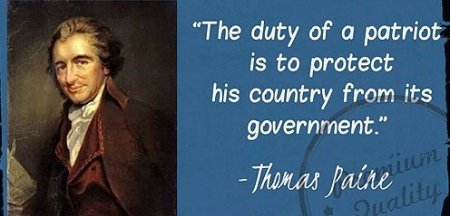
“The duty of a patriot is to protect his country from its government.”

Someone mildly familiar with Tom Paine and his life and other writings might suspect the supposed attribution from the start.  Paine was a great advocate of governments to protect the rights of citizens, especially citizens like him, who were often on the outs with popular opinion and avoided the Guillotine in France and mob violence in the U.S. only through interventions of government officials who told mobs the law did not cotton their wishes to see violence on Mr. Paine.

Wikiquote notes Paine didn’t say it.  A simple check would have found that.

But other sites claim it was written by Edward Abbey, the author of Desert Solitaire and The Monkeywrench Gang.

“A patriot must always be ready to defend his country against his government.”

— Edward Abbey, A Voice Crying in the Wilderness (Vox Clamantis en Deserto) : Notes from a Secret Journal (1990) ISBN 0312064888

Why is that delicious?

The quote — the image above, for example — is being used by pro-militia groups who have defended Cliven Bundy’s trespassing on public lands in Nevada, and by Texans who, upset that they don’t have such a good target as massive Bureau of Land Management (BLM) holdings in Texas, have ginned up a faux controversy, claiming falsely that BLM is seeking to seize lands in Texas.

Edward Abbey?  He didn’t much like BLM, and he was particularly ticked off at the Bureau of Reclamation and the imposition of Glen Canyon Dam on the Colorado River with the drowning of Glen Canyon.  Abbey’s disdain of federal land managers and grand dam schemes may have been exceeded only by his contempt for developers, miners and ranchers who took advantage of the desert for profit.

Would Abbey have supported Bundy’s overgrazing on public lands, or Texas Republicans scrambling to make a false issue to mismanage lands?  Oy.  Oy.  And oy.

See this brilliant poster at Americans Who Tell The Truth:

From Americans who Tell the Truth, Edward Abbey.

From Americans who Tell the Truth, Edward Abbey. Writer, ‘Desert Anarchist’ : 1927 – 1989 “The most common form of terrorism in the U.S.A. is that carried on by bulldozers and chainsaws. It is not enough to understand the natural world; the point is to defend and preserve it. Sentiment without action is the ruin of the soul.”

Wall of Fame (people and sites who got the cite right):

Wall of Shame (people and sites who got the cite wrong):

Save


Gun nuts twisting the words of President Kennedy

May 4, 2014

Here’s the full text of President Kennedy’s statement on President Franklin D. Roosevelt’s birthday in 1961, urging Americans to join Kennedy in making things better, including enlisting in the military, from the Kennedy Library [links added here]:

January 29, 1961

This year, the celebrations of Roosevelt Day has special significance for Democrats everywhere; for we celebrate not only the triumphs of the past but the opportunities of the future.

Twenty-eight years ago Franklin Roosevelt assumed the leadership of a stricken and demoralized nation. Poverty, distress and economic stagnation blanketed the land. But it was not long before the great creative energies of the New Deal had lifted American from its despair and set us on the path to new heights of prosperity, power and greatness.

Today America is the richest nation in the history of the world. Our power and influence extend around the globe. Yet the challenges and dangers which confront us are even more awesome and difficult than those that face Roosevelt. And we too will need to summon all the energies of our people and the capacities of our leaders if America is to remain a great and free nations — if we are to master the opportunities of the New Frontier.

The dimensions of out problems overwhelm the imagination. At home millions are unemployed and the growth of our economy has come to a virtual halt. Abroad, we are faced with powerful and unrelenting pressure which threaten freedom in every corner of the globe, and with military power so formidable that it menaces the physical survival of our own nation.

To meet these problems will require the efforts not only of our leaders or of the Democratic Party–but the combined efforts of all of our people.; No one has a right to feel that, having entrusted the tasks of government to new leaders in Washington, he can continue to pursue his private comforts unconcerned with American’s challenges and dangers. For, if freedom is to survive and prosper, it will require the sacrifice, the effort and the thoughtful attention of every citizen.

In my own native state of Massachusetts, the battle for American freedom was begun by the thousands of farmers and tradesmen who made up the Minute Men — citizens who were ready to defend their liberty at a moment’s notice. Today we need a nation of minute men; citizens who are not only prepared to take up arms, but citizens who regard the preservation of freedom as a basic purpose of their daily life and who are willing to consciously work and sacrifice for that freedom. The cause of liberty, the cause of American, cannot succeed with any lesser effort.

It is this effort and concern which makes up the New Frontier. And it is this effort and concern which will determine the success or failure not only with Administration, but of our nation itself. [emphasis added]

Source: White House Central Subject Files, Box 111, “FDR”.

Other Information Sources:

“Know your Lawmakers,” Guns Magazine, April 1960.
Letter to President John F. Kennedy from the NRA,” [NRAcentral.com].
“New Minute Men Urged by Kennedy,” The New York Times, 30 January, 1961, pg. 13.
“Kennedy Says U.S. Needs Minute Men,” Los Angeles Times, 30 January, 1961, pg. 4.
“Minutemen’s Soft-Sell Leader: Robert B. DePugh,” The New York Times, 12 November 1961, pg. 76.

It seems to me that Kennedy was not asking yahoos to take up arms against the government, but was instead asking Americans to “ask not what your country can do for you; ask what you can do for your country.”  Specifically in the last paragraph, he noted his call was to join in the New Frontier efforts his administration pushed.
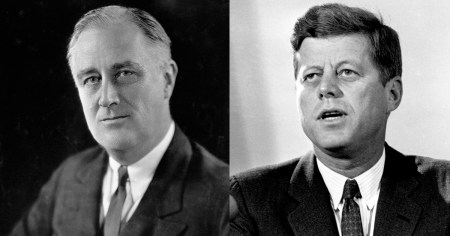
FDR, left, and JFK: Kennedy took the opportunity of Roosevelt's birth anniversary in 1961, January 29, to urge Americans to volunteer to serve the nation, to serve as the Minutemen did, voluntarily, where the nation needs help, and in support of the nation. Image from Ring of Fire Network

FDR, left, and JFK: Kennedy took the opportunity of Roosevelt’s birth anniversary in 1961, January 29, to urge Americans to volunteer to serve the nation, to serve as the Minutemen did, voluntarily, where the nation needs help, and in support of the nation. Image from Ring of Fire Network

If you’re not much a student of history, you may have forgotten about Kennedy’s New Frontier.  As presidents before him, with the Square Deal (Teddy Roosevelt, 1904), the New Deal (FDR, 1933), and the Fair Deal (Truman, 1949), Kennedy sought a shorthand term to apply to much of his program of changes.  In his speech accepting the nomination of the Democratic Party to run for president, he called this a New Frontier.

For I stand tonight facing west on what was once the last frontier. From the lands that stretch three thousand miles behind me, the pioneers of old gave up their safety, their comfort and sometimes their lives to build a new world here in the West. They were not the captives of their own doubts, the prisoners of their own price tags. Their motto was not “every man for himself” –but “all for the common cause.” They were determined to make that new world strong and free, to overcome its hazards and its hardships, to conquer the enemies that threatened from without and within.

Today some would say that those struggles are all over–that all the horizons have been explored–that all the battles have been won– that there is no longer an American frontier.

But I trust that no one in this vast assemblage will agree with those sentiments. For the problems are not all solved and the battles are not all won–and we stand today on the edge of a New Frontier–the frontier of the 1960’s–a frontier of unknown opportunities and perils– a frontier of unfulfilled hopes and threats.
[emphasis added]

Woodrow Wilson’s New Freedom promised our nation a new political and economic framework. Franklin Roosevelt’s New Deal promised security and succor to those in need. But the New Frontier of which I speak is not a set of promises–it is a set of challenges. It sums up not what I intend to offer the American people, but what I intend to ask of them. It appeals to their pride, not to their pocketbook–it holds out the promise of more sacrifice instead of more security.

But I tell you the New Frontier is here, whether we seek it or not. Beyond that frontier are the uncharted areas of science and space, unsolved problems of peace and war, unconquered pockets of ignorance and prejudice, unanswered questions of poverty and surplus. It would be easier to shrink back from that frontier, to look to the safe mediocrity of the past, to be lulled by good intentions and high rhetoric–and those who prefer that course should not cast their votes for me, regardless of party.

But I believe the times demand new invention, innovation, imagination, decision. I am asking each of you to be pioneers on that New Frontier. My call is to the young in heart, regardless of age–to all who respond to the Scriptural call: “Be strong and of a good courage; be not afraid, neither be thou dismayed.”

For courage–not complacency–is our need today–leadership–not salesmanship. And the only valid test of leadership is the ability to lead, and lead vigorously. A tired nation, said David Lloyd George, is a Tory nation–and the United States today cannot afford to be either tired or Tory.

Kennedy famously challenged Americans to stand up for service to the nation in his inaugural speech, and when he founded the Peace Corps, asking Americans to give up two or three years to work, peacefully, in other lands to promote progress there. Kennedy called Americans to share his vision, and to work for change, for a better America.

What were specifics of the New Frontier agenda?   Kennedy pushed a broad range of programs, many turned into laws in his brief term; Kennedy aimed to change America in economics, taxation, labor, education, welfare, civil rights, housing, unemployment, health, equal rights for women, environment, agriculture, crime and defense.   In each of these areas Kennedy sought to build on the legacies of Franklin D. Roosevelt and Harry Truman — in ways that conservatives today become apoplectic just thinking about.

Kennedy pushed for a higher minimum wage with built-in step increases over time not keyed to inflation.  He called for more taxcuts for the poor, coupled with targeted tax incentives to get businesses to spend their cash to create jobs.  Kennedy favored changes in law to give unions greater say in corporate expansion, tougher protection for workers from firing, and he extended collective bargaining to federal workers.  Kennedy called for expansion of federally-funded loans and scholarships for college students, and he started a program to use federal money to put technology into classrooms at the elementary and secondary levels.  Kennedy expanded unemployment and welfare benefits, and got a 20% increase in Social Security benefits.

Kennedy’s New Frontier called for sweeping changes in the way government protects the rights and welfare of all citizens.

Did Kennedy actually call for armed militias to fight government “over-reach” or expansion?

What do you think?  When a proponent of getting guns to protect himself against the U.S. government, by killing agents of the U.S. government (we must imagine), cites a part of Kennedy’s statement from 1961 as supporting arming individual citizens, is he being honest?

Please tell us what you think, in comments. Your opinion counts.

Poster from Americanfirearms.org; the quoate from Kennedy is accurate, but did Kennedy mean what this group wants us to think it means?

Poster from Americanfirearms.org; the quote from Kennedy is accurate, but did Kennedy mean what this group wants us to think it means?

Kennedy appears to have been fond of the image of the Minutemen at Lexington and Concord, trained militia from citizen volunteers, who started the path to American independence from Britain.  He invoked that image earlier, as senator from Massachusetts, in a speech honoring the Polish hero Casimir Pulaski, at a Pulaski Day Dinner in Milwaukee, Wisconsin on October 17, 1959:

We pay tribute to Casimir Pulaski tonight by honoring a great American of Polish descent, Clem Zablocki.  For he has demonstrated, in Washington and Wisconsin, the same courage and conscience, the same zeal for liberty, the same tireless patience and determination to help all who call for help.  He is a great Congressman – not only from Wisconsin – but of the United States . . .

But we also think of Casimir Pulaski tonight because his beloved Poland has once again fallen victim to a foreign power.  The independence for which he fought against the Russians at Czestochowa has been once again suppressed – and once again by the Russians.  Were he alive tonight, the hero of Savannah and Charleston would weep for his homeland – and we, inwardly or outwardly according to our custom, weep with him.

But weeping is not enough.  We know it is not enough.  And yet, while we give vent to our feelings of resentment and outrage, we are also caught up in a feeling of frustration.  What can we do about the situation in the satellites?  How can we help those liberty-loving peoples regain their liberty, without subjecting them to even more cruel repression – or subjecting the world to an even more disastrous war?  How can we let them know their fate is not forgotten – that we have not abandoned them to be – like the Irish of 1647 considered themselves when Owen Roe O’Neill was poisoned – “sheep without a shepherd when the snow shuts out the sky?”

This is the dilemma we face, as both last month and next year the President and Premier Khrushchev are pictured together in the press on both sides of the Iron Curtain.  And this is the dilemma with which this Administration has been confronted, in trying to make good on its tarnished promises of a new “liberation” policy.  For this is no longer an age when minutemen with muskets can make a revolution.  Hungary, we know, is not Cuba – and neither is Poland.  Mr. Khrushchev is not to be overthrown like Mr. Batista.  Brave bands of young men and women may be able to stop a few tanks – but street barricades and home-made hand grenades cannot long stand against a modern army and an atomic air force. [emphasis added]

The facts of the matter are that – no matter how bitter some feelings may be, or how confident some are of a victorious war for liberation – freedom behind the Iron Curtain and world peace are actually inextricably linked.  For if war should ever break out, the control and occupation of Eastern Europe would certainly be even more rigid and repressive than it is today.  That is why, in the days of upheaval in 1956, when Poland could have turned to violent rebellion as Hungary did, Cardinal Wyszynski kept advising his people that the condition of Polish freedom was peace.  Many scoffed – many thought him faint-hearted.  But by following his advice, Poland has now attained at least a measure of national independence and at least a relaxation of Communist rule.  Forced collectivization of the farmers has ceased and most of the collectives were dissolved – religious freedom has been restored in considerable degree – and freedom of speech is returning.

No one says that land of ancient freedom is once more free again.  But if Poland had not accepted this half-way house to freedom, it could have been, as Prime Minister Gomulka warned, wiped off the map of Europe.  If the present emphasis on a thaw in the Cold War should end and tensions rise again, the present good relations between Poland and the United States would undoubtedly cease, the growing contacts between the Polish people and the West would be cut off, and the present degree of freedom of speech and religion in Poland would prove to be short-lived.  On the other hand, if a real thaw develops and Soviet-American relations improve, the prospects for the continuation and perhaps the expansion of this limited degree of Polish freedom are good.  So, in a real sense, the condition for Polish freedom is peace.
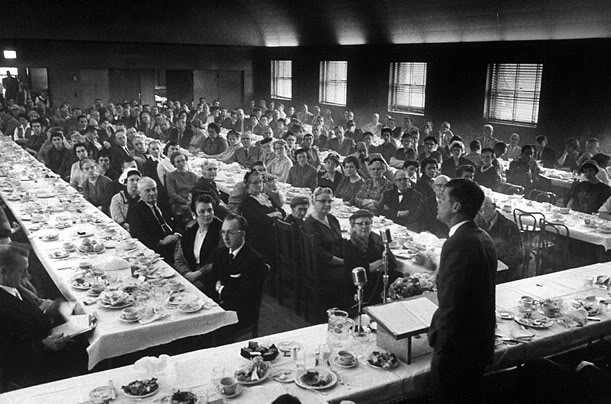
President Kennedy addressing a Wisconsin group during the 1960 presidential campaign.  (Do you have more details?)

President Kennedy addressing a Wisconsin group during the 1960 presidential campaign. (Do you have more details?) Photo by Robert W. Kelley//Time Life Pictures/Getty Images

One does not get the sense that President Kennedy was urging citizens to establish their own arsenals, contrary to the actions of the Minutemen at Lexington and Concord, nor to take up arms against the U.S. government.

Who would suggest that’s what Kennedy meant?  Oh, yeah:  AmericanFirearms.org.

More:

Page one of a speech text then-Sen. John Kennedy delivered regarding why America arms, on March 9, 1960, in Mauston, Wisconsin. JFK Library image

Page one of a speech text then-Sen. John Kennedy delivered regarding why America arms, on March 9, 1960, in Mauston, Wisconsin. JFK Library image


Quote of the moment: Education is knowing what you know, and what you don’t

March 31, 2014

Commenter Robert Lopresti mentioned a book assembled at the Library of Congress, to assist Members of Congress in creating speeches on important issues, with accurate quotes in accurate context: Respectfully Quoted: A Dictionary of Quotations.

One might wonder if anyone in Congress even knows the book exists.

You can buy the book, at Amazon, or from the Library of Congress Gift Shop, and Bartleby has it online (public domain already?).

My first use of the online version, I looked for education, and found this from William Feather (1889-1981), describing  just what “an education” is:

An education isn’t how much you have committed to memory, or even how much you know. It’s being able to differentiate between what you do know and what you don’t. It’s knowing where to go to find out what you need to know; and it’s knowing how to use the information you get.

When and where did Feather say that?  Things get murky — according to the list at the Library of Congress:

Publisher and writer William Feather, photo by William Feather III

Publisher and writer William Feather, photo by William Feather III. Can we trust a bon mot attributed to such a jovial and scholarly looking fellow?

Attributed to WILLIAM FEATHER.—August Kerber, Quotable Quotes on Education, p. 17 (1968). Unverified.

An honest assessment that we don’t know for certain that Feather said exactly that. This book could be a valuable resource!

Who the heck was William Feather?

William A. Feather (August 25, 1889 – January 7, 1981) was an American publisher and author, based in Cleveland, Ohio.

Born in Jamestown, New York, Feather relocated with his family to Cleveland in 1903. After earning a degree from Western Reserve University in 1910, he began working as a reporter for the Cleveland Press. In 1916, he established the William Feather Magazine.[1] In addition to writing for and publishing that magazine, and writing for other magazines as H.L. Mencken‘s The American Mercury, he ran a successful printing business, and wrote several books.[2]

Feather’s definition appeals to me.  Educated people know where to find the facts they need, and they know when it’s important to search for those facts, rather than stand on ignorance.

Compare it with the Hubbard/Rogers advice, that it’s what we know “that ain’t so” that gets us into trouble.

How could any test, ever test for that?


What exactly did Thomas Edison say about the theory of relativity?

March 29, 2014

Need some scholarly help here.  I worry that what I want isn’t available in print, and perhaps not at all on the internet.

Thomas Edison at 80, in 1927

Thomas Edison at 80, in 1927; from Edison After 40: Edison’s career coincided with the widespread use of photography. During his lifetime he sat several times for professional portrait photographers. In addition, most of the time there was a photographer at the laboratory, recording the historic course of events.

Remember the old “Garry Moore Show?”  In the farming and  not-quite-suburban towns where I spent my first 18 years, Garry  Moore was a popular guy.  Today he might be remembered as the variety show host who pushed to get Carol Burnett on television, and helped her early career.  In his own right, he was a television staple — MC for daytime quiz shows, night-time quiz shows, and a couple of variety programs that entertained those of us living in what was then the greater American community, but is today too often mislabeled as “fly-over land.”

Garry Moore, Carol Burnett, and Durward Kirby, in a publicity still photo from 1961's

Garry Moore, Carol Burnett, and Durward Kirby, in a publicity still photo from 1961’s “Garry Moore Show.” Wikipedia

In one of his variety programs (probably called “The Garry Moore Show”) he featured a weekly pirouette through history using old photos and old films, “That Wonderful, Wonderful Year.”  In that time before home VCRs, historical films were difficult and expensive to come by (some still are).  These vignette and skit views into history were often unique.  Hey, it was an entertainment show.

(That’s a long set-up.)

One of those history romps featured a film interview with Thomas Edison, in his 80s.  I recall it was on the event of Edison’s 86th birthday, but don’t hold me to that — especially since he didn’t live to 86 (1847-1931; this is a demonstration of the faults of memory, especially mine).

The interviewer asked Edison, the inventor and practical applicator of chemistry and physics, what he thought of new science, specifically, Albert Einstein’s theory of relativity.  Edison’s answer was direct, honest and startling — so much so that I wrote it down on a long-lost notepad.

‘I don’t think anything of Einstein’s theory of relativity,’ Edison said, ‘because I don’t understand it.’

Can you help me track down exactly what Edison said about relativity, and where and when?


Smoking out the bogus: Martin Porter’s “Four Principles of a Quotation”

March 25, 2014

Commenter SBH put me on to this interesting set of principles from a mathematician, on bogus quotes, and how to determine that they are bogus, and most important, how to avoid creating a bogus quote by stripping context or altering the text.

‘After all, a study I once read said something like 86% of all statistics cited in speeches are made up on the spot.’*

I looked up Martin Porter.  What are his principles of quotations?  Who is he, and why should we listen to him?

Mathematician Martin Porter, in the 21st century.

Mathematician Martin Porter, in the 21st century. Self portrait.

Turns out he’s a mathematician who works in algorithms to study language, and a founder of Grapeshot.  Along the way, he grew intrigued with trying to source a very famous quotation attributed to Edmund Burke (confess, you don’t really know enough about Burke to describe who he was, or why that quote might not be his, right? See Porter’s last principle).

Porter wrote an interesting essay about the experience, and about the wide abuse of the real Burke quote and what he’d learned.

At the end of the essay, he posed principles for quotations, two involving how we might hold the necessary skepticism that helps smoke out quotes that are bogus for one reason or another.

The other two, I confess, sometimes are difficult to follow.  One of my favorite statements from George Santayana, in the upper right corner of this blog, stands out of context (he wasn’t writing about history, really), nor have I read the entire book.  Porter proposes very high standards indeed: It’s not enough that the quote be accurately phrased and attributed appropriately to its creator; Porter wants the quote to be used in a similar context.  In his essay on the Burke quote, he notes Burke was talking of factions, but when Ronald Reagan used it, even getting the phrasing right, Reagan used it to talk about arming nations.  Porter suggests such a usage can lead us awry.

Edmund Burke (1729-1797), Irish statesman, author, orator, political theorist and philosopher, who, after moving to England, served for many years in the House of Commons of Great Britain as a member of the Whig party. No, not the same Whig Party that produced Millard Fillmore in America.

Edmund Burke (1729-1797), Irish statesman, author, orator, political theorist and philosopher, who, after moving to England, served for many years in the House of Commons of Great Britain as a member of the Whig party. No, not the same Whig Party that produced Millard Fillmore in America.

Porter is right, of course.

2014 is a federal election year.  Here in Texas we also have municipal elections in May — a lot of opportunities, to vote, a lot of campaigning, and a in that campaigning a stunning wealth of opportunities for people to misattribute quotes, or to invent whole new inappropriate contexts, twists, and diversions to accurate understanding.

We should heed Martin Porter better, perhaps.

Martin Porter’s four Principles for Quotations:

I therefore formulate and offer to the world the following Principles for Quotations, two for quoters and two for readers, which, if universally followed, would make an immense improvement to the reliability of the information available on the world wide web.

Principle 1 (for readers)
Whenever you see a quotation given with an author but no source assume that it is probably bogus.
Principle 2 (for readers)
Whenever you see a quotation given with a full source assume that it is probably being misused, unless you find good evidence that the quoter has read it in the source.
Principle 3 (for quoters)
Whenever you make a quotation, give the exact source.
Principle 4 (for quoters)
Only quote from works that you have read.

* You knew that one was bogus. Right?

More:

Save

Save


Quote of the moment: Darwin, on confidence begotten by ignorance

February 12, 2014

Italian panel depicting Charles Darwin, created ca. 1890, on display at the Turin Museum of Human Anatomy. Wikimedia image

Italian panel depicting Charles Darwin, created ca. 1890, on display at the Turin Museum of Human Anatomy. Wikimedia image.  Darwin sits contemplating two of his works, title in Italian, Origin of Species (1859), and Descent of Man (Origin of Man), 1871

How could I have forgotten this wonderful passage from Darwin?

Maria Popova’s Literary Jukebox reminded me today.

Ignorance more frequently begets confidence than does knowledge: it is those who know little, and not those who know much, who so positively assert that this or that problem will never be solved by science.

— Charles Darwin, Descent of Man; Introduction, p. 2.

Today was the 205th anniversary of Darwin’s birth.

Faithful readers of this blog may recognize Darwin’s thought as very close to a description of the Dunning Kruger Effect, as indeed it is.  How many others, through the years, recognized the phenomenon, and commented on it, before Dunning and Kruger gave it scientific heft?

The quote attributed to Darwin is edited just a tiny bit from his actual statement, though without loss of effect.  Darwin, ever the hard science stickler, had limited his statement much more.  In the introduction to Descent of Man, Darwin wrote:

This work contains hardly any original facts in regard to man; but as the conclusions at which I arrived, after drawing up a rough draft, appeared to me interesting, I thought that they might interest others. It has often and confidently been asserted, that man’s origin can never be known: but ignorance more frequently begets confidence than does knowledge: it is those who know little, and not those who know much, who so positively assert that this or that problem will never be solved by science. The conclusion that man is the co-descendant with other species of some ancient, lower, and extinct form, is not in any degree new.

Any way the knowledge is sliced, creationists are cock-sure they’re right, when they are most solidly in the wrong.

More: