The frequently quotable Oliver Wendell Holmes, Jr., circa 1930. Edited photograph from the Library of Congress Prints and Photographs Division. Original photo by Harris & Ewing. LC-USZ62-47817. Copyright expired.
I like paying taxes. With them I buy civilization.
Justice Oliver Wendell Holmes, Jr., attributed. (see Felix Frankfurter, Mr. Justice Holmes and the Supreme Court, Harvard University Press, 1961, page 71.)
I found reference to the quote in a book about eminent economists, through Google Scholar:
Eminent Economists: Their Life Philosophies
By Michael Szenberg
Published by Cambridge University Press, 1993
320 pages
On page 201, Szenberg refers Holmes’s view of “taxation as the price of liberty.” In a footnote, he points to Justice Frankfurter’s book. The quote is dolled up a little. According to Szenberg’s footnote:
More precisely, he rebuked a secretary’s query of “Don’t you hate to pay taxes?” with “No, young fellow, I like paying taxes, with them I buy civilization.”
Frankfurter is a reliable source. It’s likely Holmes said something very close to the words Friedman used.
Lord Bertrand Russell in a BBC Radio studio,circa 1940 – BBC Radio 4 image
The trouble with the world
is that the stupid are cocksure
and the intelligent
are full of doubt.
– Bertrand Russell, The Triumph of Stupidity in Mortals and Others: Bertrand Russell’s American Essays, 1931-1935 (Routledge, 1998), p. 28
With these words Russell stated, in 1935, a phenomenon observed and chronicled by Justin Kruger and David Dunning, in research at Cornell University, published in 1999 in the Journal of Personality and Social Psychology. “Unskilled and unaware of it: How difficulties in recognizing one’s own incompetence lead to inflated self-assessments” reported on research they had conducted on subjects at Cornell. The effect they observed is generally called, after them, the Dunning-Kruger Effect. According to the abstract:
People tend to hold overly favorable views of their abilities in many social and intellectual domains. The authors suggest that this overestimation occurs, in part, because people who are unskilled in these domains suffer a dual burden: Not only do these people reach erroneous conclusions and make unfortunate choices, but their incompetence robs them of the metacognitive ability to realize it. Across 4 studies, the authors found that participants scoring in the bottom quartile on tests of humor, grammar, and logic grossly overestimated their test performance and ability. Although their test scores put them in the 12th percentile, they estimated themselves to be in the 62nd. Several analyses linked this miscalibration to deficits in metacognitive skill, or the capacity to distinguish accuracy from error. Paradoxically, improving the skills of the participants, and thus increasing their metacognitive competence, helped them recognize the limitations of their abilities. (PsycINFO Database Record (c) 2009 APA, all rights reserved)
In other words,
Incompetent individuals tend to overestimate their own level of skill.
Incompetent individuals fail to recognize genuine skill in others.
Incompetent individuals fail to recognize the extremity of their inadequacy.
If they can be trained to substantially improve their own skill level, these individuals can recognize and acknowledge their own previous lack of skill.
Thus, the Dunning-Kruger effect explains the existence and arguments of creationists, climate change denialists, Tea Baggers and birthers, and the actions of the right-wing historical revisionist faction of the Texas State Board of Education, and provides Monty Python’s Flying Circus with volumes of new material each month, should they ever care to revive the program.
First they came for the communists, and I did not speak out—because I was not a communist;
Then they came for the trade unionists, and I did not speak out—because I was not a trade unionist;
Then they came for the Jews, and I did not speak out—because I was not a Jew;
Then they came for me—and there was no one left to speak out for me.
— Pastor Martin Niemöller
German theologian and Lutheran Pastor Martin Niemöller on a postage stamp, painted by Gerd Aretz in 1992 – Wikipedia
It’s spring, and school curricula turn to the Holocaust, in English, in world history, and in U.S. history.
Martin Niemöller’s poem registers powerfully for most people — often people do not remember exactly who said it. I have seen it attributed to Deitrich Bonhoeffer (who worked with Niemöller in opposing some Nazi programs), Albert Einstein, Reinhold Niebuhr, Albert Schweitzer, Elie Wiesel, and an “anonymous inmate in a concentration camp.”
Niemöller and his actions generate controversy — did he ever act forcefully enough? Did his actions atone for his earlier inactions? Could anything ever atone for not having seen through Hitler and opposing Naziism from the start? For those discussion reasons, I think it’s important to keep the poem attributed to Niemöller. The facts of his life, his times, and his creation of this poem, go beyond anything anyone could make up. The real story sheds light.
It’s just such a brilliant question about technology, human communication and history, that I had to make it into it’s own post.
In response to this post about Edith Wharton’s extensive writings and what she’d have done today with e-mail, Mark posted the comment:
Who remembers Paul’s tweet to the Romans?
Helluva question. What does your Sunday school class say? What does your literature professor say? What does your history teacher say? Send ’em a tweet and see.
Illustration from The Adventures of Huckleberry Finn, 1884 edition - the King, "Travelling by Rail" - Wikimedia. (The "King" is being tarred, feathered, and "ridden out of town on a rail.")
Well, the king he talked him blind; so at last he give in, and said all right, but said he believed it was blamed foolishness to stay, and that doctor hanging over them.
But the king says: “Cuss the doctor! What do we k’yer for HIM? Hain’t we got all the fools in town on our side? And ain’t that a big enough majority in any town?”
Robert F. Kennedy speech at the University of Kansas, Lawrence, March 18, 1968 - Photo by George Silk, Time-Life Pictures/Getty Images
RFK said this in 1968. In a speech I heard today it was quoted and it stirred me.
Too much and for too long, we seem to have surrendered personal excellence and community value in the mere accumulation of material things. Our Gross National Product, now, is over eight hundred billion dollars a year, but that GNP — if we judge the United States of America by that — that GNP counts air pollution and cigarette advertising and ambulances to clear our highways of carnage. It counts special locks for our doors and the jails for the people who break them. It counts the destruction of the redwoods and the loss of our natural wonder in chaotic sprawl. It counts napalm and it counts nuclear warheads, and armored cars for the police to fight the riots in our cities. It counts Whitman’s rifle and Speck’s knife, and the television programs which glorify violence in order to sell toys to our children.
Yet the Gross National Product does not allow for the health of our children, the quality of their education, or the joy of their play. It does not include the beauty of our poetry or the strength of our marriages, the intelligence of our public debate or the integrity of our public officials. It measures neither our wit nor our courage, neither our wisdom nor our learning, neither our compassion nor our devotion to our country; it measures everything, in short, except that which makes life worthwhile. And it can tell us everything about America except why we are proud that we are Americans.
Kennedy delivered these words in an address at the University of Kansas, Lawrence, Kansas, on March 18, 1968.
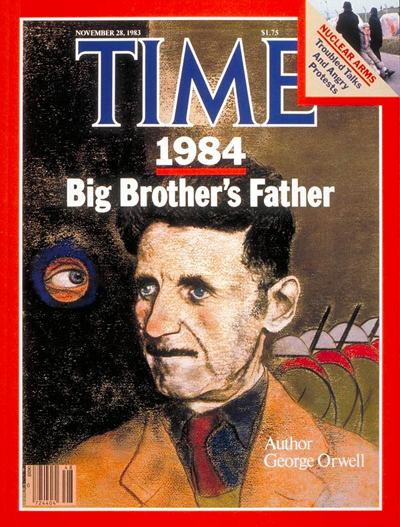
George Orwell (Eric Blair) on cover of Time Magazine, Novmber 28, 1983
And if all others accepted the lie which the Party imposed—if all records told the same tale—then the lie passed into history and became truth. ‘Who controls the past’ ran the Party slogan, ‘controls the future: who controls the present controls the past.’
This digitally-colorized scanning electron micrograph (SEM) revealed some of the ultrastructural morphology displayed on the ventral surface of a bedbug, Cimex lectularius. From this view you can see the insect’s skin piercing mouthparts it uses to obtain its blood meal, as well as a number of its six jointed legs. (Photo credit: Wikipedia)
Then the Malaysians started to complain about bedbugs, and it turns out what normally happens is that ants like to eat bedbug larvae,” McWilson Warren said. “But the ants were being killed by the DDT and the bedbugs weren’t — they were pretty resistant to it. So now you had a bedbug problem.”
He served longer in the U.S. Senate than all but five other people. His legislative history on civil rights alone maks him one of the top four or five legislators ever to serve in America — and that ignores his legislation on voting, health care, labor issues, environment, and other places.
There will be tributes to Kennedy over the next few days. Electronic media being what it is, there will be too many jeers of Kennedy, too.
And someday, long after this convention, long after the signs come down and the crowds stop cheering, and the bands stop playing, may it be said of our campaign that we kept the faith.
May it be said of our Party in 1980 that we found our faith again.
And may it be said of us, both in dark passages and in bright days, in the words of Tennyson that my brothers quoted and loved, and that have special meaning for me now:
“I am a part of all that I have met
To [Tho] much is taken, much abides
That which we are, we are —
One equal temper of heroic hearts
Strong in will
To strive, to seek, to find, and not to yield.”
For me, a few hours ago, this campaign came to an end.
For all those whose cares have been our concern, the work goes on, the cause endures, the hope still lives, and the dream shall never die.
We can hope. We do hope.
Conservatives appear to love to criticize the man. They are jealous that they had no one like him to carry their banner.
Daniel Boorstin, Librarian of Congress, Information Bulletin January 2003
According to several sources, Daniel Boorstin, the late historian and former Librarian of Congress, wrote:
I have observed that the world has suffered far less from ignorance than from pretensions to knowledge. It is not skeptics or explorers but fanatics and ideologues who menace decency and progress. No agnostic ever burned anyone at the stake or tortured a pagan, a heretic, or an unbeliever.
Does anyone know in what book or essay, or speech, he wrote or said that, and when?
Spread the word; friends don't allow friends to repeat history.
Kathryn sings with the Arlington Master Chorale. Last week they performed for the Texas Choir Directors Association Convention in San Antonio. Randy Jordan leads and directs the group.
Before the San Antonio performance, they sang the program at St. Marks Episcopal Church in Arlington, a beautifully spare performance space suited well to a hundred good, mature voices.
Joan Szymko‘s “It Takes A Village” made a stunning and rousing finale for the concert. The piece opens with the choir tapping their chests for a heartbeat rhythm, which by itself stirs an audience when performed by so many. It features a simple melody and lyric, though inspiring when done en masse or with a good solo.
And it packs an integral political message. The text is that same phrase that became a watershed between conservatives and liberals in the 1990s.
It takes a whole village to raise the children.
It takes the whole village to raise one child.
We all — everyone — must share the burden.
We all — everyone — will share the joy.
Some music is best experienced live, and this may be one. There are several recordings of this piece available on YouTube, not one done so well as the Arlington Master Chorale last week in my opinion (the choir directors loved it, too, I hear).
Here are two performances of the piece, each done very differently from the other. Until some enterprising group makes a more polished and better recorded video of the Arlington group, these will have to do (there are other versions on YouTube).
It is particularly spine-tingling to hear and see it performed by our children. When sung with gusto, the thought transcends and soars over politics. Song tells truths of the heart that politics needs to hear, and feel, and experience.
The Oklahoma All-State Choir
Oklahoma All-State Choir
Performed by the 2009 All-OMEA Mixed Chorus (Oklahoma All-State Choir).
Clinician: Johnathan Reed
Accompanist: Ron Wallace
Mt. Eden, Tennyson High and Hayward High Honor Choir at Chabot College (California)
Are there good, commercially-available recordings of this song? Please note them in comments. If you are a commercial music producer, I recommend the Arlington Master Chorale’s performance for recording.
Spread the word; friends don't allow friends to repeat history.
Soldiers, Sailors, and Airmen of the Allied Expeditionary Force: You are about to embark upon the Great Crusade, toward which we have striven these many months. The eyes of the world are upon you.
Senate Majority Leader Mike Mansfield, oil on canvas painting by Aaron Shikler, 1978 - Wikimedia image
Beginning in March 1974 I had the great pleasure and high honor of interning with the Secretary of the Senate, Francis R. Valeo. Valeo served because of his close relationship with the Majority Leader, Mike Mansfield, and working in Valeo’s office put one on the Mansfield team. In an era before serious security with magnetometers in Washington’s public buildings — we didn’t even have photo identification cards then — Mike Mansfield’s signature on my staff card got me anywhere I wanted to go in Washington, including the White House.
People who knew Mansfield held him in very high regard. I often tell people he was the best politician to work for, but in reality, he’s probably the best leader I ever worked with in any enterprise. He respected every senator as a representative of the people of one of the 50 states, and that respect was returned.
In his office one afternoon he met with the a couple of members of the Joint Chiefs of Staff, the big bigwigs from the Pentagon. Mansfield was a former sailor, marine and soldier — he had served in the Navy, Army and Marines. He lied about his age the first time. He had served in China and the Philippines, producing a life-long interest and deep expertise in U.S. affairs in the Pacific and Far East.
But this was 1974. Mansfield had turned against supporting corrupt Vietnamese politicians early in the U.S. involvement in Vietnam. Originally a supporter of Nixon’s policies, by 1974 his opposition to the war was the chief part of their relationship. Still the military guys loved him. An Army Colonel accompanying the group was anxious to explain to the young intern part of the mystique.
“You should see Mansfield in the formal meetings. Everybody is always introduced, and their full rank is laid on the table. ‘General Muckamuck. West Point ’33, Columbia Law. Admiral Bigship. General Soandso, who recently got his third star.'”
“And then they get to Mansfield. He’s the Senate Majority Leader. And he introduces himself as ‘Mike Mansfield, Private First Class.'”
I asked Mansfield about it later. He smiled, and said he might have done that a time or two. He said that the big brass in the military need to remember as every senator does that they work for the American people. Rank doesn’t make you right, he said.
Looking up a minor fact on Mansfield this morning I ran into this statement, which I’d never heard [quoting now from Wikipedia]:
This gentleman went from snuffy to national and international prominence. And when he died in 2001, he was rightly buried in Arlington. If you want to visit his grave, don’t look for him near the “Kennedy Eternal Flame”, where so many politicians are laid to rest. Look for a small, common marker shared by the majority of our heroes. Look for the marker that says “Michael J. Mansfield, Pfc. U.S. Marine Corps.”
Remarks by Col. James Michael Lowe, USMC, October 20, 2004.
The burial plot of Senator and Mrs. Mansfield can be found in section 2, marker 49-69F of Arlington National Cemetery.
For the sake of accuracy, I would like to know the occasion of Col. Lowe’s remarks, and who Col. Lowe is. The link at Wikipedia is dead. Does anyone know?
Or, until that account is unsuspended by the forces supporting Donald Trump: Follow @FillmoreWhite, the account of the Millard Fillmore White House Library
We've been soaking in the Bathtub for several months, long enough that some of the links we've used have gone to the Great Internet in the Sky.
If you find a dead link, please leave a comment to that post, and tell us what link has expired.
Thanks!
Retired teacher of law, economics, history, AP government, psychology and science. Former speechwriter, press guy and legislative aide in U.S. Senate. Former Department of Education. Former airline real estate, telecom towers, Big 6 (that old!) consultant. Lab and field research in air pollution control.
My blog, Millard Fillmore's Bathtub, is a continuing experiment to test how to use blogs to improve and speed up learning processes for students, perhaps by making some of the courses actually interesting. It is a blog for teachers, to see if we can use blogs. It is for people interested in social studies and social studies education, to see if we can learn to get it right. It's a blog for science fans, to promote good science and good science policy. It's a blog for people interested in good government and how to achieve it.
BS in Mass Communication, University of Utah
Graduate study in Rhetoric and Speech Communication, University of Arizona
JD from the National Law Center, George Washington University


 Posted by Ed Darrell








 Millard Fillmore's Bathtub
