Wow.
Of course, C. S. Lewis was a Brit, and Britain is close to Europe — heck he’s almost a Frenchman, and Russian communists used to like to go to Paris. On one of those hooks, Obama bashers will hang their refusal to agree with Martin Bashir.
Wow.
Of course, C. S. Lewis was a Brit, and Britain is close to Europe — heck he’s almost a Frenchman, and Russian communists used to like to go to Paris. On one of those hooks, Obama bashers will hang their refusal to agree with Martin Bashir.
 3 Comments |
  2012 Campaigns, Barack Obama, Politics, Religion | Tagged: 2012 Campaign, Barack Obama, C. S. Lewis, Martin Bashir, Mitt Romney, Newt Gingrich, Politics, Religion, Rick Santorum |
  Permalink
 Posted by Ed Darrell
According to the Pew Forum on Religion and Public Life, 23.9% of American adults are Catholics. That translates to 68.5 million Americans, approximately
The GOP race seems to have come down to a Mormon and two Catholics.
How can it be that they got the two craziest Catholics in America to run for the GOP nomination? Surely they do not represent the best we could find among Catholics.
Did you see Rick Santorum yesterday, or today on Face the Nation? What makes him feel free to be that ill-informed and crazy? (No, the federal government does not run education in America.)
If we still made tinfoil hats in America, the economy would be booming, from either Santorum’s camp or Gingrich’s camp.
Update: Video from CBS is now available. Bask in the insanity:
More, Resources, and Related Articles from Zemanta:
73 Comments | 2012 Campaigns, 2012 Elections, Environment, Environmental protection, Politics, Religion, Republican Party | Tagged: Disabled, environment, Newt Gingrich, Politics, Religion, Republican Party, Rick Santorum | Permalink
Posted by Ed Darrell
Borrowed completely from ThinkProgress — I’m too flabbergasted to add more at the moment:
Alabama State Senator Thinks Increasing Teacher Pay Goes Against A ‘Biblical Principle’
By Amanda Peterson Beadle on Feb 1, 2012 at 2:15 pm
Tool for flogging teachers?
According to Alabama state Sen. Shadrack McGill (R), the Bible says that increasing teacher salaries would only lead to less-qualified teachers. McGill said at a prayer breakfast that doubling teachers’ salaries — starting pay for Alabama teachers begins at $36,144 — would not help education. In fact, he said that keeping teacher pay low is a “Biblical principle“:
“If you double a teacher’s pay scale, you’ll attract people who aren’t called to teach.
“To go in and raise someone’s child for eight hours a day, or many people’s children for eight hours a day, requires a calling. It better be a calling in your life. I know I wouldn’t want to do it, OK?
“And these teachers that are called to teach, regardless of the pay scale, they would teach. It’s just in them to do. It’s the ability that God give ‘em. And there are also some teachers, it wouldn’t matter how much you would pay them, they would still perform to the same capacity.
“If you don’t keep that in balance, you’re going to attract people who are not called, who don’t need to be teaching our children. So, everything has a balance.”
McGill found justification in the Bible for not increasing teacher pay, but he evidently found nothing in scripture preventing him from approving a 67 percent pay increase for legislators in 2007, which increased annual salaries for the part-time legislators from $30,710 to $49,500. He said that the higher pay helped to stop corruption.
A 2011 report showed that while Alabama teachers have the highest starting salaries in the nation, the state lags far behind the national average for teacher pay. Currently, a part-time legislator in Alabama is making more than a full-time teacher with a Master’s degree and 15 years of experience.
If we don’t increase teacher pay, we get less than the best for our children. Which should we sacrifice, our children, or this brain-dead legislator’s complete misinterpretation of the Bible?
Somebody help me out here: Where in scriptures is there any suggestion that teachers shouldn’t get fair pay for fair work?
These guys are making a mighty effort to prove that prayer breakfasts are dangerous, anti-social gatherings that should be avoided by patriotic Americans and legislators.
Related articles suggested by Zemanta:
5 Comments | Bible, Education, Religion, Teacher Pay | Tagged: Bible, Daily Floggings, Education, Rampant stupidity, Religion, Teacher Pay | Permalink
Posted by Ed Darrell
What, exactly, are the requirements to be elected to the New Jersey Hall of Fame?
Thomas Nast is the great cartoonist whose pen launched crippling blows to the institutions of corrupt politicians including Tammany Hall’s Boss Tweed. Nast generally gets the credit for inventing the symbols of the two major national parties, the donkey for the Democratic Party (or jackass, as in the first cartoon), and the elephant for the Republican Party, the party Nast favored.
Santa Claus’s commonly-accepted image owes a lot to Nast, who drew Santa Claus supporting the Union efforts in the Civil War. Between 1855 and 1900, Nast supported the winning cause in at least seven presidential elections, illustrated the effects of America’s industrialization and rise as a world power, fought political corruption and campaigned for equal legal rights for immigrants and ex-slaves.

Thomas Nast’s tribute to the Emancipation Proclamation in Harper’s Weekly, 1863 – University of Michigan, Clements Library image; click image for a larger version
Lady Liberty? Columbia? An invention of Nast. Nast’s image of Columbia was more than minor inspiration to the French friends of America who created the Statute of Liberty. New Jersey is guarded, literally, with one of Nast’s creations.
Through it all, he clung to biases that, amplified by 1870s and 1880s politics, some people find less-than-acceptable today. When Catholics raised money from Europe to establish schools in America so Catholic children would not undergo Protestant indoctrination, Nast sided with the public schools (and, perhaps, with the Protestants). When immigrants, whose rights he defended, blindly turned the control of their votes over to corrupt political machines, he depicted those immigrants as louts, thugs and oafs. On the issue of temperance, he sided with those who wanted to restrict alcoholic beverages, in opposition to German and Irish brewers and distillers.
Through it all, his pen brilliantly and clearly stated his positions, in images. Nast’s work inspired Edgar Degas and Vincent van Gogh.
What should we make of the late-to-the-table complaints about Nast’s induction into the New Jersey Hall of Fame? Opponents say Nast lampooned Catholics. True. Nast lampooned anyone whose policies he opposed.
Zeno presents a very good case that the opposition is wrong-headed, and ironic, coming from the voluble-and-usually obnoxious Bill Donohue of the Catholic League for Religious and Civil Rights (a self-proclaimed name that many people find inaccurate), a guy who might well be a target of Nast had Nast and Donohue occupied the same place in time. (Though I quote Zeno at length here, go to his site to read the full piece.)
It was a theme to which the cartoonist returned whenever he wanted to inveigh against Romish influence (the Church was on record in opposition to the separation of church and state) or Irish immigration (Nast had decidedly nativist tendencies). Today we can look at Nast’s cartoons and see them as over the top. In high dudgeon, however, Bill Donohue cannot help but demonstrate once again his unerring instinct for avoiding le mot juste in favor of the words least apt:
[H]e demonized bishops by portraying them as crocodiles with miters for jaws; and he also depicted them as emerging from slime while prowling towards children.
Really, Bill? You had to go there? Silly man.
You just depicted Thomas Nast as a prophet.
Nast’s work provides us with a conundrum. On one hand he ardently and fervently supported the Union against the Confederacy, especially with regard to emancipation of slaves. On the other hand Nast ideologically opposed the Democratic Party — perhaps an easy thing to do in those days when the Democratic Party was on record supporting slavery — and portrayed anyone with Democratic links as a beast or thug.
Should Nast’s biases against Catholics and Irishmen who unthinkingly gave their poll power to Boss Tweed disqualify Nast from a spot in New Jersey’s Hall of Fame?
Here is a list of people elected to the New Jersey Hall of Fame over the past four years:
CLASS OF 2008
Buzz Aldrin
Clara Barton
Yogi Berra
Bill Bradley
Thomas Edison
Albert Einstein
Malcolm Forbes
Robert Wood Johnson II
Vince Lombardi
Toni Morrison
Norman Schwarzkopf
Frank Sinatra
Bruce Springsteen
Meryl Streep
Harriet TubmanCLASS OF 2009
Bud Abbott & Lou Costello
F. Scott Fitzgerald
Althea Gibson
Jon Bon Jovi
Jerry Lewis
Guglielmo Marconi
Shaquille O’Neal
Phil Rizzuto
Paul Robeson
Carl Sagan
Walt Whitman
William Carlos WilliamsUnsung Hero:
Captain Brian BrennanCLASS OF 2010
Count Basie
Judy Blume
Justice William Brennan
Danny DeVito
Larry Doby
Michael Graves
Carl Lewis
Jack Nicholson
Alice Paul
Les Paul
Phillip Roth
Susan Sarandon
Wally Schirra
Frankie Valli
President Woodrow WilsonUnsung Heroes:
Marc DiNardo & James D’heronCLASS OF 2011
John Basilone
Tony Bennett
Governor Brendan Byrne
Mary Higgins Clark
Admiral William Halsey
Franco Harris
Leon Hess
Queen Latifah
Bucky Pizzarelli
Martha Stewart
Joe Theismann
John Travolta
Bruce WillisUnsung Heroes:
9/11 Victims & First Responders
Generally a well-deserving group of heroes, don’t you think?
Careful students of history may blanche a bit at one name there, in consideration of the flap against Nast. Woodrow Wilson had his own biases — he resegregated the White House as president. He opposed civil rights for African Americans. He invited the racist, pro-Ku Klux Klan movie, “Birth of a Nation,” into the White House and praised it for its accuracy and advocacy.
Wilson led the nation into World War I (after promising he would not), and he campaigned unsuccessfully for a peace treaty that might have prevented World War II, had he been listened to. Wilson campaigned to create an international peace-keeping organization, the League of Nations, an agency doomed to failure because the U.S. Senate rejected Wilson’s every imprecation to ratify the treaty that ended the Great War and created the agency.
Can Bill Donohue actually make a case that the great cartoonist, Thomas Nast, does not belong in a pantheon that includes Frank Sinatra, Bruce Willis, John Travolta, and ex-con Martha Stewart? Is Nast not at least as deserving as Woodrow Wilson, on the same grounds?
Nominations for the class of 2012 include Aaron Burr, the vice president candidate whose overweening ambition nearly derailed the nation’s Constitution in 1800, the man who shot Alexander Hamilton fatally, and a man who plotted the overthrow of the government of the U.S.
Nast is nominated in the “General” category. The others nominated there are Alexander Calder, Alfred Stieglitz, Charles Addams, Doris Duke, Dorothy Parker, Dorothy Porter Wesley, Joyce Carol Oates, Milton Friedman, and Gov. Tom Kean.
Uh, Bill? Did you see Milton Friedman there? Yeah, he was a great economist and he made popular television and book explanations of economics (that Republicans eschew today, to the detriment of free markets and political freedom) — but should he be there considering his work for the Pinochet regime in Chile? I mean, Bill, can we be consistent? Chile is a chiefly Catholic nation, you know, and surely the murders of 10,000 Catholics should weigh in here, shouldn’t it?
(New Jersey’s ability to produce such a body of notables is, itself, notable. Probably each of those people deserves commemoration in the New Jersey Hall of Fame. Second place, two spots in the New Jersey Hall of Fame.)
Is this really what Catholics are reduced to, today — a pointless, silly campaign against commemorating a great cartoonist? May we assume Donohue and the Catholic Church oppose Nast across the board, in Nast’s campaigns against corruption, his work against slavery and support for the Union, and his support of the rights for immigrants?
Perhaps Donohue should review the situation, like Fagin.
And you, Dear Reader, should go vote for Thomas Nast’s inclusion, warts and all.
More:
15 Comments | Cartoons, Civil War, History, Political cartoons, Politics, Racism, Religion | Tagged: Cartoons, History, New Jersey Hall of Fame, Political cartoons, Politics, Racism, Religion, Thomas Nast | Permalink
Posted by Ed Darrell
I get e-mail from Sara Maxwell, alerting me to the blog post by Dave Hershey.
Ouch.
Let Dave tell it; first he used a Fox video, to show what he’s talking about:
(via Stuff Christian Culture Likes)
What would Jesus say if he came to your house and had coffee with you?
That is the question asked at around 1:10 into this video. It is a decent question. What would Jesus say?
*“I miss hearing you say Merry Christmas”
*”And if anyone wants to sue you and take your shirt, hand over your coat as well. If anyone forces you to go one mile, go with them two miles.Give to the one who asks you, and do not turn away from the one who wants to borrow from you.”
*”I tell you, love your enemies and pray for those who persecute you”
*“Do not store up for yourselves treasures on earth, where moths and vermin destroy, and where thieves break in and steal. But store up for yourselves treasures in heaven, where moths and vermin do not destroy, and where thieves do not break in and steal. For where your treasure is, there your heart will be also.”
*“Whoever wants to be my disciple must deny themselves and take up their cross and follow me.”
*“The Spirit of the Lord is on me, because he has anointed me to proclaim good news to the poor. He has sent me to proclaim freedom for the prisoners and recovery of sight for the blind, to set the oppressed free, to proclaim the year of the Lord’s favor.”
*“You still lack one thing. Sell everything you have and give to the poor, and you will have treasure in heaven. Then come, follow me.”
*Isaiah was right when he prophesied about you:“‘These people honor me with their lips, but their hearts are far from me. They worship me in vain; their teachings are merely human rules.’
What would Jesus say to us?
Hint: all but the first choice are things Jesus actually did say to people (Matthew 5:41-42, 44; 6:19-21; 16:24; Luke 4:18-19; 18:21; Matthew 15:17-19).
When I read the gospels, I find Jesus’ words incredibly challenging. What he calls people to do is uncomfortable, to say the least. I am sure in the face of our insistence that people say “Merry Christmas” and our offense when people do not that he would challenge us Christians to sell our stuff or love our enemies or something we frankly would rather not do.
The ladies in the video say they are offended that people do not say Merry Christmas. Offended? By that?
Maybe we Christians should get offended by things that actually matter, things that are horrendous evils happening right now in the world, things like global poverty, human trafficking and modern-day slavery and so many others.
Maybe if instead of wasting money on billboards urging people to say “Merry Christmas” we used that money to help those who are really suffering, people would actually care to hear more about Jesus.
The prophet Amos also probably doesn’t care if you say “Merry Christmas”. I’ll end with his powerful words (Amos 5):
21 “I hate, I despise your religious festivals;
your assemblies are a stench to me.
22 Even though you bring me burnt offerings and grain offerings,
I will not accept them.
Though you bring choice fellowship offerings,
I will have no regard for them.
23 Away with the noise of your songs!
I will not listen to the music of your harps.
24 But let justice roll on like a river,
righteousness like a never-failing stream!
Have a good Christmas/Hanukkah/Solstice/KWANZAA/Festivus, anyway.
5 Comments | Religion, Religious Freedom | Tagged: Christmas, Religion, Religious Freedom | Permalink
Posted by Ed Darrell
Kate at The Radula wrote good thoughts on the imaginary, but still destructive, “War on Christmas”:
Perhaps, dear followers of Christ, there is no war on Christmas. Perhaps the war is on the world, a war that YOU are waging on other religions, other cultures, and those who have equal faith, and equal right to express their faith (or lack there-of). Perhaps you feel that even acknowledging that there are other ways to believe, (God help anyone who says “Happy Holidays”) is an attack on you, but isn’t acknowledging your holiday while acknowledging that there are others the loving and peaceful solution? Why does the Hindu, the Jew, the Muslim, the Atheist, HAVE to wish you a Merry Christmas, and ignore their own faiths and the faiths of others?
There’s more, and you can buy a nice t-shirt to give to your genius daughter or son, at Kate’s site. (Or maybe this shirt.)
2 Comments | Holidays, Religion | Tagged: Kate Dorid, Politics, Rampant stupidity, Religion, The Radula | Permalink
Posted by Ed Darrell
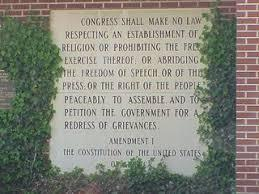
It’s engraved in stone. The First Amendment, at the entrance to the Bremen Public Library in Bremen, Indiana. The Bremen Public Library serves the citizens of German Township in Marshall County, Indiana. Photo from Bremen Library.
President Clinton directed the Secretary of Education and the Attorney General to inform each school district in America about the law on religious freedom in public schools. This was the law in 2000 when Clinton left office, and it still is the law. This statement is still accurate. [And if that site stays weird or doesn’t work for you, check it out here at the 5th Circuit U.S. Court of Appeals.]
UNITED STATES DEPARTMENT OF EDUCATION
THE SECRETARY
“…Schools do more than train children’s minds. They also help to nurture their souls by reinforcing the values they learn at home and in their communities. I believe that one of the best ways we can help out schools to do this is by supporting students’ rights to voluntarily practice their religious beliefs, including prayer in schools…. For more than 200 years, the First Amendment has protected our religious freedom and allowed many faiths to flourish in our homes, in our work place and in our schools. Clearly understood and sensibly applied, it works.”
President Clinton
May 30, 1998
Dear American Educator,
Almost three years ago, President Clinton directed me, as U.S. Secretary of Education, in consultation with the Attorney General, to provide every public school district in America with a statement of principles addressing the extent to which religious expression and activity are permitted in our public schools. In accordance with the President’s directive, I sent every school superintendent in the country guidelines on Religious Expression in Public Schools in August of 1995.
The purpose of promulgating these presidential guidelines was to end much of the confusion regarding religious expression in our nation’s public schools that had developed over more than thirty years since the U.S. Supreme Court decision in 1962 regarding state sponsored school prayer. I believe that these guidelines have helped school officials, teachers, students and parents find a new common ground on the important issue of religious freedom consistent with constitutional requirements.
In July of 1996, for example, the Saint Louis School Board adopted a district wide policy using these guidelines. While the school district had previously allowed certain religious activities, it had never spelled them out before, resulting in a lawsuit over the right of a student to pray before lunch in the cafeteria. The creation of a clearly defined policy using the guidelines allowed the school board and the family of the student to arrive at a mutually satisfactory settlement.
In a case decided last year in a United States District Court in Alabama, (Chandler v. James) involving student initiated prayer at school related events, the court instructed the DeKalb County School District to maintain for circulation in the library of each school a copy of the presidential guidelines.
The great advantage of the presidential guidelines, however, is that they allow school districts to avoid contentious disputes by developing a common understanding among students, teachers, parents and the broader community that the First Amendment does in fact provide ample room for religious expression by students while at the same time maintaining freedom from government sponsored religion.
The development and use of these presidential guidelines were not and are not isolated activities. Rather, these guidelines are part of an ongoing and growing effort by educators and America’s religious community to find a new common ground. In April of 1995, for example, thirty-five religious groups issued “Religion in the Public Schools: A Joint Statement of Current Law” that the Department drew from in developing its own guidelines. Following the release of the presidential guidelines, the National PTA and the Freedom Forum jointly published in 1996 “A Parent’s Guide to Religion in the Public Schools” which put the guidelines into an easily understandable question and answer format.
In the last two years, I have held three religious-education summits to inform faith communities and educators about the guidelines and to encourage continued dialogue and cooperation within constitutional limits. Many religious communities have contacted local schools and school systems to offer their assistance because of the clarity provided by the guidelines. The United Methodist Church has provided reading tutors to many schools, and Hadassah and the Women’s League for Conservative Judaism have both been extremely active in providing local schools with support for summer reading programs.
The guidelines we are releasing today are the same as originally issued in 1995, except that changes have been made in the sections on religious excusals and student garb to reflect the Supreme Court decision in Boerne v. Flores declaring the Religious Freedom Restoration Act unconstitutional as applied to actions of state and local governments.
These guidelines continue to reflect two basic and equally important obligations imposed on public school officials by the First Amendment. First, schools may not forbid students acting on their own from expressing their personal religious views or beliefs solely because they are of a religious nature. Schools may not discriminate against private religious expression by students, but must instead give students the same right to engage in religious activity and discussion as they have to engage in other comparable activity. Generally, this means that students may pray in a nondisruptive manner during the school day when they are not engaged in school activities and instruction, subject to the same rules of order that apply to other student speech.
At the same time, schools may not endorse religious activity or doctrine, nor may they coerce participation in religious activity. Among other things, of course, school administrators and teachers may not organize or encourage prayer exercises in the classroom. Teachers, coaches and other school officials who act as advisors to student groups must remain mindful that they cannot engage in or lead the religious activities of students.
And the right of religious expression in school does not include the right to have a “captive audience” listen, or to compel other students to participate. School officials should not permit student religious speech to turn into religious harassment aimed at a student or a small group of students. Students do not have the right to make repeated invitations to other students to participate in religious activity in the face of a request to stop.
The statement of principles set forth below derives from the First Amendment. Implementation of these principles, of course, will depend on specific factual contexts and will require careful consideration in particular cases.
In issuing these revised guidelines I encourage every school district to make sure that principals, teachers, students and parents are familiar with their content. To that end I offer three suggestions:
First, school districts should use these guidelines to revise or develop their own district wide policy regarding religious expression. In developing such a policy, school officials can engage parents, teachers, the various faith communities and the broader community in a positive dialogue to define a common ground that gives all parties the assurance that when questions do arise regarding religious expression the community is well prepared to apply these guidelines to specific cases. The Davis County School District in Farmington, Utah,is an example of a school district that has taken the affirmative step of developing such a policy.
At a time of increasing religious diversity in our country such a proactive step can help school districts create a framework of civility that reaffirms and strengthens the community consensus regarding religious liberty. School districts that do not make the effort to develop their own policy may find themselves unprepared for the intensity of the debate that can engage a community when positions harden around a live controversy involving religious expression in public schools.
Second, I encourage principals and administrators to take the additional step of making sure that teachers, so often on the front line of any dispute regarding religious expression, are fully informed about the guidelines. The Gwinnett County School system in Georgia, for example, begins every school year with workshops for teachers that include the distribution of these presidential guidelines. Our nation’s schools of education can also do their part by ensuring that prospective teachers are knowledgeable about religious expression in the classroom.
Third, I encourage schools to actively take steps to inform parents and students about religious expression in school using these guidelines. The Carter County School District in Elizabethton, Tennessee, included the subject of religious expression in a character education program that it developed in the fall of 1997. This effort included sending home to every parent a copy of the “Parent’s Guide to Religion in the Public Schools.”
Help is available for those school districts that seek to develop policies on religious expression. I have enclosed a list of associations and groups that can provide information to school districts and parents who seek to learn more about religious expression in our nation’s public schools.
In addition, citizens can turn to the U.S. Department of Education web site (http://www.ed.gov) for information about the guidelines and other activities of the Department that support the growing effort of educators and religious communities to support the education of our nation’s children.
Finally, I encourage teachers and principals to see the First Amendment as something more than a piece of dry, old parchment locked away in the national attic gathering dust. It is a vital living principle, a call to action, and a demand that each generation reaffirm its connection to the basic idea that is America — that we are a free people who protect our freedoms by respecting the freedom of others who differ from us.
Our history as a nation reflects the history of the Puritan, the Quaker, the Baptist, the Catholic, the Jew and many others fleeing persecution to find religious freedom in America. The United States remains the most successful experiment in religious freedom that the world has ever known because the First Amendment uniquely balances freedom of private religious belief and expression with freedom from state-imposed religious expression.
Public schools can neither foster religion nor preclude it. Our public schools must treat religion with fairness and respect and vigorously protect religious expression as well as the freedom of conscience of all other students. In so doing our public schools reaffirm the First Amendment and enrich the lives of their students.
I encourage you to share this information widely and in the most appropriate manner with your school community. Please accept my sincere thanks for your continuing work on behalf of all of America’s children.
Sincerely,
Richard W. Riley
U.S. Secretary of Education
RELIGIOUS EXPRESSION IN PUBLIC SCHOOLS
Student prayer and religious discussion: The Establishment Clause of the First Amendment does not prohibit purely private religious speech by students. Students therefore have the same right to engage in individual or group prayer and religious discussion during the school day as they do to engage in other comparable activity. For example, students may read their Bibles or other scriptures, say grace before meals, and pray before tests to the same extent they may engage in comparable nondisruptive activities. Local school authorities possess substantial discretion to impose rules of order and other pedagogical restrictions on student activities, but they may not structure or administer such rules to discriminate against religious activity or speech.
Generally, students may pray in a nondisruptive manner when not engaged in school activities or instruction, and subject to the rules that normally pertain in the applicable setting. Specifically, students in informal settings, such as cafeterias and hallways, may pray and discuss their religious views with each other, subject to the same rules of order as apply to other student activities and speech. Students may also speak to, and attempt to persuade, their peers about religious topics just as they do with regard to political topics. School officials, however, should intercede to stop student speech that constitutes harassment aimed at a student or a group of students.
Students may also participate in before or after school events with religious content, such as “see you at the flag pole” gatherings, on the same terms as they may participate in other noncurriculum activities on school premises. School officials may neither discourage nor encourage participation in such an event.
The right to engage in voluntary prayer or religious discussion free from discrimination does not include the right to have a captive audience listen, or to compel other students to participate. Teachers and school administrators should ensure that no student is in any way coerced to participate in religious activity.
Graduation prayer and baccalaureates: Under current Supreme Court decisions, school officials may not mandate or organize prayer at graduation, nor organize religious baccalaureate ceremonies. If a school generally opens its facilities to private groups, it must make its facilities available on the same terms to organizers of privately sponsored religious baccalaureate services. A school may not extend preferential treatment to baccalaureate ceremonies and may in some instances be obliged to disclaim official endorsement of such ceremonies.
Official neutrality regarding religious activity: Teachers and school administrators, when acting in those capacities, are representatives of the state and are prohibited by the establishment clause from soliciting or encouraging religious activity, and from participating in such activity with students. Teachers and administrators also are prohibited from discouraging activity because of its religious content, and from soliciting or encouraging antireligious activity.
Teaching about religion: Public schools may not provide religious instruction, but they may teach about religion, including the Bible or other scripture: the history of religion, comparative religion, the Bible (or other scripture)-as-literature, and the role of religion in the history of the United States and other countries all are permissible public school subjects. Similarly, it is permissible to consider religious influences on art, music, literature, and social studies. Although public schools may teach about religious holidays, including their religious aspects, and may celebrate the secular aspects of holidays, schools may not observe holidays as religious events or promote such observance by students.
Student assignments: Students may express their beliefs about religion in the form of homework, artwork, and other written and oral assignments free of discrimination based on the religious content of their submissions. Such home and classroom work should be judged by ordinary academic standards of substance and relevance, and against other legitimate pedagogical concerns identified by the school.
Religious literature: Students have a right to distribute religious literature to their schoolmates on the same terms as they are permitted to distribute other literature that is unrelated to school curriculum or activities. Schools may impose the same reasonable time, place, and manner or other constitutional restrictions on distribution of religious literature as they do on nonschool literature generally, but they may not single out religious literature for special regulation.
Religious excusals: Subject to applicable State laws, schools enjoy substantial discretion to excuse individual students from lessons that are objectionable to the student or the students’ parents on religious or other conscientious grounds. However, students generally do not have a Federal right to be excused from lessons that may be inconsistent with their religious beliefs or practices. School officials may neither encourage nor discourage students from availing themselves of an excusal option.
Released time: Subject to applicable State laws, schools have the discretion to dismiss students to off-premises religious instruction, provided that schools do not encourage or discourage participation or penalize those who do not attend. Schools may not allow religious instruction by outsiders on school premises during the school day.
Teaching values: Though schools must be neutral with respect to religion, they may play an active role with respect to teaching civic values and virtue, and the moral code that holds us together as a community. The fact that some of these values are held also by religions does not make it unlawful to teach them in school.
Student garb: Schools enjoy substantial discretion in adopting policies relating to student dress and school uniforms. Students generally have no Federal right to be exempted from religiously-neutral and generally applicable school dress rules based on their religious beliefs or practices; however, schools may not single out religious attire in general, or attire of a particular religion, for prohibition or regulation. Students may display religious messages on items of clothing to the same extent that they are permitted to display other comparable messages. Religious messages may not be singled out for suppression, but rather are subject to the same rules as generally apply to comparable messages.
THE EQUAL ACCESS ACT
The Equal Access Act is designed to ensure that, consistent with the First Amendment, student religious activities are accorded the same access to public school facilities as are student secular activities. Based on decisions of the Federal courts, as well as its interpretations of the Act, the Department of Justice has advised that the Act should be interpreted as providing, among other things, that:
General provisions: Student religious groups at public secondary schools have the same right of access to school facilities as is enjoyed by other comparable student groups. Under the Equal Access Act, a school receiving Federal funds that allows one or more student noncurriculum-related clubs to meet on its premises during noninstructional time may not refuse access to student religious groups.
Prayer services and worship exercises covered: A meeting, as defined and protected by the Equal Access Act, may include a prayer service, Bible reading, or other worship exercise.
Equal access to means of publicizing meetings: A school receiving Federal funds must allow student groups meeting under the Act to use the school media — including the public address system, the school newspaper, and the school bulletin board — to announce their meetings on the same terms as other noncurriculum-related student groups are allowed to use the school media. Any policy concerning the use of school media must be applied to all noncurriculum-related student groups in a nondiscriminatory matter. Schools, however, may inform students that certain groups are not school sponsored.
Lunch-time and recess covered: A school creates a limited open forum under the Equal Access Act, triggering equal access rights for religious groups, when it allows students to meet during their lunch periods or other noninstructional time during the school day, as well as when it allows students to meet before and after the school day.
Revised May 1998
List of organizations that can answer questions on religious expression in public schools
- Religious Action Center of Reform Judaism
- Name: Rabbi David Saperstein
- Address: 2027 Massachusetts Ave., NW, Washington, DC 20036
- Phone: (202) 387-2800
- Fax: (202) 667-9070
- Web site: http://www.rj.org/rac/
- American Association of School Administrators
- Name: Andrew Rotherham
- Address: 1801 N. Moore St., Arlington, VA 22209
- Phone: (703) 528-0700
- Fax: (703) 528-2146
- Web site: http://www.aasa.org
- American Jewish Congress
- Name: Marc Stern
- Address: 15 East 84th Street, New York, NY 10028
- Phone: (212) 360-1545
- Fax: (212) 861-7056
- National PTA
- Name: Maribeth Oakes
- Address: 1090 Vermont Ave., NW, Suite 1200, Washington, DC 20005
- Phone: (202) 289-6790
- Fax: (202) 289-6791
- Web site: http://www.pta.org
- Christian Legal Society
- Name: Steven McFarland
- Address: 4208 Evergreen Lane, #222, Annandale, VA 22003
- Phone: (703) 642-1070
- Fax: (703) 642-1075
- Web site: http://www.clsnet.com
- National Association of Evangelicals
- Name: Forest Montgomery
- Address: 1023 15th Street, NW #500, Washington, DC 20005
- Phone: (202) 789-1011
- Fax: (202) 842-0392
- Web site: http://www.nae.net
- National School Boards Association
- Name: Laurie Westley
- Address: 1680 Duke Street, Alexandria, VA 22314
- Phone: (703) 838-6703
- Fax: (703) 548-5613
- Web site: http://www.nsba.org
- Freedom Forum
- Name: Charles Haynes
- Address: 1101 Wilson Blvd, Arlington, VA 22209
- Phone: (703) 528-0800
- Fax: (703) 284-2879
- Web site: http://www.freedomforum.org
-###-
5 Comments | Bible, Education, First Amendment, History, Law, Religion, Religious Freedom | Tagged: Bible, Education, First Amendment, History, Law, public schools, Religious Freedom | Permalink
Posted by Ed Darrell
This is the astonishing sort of statement that makes P. Z. Myers in his crabbiest modes of atheism look completely calm and cool in his rationalism.
Our old authoritarian, anti-discussion friend Neil Simpson said:
As a Christian, I scoff at superstitions. I leave those to non-believers.
Yeah, the same Neil Simpson who holds superstitious convictions that evolution is wrong, warming doesn’t occur and CO2 can’t be a greenhouse gas, etc., etc. Check out his blog — is there any statement he makes that is not based in superstition?
He’ll probably argue that he has proof of Jesus, so what Jesus would have called faith, Simpson will call evidence-based views.
How can someone practice the faith when they deny it’s faith? Aye, there’s a huge problem for Christianity these days.
_____________
See Dictionary.com:
superstition [soo-per-stish-uhn] – noun
1. a belief or notion, not based on reason or knowledge, in or of the ominous significance of a particular thing, circumstance, occurrence, proceeding, or the like.
2. a system or collection of such beliefs.
3. a custom or act based on such a belief.
and,
relgion [ri-lij-uhn] – noun
1. a set of beliefs concerning the cause, nature, and purpose of the universe, especially when considered as the creation of a superhuman agency or agencies, usually involving devotional and ritual observances, and often containing a moral code governing the conduct of human affairs.
2. a specific fundamental set of beliefs and practices generally agreed upon by a number of persons or sects: the Christian religion; the Buddhist religion.
3. the body of persons adhering to a particular set of beliefs and practices: a world council of religions.
_____________
Update: At Dispatches from the Culture Wars, Ed Brayton finds the statement laughable, too. As always, more comments at the more-trafficked sites.
Leave a Comment » | Humor, Rampant stupidity, Religion | Tagged: Humor, Neil Simpson, Rampant stupidity, Religion, Superstition | Permalink
Posted by Ed Darrell
Breeding ground for environmentalists? Potomac Presbyterian Church, Potomac, Maryland, photo by Sarah Beth Hensley, courtesy Potomac Patch
Shouldn’t this make the self-appointed, self-appointed Christians, anti-environmentalists, and global warming . . . um . . . disbelievers howl?
According to an environmental historian I know, the ranks of the Presbyterians have produced many of this country’s well-known environmentalists: John Muir, Rachel Carson, Edward Abbey, the list goes on.
Just think: Environmentalism as the result of a Christian upbringing? How could such a thing be?
The fawning John Galt Fan Club will similarly be disamused. They claim environmentalists come from Stalin and the communists, not from Presbyterians.
What will the neighbors say?
Could it be true?
8 Comments | Environment, Environmental protection, History, Rachel Carson, Religion | Tagged: Edward Abbey, Environmental protection, History, John Muir, Rachel Carson, Religion | Permalink
Posted by Ed Darrell
. . . didn’t happen.
Our friend, The Sensuous Curmudgeon, got it right, I think:
The BBC reports ‘Rapture’: Believers perplexed after prediction fails. It says:
Some believers expressed bewilderment or said it was a test from God of their faith, after the day passed without event.
Meanwhile, the evangelist at the centre of the claim, Harold Camping, has not been seen since before the deadline.
Maybe Camping has gone to his reward. We don’t know — but we do know one thing: This will probably our last Rapture thread for a while.
If only we could get the creationists to make some kind of spectacular, easily verifiable, utterly goofball predictions like the end-of-the-world folks do. But it wouldn’t matter; they’ll continue to be creationists. If 21 May has taught us anything, it’s that true believers never stop believing.
Evidence prevents the need to believe; we should stick to the evidence. Camping started with a calculation that the flood of Noah, which never occurred as Camping thought, occurred 7,000 years ago, some 2,000 to 3,000 years different from the calculations made from the Bible by most young Earth creationists (but not Ken Ham), and way off the smoke-ring calculations of intelligent design whimsies, who can’t be pinned down to any number at all.
But they never stop believing contrary to the evidence.
Keep them off of juries, if you wish for justice.
12 Comments | Creationism, Intelligent Design, Rampant stupidity, Reason, Religion, Tinfoil Hats | Tagged: Creationism, Harold Camping, Intelligent Design, Rampant stupidity, Rapture, Reason, Religion, Sensuous Curmudgeon | Permalink
Posted by Ed Darrell
Texas doesn’t have a recall procedure for politicians in office. If it did, would Texans have the guts to use it on Rick Perry?
You’ve probably seen it in the news: Over the last ten days, Texas has been scorched by several large wildfires. At least two firemen were killed. Hundreds of homes and one state park burned away. (See the Christian Science Monitor: “Texas wildfires: Why this season is one of the worst in state history,” and “Can U.S. handle historic Texas wildfires?”)
Firefighters, mostly, come from small town, volunteer fire departments. Most of the affected towns are too small to be able to afford a larger, professional fire-fighting department.
Gov. Rick Perry’s mathematical errors cost Texas $27 billion, a shortfall that Republicans propose to make up by cutting to the bone, and deeper, education programs, road building and maintenance, aid to the poor, and police and fire departments.
Yes, in the middle of one of the biggest fire disasters in Texas history, Rick Perry and the Texas Lege propose to cut the funding to the fire fighters.
If they don’t cut funding, they would have to roll back tax cuts to wealthy property owners granted six years ago, or dip into the states $9 billion “rainy day” fund.
Gov. Perry does have one other trick up his sleeve to help victims of the fires: He’s asked Texans to pray for rain. Fire departments need equipment, people and training, all of which cost money. Gov. Perry asks for prayers instead.
Gov. Perry Issues Proclamation for Days of Prayer for Rain in Texas
Thursday, April 21, 2011 • Austin, Texas • Proclamation
TO ALL TO WHOM THESE PRESENTS SHALL COME:
WHEREAS, the state of Texas is in the midst of an exceptional drought, with some parts of the state receiving no significant rainfall for almost three months, matching rainfall deficit records dating back to the 1930s; and
WHEREAS, a combination of higher than normal temperatures, low precipitation and low relative humidity has caused an extreme fire danger over most of the State, sparking more than 8,000 wildfires which have cost several lives, engulfed more than 1.8 million acres of land and destroyed almost 400 homes, causing me to issue an ongoing disaster declaration since December of last year; and
WHEREAS, these dire conditions have caused agricultural crops to fail, lake and reservoir levels to fall and cattle and livestock to struggle under intense stress, imposing a tremendous financial and emotional toll on our land and our people; and
WHEREAS, throughout our history, both as a state and as individuals, Texans have been strengthened, assured and lifted up through prayer; it seems right and fitting that the people of Texas should join together in prayer to humbly seek an end to this devastating drought and these dangerous wildfires;
NOW, THEREFORE, I, RICK PERRY, Governor of Texas, under the authority vested in me by the Constitution and Statutes of the State of Texas, do hereby proclaim the three-day period from Friday, April 22, 2011, to Sunday, April 24, 2011, as Days of Prayer for Rain in the State of Texas. I urge Texans of all faiths and traditions to offer prayers on that day for the healing of our land, the rebuilding of our communities and the restoration of our normal way of life.
IN TESTIMONY WHEREOF, I have hereunto signed my name and have officially caused the Seal of State to be affixed at my Office in the City of Austin, Texas, this the 21st day of April, 2011.
RICK PERRY
Governor of Texas
Perry’s call for prayer rightly earned ridicule. Ed Brayton at Dispatches from the Culture Wars wondered about Jon Hagee and Pat Robertson weighing in, as they usually do, claiming big disasters to be the result of sinfulness in the local population. P. Z. Myers at Pharyngula simply wonders about the effectiveness of a governor who does that.
6 Comments | Disasters, History, Rampant stupidity, Religion, Texas, Texas Lege | Tagged: Disasters, Gov. Rick Perry, History, Prayer, Rampant stupidity, Religion, Texas, Wildfires | Permalink
Posted by Ed Darrell
Ken Ham’s organization, Answers in Genesis, tells the sad story of a case of child abuse at his group’s Creation Museum in Kentucky.
I don’t get the idea that Ham is sad about it, though, do you?
Destroying a child’s natural curiosity about science and the world around them damages them for life. In the U.S., we are fighting trends that show kids in 4th grade are as scientifically adept as the other best students in the world; by 8th grade their affinity for science has begun to fade, and by 12th grade, U.S. students rank far below many other industrialized nations in science achievement. Ken Ham’s story is one reason why that happens.
Isn’t crushing a child’s intelligence a form of child abuse?
Is this story funny, or tragic?
Update: At Digital Cuttlefish, a story from the other side. (Thanks, George.)
Another update: Even more from Digital Cuttlefish, The Rest of the Story.
19 Comments | Creationism, Education, Evolution, Humor, Religion, Science, War on Education, War on Science | Tagged: Creationism, Education, Evolution, Humor, Religion, Science, War on Education, War on Science | Permalink
Posted by Ed Darrell
Tip of the old scrub brush to Disciple/Methodist David Bates, with whom I used to enjoy singing bass on the back row of the choir.
From a 2010 production of Austin City Limits, Steve Martin joins the Steep Canyon Rangers in an a capella singing of the entire atheist hymnal.
Atheists have a very witty lyricist.
Update: “Austin City Limits” asserted its copyright on that version (might be available at their website). Here’s the song from a handheld camera at Merlefest, courtesy of Freedom Tuners:
Also via Boing-Boing; credit where credit is due.
6 Comments | Humor, Music, Religion | Tagged: Atheism, Austin City Limits, Humor, Music, Religion, Steep Canyon Rangers, Steve Martin | Permalink
Posted by Ed Darrell
This video does NOT have the seal of approval from Dallas First Baptist Church. Also, the composer of the song was Jewish. Reasoning Person discretion advised:
A 2007 post on YouTube, with these details:
Sung by The Drifters. Cartoon by Joshua Held.
Featuring Bill Pinkney on lead bass and Clyde McPhatter on tenor.
An animated Christmas Card, and a homage to a great song, a great band, and a great Holiday.More me on: http://www.joshuaheld.com
Tip of the old scrub brush to Oh, For Goodness Sake.
__________
Some guy, Melvin Rose, posted this comment on a Dallas Morning News blog about First Baptist’s Grinchiness:

Pastor Jeffress, in his deepest Grinch voice, orders the Whos in Whoville to toe the Christmas line. If you're not "religiously correct," you'd better watch out!
Imagine if a guy had a really primo parking space at the mall, right by the door, and you were circling round and round looking for a space, and he said to you, “Happy Holidays! I’m leaving. Would you like my space?”
Who amongst us, no matter what flavor of religion they choose, would turn the guy down?
Two people complained about it. I kid you not.
It’s not the War on Christmas we need to worry about — it’s the War for Fundamentalist Correctness that threatens us more.
2 Comments | Cartoons, History, holiday, Holidays, Music, Religion, Religious Freedom | Tagged: Cartoons, History, Merry Christmas, Music, Religion, Religious Freedom, War on Religious Freedom | Permalink
Posted by Ed Darrell
War on Christmas? There are those who complain that failing to put “Christ” into every missive during this season is, somehow, a threat to Christianity and western culture.

From Yoism.com
Here in Dallas, First Baptist Church, the big one downtown, put up a site tracking businesses (GrinchAlert.com) they deem not sufficiently saved, who manifest their imagined antipathy to Christianity by failing to say “Merry Christmas” at every turn. Some businesses substitute what these busy-body Baptists regard as near pagan rite: “Happy Holidays!” (Sample complaints: “No Christmas Tree, No mangerscene” (sic); “Excessive use of ‘holiday’, no mention of Christmas. With a name like American Airlines, come on.”)
You may roll your eyes now.
Renowned preacher Fred Craddock, in a column in Christian Century, inadvertently reports that it is the self-appointed defenders of overweening Christian-ness themselves who do damage to the cause of Christianity. Everybody is so busy having Christmas, they forget about the Christian tradition, the necessity of Advent. “Forget Advent,” they appear to say, “Have a ‘Merry Christmas,’ or else!” Craddock’s words come here through the bulletin of the Church of the Saviour:
Inward/Outward from Church of the Saviour
We Wait
Fred Craddock
Every year for four weeks we wait. Ours is not a passive waiting; we wonder as we wait. We wait in the heavy joy of repentance, which cleanses us to be ready to receive the One Who Comes. We renew baptismal vows. We encourage one another in order to be a community of fresh expectancy.
And we pray, “O Come, O Come, Emmanuel” and “Come, O Long Expected Jesus.” At times we fuss at God: “How long, O Lord? How long will you tarry?”
Our generation is impatient. Advent lasts too long. Nasty notes are passed to the choirmaster: “We don’t know these Advent songs. Why don’t we sing some carols?” Everybody is already having Christmas except the church.
3 Comments | Politics, Religion, Religious Freedom | Tagged: Christian Century, Christmas, Culture, Fred Craddock, Politics, Religion, Religious Freedom, War on Christmas | Permalink
Posted by Ed Darrell
You are currently browsing the archives for the Religion category.


Ed Darrell on Texas's Colorado River


Come on in, the water's fine. Come often: Cleanliness is next to godliness.


 Millard Fillmore's Bathtub