Breastfeeding still recommended, despite DDT contamination

September 23, 2007

Despite DDT’s being affiliated with reduced cognitive ability in infants after intrauterine exposure, and despite indications that DDT may retard fetal development, a team of Spanish researchers urges mothers to breastfeed anyway. Their study shows that breastfed kids develop better despite after birth even when exposed to DDT in utero, despite any dangers of exposure to DDT and other chemicals in breast milk.

No, the study does not say DDT is harmless.

From the American Journal of Epidemiology, abstracts of the study have been released in advance of publication in the October 2007 edition.

Beneficial Effects of Breastfeeding on Cognition Regardless of DDT Concentrations at Birth

Núria Ribas-Fitó1, Jordi Júlvez1, Maties Torrent2, Joan O. Grimalt3 and Jordi Sunyer1,4 1 Centre de Recerca en Epidemiologia Ambiental, Institut Municipal Investigació Mèdica, Barcelona, Spain
2 Àrea de Salut de Menorca, Servei de Salut de les Illes Balears, Menorca, Spain
3 Departament de Química Ambiental, Institut d’Investigacions Químiques i Ambientals de Barcelona–Centre Superior d’Investigacions Científiques, Barcelona, Spain
4 Departament de Ciències Experimentals i de la Salut, Universitat Pompeu Fabra, Barcelona, Spain

Correspondence to Dr. Núria Ribas-Fitó, Centre de Recerca en Epidemiologia Ambiental, Institut Municipal Investigació Mèdica, C. Doctor Aiguader 88, 08003 Barcelona, Catalonia, Spain (e-mail: nribas@imim.es)

Received for publication March 19, 2007. Accepted for publication June 13, 2007.

The authors previously reported that intrauterine exposure to background concentrations of p,p’-dichlorodiphenyltrichloroethane (DDT) reduces cognitive performance among preschoolers. Breastfeeding has been associated with both increased exposure to certain pollutants during infancy and better performance on cognitive tests. Thus, the authors examined the role of breastfeeding in cognitive function among preschoolers, taking prenatal DDT exposure into account. Two birth cohorts in Spain (Ribera d’Ebre and Menorca) were recruited between 1997 and 1999 (n = 391). Infants were assessed at age 4 years using the McCarthy Scales of Children’s Abilities. Levels of organochlorine compounds were measured in umbilical cord serum. Information on type and duration of breastfeeding was obtained by questionnaire when the children were 1 year of age. Children who were breastfed for more than 20 weeks had better cognitive performance regardless of their in utero exposure to DDT. A linear dose response between breastfeeding and cognition was observed in all DDT groups (for children highly exposed to DDT, adjusted ß = 0.30 (standard error, 0.12) per week breastfed). Despite the possibility of harm from environmental contaminants in breast milk, breastfeeding for long periods should still be recommended as the best infant feeding method.

breast feeding; child; child development; child, preschool; cognition; DDT; infant; intelligence

Abbreviations: DDE, p,p’-dichlorodiphenyldichloroethylene; DDT, p,p’-dichlorodiphenyltrichloroethane; IQ, intelligence quotient

Some of the members of this research team have also tied DDT’s daughter product, DDE, to increased asthma in children, in research published in Environmental Health Perspectives in December 2005.


Evolution avoidance syndrome

September 9, 2007

Scott Lanyon is director of the University of Minnesota’s Bell Museum of Natural History in Minneapolis. He writes regularly in the museum’s newsletter, Imprint. His latest column addresses the reluctance of scientists and teachers to use the word “evolution” even when their topic hits directly on it.

Evolution Avoidance Syndrome
By Scott Lanyon
Summer 2007

We have yet another invasive species in the Upper Midwest to worry about these days with the discovery of viral hemorrhagic septicemia virus (VHSv) in inland waters of Wisconsin. VHSv follows in the proud tradition of the zebra mussel, sea lamprey, a variety of carp species, Eurasian watermilfoil, purple loosestrife, curl-leaf pondweed, buckthorn, amur maple, a variety of thistle species, earthworms, gypsy moths, West Nile virus, soybean rust, and other pests that have been introduced to our region and that are causing great harm to our natural areas and our economy.

Read the rest of this entry »


Majerus’s Peppered Moth PowerPoint

August 29, 2007

True to his word, Michael Majerus put up on his lab’s website the PowerPoint slides from his presentation in Sweden, in which he verified Bernard Kettlewell’s findings that natural selection had changed the colors of certain moths in Britain.

Go to Majerus’s website and download the .ppt presentation. Warning — it’s about 60 megabytes. [Problems of time: The PowerPoint has disappeared from that site; go here to get the paper on Majerus’s research.]

Encyclopedia Britannica, photos of peppered moths against light bark and lichens

Have you ever noticed that creationists don’t put up on their lab websites the papers or slide presentations they make at scientific meetings? What’s up with that, creationists?

See earlier post, here, “Creationists lose key Texas case.”


Creationists lose key Texas case, peppered moths

August 29, 2007

Texas creationists have lost a key case in their campaign against biology textbooks. No, not in the courts.

Peppered moth, lighter colored, against pollution-colored tree; photo by John S. Haywood

They lost their case in nature. In the wild.

Colors changed in peppered moths because of natural selection, a new study confirms. This strikes a serious blow to one of the chief creationist complaints about how evolution is discussed in biology textbooks. Photo at right showing two moths, of the light and dark forms, against pollution-colored tree bark; photo by John S. Haywood, from Kettlewell’s paper, via Encyclopedia Britannica.

British moth researcher Michael Majerus reported that a seven-year research project has confirmed the 1950s work of Bernard Kettlewell: Changes in the coloring of peppered moths is a result of natural selection at work. Majerus is the researcher whose work was mischaracterized by creationists as having questioned or disproven Kettlewell’s work, which showed that natural selection was responsible for a change in the color of most peppered moths in Britain.

Majerus reported his study at a biologists’ meeting in Sweden on August 23. “We need to address global problems now, and to do so with any chance of success, we have to base our decisions on scientific facts: and that includes the fact of Darwinian evolution. If the rise and fall of the peppered moth is one of the most visually impacting and easily understood examples of Darwinian evolution in action, it should be taught. It provides after all: The Proof of Evolution.”

Read the rest of this entry »


Fisking “Junk Science’s” campaign for DDT: Point #6

August 9, 2007

Another in a continuing series, showing the errors in JunkScience.com’s list of “100 things you should know about DDT.” (No, these are not in order.)

Steven Milloy and the ghost of entomologist J. Gordon Edwards listed this as point six in their list of “100 things you should know about DDT “[did Edwards really have anything to do with the list before he died?]:

6. “To only a few chemicals does man owe as great a debt as to DDT… In little more than two decades, DDT has prevented 500 million human deaths, due to malaria, that otherwise would have been inevitable.”

[National Academy of Sciences, Committee on Research in the Life Sciences of the Committee on Science and Public Policy. 1970. The Life Sciences; Recent Progress and Application to Human Affairs; The World of Biological Research; Requirements for the Future.]

In contrast to their citation for the Sweeney hearing record, which leads one away from the actual hearing record, for this citation, the publication actually exists, though it is no longer available in print. It’s available on-line, in an easily searchable format. [I urge you to check these sources out for yourself; I won’t jive you, but you should see for yourself how the critics of Rachel Carson and WHO distort the data — I think you’ll be concerned, if not outraged.] The quote, though troubled by the tell-tale ellipses of the science liar, is accurately stated so far as it goes.

The problems? It’s only part of the story as told in that publication.  The National Academy of Science calls for DDT to be replaced in that book; NAS is NOT calling for a rollback of any ban, nor is NAS defending DDT against the claims of harm.  The book documents and agrees with the harms Rachel Carson wrote about eight years earlier.

Cover of the electronic version of Life Sciences, the 1970 book looking to future needs in biology and agriculture.

Cover of the electronic version of Life Sciences, the 1970 book looking to future needs in biology and agriculture.

Milloy (and Edwards, he claims), are trying to make a case that the National Academy of Sciences, one of the more reputable and authoritative groups of distinguished scientists in the world, thinks that DDT is just dandy, in contrast to the views of Rachel Carson and environmentalists (who are always cast as stupid and venal in Milloy’s accounts) who asked that DDT use be reduced to save eagles, robins and other songbirds, fish, and other wildlife, and to keep DDT useful against malaria.

First, there is no way that a ban on DDT could have been responsible for 500 million deaths due to malaria.  Calculate it yourself, the mathematics are simply impossible: At about 1 million deaths per year, if we assume DDT could have prevented all of the deaths (which is not so), and had we assumed usage started in 1939 instead of 1946 (a spot of 7 years and 7 million deaths), we would have 69 million deaths prevented by 2008. As best I can determine, the 500 million death figure is a misreading from an early WHO report that noted about 500 million people are annually exposed to malaria, I’m guessing a bit at that conclusion — that’s the nicest way to attribute it to simple error and not malicious lie. It was 500 million exposures to malaria, not 500 million deaths. It’s unfortunate that this erroneous figure found its way into a publication of the NAS — I suppose it’s the proof that anyone can err.

Read the rest of this entry »


Spreading miasma on malaria

July 23, 2007

The Straight Dope has a motto: “Fighting ignorance since 1973. (It’s taking longer than we thought.)”

Alas, the motto could work as well for people who understand science, who understand chemistry and biology, and who urge sanity in discussions about DDT, malaria prevention and control, and Rachel Carson.

Photo from a 1950s science text, showing DDT spraying on crowded beach

DDT sprayed on a crowded beach -- photo from an unidentified 1950s publication. Caption in the photo: "This machine is spreading a kind of fog of DDT spray to see if it will kill the mosquitoes and other insects on the beach. Outdoors, the spray soon spreads and does not harm people."

The meme that “Rachel Carson caused millions of deaths” and prompted the disappearance of DDT is factually in error, but popular, and still spreading. It doesn’t help that there are well-funded groups that work hard to spread the disinformation.

As Ben Franklin noted, in a fair fight, truth wins. The difficulty is that the fight for truth about DDT and Rachel Carson has never been fair, and the anti-sense forces have a 25-year head start on wise people like Bug Girl, Deltoid, Rep. Jason Altmire of Pennsylvania, and even dunderheads like me.

How widespread is the damage? Well, how many editorial pieces were there slamming Rachel Carson, falsely, on the event of the 100th anniversary of her birth? Has Sen. Tom Coburn, R-Okla., lifted his holds on naming a post office for her?

The damage continues to spread.

For example, these blogs have fallen victim to the malaria/DDT/Rachel Carson hoax:

a. London Fog, ostensibly about government in London, Ontario, goes off half-cocked on DDT

b. Irrational Optimism, about a Georgian transplanted to Utah, picks up the misunderstandings of DDT

c. The Squamata Report, a general diatribe, accepts at face value all the falsehoods about DDT, especially those that cast scientists and environmentally-concerned politicians in a light where they can be ridiculed

d. PoliPundit.com — not the most bizarre view there, so of course it also accepts the false myths as good data

e. Boots and Sabers, sort of a frat party for young military guys, makes the gung-ho gonzo claim that it would have been worth it to sacrifice bald eagles because DDT could have saved African kids

d. Even Forbes Magazine’s blogs put out the faulty version of the story

e. Red State includes an artless and caustic piece here (repeated during what appears to be a brain power failure at PowerLine)

f. The famous column at the Wall Street Journal, marking a premature end of fact checking at that newspaper’s opinion columns

g. “Rachel Carson’s Genocide,” hysteria at a Ron Paul site misnamed Rational Review

h. Even Nobel Prize winning economists and distinguished federal judges get sucked into the vortex of specious information if they are not scrupulously careful — as Becker and Posner did here, and again here. (See final installment,too.)

And even while fighting ignorance and generally rebutting the wild claims about Rachel Carson, even Cecil Adams at Straight Dope gets suckered in by some of the myths. (In “moderate amounts,” DDT concentrates up to 10 million times in the wild, poisoning birds of prey and predator fishes, especially; DDT is deadly to mosquito-eating birds and bats, and pest-eating lizards; EPA’s hearings on DDT were overwhelmingly in favor of banning the substance — a court suit cited EPA for not moving fast enough to ban such a dangerous substance, and evidence in such trials is not made up; the cause of egg-shell thinning in birds is pretty solidly established to be DDT and its breakdown substances, only the exact process is not well understood; the international treaty against POPs has a specific out-clause for DDT to be used to prevent malaria; and so on).

So, there’s a lot of work to be done, and little time. Stay tuned.

Update: The Capital Times in Madison, Wisconsin, had a wonderful feature on the 1970 hearings in that state to ban DDT,[alternate URL here] and the subsequent success with the spectacular return of the bald eagle to local waterways. In comments, early in the process, the junk science about DDT and malaria appear. It’s everywhere.

P.S. — Here’s a reading for a lecture at Purdue University that neatly summarizes Carson’s life and work, accurately. (In fact, the entire lecture series, by Jules Janick, should prove interesting to people interested in horticulture.)


Collateral damage from magic bullets

July 22, 2007

In an earlier post I noted Norman Borlaug’s receiving the Congressional Gold Medal. In comments, Bernarda noted those who disagree with the claim that Borlaug’s Green Revolution was much of a benefit, or perhaps more accurately, those who note the problems that result from such advances — and there are many. Bernarda pointed to a BBC lecture from Vendana Shiva, detailing the problems that Punjab experienced as a result of governmental and society structures unable to deal with the changes required by high-yield crops: “Poverty and Globalisation.” It’s worth a read or a listen.
Similarly, in another BBC lecture in that series, Gro Harlem Bruntland details problems from “progress” that includes cutting the forests, in “Health and Population.” Relevant to other discussions here, she notes a rise in malaria due to deforestation, raising an issue that the junk science purveyors opposed to Rachel Carson’s honoring would like to ignore. Here is a small excerpt of her talk — note that deforestation is not a problem that more DDT can solve:

Gro Harlem Bruntland:  Recently, in Mozambique, I saw children with their eyes glazed with fever from a malaria that could have been prevented if their parents could afford bed nets. Deforestation had changed malaria from a nuisance to a curse in a matter of twenty years. 

Gro Harlem Brundtland, former Director General of the World Health Organization (WHO). Wikiquote image.

Gro Harlem Brundtland, former Director General of the World Health Organization (WHO). Wikiquote image.

More people are suffering from this killing and debilitating disease now than ever before, and deforestation, climate change and breakdowns in health services have caused the disease to spread to new areas and areas that have been malaria-free for decades, like in Europe.

In the Philippines, I have watched how beggars sit exhausted on the pavements convulsed with coughing. Tuberculosis, which we long believed had been brought under control by effective treatment, is on the rise again. Increasingly, we see forms of tuberculosis which are resistant to all but a very expensive cocktail of drugs.

I think that HIV/AIDS may be the most serious threat to face sub-Saharan Africa and other developing regions. space. Already, the AIDS epidemic is the leading cause of death in several African countries. AIDS has reversed the increases in life expectancy we have seen over the past thirty years. The social and economic devastation in countries that could lose a fifth of their productive populations is heart-rending.

I believe we are facing this alarming situation largely because of an outdated approach to development. Our theories have to catch up with what our ears and eyes are telling us – and fast.

There was a period in development thinking – not so long ago – when spending on public services, such as health and education, would have to wait. Good health was a luxury, only to be achieved when countries had developed a particular level of physical infrastructure and established a certain economic strength. The implicit assumption was that health was to do with consumption. Experience and research over the past few years have shown that such thinking was at best simplistic, and at worst plainly wrong.

I maintain that if people’s health improves, they make a real contribution to their nation’s prosperity. In my judgement, good health is not only an important concern for individuals, it plays a central role in achieving sustainable economic growth and an effective use of resources.

As in Europe at the end of the 19th and beginning of the 20th century, we have seen that developing countries which invest relatively more, and well, on health are likely to achieve higher economic growth.

In other words, malaria prevention grows on trees, or malaria grows with the cutting of trees.


Cancer and DDT: Current information

July 13, 2007

Okay, this piece is biased, too — but they give references so you can check it out.


Four Stone Hearth 18

July 12, 2007

More catching up: 4 Stone Hearth 18 is up over at Clioaudio — a carnival of blog entries on “Archaeology, Biological Anthropology, Linguistics and Social Anthropology.” Some excellent entries, and even a reference back to the Caddoland map I noted a week or so ago.

4 Stone Hearth on iPod, by Beej Jorgensen

The entries on use of computers during class are useful. This one seems to have a lot of material for world geography and world history, but it’s stuff any social studies teacher should have available as a resource.

Don’t go blind, as Tom Boswell’s father told him when he turned Tom loose in the Library of Congress’ room on baseball.

Campfire Crowd image copyright by Beej Jorgensen.


Whom the gods destroy, they first make mad

July 9, 2007

(Who said that, first?)

Vox Day writes a column at the abominable WorldNet Daily. Also he blogs.  Frequently he demonstrates the flight of reason from those pages, such as his column on July 7, in which he wrote:

What is interesting is observable evidence shows that even professional evolutionary biologists are increasingly frightened to expose themselves to the ridicule that the softness of their science renders them liable. Consider this recent post at the science blog Pharyngula by Dr. P.Z. Myers, a biologist and associate professor at the University of Minnesota, Morris, entitled Don’t Debate Creationists.

Why does that demonstrate Day’s flight from reason?  Here, let me explain.

First, Day establishes as his premise that real biologists, scientists who practice in the real world and actually understand Darwin and evolution, are “afraid to expose themselves to the ridicule that the softness of their science renders them liable.”  In short, he’s saying they don’t talk to the public.

His evidence?  He cites a blog post by P. Z. Myers, an evolutionary development biologist at the University of Minnesota, Morris, a co-founder of and frequent contributor to the evolution-promoting weblog Panda’s Thumb, and the creator and author of the science weblog Pharyngula.

So, what Day is saying is that Myers doesn’t bother to expose himself to public scrutiny despite Myers’ being a distinguished researcher and teacher who daily exposes himself to tens of thousands of readers on two of the most heavily trafficked blogs in the world — generally, many times each day — in addition to his work exposing himself to other scientists via his research publications, and through his teaching several classes. 

Right.  And preachers never speak, Pope Benedict is not Catholic, and polar bears don’t defecate on the ice or in the water.  Nor is the sky blue.

Of such evidence are most rants at WorldNet Daily made.


Encore post: Recognizing bogus history, 2

July 3, 2007

Editor’s Note:  I’m traveling this week, celebrating our independence 231 years on.  While mostly out of pocket, I’ll feature some encore posts, material that deserves another look to keep it from fading from memory.  This post, below, is the second of a two-part series from August 2006.

Recognizing bogus history, 2

Bogus history infects political discussions more than others, though there are some areas where bogus history strays into the realm of science (false claims that Darwin and Pasteur recanted, for example).

1. The author pitches the claim directly to the media or to organizations of non-historians, for pay.

Historians are detectives, and they like to share what they find. One historian working in the papers of one figure from history will find a letter from another figure, and pass that information on to the historian working on the second figure. Historians teach history, write it up for scholarly work, and often spin it in more fascinating tales for popular work. Most years there are several good works competing for the Pulitzer Prize in history. Academic historians, those tied to universities and other teaching institutions, join societies, attend meetings, and write their material in journals — all pitched to sharing what they have learned.

Bogus historians tend to show up at conferences of non-historians. Douglas Stringfellow’s tales of World War II derring do were pitched to civic clubs, places where other historians or anyone else likely to know better, generally would not appear (Stringfellow’s stories of action behind enemy lines in World War II won him several speaking awards, and based on his war record, he was nominated to a seat in Congress for Utah, in 1952, which he won; a soldier who knew Stringfellow during the war happened through Salt Lake City during the 1954 re-election campaign, and revealed that Stringfellow’s exploits were contrived; he was forced to resign the nomination). Case in point: David Barton speaks more often to gun collectors than to history groups.

2. The author says that a powerful establishment is trying to suppress his or her work.

Sen. Joseph McCarthy insisted that anyone who opposed his claims that communists dominated certain government agencies, or that any given person was a communist, was because those who challenged him were, themselves, part of the greater conspiracy, trying to silence him. Utah Sen. Arthur V. Watkins, who chaired the committee that recommended censure for Sen. McCarthy, lost his own re-election campaign in 1958 in part to the belief by Utah voters that such a conspiracy existed and had succeeded in suppressing McCarthy.

But there was no organized campaign against McCarthy.  Individual Americans, spurred by patriotism, the Boy Scout Law, or just a sense that truth is valuable, spoke up against him, time and again in many different forums.  Sen. Watkins powerfully opposed communism.  Later historians found any truth in McCarthy’s claims against the State Department and other government agencies, and his critics, got there accidentally, below the usual levels of coincidence.

3. The sources that verify the new interpretation of history are obscure; if they involve a famous person, the sources are not those usually relied on by historians.

Most internet hoaxes simply don’t list sources. Bogus quotes circulating that have been attributed to Madison, Jefferson, Washington, Lincoln, and others, often list a year, and nothing else. When I staffed the Senate, several times a year I’d get letters to work on with claims that the Supreme Court had ruled in 1892 that the U.S. is, officially, a “Christian nation.” Usually there there was no case name attached, but I came to understand that the case referred to was the Church of the Holy Trinity vs. U.S. 1892 was far enough back that it was a difficult case for people outside of a decent law library to get — and then, it is couched in 1892 legalese, which makes it difficult to understand. It is an obscure enough case that most of the time it won’t be checked out. If the case can be produced, rarely will it be among lawyers who can interpret what happened from the fog of the language of the decision. The case is not listed at the Cornell University Law School’s on-line Legal Information Institute, nor at Findlaw.com — the databases they rely on go back to 1893. There is a full text copy at the Justicia website. [This was written in 2007.]

The case involved a law that prohibited the importing of laborers, and the Court ruled that the law probably was not intended to apply to a white, white collar worker, a preacher from England (the law was probably aimed at Chinese workers, coming as it did in that time when immigration from China was prohibited). It appears from the case that the church had argued some First Amendment justification to be exempt, and the U.S. Solicitor General had argued in response that the First Amendment requires the courts to assume that the government is hostile to religion; Justice David Brewer wrote at length about how the nation had accommodated religion over the years, especially Christianity, in dismissing the Solicitor General’s argument (he did not accept the church’s argument, either). This sort of writing is called obiter dicta in legal studies — words of an opinion wholly unnecessary to the decision. The case is cited rarely, and never for its religious “ruling,” because that was not what was ruled, and the language was not applied as law then, nor has it been since.  The Supreme Court ruled that importing preachers from England was not covered by the law. The ruling makes no mention of religion.

A bit of reflection on what really happened in history should make this clear: Consider the effect of such a ruling by the Supreme Court on later cases involving textbooks, busing of parochial students, student prayer, Bible readings, etc. Had such a precedent existed, lawyers would have sniffed it out regardless its obscurity.

4. Evidence for the history is anecdotal.

America’s founders carefully wrote laws that assure religious freedom, largely by creating a separation of state and church. To those unhappy with such a separation, every utterance of a founder in which God is praised, or invoked in any way, becomes “proof” that the founders did not mean what they wrote in the laws. Anecdote trumps any other evidence, to these people.
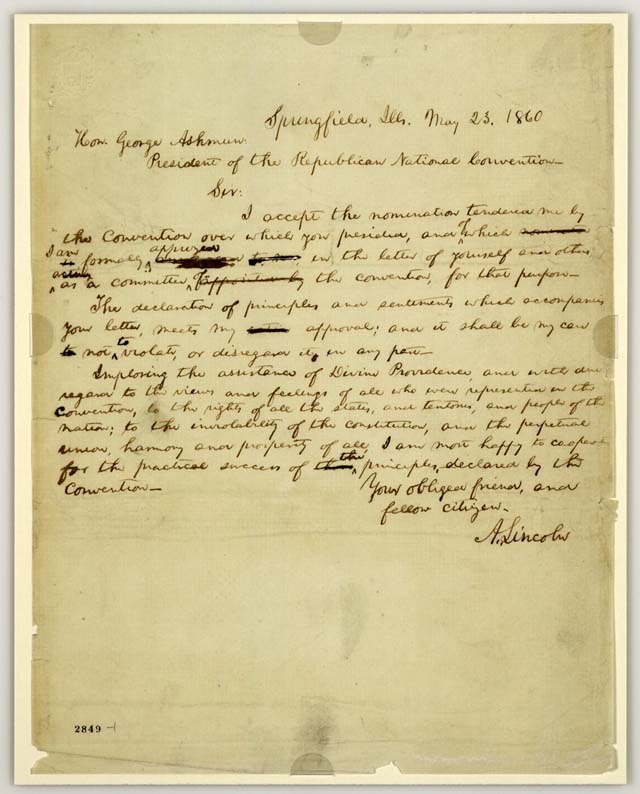
Abraham Lincoln's letter to the president of the Republican National Convention of 1860, accepting the convention's nomination for the presidency.

Abraham Lincoln’s letter to the president of the Republican National Convention of 1860, accepting the convention’s nomination for the presidency. It was written, you will note, from Springfield, Illinois, 200 miles away from Chicago where the convention was held.

To prove to me the piety of Abraham Lincoln, a fellow showed me photograph of a plaque on a church in Chicago, said to be the church where Abraham Lincoln said his prayers every morning during the Republican Convention of 1860, at which Lincoln got the nomination for president. Other records — newspapers, Lincoln’s letters and other documents, show that, as was the fashion in 1860, Lincoln did not attend the convention in Chicago, but as a candidate for president, stayed at home in Springfield, nearly 200 miles away.

Most real history can be read in documents, and does not need to rely on folk retellings exclusively.

5. The author says a belief is credible because it has endured for some time, or because many people believe it to be true.

Faced with the evidence that a dozen quotes he had attributed to figures such as James Madison, George Washington and Patrick Henry were whole cloth inventions, Texas quote-purveyor David Barton issued a statement urging people not to rely on them because they were “questionable.

A great example of belief triumphing over fact presents itself as the Cardiff Giant, now on display at the Farmers’ Museum in Cooperstown, New York (go visit when you visit the Baseball Hall of Fame). After an argument with a cleric over whether the Bible’s claim that giants once existed, a tobacconist named George Hull hired stonecarvers to carve a giant; then he hired a farmer to bury the carving on his farm, and claim to have struck it when planting. Once discovered the “petrified man” was put on display, for a fee. Hull got lucky: Syracuse businessmen offered to buy it from him for an enormous sum.

Paleontologist Othniel Marsh inspected it on display, and pronounced it a hoax. For some odd reason, that increased the popularity of the attraction. Carnival and side show entrepreneur P. T. Barnum offered $60,000 for the carving, but was refused. Barnum then had a plaster replica made and put on display. The owners of the original hoaxed carving sued, but the suit was thrown out because they could not demonstrate the “genuineness” of their own hoax.  Barnum made more money than the original.  A hoaxed hoax is even more popular than the truth.

A photo (staged?) of the 1869 unearthing of the Cardiff Giant (Cardiff, New York). Photograph courtesy Farmers Museum via Associated Press, and via National Geographic.

A photo (staged?) of the 1869 unearthing of the Cardiff Giant (Cardiff, New York). Photograph courtesy Farmers Museum (where the carving now rests, on display to museum visitors)  via Associated Press, and via National Geographic.

6. The author has worked in isolation.

Historians often help each other. Good historians put out queries to many sources, the better to assure accuracy. So, conversely, if there are only a few people who know anything about an account, that fact alone may cause suspicion. Clifford Irving’s hoax biography of Howard Hughes, while remarkably accurate in some regards, was unraveled when enough people familiar with Hughes called the bluff — including, of course, Hughes himself. The book got as far as it did with extreme secrecy on Irving’s part. Working alone makes error easier, and is essential for intentional frauds.

7. The author must propose a new interpretation of history to explain an observation.

Various conspiracy claims require that key people act counter to their known character. If Franklin Roosevelt had “allowed” Pearl Harbor to occur in order to get the U.S. into war, his actions over the previous six years to support Britain start to make little sense. Had Lyndon Johnson been part of a conspiracy to assassinate John Kennedy, his later carrying out the legislative plan of Kennedy runs contrary to all such motivations. If the founders of the U.S. actually intended to make Christianity the state religion, their efforts to disestablish the churches in all 13 colonies, efforts to write bills of rights for each state including freedom of religion, and efforts to create the First Amendment in the Bill of Rights seem like incredible, repeated errors.

Bogus history is much like the conjectured problems that result from time travel: Change one jot of history, and there is a cascading effect on later events. In many cases,were the bogus histories accurate, what follows could not be so, and we wouldn’t be here to discuss it.

Those are the seven warning signs of bogus history. Bogus, or voodoo history should be suspected if two or more of the signs are present — though it is quite possible for actual history to show more than two signs (perhaps actual history could show all seven signs — but I’d have to see an example before stating it’s so).

More:


Encore post: Recognizing bogus history, 1

July 3, 2007

While traveling this week, I’ll feature a few blasts from the past — posts that may merit new attention. This post comes from a two-part series in August 2006:

Recognizing bogus history, 1

Robert Park provides a short e-mail newsletter every Friday, covering news in the world of physics. It’s called “What’s New.” Park makes an art of smoking out bogus science and frauds people try to perpetrate in the name of science, or for money. He wrote an opinion column for the Chronicle of Higher Education published January 31, 2003, in which he listed the “7 warning signs of bogus science.”

Please go read Park’s entire essay, it’s good.

And it got me thinking about whether there are similar warning signs for bogus history? Are there clues that a biography of Howard Hughes is false that should pop out at any disinterested observer? Are there clues that the claimed quote from James Madison saying the U.S. government is founded on the Ten Commandments is pure buncombe? Should Oliver Stone have been able to to more readily separate fact from fantasy about the Kennedy assassination (assuming he wasn’t just going for the dramatic elements)? Can we generalize for such hoaxes, to inoculate ourselves and our history texts against error?

Perhaps some of the detection methods Park suggests would work for history. He wrote his opinion piece after the Supreme Court’s decision in Daubert v. Merrell Dow Pharmaceuticals, Inc., in which the Court laid out some rules lower courts should use to smoke out and eliminate false science. As Park described it, “The case involved Bendectin, the only morning-sickness medication ever approved by the Food and Drug Administration. It had been used by millions of women, and more than 30 published studies had found no evidence that it caused birth defects. Yet eight so-called experts were willing to testify, in exchange for a fee from the Daubert family, that Bendectin might indeed cause birth defects.” The Court said lower courts must act as gatekeepers against science buncombe — a difficult task for some judges who, in their training as attorneys, often spent little time studying science.

Some of the Daubert reasoning surfaced in another case recently, the opinion in Pennsylvania district federal court in which Federal District Judge John Jones struck down a school board’s order that intelligent design be introduced to high school biology students, Kitzmiller v. Dover Area School District.

Can we generalize to history, too? I’m going to try, below the fold.

Here are Park’s seven warning signs, boiled down:

Park wrote:

Justice Stephen G. Breyer encouraged trial judges to appoint independent experts to help them. He noted that courts can turn to scientific organizations, like the National Academy of Sciences and the American Association for the Advancement of Science, to identify neutral experts who could preview questionable scientific testimony and advise a judge on whether a jury should be exposed to it. Judges are still concerned about meeting their responsibilities under the Daubert decision, and a group of them asked me how to recognize questionable scientific claims. What are the warning signs?

I have identified seven indicators that a scientific claim lies well outside the bounds of rational scientific discourse. Of course, they are only warning signs — even a claim with several of the signs could be legitimate. [I have cut out the explanations. — E.D.]

  1. The discoverer pitches the claim directly to the media.
  2. The discoverer says that a powerful establishment is trying to suppress his or her work.
  3. The scientific effect involved is always at the very limit of detection.
  4. Evidence for a discovery is anecdotal.
  5. The discoverer says a belief is credible because it has endured for centuries.
  6. The discoverer has worked in isolation.
  7. The discoverer must propose new laws of nature to explain an observation.

Voodoo history

Here, with thanks to Robert Park, is what I propose for the warning signs for bogus history, for voodoo history:

  1. The author pitches the claim directly to the media or to organizations of non-historians, for pay.
  2. The author says that a powerful establishment is trying to suppress his or her work.
  3. The sources that verify the new interpretation of history are obscure; if they involve a famous person, the sources are not those usually relied on by historians.
  4. Evidence for the history is anecdotal.
  5. The author says a belief is credible because it has endured for some time, or because many people believe it to be true.
  6. The author has worked in isolation.
  7. The author must propose a new interpretation of history to explain an observation.

Any history account that shows one or more of those warning signs should be viewed skeptically.

In another post, I’ll flesh out the reasoning behind why they are warning signs.


Dembski’s blog caught hoaxing again

June 30, 2007

An acquaintance sends word he’s happy to be back in the mountains with his hammer again, breaking rocks as a geologist in support of a mining venture. The price of gold is high, a few advances in technology have helped the process, and our friend was tapped by suits with money to help keep the actual gold mining operation in the proper vein, so to speak.

Mining is best done with a good scientist on hand to make sure the hole dug out is done right, and to be sure that the digging keeps going for the genuine nuggets.

William Dembski’s blog, Uncommon Descent, has no scientists with any geology training, it appears. But again they’ve been mining, for quotes instead of useful ore, and they’ve come up with fool’s information. Unable to tell the difference between fool’s information and the real stuff, they’ve published the fool’s information for the world to see.

A wise person does not allow fool’s information into one’s information banks. Read the rest of this entry »


Hey, Britain! Duck! It’s another armada!

June 28, 2007

Gordon Brown may face a situation Tony Blair didn’t imagine: An invasion of ducks.

Plastic cuck similar to floating armada members - Times of London photo

Plastic ducks. An armada of ducks.

Quack! Quack!

Or, maybe more appropriately, “Rubber Ducky, you’re the one!”

Geography fans everywhere are salivating. History fans already recognize the ducks bear no resemblance to the Spanish Armada, but may be interested anyway.

Plastic duck toys, survivors from an original lot of about 30,000 knocked off a container ship in the north Pacific in 1992, could be drifting onto the shores of the British Isles this summer. A reward is offered for the first one found and reported to a scientist who has tracked the ducks from their accident, through currents in four of the world’s five oceans, to landfalls in North America, South America, Southeast Asia, Indonesia — and through the Arctic.

The Times of London carried a story today: Read the rest of this entry »


NY Times special on evolution – run, get it!

June 26, 2007

Evolution is the subject of a special edition of the Science section of the New York Times today. The section features articles by most of the best of the stable of science writing contributors the paper has, covering up to the latest developments in the field of evolution.

It’s available on-line, too, for a week or so — free subscription required. Or, Times Select customers will be able to access the stuff so long as they subscribe.

Since the section covers the best of science, there is nothing on intelligent design or other forms of creationism. The aim of the editors is the best of science, not “balance” in presenting opposing views even if vapid.

So, for $1.00, biology teachers can get a dozen weeks’ of enrichment material for this fall’s classes.

Run, don’t walk — your local Starbuck’s should have the paper, if your local newsstand doesn’t. It’s worth it just for the lead article featuring evo-devo, if that’s all you read.
