Some bloggers have sworn off comments on Sarah Palin. Good on them.
This fruit is too low-hanging.
Palin doesn’t appear to have a clue about what the phrase “Sputnik moment” refers to — and mistakes it with the much later financial difficulties of the Soviet Union. You’d think, since she was so close to the U.S.S.R. in Alaska, she’d know something about Sputnik.
And what’s with the “WTF” on television? Has she no composure, no decency?
Please note that the launch of the satellite scared the bejeebers out of Americans. Most people thought — without knowing anything about how heavy a nuclear device might be, nor how hard it might be to target one — that if the Russians could orbit a satellite the size of a beach ball, they could certainly launch missiles with nuclear warheads to rain down on America. Maybe, some thought, Russians had already orbited such nukes, which could just fall from space without warning.
That was the spooky, red scary part. Then there was the kick-American-science-in-the-pants part. A lot of policy makers asked how the Russians could surpass the U.S. in the race for space (wholly apart from the imported German rocket scientists used by both the U.S. and the U.S.S.R.). Looking around, they found science and technology education in America sadly lacking. Congress passed a law that called science education necessary for our defense, and appropriated money to help boost science education — the National Defense Education Act.
The Cold War stimulated the first example of comprehensive Federal education legislation, when in 1958 Congress passed the National Defense Education Act (NDEA) in response to the Soviet launch of Sputnik. To help ensure that highly trained individuals would be available to help America compete with the Soviet Union in scientific and technical fields, the NDEA included support for loans to college students, the improvement of science, mathematics, and foreign language instruction in elementary and secondary schools, graduate fellowships, foreign language and area studies, and vocational-technical training.
Sputnik once again elevated the word “competition” in the language of government officials and the American public. Sputnik threatened the American national interest even more than the Soviet Union’s breaking of America’s atomic monopoly in 1949; indeed it rocked the very defense of the United States because Russia’s ability to place a satellite into orbit meant that it could build rockets powerful enough to propel hydrogen bomb warheads atop intercontinental ballistic missiles. Perhaps more importantly, however, Sputnik forced a national self-appraisal that questioned American education, scientific, technical and industrial strength, and even the moral fiber of the nation. What had gone wrong, questioned the pundits as well as the man in the street. They saw the nation’s tradition of being “Number One” facing its toughest competition, particularly in the areas of science and technology and in science education.
With its ties to the nation’s research universities, the Foundation of course became a key player in the unfolding events during this trying time. An indication is shown by the large increase in Foundation monies for programs already in place and for new programs. In fiscal year 1958, the year before Sputnik, the Foundation’s appropriation had leveled at $40 million. In fiscal 1959, it more than tripled at $134 million, and by 1968 the Foundation budget stood at nearly $500 million. Highlights of this phase of the agency’s history cannot be told in a vacuum, however, but must be placed within the broad context of American political happenings.
The Congress reacted to Sputnik with important pieces of legislation and an internal reorganization of its own committees. Taken together, the action announced that America would meet the Soviet competition. The National Aeronautics and Space Act, more than any other post-Sputnik law, had great impact on increasing federal funding of scientific research and development. Signed by the president in July 1958, the law created the National Aeronautics and Space Administration (NASA) and gave it responsibility for the technological advancement of the space program. NASA became a major contracting agency and boosted tremendously the extra mural research support of the federal government. NASA not only symbolized America’s response to the Soviet challenge, but also dramatized the federal role in support of science and technology.
Among other things, the National Science Foundation looked at science textbooks used in elementary and secondary schools, and found them badly outdated. NSF and other organizations spurred the development of new, up-to-date books, and tougher academic curricula in all sciences.
So, when President Obama refers to a “Sputnik moment,” he isn’t referring to a foolish expenditure of money for space junk that bankrupts the nation. He’s referring to that time in 1957 when America woke up to the fact that education is important to defense, and to preparing for the future, and did a lot about improving education. Between the G.I. Bill’s education benefits and the NDEA, the U.S. became the world’s leader in science and technology for the latter half of the 20th century.
But we’ve coasted on that 1958 law for too long. Now we are being lapped by others — India, China, France, Japan, and others — and it’s time to spur progress in education again, to spur progress and great leaps in science.
One gets the impression Palin does not think much of science, nor education, nor especially science education. She could use some lessons in history, too. Sputnik didn’t bankrupt the Soviet Union. Ignoring Sputnik might have bankrupted the U.S.
If you’re a few dozen miles from the Earth, for example:
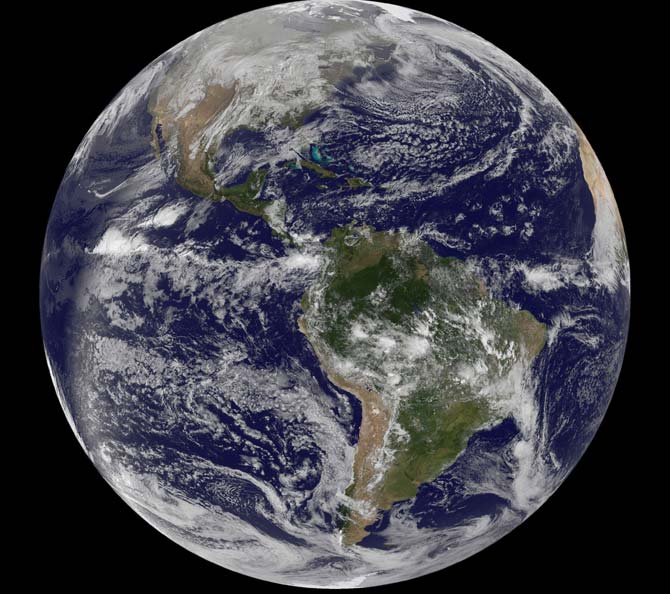
From NASA: The GOES-13 satellite captured a "full-disk image" of North and South America in an image created December 30 at 1445 UTC (9:45 a.m. EST), as the world awaits the new year. Credit: NOAA/NASA GOES Project; click on picture for larger view
As the World Turns to 2011 GOES Satellites Watch its Approach and Look Back at 2010
The GOES series of satellites keep an eye on the weather happening over the continental U.S. and eastern Pacific and Atlantic Oceans and had a busy time with wild weather in 2010. Today, GOES-13 captured one of the last images of North and South America in 2010 as the world continues to turn toward 2011.
The Geostationary Operational Environmental Satellite called GOES-13 satellite captured a “full-disk image” of North and South America in an image created December 30 at 1445 UTC (9:45 a.m. EST) as the world awaits the new year. The stunning image shows cloud cover associated low pressure areas over the upper Midwestern U.S. and Colorado’s Rocky Mountains.
NASA’s GOES Project, located at NASA’s Goddard Space Flight Center in Greenbelt, Md., procures and manages the development and launch of the GOES series of satellites for NOAA on a cost-reimbursable basis. NASA’s GOES Project also creates some of the GOES satellite images and GOES satellite imagery animations. NOAA manages the operational environmental satellite program and establishes requirements, provides all funding and distributes environmental satellite data for the United States.
NASA’s GOES Project was very busy this year. GOES-13 monitors the eastern continental U.S., Atlantic Ocean, Gulf of Mexico and Caribbean, while GOES-11 monitors weather conditions over the western U.S. and the Eastern Pacific Ocean.
In 2010, GOES satellites were busy providing images and animations of weather systems from nor’easters to tropical cyclones that caused blizzards, flooding and wind damage.
Most recently, the GOES project used satellite data to create an impressive animation of the great Christmas weekend blizzard that pummeled the northeastern U.S. Prior to that, GOES imagery showed travel conditions for the holiday weekend when that low was over the Colorado Rockies.
On Dec. 19, the GOES-11 satellite captured an image of the famous “Pineapple Express.” Occasionally in the winter, a large jet stream forms across the mid-Pacific, carrying a continuous flow of moisture from the vicinity of Hawaii to California, bringing heavy rain and snow to the Sierra-Nevada for several days.
During the summer, on July 25, GOES-13 imagery tracked one of the most destructive storms in years to strike Washington, D.C. and the surrounding area. Strong winds downed trees and power lines, leaving hundreds of thousands of residents without power, stopping elevators, and darkening malls and movie theaters. Falling trees killed at least two people. The NASA GOES Project created a satellite animation of the storm as moved through the region.
GOES-13 was busy in the Atlantic during the 2010 hurricane season. The Atlantic season started on June 1 and ended on November 30. The Atlantic season tied for third with two other years (1995 and 1887) as having the largest number of named storms at 19, and tied with two other seasons (1969 and 1887) for the second largest number of hurricanes, with 12. GOES-13 covered all of those tropical cyclones. GOES-11 didn’t see the action in the Eastern Pacific tropics that GOES-13 did, however. Because of a La Niña event, the 2010 Pacific hurricane season (which began May 15 and ended Nov. 30) was the least active season in terms of the number of named storms and hurricanes on record. All tropical cyclones can be seen at NASA’s Hurricane page archives for 2010 at: http://www.nasa.gov/mission_pages/hurricanes/archives/index.html.
On April 14, months before hurricane season started, GOES-13 became the official GOES-EAST satellite. GOES-13 was moved from on-orbit storage and into active duty. It is perched 22,300 miles above the equator to spot potentially life-threatening weather, including tropical storm activity in the Atlantic Ocean and Gulf of Mexico..
Here’s another way to drive creationists absolutely up the wall: Lift a glass of champagne today in tribute to Edwin Hubble and his great discovery.
Ultraviolet image of the Andromeda Galaxy, first known to be a galaxy by Edwin Hubble on December 30, 1924 - Galaxy Evolution Explorer image courtesy NASA
Today is a good day to celebrate the universe in all it’s glory – December 30.
On December 30, 1924, Edwin Hubble announced he’d discovered other galaxies in distant space. Though it may not have been so clear at the time, it meant that, as a galaxy, we are not alone in the universe (whether we are alone as intelligent life is a separate question). It also meant that the universe is much, much bigger than most people had dared to imagine.
Hubble was the guy who showed us the universe is not only bigger than we imagined, it’s probably much bigger and much more fantastic than we can imagine. Hubble is the guy who opened our imaginations to the vastness of all creation.
How does one celebrate Hubble Day? Here are some suggestions:
Easier than Christmas cards: Send a thank-you note to your junior high school science teacher, or whoever it was who inspired your interest in science. Mrs. Hedburg, Mrs. Andrews, Elizabeth K. Driggs, Herbert Gilbert, Mr. Willis, and Stephen McNeal, thank you.
Rearrange your Christmas/Hanukkah/Eid/KWANZAA lights in the shape of the Andromeda Galaxy — or in the shape of any of the great photos from the Hubble Telescope (Andromeda Galaxy pictured above; Hubble images here)
A few of the images from the Hubble Telescope
Go visit your local science museum; take your kids along – borrow somebody else’s kids if you have to (take them along, too)
Spend two hours in your local library, just looking through the books on astronomy and the universe
Anybody got a good recipe for a cocktail called “The Hubble?” “The Andromeda?” Put it in the comments, please
In 1924, he announced the discovery of a Cepheid, or variable star, in the Andromeda Nebulae. Since the work of Henrietta Leavitt had made it possible to calculate the distance to Cepheids, he calculated that this Cepheid was much further away than anyone had thought and that therefore the nebulae was not a gaseous cloud inside our galaxy, like so many nebulae, but in fact, a galaxy of stars just like the Milky Way. Only much further away. Until now, people believed that the only thing existing outside the Milky Way were the Magellanic Clouds. The Universe was much bigger than had been previously presumed.
Later Hubble noted that the universe demonstrates a “red-shift phenomenon.” The universe is expanding. This led to the idea of an initial expansion event, and the theory eventually known as Big Bang.
Hubble’s life offered several surprises, and firsts:
Hubble was a tall, elegant, athletic, man who at age 30 had an undergraduate degree in astronomy and mathematics, a legal degree as a Rhodes scholar, followed by a PhD in astronomy. He was an attorney in Kentucky (joined its bar in 1913), and had served in WWI, rising to the rank of major. He was bored with law and decided to go back to his studies in astronomy.
In 1919 he began to work at Mt. Wilson Observatory in California, where he would work for the rest of his life. . . .
Hubble wanted to classify the galaxies according to their content, distance, shape, and brightness patterns, and in his observations he made another momentous discovery: By observing redshifts in the light wavelengths emitted by the galaxies, he saw that galaxies were moving away from each other at a rate constant to the distance between them (Hubble’s Law). The further away they were, the faster they receded. This led to the calculation of the point where the expansion began, and confirmation of the big bang theory. Hubble calculated it to be about 2 billion years ago, but more recent estimates have revised that to 20 billion years ago.
An active anti-fascist, Hubble wanted to joined the armed forces again during World War II, but was convinced he could contribute more as a scientist on the homefront. When the 200-inch telescope was completed on Mt. Palomar, Hubble was given the honor of first use. He died in 1953.
“Equipped with his five senses, man explores the universe around him and calls the adventure Science.”
(Does anyone have a suitable citation for that video? Where did it come from? Who produced it? Is there more somewhere?)
Happy Hubble Day! Look up!
Resources:
Journey to Palomar site (production currently being broadcast on PBS affiliates – wonderful story of George Ellery Hale and the origins of modern astronomy at Palomar; that’s where Hubble worked)
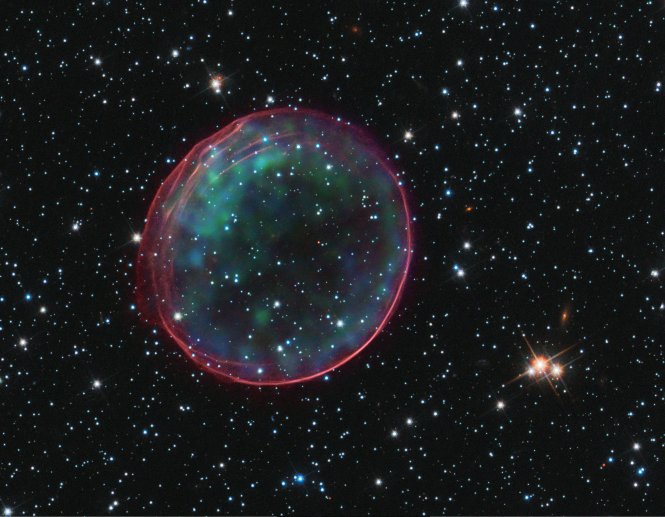
Supernova SNR 0509-67.5, image a composite of Hubble Space Telescope and CHANDRA X-ray Observatory images - image from NASA (click on image for larger view)
This colorful creation was made by combining data from two of NASA’s Great Observatories. Optical data of SNR 0509-67.5 and its accompanying star field, taken with the Hubble Space Telescope, are composited with X-ray energies from the Chandra X-ray Observatory. The result shows soft green and blue hues of heated material from the X-ray data surrounded by the glowing pink optical shell which shows the ambient gas being shocked by the expanding blast wave from the supernova. Ripples in the shell’s appearance coincide with brighter areas of the X-ray data.
The Type 1a supernova that resulted in the creation of SNR 0509-67.5 occurred nearly 400 years ago for Earth viewers. The supernova remnant, and its progenitor star reside in the Large Magellanic Cloud (LMC), a small galaxy about 160,000 light-years from Earth. The bubble-shaped shroud of gas is 23 light-years across and is expanding at more than 11 million miles per hour (5,000 kilometers per second).
Data from Hubble’s Advanced Camera for Surveys, taken in 2006 with a filter that isolates light from glowing hydrogen were combined with visible-light images of the surrounding star field that were imaged with Hubble’s Wide Field Camera 3 in 2010. These data were then merged with X-ray data from the Chandra X-ray Observatory taken with the Advanced CCD Imaging Spectrometer (ACIS) in 2000 and 2007.
Credits: X-ray: NASA/CXC/SAO/J.Hughes et al, Optical: NASA/ESA/Hubble Heritage Team (STScI/AURA)
Spread the word; friends don't allow friends to repeat history.
December 27 is one of those days — many of us are off work, but it’s after Boxing Day, and it’s not yet on to New Year’s Eve or Day. We should have celebrated, maybe.
We should celebrate it as a day of portent: A good embarkation, and a good, safe end to a nation-encouraging trip to almost touch the Moon.
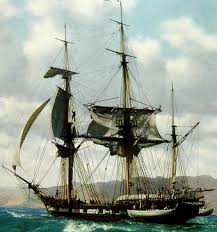
HMS Beagle, on a voyage of discovery
On December 27, 1831, Charles Darwin and H.M.S. Beagle set sail on an around-the-world voyage of discovery that would change all of science, and especially biology, forever.
December 27 1831
After a few delays, H.M.S. Beagle headed out from Plymouth with a crew of 73 under clear skies and a good wind. Darwin became sea-sick almost immediately.
Darwin never fully overcame his seasickness, but he fought it well enough to become the single greatest collector of specimens in history for the British Museum and British science, a distinction that won him election to science societies even before his return from the trip — and cemented his life in science, instead of in the church. Darwin’s discoveries would have revolutionized biology in any case. In analyzing what he had found, a few years later and with the aid of experts at the British Museum, Darwin realized he had disproved much of William Paley’s hypotheses about life and its diversity, and that another, more basic explanation was possible. This led to his discovery of evolution by natural and sexual selection.
Mini-sheet from the Royal Mail in 2009 honoring Darwin's discoveries in the Galapagos Islands
On December 27, 1968, Apollo 8 splashed down after a successful and heartening trip to orbit the Moon. The three crewmen, Commander Frank Borman, James A. Lovell, Jr., and William A. Anders, had orbited the Moon, a very important milestone in the methodological race to put humans on the Moon (which would be accomplished seven months later). 1968 was a terrible year for the U.S., with the North Korean capture of the U.S.S. Pueblo, assassinations of Rev. Martin Luther King, Jr., and Sen. Robert F. Kennedy during the presidential campaign, riots in dozens of American cities, nasty political conventions with riots at the Democratic Convention in Chicago, a contentious and bitter election making sore the nation’s divide over Vietnam policy, and other problems. On Christmas Eve, Borman, Lovell and Anders broadcast from orbit around the Moon, a triumphant and touching moment for the Apollo Program and Americans around the world. Their safe return on December 27 raised hopes for a better year in 1969.
In 1968, NASA engineers were scrambling to meet President Kennedy’s challenge to land a man on the moon by decade’s end. Because delays with the lunar module were threatening to slow the Apollo program, NASA chose to change mission plans and send the crew of Apollo 8 all the way to the moon without a lunar module.
Exactly 42 years ago, the three astronauts of Apollo 8 became the first humans to orbit another celestial object. As they came around the dark side for the third time, Frank Borman, the commander, finally turned their capsule around. And then they saw the Earth.
Borman: Oh my God! Look at that picture over there! Here’s the Earth coming up. Wow, is that pretty.
Anders: Hey, don’t take that, it’s not scheduled.
Borman: (laughing) You got a color film, Jim?
Anders: Hand me that roll of color quick, will you…
One of the resulting photos taken by Anders on a Hasselblad camera became one of the world’s most iconic images.
As Bill Anders recalls it:
I just happened to have one with color film in it and a long lens. All I did was to keep snapping… It’s not a very good photo as photos go, but it’s a special one. It was the first statement of our planet Earth and it was particularly impressive because it’s contrasted against this startling horizon… After all the training and studying we’d done as pilots and engineers to get to the moon safely and get back, [and] as human beings to explore moon orbit, what we really discovered was the planet Earth.
Yeah, we missed toasting it on time in 2010. Plan to raise a glass on December 27, 2011, to Good Trip Day for the human race. December 27 is a day we should remember, for these achievements.
Spread the word; friends don't allow friends to repeat history.
NASA Asks Public for Final Shuttle Missions’ Wakeup Songs
HOUSTON — If you like music, the space program and are a little nostalgic, NASA has the perfect opportunity for you. For the first time, the public can help choose songs to wake up the astronauts during the last two scheduled space shuttle missions.
Traditionally, the songs played to wake up the astronauts are selected by friends and family of the crews. For the last two scheduled missions, NASA is inviting the public to visit the “Wakeup Song Contest” website to select songs from a list of the top 40 previous wakeup calls or to submit original tunes for consideration. To vote or submit a song, visit:
The two songs with the most votes from the top 40 list will be played as crew wakeup calls on the final scheduled flight of space shuttle Discovery. Discovery’s STS-133 mission is targeted to launch on Nov. 1.
“We’re looking forward to hearing which songs the public wants played for us,” STS-133 Commander Steve Lindsey said. “It’s going to be a difficult choice, because there have been so many great songs played over the years.”
Original songs must have a space theme and be submitted to NASA by 4 p.m. CST on Jan. 10, 2011. The songs will be reviewed by agency officials and the top finalists put to a public vote. The top two songs will be used to wake space shuttle Endeavour’s STS-134 crew.
Endeavour’s mission is the last scheduled space shuttle flight. It is targeted to launch on Feb. 26, 2011.
“Space shuttle crews really enjoy the morning wake-up music,” STS-134 Commander Mark Kelly said. “While we don’t have the best quality speaker in the space shuttle, it will be interesting to hear what the public comes up with. We are looking forward to it.”
The song contest campaign follows NASA’s ongoing “Face in Space” project. It invites the public to send electronic images of their faces into orbit aboard one of the final remaining space shuttle missions. To submit your image, visit:
Still from “We Are Science Probes.” Full clip of movie below.
In animation, a parable about the dangers of being intentionally ignorant of science. In the not-distant-enough future, a probe from another planet arrives on Earth after the demise of human civilization. Unfortunately, the probes land in Kansas, the land of creationism and woo. The plot thickens.
[My apologies — the version I found did not come with a “pause” button. It will play automatically when you open this post. Fortunately, it’s almost perfectly safe-for-work. If you don’t like the music, turn it off. There is no spoken dialogue in the cartoon. If you wish to pause the playing of the cartoon, right click to get to the Adobe Flash Player controls. To pause the playing click the checkmark next to “play.”]
[Update August 18 — Okay, I give up — 100% of comments I’ve been getting ran against the video without the “start” or “pause” buttons. You’ll have to go see it at another site — here, for example.]
Sure would love this group to turn their creative faculties to hard history — say, the Progressive Movement and Gilded Age. (Probably less chance of commercialization there, and perhaps less chance of awe-striking art, too.)
From various “Today in History” features, AP, New York Times, and others:
July 24, 1969: Apollo 11 returned to the Earth, and splashed down in the Pacific Ocean, Michael Collins, Buzz Aldrin and Neil Armstrong — Aldrin and Armstrong having landed on the Moon.
July 24, 1847: A larger contingent of Mormons, refugees from a literal religious war in Illinois and Missouri, entered into the Salt Lake Valley under the leadership of Brigham Young, who famously said from his wagon sick-bed, “This is the place; drive on!”
July 24, 1866: Tennessee became the first of the Confederate States, the former “state in rebellion,” to be readmitted fully to the Union, following the end of the American Civil War.
July 24, 2005: Lance Armstrong won his seventh consecutive Tour de France bicycle race.
July 24, 1959: Visiting Moscow, USSR, to support an exhibit of U.S. technology and know-how, Vice President Richard Nixon engaged Soviet Communist Party Secretary and Premier Nikita Khruschev in a volley of points about which nation was doing better, at a display of the “typical” American kitchen, featuring an electric stove, a refrigerator, and a dishwasher. Khruschev said the Soviet Union produced similar products; Nixon barbed back that even Communist Party leaders didn’t have such things in their homes, typically, but such appliances were within the reach of every American family. It was the “Kitchen Debate.”
July 24, 1974: The U.S. Supreme Court ruled unanimously that President Richard Nixon had to turn over previously-secret recordings made of conversations in the White House between Nixon and his aides, to the special prosecutor appointed to investigate the Watergate affair and cover-up. Nixon would resign the presidency within two weeks, the only president to leave office by resignation.
July 24, 1975: An Apollo spacecraft splashed down after a mission that included the first link-up of American and Soviet spacecraft. (The Apollo mission was not officially numbered, but is sometimes called “Apollo 18” — after Apollo 17, the last trip to the Moon.)
Spread the word; friends don't allow friends to repeat history.
As Scott points out in the post immediately below, the news that President Obama tasked NASA head Bolden, as perhaps his foremost mission, with raising Muslim self-esteem is entirely absent from the New York Times and the Washington Post, as well as the nightly newscasts of ABC, NBC, and CBS. Why?
It might be, as Mirengoff goes on to speculate wildly and without reason, because the news agencies are taking payoffs from Obama, or just so enthralled with him that they can’t bring themselves to report bad news.
Think about that for a moment: News agencies unwilling to report bad news? Is your Hemingway Sh__ Detector working yet? Mine’s clanging something fierce.
Does Mirengoff seriously think the Poobahs at Disney sit around issuing orders that ABC news gatherers ignore bad news about Obama? Has Mirengoff been in some sort of plastic bubble, deprived of newspapers and television for the past four years?
Why the silent treatment? Because it’s very much a not-much-news story, Paul. It doesn’t say what you think it says, or worse, what you know it doesn’t say, but claim it does for whatever trouble you can stir up.
Charles Bolden, NASA’s administrator, explained for a news channel that broadcasts to the Middle East, what his job is with regard to the Arabic and Islamic populations (this is the version reported by York):
“When I became the NASA administrator, [Obama] charged me with three things,” NASA head Charles Bolden said in a recent interview with the Middle Eastern news network al-Jazeera. “One, he wanted me to help re-inspire children to want to get into science and math; he wanted me to expand our international relationships; and third, and perhaps foremost, he wanted me to find a way to reach out to the Muslim world and engage much more with dominantly Muslim nations to help them feel good about their historic contribution to science, math, and engineering.”
Good reporters would look at the interview, and realize the PowerLine guys got the story dead wrong. Not bothering to speculate on why part-time yahoos misreported the story, they’d go on to real news.
Note carefully what Bolden said, and then note carefully what he did not say. Bolden didn’t say the mission of NASA had changed. Bolden didn’t say Obama told him to ignore the mission of NASA. Bolden said NASA, arguably our nation’s most famous and vanguard science agency, has a top duty to inspire children to do well in science in math, to cooperate with other nations in exploring space as we have done since at least the Reagan administration, and, for audiences in Arabic nations, to help them understand Arabic contributions to science.
“Let go of the power line, step back, and no one else will get hurt.” Downed powerline in New Jersey, in summer 2011. Photo by Saed Hindash, The Star-Ledger
Bolden did not say, as Hot Air misreported, “NASA’s spaced-out mission no longer includes . . . space.” Hot Air isn’t reporting. This is a time-tested propaganda technique they engage in: MSU, “making [stuff] up.”
Which of those goals does Power Line disagree with? Each of them is a noble enterprise on its own.
But, pausing for just a moment to make liars out of Power Line and the Examiner, and others, ABC News got it right. How soon do you think Mirengoff or Scott Johnson at Power Line will update their story to note ABC reported it? How much longer before others do?
If ABC can get it right, why not these other guys?
Yellow journalism was bad enough the first time around. PowerLine, could you at least take the time to get the story right? If you don’t have a Hemingway to help you out, you can always use the old Cheech and Chong Excrement Detection Method. I don’t recommend it, but it tends to make reporters more careful if they ever use it once.
You gotta wonder why these people spread easily-falsified, malignant rumors. Who are they working for? It’s pretty clear they don’t have much respect for their readers.
This is a hoax, people. NASA has not changed its mission. The president cannot change NASA’s mission since that is dictated by law (it requires an “act of Congress,” literally). NASA’s chief did not say that stupid thing others claim — he’s not stupid. Don’t pretend it’s news, don’t pretend it’s a problem when the head of NASA says he’s trying to promote interest in science, math and history, and international cooperation. That’s his job.
No one was assigned the job to get the story wrong. I wish people would quit working so hard at it.
Pam Geller at Atlas Shrugged stumbled into the error, too (When Geller reports such a story, that’s often a clue that what she claims is dead wrong; any reporter worth her or his salt would have to be putting the Hemingway on “vibrate only” at this point.)
Rand Simberg at Pajamas Media got it wrong –– but that doesn’t stop him from waxing malevolently about the problems with things, had he been accurate (can we really trust someone who doesn’t spell it “pyjamas?”)
At the Fort Wayne (Indiana) News-Sentinel, columnist Kevin Leininger not only didn’t listen to the entire interview (and so get the story wrong), he reaches back to add the racist complaint that Obama put Martin Luther King, Jr.’s bust in the Oval Office, replacing a bust of Churchill borrowed from England. Leininger appears to be anti-American and racist both with that one, and now he shows religious intolerance. Somebody will send me a copy of Leininger’s column and say, “See, this is why we need to license journalists.” Hey, Leininger — why shouldn’t America honor American heroes like Martin Luther King, Jr.?
The International Astronomical Union (IAU) recently approved the name Rachmaninoff for an intriguing double-ring basin on Mercury. This basin, first imaged in its entirety during MESSENGER’s third Mercury flyby, was quickly identified as a feature of high scientific interest, because of its fresh appearance, its distinctively colored interior plains, and the extensional troughs on its floor. The basin’s name honors the Russian composer, pianist and conductor, Sergei Rachmaninoff (1873-1943).
IAU names craters on Mercury after “deceased artists, musicians, painters and authors who have made outstanding or fundamental contributions to their field and have been recognized as art historically significant figures for more than 50 years.” The process of proposing a new crater name includes gathering fundamental information about the crater, such as the crater’s central latitude, central longitude, and diameter. Justification is provided as to why the crater is of sufficient scientific importance to be named, and details are provided about the name choice, including sources that support the worthy contributions made by that individual. Ten newly named craters join 42 others named since MESSENGER’s first Mercury flybyin January 2008.
Image Credit: NASA/Johns Hopkins University Applied Physics Laboratory/Carnegie Institution of Washington
Tip of the old scrub brush to Eric Koenig.
Spread the word; friends don't allow friends to repeat history.
Uh-oh. Did P. Z. Myers see the name of the commanding officer of the space shuttle Atlantis on the current flight, STS-132?
Short press release from NASA:
Sun, 16 May 2010 06:48:08 -0500
Commander Ken Ham [emphasis added] and the crew of Atlantis performed the Terminal Initiation burn at 7:40 a.m. EDT, firing the left Orbital Maneuvering System engine for nine seconds to place the shuttle on the final path for its 10:27 a.m. docking to the International Space Station. When Atlantis is about 600 feet from the station, Ham will maneuver Atlantis through a backflip rotation to expose the heat shield to station crew members who will use digital cameras to photograph Atlantis’ upper and lower surfaces through windows of the Zvezda Service Module. Oleg Kotov will use a 400mm lens, and T.J. Creamer, Soichi Noguchi and Tracy Caldwell Dyson all will use 800mm lenses. The photos will be transmitted to Mission Control for evaluation by imagery experts and mission managers to determine whether the heat shield sustained any damaged during launch.
Not only is it not the same Ken Ham, I’ll wager they are completely unrelated, and that they’ve never met. I wonder how the astronaut lives with people confusing him with the Ken Ham of the creationism cult. Perhaps creationists stray into the real process of space exploration so rarely that no one has made the connection yet.
. . . this Ken Ham, who doesn't "believe" in much of the science that gets the other Ken Ham into orbit.
This Ken Ham, the astronaut (NASA photo), is not to be confused with . . .
Spread the word; friends don't allow friends to repeat history.
Tomorrow, April 14, Mission Specialists Dottie Metcalf-Lindenburger is scheduled to talk with students at Eastern Guilford High School in North Carolina, and all of the 71,000 students in Eastern Guilford School District.
Caption from NASA: STS-131 Mission Specialist Dorothy Metcalf-Lindenburger, attired in a training version of her shuttle launch and entry suit, poses for a photo prior to the start of an ingress/egress training session in the Space Vehicle Mock-up Facility at NASA's Johnson Space Center. Photo Credit: NASA
Metcalf-Lindenburger is one of three teachers selected in 2004 as astronauts. NASA is committed to help education out. After the Challenger disaster, and the death of “teacher in space” Christa McAuliffe, NASA finally determined to make teachers into astronauts rather than fly “civilians.”
Haley Miller
Guilford Public Schools, Guilford, N.C.
336-370-3200 millerh3@gcsnc.com
April 12, 2010
MEDIA ADVISORY : M10-048
Orbiting Space Shuttle Astronauts — Including Former Teacher — Call North Carolina Students
WASHINGTON — Astronauts orbiting 220 miles above Earth will speak with students in Gibsonville, N.C., on Wednesday, April 14. The call with the students and space shuttle Commander Alan Poindexter and Mission Specialists Dottie Metcalf-Lindenburger, Stephanie Wilson and Clay Anderson will take place at 1:06 p.m. EDT at Eastern Guilford High School in Gibsonville.
Eastern Guilford High School is hosting students from Eastern Guilford Middle School, Gibsonville Elementary, McLeansville Elementary, Rankin Elementary and Sedalia Elementary for the downlink. The school also will broadcast the event to the entire Guilford County Schools district, which serves more than 71,000 students.
The astronauts launched Monday, April 5, aboard space shuttle Discovery from NASA’s Kennedy Space Center in Florida. During the 13-day mission to the International Space Station, the crew will deliver science experiments and supplies; take three spacewalks to switch out a gyroscope on the station’s truss, or backbone; install a spare ammonia storage tank and return a used one; and retrieve a Japanese experiment from the station’s exterior.
Metcalf-Lindenburger is one of three teachers selected to fly as shuttle mission specialists in the 2004 Educator Astronaut Class. She operates the shuttle’s robotic arm. Without robotics, major accomplishments like building the station, repairing satellites in space and exploring other worlds would not be possible.
Students have been preparing for the downlink by conducting NASA engineering design challenges and implementing agency robotics resources and activities into K-12 classrooms. A science, technology, engineering and math, or STEM, club was organized to increase participation and interest, particularly by female students.
The school’s guidance department also is collaborating with local universities to help students investigate and explore STEM opportunities beyond graduation. During follow up in-district workshops in April and May, a NASA Aerospace Education Services Program specialist will demonstrate how to access and use NASA resources in K-12 curricula.
Eastern Guilford High School employee Michael Woods, a former Aerospace Education Services Project specialist at NASA’s Goddard Space Flight Center in Greenbelt, Md., and the agency’s Langley Research Center in Hampton, Va., is leading the downlink effort. In December 2009, NASA awarded Guilford County Schools a two-year grant of nearly $1 million to help middle and high school teachers develop science lessons using the space agency’s content.
The event is part of a series with educational organizations in the U.S. and abroad to improve teaching and learning in science, technology, engineering and mathematics. The in-orbit call is part of Teaching From Space, a NASA project that uses the unique environment of human spaceflight to promote learning opportunities and build partnerships with the kindergarten through 12th grade education community.
NASA Television will air video of the astronauts during the downlink. For NASA TV downlink, schedule and streaming video information, visit:
In a discussion of the Cold War, the Space Race, and the Race to the Moon, we get to a photo about Apollo 11’s landing on the Moon.
Like clockwork, a hand goes up: “Mr. Darrell, wasn’t that landing a hoax? They didn’t really go to the Moon then, did they?”
There are a lot of ways to know that Apollo 11 landed on the Moon. Among other things, students could talk to people alive at the time who have the slightest bit of technological savvy: With lots of other people, I tracked part of the trip with my 6-inch reflecting telescope. Ham radio operators listened in on the radio broadcasts. And so on.
But I really like this chunk of evidence: How about a photograph of the landing site?
Holy cow! You can see the tracksof Neil Armstrong’s footprints to the lip of Little West crater (see arrow below).
Tranquility Base, shot from the Lunar Reconnaissance Orbiter Camera (LROC), showing the traces left by Apollo 11's landing on the Moon. It really happened. Credit: NASA/GSFC/Arizona State University
The astronaut path to the TV camera is visible, and you may even be able to see the camera stand (arrow). You can identify two parts of the Early Apollo Science Experiments Package (EASEP) – the Lunar Ranging Retro Reflector (LRRR) and the Passive Seismic Experiment (PSE). Neil Armstrong’s tracks to Little West crater (33 m diameter) are also discernable (unlabeled arrow). His quick jaunt provided scientists with their first view into a lunar crater.
Bob Park is probably right (he usually is). The International Space Station doesn’t have enough science value to justify the expense of it. A lot of the work we do in space exploration could better be done by robots. But you know, I grew up in that era when a manned space launch was a school-stopping experience. I was still in high school when Neil Armstrong set foot on the Moon. So I will be saddened when the shuttle launches come to an end.
Let’s hope the next chapter of space exploration will be at least as cool.
Spread the word; friends don't allow friends to repeat history.
Ultraviolet image of the Andromeda Galaxy, first known to be a galaxy by Edwin Hubble on December 30, 1924 - Galaxy Evolution Explorer image courtesy NASA
On December 30, 1924, Edwin Hubble announced he’d discovered other galaxies in distant space. Though it may not have been so clear at the time, it meant that, as a galaxy, we are not alone in the universe (whether we are alone as intelligent life is a separate question). It also meant that the universe is much, much bigger than most people had dared to imagine.
Hubble was the guy who showed us the universe is not only bigger than we imagined, it’s probably much bigger and much more fantastic than we can imagine. Hubble is the guy who opened our imaginations to the vastness of all creation.
How does one celebrate Hubble Day? Here are some suggestions:
Easier than Christmas cards: Send a thank-you note to your junior high school science teacher, or whoever it was who inspired your interest in science. Mrs. Hedburg, Mrs. Andrews, Elizabeth K. Driggs, Herbert Gilbert, Mr. Willis, and Stephen McNeal, thank you.
Rearrange your Christmas/Hanukkah/Eid/KWANZAA lights in the shape of the Andromeda Galaxy — or in the shape of any of the great photos from the Hubble Telescope (Andromeda Galaxy pictured above; Hubble images here)
A few of the images from the Hubble Telescope
Go visit your local science museum; take your kids along – borrow somebody else’s kids if you have to (take them along, too)
Spend two hours in your local library, just looking through the books on astronomy and the universe
Anybody got a good recipe for a cocktail called “The Hubble?” “The Andromeda?” Put it in the comments, please
In 1924, he announced the discovery of a Cepheid, or variable star, in the Andromeda Nebulae. Since the work of Henrietta Leavitt had made it possible to calculate the distance to Cepheids, he calculated that this Cepheid was much further away than anyone had thought and that therefore the nebulae was not a gaseous cloud inside our galaxy, like so many nebulae, but in fact, a galaxy of stars just like the Milky Way. Only much further away. Until now, people believed that the only thing existing outside the Milky Way were the Magellanic Clouds. The Universe was much bigger than had been previously presumed.
Later Hubble noted that the universe demonstrates a “red-shift phenomenon.” The universe is expanding. This led to the idea of an initial expansion event, and the theory eventually known as Big Bang.
Hubble’s life offered several surprises, and firsts:
Hubble was a tall, elegant, athletic, man who at age 30 had an undergraduate degree in astronomy and mathematics, a legal degree as a Rhodes scholar, followed by a PhD in astronomy. He was an attorney in Kentucky (joined its bar in 1913), and had served in WWI, rising to the rank of major. He was bored with law and decided to go back to his studies in astronomy.
In 1919 he began to work at Mt. Wilson Observatory in California, where he would work for the rest of his life. . . .
Hubble wanted to classify the galaxies according to their content, distance, shape, and brightness patterns, and in his observations he made another momentous discovery: By observing redshifts in the light wavelengths emitted by the galaxies, he saw that galaxies were moving away from each other at a rate constant to the distance between them (Hubble’s Law). The further away they were, the faster they receded. This led to the calculation of the point where the expansion began, and confirmation of the big bang theory. Hubble calculated it to be about 2 billion years ago, but more recent estimates have revised that to 20 billion years ago.
An active anti-fascist, Hubble wanted to joined the armed forces again during World War II, but was convinced he could contribute more as a scientist on the homefront. When the 200-inch telescope was completed on Mt. Palomar, Hubble was given the honor of first use. He died in 1953.
“Equipped with his five senses, man explores the universe around him and calls the adventure Science.”
(Does anyone have a suitable citation for that video? Where did it come from? Who produced it? Is there more somewhere?)
Happy Hubble Day! Look up!
Resources:
Journey to Palomar site (production currently being broadcast on PBS affiliates – wonderful story of George Ellery Hale and the origins of modern astronomy at Palomar; that’s where Hubble worked)
Or, until that account is unsuspended by the forces supporting Donald Trump: Follow @FillmoreWhite, the account of the Millard Fillmore White House Library
We've been soaking in the Bathtub for several months, long enough that some of the links we've used have gone to the Great Internet in the Sky.
If you find a dead link, please leave a comment to that post, and tell us what link has expired.
Thanks!
Retired teacher of law, economics, history, AP government, psychology and science. Former speechwriter, press guy and legislative aide in U.S. Senate. Former Department of Education. Former airline real estate, telecom towers, Big 6 (that old!) consultant. Lab and field research in air pollution control.
My blog, Millard Fillmore's Bathtub, is a continuing experiment to test how to use blogs to improve and speed up learning processes for students, perhaps by making some of the courses actually interesting. It is a blog for teachers, to see if we can use blogs. It is for people interested in social studies and social studies education, to see if we can learn to get it right. It's a blog for science fans, to promote good science and good science policy. It's a blog for people interested in good government and how to achieve it.
BS in Mass Communication, University of Utah
Graduate study in Rhetoric and Speech Communication, University of Arizona
JD from the National Law Center, George Washington University