Inspiration for the first day of school, part 1 – Dalton Sherman

August 23, 2010

An encore post from two years ago.  50,000 educators from Dallas ISD gathered at the American Airlines Center, and then-5th grader Dalton Sherman gave the performance of his young life.

That was 2008.  Later that school year a $64 million shortfall showed up in the Dallas ISD budget, and many of those teachers were laid off mid-year.  In 2010, Dallas ISD provided a short video of encouragement from Superintendent Michael Hinojosa, rather than a mass gathering and pep rally.

Below is the post from 2008.

______________________

“Do you believe in me?”  5th grader Dalton Sherman inspires Dallas teachers

Taylor Mali is one of my usual suspects for inspiring teachers. He does a great job, with just a tinge of profanity (appropriately placed, many teachers argue – if they ask for it, you have to give it to them).

This year’s inspiration for Dallas teachers comes from Dalton Sherman, a fifth grader at Charles Rice Learning Center. Here’s a YouTube video of the presentation about 20,000 of us watched last Wednesday, a small point that redeemed the annual “convocation” exercise, for 2008:

Sherman’s presentation rescued what had been shaping up as another day of rah-rah imprecations to teachers who badly wanted, and in my case needed, to be spending time putting classrooms together.

(By the way, at the start of his presentation, you can see several people leap to their feet in the first row — Mom, Dad, and older brother. Nice built-in cheering section.)

Staff at DISD headquarters put the speech together for Dalton to memorize, and he worked over the summer to get it down. This background is wonderfully encouraging.

First, it makes a statement that DISD officials learn from mistakes. Last year the keynote was given by a speaker out of central casting’s “classic motivational speaker” reserves. As one teacher described it to me before the fete last Wednesday, “It was a real beating.”

Second, DISD’s planning ahead to pull this off suggests someone is looking a little bit down the road. This was a four or five month exercise for a less-than-10 minute presentation. It’s nice to know someone’s looking ahead at all.

Third, the cynical teachers gave Dalton Sherman a warm standing ovation. That it was delivered by a 10-year-old kids from DISD made a strong symbol. But the content was what hooked the teachers. Superintendent Michael Hinojosa provided a death-by-PowerPoint presentation leading up to the speech, one that was probably not designed solely as contrasting lead in. In other words, Dalton Sherman’s speech demonstrated as nothing else the district has done lately that someone downtown understands that the teachers count, the foot soldiers in our war on ignorance and jihad for progress.

The kids came back Monday, bless ’em. School’s in session, to anyone paying attention.

Resources:

Full text of Dalton Sherman’s speech to Dallas Independent School District teachers, August 20, 2008:

I believe in me. Do you believe in me?

Do you believe I can stand up here, fearless, and talk to all 20,000 of you?

Hey, Charles Rice Learning Center – do you believe in me?

That’s right – they do.

Because here’s the deal: I can do anything, be anything, create anything, dream anything, become anything – because you believe in me. And it rubs off on me.

Let me ask you a question, Dallas ISD.

Do you believe in my classmates?

Do you believe that every single one of us can graduate ready for college or the workplace?

You better. Because next week, we’re all showing up in your schools – all 157,000 of us – and what we need from you is to believe that we can reach our highest potential.

No matter where we come from, whether it’s sunny South Dallas, whether its Pleasant Grove, whether its Oak Cliff or North Dallas or West Dallas or wherever, you better not give up on us. No, you better not.

Because, as you know, in some cases, you’re all we’ve got. You’re the ones who feed us, who wipe our tears, who hold our hands or hug us when we need it. You’re the ones who love us when sometimes it feels like no else does – and when we need it the most.

Don’t give up on my classmates.

Do you believe in your colleagues?

I hope so. They came to your school because they wanted to make a difference, too. Believe in them, trust them and lean on them when times get tough – and we all know, we kids can sometimes make it tough.

Am I right?

Can I get an Amen?

So, whether you’re a counselor or a librarian, a teacher assistant or work in the front office, whether you serve up meals in the cafeteria or keep the halls clean, or whether you’re a teacher or a principal, we need you!

Please, believe in your colleagues, and they’ll believe in you.

Do you believe in yourself? Do you believe that what you’re doing is shaping not just my generation, but that of my children – and my children’s children?

There’s probably easier ways to make a living, but I want to tell you, on behalf of all of the students in Dallas, we need you. We need you now more than ever.

Believe in yourself.

Finally, do you believe that every child in Dallas needs to be ready for college or the workplace? Do you believe that Dallas students can achieve?

We need you, ladies and gentlemen. We need you to know that what you are doing is the most important job in the city today. We need you to believe in us, in your colleagues, in yourselves and in our goals.

If you don’t believe – well, I’m not going there.

I want to thank you for what you do – for me and for so many others.

Do you believe in me? Because I believe in me. And you helped me get to where I am today.

Thank you.


Some teachers had great summer experiences

August 6, 2010

One of our more adventurous teachers spent the summer on a Fulbright-Hays program in Senegal, in West Africa.

Lunch in Senegal, William Adkins photo

No, that's not William Adkins. That's his lunch one day in Senegal.

William Adkins’ African adventure blog is here.  Mine it for stuff you can use in economics, art, world history, world geography, or anything else.  He’ll probably give you free reign to use the photos for classroom presentations.

What did you do on your summer vacation?

Add to FacebookAdd to NewsvineAdd to DiggAdd to Del.icio.usAdd to StumbleuponAdd to RedditAdd to BlinklistAdd to TwitterAdd to TechnoratiAdd to Furl


Which party encourages education in Texas?

June 28, 2010

You have the tools to compare the party platforms and determine for yourself which part supports education in Texas — I mean, really supports education, as opposed to using Doublespeak to profess support while angling to get a shiv in the back of education.

You can look at the 2010 Texas Republican Party Platform here.  There are brief mentions of education in other sections, but you’ll find education starting on page 12.  Texas Democrats put education up front, on page 2 (unofficial version, but the emphasis won’t change).

Education sections of the 2010 Texas Democratic Party Platform appear immediately previous to this post, in eleven sections.

Which party is more favorable to educating our children well?


2010 Texas Democratic Platform: Effective Teachers for Every Student

June 28, 2010

This post is sixth in a series on the education planks of the 2010 Texas Democratic Party Platform.

This is an unofficial version published in advance of the final version from the Texas Democrats, but I expect very few changes.

EFFECTIVE TEACHERS FOR EVERY STUDENT

The most important factor in student success is having qualified teachers in our classrooms. Texas has a serious teacher shortage. Teacher pay and benefits are not competitive with private sector pay for occupations requiring comparable knowledge and skills. To recruit and retain our best to teach, Texas Democrats advocate the following:

  • raise teacher and support staff pay to levels exceeding the national average;
  • extend quality state funded health insurance to all education employees;
  • respect and safeguard the rights and benefits of education employees;
  • guarantee that every class has a teacher certified to teach that subject;
  • recruit and train teachers who reflect the state’s diversity;
  • provide a mentor (a master teacher) for every novice teacher;
  • base teacher pay and evaluations on multiple measures that give a full, rounded picture of student and teacher accomplishment, and oppose Republican plans to use narrow test results instead;
  • provide retired teachers a cost-of-living increase to restore their pensions’ purchasing power, which has eroded more than 20 percent under Rick Perry and the Republicans since the last increase in 2001;
  • repeal the federal government pension offset and windfall elimination provisions that unfairly reduce Social Security benefits for educational retirees and other public employees; and
  • provide tuition credits and financial assistance for college students who become certified public school teachers and teach for a specified period of time in public schools.

2010 Texas Democratic Platform: Excellent Schools for Every Student

June 28, 2010

This post is fourth in a series on the education planks of the 2010 Texas Democratic Party Platform.

This is an unofficial version published in advance of the final version from the Texas Democrats, but I expect very few changes.

EXCELLENT SCHOOLS FOR EVERY STUDENT

To make public education our highest priority, we believe the state should:

  • provide universal access to pre-kindergarten and kindergarten;
  • provide universally accessible after school programs for grades 1-12;
  • provide free, accurate and updated instructional materials aligned to educationally appropriate, non-ideological state curriculum standards and tests;
  • provide free computer and internet access, as well as digital instructional materials;
  • provide early intervention programs to ensure every child performs at grade level in English Language Arts, Social Studies, Math, and Science;
  • ensure that students with disabilities receive an appropriate education in the least restrictive environment, including access to the full range of services and supports called for in their individual education plans;
  • provide appropriate career and technical education programs;
  • reject efforts to destroy bilingual education;
  • promote multi-language instruction, beginning in elementary school, to make all students fluent in English and at least one other language;
  • replace high-stakes tests, used to punish students and schools, with multiple measures that restore the original intent of the state assessment system–improving instruction to help students think critically, be creative and succeed;
  • end inappropriate testing of students with disabilities whose individual education plans call for alternative assessments of their educational progress;
  • enforce and extend class size limits to allow every student to receive necessary individualized attention;
  • support Title IX protections for gender equity in public education institutions;
  • ensure that every school has a fully funded library that meets state requirements;
  • provide environmental education programs for children and adults; and
  • oppose private school vouchers.

2010 Texas Democratic Platform: Public Education Funding

June 28, 2010

This post is third in a series on the education planks of the 2010 Texas Democratic Party Platform.

This is an unofficial version published in advance of the final version from the Texas Democrats, but I expect very few changes.

PUBLIC EDUCATION FUNDING

Texas Democrats believe:

  • the state should establish a 100% equitable school finance system with sufficient state revenue to allow every district to offer an exemplary program;
  • the state should equitably reduce reliance on “Robin Hood” recapture;
  • state funding formulas should fully reflect all student and district cost differences and the impact of inflation and state mandates;
  • Texas should maintain or extend the 22-1 class size limits and expand access to prekindergarten and kindergarten programs; and
  • the federal government should fully fund all federal education mandates and the Elementary and [Secondary] Education Act.

Republicans have shortchanged education funding every session they have controlled the Texas Legislature. After cutting billions from public education in 2003, the 2006 Republican school funding plan froze per pupil funding, leaving local districts faced with increasing costs for fuel, utilities, insurance and personnel with little new state money. To make matters worse, that same plan placed stringent limits on local ability to make up for the state’s failures.

In 2009, Republicans hypocritically supplanted state support for our schools with the very federal “stimulus” aid they publicly condemned after state revenues plunged because of the Republican-caused recession and the structural state budget deficit they created. They reduced state funding for our schools by over $3 billion. Because our student population continues to grow, the combined reduction in state revenue per student was nearly 13%.

Most Texans support our public schools, yet now Republicans want to cut even more from education and also want to siphon off limited public education funds for inequitable, unaccountable voucher and privatization schemes. Texas Democrats believe these attempts to destroy our public schools must be stopped.


2010 Texas Democratic Platform: Education (preface)

June 28, 2010

This post is second in a series on the education planks of the 2010 Texas Democratic Party Platform.

This is an unofficial version published in advance of the final version from the Texas Democrats, but I expect very few changes.

EDUCATION

Texas Democrats strongly support our Constitution’s recognition that a free, quality public education is “essential to the preservation of the liberties and rights of the people.” Texas Democrats believe a world class education system is a moral imperative and an economic necessity that requires parents, educators and community leaders to work together to provide our children the skills needed to compete and succeed in a global economy.

Texas Democrats believe all children should be able to attend a safe, secure school and have access to an exemplary educational program that values and encourages critical thinking and creativity, not the “drill and kill” teach-to-the-test policy Republicans have forced on students and teachers. To fulfill this commitment, Texas Democrats continue leading the fight to improve student achievement, lower dropout rates, and attract and retain well-qualified teachers.

Democrats also believe it is essential that all Texans have access to affordable, quality higher education and career education programs, with a renewed emphasis on the importance of a full four year college education, and particular attention to science, technology and engineering.


Hired back, Mississippi teacher promises to continue leading prayers in classroom

May 29, 2010

Religious terrorists kidnapped the First Amendment while it was visiting Meadville, Mississippi, last week.

Local resident’s expressed support for the kidnappers.

The teacher whose job was on the block for leading prayers in violation of federal law protecting students from school-imposed religion, was hired back on a technicality:  There was no formal, written warning to her that leading prayers is against the law (though it’s in every teacher training program).

The teacher, Alice Hawley, promised to continue to lead prayers in class, in violation of the law.

The newspaper did not ask whether she will follow any laws in her classroom.

On the other hand, one might take some hope that a teacher who flagrantly flouts the law in this case makes the path clear for Texas teachers to flout the standards voted in by the Texas State Soviet of Education, who would nominally be colleagues-in-crucifying to Ms. Hawley.  If you can’t fire a teacher for violating the Constitution and rulings of the U.S. Supreme Court, certainly you can’t fire a teacher for teaching history instead of Don McLeroy’s claim that the U.S. Constitution says the federal government can dictate religion to us.

Mississippi:  Fighting for its ranking among U.S. states, in educational achievement.  (Last place)


Stupid teacher tricks: No, teachers can’t lead prayers

May 26, 2010

What devilry gets into a tiny few teachers to make them think they alone are immune from the First Amendment?

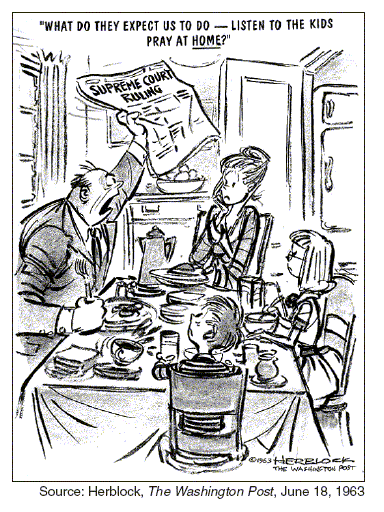
In a public classroom, teachers are the government.  They may not lead prayers, not even if all the students consent.

Down in Meadville, Mississippi, a Franklin County High School teacher, Alice Hawley,  lost her teaching contract because she led daily prayers in her classes.

She agreed to stop the illegal practice, and has been invited back.

I understand fans on Facebook have come unglued.  I haven’t found that link.

Herblock cartoon of June 18, 1963 - school prayer

Probably still under copyright - Herblock in the Washington Post, June 18, 1963 (school prayer)


But it could always be worse: Maine Republicans trash classroom for teaching the Constitution

May 15, 2010

You couldn’t get fiction like this published.

Republicans in Maine voted to scrap the Republican platform and write a new one — not enough unholy discrimination in the old one, too much Eisenhower, too much Lincoln, or something like that.  The convention spilled out into a local middle school for some of the platform writing shenanigans.

In one 8th grade classroom, the Maine Republicans found something they objected to, something they don’t want taught to 8th graders:  The U.S. Constitution.

Pharyngula has the story and comments here.  ThinkProgress has more gory details here. Portland (Maine) Press-Herald story here. Bangor Daily News story here.

The Republicans were particularly incensed by a poster showing a collage used to open a project assigned to the Portland 8th graders.  The 8th graders make poster collages elaborating on the Four Freedoms speech of Franklin Roosevelt, and the accompanying posters by Norman Rockwell.  Norman Rockwell.  You know.  The guy who started his professional career as art director for the Boy Scouts of America . . .

“Brainwashing” the Republicans called U.S. history.  Brainwashing.

Speaking of the children, they got into the act Tuesday after a note from “a Republican” was found in Clifford’s classroom. “A Republican was here,” it read. “What gives you the right to propagandize impressionable kids?”

Responded eighth-grader Lilly O’Leary, one of several students who sent e-mails to this newspaper decrying the behavior of their weekend guests, “I am not being brainwashed in his class under any circumstances. I am being told that I have the right to my own opinion.”

She added, “These people were adults and they were acting very immaturely.”

Remember when Republicans used to complain that we can’t jail flag-burning protesters?  When did those guys get kicked out of the party, and who are these new thugs?

When did it become the Re-Poe-blican Party?  When did they take up the Blackshirt tactics?

C’mon, Republicans.  Come back to America.  Repent now.

And — as for us Texans?  This is the stuff Don McLeroy wants to see happen in Texas social studies standards — vandalism of the U.S. Constitution and American law and tradition.

As a Scouter, as a teacher, as a fan of the U.S. Constitution, I’m concerned.  Should I be scared?

“I saw nothing in the room — and nobody pointed out anything in the room — that appeared to give a more balanced view,” [Knox County Republican Party Chairman William] Chapman said.

[Teacher Paul] Clifford and the school’s principal, Mike McCarthy, pointed out in media accounts that the posters were part of projects on freedom and free expression. [Bangor Daily News]

Maybe everyone should be scared.

_______________

Hmmmmm.  Ken County, Maine, Republicans offer rewards to people who rat out others who vandalize campaign signs.  How about they extend that to rat out the Republicans who vandalized Paul Clifford’s classroom?  You know, in the interest of free speech and all . . .

More:

Norman Rockwell, poster of his paintings on the Four Freedoms (Library of Congress image)

Norman Rockwell, poster of his paintings on the Four Freedoms (Library of Congress image). This is part of what the Maine Tea Party Republicans objected to.

Exercise your right to stand up for freedom and educationspread the word:

Add to FacebookAdd to NewsvineAdd to DiggAdd to Del.icio.usAdd to StumbleuponAdd to RedditAdd to BlinklistAdd to TwitterAdd to TechnoratiAdd to Furl


Ravitch calls the issue: Will public education survive?

May 1, 2010

Diane Ravitch in Dallas, April 28, 2010 - IMGP3872  Copyright 2010 Ed Darrell

Diane Ravitch in Dallas, April 28, 2010 – Copyright 2010 Ed Darrell (you may use freely, with attribution)

Bill McKenzie, editorial board member and writer for the Dallas Morning News, wrote briefly about the rekindled controversy over standards a year ago — but did he listen to Diane Ravitch on Wednesday night?

He should have.

I first met Ravitch a couple of decades ago when I worked for Checker Finn at the Office of Educational Research and Improvement.   Ted Bell’s idea of a commission to look at education quality, and it’s 1983 report, saved the Reagan administration and assured Reagan’s reelection in 1984.  She was one of the most prodigious and serious thinkers behind education reform efforts, then a close friend of Finn (who was Assistant Secretary of  Education for Research) — a position that Ravitch herself held in the administration of George H. W. Bush.

Ravitch now criticizes the end result of all that turmoil and hard work, the No Child Left Behind Act, and the way it has distorted education to keep us in the crisis we were warned of in 1983.  Then, the “rising tide of mediocrity” came in part because we didn’t have a good way to compare student achievement, state to state.  Today, the mediocrity is driven by the tests that resulted from legislative efforts to solve the problem.

Conditions in education in America have changed.  We still have a crisis after 27 years of education reform (how long do we have a crisis before it becomes the norm), but for the first time, Ravitch said, “There is a real question about whether public education will survive.”  The past consensus on the value of public education and need for public schools, as I would put it, now is challenged by people who want to kill it.

“The new issue today:  Will we have a public education system bound by law to accept all children.”

Ironic, no?  The No Child Left Behind Act has instead created a system where many children could be forced to the rear.

I took an evening in the middle of a week of TAKS testing — the Texas Assessment of Knowledge and Skills.  With ninth through twelfth grades, we had four days of testing which essentially requires the shutdown of the education for the week (we had Monday to review for the test).  It was a week to reflect on just how far we have strayed from the good intentions of public education advocates who pushed the Excellence in Education Commission’s report in 1983.

Ravitch spoke for over an hour.  I’ll have more to report as I get caught up, after a month of meetings, test prep, testing, and little sleep.

Background, more:


Colleague’s Fulbright-Hays trip to Senegal

April 26, 2010

One of my colleagues — an art teacher; you know, the adventurous type — heads off to Senegal this summer on a Fulbright-Hays program.

I’m sorta jealous, of course.  I need time to push our history course to championship level, though — I didn’t apply for anything this summer.

You can track Mr. Adkins’ trip and progress at a blog he’s set up, appropriately called Mr. Adkins’ Great Adventure in Senegal.

If you’re teaching world history, or art, or government, or environmental science, or geography, this might be a great blog to track.

Senegal is a very interesting place.  Note on the map how it completely surrounds its neighbor nation of The Gambia.

FAA map of Senegal

Senegal, map courtesy of the U.S. Federal Aviation Administration (FAA)

France held the nation as a colony once upon a time, from 1850 to independence of the Mali Federation in 1960 — one of the national languages is French, but regional languages are numerous, Wolof, Soninke, Seereer-Siin, Fula, Maninka, and Diola.  The Mali Federation was short-lived, and Senegal broke off in August of 1960.

If you listen to NPR, you’ve probably heard their reporter signing off in that distinct way she does, “Tthis is Ofeibea Quist-Arcton, for NPR, in Dah-KAHHH!”  (Not to be confused with Dacca, Pakistan).

According to the CIA Factbook (online version):

The French colonies of Senegal and the French Sudan were merged in 1959 and granted their independence as the Mali Federation in 1960. The union broke up after only a few months. Senegal joined with The Gambia to form the nominal confederation of Senegambia in 1982, but the envisaged integration of the two countries was never carried out, and the union was dissolved in 1989. The Movement of Democratic Forces in the Casamance (MFDC) has led a low-level separatist insurgency in southern Senegal since the 1980s, and several peace deals have failed to resolve the conflict. Nevertheless, Senegal remains one of the most stable democracies in Africa. Senegal was ruled by a Socialist Party for 40 years until current President Abdoulaye WADE was elected in 2000. He was reelected in February 2007, but has amended Senegal’s constitution over a dozen times to increase executive power and weaken the opposition, part of the President’s increasingly autocratic governing style. Senegal has a long history of participating in international peacekeeping and regional mediation.

The country is tropical, hot and humid.  Geographically, it is low, rolling plains.

Dakar is about as far west as one can go on the African continent.   (See the map inset — Senegal is in dark green).

Senegal has iron ores, and phosphorus (ancient bird droppings?).  It’s not a rich nation, but it’s better off than many developing countries.

Adkins is in for a great adventure, no?

Africa, showing Senegal - CIA Factbook

Africa, showing Senegal - CIA Factbook


Remembering Christa McAuliffe: Teacher talks with North Carolina school kids, from space

April 13, 2010

Sometimes progress is so strong that we forget to note the milestones.

I’m remembering Christa McAuliffe today.

Tomorrow, April 14, Mission Specialists Dottie Metcalf-Lindenburger is scheduled to talk with students at Eastern Guilford High School in North Carolina, and all of the 71,000 students in Eastern Guilford School District.

Astronaut Dorothy Metcalf-Lindenburger, former teacher - NASA photo

Caption from NASA: STS-131 Mission Specialist Dorothy Metcalf-Lindenburger, attired in a training version of her shuttle launch and entry suit, poses for a photo prior to the start of an ingress/egress training session in the Space Vehicle Mock-up Facility at NASA's Johnson Space Center. Photo Credit: NASA

Metcalf-Lindenburger is one of three teachers selected in 2004 as astronauts.  NASA is committed to help education out.  After the Challenger disaster, and the death of “teacher in space” Christa McAuliffe, NASA finally determined to make teachers into astronauts rather than fly “civilians.”

Bittersweet, but there it is.

Press release from NASA:

Stephanie Schierholz
Headquarters, Washington
202-358-4997
stephanie.schierholz@nasa.gov

Jenna Maddix
Johnson Space Center, Houston
281-244-0185
jenna.c.maddix@nasa.gov

Haley Miller
Guilford Public Schools, Guilford, N.C.
336-370-3200
millerh3@gcsnc.com

April 12, 2010

MEDIA ADVISORY : M10-048

Orbiting Space Shuttle Astronauts — Including Former Teacher — Call North Carolina Students

WASHINGTON — Astronauts orbiting 220 miles above Earth will speak with students in Gibsonville, N.C., on Wednesday, April 14. The call with the students and space shuttle Commander Alan Poindexter and Mission Specialists Dottie Metcalf-Lindenburger, Stephanie Wilson and Clay Anderson will take place at 1:06 p.m. EDT at Eastern Guilford High School in Gibsonville.

Eastern Guilford High School is hosting students from Eastern Guilford Middle School, Gibsonville Elementary, McLeansville Elementary, Rankin Elementary and Sedalia Elementary for the downlink. The school also will broadcast the event to the entire Guilford County Schools district, which serves more than 71,000 students.

The astronauts launched Monday, April 5, aboard space shuttle Discovery from NASA’s Kennedy Space Center in Florida. During the 13-day mission to the International Space Station, the crew will deliver science experiments and supplies; take three spacewalks to switch out a gyroscope on the station’s truss, or backbone; install a spare ammonia storage tank and return a used one; and retrieve a Japanese experiment from the station’s exterior.

Metcalf-Lindenburger is one of three teachers selected to fly as shuttle mission specialists in the 2004 Educator Astronaut Class. She operates the shuttle’s robotic arm. Without robotics, major accomplishments like building the station, repairing satellites in space and exploring other worlds would not be possible.

Students have been preparing for the downlink by conducting NASA engineering design challenges and implementing agency robotics resources and activities into K-12 classrooms. A science, technology, engineering and math, or STEM, club was organized to increase participation and interest, particularly by female students.

The school’s guidance department also is collaborating with local universities to help students investigate and explore STEM opportunities beyond graduation. During follow up in-district workshops in April and May, a NASA Aerospace Education Services Program specialist will demonstrate how to access and use NASA resources in K-12 curricula.

Eastern Guilford High School employee Michael Woods, a former Aerospace Education Services Project specialist at NASA’s Goddard Space Flight Center in Greenbelt, Md., and the agency’s Langley Research Center in Hampton, Va., is leading the downlink effort. In December 2009, NASA awarded Guilford County Schools a two-year grant of nearly $1 million to help middle and high school teachers develop science lessons using the space agency’s content.

The event is part of a series with educational organizations in the U.S. and abroad to improve teaching and learning in science, technology, engineering and mathematics. The in-orbit call is part of Teaching From Space, a NASA project that uses the unique environment of human spaceflight to promote learning opportunities and build partnerships with the kindergarten through 12th grade education community.

NASA Television will air video of the astronauts during the downlink. For NASA TV downlink, schedule and streaming video information, visit:

http://www.nasa.gov/ntv

Even Bob Park will pipe down for a day for this (though he’s right, you know).


What social studies teachers will do for others

March 19, 2010

Social studies teacher Jeff Brazil gets his head shaved alongside Lars Schou - Jackson Hole, Wyoming

Social studies teacher Jeff Brazil gets his head shaved alongside Lars Schou on Thursday at Jackson Hole High School as part of St. Baldrick’s, a cancer awareness campaign and fundraiser - News&Guide Photo / Price Chambers/JACKSON HOLE DAILY


Diane Ravitch’s “U-turn”: The teachers were right

March 4, 2010

Were I to advise Diane Ravitch right now, I’d tell her to change all her computer passwords and redouble the security on her servers.  Why?  After what happened to the scientists who study global warming, I expect many of the same wackoes are working right now to get her e-mails, knowing that the mere act of stealing them will be enough to indict her change of heart on education in America.

It’s much the same mob crowd in both cases.  [I’m hopeful it’s not a mob.]

Dr. Ravitch thinks big thoughts about education.  She stands in the vanguard of those people who are both academically astute in education, and who can make a case that appeals to policy makers.  Working under Checker Finn at the old Office of Educational Research and Improvement, we quickly got familiar with Ravitch’s works and views.  Finn and Ravitch, good friends and like-minded in education issues, were the running backs and sticky-handed receivers for any conservative education quarterback, back in the Day.

Finn was Assistant Secretary of Education for Research under Bill Bennett.  Ravitch succeeded Finn, under Lamar Alexander.  While Bennett and Alexander took troubling turns to the right, and Finn stayed much where he was, Ravitch has been looking hard at what’s working in schools today.

Ravitch doesn’t like the conservative revolution’s results in education.  She’s changed her views.  Says one of the better stories about her changing views, in The New York Times:

Once outspoken about the power of standardized testing, charter schools and free markets to improve schools, Dr. Ravitch is now caustically critical. She underwent an intellectual crisis, she says, discovering that these strategies, which she now calls faddish trends, were undermining public education. She resigned last year from the boards of two conservative research groups.

“School reform today is like a freight train, and I’m out on the tracks saying, ‘You’re going the wrong way!’ ” Dr. Ravitch said in an interview.

This is big stuff, and good news to teachers who, since I was at Education in 1987, have been telling policy makers the same things Ravitch is saying now.

David Gardner and Milton Goldberg wrote in the report of the Excellence in Education Commission in 1983 that America faces a “rising tide of mediocrity” because of bad decisions.  That’s true of much education reform today, too.

Gardner and Goldberg also said that, had a foreign nation done that damage to us, we’d regard it as an act of war.

Maybe Ravitch’s turn can help mediate an end to the Right’s War on Education and pogroms against teachers.

Here in Texas the conservatives on the Texas State Board of Education didn’t like Ravitch’s views when she was in the conservative camp, so Texas has started, finally, to vote out commissioners who don’t get it, who prefer a state of war on Texas’s children to promoting public education

Let’s hope more people listen to Ravitch now.

More:

Be sure to listen to the NPR interview from Morning Edition, yesterday (you can read it, too).

And, in next Sunday’s New York Times Magazine, a story about how to build a better teacher; do you know the difference between testing and teaching?