A History Teacher, even while on hiatus, shows how you can protect your students and point them in the right direction in their research, all at the same time.
Thanks to Google, of course, and a tip of the old scrub brush to A History Teacher.
A History Teacher, even while on hiatus, shows how you can protect your students and point them in the right direction in their research, all at the same time.
Thanks to Google, of course, and a tip of the old scrub brush to A History Teacher.
 1 Comment |
  Classroom technology, Education, Technology, Technology in the classroom, Weblogs | Tagged: Classroom technology, Education, Technology |
  Permalink
 Posted by Ed Darrell
How come the science guys get all the really cool videos?
I found this from Mollishka at a geocentric view, and I crib it entirely from there:
Ever wanted to see what it looks like when a sphere gets turned inside out, or simply know what is meant when people talk about turning closed surfaces (like a sphere) inside out? Hat tip to Scott Aaronson for this video:
As it turns out, I actually recognize several of the intermediate steps (for a few of the algorithms they show) as neat-o sculptures that often show up near math departments.
a geocentric view has several other features I found interesting. It’s written by a graduate student in astronomy — go noodle around.
1 Comment | Point of personal privilege, Science, Technology, Technology in the classroom, Video and film | Tagged: Education, Mathematics, Technology in the classroom, video | Permalink
Posted by Ed Darrell
Bush administration officials make the case more powerfully that we need to resurrect the Office of Technology Assessment (OTA).
Bushies, going against their earlier claims that they accept that the nation needs to do something about changing climate, “eviscerated” testimony of a government official designed to protect public health. More voodoo science from Bush. According to The Carpetbagger Report:
Dr. Julie Gerberding, director of the Centers for Disease Control and Prevention, told a Senate panel yesterday that climate change “is anticipated to have a broad range of impacts on the health of Americans.” If that sounds a little vague and non-specific, there’s a good reason — the White House refused to let her say what she wanted to say.
Sadly, Carpetbagger Report lists several other instances in which White House officials have gutted the release of important information on global warming’s dangers.
If Osama bin Laden did something like that, we’d invade a smaller nation to stop it. Preventing Americans from being prepared for disaster is a terroristic threat under the Homeland Security Act, isn’t it? Is there a clause for citizen suits in there somewhere? Who will stand up to the abuses by George Bush?
Here’s the Washington Post story on the event. Here’s my previous post, with links to Denialism and Pharyngula, and even John Wilkins (love that picture of Snowflake!).
Hillary Clinton specifically calls for the recreation of OTA, a clue some of us politicos use to indicate she really does know what government under the Constitution should be doing. Other Democrats are friendly to the idea, but so far I’ve not heard a peep from any of the Republican presidential candidates. Orrin? What about you?
Bring back the OTA. Exorcise the demons of totalitarian Bushism.
2 Comments | Accuracy, Junk science, Politics, Research, Santayana's ghost, Science, Technology, Voodoo science, War on Science, War on Terrorism | Tagged: Bush censorship, Climate change, Junk science, Office of Technology Assessment, Politics, Voodoo science | Permalink
Posted by Ed Darrell
Panorama of the Mountains noted the 60th anniversary of the first known faster-than-sound flight by a human — October 14, 1947. Test pilot and all-around good guy Chuck Yeager did it.

This is a great post-World War II, Cold War story of technology that should pique interest in the time and the events for many students. For a 90 minute class, a solid lesson plan could be developed around the science and technology of the flight (yes, even in history — this is key stuff in the development of economics, too). The physics of sound, a brief history of flight and aircraft, the reasons for post-war development of such technologies, the political situation: There are a dozen hooks to get into the topic. Fair use would cover showing a clip from “The Right Stuff” about the flight, and there are some dramatic clips there. (The movie is 3 hours and 13 minutes; great stuff in a format too long for classroom use. Is there any possibility your kids would read the Tom Wolfe book?)
When will someone – the Air Force? NASA? an aircraft company? — put together a DVD with authorized film clips from the newsreels and the movie, and suggested warm ups and quiz questions?
Back in the bad old days one of my elementary school teachers did an entire morning on the speed of sound, aircraft engineering, and the history of faster-than-sound flight. I learned the accurate way to measure the distance to lightning by counting seconds to the thunder (it’s about a mile for every 5 seconds, not a mile for every second, as our school-yard lore had it).

This program, to fly at the speed of sound, at what is now Edwards Air Force Base changed the way science of flight is done in the U.S. Yeager led the group of Air Force pilots who proved that military pilots could do the testing of aircraft; the project proved the value of conducting research with experimental aircraft on military time. The methods developed for testing, evaluating, redesigning and retesting are still used today. The drive for safety for the pilots also grew out of these early efforts at supersonic flight.
Yeager’s flight came when technology was cool, not just for the virtual reality role playing games (RPGs), which were still decades in the future, but because it was new, interesting, and it opened a world of possibilities. We all wanted to fly airplanes, especially small, fast airplanes. Read the rest of this entry »
6 Comments | Airplanes, Cold War, Heroes, History, Physics, Science, Technology | Tagged: Chuck Yeager, faster than sound, Science, supersonic flight, Technology | Permalink
Posted by Ed Darrell
The Economist’s on-line site launched a debate feature. First topic up in this Oxford-style debate: “Effectiveness of Technology – Does new technology add to the quality of education?”Discussions are open — you can play, too! — October 15th-23rd, 2007.In his opening statement defending the resolution, Sir John Daniel, president and CEO of The Commonwealth of Learning, provokes thought and discussion from the start:
Technology is replacing scarcity by abundance in other aspects of life: why not in education?It is not for lack of prophets. Ever since the invention of the blackboard each new communications medium has been hailed as an educational revolution. Rosy forecasts about the impact of radio, film, television, programmed learning, computers and the Internet succeeded each other through the 20th century although, revealingly, each prophet compared the revolutionary potential of the newest medium to the printing press, not to the previous technological white hope!Why hasn’t it worked? Why has the continuing introduction of new technologies and new media added little to the quality of most education? What can we learn from those few applications of communications media that are acknowledged successes?Technology is the application of scientific and other organized knowledge to practical tasks by organizations consisting of people and machines. In The Wealth of Nations Adam Smith described how applying knowledge to the practical task of making pins led to a factory that produced them with consistent quality in higher volume and at lower cost than artisans making each pin by hand. The technological bases of Adam Smith’s pin factory were the principles of specialisation, division of labour and economies of scale.Most applications of technology in education disappoint because they ignore these principles and so fail to use technology’s intrinsic strengths to tackle real problems.
SRI International’s Robert Kozma bases his case to reject the resolution on research that shows the effectiveness of computers in learning, especially a study by James Kulik at the University of Michigan:
As a group, these studies looked at several types of educational technology applications (such as tutorials, simulations, and word processors), in a variety of subjects (such as mathematics, natural science, social science, reading and writing), and a range of grade levels (from vary young to high school). His findings across studies can be summarized as follows:
• Students who used computer tutorials in mathematics, natural science, or social science scored significantly higher in these subjects compared to traditional approaches, equivalent to an increase from 50th to 72nd percentile in test scores. Students who used simulation software in science also scored higher, equivalent to a jump from 50th to 66th percentile.
• Very young students who used computers to write their own stories scored significantly higher on measures of reading skill, equivalent to a boost from 50th to 80th percentile for kindergarteners and from 50th to 66th percentile for first graders. However, the use of tutorials in reading did not make a difference.
• Students who used word processors or otherwise used the computer for writing scored higher on measures of writing skill, equivalent to a rise from 50th to 62nd percentile.
What do you think, Dear Reader? Technology working or not? Meander over to the Economist site and weigh in with your opinions.
Leave a Comment » | Education quality, Education success, Technology, Technology in the classroom | Tagged: computers, Education reform, Technology, Technology in the classroom | Permalink
Posted by Ed Darrell
Another piece of history of the 20th century often overlooked: June 30, 1956, two airliners collided over the Grand Canyon.
6 Comments | Disasters, Technology, Transportation | Tagged: 1956, airplane crash, disaster | Permalink
Posted by Ed Darrell
The Nobel Committees are working overtime to frustrate my predictions this year.
Two Europeans won the Nobel Prize in Physics. Albert Fert, Unité Mixte de Physique CNRS/THALES, Université Paris-Sud, Orsay, France, and Peter Grünberg, Forschungszentrum Jülich, Germany, won for the discovery of “giant magnetoresistance.”
It’s called one of the first real applications of nanotechnology. Here’s an explanation from IBM’s website, of how the discovery affects new hard drive technologies. This is the basic technology for the working of your hard drive.
Go see the press release from the Nobel Foundation. Video of the announcement ceremony should be available here, later today.
Score so far this year: Five awards, one person schooled in the U.S, by Quaker schools, not public schools. My predictions that the awards go to U.S. citizens schooled in the public schools are not doing well, so far this year. Is the trend over already?
1 Comment | Education success, Heroes, Physics, Science, Technology | Tagged: nanotechnology, Nobel Prizes, Physics | Permalink
Posted by Ed Darrell
America woke up on October 4, 1957.

The Union of Soviet Socialist Republics (USSR) launched the world’s first artificial satellite into orbit. After successfully putting the shiny ball into orbit, the Soviets trumpeted the news that Sputnik traced the skies over the entire planet, to the shock of most people in the U.S. (Photo of the model in the Smithsonian’s Air & Space Museum in Washington, D.C.)
New Scientist magazine’s website provides significant details about how awake America became, including very good coverage of the Moon landings that were nearly a direct result of Sputnik’s launch — without Sputnik, the U.S. probably wouldn’t have jump started its own space program so, with the creation of NASA and the drive for manned space flight, and without the space race President John F. Kennedy probably wouldn’t have made his dramatic 1961 proposal to put humans on the Moon inside a decade.
Sputnik really did change the world.
Much of the progress to the 1969 Moon landing could not have occurred without the reform of education and science prompted by the Soviets’ triumph. With apathetic parents and the No Child Left Behind Act vexing U.S. education and educators from both sides, more than nostalgia makes one misty-eyed for the National Defense Education Act (NDEA), a direct product of Sputnik-inspired national ambition. Coupled with the GI Bill for veterans of World War II and Korea, NDEA drove U.S. education to be the envy of the world, best in overall achievement (and also drove creationists to try to block such improvements).
(Today NDEA gets little more than a footnote in real history — Wikipedia’s entry is short and frustrating, the U.S. Department of Education gives little more. Educators, you have got to tell your history.)
Texas Essential Knowledge and Skills (TEKS) lists 1957 as among the dozen dates students need to know in U.S. history, for Sputnik. It is the only date Texas officials list for U.S. history that is really an accomplishment by another nation. (The first time I encountered this requirement was in a meeting of social studies teachers gearing up for classes starting the following week. The standards mention the years, but not the events; I asked what the event was in 1957 that we were supposed to teach, noting that if it was the Little Rock school integration attempt, there were probably other more memorable events in civil rights. No one mentioned Sputnik. It was more than two weeks before I got confirmation through our district that Sputnik was the historic event intended. Ouch, ouch, ouch!)
Sputnik was big enough news to drive Elvis Presley off the radio, at least briefly, in southern Idaho. My older brothers headed out after dinner to catch a glimpse of the satellite crossing the sky. In those darker times — literally — rural skies offered a couple of meteoroids before anyone spotted Sputnik. But there it was, slowly painting a path across our skies, over the potato fields, over the Snake River, over America.
Sputnik’s launch changed our lives, mostly for the better.
Resources:
Phil Plait at Bad Astronomy provides a series of links teachers can rely on for good information, especially if you’re composing a lesson plan quickly.
New Scientist’s broad range of coverage of the space race, up to the current drive to go to Mars, is well worth bookmarking.

Google’s anniversary logo, in use today only, gets you to a good compilation of sources.
Fifty nano-satellites launched in honor of the 50th anniversary of Sputnik.
NASA’s history of the event. You can listen to a .wav recording of the telemetry signal from the satellite there, too.
How will you mark the anniversary?
[More links below the fold.]
14 Comments | 1957, Education, History, Science, Space exploration, Space Race, Technology | Tagged: 1957, Cold War, Education reform, History, Space exploration, Space Race, Sputnik, Technology | Permalink
Posted by Ed Darrell
Complete outline of U.S. history, high school version from Civil War to the present, for on-line use. Be sure to note the disclaimer!
From Oxnard High School, Oxnard, California.
Leave a Comment » | History, History blogs, On-line education, On-line learning, Technology, Textbooks | Permalink
Posted by Ed Darrell
Imagine the United States government had an agency that was staffed with experts who were respected by scientists and policy makers of all political stripes.
Imagine this agency did studies on serious issues that would affect the nation in the future, and recommend policies that would allow our nation to take advantage of technology to promote human welfare and our economy, and that would allow our nation to resolve issues that threaten our health, domestic welfare and national security.
Imagine that, because the agency had such strong support and credibility, policy makers would enact recommendations the agency made.
Imagine!?! No, all you need to do is remember the Office of Technology Assessment (OTA), an arm of Congress that provided powerful information, insight and recommendations on technology policies for about two decades, from about 1974 to 1995.
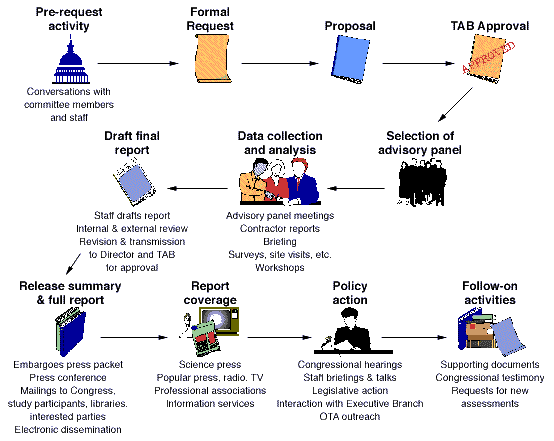 Click on thumbnail for chart of the assessment process used by the Office of Technology Assessment to advise Congress on important technology issues.
Now, think about how useful it would be to have such an agency back, to advise our nation on climate change, emergency preparedness, weapons of mass destruction in the post-Soviet era, malaria eradication policies, internet safety and security, and other key issues.
It’s time to bring back the OTA.
Mark Hoofnagle at the Denialism Blog started sounding the conch:
The fact of the matter is that our government is currently operating without any real scientific analysis of policy. Any member can introduce whatever set of facts they want, by employing some crank think tank to cherry-pick the scientific literature to suit any ideological agenda. This is truly should be a non-partisan issue. Everybody should want the government to be operating from one set of facts, ideally facts investigated by an independent body within the congress that is fiercely non-partisan, to set the bounds of legitimate debate. Everybody should want policy and policy debates to be based upon sound scientific ground. Everybody should want evidence-based government.
Go read what he said. Check in with P. Z. Myers’ view. See what John Wilkins says. Hoofnagle lists actions you can take, today, to get the ball rolling.
In the meantime, wander over to the Princeton University site where the OTA’s reports are now archived (I understand the government was going to take it offline, sort of a latter-day burning of the library at Alexandria). Noodle around and look at the report titles. Notice that, though the agency was killed dead by 1995, the agency had reports on climate change. Notice that the agency was a decade or two ahead in urging policies to encourage the internet. Look at the other issues the agency dealt with, look at the legislation that resulted — and you’ll lament with me that we don’t have the agency around today, when the issues are tougher, the technology more difficult to understand, and politics more driven by rumor than fact.
Killing the OTA was the Pearl Harbor of the present war on science. It’s time we started to fight back, to take back the scientific Pacific — our nation’s future is no less in peril now from the war on science, than it was then from hostile nations.
Resources:
6 Comments | Accuracy, Government, History, Politics, Reason, Science, Technology, U.S. House of Representatives, U.S. Senate | Permalink
Posted by Ed Darrell

From the Taos News Online.
There is just something about Taos that brings out the beauty of things, and the artistic nature of people in order to capture the beauty.
Leave a Comment » | Art, Creativity, Geography - Physical, Natural history, Technology | Permalink
Posted by Ed Darrell
You saw this last year, right?
It’s a new school year. Watch it again. Certainly it’s still a conversation starter for teachers — it maybe a good place to start conversations for students, too, in government, history, geography and economics courses especially.
Karl Fisch created the original version for a staff development session at Arapahoe High School in Littleton, Colorado. It’s gone around the world several times since then — more than 5 million viewings by some counts.
♦ Did you know that 5 million is barely more than the number of people who live in the Dallas/Fort Worth metropolitan areas?
♦ Did you know that 5 million is just 1/60th of the U.S. population (300 million)? That’s just 1.7% of the U.S.?
♦ Did you know that 5 million non-Jews also perished in the Holocaust?
♦ Did you know that the White House lost 5 million e-mails in two years? Did you know almost no one noticed?
♦ Did you know some estimates are that 5 million Iraqis are refugees as a result of the current conflict there?
♦ Did you know that the Apple iTunes Store passed 5 million hits — in June 2003?
♦ Five million is a lot — but maybe not enough. Show this, and Fischer’s site, to other people you know who should be interested.
♦ Did you know that Karl Fischer has other thought provoking presentations?
Take a look. I may have more to say about it. It is, after all, deserving of further thought.
Leave a Comment » | Education, Education quality, History, Santayana's ghost, Teaching, Technology, Technology in the classroom | Permalink
Posted by Ed Darrell
Irony sometimes means happy surprises. Cuneiform on the world wide web?
 The University of California system is working hard to deliver important information to scholars on the web. One of these projects is the Cuneiform Digital Library Initiative (CDLI). Here is the official desription:
The Cuneiform Digital Library Initiative (CDLI) represents the efforts of an international group of Assyriologists, museum curators and historians of science to make available through the internet the form and content of cuneiform tablets dating from the beginning of writing, ca. 3350 BC, until the end of the pre-Christian era. We estimate the number of these documents currently kept in public and private collections to exceed 500,000 exemplars, of which now more than 200,000 have been catalogued in electronic form by the CDLI.
Some of the photos demonstrate the beauty of everyday history and archaeology. These are instructional photos, but some are works of art. Examples of drawings of the writing are available, which can be used in the classroom to show students what the writing looks like.
The image here is described: The tablet . . . (Cornell 78)
contains an inscription of the Old Babylonian king Sinkashid of Warka/Erech (ca. 1800 BC). (copyright by Cornell University Library)
Obv. 1 {d}suen-ga-szi-id “Sinkashid, 2 nita kal-ga strong man, 3 lugal unu{ki}-ga king of Uruk, 4 lugal am-na-nu-um king of Amnanum, Rev. e2-gal his palace nam-lugal-la-ka-ni of kingship mu-du3 did build.”
Some sites in CDLI allow searches by topic. Students, consider these school tablets, and thank your lucky stars, inventors and the trees for paper and ink. Can you imagine lugging these things in a backpack?
1 Comment | Ancient history, Archaeology, Geography - Physical, Historic documents, History, History images, Images, Technology, Technology in the classroom, World history | Permalink
Posted by Ed Darrell
Can intelligence rub off from an intelligent classroom to the students?
Educational osmosis is one way to learn, I have found. I think a good classroom is one in which the student learns regardless what the student is doing, even daydreaming by looking out the window. How to achieve that? We’re working on it. In 2007, such a classroom should visually stimulate learning, and do so with sound and kinesthetics, too. Repetition in different media, with different contexts, aids learning and cementing of knowledge. But, I speak only from experience, having taken only a tiny handful of “real” education classes in my life, and they rank at the bottom of my list of useful courses.
Brian C. Smith blogs about education technology from the technology side, at Streaming Thoughts. Some time ago he asked teachers to tell about their ideal classroom technology (my response is here). Now he’s back with results of his survey — what technology do teachers need for educational success?
It may be my fault for failing to make the point, but I think a successful classroom also needs access to a photocopier that can turn around material in short order — a fast photocopier is preferred. Classrooms also need printers.
I also wonder if working ventilation and temperature control for comfort figures into the technology equation.
The ideal classroom technology is that set which allows the student to learn well, with speed and wisdom.

1 Comment | Brain learning, Classroom management, Classroom technology, Education, Education spending, Teaching, Technology, Technology in the classroom | Tagged: Brain learning, Classroom technology, Education, Research, Teaching | Permalink
Posted by Ed Darrell
Via The Pump Handle, a very good blog on public health issues, we get an article by Tom Bethell noting that a revolutionary mine communication system saved 45 lives in Utah during a mine fire in 1998. Unfortunately, most U.S. mine operators refuse to use the system, including the Crandall Mine in Huntington Canyon, Utah, where nine miners have died in the last three weeks.
Bethell is an old United Mine Workers Union writer, and might be considered biased because of his past affiliations. However, I’ve watched his work since I staffed the Senate committee that dealt with mine safety, and my experience is that his work is very good, tilted toward workers and increased safety for very good reasons.
Bethell’s article ran in the award-winning weekly newspaper, The Mountain Eagle in Whitesburg, Kentucky — operated by Tom and Pat Gish since 1956. Though nominally a small-town weekly, the newspaper’s influence is multiplied by solid reporting and followup on stories and issues that are vital to the local community. Coal mining is a big part of life in that area of Kentucky.
I cannot improve on Bethell’s writing, nor on the drama his story has naturally from its topic and the tragedy it reveals. Bethell’s article is below the fold:
2 Comments | Disasters, Government, History, Science, Technology | Permalink
Posted by Ed Darrell
You are currently browsing the archives for the Technology category.


Ed Darrell on Texas's Colorado River


Come on in, the water's fine. Come often: Cleanliness is next to godliness.


 Millard Fillmore's Bathtub