Typewriters of the moment: Isaac Asimov’s astonishingly prolific career

December 22, 2012

Isaac Asimov remains one of my favorite writers.  He wrote well enough, and his curiosity took him to topics I often find interesting.  At one time having published more books than anyone else in history on a wide variety of topics from quantum mechanics to trivia in the books of the Bible (does he still hold that record?), it was a sure bet one could find at least one book in one’s area of interest penned by Asimov.

When I started the spasmodic feature, “Typewriter of the Moment,” years ago I did a search for Asimov with a typewriter.  I didn’t find an image I thought suitable back when the internet was still operated by steam, and somehow I just never got back to that.

The other night this image popped up on one of my Facebook feeds, from “the Other 98%”:

Painting of Isaac Asimov creating at a typewriter, an early IBM Selectric. Who did the painting?

Painting of Isaac Asimov creating at a typewriter, an early IBM Selectric. Who did the painting?

I appreciate the sentiment in the quote.  Asimov noted the Dunning-Kruger Effect, even if he didn’t have the advantage of Dunning and Kruger having named it yet, and he lamented the powerful undertone of anti-intellectualism that victims of the syndrome exhibit:

Anti- intellectualism has been a constant thread winding its way through our political and cultural life, nurtured by the false notion that democracy means that my ignorance is just as good as your knowledge. (Asimov in an essay for Newsweek: “A Cult of Ignorance,” January 21, 1980, p. 19)

It’s an arresting image, a heckuva a quote, and it would make a good poster.  Plus, it’s an early IBM Selectric typewriter, marrying Asimov’s creativity with a great technological advancement in writing tools.

One boggles at the idea of Asimov with a great word processing program, a fast computer with great memory, and the internet at his disposal.  If Asimov were alive and creating today, we’d think Moore’s Law a great hindrance to the advancement of knowledge.

The painting delights me.  It’s almost photographic, and I like paintings that take great care to get small details right, photographically.  No dig at more spare or even abstract art, but this sort of painting takes great skill and great creativity.  Rising spirit-like from the typewriter’s platen we see a satellite (manned spacecraft, perhaps?), a flask of chemicals, and a leather-bound book, essential components in science fiction, and science.

So, who did the painting?  Was it done solely for that Facebook poster?

English: An IBM Selectric typewriter, model 71...

This is what that typewriter in the painting looks like, from the author’s angle. An IBM Selectric typewriter, model 713 (Selectric I with 11″ writing line), circa 1970. Wikipedia image

I’ve searched on TinEye, and Bing and Google, without success to identify the painter.

One version of the painting, before text was added, showed up at IO9, a site dedicated to science fiction, in an article discussing the writing habits of famous writers.

This does not appear to me to be the original, simply because data on the artist is not contained in the information section of the image.  The artist who did this illustration would be proud of it, and want to advertise her or his work.

This version has a slightly higher resolution; click on the image and note the reflections of lights in Asimov’s glasses, the reflections on the desk, and even the dings on the edge of the desk facing the viewer — this is great stuff!

But still I wonder:  Who was the original artist?

Any ideas, Dear Reader?

Rowena Morrill's painting of Isaac Asimov, before posterization with a quote over his head.

Rowena Morrill’s painting of Isaac Asimov, before posterization with a quote over his head.

Did Asimov write on a Selectric?  Did he switch to the newer version, with a wider carriage, or stick with the old original?  Is there a photo upon which this painting is based?

Almost immediate update:  This site claims the artist is the same as the one at the bottom of the post, Rowena Morrill.  That’s a start.  Here’s more:  At Rowenaart, both pictures appear credited to Rowena.  Mystery solved?  Go buy a poster from her; this is great stuff.

First Amendment Update, January 2015: You will want to read Asimov’s entire essay.  He’s not just insulting ignorants and ignorance; he also urges that Americans, almost all Americans, do not read enough to keep freedom alive.  For example, on the “right to know”:

There are 200 million Americans who have inhabited schoolrooms at some time in their lives and who will admit that they know how to read (provided you promise not to use their names and shame them before their neighbors), but most decent periodicals believe they are doing amazingly well if they have circulations of half a million. It may be that only 1 per cent–or less―of American make a stab at exercising their right to know. And if they try to do anything on that basis they are quite likely to be accused of being elitists.

I contend that the slogan “America’s right to know” is a meaningless one when we have an ignorant population, and that the function of a free press is virtually zero when hardly anyone can read.

More:

English: This image is a reproduction of an or...

Hello! Could this be by the same artist? Caption from Wikipedia: This image is a reproduction of an original painting by renowned science-fiction and fantasy illustrator Rowena http://www.rowenaart.com/. It depicts Dr. Isaac Asimov enthroned with symbols of his life’s work. (Photo credit: Wikipedia)


Kill Devil Hills, North Carolina: Wright Bros. National Memorial

December 17, 2012

Kill Devil Hills monument to theWright Brothers

Wikipedia description: Standing sixty feet (18.3 meters) tall and perched atop a ninety foot (27.4 meters) stabilized sand dune known as Kill Devil Hill, this monument towers over Wright Brothers National Memorial Park in Kill Devil Hills, NC. The park commemorates and preserves the site where the Wright brothers launched the world’s first successful sustained, powered flights in a heavier-than-air machine. The inscription that wraps around the base of the monument states “In commemoration of the conquest of the air by the brothers Wilbur and Orville Wright. Conceived by genius, achieved by dauntless resolution and unconquerable faith.” Photo by Ken Thomas, taken with a Panasonic Lumix DMC-FZ50 in Dare County, NC, USA.

At this site, on December 17, 1903, Wilbur and Orville Wright first achieved flight in a heavier-than-air machine.


December 17, history written in the wind

December 17, 2012

Ten feet in altitude, 120 feet traveled, 12 seconds long. That was the first flight in a heavier-than-air machine achieved by Orville and Wilbur Wright of Dayton, Ohio, at Kittyhawk, North Carolina, on December 17, 1903.

Few witnesses observed the flight.  Though the brothers Wright fully understood the potential of the machine they had created, even they waited before revealing to their supporters, and then the world, what they had accomplished.

From the Library of Congress:

On the morning of December 17, 1903, Wilbur and Orville Wright took turns piloting and monitoring their flying machine in Kill Devil Hills, North Carolina. Orville piloted the first flight that lasted just twelve seconds. On the fourth and final flight of the day, Wilbur traveled 852 feet, remaining airborne for 57 seconds. That morning the brothers became the first people to demonstrate sustained flight of a heavier-than-air machine under the complete control of the pilot.

No lost luggage, no coffee, no tea, no meal in a basket, either.  No ATC (Air Traffic Control) delays.  Neither brother endured a TSA screening.

Resources on the Wright Brothers’ first flight:

(I almost always forget the big dates until the end of the day.  This is mostly an encore post.)


Longevity of DDT, in pictures

December 16, 2012

One of the key problems with DDT is its persistence.  That was a selling point early on — one application would last for six months to a year.  In the wild or in a city, DDT can breakdown in about a year, but it breaks down into DDE which is pretty deadly itself and can cause a raft of other trouble while it hangs around.  While DDT will kill young birds and even adult songbirds outright, its most pernicious workings come in the breakdowns.  DDE insinuates itself in the reproductive organs of animals, causing birds to be unable to lay eggs with properly calcified eggshells.  Even if the DDT doesn’t kill the chicks, the DDE gets next year’s generation, making sure the egg cannot protect the chick to hatching.

A treaty adhered to by most of the world’s nations targets DDT specifically, you can tell by the name if you don’t know the content:  The Persistent Organic Pollutants Treaty (POPs), also known as the Stockholm Convention after the city where it was finally negotiated under the direction of the United Nations’ health care arm, the World Health Organization (WHO).

40 years after DDT use essentially ended in the U.S., traces of it still show up in the tissues of creatures in the wild, in plants, in crops, and in human tissue.

Where does it come from?

Most of what shows up is just circulating in the air, soil, water and living things.  There could be other sources.

I doubt this is a significant source, but a lot of DDT remains stored in barns and sheds on farms and in gardens across North America.  Over at a blog operated by an exterminator in Charlotte, North Carolina, we get a glimpse of history and potential disaster all at once.

Today, I traveled up to a Lincolnton, North Carolina Farm house to give a gentleman a price on Termite Protection for his home. After I performed an inspection, he took me out to his barn to show off a couple of old tractors. Immediately catching my eye on an old work bench was anachronistic blast from the past.

There it was, an unopened bottle of DDT. (See images below)  DDT  was Banned in the United States more than 30 years ago, and  it remains America’s best known toxic substance. Like some sort of rap star, it’s known just by its initials; it’s the Notorious B.I.G. of pesticides. And much like the Notorious B.I.G., it has been put to rest.

Electrolux Insecticide with DDT, Charlotte Pest Control Image

Electrolux Insecticide featuring DDT in the formulation, on a barn workbench in 2012, near Charlotte North Carolina – Charlotte Pest Control image

Did it really have DDT?  Look at the next photo.  It’s badly focused, but you can probably make it out, that line at the bottom of the can.

Contents label of Electrolux Insecticide, showing DDT

Label of Electrolux Insecticide can, showing DDT as the contents. Charlottepestcontrol.me image

DDT put to rest?  If only it were that easy. Not only is the stuff in that can still deadly, it’ll hang around for decades if released from the can.

You’re wondering, of course, just what in the world was Electrolux doing selling DDT?  Look at the label: See that woman using the vacuum rather like a spray device?

Cannister vacuums of the 1950s and 1960s were advertised as universal tools.  Not only would they suck up dirt from a floor, but they could also be used as blowers, simply by reversing the hole into which the hose was plugged.  Manufacturers provided attachments to make vacuums into paint blowers, powdered plant fertilizer spreaders, and liquid or powder pesticide sprayers.  See for example this page from a 1960s-era Universal canister vacuum:

Instruction manual for Universal vacuum, showing use as a sprayer of DDT or wax.  VacuumLand image

Instruction booklet for a Universal-brand cannister vacuum, showing the attachments used to turn it into a sprayer — and on page 28, a sprayer of DDT insecticide. Image courtesy of VacuumLand (go to that site to see the entire instruction manual).

The greatest dangers of DDT came from broadcast use outdoors.  These pictures show indoor use, but in application by an untrained, poorly-equipped amateur.  If your exterminator shows up in heels and pearls, fire that company and hire someone else!

In any case, vacuum manufacturers and resellers would often provide virtually every product that could be added to or used with a machine, often at very high markup.  In this case, Electrolux had some other company package DDT in a can with the Electrolux label.  That can must have been sold before 1972 when over-the-counter sales of DDT ended; it probably was before 1970, when most in-home uses of DDT were ordered to stop.   In the photos I have not detected anything to date it, but it must be at least 42 years old.

What a different time it was, when housewives used their vacuums to thoroughly spray their own homes with DDT!

More:


Selecting a replacement for South Carolina’s Sen. Jim DeMint

December 9, 2012

Pecan tree shaker

Machine used by the San Antonio River Authority, similar to one to be used in South Carolina.


Typewriter of the moment: Ava and Linus Pauling, 1957

December 8, 2012

Can you identify the typewriter?  Update: In comments, Ed Ackerman said it looks like an Olympia.  Agree?

Linus and Ava Pauling, 1957

Caption from the Oregon State University Library: Linus and Ava Helen Pauling working on “An Appeal by American Scientists to the Government and Peoples of the World”. 1957. Original held in the Ava Helen and Linus Pauling Papers, Oregon State University Libraries.

Linus C. Pauling won distinction for his science work with the Nobel Prize in Chemistry, in 1954.

The Nobel Prize in Chemistry 1954 was awarded to Linus Pauling “for his research into the nature of the chemical bond and its application to the elucidation of the structure of complex substances.”

In 1957, Chemistry Nobel Prize winner Linus Pauling turned to other issues.  Having been beaten in the race to confirm the form of DNA by Watson and Crick in 1953, Pauling turned to peace activism.  He opposed atomic weapons and wars.

In this photo, posed, Pauling and his wife who partnered with him in his campaigns for peace, worked on a statement to be issued later, to be known as “An Appeal by American Scientists to the Government and Peoples of the World.”

Note the tools of editing of the day:  Cellophane tape, glue, scissors, pencils and pens.  The typewriter’s output could be cut into strips and rearranged on a separate sheet of paper, to be retyped later in order.  This was manual, analog word processing.

An online exhibit of Pauling’s work and photos at the Oregon State Library explained the document being worked on, and its use:

While the debate raged, Pauling continued to keep a high public profile, speaking widely and appearing often in newspapers and magazines through 1956 and into 1957, garnering attention by positing shocking estimates of fallout-related damage to human health. By the spring of 1957 it appeared that his and Russell’s efforts were yielding fruit. Alarmed by the dangers of fallout, Japanese, British, German, and Indian politicians began urging a halt to H-bomb tests, as did the Pope and the World Council of Churches.

In May, after delivering a fiery anti-Bomb speech at Washington University in St. Louis, Pauling conferred with two other scientists, Barry Commoner and Edward Condon, about next steps. They decided to mount a scientists’ petition to stop nuclear testing as a way to draw attention to the concerns of a growing number of anti-Bomb scientists. Their “Appeal by American Scientists to the Government and Peoples of the World,” mimeographed and hand-mailed, garnered more than two dozen signatures within a week. Pauling took the project back to Pasadena, where he and Ava Helen, along with some volunteers, mailed hundreds of additional copies to researchers in more American universities and national laboratories. Within a few weeks they had gathered some two thousand signatures, including more than fifty members of the National Academy of Sciences and a few Nobel laureates.

On June 3, Pauling released his signatures to the world, sending copies to the United Nations and President Eisenhower. The petition made national headlines — and spurred an immediate attempt to isolate its primary author. Even the president took a shot at Pauling. “I noticed that in many instances scientists that seem to be out of their own field of competence are getting into this argument about bomb testing,” said Eisenhower, “and it looks almost like an organized affair.” This thinly veiled allusion to Communist backing for Pauling’s effort was echoed by a number of other critics of the ban-the-Bomb movement. The head of HUAC blasted Pauling on the floor of Congress for spreading Soviet propaganda. A few days later Pauling was subpoenaed to appear before a Senate investigatory committee (although those hearings were delayed, then canceled). Through it all, he continued to broaden the distribution of his petition through the end of 1957, expanding his mailing list to scientists around the world, including many in Communist countries. By the beginning of 1958, he and Ava Helen counted more than 9,000 signatures. When the expanded petition response was submitted to the United Nations, it once again made headlines worldwide.

Where is a text of the document?  I found one image of the document in holdings of the National Institutes for Health.  It’s indexed under “petitions” in the papers and documents of Linus Pauling in the Profiles of Science section.

For his work against war, Pauling won the Nobel Prize for Peace for 1962 (awarded in 1963).  Pauling is the only person to have won two Nobel awards alone, undivided with anyone else.

Does that typewriter survive today?  Is it in the collection of Oregon State University?

More:


Typewriter of the moment: Mark Twain’s Hammond

December 5, 2012

Still hoping to find a photo of Samuel Clemens at work on a typewriter.

But until then, this one will have to do:

Mark Twain's Hammond typewriter, Jerry J. Davis photo

A Hammond typewriter that once belonged to Samuel Clemens, or Mark Twain. Photographed by Jerry J. Davis, in an unstated location, probably Hannibal, Missouri

A Hammond typewriter, from oobject.com; perhaps not the typewriter that WAS pictured above; but Twain used this one, and the link to the photo above has died but good.

A Hammond typewriter, from oobject.com; perhaps not the typewriter that WAS pictured above; but Twain used this one, and the link to the photo above has died but good.

Other photos of Twain’s typewriter must exist; and since we know of at least two such machines, there must be some photos of each of them, no?  I wish museums and historians would consider the value of images of some of these objects, and make high quality photos of some of these famous machines.

Twain’s fascination with technology shines clearly in his work.  From his earliest writings we get lyrical and accurate descriptions of the mechanical workings of Mississippi riverboats, for one example.  A Connecticut Yankee in King Arthur’s Court paints a long paean to technology of the late 19th century, transplanted in the tale several centuries earlier.

Some accounts claim The Adventures of Huckleberry Finn to be the first manuscript completed by typewriter — this one, perhaps? TwainQuotes.com features what may be a description of this history:

…I will now claim — until dispossessed — that I was the first person in the world to apply the typewriter to literature…The early machine was full of caprices, full of defects — devilish ones. It had as many immoralities as the machine of today has virtues. After a year or two I found that it was degrading my character, so I thought I would give it to Howells…He took it home to Boston, and my morals began to improve, but his have never recovered.

– “The First Writing Machines”

As a publisher and investor, Twain pushed the development of automated typesetting machines to quickly publish the memoirs of former President Ulysses S Grant.  Though the books were set quickly, and the best-selling memoirs provided an income for Grant’s widow, the technology was still balky and cost Twain his own fortune.

Mark Twain's Hammond typewriter - TwainQuotes.com

Twain’s Hammond at the Mark Twain Museum in Hannibal, Missouri. Image from TwainQuotes.com. Is this the same machine pictured above? There are similarities, but differences more than just the angle.

We shouldn’t be surprised with his acerbic comments on the machines; Twain’s caustic humor targeted everything in modern life.  TwainQuotes.com notes a fraction of a letter to his longtime friend:  Twain’s Hammond at the Mark Twain Museum in Hannibal, Missouri. Image from TwainQuotes.com

The machine is at Bliss’s, grimly pursuing its appointed mission, slowly & implacably rotting away at another man’s chances for salvation.

I have sent Bliss word not to donate it to a charity (though it is a pity to fool away a chance to do a charity an ill turn), but to let me know when he has got his dose, because I’ve got another candidate for damnation. You just wait a couple of weeks & if you don’t see the TypeWriter coming tilting along toward Cambridge with the raging hell of an unsatisfied appetite in its eye, I lose my guess.

– Letter to William Dean Howells, 25 June 1875

Were things really so bad?

I regret to note that in our visit to Hannibal last June I did not encounter any typewriters.  Clearly, I’ll have to go back.

Tip of the old scrub brush to OObjects.

More:


Typewriter of the moment: Sports broadcaster Red Barber

November 1, 2012

Sportswriter Red Barber at his typewriter - Florida State Archives photo

Sportswriter Red Barber at his typewriter – State Archives of Florida, Florida Memory, http://floridamemory.com/items/show/10011

The great Red Barber, when his hair was still red, working at his typewriter, with a volume of Roget’s Thesaurus close by.

Many of us knew Red chiefly through his weekly chats with Bob Edwards at NPR’s Morning Edition.  The biographies say Red died in 1992.  That was 19 years ago — it seems more recent than that.  (Edwards left Morning Edition in 2004.)

It may be ironic to show Barber at his typewriter.  He would be more accurately portrayed, perhaps, behind a microphone at a baseball park.

From 1939 through 1953 Barber served as the voice of the Brooklyn Dodgers. He was working for the New York Yankees when he retired in 1966. Barber had the distinction of broadcasting baseball’s first night game on May 24, 1935 in Cincinnati and the sport’s first televised contest on August 26, 1939 in Brooklyn.

During his 33-year career Barber became the recognized master of baseball play-by-play, impressing listeners as a down-to-earth man who not only informed but also entertained with folksy colloquialisms such as “in the catbird seat,” “pea patch,” and “rhubarb” which gave his broadcasts a distinctive flavor. (Radio Hall of Fame)

More:


Typewriter of the moment: An old one, manual or electric (yours?)

October 25, 2012

Typewriter

A manual, Royal typewriter (Photo by mikeymckay)

It’s enough to make an old typewriter guy drive to Arizona, for more than the air (with a stop in Albuquerque at the Owl Cafe for an Owl burger, of course).

Polymath reporter Bill Geist from CBS News reported this piece for Sunday Morning, in February, featuring Mesa Typewriter Exchange in Arizona, and more:

Where is that movie on typewriters“The Typewriter in the 21st Century.”  Geist was poaching on their material a bit, wasn’t he?

Bring on the movie!

More:


Typewriter of the moment: e. e. cummings

October 25, 2012

Typewriter of the poet and author e. e. cummings:

Typewriter of e. e. cummings at NYPL, photo by Chris Wolack, WildmooBooks

Typewriter of e. e. cummings, displayed at the New York Public Library, 2012. Photo by Chris Wolack, WildmooBooks

Through March of 2012, 250 objects from the collections of the New York Public Library were displayed to celebrate the 100th anniversary of the opening of the library’s Stephen A. Schwarzman Building.  A few of the objects exhibited were typewriters, including this one.

Did you notice?  The keyboard shows only capital letters!  Did that anger cummings, or make him crazy?  Not that we can see.

More: 

Self-Portrait, Oil Painting. Cummings in the 1950s. Courtesy of Nancy T. Andrews, via Modern American Poetry


Tip of the old scrub brush to Chris Wolack at WildmooBooks.


What do your clothes see in the washing machine?

September 15, 2012

Do you ever wonder what  your clothes would see, if they could see, from inside the washing machine?

Dario Viola provides a brief answer, courtesy his waterproof GoPro camera, on Vimeo:


Encore typewriter of the moment: Mencken and the 1948 conventions

September 4, 2012


Mencken at 1948 Democratic Convention

Mencken at 1948 Democratic Convention

Photo from the collection of the School of Journalism and Mass Communication, at the Park Library, University of North Carolina.

H. L. Mencken at one of the 1948 political conventions (Thomas Dewey was the Republican nominee, Harry S. Truman was the Democratic nominee). Obviously the photo is a copy from the National Press Club Library. The Park Library site describes the photo and Mencken:

H. L. Mencken (1880-1956) was a familiar figure at many national political conventions. This photo, taken at the one in 1948, was his last political convention. He is well known for his attacks on American taste and culture, or the lack of same. His magnum opus, The American Language: An Inquiry into the Development of English in the United States, was first published in 1919 and remains a classic. From 1906 to 1941, he worked chiefly as a reporter, editor, and columnist for the Baltimore Sun. (Photo courtesy of the Baltimore Sun Library.)

Assuming Mencken covered both conventions, this photo was taken at the Democratic convention in Philadelphia in mid-July, 1948. We know it was taken in Philadelphia since both parties held their conventions there that year, the Republicans from June 21 to June 26, and the Democrats from July 12 to July 14.

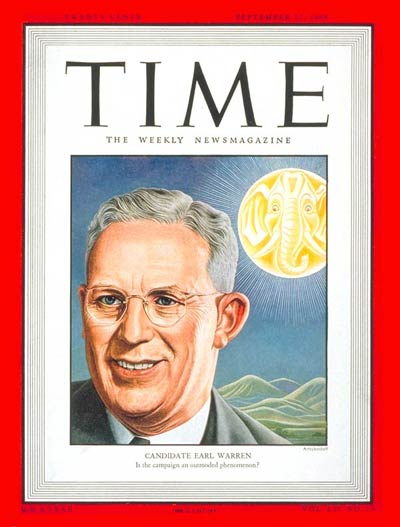
Republicans nominated New York Gov. Thomas J. Dewey and California Gov. Earl Warren for president and vice president.

After a contentious convention that saw Minneapolis Mayor Hubert H. Humphrey propose a civil rights plank that got South Carolina Gov. Strom Thurmond to walk out of the convention and found his own States’ Rights (Dixiecrat) Party (with himself as the nominee for president), and former Vice President Henry Wallace walk out because the party platform was too conservative (Wallace ran on the Socialist Progressive Party ticket), Democrats nominated President Harry S Truman and Kentucky Sen. Alben W. Barkley for president and vice president. Truman narrowly defeated Georgia Sen. Richard B. Russell for the nomination. Had Thurmond not walked out, Truman may well have lost the nomination of his own party.

And the rest of the story?

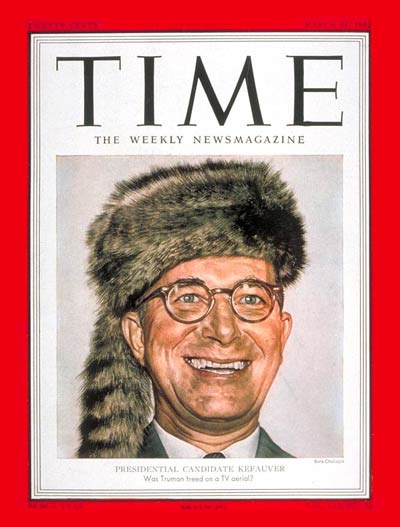
Sen. Estes Kefauver, cover of Time Magazine, 1952

Sen. Estes Kefauver

  • Truman had a contentious second term, and was defeated in the New Hampshire primary in 1952 by Sen. Estes Kefauver; Truman ended his campaign for a second full term shortly after.
  • Earl Warren was appointed Chief Justice of the Supreme Court by Truman’s successor, President Dwight D. Eisenhower, in late 1953. Warren is remembered for engineering the 9-0 decision in Brown vs. Topeka Board of Educationwhich ruled “separate but equal” school systems to violate the Constitution’s equal protection clause, and for his chairing the commission that investigated the assassination of President John F. Kennedy.  
  • Hubert Humphrey moved on to the U.S. Senate, served as Vice President to Lyndon Johnson, and won the Democratic nomination for president in another contentious convention in 1968 in Chicago. Humphrey lost the election to Richard Nixon, and returned to the U.S. Senate two years later.

    California Gov. Earl Warren, cover of Life Magazine, May 10, 1948; copyright Time-Life.

  • Strom Thurmond won election to the U.S. Senate in 1954, switching parties to Republican in 1964, and serving until his death in 2003.
  • Russell, who had served as Georgia’s senator since 1933, continued to serve to his death on January 21, 1971; he was a key member of the Warren Commission that investigated the assassination of President John F. Kennedy. The Russell Senate Office Building is named in his honor, the oldest of the three Senate office buildings.
  • Barkley was the oldest vice president ever inaugurated, aged 71. He remarried in his first year as vice president (his first wife died in 1947). Barkley’s nephew suggested that he should be called “the veep” because “Mr. Vice President” was too long. The title was seized up on by headline writers. Considered too old to run for the presidency in 1952, Barkley won a U.S. Senate seat from Kentucky in the 1954 elections, serving from 1955 to his death in 1956. Barkley Dam on the Cumberland River is named in his honor, as is the lake behind it, Lake Barkley.
  • Henry Wallace finished a distant fourth in the 1948 election, behind Dewey and Thurmond. His political career was essentially over due to his inability or unwillingness to disavow communist support. He achieved success as a chicken breeder. In a daramatic turnabout, he wrote a book, Where I Was Wrong, disavowing communism and critical of Joseph Stalin, and endorsed Republican candidates in 1956 and 1960. He died of Amyotrophic Lateral Sclerosis (ALS, or Lou Gehrig’s Disease) in 1965.
  • Dewey returned to his law practice. In 1952, Dewey helped engineer the nomination of Eisenhower over his old political nemesis Sen. Robert Taft of Ohio, pushed Richard Nixon as the Vice Presidential nominee, and in 1956 first convinced Ike to run again, and then to keep Nixon on the ticket. Dewey politely refused offers of offices, including refusing a nomination to the U.S. Supreme Court, sticking to his law practice which made him very wealthy. He died suddenly of a heart attack in 1971, at age 68.
  • Mencken suffered a stroke later in 1948 that left him unable to speak, or read, or write for a time. He spent much of the rest of his life working to organize his papers, and died in 1956. His epitaph, on his tombstone and on a plaque in the lobby of the Baltimore Sun, reads: “If, after I depart this vale, you ever remember me and have thought to please my ghost, forgive some sinner, and wink your eye at some homely girl.”

This is an encore post.  Some new links have been added — though, as you can see, I don’t yet have a better photo of Mencken at the conventions.  More news sources, below.

More, Other Sources:


Typewriter of the moment: LBJ’s teleprompter typewriter

August 6, 2012

LBJ Library photo by Mike Geissinger

July 27, 1967, in preparations for President Lyndon B. Johnson’s televised address to the Nation concerning civil unrest in American cities, an unidentified White House Staff member types President Johnson’s address for a teleprompter – LBJ Library photo by Mike Geissinger, public domain (Other sizes of photo available at LBJ Library site)

The first personal computers were more than a decade away.  Today’s teleprompters — a computer screen mounted to reflect into a glass in front of a television camera lens — had not been conceived.  Teleprompters were cathode-ray tube televisions attached to a massive television camera with a clunky device.  The image would be reversed to reflect correctly.  Into that television would be a closed-circuit feed of a scrolling piece of paper on which was typed, in very large letters, the script the speaker was to read.  In this case, of course, the speaker was the President of the United States, Lyndon B. Johnson.

In 1967, a special typewriter was required to type out the oversized-font, easy-to-read script on a roll of paper with sprocket holes along the side to enable an automated scrolling.

Just looking at the equipment for the technology of the time is an education.

Schematic of teleprompter system, from Wikimedia Commons

Schematic of teleprompter system:
1. Video camera
2. Shroud
3. Video monitor
4. One-way mirror
5. Image from subject
6. Image from video monitor

Teleprompters allow someone reading a script to look directly into the television camera lens, giving an impression to a viewer that the person is speaking directly to them, instead of glancing down at a script and back at a camera.  Research showed viewers tend to grow disinterested in people looking down at a script, and would more likely be engaged by someone appearing to look at them.

Teleprompters existed in the 1950s, but many local television stations did not use them until into the 1960s — news broadcasts of the time often featured the anchors reading from written scripts on a desk in front of the broadcaster.  A few intrepid news anchors, throwbacks to a more theatrically-inclined era, would memorize an entire script every night.

The schematic is based on modern, smaller television cameras and modern, thin devices to project the word images.  Older versions were larger — sometimes much larger.

Ed Mason as a studio technician, adjusting the teleprompter before a local broadcast - WCIA TV (Illinois) circa 1957

Ed Mason as a studio technician, adjusting the teleprompter before a local broadcast, WCIA television, Channel 3 in Champaign, Illinois; photos from site of DougQuick.com, an on-line tour of history of broadcasting

One popular version put a simple paper scroller mounted above the lens of the very large, studio television cameras — a broadcaster’s eyes could focus an inch above the lens, and viewers couldn’t tell he or she was not looking directly into the lens.

Modern teleprompter mounted on television camera, circa 2005 - Wikipedia image

Modern teleprompter mounted on television camera, circa 2005; text is projected from a thin screen on the top of the camera lens – Wikipedia image

Teleprompters emerged as a symbolic political whipping device in the early 21st century. Partisans wishing to impugn the intelligence of a politician complain that he or she cannot speak extemporaneously, without a script. Oddly, the charge was rarely leveled at President Ronald Reagan, famous for his use of scripts in almost every situation. Reagan’s White House pushed modernizing of the technical devices employed at the White House, including the latest in teleprompter devices.

The most frequently-seen politician-used teleprompters today are simple stands, “conference” teleprompters, designed as much to allow a speaker to use teleprompters with a live audience as to facilitate television use.  The devices are simple stands with a highly-reflective, clear plastic or glass on the top, and computer screen on the floor shining up.

A modern,

A modern, “conference” teleprompter of the style usually seen at public appearances by politicians.

Modern teleprompters cost a fraction of earlier versions.  Everybody uses them now — I’ve even heard of first-time candidates who did not have to go to teleprompter school.

Here I am, reading from a teleprompter at the George H. W. Bush Library and Museum in College Station, Texas, in 2011:

Ed Darrell tries out the Presidential podium and teleprompter

Here I am trying out the teleprompter and podium at the George H. W. Bush Library and Museum, College Station, Texas, in 2011.

And more people using teleprompters, with years in captions, so far as I can get them.

Teleprompter script used by President Kennedy; JFK Library collection, image by thewastesmile

Teleprompter script used by President John F. Kennedy, from Kennedy Library collection; image by a private party.

President Reagan using a teleprompter, in speech from the Oval Office - undated

President Reagan often used teleprompters — in a computerized form by then.

Teleprompter in use:  LBJ addresses the nation prior to signing the Civil Rights Act of 1964, on July 2, 1964 - LBJ Library and Museum photo

Teleprompter in use:  In the White House East Room, President Lyndon B. Johnson used a teleprompter to address the nation in a live television broadcast, just before he signed the 1964 Civil Rights Act. People watching include Attorney General Robert Kennedy, Senator Hubert Humphrey, First Lady “Lady Bird” Johnson, Rev. Martin Luther King, Jr., F.B.I. Director J. Edgar Hoover, Speaker of the House John McCormack. Television cameras are broadcasting the ceremony.

A more modern use:

Judy Licht using a teleprompter in a broadcast from Italy.

Broadcaster Judy Licht using a teleprompter in broadcast or taping from Piazza Duomo, Milan, Italy, in September 2007.


Notebook – an animation look at reality in a digital age

August 4, 2012

I’m up for a brilliant little idea not carried on too long.

Stumbled into this film from four years ago.  The producer/director/creator explains it:

Noteboek (English title: Notebook) consists of 4 short experimental films where I try to confuse the reality.
In these films, illusions and expectations are challenged.

Noteboek is a short film and part of my graduation project.

[Music: The White Stripes-Seven Nation Army.]

And where is Evelien Lohbeck today?

If you want to see more work please visit:
evelienlohbeck.com

The guy’s woman’s got a wicked sense of the surreal, and a good sense of humor.

Tip of the old scrub brush to Le Web  . . . et le reste.

More:


Typewriter anniversary: July 23, 1829, William Austin Burt’s “typographer”

July 23, 2012

An encore post, history we need to remember.

National Typewriter Day, July 23?  Type a letter to your mom, to celebrate.

William Austin Burt received a patent on a typographer on July 23, 1829 — signed personally by President Andrew Jackson.

First patent issued for a typewriter, July 23, 1829, to William Austin Burt -- signed by Andrew Jackson

Image of the first patent issued for a typewriter, July 23, 1829, to William Austin Burt, a Michigan surveyor and inventor. It was signed personally by President Andrew Jackson.

The typographer is considered the forerunner to the typewriter.

Burt’s chief reputation came from his work as a surveyor in Michigan. He discovered the massive iron ore deposits for which Michigan became famous, the iron that fueled much of American industrialization in the 19th and 20th centuries. He discovered one of the world’s largest deposits of copper, the Calumet and Hecla Mine. He invented the solar compass, to survey areas where iron deposits made magnetic compasses inaccurate.

English: Typographer patent 1829 by William Au...


Patent drawing of W. A. Burt’s typographer, the first patented typewriter – Wikimedia image

Some of Burt’s biographies do not mention his invention of the typewriter.

Burt was born in an era of great technological development and invention. People in all walks of life invented devices to aid their work, or just for the joy of invention. Even future president Abraham Lincoln invented a device to float cargo boats in shallow water, hoping to increase river commerce to his home county, Sangamon County, Illinois.

William Austin Burt

William Austin Burt (Photo: Wikipedia)

Burt invented devices to aid his work in surveying, a very important service industry in frontier America. Because surveyors often worked on the frontier, they were famous for discovering natural resources in the course of their work. So it was that Burt, working in the Upper Peninsula of Michigan, found his magnetic compasses spinning wildly. Suspecting a natural phenomenon, Burt ordered his crew to look for ferrous rocks, and they quickly determined they were in an area rife with iron deposits.

It was to further surverying in such areas that Burt invented the solar compass.

Even uninteresting frontiersmen could lead lives that fascinate us today. Was it Burt’s inventiveness that led him to such a life as a surveyor, or was it his work that pushed him to invent?

First typewritten letter, 1829 - Wikimedia Image

First letter ever written on a typewriter, in 1829 — to Martin Van Buren, then Vice President of the U.S., and future president. Notice the letter was written nearly two months prior to the patent being issued on the device upon which it was written. Wikimedia image