Northland Poster Collective dead; long live Ricardo Levins Morales

September 25, 2011

Great posters with provocative aphorisms came out of the Northland Poster Collective.  Alas, Northland called it quits in 2010.

One of their best artists, Ricardo Levins Morales, continues the fight at his own site.  Morales is the guy who made this work, on the importance of standardized student tests:

Testing, by Ricardo Levins Morales

Testing, by Ricardo Levins Morales

Earlier I questioned whether Einstein actually said that.  I don’t think he did — but I love the poster and the sentiment, all the same.  I haven’t been able to verify the quote in Alice Calaprice’s The Ultimate Quotable Einstein, for example.

In my classroom the air conditioning often did not work last spring, at testing time.  When we’d open the windows, we’d get visitors — usually bees, but birds on at least two occasions.  The student in the picture has her priorities right.

The poster is just $10.95.  Teachers, if a dozen of these appeared in your school, it might make a difference.


“Is our media learning?” Test scores require raises for public school teachers, don’t they?

September 10, 2011

Mike the Mad Biologist makes the case succinctly and clearly (teachers, observe his methods):

That shudder you felt was the Earth wobbling as an . . .

. . . education story actually covered U.S. students’ academic achievement during the last few decades accurately. I’ve made the point before that the claim of stagnating test scores for U.S. students is demonstrably false–in every demographic group, there has been a rise in achievement (and the minority-white achievement gap is closing to boot). Shockingly, in a Slate report on Steven Brill’s new book Class Warfare, Richard Rothstein sets up Brill with this:

The case they make for their cause by now enjoys the status of conventional wisdom. Student achievement has been stagnant or declining for decades, even as money poured into public schools to improve teacher salaries, pensions, and working conditions (reducing class sizes, or hiring aides to give teachers more free time). Teachers typically have abysmally low standards, especially for minorities and other disadvantaged students, who predictably fall to the level of their teachers’ expectations. Although teachers’ quality can be estimated by the annual growth of their students’ scores on standardized tests of basic math and reading skills, teachers have not been held accountable for performance. Instead, they get lifetime job security even if students don’t learn. Brill observes a union-protected teacher in a Harlem public school bellowing “how many days in a week?,” caring little that students pay him no heed and wrestle on the floor instead.

Protecting this incompetence are teacher unions, whose contracts prevent principals from firing inadequate (and worse) teachers. The contracts also permit senior teachers to choose their schools, which further undermines principals’ authority. Union negotiations have produced perpetually rising salaries, guaranteed even to teachers who sleep through their careers. Breaking unions’ grip on public education is “the civil rights issue of this generation,” and some hard-working, idealistic Ivy Leaguers and their allies have shown how.

And then knocks him down with:

Central to the reformers’ argument is the claim that radical change is essential because student achievement (especially for minority and disadvantaged children) has been flat or declining for decades. This is, however, false. The only consistent data on student achievement come from a federal sample, the National Assessment of Educational Progress. Though you would never know it from the state of public alarm about education, the numbers show that regular public school performance has skyrocketed in the last two decades to the point that, for example, black elementary school students now have better math skills than whites had only 20 years ago. (There has also been progress for middle schoolers, and in reading; and less, but not insubstantial, progress for high schoolers.) The reason test score gaps have barely narrowed is that white students have also improved, at least at the elementary and middle school levels. The causes of these truly spectacular gains are unknown, but they are probably inconsistent with the idea that typical inner-city teachers are content to watch students wrestle on the classroom floor instead of learning.

The question we need to ask is “Is our media learning?” (to steal a phrase from Little Lord Pontchartrain).

Maybe they are . . .

Brill, God bless him, proposed to shake up public schools in America a few weeks ago in a long article in the Weekend Wall Street Journal.  His solution?  Make AFT local leader Randi Weingarten superintendent of New York’s public schools.

Actually, his story was much better than his advocacy.  But I hope to get more commentary on that proposal, and this continuing War on Education and War on Americans, soon.


Should parents take their kids out of the education testing race?

September 5, 2011

Bunch of opposite-editorial page articles say states ought to get off the testing treadmill, do some real walking instead.  Is it a national movement?

One of these pieces explained:

For example, Tim Slekar, a professor of education in Pennsylvania, opted his son Luke out of his state’s tests last school year to “make my community aware and to try and enlighten them of the real issues.” This parent and professor’s plea is simple and forceful: “Stop treating my child as data! He’s a great kid who loves to learn. He is not a politician’s pawn in a chess game designed to prove the inadequacy of his teachers and school.”

If it’s not a national movement, should it be?

List of Op-Eds which support opting out of the state test in order to save the public schools:

http://www.baltimoresun.com/news/opinion/oped/bs-ed-school-testing-20110825,0,7660909.story

http://www.huffingtonpost.com/timothy-d-slekar/public-schools-are-not-ne_b_943803.html

http://www.dailykos.com/story/2011/08/28/1011377/-Empty-Test-Chair-by-Empty-Test-Chair

http://www.examiner.com/education-reform-in-baltimore/opt-out-or-give-up-resistance-shades-of-grey

http://pegwithpen.blogspot.com/2011/09/why-opt-out-of-state-test-better.html

http://www.realhartford.org/2011/08/31/back-to-school-guide-reclaiming-your-childs-education-22/

http://liukarama.typepad.com/empowermagazine/2011/08/back-to-school-advice-opt-out-of-standardized-tests.html

http://www.cnn.com/2011/US/03/20/pennsylvania.school.testing/index.html

http://blogs.edweek.org/teachers/teacher_in_a_strange_land/2011/09/opting_out.html

http://www.marionbrady.com/articles/Orlando_Sentinel_Column/arts.html

http://www.newdemocracyworld.org/old/shove.htm

http://www.dailykos.com/story/2011/08/28/1011377/-Empty-Test-Chair-by-Empty-Test-Chair

http://www.huffingtonpost.com/timothy-d-slekar/i-am-more-than-a-test-sco_b_921279.html

http://www.edubiquity.org/?p=110

When parents choose to get their kids out of the test, do the kids know why, and do they develop any greater love for learning?  If so, I’m for it.

But, parents, don’t take your kid out, so your kid can sit in my class wasting his time, my time, and other students’ time, saying “I don’t have to learn this stuff.”

_____________

Much more detail on the issue and events at Real Hartford.


A Seussian fable, about how tests ruin school reform

April 7, 2011

Look, you really need to go to TeacherSabrina’s blog, Failing Schools, where she first posted this, and take a look at many of her posts.

But I can’t resist putting the video here, because I know a few old-timers would be confused by the link, and some people will think they don’t have the time to make two clicks instead of one.

So, here, in its Seussian glory and demand for Flash Animation, is TeacherSabrina’s story of D.C.’s late Queen of the Schools, Michelle Rhee, and her desire to get D.C.’s kids to score well on an increasing battery of tests  [Got a good joke about assault and battery we can insert here?]:  “Rhee the Reformer:  A Cautionary Tale.”

Tip of the old scrub brush to Accountable Talk.


Where does your state, or nation rank? Advanced level of math proficiency

December 27, 2010

I had to turn the graphic on its side to fit it in here big enough that you can read it. Where does your state, or nation, rank in percentage of students achieving an advanced level of math proficiency? For U.S. citizens, this is not a pretty chart.

Source: The Atlantic, “Your Child Left Behind” and acccompanying charts, “Miseducation Nation,” November 2010.

Math proficiency, country and state comparisons, The Atlantic, 2010

Where does your state, or nation, rank?

Hey, at least we’re ahead of Tunisia and Kyrgyzstan.  Can your students find those nations on a map?  Do they know what continents to look in?

Tip of the old scrub brush to McLeod’s Cartoons.


Texas ranks ahead of Indiana in higher level math proficiency!

December 26, 2010

That’s not really great news — Texas loses to Lithuania.

But without changing the captions on this great cartoon from McLeod Cartoons, it’s about the best we can say.

McLeod Cartoons on U.S. math achievement

Bragging with little to brag about -- your child left behind

McLeod’s inspiration came from The Atlantic’s report, “Your Child left Behind.”


New paradigm for education

October 31, 2010

Not sure where this guy, Sir Ken Robinson,  is going — nor especially how it would relate to education in the U.S. (this group is from Britian — hear the accent?).

The animation is great — I’d love to have someone who could do this for quick history lessons to correspond with what we’re supposed to be doing on the curriculum calendar.

Plus, of course, he’s right.  We need less standardization, and more personalization.  Firing teachers frustrates both ends of that equation. He’s right — the schools are headed in the wrong direction.

I’ll wager Arne Duncan has never seen this.  Any of our old friends at Education know?  I’ll wager this speech and film drop into the abyss, regardless the credentials of Sir Ken Robinson and the good intentions of RSA.

RSA is the acronym for the clumsily-named Royal Society for the encouragement of Arts, Manufactures and Commerce.  “RSA” is a deft recovery from such a nomenclaturical handicap.

This RSA Animate thing has some potential — a lot like some of the animation schemes used by network news.

Resources:


2010 Texas Democratic Platform: Education (preface)

June 28, 2010

This post is second in a series on the education planks of the 2010 Texas Democratic Party Platform.

This is an unofficial version published in advance of the final version from the Texas Democrats, but I expect very few changes.

EDUCATION

Texas Democrats strongly support our Constitution’s recognition that a free, quality public education is “essential to the preservation of the liberties and rights of the people.” Texas Democrats believe a world class education system is a moral imperative and an economic necessity that requires parents, educators and community leaders to work together to provide our children the skills needed to compete and succeed in a global economy.

Texas Democrats believe all children should be able to attend a safe, secure school and have access to an exemplary educational program that values and encourages critical thinking and creativity, not the “drill and kill” teach-to-the-test policy Republicans have forced on students and teachers. To fulfill this commitment, Texas Democrats continue leading the fight to improve student achievement, lower dropout rates, and attract and retain well-qualified teachers.

Democrats also believe it is essential that all Texans have access to affordable, quality higher education and career education programs, with a renewed emphasis on the importance of a full four year college education, and particular attention to science, technology and engineering.


Race to the Top: What’s a good job for a great bubble-guesser?

June 22, 2010

Education issues suffered here at the Bathtub over the past several months.  Confession:  I don’t like to write while angry, and thinking about education generally gets me there quickly.  When I write in anger, I like to sit on the stuff and edit when I’m cooled down.  But when I get back to edit, I get angry again.

If you watched the follies from the Texas State Soviet of Education over social studies standards, you might understand some of my anger.  I’m fortunate in some ways that my students don’t track the news more closely — they tended to miss the Soviet’s gutting of Hispanic history from Texas history standards, and so they didn’t get angry.  More than 85% of my students are Hispanic, many related to the Texas heroes dropped from the standards because they were brown (“What’s Hispanic Heritage Month for, anyway?” the Soviet probably wondered.)

Test bubbling, from TweenTeacher

Power of Bubbling -- for a scary story, click on the image and go read it at TweenTeacher

Plus, time for thinking about these issues evaporated during the school year.   Summer isn’t much better, though a bunch of us had eight great days with members of the history department at UT-Arlington focusing on the Gilded Age, Progressive Era, Age of Imperialism . . . even though reminded every day that the Texas Soviet doesn’t want us to teach that period as it is recorded in the history books.  (No, there are not plans for a translation into Texas Soviet Speak, at least not soon.  Teachers will have to make do.)

In one of our (too) many testing/oath-signing sessions this spring, a colleague cynically wondered what would be a good job for a kid who does well on the tests, a kid who has “demonstrated mastery of bubble-guessing.”

Bubble-guessing.  Wow.  Is that an apt description for what many schools teach these days!

I have a few days to put up the periscope and see what is going on out there.  A couple of things I’ve noticed, that you may want to follow:

Yong Zhao noticed that the Race to the Top criteria shouldn’t be etched in stone, and that small changes result in different winners. He’s actually more critical than that — he’s not just saying that the criteria can change.  He’s saying the criteria are lousy.

Education has a new god: data. It is believed to have the power to save American education and thus everything in education must be about data—collect more data about our children, evaluate teachers and administrators based on data, and reward and punish schools using data.

Sound familiar?

Zhao points to serious analyses of the Race to the Top applications and rejections which show, among other things, Pennsylvania was penalized for focusing on early childhood education, instead of collecting data.

Why was it we got into this swamp in the first place, and where did all these alligators come from?

Go read Zhao’s analysis, and maybe cruise around his blog.  It’s worth your while.  He’s a professor at Michigan State — University Distinguished Professor of Education.  (One thing you should read there:  Zhao’s slides from a recent speech.  E-mail the link to your principal.  Somebody find a YouTube version of that speech, please.)  [Checker Finn, do you ever get over to this backwater?  Zhao’s on to something.  Zhao’s on to a lot of things.]

Race to the Top is the worst thing the Obama administration has done, in my opinion.  It is aimed, or mis-aimed to give us a nation of bubble-guessers.  My guess is that aim is unintentional.  But the road to hell, or a Republican majority . . .

While we’re looking around, pay some attention to David Warlick’s 2¢ worth.  That’s where I found the links to Zhao.

Warlick has a couple of points worth pondering today:  First, has the technology train left the station, and so it’s no longer acceptable for teachers to use old tools?  He’s got a rant on trying to figure out if we’re teaching the “right stuff”:

I could have shared some of these new ideas with her, but it would not have helped.  The last time I helped my daughter prepare for a test, it was 8th grade and the unit test on the Civil War.  When she walked into that classroom, she could talk about and write about the reasons for the war, what the North and the South wanted to achieve, the advantages that the North held and those of the South, as well as their disadvantages.  She could tell you who won and who lost and why.

She made a 52 on the test because she couldn’t give the dates of the major battles of the war.

One of our mantras in the old Transportation Consulting Group at Ernst & Young was to understand that “You’re always ready to fight the last war.”  For what we were doing, generally we had to change the technology for each assignment.

That’s doubly true in education, in social studies, I think.  I constantly remind myself that my students don’t need the same things I got in high school.  We shouldn’t equip students to fight the last war, but instead prepare them to understand they need to get ready for the next one.

And what about your tags?  Warlick wonders. No answers, but good wonderings.


Ravitch calls the issue: Will public education survive?

May 1, 2010

Diane Ravitch in Dallas, April 28, 2010 - IMGP3872  Copyright 2010 Ed Darrell

Diane Ravitch in Dallas, April 28, 2010 – Copyright 2010 Ed Darrell (you may use freely, with attribution)

Bill McKenzie, editorial board member and writer for the Dallas Morning News, wrote briefly about the rekindled controversy over standards a year ago — but did he listen to Diane Ravitch on Wednesday night?

He should have.

I first met Ravitch a couple of decades ago when I worked for Checker Finn at the Office of Educational Research and Improvement.   Ted Bell’s idea of a commission to look at education quality, and it’s 1983 report, saved the Reagan administration and assured Reagan’s reelection in 1984.  She was one of the most prodigious and serious thinkers behind education reform efforts, then a close friend of Finn (who was Assistant Secretary of  Education for Research) — a position that Ravitch herself held in the administration of George H. W. Bush.

Ravitch now criticizes the end result of all that turmoil and hard work, the No Child Left Behind Act, and the way it has distorted education to keep us in the crisis we were warned of in 1983.  Then, the “rising tide of mediocrity” came in part because we didn’t have a good way to compare student achievement, state to state.  Today, the mediocrity is driven by the tests that resulted from legislative efforts to solve the problem.

Conditions in education in America have changed.  We still have a crisis after 27 years of education reform (how long do we have a crisis before it becomes the norm), but for the first time, Ravitch said, “There is a real question about whether public education will survive.”  The past consensus on the value of public education and need for public schools, as I would put it, now is challenged by people who want to kill it.

“The new issue today:  Will we have a public education system bound by law to accept all children.”

Ironic, no?  The No Child Left Behind Act has instead created a system where many children could be forced to the rear.

I took an evening in the middle of a week of TAKS testing — the Texas Assessment of Knowledge and Skills.  With ninth through twelfth grades, we had four days of testing which essentially requires the shutdown of the education for the week (we had Monday to review for the test).  It was a week to reflect on just how far we have strayed from the good intentions of public education advocates who pushed the Excellence in Education Commission’s report in 1983.

Ravitch spoke for over an hour.  I’ll have more to report as I get caught up, after a month of meetings, test prep, testing, and little sleep.

Background, more:


Diane Ravitch’s “U-turn”: The teachers were right

March 4, 2010

Were I to advise Diane Ravitch right now, I’d tell her to change all her computer passwords and redouble the security on her servers.  Why?  After what happened to the scientists who study global warming, I expect many of the same wackoes are working right now to get her e-mails, knowing that the mere act of stealing them will be enough to indict her change of heart on education in America.

It’s much the same mob crowd in both cases.  [I’m hopeful it’s not a mob.]

Dr. Ravitch thinks big thoughts about education.  She stands in the vanguard of those people who are both academically astute in education, and who can make a case that appeals to policy makers.  Working under Checker Finn at the old Office of Educational Research and Improvement, we quickly got familiar with Ravitch’s works and views.  Finn and Ravitch, good friends and like-minded in education issues, were the running backs and sticky-handed receivers for any conservative education quarterback, back in the Day.

Finn was Assistant Secretary of Education for Research under Bill Bennett.  Ravitch succeeded Finn, under Lamar Alexander.  While Bennett and Alexander took troubling turns to the right, and Finn stayed much where he was, Ravitch has been looking hard at what’s working in schools today.

Ravitch doesn’t like the conservative revolution’s results in education.  She’s changed her views.  Says one of the better stories about her changing views, in The New York Times:

Once outspoken about the power of standardized testing, charter schools and free markets to improve schools, Dr. Ravitch is now caustically critical. She underwent an intellectual crisis, she says, discovering that these strategies, which she now calls faddish trends, were undermining public education. She resigned last year from the boards of two conservative research groups.

“School reform today is like a freight train, and I’m out on the tracks saying, ‘You’re going the wrong way!’ ” Dr. Ravitch said in an interview.

This is big stuff, and good news to teachers who, since I was at Education in 1987, have been telling policy makers the same things Ravitch is saying now.

David Gardner and Milton Goldberg wrote in the report of the Excellence in Education Commission in 1983 that America faces a “rising tide of mediocrity” because of bad decisions.  That’s true of much education reform today, too.

Gardner and Goldberg also said that, had a foreign nation done that damage to us, we’d regard it as an act of war.

Maybe Ravitch’s turn can help mediate an end to the Right’s War on Education and pogroms against teachers.

Here in Texas the conservatives on the Texas State Board of Education didn’t like Ravitch’s views when she was in the conservative camp, so Texas has started, finally, to vote out commissioners who don’t get it, who prefer a state of war on Texas’s children to promoting public education

Let’s hope more people listen to Ravitch now.

More:

Be sure to listen to the NPR interview from Morning Edition, yesterday (you can read it, too).

And, in next Sunday’s New York Times Magazine, a story about how to build a better teacher; do you know the difference between testing and teaching?


Social studies train wreck at Texas State Board of Education: Live! A Nation at Risk

January 13, 2010

Steve Schafersman will live blog the hearings on social studies standards before the Texas State Board of Education (SBOE) today, at Evo-Sphere.  Schafersman is president of Texas Citizens for Science, and a long-time activist for better education in Texas on all topics.

Rapid updates or live-blogging should be available at the blog of the Texas Freedom Network, TFN Insider.

It’s Item #6 on the SBOE agenda, with a title that tips off the trouble:

Item #6 — Public Hearing Regarding Proposed Revisions to 19 TAC Chapter 113, Texas Essential Knowledge and Skills for Social Studies, and Chapter 118, Texas Essential Knowledge and Skills for Economics with Emphasis on the Free Enterprise System and Its Benefits.

Schafersman e-mailed an introduction to the meeting:

Some say the Social Studies public testimony by the religious right, liberals, etc., then the SBOE debate, motions to amend, votes, etc. is a bigger circus than adopting the science standards. Judge for yourself. You can watch the entire circus, carnival, and sideshow on the webcast video at http://www.texasadm in.com/cgi- bin/tea.cgi

This is Texas democracy in action, when sullen and tight-lipped State Board members listen to public testifiers for 3 minutes each and profoundly ignore them since they already know what they are going to do. But I, at least, feel better after speaking so I don’t later feel responsible for the crappy amendments, changes, and policies that come out of this horrible Board because I did nothing. The proposed Social Studies standards written by the panels composed of teachers and professors are excellent (when have I heard this before), but the SBOE can’t wait to shamelessly impose their own Religious Right agenda on them.

You’ll recall that SBOE has at every possible turn disregarded the advice of famous and serious historians, respected free-market-advocating economists, geographers and educators on these standards.  Economists, for example, want Texas kids to learn about “capitalism,” since that’s what it’s called by economists and policy makers, and colleges.  SBOE thinks “capitalism” sounds too subversive, and wishes instead to require Texas kids to learn about “free enterprise” instead.

‘A rose by any other name’ you think, until you start thinking of how Texas kids do on standardized tests, college admission exams, and the punchline on the joke, about Texas kids being told not to study capitalism.  No siree, no capitalism in the fictional home of J. R. Ewing, never mind the real-life capitalists like T. Boone Pickens or H. Ross Perot (Jr. and Sr.).

In Dallas, the city prepares to name a street after Cesar Chavez, the great Hispanic union organizer and advocate for working Americans.  In Austin, SBOE works to strike all mentions of Chavez, because they dislike the politics of heroes of our ethnic minorities (soon to be a majority in Texas).  In Washington historians and policy-makers follow the legacy of Thurgood Marshall, the great civil rights attorney and first African-American to sit on the U.S. Supreme Court.  In Austin, SBOE thinks Marshall should be left out of history books.  Many of us suspect he’s anathema to the white right-wing in Austin:  A smart, successful and noble man of color.

Mel and Norma Gabler died years ago, but their history lingers in the halls of education policy in Austin.  It’s Shakespearean.

This is a massive battle.  David Barton worked for 30 years to gut history standards nationally to teach a history of America that never was, and as the official religionist appointee of the right-wing SBOE members, he stands on the brink of accomplishing much of the revisionism he’s advocated.  See the Texas Tribune story on the issue, “Hijacking History.”

Generally we shouldn’t negotiate with terrorists, Ronald Reagan said.  At the SBOE, we’ve put the terrorists in charge of history and economic curricula — if not the terrorist themselves, at least the terrorists’ camels’ noses.  Texas’s process has earned flashing red-light, claxon-sounding repeating of the words of Ronald Reagan’s Commission on Excellence in Education:  If a foreign nation did this to us, we’d consider it an act of war [excerpt below the fold].

Make no mistake about it.  SBOE’s goal is to roll back any of the reforms left from Reagan’s Commission’s work.  Our nation is more at risk from foreign competition than ever before.  SBOE plans to give away a bit more of our future to China, this week.

Our saving grace is the general incompetence of SBOE members to make significant reform in Texas’s wounded schools, reeling from unworkable and damaging requirements under the No Child Left Behind Act and a testing program that severely limits what can be taught in any social studies course other than those bastions of learning left in International Baccalaureate programs and Advanced Placement courses (estimates are that between 5% and 10% of Texas high school students can take one of those good courses).  Whatever silliness, craziness or lies SBOE orders to  be taught, it can’t be taught and tested well.  Inertia preventing change works to save America in this case.

In business, most CEOs at least appreciate the value of having good front-line employees who are the ones who really deliver the service or product and produce the profit of the enterprise (even if they don’t treat those employees so well as the employees deserve).  Education may be the last bastion of flogging the horse that should be pulling the cart instead.  In this case, having well-trained teachers in the classroom is the last hope for Texas, Texas parents and Texas students — and Texas’s economic future and future in liberty.  Teachers are the last defense of freedom in Texas.  Today SBOE will make another assault on the ramparts that protect the teachers in their work.

When will the French fleet arrive to lend aid?  Will it arrive at all?  And if it arrives, will Texas kids know better than to shoot at the ships?

Carol Haynes, who claims to have a doctorate in some discipline, told the board how to rewrite the standards to completely change the history of the civil rights movement in their last hearing on the topic.  According to Haynes, apparently, Dr. Martin Luther King, Jr., was opposed to civil rights and Barry Goldwater was in favor — the Board didn’t offer to correct her revisionism, but instead asked her to go beyond her three minutes in fawning acceptance. This appears to be SBOE’s approval of various Other Universe hypotheses offered by Star Trek, allowing any damned thing at all to be taught as history (except the right stuff).  Haynes is scheduled to testify again (#128), probably very late at night, but perhaps in time for the 10:00 p.m. Texas television news broadcasts.  Oy.

Excerpt from the Report of the Commission on Excellence in Education, A Nation at Risk, below the fold.
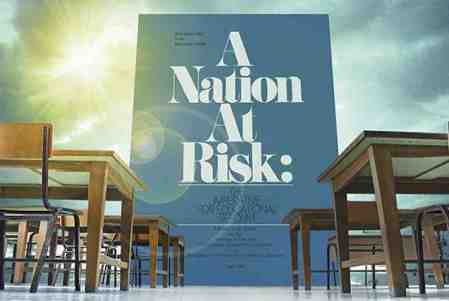
ae_summer2015mehta_opener-1100x736

Cover of A Nation at Risk: The Imperative for Educational Reform, the 1983 report that started the education reform mess. AFT graphic.

Stand up for your nation, it’s children and future; sound the alarm:

Add to FacebookAdd to NewsvineAdd to DiggAdd to Del.icio.usAdd to StumbleuponAdd to RedditAdd to BlinklistAdd to TwitterAdd to TechnoratiAdd to Furl


Read the rest of this entry »


If at first you don’t succeed . . .

November 7, 2009

. . . try again, and then quit, Mark Twain said.  “No use being a fool about it.”

All I can say is, I’m happy she is not working to get a license to drive a bus.

(News story:  Woman passes written test for drivers license on 950th attempt.)


Nation’s best, but sub-par in Texas school ratings

September 18, 2009

In discussing the Broad Prize won yesterday by Aldine Independent School District (near Houston), William McKenzie, an editorial writer at the Dallas Morning News unintentionally summed up part of the problem with Texas’s testing-uber-alles school ratings, at the DMN’s blog site:

Like Brownsville last year, the state only recognized Aldine as an “acceptable” district, not a “recognized” or “exemplary” one. That could be for several reasons, but the best way to look at the difference between the state’s ranking and Aldine’s Broad Prize is that Aldine is showing substantial progress but still has a high mountain to climb before it’s on a par with suburban districts that do reach the exemplary level.

It doesn’t matter if your district has two of the top high schools in the nation on the Newsweek ratings, as Dallas ISD does.  It doesn’t matter if 85% of a high school’s kids go to great colleges with lots of scholarship money.  A school can get hammered by statistical flukes.

Too often teachers are pushed to focus on getting the subpar up to mediocre.  A school gets no additional credit, in state rankings, for championship performance in the top tier of its students — and so some of the best performing schools in Texas have rankings less than they should have.

It’s nice that Aldine ISD got the Broad Prize.  That prize recognizes outstanding achievement by students in many areas.  But it counts for absolutely nothing in the state’s rankings of schools and districts.

Remember, Texas is one of those states where International Baccalaureate programs come under fire for requiring kids to read “suspect” books, and study hard, and where AP-required course material is dismissed as wrong by members of the State Board of Education.

For teachers in Texas, daily floggings will continue until teacher morale improves enough to push scores up.  Or until someone in authority gets rid of the flogging (I was going to say “shoots the flogger,” but this is Texas; somebody might start shooting).


46 states agree to work for common education standards — Texas left out

June 17, 2009

(This issue has moved a bit since I first drafted this post — watch for updates.)

Ain’t it the way?

46 of the 50 states agreed to work for common education standards through a project of the National Governors Association (NGA) and the Council of Chief State School Officers.  Texas is one of four states not agreeing.  News comes from a report in the venerable Education Week (and to me directly via e-mail from Steve Schafersman at Texas Citizens for Science).

National standards for education are prohibited in the U.S. by law and tradition.  Education standards traditionally have been set by each of the more than 15,000 local school districts.  After the 1957 Sputnik education cleanup, and after the 1983 report of the Excellence in Education Commission, the nation has seen a drive to get at least state-wide standards, though a jealous regard for federalism still prevents national standards.

Almost all other industrialized nations have a set of national standards set by the national government, against which progress may be measured.  All the industrialized nations who score higher than U.S. students in international education comparisons, have standards mandated by a national group.

So if it’s an internationally recognized way of improving education, as part of their continuing war on education, and their war on science and evolution theory, the Texas State Board of Education takes the Neanderthal stance, avoiding cooperation with the 92% of the states working to improve American education.

You couldn’t make up villains like this.

Article below the fold.

Read the rest of this entry »