Here’s something that will make the Texas State Board of Education cringe and cower under their desks; watch it in good health:
Hubble Deep Field , 3-D animation
August 28, 2009
 2 Comments |
  Accuracy, animation, Astronomy, Big Bang, Science, State school boards, Texas | Tagged: 3-D, animation, Astronomy, Hubble Deep Field, Science, Texas State Board of Education |
  Permalink
 Posted by Ed Darrell
Intelligent design in science classes: Two views
August 19, 2009Texas’s ACLU chapter’s convention on August 1 featured a lively and informative session on intelligent design. It might seem like it was set up as a debate, but as the video shows, the two views complemented each other surprisingly.
Presenters were Liberty Legal Institute’s Hiram Sasser and Barbara Forrest, a professor of philosophy at Southeastern Louisiana University, the premier chronicler of the creationism wars in the U.S.
Help others to see:


Leave a Comment » | Creationism, Darwin, Education, Evolution, Freedom - Political, Intelligent Design, Religious Freedom, Science, Separation of church and state, Teaching, Texas, War on Education, War on Science | Tagged: ACLU, Creationism, Education, Evolution, First Amendment, Intelligent Design, Religion, Science, Separation of church and state, Texas | Permalink
Posted by Ed Darrell
Drought: Heckuva way to run the end to global warming
July 30, 2009“This is a hell of a way to run a desert.”
Utah Gov. Scott Matheson, during floods in 1983

A new Dust Bowl? (Image updated January 2013; old links dead)
No, I’m not repeating the error of many who take every snowflake as bizarre evidence that global warming has ended.
I think we need to stick to the facts.
2009 may be cooler than 1998, one of the hottest years on record, but that in no way suggests an end to the climate crisis scientists have been tracking for the past couple of decades.
Cooler weather in New York does not offset the rest of reality.
Reality is we have crushing droughts in California and Texas.
California drought explained by USA Today:
FIREBAUGH, Calif. — The road to Todd Allen’s farm wends past irrigation canals filled with the water that California‘s hot Central Valley depends on to produce vegetables and fruit for the nation. Yet not a drop will make it to his barren fields.Three years into a drought that evokes fears of a modern-day dust bowl, Allen and others here say the culprit now isn’t Mother Nature so much as the federal government. Court and regulatory rulings protecting endangered fish have choked the annual flow of water from California’s Sierra mountains down to its people and irrigated fields, compounding a natural dry spell.
“This is a regulatory drought, is what it is,” Allen says. “It just doesn’t seem fair.”
For those like Allen at the end of the water-rights line, the flow has slowed to a trickle: His water district is receiving just 10% of the normal allocation of water from federal Bureau of Reclamation reservoirs. He says he’s been forced to lay off all his workers and watch the crops die on his 300 acres while bills for an irrigation system he put in are due.
“My payments don’t stop when they cut my water off,” Allen says.
Although some farmers with more senior water rights are able to keep going, local officials say 250,000 acres has gone fallow for lack of water in Fresno County, the nation’s most productive agriculture county. Statewide, the unplanted acreage is almost twice that.
Unemployment has soared into Depression-era range; it is 40% in this western Fresno County area where most everyone’s job is dependent on farming. Resident laborers who for years sweated in fields to fill the nation’s food baskets find themselves waiting for food handouts.
“The water’s cut off,” complains Robert Silva, 68, mayor of the farm community of Mendota. “Mendota is known as the cantaloupe capital of the world. Now we’re the food-line capital.”
Three years of dry conditions is being felt across much of the nation’s most populous state.
Gov. Arnold Schwarzenegger declared a water emergency in February and asked for 20% voluntary cuts in water use. The U.S. Department of Agriculture’s Drought Monitor lists 44% of the state as in a “severe” drought.
In arid Southern California, cities and water districts have raised rates to encourage conservation and imposed limits on use
Texas drought, detailed in the Dallas Morning News:
AUSTIN – The drought that has gripped Central Texas is approaching the severity of Texas’ most famous drought, the 1950s dry spell that lasted several years, Lower Colorado River Authority officials say.
But the current drought, which began in the fall of 2007, has seen more intense concentrations of high temperatures and less rainfall than the majority of the earlier drought.
“It was hot, yes, it was dry” in the 1950s, said LCRA meteorologist Bob Rose, “but it wasn’t crazy hot like this year.” Soil moisture is negligible now. And with spotty precipitation, “we haven’t been able to generate any runoff” to replenish reservoirs, he said.
“What makes our current drought unique is not the duration but the severity,” Rose said this week at a drought briefing for meteorologists and reporters.
With state officials warning of wildfire dangers, and water restrictions spreading rapidly across the state, Texas Gov. Rick Perry (R) issued disaster declarations for 167 of the states 254 counties.
Texas suffers more than California, across a broader area with deeper drought, according to the Associated Press:
According to drought statistics released by the U.S. Department of Agriculture, 77 of Texas’ 254 counties are in extreme or exceptional drought, the most severe categories. No other state in the continental U.S. has even one area in those categories.
John Nielsen-Gammon, the Texas state climatologist at Texas A&M University, said he expects harsh drought conditions to last at least another month.
In the bone-dry San Antonio-Austin area, the conditions that started in 2007 are being compared to the devastating drought of the 1950s. There have been 36 days of 100 degrees or more this year in an area where the total usually is closer to 12.
Among the most obvious problems are the lack of water in Lake Travis and Lake Buchanan near Austin, two massive reservoirs along the Colorado River that provide drinking water for more than 1 million people and also are popular boating and swimming spots. Streams and tributaries that feed the lakes have “all but dried up,” according to the Lower Colorado River Authority.
San Antonio, which relies on the Edwards Aquifer for its water, is enduring its driest 23-month period since the start of recorded weather data in 1885, according to the National Weather Service. The aquifer’s been hovering just above 640 feet deep, and if it dips below that, the city will issue its harshest watering restrictions yet.
Self-professed climate skeptics will argue that everything is hunky-dory and we can continue blundering along pollutiong willy-nilly because droughts alone are not evidence of warming, and so cannot rebut spot evidence of increased rainfall or local cooling. Notice how they try to have the argument both ways? Local weather counts for their side, but can’t count against it.
It’s more complex than that. Much of the damage from climate change occurs in the upset of a balance in local ecosystems. The Green Blog at the Boston Globe site discusses the subtle, ecosystem distorting effects and how easy they are to miss in the grand schemes of things.
A lot of the problem has to do with timing. About half of the water that recharges the [Northeast] region’s aquifer is from spring snowmelt, said [USGS hydrologist Thomas] Mack, allowing it to be plentiful to residents for summer lawn watering and other uses.
But global warming is causing the snow to melt earlier by around two to four weeks. At the same time, more rain, instead of snow, is expected to fall in the winter. That means the aquifer is filling up earlier in the spring.
The problem is the region’s bedrock aquifer can’t hold water for a long time – filling it up when it is needed the least and draining before the busy summer.
All environmental problems are complex, and global “warming” is massively more complex than any other environmental issue humans have recognized and dealt with. Climate change deals with the entire Earth, and with the two great pools of fluids on the Earth, the oceans and the atmosphere, where the sheer physics of change are nearly impossible to understand, let alone predict.
Perhaps, as local conditions in more and more places demonstrate damages from climate change, skeptics can be brought around to understand that action is required even when we don’t have all the possible data points we’d like.
Resources:
- Fort Worth Star-Telegram, “Once-in-a-century drought”
- Study predicts Colorado River reservoirs will be depleted by mid-century (in Colorado, Utah, Arizona and Nevada)
- Times of India report on conference on global warming that featured Bill McKibben, noting dangers to India of climate change
- San Francisco Chronicle version of a Popular Mechanics story on a report by the National Research Council detailing immediate problems presented by climate change to transportation, especially commercial transportation. The author notes the focus has usually been on transportation’s contribution to emissions, so problems may have been overlooked.
- St. Louis Post-Dispatch story on a report by the Union of Concerned Scientists: Midwest weather disasters will increase in frequency with climate warming, especially flooding (wetter is not better, in many cases)
- Cleveland Plain Dealer report on Union of Concerned Scientists’ report on climate change in Ohio; Lake Erie to drop, among other problems
- Union of Concerned Scientists, series of reports on climate change effects on the upper Midwest
4 Comments | air pollution, Climate change, Conservation, Cost of Green, Dust Bowl, Global warming, History, Science, Texas, Water | Tagged: California Drought, Climate change, Cost of Green, Environmental protection, Global warming, History, Politics, Science, Texas Drought, Water, Weather | Permalink
Posted by Ed Darrell
Blue jay, purple pepper
July 23, 2009We’ve been bumping around 100° F for about a month now. It’s Texas. It’s hot.
Sometimes the blue jays do all they can to stay out of the sun — like this guy, who was bent on getting some of Kathryn’s weird purple peppers.

Blue jay working to get a purple pepper
Considering these shots were done in the shade, with just a 200 mm zoom, through a foggy window, they came out pretty well.
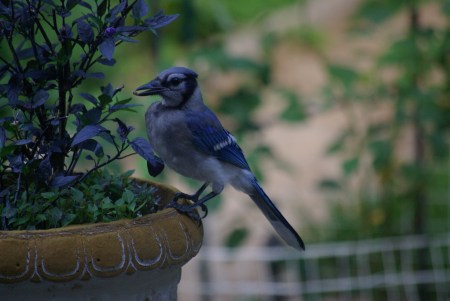
Blue Jay wrestles the pepper, or something, from the plant.
The peppers eventually grow to be the size of a Bing cherry — too big for the jays, then. They go after these peppers before they mature, and after they dry.

With her prize, the blue jay heads for its dining area in the live oak.
Mary K left us with her old bird feeder when she moved. This year we’ve kept feeders in both the front and back yards. Blue jays appear to have recovered from their West Nile devastation three years ago — we had one family nesting in the live oak earlier, in the spring — and Kathryn learned that the jays like peanuts still in the shell.
It’s been a good year for watching birds in our yard. Still haven’t captured that little green hummer in a camera, though.
1 Comment | Bird Watching, Natural history, Ornithology, Texas, Travel | Tagged: Bird Watching, Blue Jays, Ornithology, Texas, Tourism, Travel | Permalink
Posted by Ed Darrell
News flash: Texas has a second natural lake!
July 20, 2009Years ago, in Virginia, I had learned that Virginia had only one natural lake, the Great Dismal Swamp. Accompanying that chunk of information in that lecture was that Texas had only two natural lakes.
But upon arriving in Texas, I could find reference to only one natural lake, Caddo, and it had ceased being fully natural when its maintenance fell to a dam.
What happened to Texas’s second natural lake?
A Google search right now on “Texas +’natural lake'” produces ten listings on the first page, all of them pointing to the fact that Texas has just one natural lake. Here are the first five:
- Texas Parks and Wildlife site for Caddo Lake State Park, noting that Caddo was the only natural lake until dammed
- Wikipedia’s listing on Caddo Lake
- Texas “Fast Facts and Trivia” from 50states.com
- A blog posting from some site called “Millard Fillmore’s Bathtub” (say, what?) talking about efforts to save Caddo, Texas’s “only natural lake”
- WikiAnswers, “What is the only natural lake formed in Texas?”
I have found a second natural lake in Texas. It’s not a new discovery at all — it’s just a case of people not having the facts, and overlooking how to find the truth. It’s especially difficult when the lake hides itself.
Our testing coordinator at Molina High School, Brad Wachsmann, spins yarns that belie his youth. In the middle of one yarn last year, corroborated by other yarns, he mentioned that he has family in Big Lake, Texas; and he described visiting and having relatives urge people to run out and see the lake since it’s rebirth in torrential rains.
“A second natural lake in Texas?” I asked. Wachsmann knew the drill. Yes, Big Lake is a natural lake in Texas, and yes, people forget about it.
Texas teachers, listen to your testing coordinators, okay?
All of this came to mind reading the Austin American-Statesman, still a bastion of great journalism despite problems in the newspaper industry. On Monday, July 7, the paper ran a story and an editorial about the clean up of the oil industry refuse that killed the shoreline of part of the lake; the springs that once fed the lake have mostly gone dry, but that’s likely due to agricultural water mining.
It’s a story of boom and bust, environmental degradation for profit, and eventual recovery we hope.
Looking at the landscape that surrounds the Reagan County seat, you wonder whether the name Big Lake was somebody’s idea of joke. It’s dry and dusty, where the flora sprouts reluctantly and lives precariously.
Yet, the West Texas town of Big Lake got its name from a natural lake that was fed by springs that have long since gone dry. While the area may not fit everyone’s definition of photogenic, it has its own brand of charm – charm that could be enhanced if the damage done to the fragile ecosystem by salt spills were reversed or even minimized.
As the American-Statesman’s Ralph K.M. Haurwitz reported in Monday’s editions, the University of Texas and Texas A&M systems have benefited from the $4.4 billion in royalty payments and mineral income produced by its West Texas acreage since Santa Rita No. 1 well came in on May 28, 1923.
The salt water byproduct of oil and natural gas production, however, contaminated 11 square miles near Big Lake, killing most everything that grows. The lack of vegetation allows wind and water erosion.
Hey, it gets better. This is real Texas history, real American history — you can’t make this stuff up. Haurwitz’s article talks about the heritage of Texas education. Remember that old story about setting aside certain sections of townships to help fund education in lands on the American frontier? Texas wasn’t a public lands state as farther west, but it still reserved sections of land for the benefit of education.
Rose petals blessed by a priest? I’ll wager the priest didn’t make the trip to the top of the derrick. Haurwitz wrote:
BIG LAKE — Investors appealed to the patron saint of impossible causes when oil drilling began on University of Texas System land in 1921. It didn’t hurt.
Santa Rita No. 1 blew in on May 28, 1923, after rose petals blessed by a priest were scattered from the top of the derrick at the behest of some Catholic women in New York who had purchased shares in the Texon Oil and Land Co., which drilled that first well.
Since then, the UT System’s 2.1 million acres in West Texas have produced $4.4 billion in royalty payments and other mineral income for the Permanent University Fund, an endowment that supports the UT and Texas A&M University systems.
But this long-running bonanza for higher education exacted a price from the remote, semiarid landscape where it all began. Millions of barrels of salt water, a byproduct of oil and natural gas production, contaminated 11 square miles, or more than 7,000 acres, killing virtually all vegetation and leaving the land vulnerable to wind and water erosion. Hundreds of mesquite stumps with three feet of exposed roots testify to the dramatic loss of topsoil.
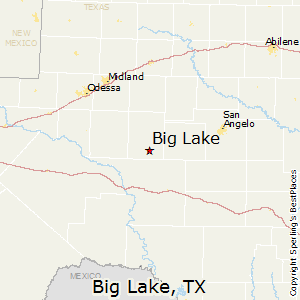
Where in Texas is Big Lake?
The town of Big Lake is just north of the lake itself, on State Highway 137 running north and south, and U.S. Highway 67 running east and west, approximately 65 miles west of San Angelo. Big Lake sits about 10 miles north of Interstate 10, and about 75 miles south of Interstate 20. Big Lake calls itself “the gateway to the Permian Basin.”
Big Lake is the home of Reagan County High School. Jim Morris was baseball coach for the Reagan High Owls when his team persuaded him to try out for a major league baseball team. His story was chronicled, with some artistic license, in the Disney movie “Rookie.”
Land managers are working to stop erosion on the often-dry shores of Big Lake using any trick they can find. One trick: Plant salt grass.
Salt grass? Along Texas’s Gulf Coast, there are a few species of grass that, while not halophytes, are at least salt tolerant. Salt grass. This grass made it profitable to graze cattle on what would otherwise have been unproductive land in the Texas cattle boom. This role in Texas history is memorialized in the Salt Grass Steakhouse chain, now found in five states.
And if planting salt grass works to control erosion, it will help clean up a large part of Texas other natural lake, Big Lake.
Big Lake’s being wet or dry is a whim of local climate. You could say that half of all of Texas’s natural lakes are now dry as a result of continued warming; you could say that two good gully-washers or toad-stranglers could restore water to half of Texas’s natural lakes.
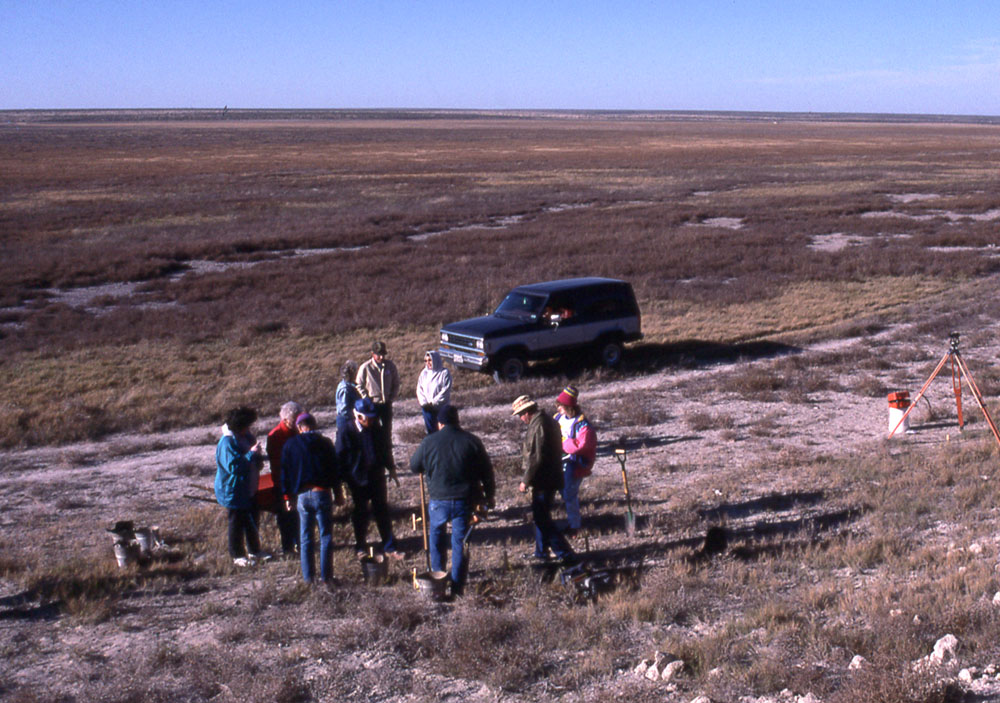
Field crew meeting at the outset of the 1992 excavations at the Big Lake Bison Kill site. The dry bed of Big Lake stretches for miles in the background. Big Lake is an intermittent saline lake or playa, an uncommon landform on the Edwards Plateau. Photo by Larry Riemenschneider, Concho Valley Archeological Society.
More details about Big Lake and prehistory, below the fold.
26 Comments | Accuracy, Cost of Green, Environmental protection, Geography - Physical, geology, History, Science, Texas, Travel | Tagged: Accuracy, Cost of Green, Environmental protection, geography, geology, History, Science, Texas, Travel | Permalink
Posted by Ed Darrell
Scientist steps in to try to save the day
July 19, 2009On the one hand, you hope he’s got a good copy of the original cast recording of “Man of La Mancha,” with the late Richard Kiley singing the importance of dreaming the impossible dream. On the other hand, you hope it’s not an impossible situation at all.
Mathematics Professor Lorenzo Sadun declared his candidacy for the Texas State Board of Education seat representing District 10. He’ll be running against incumbent Cynthia Dunbar in a district that has a history of electing people with little or no education background and a commitment to scorched Earth conservative policies — if Dunbar chooses to run again. Dunbar has not announced her intentions.
Sadun is professor of mathematics at the University of Texas, in Austin.

Mathematics Prof. Lorenzo Sadun, University of Texas - Daily Texan photo by Mike Paschal
In the 2006 election, there was no Democratic nominee. Dunbar ran against a Libertarian and won approximately 70 percent of the vote. The 2010 primary election is scheduled for March, and Sadun declared last week that he will seek the Democratic nomination.
The Place 10 seat-holder may become very influential. With the board almost evenly split, a negative or positive vote can greatly affect educational policy and standards.
If Sadun is elected, he will be the only scientist on the board. He said that even though he may encounter opposition from members of the board, he will find a common ground with his colleagues and will pursue agreement without sacrificing the quality of education for Texas students.
“Despite my taking a fairly hard line, I am a conciliator,” Sadun said. “I have not met a person who knew so much I couldn’t teach them something, and I’ve never met someone who knew so little that they couldn’t teach me something.”
District 10 includes 14 counties surrounding Travis County to the east of the county, and the northern part of Travis County. Travis, home to the Texas state capital Austin and one of Texas’s five supercounties, was split in education board districts to limit the influence of its highly-educated, more liberal voter population.

District 10, Texas State Board of Education
Burnt Orange Report wrote that Dunbar will face opposition if she chooses to run again.
- Dr. Rebecca Osborne, a teacher in the Roundrock ISD, has also announced her intention to run for the District 10 seat, as a Republican.
- Austin education activist Julie Cowan will run for the Republican nomination
- Judy Jennings will run for the Democratic nomination. She is Director of Assessment at Resources for Learning.
- Democratic Party activist Susan Shelton will also seek the Democratic nomination.
Events in District 10 offer a sign of hope that the era ended when apathy from candidates and voters allowe anti-public education forces to dominate the Texas State Board of Education. And if Sadun were to win, it would be the first time a working scientist was elected to SBOE.
Who knows? Sadun could succeed — but if he wins a seat on the SBOE, it’s not likely he’d sing that other song Richard Kiley made famous, “Stranger in Paradise.” He’s no stranger to quality education, and SBOE isn’t paradise.
27 Comments | Campaigns, Education, Education reform, Elections, History, Politics, State school boards, Texas | Tagged: Campaign, Education, Elections, Politics, Texas, Texas State Board of Education | Permalink
Posted by Ed Darrell
Probably not the way to get a good reputation among scientists
July 19, 2009Tensions between science and religion, and science and business, continue to drag down Texas’s hopes to be known as a major research location.
A hard look shows it’s not just the Deliverance-style local politics at the State Board of Education on science standards. Texas has trouble in a lot of areas.
For example, imagine a hurricane wiped out the town where one of the state’s major medical schools resides, and in the aftermath, rather than working to preserve the jobs of professors who agree to come back to the damaged buildings and storm-wracked town, the university uses the troubles as an excuse to get rid of faculty — not bad faculty, necessarily, just faculty the administration doesn’t like, or doesn’t know, or just for the heck of it.
This ain’t no way to run a medical school.
The rolling disaster that hit the Universityof Texas Medical Branch in Galveston, starting with Hurricane Ike, continued through unexpected layoffs of faculty on top of the 3,000 people laid off due to storm damage. The layoffs were unjustified, too, many thought, and so they appealed. The appeals process seems to have offered only a semblance of justice, to many of those involved, according to an article in The Scientist (free subscription required).
The story hasn’t got much traction in Texas media.
4 Comments | Health care, Higher education, History, Labor and unions, medicine, Science, Texas, Texas Lege | Tagged: Appeals, Faculty, Firings, Health care, labor, Layoffs, Medical School, medicine, Science, Texas, Universityof Texas Medical Branch Galveston | Permalink
Posted by Ed Darrell
Trouble at the Texas State Board of Education: Social studies curriculum
July 15, 2009I’m posting on the run from an AP Summer Institute at Texas Christian University, so just the facts.
Today’s Fort Worth Start Telegram featured a story on the social studies curriculum battles in the Texas State Board of Education. It’s one of those stories that does well in presenting the facts, but for the sake of “objectivity” treats the yahoos of the review committee — David Barton and Peter Marshall in particular — as respected academics.
Should Texas be worried?
See immediately previous post with the address to listen to live webcasts of the Board’s meetings this week.
Leave a Comment » | Economics, Geography - Economic, Geography - Physical, Geography - Political, History, Politics, Social Studies, Texas, Texas history, War on Education | Tagged: Politics, Religion, Social Studies, Texas, Texas Sate Board of Education, War on Education | Permalink
Posted by Ed Darrell
No man’s life, limb or liberty: Texas State Coard of Education in session
July 15, 2009Starting at 1:00 p.m. Central today, the Texas State Board of Education will be in session. You can listen to a live webcast of the meeting here.
According to the note I got from Steve Schafersman at Texas Citizens for Science, this is the agenda today:
Important agenda items include 3. Ethics Training, 4. Legislative Update, 6. Discussion of Expert Reviewers, and 7. Discussion of Texas High School Graduation Requirements.
More meetings tomorrow and Friday — they should all be webcasts.
Leave a Comment » | Education, Social Studies, State school boards, Texas, Texas Citizens for Science | Tagged: Education, Social Studies, state board of education, Texas, War on Education | Permalink
Posted by Ed Darrell
Texas education: It should be about the kids, and education
July 14, 2009Dallas Morning News columnist Jackie Floyd gets at the real issues week after week, stripping away the spin and silliness other reporters cover in the misaimed hope for objectivity.
And today her column looks at the social studies recommendations from a special review panel, released last week: “Curriculum debate marred by ideologues.”
A lot of what the expert advisers have to say about the standards for teaching social studies to Texas kids is genuinely depressing stuff.
It’s depressing because, as you wade through the half-dozen point-by-point reports that will be used to advise the people deciding what your kids will learn, you might wonder whether the people who oversee our public schools care a lot less about education than they do about ideology.
You might even get the sense they care an awful lot less about helping the next generation of Texans lead meaningful, productive lives than about telling them how to vote.
It’s not a big surprise, since some members of the State Board of Education sometimes behave as if schooling children is simply a matter of making them memorize an encyclopedic list of political talking points.
She names names, though I doubt she had a chance to actually kick the butts that need kicking.
And it’s the board that appointed a panel of experts that includes a family-values activist from Aledo and a minister in Massachusetts who specializes in “Christian heritage.” It’s that awful, embarrassing fight over evolution all over again.
As a result, what is presumably supposed to be a sensible discussion about what children need to learn has been reduced to a self-serving bickering match over who gets to be commandant of the indoctrination camp.
“To have Cesar Chavez listed next to Ben Franklin is ludicrous,” snarls one of the panelists; another says kids must be drilled more about Roe vs. Wade, which he says has “arguably more impacted American life than any other Supreme Court decision in the 20th century.”
Another expert makes careful tallies over whether curriculum recommendations cite Latinos with the same frequency as black and white historical figures – as if classroom studies can be reduced to a racial quid pro quo of the number of times specific historical figures are mentioned.
It’s not all ideological flag-waving, of course – but a lot of it is. There’s a silly freedom-fries debate over whether to substitute the term “free enterprise system” for “capitalism,” of whether suggested teaching examples should exclude Carl Sagan or Neil Armstrong or the guy who invented canned milk; of whether there are too many women and minorities and not enough founding fathers; of whether religion and the rule of law should be taught with more or less vigor than civil liberties and colonial adventurism.
Best, she notices that there were a couple of real experts on the panel whose reports have gotten short shrift in the news, and whose reports will be give short shrift by the politically-driven education board.
Miraculously – or at least astonishingly – in one of the reports, I found that awareness candidly articulated.
Somehow, Dr. Lybeth Hodges, a Texas Woman’s University history professor and a last-minute panel appointee, did not see a need to draft a political manifesto. She just made (get this!) sensible, useful curriculum recommendations.
She pointed out items that might actually help kids learn more and be better prepared for tests, such as that specific grade-level curriculum doesn’t always match the dreaded TAKS tests.
She noted that there are more than 90 “student expectations” for fifth-graders, an unrealistic pipe dream given that “some sound like test questions I give my college freshmen.”
Hodges, unlike some other appointees, took the blessedly pragmatic view that constantly trying to balance dueling ideologies will only result in a bloated, unmanageable list of standards that few kids will find meaningful and retain.
“It should not be a political exercise,” she said briskly, when we spoke a few days ago.
“I never thought about the political aspect at all,” she said. “I thought we were being asked to do what is reasonable and helpful for teachers. … They have enough red tape as it is.”
As we talked, my head was gradually swaddled in a pleasurable sense of optimism: Here was one person, at least, more interested in getting something useful done than in endlessly re-enacting the same old tired-out culture battle.
Call me a starry-eyed dreamer, but American education isn’t supposed to be a tedious exercise in demagoguery.
“To me, teachers aren’t there to carry out indoctrination in our schools,” Hodges said. “These people are trying to open little minds.”
If we’re going to open them successfully, we need more big minds at the top.
Also, check out the comments on the newspaper’s education blog, on the report of Gail Lowe being appointed chair of the SBOE. It’s instructive.
2 Comments | Bogus history, Education, Education quality, Education reform, Politics, Social Studies, State school boards, TEKS, Texas, Voodoo history | Permalink
Posted by Ed Darrell
Perry to Texas Education: “Drop dead, but not as fast as before”
July 10, 2009Texas Gov. Rick Perry named Gail Lowe, R-Lampasas, to chair the State Board of Education.
Texas senators rejected Perry’s earlier nomination of Don McLeroy, R-Beaumont, due to McLeroy’s divisive tactics on board issues. The chair must come from one of the board’s 15 elected members.
Perry was thought to favor a radical conservative to push the anti-education wishes of hard-core Republicans in Texas, whose vote Perry hopes to have in a tough fight for the Republican gubernatorial nomination in 2010. U.S. Sen. Kay Bailey Hutchison will try to oust Perry for the party’s nomination. Some feared Perry would nominate Cynthia Dunbar, R-Richmond, who is even more radical than McLeroy.
In contrast, Lowe has been a relatively reliable vote against Texas teachers and science curricula, but she is not known to be as polarizing as McLeroy. She has compromised on some issues, voting with educators and students.
Perry’s turning to Lowe indicates his disregard of education as an issue, and his writing off of the vote of Texas teachers and parents of students. Perry could have named an experienced administrator and peace maker who could push the board to do its legally-mandated work on time, by nominating Bob Craig, R-Lubbock. Perry’s turning to Lowe instead indicates that a working board is not among his priorities.
Lowe’s appointment to the chair probably is not so bad as a Dunbar appointment would have been. But unless Ms. Lowe makes serious efforts to push for journeyman policy-making from board members, avoiding intentional controversies and simply resolving controversial issues that cannot be avoided, the SBOE will contined to be little more than political theatre in Austin, except when it actually rules on curricula and textbook issues.
Few expect the board to be a fountain of wisdom, or an example of education excellence over the next two years.
Perry’s action becomes not so bad as the potential slap in the face to Texas education that he might have delivered. It’s the slap without a windup. Texas students deserved a kiss instead.
Lowe will serve at least until the State Senate can act to approve or disapprove the nomination; the legislature will meet next in January 2011. Lowe can serve for 17 months before the legislature meets.
Information:
- Announcement at Texas Freedom Network blog, Insider
- Tony’s Curricublog on the appointment
- Houston Chronicle story on the chair selection from July 5, describing the issues and candidates
- Terence Stutz note at the Dallas Morning News Trailblazer blog
- Associated Press story in the Fort Worth Star-Telegram
- Austin American-Statesman Postcards blog notice
Pre-nomination information:
- July 10 editorial in The Daily Texan (University of Texas), before the nomination announcement
- Burnt Orange Report comments, on possibility of Dunbar appointment
- Inkbluesky — well, you gotta read this one to get it
Also at Millard Fillmore’s Bathtub:
3 Comments | Education, Education quality, Education reform, Politics, State school boards, Texas, Textbook Selection, Textbooks, War on Education | Tagged: Don McLeroy, Education, Gail Lowe, Gov. Rick Perry, Politics, Texas, Texas State Board of Education, War on Education | Permalink
Posted by Ed Darrell
David Barton: Mediocre scientists who are Christian, good; great scientists, bad
July 9, 2009I’m reviewing the reviews of Texas social studies curricula offered by the six people appointed by the Texas State Board of Education. David Barton, a harsh partisan politician, religious bigot, pseudo-historian and questionable pedagogue, offers up this whopper, about fifth grade standards.:
In Grade 5 (b)(24)(A), there are certainly many more notable scientists than Carl Sagan – such as Wernher von Braun, Matthew Maury, Joseph Henry, Maria Mitchell, David Rittenhouse, etc.
Say what? “More notable scientists than Carl Sagan . . . ?” What is this about?
It’s about David Barton’s unholy bias against science, and in particular, good and great scientists like Carl Sagan who professed atheism, or any faith other than David Barton’s anti-science brand of fundamentalism.
David Barton doesn’t want any Texas child to grow up to be a great astronomer like Carl Sagan, if there is any chance that child will also be atheist, like Carl Sagan. Given a choice between great science from an atheist, or mediocre science from a fundamentalist Christian, Barton chooses mediocrity.
Currently the fifth grade standards for social studies require students to appreciate the contributions of scientists. Here is the standard Barton complains about:
(24) Science, technology, and society. The student understands the impact of science and technology on life in the United States. The student is expected to:
(A) describe the contributions of famous inventors and scientists such as Neil Armstrong, John J. Audubon, Benjamin Banneker, Clarence Birdseye, George Washington Carver, Thomas Edison, and Carl Sagan;
(B) identify how scientific discoveries and technological innovations such as the transcontinental railroad, the discovery of oil, and the rapid growth of technology industries have advanced the economic development of the United States;
(C) explain how scientific discoveries and technological innovations in the fields of medicine, communication, and transportation have benefited individuals and society in the United States;
(D) analyze environmental changes brought about by scientific discoveries and technological innovations such as air conditioning and fertilizers; and
(E) predict how future scientific discoveries and technological innovations could affect life in the United States.
Why doesn’t Barton like Carl Sagan? In addition to Sagan’s being a great astronomer, he was a grand populizer of science, especially with his series for PBS, Cosmos.
But offensive to Barton was Sagain’s atheism. Sagan wasn’t militant about it, but he did honestly answer people who asked that he found no evidence for the efficacy or truth of religion, nor for the existence of supernatural gods.
More than that, Sagan defended evolution theory. Plus, he was Jewish.
Any one of those items might earn the David Barton Stamp of Snooty-nosed Disapproval, but together, they are about fatal.
Do the scientists Barton suggests in Sagan’s stead measure up? Barton named four:
Wernher von Braun, Matthew Maury, Joseph Henry, Maria Mitchell, David Rittenhouse
In the category of “Sagan Caliber,” only von Braun might stake a claim. Wernher von Braun, you may recall, was the guy who ran the Nazi’s rocketry program. After the war, it was considered a coup that the U.S. snagged him to work, first for the Air Force, and then for NASA. Excuse me for worrying, but I wonder whether Barton likes von Braun for his rocketry, for his accommodation of anti-evolution views, or for his Nazi-supporting roots. (No, I don’t trust Barton as far as I can hurl the Texas Republican Party Platform, which bore Barton’s fould stamp while he was vice chair of the group.)
So, apart from the fact that von Braun was largely an engineer, and Sagan was a brilliant astronomer with major contributions to our understanding of the cosmos, what about the chops of the other four people? Why would Barton suggest lesser knowns and unknowns?
Matthew Maury once headed the U.S. Naval Observatory, in the 19th century. He was famous for studying ocean currents, piggy-backing on the work of Ben Franklin and others. Do a Google search, though, and you’ll begin to undrstand: Maury is a favorite of creationists, a scientist who claimed to subjugate his science to the Bible. Maury claimed his work on ocean currents was inspired at least in part by a verse in Psalms 8 which referred to “paths in the sea.” Maury is not of the stature or achievement of Sagan, but Maury is politically correct to Barton.
Joseph Henry is too ignored, the first head of the Smithsonian Institution. Henry made his mark in research on magnetism and electricity. But it’s not Henry’s science Barton recognizes. Henry, as a largely unknown scientist today, is a mainstay of creationists’ list of scientists who made contributions to science despite their being creationists. What? Oh, this is inside baseball in the war to keep evolution in science texts. In response to the (accurate) claim that creationists have not contributed anything of scientific value to biology since about William Paley in 1802, Barton and his fellow creationists will trot out a lengthy list of scientists who were at least nominally Christian, and claim that they were creationists, and that they made contributions to science. The list misses the point that Henry, to pick one example, didn’t work in biology nor make a contribution to biology, nor is there much evidence that Henry was a creationist in the modern sense of denying science. Henry is obscure enough that Barton can claim he was politically correct, to Barton’s taste, to be studied by school children without challenging Barton’s creationist ideas.
Maria Mitchell was an American astronomer, the second woman to discover a comet. While she was a Unitarian and a campaigner for women’s rights, or more accurately, because of that, I can’t figure how she passes muster as politically correct to David Barton. Surely she deserves to be studied more in American history than she is — perhaps with field trips to the Maria Mitchell House National Historic Landmark. It may be that Barton has mistaken Mitchell for another creationist scientist. While Mitchell’s life deseves more attention — her name would be an excellent addition to the list of woman scientists Texas children should study — she is not of the stature of Sagan.
David Rittenhouse, a surveyor and astronomer, and the first head of the U.S. Mint, is similarly confusing as part of Barton’s list. Rittenhouse deserves more study, for his role in extending the Mason-Dixon line, if nothing else, but it is difficult to make a case that his contributions to science approach those of Carl Sagan. Why is Rittenhouse listed by Barton? If nothing else, it shows the level of contempt Barton holds for Sagan as “just another scientist.” Barton urges the study of other scientists, any other scientists, rather than study of Sagan.
Barton just doesn’t like Sagan. Why? Other religionists give us the common dominionist or radical religionist view of Sagan:
Just what is the Secular Humanist worldview? First and foremost Secular Humanists are naturalists. A naturalist believes that nature is all that exists. “The Cosmos is all there is, or was, or ever will be.” This was the late Carl Sagan’s opening line on the television series “Cosmos.” Sagan was a noted astronomer and a proud secular humanist. Sagan maintained that the God of the Bible was nonexistent. (Imagine Sagan’s astonishment when he came face to face with his Maker.)
Sagan’s science, in Barton’s view, doesn’t leave enough room for Barton’s religion. Sagan was outspoken about his opposition to superstition. Sagan urged reason and the active use of his “Baloney-Detection Kit.” One of Sagan’s later popular books was titled Demon-haunted World: Science as a candle in the dark. Sagan argued for the use of reason and science to learn about our world, to use to build a framework for solving the world’s problems.
Barton prefers the dark to any light shed by Sagan, it appears.
More resources on the State Board of Education review of social studies curricula
- “Texas Tall Tale,” from the July/August 2009 edition of Church and State
- Capitol Annex, with a review of Barton’s paper that notes his incorrect quotes and incorrect citations of Texas law; and here detailing Barton’s falling victim to an internet hoax (which he cites as fact in his review)
- Eye on Williamson, “SBOE’s next trick, history with a conservative religious slant”
- Off the Kuff, “SBOE’s assault on history”
- Three Wise Men said it’s Texas conservatives up to their old, anti-Texas tricks
- Louisiana Coaliation for Science calls Barton one of Bobby Jindal’s “friends in low places”
5 Comments | Accuracy, Bad Quotes, Bogus history, Capitalism, Citizenship, Education, Education quality, History, Politics, Public education, Religion, Science, Science and faith, Separation of church and state, Social Studies, Texas, Textbook Selection, Textbooks, Voodoo history, Voodoo science, War on Education | Tagged: Bogus history, Carl Sagan, David Barton, Politics, Science, science education, Separation of Chruch and State, Social Studies, Texas, Texas State Board of Education, Voodoo history | Permalink
Posted by Ed Darrell
Texas social studies curriculum panel reports: The Great Texas History Smackdown
July 7, 2009Just when you thought it was safe to take a serious summer vacation, finish the latest Doris Kearns Goodwin, and catch up on a couple of novels . . .
The sharks of education policy are back.
Or the long knives are about to come out (vicious historical reference, of course, but I’m wagering the anti-education folks didn’t catch it). Pick your metaphor.
Our friend Steve Schafersman sent out an e-mail alert this morning:
The Expert Reviews of the proposed Texas Social Studies curriculum are now available at
http://ritter. tea.state. tx.us/teks/ social/experts. html
Social Studies Expert Reviewers
- David Barton, President, WallBuilders
Review of Current Social Studies TEKS
- Jesus Francisco de la Teja, Professor and Chair, Department of History, Texas State University
Review of Current Social Studies TEKS
- Daniel L. Dreisbach, Professor, American University
Review of Current Social Studies TEKS
- Lybeth Hodges, Professor, History, Texas Woman’s University
Review of Current Social Studies TEKS
- Jim Kracht, Associate Dean and Professor, College of Education and Human Development, Texas A&M University
Review of Current Social Studies TEKS
- Peter Marshall, President, Peter Marshall Ministries
Review of Current Social Studies TEKSYou can download their review as a pdf file.
Three of these reviewers are legitimate, knowledgeable, and respected academics who undoubtedly did a fair, competent, and professional job. The other three are anti-church- state separation, anti-secular public government, and pseudoscholars and pseudohistorians. I expect their contributions to be biased, unprofessional, and pseudoscholarly. Here are the bad ones:
- Peter Marshall is a religious right minister who says America must return to its Christian roots. He is opposed to C-S separation and wants to intermingle religion and government.
http://petermarshal lministries. com/
http://petermarshal lministries. com/about/ heritage. cfm
http://petermarshal lministries. com/about/ rev_peter_ marshall. cfm
- Daniel Dreisbach is a professor at American University in Washington. He is opposed to C-S separation and wants to intermingle religion and government.
http://www.hillsdal e.edu/news/ imprimis/ archive/issue. asp?year= 2006&month= 10
http://www.orthodox ytoday.org/ articles7/ DreisbachChurch. php
- David Barton is a very well-known radical religious right pseudohistorian. He is opposed to C-S separation and wants to intermingle religion and government.
http://en.wikipedia .org/wiki/ David_Barton
http://www.wallbuil ders.com/ ABTOverview. aspBarton may be the worst of the three. He founded Wallbuilders to deliberately destroy C-S separation and promote Fundamentalist Christianity in US government. Just about everything he has written is unhistorical and inaccurate. For example, Barton has published numerous “quotes” about C-S separation made by the Founding Fathers that upon investigation turned out to be hoaxes. Here’s what Senator Arlen Specter had to say about Barton:
Probably the best refutation of Barton’s argument simply is to quote his own exegesis of the First Amendment: “Today,” Barton says, “we would best understand the actual context of the First Amendment by saying, ‘Congress shall make no law establishing one Christian denomination as the national denomination. ‘ ” In keeping with Barton’s restated First Amendment, Congress could presumably make a law establishing all Christian denominations as the national religion, and each state could pass a law establishing a particular Christian church as its official religion.
All of this pseudoscholarship would hardly be worth discussing, let alone disproving, were it not for the fact that it is taken so very seriously by so many people.
I am sure these six will participate in a Great Texas History Smackdown before our crazy SBOE. Perhaps this will finally sicken enough citizens that they will finally vote to get rid of the SBOE, either directly or indirectly. Be sure to listen to this hearing on the web audio. Even better, the web video might be working so you can watch the SBOE Carnival Sideshow.
Steven Schafersman, Ph.D.
President, Texas Citizens for Science
The non-expert experts were appointed by Don McLeroy before the Texas Senate refused to confirm his temporary chairmanship of the State Board of Education. The good McLeroy may have done as chairman is interred with his dead chairmanship; the evil he did lives on. (Under McLeroy and Barton’s reading of history and literature, most students won’t catch the reference for the previous sentence.)
Tony Whitson at Curricublog posted information you need to read. Texas Freedom Network’s Insider has a first pass analysis of the crank experts’ analyses — they want to make Texas’s social studies curriculum more sexist, more racist, more anti-Semitic, more anti-working man, and closer to Sunday school pseudo-history. While Dallas prepares to name a major street in honor of Cesar Chavez, Barton and Marshall say he’s too Mexican and too close to Jews, and so should be de-emphasized in history books (a small picture of Chavez appears on one of the main U.S. history texts now).
That’s the stuff that jumps out at first. What else will we find when we dig?
More to come; watch those spaces, and this one, too.
5 Comments | Bogus history, Citizenship, Civil Rights, Religion, Separation of church and state, Social Studies, State school boards, TEKS, Texas, Texas Citizens for Science, Texas Freedom Network, Texas history, Textbook Selection, Textbooks, Voodoo history, War on Education, War on the Constitution | Tagged: Bogus history, David Barton, Don McLeroy, Education, education standards, Separation of church and state, Social Studies, Texas, Texas State Board of Education, Voodoo history, War on Education | Permalink
Posted by Ed Darrell
100 Tall Texans
July 2, 2009The exhibit left the George H. W. Bush Presidential Library in March 2007 — but the good folks who run the library left an on-line version. It’s a gallery of 100 photographic portraits of important Texans. Click on the photo, you get a short biography of each person.

Red Adair, pioneer in putting out oil field fires - Image from George H. W. Bush Presidential Library
Red Adair holds the first spot on the list, and ZZ Top occupies the last (the list is alphabetical). The list is eclectic, and useful. The list focuses on the 20th century, leaving out the usual Texas luminaries Austin, Houston and de Zavala, and that’s good. This is a great list for junior high Texas history students to use, for learning Texas history, or for selecting the “famous Texan” who will be the subject of their biography project.
A handful of these people are commonly reported on in classrooms. Most are not, however. You’ll learn more about Texas folklore and Texas’s Mexican heritage in music from these short biographies than you can learn in many Texas history courses. Adair to ZZ Top, including John Henry Faulk, John Nance Garner, Walter Cronkite, Bobby Layne, Janis Joplin, Scott Joplin, Michael DeBakey, George Foreman, Lydia Mendoza, Sam “Lightnin'” Hopkins, Hector Garcia, and Bessie Coleman, and 86 others. All the major Texas industries are represented, and all parts of Texas. If a student knew all of these people, the student would have a heck of a bunch of Texas knowledge.

Bessie Coleman, world's first licensed black pilot - image from the George H. W. Bush Presidential Library
Use this exhibit to broaden your knowledge of Texas history, or to invent new teaching points. A savvy teacher could use these to create 100 bell ringers, I suspect — and do a lot more.
It would be great if the library were to publish a poster featuring the 100 portraits. Anybody in College Station listening?
How do you use this exhibit in your classroom?
1 Comment | Biography, History, History images, Libraries, Museums, Texas, Texas history | Tagged: 100 Tall Texans, Bessie Coleman, Biography, George H. W. Bush Presidential Library, History, History images, Red Adair, Texas, Texas history | Permalink
Posted by Ed Darrell
Rick Perry’s education dilemma
June 25, 2009Betsy Oney teaches in Arlington, Texas. She’s a frontline soldier in the fight to educate our kids.
She also reads the newspapers and pays attention to what is going on at the highest levels in Texas government. From her view, she describes better than anyone else I’ve seen, the problem facing Texas Gov. Rick Perry right now, after the Texas State Senate rejected Perry’s nominee to head the State Board of Education, Don McLeroy.
Texas governor in a dilemma over education board pick
By BETSY ONEYSpecial to the Star-TelegramGov. Rick Perry is in something of a Catch-22.
It started two years ago when he appointed dentist Don McLeroy to chair the State Board of Education. McLeroy is described by his many supporters as a “good and decent man,” and of that we can be sure.
McLeroy’s appointment came after the 80th Legislature adjourned, so he had to be confirmed during this year’s session. The confirmation failed in the Senate.
McLeroy’s supporters blame that on the fact that he’s a Christian. Records show that this Senate, and the House Public Education Committee in a July 16 hearing, were concerned not that he’s Christian but that McLeroy politicized Texas children’s education and led the board and the Texas education system into the spotlight. And what Texans and Americans saw in that light was a fairly grotesque parade of a few people — a majority faction of the board led by McLeroy — who listened to ideology instead of experts and were intent on imposing an antiquated education system on Texas children.
From that same elected board, Perry now must decide on a new chairman who, like McLeroy, will serve without scrutiny until the next legislative session, in 2011.
Perry’s decision is his Catch-22.
He probably won’t consider a Democrat. That leaves nine Republican possibilities. Seven are the radical members responsible for politicizing children’s education. They voted in lock step on a range of issues that individually and collectively have been widely seen by educators and lawyers as anything from illegal to unconstitutional to damaging children. Nominating from that pool might yield a different management style than McLeroy offered, but the ideology, intent and backward direction would remain the same.
The two remaining Republicans are conservative, but not extremists. Both District 11’s Pat Hardy of Fort Worth and District 15’s Bob Craig of Lubbock are well-qualified and would lead Texas public education in the right direction. In contrast to the radical members, they would be responsive to the changing educational needs that the future demands as well as to the rich diversity of children in our population.
Although Hardy has been mentioned as a nominee by senators, she’s recommending Craig.
Craig, an attorney, is a logical choice. He’s served on the board since 2002 and before that served on the Lubbock school board for 14 years. Craig is a “good and decent man,” but in contrast to McLeroy, his voting record and conciliatory demeanor show him to be a rational, uniting public education supporter. He listens to educators and experts. He respects the opinions of others. He votes in the interest of all children.
It’s clear that Perry could not make a better choice than Bob Craig. The Catch-22 is that by appointing a nonextremist, Perry risks losing support from his biggest donors, the religious right.
These donors see benefit in turning public education into religious education at taxpayer expense. They see benefit in keeping critical thinking out of the classroom. Their money is essential in his campaign against Republican Kay Bailey Hutchison in the next gubernatorial primary election.
If Perry appoints from the pool of radical rights, the voting public will be alerted that he’s sacrificing our children’s education and Texas’ future for his own political interests. So he’ll lose votes.
Money and ideology vs. public’s interest and, ultimately, its confidence. What a dilemma! Stay tuned.
Betsy Oney of Fort Worth holds a master of education degree and is a master reading teacher (and English-as-a-second-language teacher) in the Arlington school district.
Can you tell Ms. Oney is literate? She tosses out “Catch-22” expecting us to know that that means! She has high expectations for her audience.
Oney’s discipline in Texas schools is one of those insulted by new standards brought down from some mountain by the Texas SBOE in the past year, ignoring the work of Ms. Oney’s colleagues and professionals in her field.
Tip of the old scrub brush to Robert Luhn via Glenn Branch.
3 Comments | Education, Education quality, Politics, State school boards, Texas, War on Education | Tagged: Betsy Oney, Education, education standards, Gov. Rick Perry, Politcs, Texas, Texas State Board of Education, War on Education | Permalink
Posted by Ed Darrell




 Millard Fillmore's Bathtub