June 30, 2009
This is completely an encore post from a year ago today; still thinking about those airplanes and the Grand Canyon.
[2008] Today’s the 52nd [53rd] anniversary of a horrendous accident in the air over the Grand Canyon. Two airliners collided, and 128 people died.
In 1956 there was no national radar system. When commercial flights left airports, often the only contact they had with any form of air traffic control was when the pilots radioed in for weather information, or for landing instructions. Especially there was no system to avoid collisions. As this 2006 story in the Deseret News (Salt Lake City) relates, the modern air traffic control system was spurred mightily by this tragedy.
About 9 a.m. Saturday, June 30, [1956], the TWA flight bound for Kansas City, Mo., and the United flight bound for Chicago left Los Angeles International Airport within three minutes of each other. The TWA flight, carrying 70 people, filed a flight plan to cruise at 19,000 feet. The United flight, with 58 people on board, planned to cruise at 21,000 feet.
About 20 minutes into the flight, TWA pilot Capt. Jack Gandy requested permission to climb to 21,000 feet. An air traffic controller in Salt Lake City turned down Gandy’s request. Then Gandy asked to fly “1,000 on top,” meaning at least a thousand feet above the clouds, which that morning were billowing as high as 30,000 feet. That request was granted.
By the time both planes were over the Grand Canyon, the pilots were flying in and out of the clouds, on visual flight rules and off their prescribed flight plans, apparently typical in those days as pilots veered off course to play tour guide.
No one knows exactly what happened.
It was the last big accident before instigation of the “black box,” so investigators had to piece together details from debris on the ground.
They decided that the left wing and propeller of the United plane hit the center fin of the TWA’s tail and cut through the fuselage, sending Flight 2 nose-first into the canyon, two miles south of the juncture of the Colorado and Little Colorado rivers. The United DC- 7, which had lost most of its left wing, began spiraling down. Capt. Robert Shirley radioed Salt Lake City a garbled message that controllers understood only after they slowed down the recording: “Salt Lake, ah, 718 . . . we are going in.” Flight 718 smashed into a cliff on Chuar Butte.
The accident plays a key role in a Tony Hillerman mystery, Skeleton Man — Hillerman writes about two Navajo Nation policemen.
I’m thinking of the crash today for two reasons. I’m off for a tour of canyons, including both rims of the Grand Canyon, in the next two weeks. The last time I was there was 1986, with the President’s Commission on Americans Outdoors. We flew in on a Twin Otter, coming up from Phoenix, over the Roosevelt Dam, up over the Mogollon Rim, over the Glen Canyon Recreation area and stopping it Page. From Page to Grand Canyon, we took full advantage of the huge windows in the Otter — seeing first hand the sights that the controversial tourist flights were designed to reveal. Safety was a key concern, and we talked about it constantly with the pilots.
A few weeks later, on June 18, 1986, that DeHavilland Twin Otter collided with a Bell Jet Ranger helicopter over the Canyon. 25 people died in that crash.
I have flown over the Canyon a dozen times since then — no longer will airliners dip down to give passengers a better view, not least because airliners cruise tens of thousands of feet higher now than they did then. I think of those airplane accidents every time I see the Canyon.
We’re driving in. We’ll spend a day and a half on the South Rim, and another couple of nights on the North Rim. We’re taking our time on the ground. But if we had time, and we could afford it, I’d love to get up in an airplane or helicopter to see the Canyon from the air again.
Updates, 2009:
Spread the word; friends don't allow friends to repeat history.
 2 Comments |
  Airplanes, Disasters, History, Transportation, Travel | Tagged: 1956, Air Safety, Airplane Crashes, Aviation, Disasters, Grand Canyon, History, Travel |
  Permalink
 Posted by Ed Darrell
March 8, 2009

The Black Ships — Commodore Matthew C. Perry’s squadron in Japan, 1854 – CSSVirginia.org image from Gleason’s Pictorial Drawing Room Companion, Boston, May 15, 1852 (also, see BaxleyStamps.com); obviously the drawing was published prior to the expedition’s sailing.
On March 8, 1854, Commodore Matthew C. Perry landed for the second time in Japan, having been sent on a mission a year earlier by President Millard Fillmore. On this trip, within 30 days he concluded a treaty with Japan which opened Japan to trade with the U.S. (the Convention of Kanagawa), and which began a cascade of events that opened Japan to trade with the world.

Commodore Matthew C. Perry in 1852 photograph, Library of Congress via WikiMedia
Within 50 years Japan would come to dominate the seas of the the Western Pacific, and would become a major world power.

1854 japanese woodblock print of U.S. Navy Commodore Matthew C. Perry. Peabody Museum: “The characters located across the top read from right to left, ‘A North American Figure’ and ‘Portrait of Perry.’ According to the Peabody Essex Museum, ‘this print may be one of the first depictions of westerners in Japanese art, and exaggerates Perry’s western features (oblong face, down-turned eyes, bushy brown eyebrows, and large nose).'” But compare with photo above, right. Peabody Museum holding, image from Library of Congress via WikiMedia
Then, 20 years later, on March 8, 1874, Millard Fillmore died in Buffalo, New York.
The Perry expedition to Japan was the most famous, and perhaps the greatest recognized achievement of Fillmore’s presidency. Fillmore had started the U.S. on a course of imperialistic exploitation and exploration of the world, with other expeditions of much less success to Africa and South America, according to the story of his death in The New York Times:
The general policy of his Administration was wise and liberal, and he left the country at peace with all the world and enjoying a high degree of prosperity. His Administration was distinguished by the Lopez fillibustering expeditions to Cuba, which were discountenanced by the Government, and by several important expeditions to distant lands. The expedition to Japan under Commodore Perry resulted in a favorable treaty with that country, but that dispatched under Lieut. Lynch, in search of gold in the interior of Africa, failed of its object. Exploring expeditions were also sent to the Chinese seas, and to the Valley of the Amazon.
Here we are in 2013, 160 years after the end of Millard Fillmore’s presidency, 159 years after Commodore Perry’s success on the mission to Japan Fillmore sent him on, 139 years after Millard Fillmore’s death, and not yet have we come to grips with Fillmore’s real legacy in U.S. history. Most of that legacy, we don’t even acknowledge in public. Santayana’s Ghost paces nervously.
Spread the word; friends don't allow friends to repeat history.
6 Comments | foreign affairs, Geography - Physical, Geography - Political, History, History and art, History images, History museums, Japan, Millard Fillmore, Transportation, Travel, Turning Points | Tagged: Commodore Matthew C. Perry, Foreign Relations, History, Japan, Millard Fillmore | Permalink
Posted by Ed Darrell
December 17, 2008
In English, it’s just one letter difference between “winds” and “wings.” An encore post, commemorating one historic event from December 17 involving both winds and wings:

Photo from Treasures of the Library of Congress; “First Flight” by John T. Daniels (d. 1948); this is a modern gelatin print from the glass negative.
Ten feet in altitude, 120 feet traveled, 12 seconds long. That was the first flight in a heavier-than-air machine achieved by Orville and Wilbur Wright of Dayton, Ohio, at Kittyhawk, North Carolina, on December 17, 1903.
From the Library of Congress:
On the morning of December 17, 1903, Wilbur and Orville Wright took turns piloting and monitoring their flying machine in Kill Devil Hills, North Carolina. Orville piloted the first flight that lasted just twelve seconds. On the fourth and final flight of the day, Wilbur traveled 852 feet, remaining airborne for 57 seconds. That morning the brothers became the first people to demonstrate sustained flight of a heavier-than-air machine under the complete control of the pilot.
No lost luggage, no coffee, no tea, no meal in a basket, either.
Resources on the Wright Brothers’ first flight:
Spread the word; friends don't allow friends to repeat history.
1 Comment | Airplanes, Geography - Physical, Heroes, History, History images, Icons of history, Images, Invention, Technology, Transportation, Travel | Tagged: Airplanes, Aviation, History, Inventions, Kittyhawk, Technology, Wright Brothers | Permalink
Posted by Ed Darrell
September 30, 2008

Atchison, Topeka & Santa Fe Railroad, 1899 - from the Library of Congress
American Memory at the Library of Congress features dozens of historic railroad maps of U.S. railroads.
This is a great collection for U.S. history presentations on development of the railroads, or on settlement of the west, in particular.
The Railroad maps represent an important historical record, illustrating the growth of travel and settlement as well as the development of industry and agriculture in the United States. They depict the development of cartographic style and technique, highlighting the achievement of early railroaders. Included in the collection are progress report surveys for individual lines, official government surveys, promotional maps, maps showing land grants and rights-of-way, and route guides published by commercial firms.
Heck, if nothing else, these make great backgrounds for PowerPoint presentations.
Bookmark the site — kids working on projects specific to a state or region should have a field day with these things.
Spread the word; friends don't allow friends to repeat history.
2 Comments | Education, Geography - Economic, Geography - Political, Historic documents, History, History and art, History images, Maps, Railroads, Transportation, Travel | Tagged: Education, geography, History, History images, Maps, Railroads, Transportation, Travel | Permalink
Posted by Ed Darrell
September 6, 2008
Especially you economics teachers, look at this very carefully:

Six cans of juice, at a store on Baffin Island - photo from Tales from the Arctic
How much do you pay for juice at your local market?
“The High Cost of Northern Living” at Arctic Economics points to Tales from the Arctic and “Believe me now?”
How much per ounce?
Kennie (at Tales from the Arctic) features a bunch of unbelievable prices. Getting goods to towns in the far north of North America, in Canada and Alaska, is a major production. Transportation and handling kick prices up a bit.
We’ll find out how alert Sarah Palin is when somebody asks her the price of a gallon of milk . . .
More seriously, economics teachers might find some object lessons in these photos, and a good presentation on supply and demand, and the costs of distribution.
Milk at $8.50 a gallon? Even in Canadian currency, that burns.
I wonder: Do prices like these make economics any easier to teach to high school kids? Does the urgency of high prices make the subject more relevant?
Tip of the frozen scrub brush to Arctic Economics, of course.
Spread the word; friends don't allow friends to repeat history.
6 Comments | Economics, Food history, Freedom - Economic, Geography - Economic, Geography - Physical, Maps, Personal finance, Transportation, Travel | Tagged: Alaska, Canada, Economics, geography, Market Basket, Travel | Permalink
Posted by Ed Darrell
August 15, 2008

Will Rogers, images from Will Rogers Museums, Oklahoma
After Mark Twain died, America found another great humorist, raconteur, story-teller, who tickled the nation’s funny-bone and pricked the collective social conscience at the same time. Will Rogers is most famous today for his sentiment that he never met a man he didn’t like. In 1935, he was at the height of his popularity, still performing as a lariat-twirling, Vaudeville comedian who communed with presidents, and kept his common sense. He wrote a daily newspaper column that was carried in 500 newspapers across America. Rogers was so popular that Texas and Oklahoma have dueled over who gets the bragging rights in claiming him as a native son.

Will Rogers ready to perform. Photo taken prior to 1900 - Wikimedia
Wiley Post was known as one of the best pilots in America. He gained fame by being the first pilot to fly solo around the world. Post was famous for his work developing new ways to fly at high altitudes. Post was born in Texas and moved to Oklahoma. He lost an eye in an oil-field accident in 1924, then used the settlement money to buy his first airplane. He befriended Will Rogers when flying Rogers to an appearance at a Rodeo, and the two kept up their friendship literally to death.
Post asked Rogers to come along on a tour of the great unknown land of Alaska, where Post was trying to map routes for mail planes to Russia. Ever adventurous, Rogers agreed — he could file his newspaper columns from Alaska by radio and telephone. On August 15, 1935, their airplane crashed near Point Barrow, Alaska, killing them both.

Wiley Post, first to fly solo around the world, in an early pressure suit for high-altitude flying - Wikimedia photo
On August 15, 2008, a ceremony in Claremore, Oklahoma, will honor the two men on the 73rd anniversary of their deaths. About 50 pilots from Oklahoma, Missouri, Kansas and Arkansas will fly in to the Claremore Airport for the Will Rogers-Wiley Post Fly-In Weekend. Oklahoma Lt. Gov. Jari Askins will offer a tribute.
Rogers was 56, leaving behind his wife, Betty, and four children. Post, 36, left a widow.
Rogers’ life is really quite legendary. Historian Joseph H. Carter summed it up:
Will Rogers was first an Indian, a cowboy then a national figure. He now is a legend.
Born in 1879 on a large ranch in the Cherokee Nation near what later would become Oologah, Oklahoma, Will Rogers was taught by a freed slave how to use a lasso as a tool to work Texas Longhorn cattle on the family ranch.
As he grew older, Will Rogers’ roping skills developed so special that he was listed in the Guinness Book of Records for throwing three lassos at once: One rope caught the running horse’s neck, the other would hoop around the rider and the third swooped up under the horse to loop all four legs.
Will Rogers’ unsurpassed lariat feats were recorded in the classic movie, “The Ropin’ Fool.”
His hard-earned skills won him jobs trick roping in wild west shows and on the vaudeville stages where, soon, he started telling small jokes.
Quickly, his wise cracks and folksy observations became more prized by audiences than his expert roping. He became recognized as being a very informed and smart philosopher–telling the truth in very simple words so that everyone could understand.
After the 10th grade, Will Rogers dropped out of school to become a cowboy in a cattle drive. He always regretted that he didn’t finish school, but he made sure that he never stopped learning–reading, thinking and talking to smart people. His hard work paid off.
Will Rogers was the star of Broadway and 71 movies of the 1920s and 1930s; a popular broadcaster; besides writing more than 4,000 syndicated newspaper columns and befriending Presidents, Senators and Kings.
During his lifetime, he traveled around the globe three times– meeting people, covering wars, talking about peace and learning everything possible.
He wrote six books. In fact he published more than two million words. He was the first big time radio commentator, was a guest at the White House and his opinions were sought by the leaders of the world.
Inside himself, Will Rogers remained a simple Oklahoma cowboy. “I never met a man I didn’t like,” was his credo of genuine love and respect for humanity and all people everywhere. He gave his own money to disaster victims and raised thousands for the Red Cross and Salvation Army.
Post’s legacy is significant, too. His employer, Oklahoma oil man F. C. Hall, encouraged Post to push for aviation records using Hall’s Lockheed Vega, and Post was happy to comply. Before his history-making trip around the world, he had won races and navigation contests. NASA traces the development of the space-walking suits worn by astronauts to Post’s early attempts for flight records:
For Wiley Post to achieve the altitude records he sought, he needed protection. (Pressurized aircraft cabins had not yet been developed.) Post’s solution was a suit that could be pressurized by his airplane engine’s supercharger.
First attempts at building a pressure suit failed since the suit became rigid and immobile when pressurized. Post discovered he couldn’t move inside the inflated suit, much less work airplane controls. A later version succeeded with the suit constructed already in a sitting position. This allowed Post to place his hands on the airplane controls and his feet on the rudder bars. Moving his arms and legs was difficult, but not impossible. To provide visibility, a viewing port was part of the rigid helmet placed over Post’s head. The port was small, but a larger one was unnecessary because Post had only one good eye!

Last photo of Will Rogers (in the hat) and Wiley Post, in Alaska in 1935 (from Century of Flight)
Tip of the old scrub brush to Alaska bush advocate Pamela Bumsted.
Resources:
Spread the word; friends don't allow friends to repeat history.
9 Comments | Airplanes, Education, Famous quotes, History, Humor, Politics, Technology, Texas history, Transportation | Tagged: Airplanes, Alaska, Aviation, Famous quotes, History, Humor, Oklahoma, Texas, Transportation | Permalink
Posted by Ed Darrell
July 26, 2008
Okay, it’s the 202nd anniversary of Robert Fulton’s historic, 32-hour steamboat trip from New York City to Albany, demonstrating the viability of steamboat travel for commerce on the Hudson. But for such a historic river, why not delay that fete for a couple of years and roll it into the 400th anniversary of Champlain’s exploration of the lake that now bears his name, and Henry Hudson’s discover of the mouth of the river to the south, the Hudson, whose mouth is home to New York City.

400 years of Hudson River history in 2009 - Hudson, Champlain, Fulton
And so 2009 marks the Quadricentennial Celebration on the Hudson, honoring Hudson, Fulton and Champlain.
Alas, the committee to coordinate the celebration along the length of the river was not put in place until February, so there is a scramble. Local celebrations will proceed, but the overall effort may fall short of the 1909 tricentennial, with replicas of Hudson’s ship, Half Moon, and Champlain’s boats, and Fulton’s steamer, and parades, and festivals, and . . .
Still, the history is notable, and the stories worth telling.
Most of my students in U.S. and world history over the past five years have been almost completely unaware of any of these stories. One kid was familiar with the Sons of Champlin, the rock band of Bill Champlin, because his father played the old vinyl records. Most students know nothing of the lore of Hudson, the mutiny and the old Dutch stories that have thunder caused by Hudson and his loyal crewman bowling in the clouds over the Catskills. They don’t even know the story of Rip van Winkle, since it’s not in the Texas Essential Knowledge and Skills (TEKS) list and so gets left out of even elementary school curricula. Is this an essential piece of culture that American children should know? American adults won’t know it, if we don’t teach it.

Henry Hudson, from a woodcut
Explorations and settlement of Quebec by Samuel de Champlain get overlooked in post-NCLB texts. Texts tend to make mention of the French settlement of Canada, but placing these explorations in the larger frame of the drive to find a route through or around North America to get to China, or the often-bitter contests between French, English, Spanish, Dutch and other European explorers and settlers gets lost. French-speaking Cajuns just show up in histories of Texas and the Southwest, with little acknowledgment given to the once-great French holdings in North America, nor the incredible migration of French from Acadia to Louisiana that gives the State of Louisiana such a distinctive culture today.

French explorer and settler Samuel de Champlain
Champlain’s explorations and settlement set up the conflict between England and France that would result in the French and Indian War in the U.S., and would not play out completely until after the Louisiana Purchase and War of 1812.
Fulton’s steamboat success ushered in the age of the modern, non-sail powered navies, and also highlights the role geography plays in the development of technology. The Hudson River is ideally suited for navigation from its mouth, north to present-day Albany. This is such a distance over essentially calm waters that sail would have been preferred, except that the winds on the Hudson were not so reliable as ocean winds. Steam solved the problem. Few other rivers in America would have offered such an opportunity for commercial development — so the Hudson River helped drive the age of steam.
New York City remains an economic powerhouse. New York Harbor remains one of the most active trading areas in the world. Robert Fulton helped propel New York ahead of Charleston, Baltimore and Boston — a role in New York history that earned him a place in for New York in the U.S. Capitol’s Statuary Hall. The steamboat monopoly Fulton helped establish was a key player in Gibbons v. Ogden, the landmark Supreme Court case in which the Court held that Congress has the power to regulate commerce between states — an upholding of the Commerce Clause against the old structures created under colonial rule and the Articles of Confederation.

Robert Fulton's statute in the U.S. Capitol - photo by Robert Lienhard
400 years of history along the Hudson, a river of great prominence in world history. History teachers should watch those festivities for new sources of information, new ideas for classroom exercises.
Resources:
Spread the word; friends don't allow friends to repeat history.
6 Comments | America's founding, Commerce Clause, Economics, Education, Geography - Economic, Geography - Physical, Heroes, History, Invention, Law, Natural resources, Politics, Science, Supreme Court cases, Technology, Transportation, Travel, U.S. Constitution | Tagged: Age of Exploration, Business, Champlain, geography, Henry Hudson, History, Law, Robert Fulton, Science, Steam Power, Technology | Permalink
Posted by Ed Darrell
July 22, 2008
In the U.S. we still have people throwing themselves in front of Zambonis to protest doing anything about global warming. In Russia, warming is taken as a fact.
And so Russians get a leg up on U.S. companies, in this case working to open an Arctic “bridge” for shipping goods from Russia to Canada and back.
Bookmark this site, Arctic Economics, you economics and geography teachers.
Spread the word; friends don't allow friends to repeat history.
3 Comments | Business, Climate change, Economics, Free market economics, Geography - Economic, Geography - Physical, Global warming, Globalization, Natural resources, oceans, Science, Transportation, Travel | Tagged: Business, Climate change, Economics, geography, Global warming, Globalization, Russia, Trade Routes, Travel | Permalink
Posted by Ed Darrell
June 30, 2008
[2008] Today’s the 52nd anniversary of a horrendous accident in the air over the Grand Canyon. Two airliners collided, and 128 people died.
In 1956 there was no national radar system. When commercial flights left airports, often the only contact they had with any form of air traffic control was when the pilots radioed in for weather information, or for landing instructions. Especially there was no system to avoid collisions. As this 2006 story in the Deseret News (Salt Lake City) relates, the modern air traffic control system was spurred mightily by this tragedy.
About 9 a.m. Saturday, June 30, [1956], the TWA flight bound for Kansas City, Mo., and the United flight bound for Chicago left Los Angeles International Airport within three minutes of each other. The TWA flight, carrying 70 people, filed a flight plan to cruise at 19,000 feet. The United flight, with 58 people on board, planned to cruise at 21,000 feet.
About 20 minutes into the flight, TWA pilot Capt. Jack Gandy requested permission to climb to 21,000 feet. An air traffic controller in Salt Lake City turned down Gandy’s request. Then Gandy asked to fly “1,000 on top,” meaning at least a thousand feet above the clouds, which that morning were billowing as high as 30,000 feet. That request was granted.
By the time both planes were over the Grand Canyon, the pilots were flying in and out of the clouds, on visual flight rules and off their prescribed flight plans, apparently typical in those days as pilots veered off course to play tour guide.
No one knows exactly what happened.
It was the last big accident before instigation of the “black box,” so investigators had to piece together details from debris on the ground.
They decided that the left wing and propeller of the United plane hit the center fin of the TWA’s tail and cut through the fuselage, sending Flight 2 nose-first into the canyon, two miles south of the juncture of the Colorado and Little Colorado rivers. The United DC- 7, which had lost most of its left wing, began spiraling down. Capt. Robert Shirley radioed Salt Lake City a garbled message that controllers understood only after they slowed down the recording: “Salt Lake, ah, 718 . . . we are going in.” Flight 718 smashed into a cliff on Chuar Butte.
The accident plays a key role in a Tony Hillerman mystery, Skeleton Man — Hillerman writes about two Navajo Nation policemen.
I’m thinking of the crash today for two reasons. I’m off for a tour of canyons, including both rims of the Grand Canyon, in the next two weeks. The last time I was there was 1986, with the President’s Commission on Americans Outdoors. We flew in on a Twin Otter, coming up from Phoenix, over the Roosevelt Dam, up over the Mogollon Rim, over the Glen Canyon Recreation area and stopping it Page. From Page to Grand Canyon, we took full advantage of the huge windows in the Otter — seeing first hand the sights that the controversial tourist flights were designed to reveal. Safety was a key concern, and we talked about it constantly with the pilots.
A few weeks later, on June 18, 1986, that DeHavilland Twin Otter collided with a Bell Jet Ranger helicopter over the Canyon. 25 people died in that crash.
I have flown over the Canyon a dozen times since then — no longer will airliners dip down to give passengers a better view, not least because airliners cruise tens of thousands of feet higher now than they did then. I think of those airplane accidents every time I see the Canyon.
We’re driving in. We’ll spend a day and a half on the South Rim, and another couple of nights on the North Rim. We’re taking our time on the ground. But if we had time, and we could afford it, I’d love to get up in an airplane or helicopter to see the Canyon from the air again.
Spread the word; friends don't allow friends to repeat history.
7 Comments | Airplanes, Disasters, History, Transportation, Travel | Tagged: airplane crash, Aviation, Disasters, Grand Canyon, History, Transportation, Travel | Permalink
Posted by Ed Darrell
February 29, 2008
Getting snowed out of Springfield, Illinois last week gave me an extra 8 or 10 hours to sit around airports and find things to gripe about.
Is anyone else bothered by the tendency to use high-definition television monitors with a regular TV signal, and then spread the picture out to cover the screen, which makes the victims on the television look as if they’d been modified for a guest appearance on South Park?
(This image is for illustration of the phenomenon only.)
Am I the only person who prefers that people look like people, even if there is a blank area on the television screen? In the past year I’ve been in a couple dozen classrooms where the projectors were set to distort every image transmitted. For a presentation on, say, Emmitt Till, or the death of Rosa Parks, I thought the settings disrespectful at best.
How can they call it “high definition” if it distorts everyones’ faces?
I was relieved late Sunday to get back home to our old, analog televisions and normal human proportions on the screen.
Spread the word; friends don't allow friends to repeat history.
6 Comments | Technology, Television, Transportation, Travel | Tagged: Media, Technology, Television, Travel | Permalink
Posted by Ed Darrell
February 21, 2008
Time flies, people sometimes don’t. I’m in O’Hare, now with a few hours to spend because, for the third time today, fifth flight, a flight I was booked on was canceled due to weather.
Above, the neck of American Airlines’ Concourse H and K, in Terminal 3; picture is many months old, but I like it because it contains many hours of my sweat in hammering out the lease agreements. The photo is from a Chicago limousine service.
The trip to DFW Airport that I used to make a couple of times a week minimum in about 25 minutes took nearly an hour today — the roads are wider, but the traffic is much heavier. The trip from the curb to the gate that I used to sprint now takes 40 minutes, and I have to get undressed.
And then the flight to St. Louis was cancelled. And then the flight from St. Louis to Bart Simpson’s Springfield was cancelled . . . I tried a back door, to Chicago and then on United back to Springfield (Illinois — isn’t every Springfield Bart’s hometown?). The hop from O’Hare was cancelled. I’ll miss the 3:00 p.m. seminar start.
It’s been more than 15 years since I actually got stuck on a weather delay. Airlines fly very well, most of the time. I also fly about 99.7% less than I used to fly.
It’s a lot of trouble. It’s a good cause. The Bill of Rights Institute and the Liberty Fund teamed up for a seminar on presidents and the Constitution, focusing on Lincoln, in Springfield. I always get material that sparks classroom discussion and great learning experiences for students.
Our department chair told me that our district won’t consider this as part of my required in-service training, however. Go figure. I can sit through hours of people who don’t know Excel as well as I do and be counted as learning; but when I get great sessions with hard reading requirements and outstanding discussion with great experts, zip. Quality in education? What?
Blogging light the next couple of days.
Spread the word; friends don't allow friends to repeat history.
Leave a Comment » | Abraham Lincoln, Transportation, Travel | Tagged: Abraham Lincoln, continuing education, Travel | Permalink
Posted by Ed Darrell
February 14, 2008
Looking for something else I found the Smithsonian Institution’s on-line history of air passenger travel in the U.S., America by Air.
I can easily see a time when a student with a computer terminal gets an assignment to look at some of the activities available at a site like America by Air, with on-line quizzes as the student progresses through the exhibits.

How far away are we? Two questions: Does your school provide an internet-linked computer for each student? Do you have the software or technical support to give an on-line assignment and track results?
Teaching stays stuck in the 19th century, learning opportunities fly through the 21st.
Spread the word; friends don't allow friends to repeat history.
Leave a Comment » | Airplanes, Classroom technology, Economics, Education quality, History, History images, History museums, On-line education, Technology in the classroom, Transportation, Travel | Tagged: air travel, Classroom technology, Education, History, Media, On-line learning, Technology, Transportation | Permalink
Posted by Ed Darrell
January 12, 2008
There’s a fun blog, Tugster: A Waterblog, that usually features photos of tugs that ply the waters around New York City. Good to wonderful photos; and I’ve been hoping for a reason to mention the blog.
Here’s one: What do you see peeking through the trees and wires?

It’s the masts of the barque Peking, a sailing ship built for a German shipping company in 1911 — the same year the Titanic was built. This was a freight hauler, used originally to take nitrates mined in South America to Europe.
After a relatively long sailing career, the ship has been retired as a museum ship at the South Street Seaport Museum (a great place to visit when you get to New York). It’s in dry dock right now, which is where these photos were taken.

Tugster points to a lot of details, with several photos. It’s interesting to see a ship of the vintage of the Titanic, out of water. It’s interesting to see one of the faster sailing ships, especially one built for use in the 20th century. You can see how the technology of ships and shipbuilding allowed for faster sail vessels; this is part of the story of how technologies get eclipsed, too — when sailing could no longer keep up with steam, advances in sailing ships slowed to a stop.
This was one of the last, fast sailing vessels built — one of a chain of “flying P-liners.”
Get on over to Tugster and see what you can do with the photos, and the history.

4-masted barque Peking under sail, in the River Thames, unknown year. The ship was originally named Arethusa. Wikimedia photo
Spread the word; friends don't allow friends to repeat history.
5 Comments | Capturing history, Geography - Economic, History, Museums, Technology, Transportation, Travel, World War I | Tagged: Barque Peking, Economics, foreign trade, History, sailing ships, South Street Seaport Museum, Technology, Tugster | Permalink
Posted by Ed Darrell
December 4, 2007

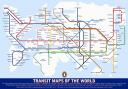
Fun map. Readers at Strange Maps noted lots of geographical challenges in these train routes. Wouldn’t this make a great warm-up/bell-ringer, to have students find the geographical difficulties, errors and impossibilities?
And then there’s the book itself. The perfect gift for Dr. Jack Rhodes*, perhaps, or for Jim Lehrer, or someone else to whom transportation has been a great and grand pastime, as it has been for author Mark Ovenden.

Cool. Funny. Maybe instructive.
This would be a heckuva two-week study in geography, no? There are those great films on the construction of the New York subway system; there must be wonderful photos of the art in the Moscow system.
Or am I being too pedantic?
(Click thumbnail below for a larger view of the map.)
Tip of the old scrub brush, and go visit, Strange Maps.
* Jack Rhodes was director of forensics at the University of Utah when I was an undergraduate there — my old debate coach. He was so familiar with bus and train schedules, as a hobbyist, that we frequently tried to stump him with questions about a passing train or bus we’d see driving around the nation. To my knowledge, he always got the name of the train right, and the bus’s scheduled next stop right. You sorta had to be there, but it was an amazing series of feats of memory.
Spread the word; friends don't allow friends to repeat history.
3 Comments | Bell Ringers, Books, Geography - Physical, Harry Wong, Technology, Transportation, Warm-up exercises | Tagged: Books, Education, geography, Maps, public transit, subway | Permalink
Posted by Ed Darrell
October 17, 2007
Another piece of history of the 20th century often overlooked: June 30, 1956, two airliners collided over the Grand Canyon.
The newsletter of the Grand Canyon Association featured a good, concise story with photos this summer. It’s in .pdf format.
Spread the word; friends don't allow friends to repeat history.
6 Comments | Disasters, Technology, Transportation | Tagged: 1956, airplane crash, disaster | Permalink
Posted by Ed Darrell







 Millard Fillmore's Bathtub

