Typewriter (film) of the moment: Nicholson and Lockett

September 2, 2011

Not a nostalgic look, Gary Nicholson and Christopher Lockett are making a documentary about typewriters, and people who use them in the 21st century.

Yeah, I’m interested.

Here’s their description of the project:

In May of 2010, Los Angeles-based filmmakers Christopher Lockett and Gary Nicholson read an article on Wired.com about “The Last Generation Of Typewriter Repairmen.” Casual conversation over coffee about the importance of the typewriter in world history eventually turned toward the inevitable conclusion that “this would make a good documentary.”

Lockett and Nicholson agreed that the passing of the typewriter, a portable printing press that moved the world’s communication technology from pen and ink to the QWERTY keyboards on today’s computers, along with the highly skilled technicians who service them, should be documented.

But as so often happens in documentaries, a funny thing happened on the way…  to paraphrase Mark Twain, news of the typewriter’s death is greatly exaggerated.  Three typewriter repairmen the filmmakers have interviewed all agree that their business is better than it has been in years.

Perhaps it is a reaction to the plugged in existence of today’s 24/7 communications world. Perhaps it is mere nostalgia and kitsch. Perhaps it is an admiration for the elegance of design and the value of time-tested workmanship. And for some, like typewriter collector Steve Soboroff, it is the appeal of owning machines on which American writers like Ernest Hemingway, Tennessee Williams, Ray Bradbury, John Updike and Jack London typed some of their finest work. (He also owns typewriters once owned by George Bernard Shaw and John Lennon)

But one thing is certain, from the Typosphere – an online community of bloggers who sometimes meet up for “Type-In” events, to vintage stores in fashionable neighborhoods in Brooklyn and Los Angeles, Portland and Philadelphia, to noted typewriter collector Tom Hanks, to teachers using typewriters to encourage young writers to focus their thoughts without benefit of a delete key – if the typewriter is on the way out, it’s going out with more appreciation that it’s seen in years.

So far, the filmmakers have documented two Type-in events, (Los Angeles and Phoenix, AZ) have interviewed three typewriter repairmen, one noted typewriter collector and already have arranged to interview at least one Hollywood screenwriter who still uses a typewriter. They have also interviewed journalists, authors, teachers, enthusiasts and people who use typewriters in their personal and professional life.

But there are other novelists, screenwriters and enthusiasts out there. And there are so many more typewriters they’d like to feature – typewriters that produced some of the finest works of 20th Century American literature.  They have also interviewed technicians with the L.A. County Sheriff’s Office who repair the typewriters the department still uses. They are handy for typing forms in triplicate and for such communications requiring a personal touch as letters of condolence.

Along with dozens of photographically gorgeous typewriters lovingly restored by repairmen Ruben Flores, Ermanno Manzorati and Bill Wahl, the filmmakers have interviewed Darryl Rehr, the author of the definitive book “Collecting Antique Typewriters” and an artist whose work features typewriters.

On the wish-list are an East Coast-based orchestra that uses typewriters in their music, the US Patent office holding Christopher Scholes original 1868 US Patent for the typewriter, a man in Philadelphia who has wired a manual typewriter to a computer screen via USB cable and a 15-year-old collector in West Virginia who has collected more than 200 machines and has written and published a book about collecting typewriters. A writer who got kicked out of the Writers Room in Grenwich Village for using his grandmother’s 1929 Royal typewriter and making too much noise. He was given an ultimatum: Use a laptop or get out. Also on that wish-list: an artist who creates her work by typing out portraits on the page, an “instant poet” who types spontaneous poetry on the street, and an author who has documented the feminist history of the typewriter’s early days – it was the first piece of office machinery that gave women the opportunity for employment outside the home.

All of which is currently beyond the filmmakers’ financial grasp. Travel isn’t cheap. In terms of technical skills and gear, the filmmakers are covered. Lockett holds an MFA in Cinematography from the American Film Institute and his credits include TV shows for every major TV network and most cable networks, indie features and PBS documentaries. Nicholson holds a BFA in Motion Pictures and Television from the Academy of Art University  and his producing credits include indie features, Broadway, and music. The team is shooting on Canon 7D and 60D DLSRs and editing in 1920 x 1080 full HD on Final Cut Pro and recording sound digitally on a Zoom H4N.

The Typewriter (In The 21st Century) – if the typewriter didn’t exist, the filmmakers couldn’t have typed this. And you probably wouldn’t be reading it on a computer screen. It’s that important.

The film will feature people who demonstrate much greater fanatacism towards typewriters than I do.

My ears are tintinnabulating in anticipation.


Typewriter of the moment: July 23, 1829 William A. Burt’s typographer patented

July 23, 2011

William Austin Burt received a patent on a typographer on July 23, 1829 — signed personally by President Andrew Jackson.

First patent issued for a typewriter, July 23, 1829, to William Austin Burt -- signed by Andrew Jackson

Image of the first patent issued for a typewriter, July 23, 1829, to William Austin Burt, a Michigan surveyor and inventor. It was signed personally by President Andrew Jackson.

The typographer is considered the forerunner to the typewriter.

Burt’s chief reputation came from his work as a surveyor in Michigan.  He discovered the massive iron ore deposits for which Michigan became famous, the iron that fueled much of American industrialization in the 19th and 20th centuries.  He discovered one of the world’s largest deposits of copper, the Calumet and Hecla Mine.  He invented the solar compass, to survey areas where iron deposits made magnetic compasses inaccurate.

Drawing of W. A. Burt's typographer, the first patented typewriter - Wikimedia image

Patent drawing of W. A. Burt’s typographer, the first patented typewriter – Wikimedia image

Some of Burt’s biographies do not mention his invention of the typewriter.

Burt was born in an era of great technological development and invention.  People in all walks of life invented devices to aid their work, or just for the joy of invention.  Even future president Abraham Lincoln invented a device to float cargo boats in shallow water, hoping to increase river commerce to his home county, Sangamon County, Illinois.

Burt invented devices to aid his work in surveying, a very important service industry in frontier America.   Because surveyors often worked on the frontier, they were famous for discovering natural resources in the course of their work. So it was that Burt, working in the Upper Peninsula of Michigan, found his magnetic compasses spinning wildly.  Suspecting a natural phenomenon, Burt ordered his crew to look for ferrous rocks, and they quickly determined they were in an area rife with iron deposits.

It was to further surverying in such areas that Burt invented the solar compass.

Even uninteresting frontiersmen could lead lives that fascinate us today.  Was it Burt’s inventiveness that led him to such a life as a surveyor, or was it his work that pushed him to invent?

First typewritten letter, 1829 - Wikimedia Image

First letter ever written on a typewriter, in 1829 — to Martin Van Buren, then Vice President Secretary of State of the U.S., and future Vice President and President. Notice the letter was written nearly two months prior to the patent being issued on the device upon which it was written. Wikimedia image


A century of IBM

June 23, 2011

IBM turned 100 years old last week, on June 16.

IBM logo, 100th anniversary plus the Selectric typewriter

An "element" from an IBM Selectric typewriter, incorporated into a logo celebrating IBM's 100th year

In our studies of the effects of technology in the 20th century, do we give enough information and deference about IBM?  The company surely is not familiar to high school students — seniors for the class of 2012 having been born circa 1994, long after the heyday of the IBM System 360, the once-ubiquitous data punch cards, and the astonishingly advanced Selectric typewriters.  IBM retired the Selectric in 1986, a year before our older son was born, nearly a decade before today’s high school seniors bounced into the world.  The IBM punch cards, introduced in 1928, became difficult to find by the time I was coaching debate at the University of Arizona (we used the cards for debate evidence because they were larger and lighter than index cards, as did many other people in other walks of life).  Computing power of the S/360 paled in comparison to minicomputers available by 1985, and especially in comparison to the desktop microcomputers that dominate our working world today.

I wonder what today’s high school students really understand of the computer revolution?  Do they understand the fundamental roles IBM played in inventing the 21st century?

IBM System 360 at NASA, circa 1969

Caption from IBM: "IBM System/360 at NASA The System/360 Model 75 processed data for the first lunar landing 240,000 miles away from the moon, at NASA’s Manned Spacecraft Center in Houston, Texas. It was one of five System/360 machines used by NASA for the Apollo 11 mission and the same computer that later calculated liftoff data needed by astronauts Neil Armstrong and Edwin 'Buzz' Aldrin for the flight back to Earth."

IBM occupies a particular fond spot in my heart.  Through the National Merit Scholarship program, I had my college paid for in great measure by a four-year grant from IBM, a Thomas J. Watson, Jr., Scholarship.  As I recall it was for about $5,000, much more than adequate for tuition and fees at the University of Utah at under $400/quarter.  Coupled with a more modest scholarship from Utah and my 40 hours/week job in a laboratory, my undergraduate years were financially easy compared to our sons’ studies today.

As a sort of thank-you, I was expected to make an annual trek to the IBM offices in Salt Lake City to report on my progress.  IBMers at the time were still very much on the white-shirt/blue-shirt plan, and the contrast between campus and the IBM office could scarcely have been more stark.  Despite their sponsoring my education, I could not convince IBM to give me a price break on my first IBM Correcting Selectric II; it was a major scrape to come up with the $740, full list price of the beast.

But what a great investment!  My apartment became term-paper central.  At the end of the quarter, I could go without  paying for a meal for two or three weeks.  I did have one apartment manager complain about women spending the night in my apartment, and I don’t think he believed me when I said they were working on term papers.  I had not expected the academic benefits of the machine:  My grades in broadcast classes rose with scripts submitted in easy-to-read Orator typeface; I’m convinced the lack of pencil-corrected errors added a full half-grade to other papers, too.

That typewriter finally succumbed to my unwillingness to pay for the annual servicing from IBM.  I think Kathryn donated it to the Salvation Army sometime after we got to Texas, after two decades of service.  I found another at a garage sale in about 2000, for $10, with six elements and a slew of ribbons and correctapes.  It also succumbed to a lack of service, though, and joined its predecessor at the Salvation Army five years ago.  I’d love to have a good working version today, still, though I can do almost everything it could do with a wordprocessor and a laser printer.

IBM System 360 coming to Japan - IBM image

Caption from IBM: "The System/360 Model 75 processed data for the first lunar landing 240,000 miles away from the moon, at NASA’s Manned Spacecraft Center in Houston, Texas. It was one of five System/360 machines used by NASA for the Apollo 11 mission and the same computer that later calculated liftoff data needed by astronauts Neil Armstrong and Edwin “Buzz” Aldrin for the flight back to Earth. Two men standing on truck w/System/360 logo magnifying-glass IBM System/360 in Japan At Tokai Bank in Japan, all operations were performed manually, forcing employees to run calculations on abacuses into the late hours of the night. The arrival of the System/360 enabled the company to do away with abacuses and, in doing so, send employees home to spend more time with their families, drastically improving morale. Meanwhile, more work was completed in a shorter time frame, and customer satisfaction soared."

IBM’s leadership as a company runs much deeper than simply as an innovator in technology.  IBM for years had the best corporate training available — at American Airlines we benchmarked our training against IBM, when benchmarking was a tool of corporate improvement.  IBM’s people had the good sense to sit us down and explain they had benchmarked their own training against American’s pilot training, which they explained was the model for outstanding training:  Hire people who already know how to do the job, have a lot of experience, and love the work; train them intensively in the company ways and systems, and especially the machines they will use; use simulators to offer much more practice than can safely be had on the job; provide a mentor to monitor closely that the student (pilot) is doing the job right; require extensive refresher courses at least once a year.

At one point IBM had 20% growth in revenues for 20 consecutive years. IBM even figures in one of the great urban legends of the 20th century.  For the film of Arthur C. Clarke’s novel, 2001:  A Space Odyssey, director Stanley Kubrick used a  computer as a central character.  The computer becomes the bad guy in the movie, however; the urban legend is that the company refused to let Kubrick use their logo.  So, the legend claims, Kubrick simply backed up one letter in the alphabet for each letter, and the nefarious HAL computer was born. Both Kubrick and Clarke denied that was the case, noting that HAL was a form of acronym for “Heuristic Algorithmic.”  They also note that IBM computers are pictured in the movie.  The story merely adds to the understanding that IBM was everywhere that technology or good management was found on the planet.

Despite having been eclipsed by its two partners in micro computers, Microsoft and Intel, IBM today offers yet another reinvention of itself, larger than it was when its fortunes were said to have collapsed, a few years before our high school students were born.

CBS Sunday Morning offered a short version of the company’s history on June 12 — fortunately, one of the items CBS posted on YouTube (they don’t put enough of the Sunday Morning stuff there, if you ask me).

More: 


Typewriter of the moment: Godrej & Boyce, the last manual ever made

April 30, 2011

Can this be correct?

The Daily Mail in London reports that the last manufacturer of manual typewriters in the world, Godrej & Boyce of India, is shutting down production.

Is this the last manual typewriter ever to be made?

Godrej and Boyce, Prima, the last manual typewriter manufactured in the world

The Prima, from Godrej & Boyce; in India, the last company making manual typewriters is closing down

According to the Daily Mail:

It’s an invention that revolutionised the way we work, becoming an essential piece of office equipment for the best part of a century.

But after years of sterling service, that bane for secretaries has reached the end of the line.

Godrej and Boyce – the last company left in the world that was still manufacturing typewriters – has shut down its production plant in Mumbai, India with just a few hundred machines left in stock.

Although typewriters became obsolete years ago in the west, they were still common in India  – until recently.  Demand for the machines has sunk in the last ten years as consumers switch to computers.

The company’s general manager, Milind Dukle, told India’s Business Standard newspaper: ‘We are not getting many orders now.

‘From the early 2000s onwards, computers started dominating. All the manufacturers of office typewriters stopped production, except us.

‘Till 2009, we used to produce 10,000 to 12,000 machines a year. But this might be the last chance for typewriter lovers. Now, our primary market is among the defence agencies, courts and government offices.’

The company is now down to its last  200 machines – the majority of which are Arabic language models.

The firm began production in the 1950s – when Prime Minister Jawaharlal Nehru described the typewriter as a symbol of India’s emerging independence and industrialisation. It was still selling 50,000 models annually in the early 1990s, but last year it sold less than 800 machines.

The first commercial typewriter was produced in the U.S. in 1867 and by the turn of the century had developed into the  standardised format – including a qwerty’ keyboard – that we know today.

Say it ain’t so, Mr. Christopher Latham Sholes!

Godrej & Boyce manufactures several different technology products in its conglomerate of factories — but the typewriter is already gone from their website’s listing of company products.

Electric typewriters will continue to roll off of foreign assembly lines, for companies like Swintec and Brother.

More, resources, etc.: 


Typewriter of the moment: Helen Keller (again)

February 21, 2011

Helen Keller at her typewriter, 1946 - Perkins School for the Blind

Helen Keller at her typewriter, circa 1946 – Perkins School for the Blind

Helen Keller at her typewriter, circa 1946

Helen Keller at her typewriter, circa 1946. Perkins School for the Blind caption: In 1902, Helen Keller became the first person who was deafblind to write a book. Her autobiography, The Story of My Life, was the first of 14 books she wrote in her lifetime.

Earlier at Millard Fillmore’s Bathtub:  “Typewriter of the Moment:  Helen Keller”


Typewriter of the moment: Daniel Patrick Moynihan’s policy machine and crystal ball

January 15, 2011

Daniel Patrick Moynihan at his typewriter - photo from the American Academy of Political and Social Science

Daniel Patrick Moynihan at his typewriter – photo from the American Academy of Political and Social Science

This photo adorns the page announcing and asking for nominations to the annual Daniel Patrick Moynihan Prize, at the site of the American Academy of Political and Social Sciences.

Moynihan was the always-opinionated, rarely un-informed social scientist who caused a firestorm of criticism to rain down on Richard Nixon when Moynihan, working for Nixon, suggested that civil rights might benefit from a period of  “benign neglect” by the President.  Later he caused another firestorm, and along period of reflection, when he worried in a paper about the potential bad effects of social welfare programs that would ease suffering, but fail to achieve all of their loftier goals — the workers compensation program that could not restore a worker to full service, the program to provide food and shelter to the children of out-of-work parents if the parents could not find new jobs, etc.  He worried about the ‘culture of poverty.’

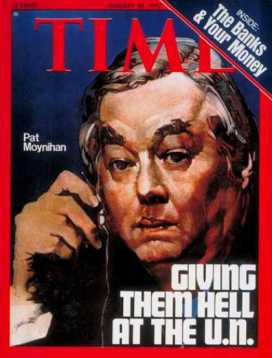
He raised hell as the U.S. Ambassador to the United Nations.

Time Magazine cover of UN Ambassador Daniel Patrick Moynihan

Time Magazine cover of UN Ambassador Daniel Patrick Moynihan

I knew him as the U.S. Senator from the State of New York, where he would shock his staff by showing up early on a Saturday morning to knock out a few letters to the editor, and op-ed pieces on his typewriter, without the bother of an in-session Senate to slow him down.  Later I worked for Checker Finn, who had worked with Moynihan when Moynihan was U.S. Ambassador to India.  Finn adopted many of his scholarly habits from Moynihan.  While working for Finn, nearly 25 years ago at the Department of Education, I got a taste of the world to come when Finn aggressively adopted e-mail messaging for himself and anyone of any executive influence under him, at the old Office of Educational Research and Improvement (OERI).  Aggressive adoption of new technologies can greatly improve organizations and organizational effectiveness.

Almost always with a bow tie.  Usually heavily editing his speeches, or writing his own op-ed pieces while other officials paid ghosts to do it for them.  Thinking thoughts Republicans would come to love, while a Democrat, but years before Republicans would come to love them.  Thinking thoughts Democrats would learn to love, but much later.

Few topics evaded his attention and careful thought.  He talked at length with David Gergen about the problem of Wikileaks, a dozen years before Wikileaks came to public attention (and years before Wikileaks even existed.)  He wrote books about international affairs, and education at home.  He pushed environmental laws to be better. Moynihan worried about the health of American families while James Dobson was still learning what a microphone and a family were.  In 1970, Moynihan warned the U.S. president that global warming is a problem.

Moynihan often appeared as the man who went everywhere, and did everything — after leaving Tulsa.  Moynihan studied everywhere.  He worked under New York Gov. Averell Harriman, and Presidents Kennedy, Johnson, Nixon and Ford, before serving a quarter century in the U.S. Senate (Is there some magic in that seat?  His predecessor was James Buckley; his successor was Hilary Rodham Clinton).   Here’s his brief Congressional biography:

MOYNIHAN, Daniel Patrick, a Senator from New York; born in Tulsa, Tulsa County, Okla., March 16, 1927; attended the public and parochial schools of New York City; attended City College of New York 1943; graduated, Tufts University, Medford, Mass., 1948; received graduate and law degrees from the Fletcher School of Law and Diplomacy 1949, 1961, 1968; studied as a Fulbright fellow, London School of Economics and Political Science 1950-1951; served in the United States Navy 1944-1947; Navy reserve 1947-1966; assistant and secretary to New York Governor W. Averell Harriman 1955-1958; member, New York State Tenure Commission 1959-1960; director, Syracuse University’s New York State Government Research Project 1959-1961; director, Joint Center for Urban Studies, Massachusetts Institute of Technology and Harvard University 1966-1969; author; held cabinet or sub-cabinet positions under Presidents John Kennedy, Lyndon Johnson, Richard Nixon, and Gerald Ford 1961-1976; Ambassador to India 1973-1975; United States Permanent Representative to the United Nations 1975-1976; elected as a Democrat to the United States Senate in 1976; reelected in 1982, 1988, and 1994 and served from January 3, 1977, to January 3, 2001; was not a candidate for reelection in 2000; chairman, Committee on the Environment and Public Works (One Hundred Second and One Hundred Third Congresses); Committee on Finance (One Hundred Third Congress); awarded the Presidential Medal of Freedom on August 9, 2000; professor at Syracuse University’s Maxwell School 2001; senior scholar, Woodrow Wilson International Center for Scholars 2001-2003; died of complications from a ruptured appendix on March 26, 2003; interment at Arlington National Cemetery.

Moynihan was a man ahead of his time.

In this photo, he’s making use of the technology of his time:  A typewriter (I think it’s an old Royal).  How much different would the world be had there been personal computers, and the internet, for Moynihan to toy with?

Moynihan was a writer, and the typewriter the chief tool of his trade.  How important was writing?  He gets his own page at Amazon.com.   Hendrik Hertzberg, in The New Yorker, last year:

Nevertheless, Pat Moynihan was, first, last, and always, a writer. “When I was five years old, I asked my mother, what does Dad do?” his daughter, Maura, recalls in a charming afterword to a splendid new book. “She replied, he’s a writer. And he was: he wrote every day—even at Christmas—articles, books, speeches, and, in great abundance, letters.” You might say he wrote his way to power. Without the writing, no foot-in-the-door job in John F. Kennedy’s Labor Department (and no influence once he was there), no high domestic-policy post in Richard Nixon’s White House, no ambassadorships to India and the United Nations, no twenty-four years in the Senate—and no Moynihan Station.

More, Resources:

Daniel Patrick Moynihan and typewriter, Harvard University

Daniel Patrick Moynihan and typewriter (Smith-Corona, I think) in his office at Harvard University – 1971. George Tames/The New York Times.


Typewriter of the moment: Sigurd Olson, a typewriter in the wilderness

January 11, 2011


Chuck Wick with Sigurd Olson's typewriter, in Olson's Ely, Minnesota, Home.  MPR photo
Chuck Wick knew Sigurd Olson and now owns Olson’s Ely home and writing shack. Olson’s old Royal typewriter, his pipes, photos, duck decoys and rock collection are still in the shack, where they were left after Olson died more than 20 years ago. (MPR Photo/Bob Kelleher)

Sigurd Olson, in his spare time, ghosted part of the National Wilderness Act, always fighting to preserve and protect his love, the Boundary Waters Canoe Area — on this typewriter.

It’s just a small shack, really an old garage — a drab olive green with a pair of windows on each side, tucked under a few shade trees in the corner of the yard.

When you enter, you hear the spring of a weathered, wooden screen door, and the slap when it closes behind.

Inside, it’s mustiness and old pine. The faded Royal typewriter still waits on a broad oak desk. Olson’s pipes are in the shallow bowl to the right.

Sigurd Olson at Quetico

Sigurd Olson at Quetico

From this typewriter, and this shack, Sigurd Olson captured in words the spirit of wilderness. Olson’s poetic writing has been compared to Henry David Thoreau’s, or John Muir’s. Chuck Wick owns the shack now.

“There’s all kinds of stuff here,” Wick says, fumbling a metal axe head pulled from a wooden drawer. “This piece here — this is an interesting one here. This is a trader’s axe that’s back from the voyageurs era.”

As he worked in his shack, Olson worried that 20th century America was fast gobbling up the nation’s last wild places.

Read the story at Minnesota Public Radio.

Read Olson’s book, The Singing Wilderness, or visit the website for the documentary on Olson with the same title, by Peter Olsen.

Resources:

It is wonderful to have national parks and forests to go to, but they are not enough. It is not enough to make a trip once a year or to see these places occasionally over a long week end. We need to have places close at hand, breathing spaces in cities and towns, little plots of ground where things have not changed; green belts, oases among the piles of steel and stone.

Sigurd Olson, “Our Need of Breathing Space,” at a Resources for the Future, Inc., forum, Washington, D.C., early 1958.


Typewriter of the moment: William Saroyan

December 19, 2010

William Saroyan's typewriter, photo from the Bancroft Library, University of Caliornia - Berkeley

William Saroyan's typewriter, displayed at the Saroyan Museum at his home in San Francisco - photo from the Bancroft Library, University of California; Berkeley

William Saroyan’s niece, Jacqueline Kazarian, recently gifted the Bancroft Library with a significant part of the archives of Saroyan’s work.  The press release on the gift included a photo of Saroyan’s Fox typewriter, which is displayed at the Saroyan museum in San Francisco.

Saroyan came from an Armenian American family, born in Fresno, California in 1908.  His writings illuminated the experience of Californians and Armenian Americans, especially during the Great Depression.

In many ways Saroyan’s work symbolizes the uniqueness of the Armenian community in America, especially California.  [You still out there, Ben Davidian?]   Wikipedia strikes the right tone:

Saroyan’s stories celebrated optimism in the midst of the trials and tribulations of the Depression. Several of Saroyan’s works were drawn from his own experiences, although his approach to autobiographical fact contained a fair bit of poetic license.

His advice to a young writer was: “Try to learn to breathe deeply; really to taste food when you eat, and when you sleep really to sleep. Try as much as possible to be wholly alive with all your might, and when you laugh, laugh like hell.” Saroyan endeavored to create a prose style full of zest for life and seemingly impressionistic, that came to be called “Saroyanesque”.

The complete May 19, 2010,  press release from the University of California is below.

a sketch "from a Turkish admirer," a photo of the author in his youth, and a framed sketch of Saroyan

The Bancroft Library's new archival material on William Saroyan includes (left to right) a sketch "from a Turkish admirer," a photo of the author in his youth, and a framed drawing of Saroyan with a passage of his writing on Armenia. (Images courtesy of the Bancroft Library)

The Bancroft Library accepts gift of William Saroyan archives

By Kathleen Maclay, Media Relations | 19 May 2010

William Saroyan

William Saroyan (Photo courtesy of The Bancroft Library)

BERKELEY — The Bancroft Library at the University of California, Berkeley, has received a spectacular gift of hundreds of books, drawings, correspondence and other personal communications to and from one of America’s best-known writers, the Armenian-American author and playwright William Saroyan.

The rich collection includes approximately 48 cartons with 1,200 books and other archival materials assembled by his niece, Jacqueline Kazarian, of San Francisco, who also is the founder of the William Saroyan Literary Foundation International. A celebration of the gift is set for noon on Friday (May 21) at The Faculty Club on campus.

“UC Berkeley is such an incredible place of learning and growing and intellectual exploration,” said Kazarian, who earned degrees in communication and decorative arts at UC Berkeley in the early 1950s. “I know that my uncle wanted his library, manuscripts and galleys to go to Berkeley. Students will be inspired by the collection.”

Apart from this gift, The Bancroft Library already retains significant holdings of Saroyan’s work that it collected over the course of his life and career, and it continues to add to that collection. Most of the latest materials come from Saroyan’s home on San Francisco’s 15th Avenue that is now a Saroyan museum directed by Kazarian. Those materials were supplemented by Kazarian’s extensive personal collection, as well as by items of Saroyan’s that she acquired through a prominent Boston archivist and via a Saroyan friend.

“Jacqueline Kazarian’s new gift is the largest and most substantial augmentation to the Saroyan collections at Bancroft that we have ever received,” said Peter Hanff, Bancroft’s deputy director.

The author’s classic manual typewriter, as displayed at his San Francisco home

The author’s classic Fox manual typewriter, as displayed at his San Francisco home. (Photo courtesy of The Bancroft Library)

Saroyan, born in Fresno, Calif., in 1908, drew extensively on his Armenian-American heritage and childhood experiences for his books, plays and short stories. Much of his writing was considered impressionistic and reflected a hearty optimism often hard to find during the gritty Great Depression. He died in 1981 at the age of 72, with his niece at his side.When Story magazine editors Martha Foley and Whit Burnett printed Saroyan’s “The Daring Young Man on the Flying Trapeze” in 1934, it was an immediate success, triggering Saroyan’s fame and standing as one of his many literary achievements.

“Uncle Bill’s writing revolutionized the short story,” said Kazarian, adding that she has always found his work “almost spiritual and fable-like.”

His five-act play, “The Time of Your Life,” is the only American play to have won both the New York Drama Critics’ Circle Award and the Pulitzer Prize. Saroyan’s work as a screenwriter with Hollywood director Louis B. Mayer on the film “The Human Comedy” won an Academy Award in 1943, and Saroyan later wrote a widely acclaimed book with the same title.

Kazarian’s gift to The Bancroft Library includes multiple first editions of Saroyan’s works, such as “The Daring Young Man on the Flying Trapeze,” “My Name is Aram” (1940), “The Human Comedy” and “Obituaries” (1979), and many materials personally inscribed by the writer. Also among the new items according to Steven Black, the head of acquisitions for Bancroft, are letters, telegrams and notes written by Saroyan to relatives and others close to him, mostly during the 1930s and 1940s.

antiquarian book dealer Peter Howard of Berkeley, shown here poring through Saroyan materials

Antiquarian book dealer Peter Howard of Berkeley, poring through Saroyan materials. (Photo courtesy of The Bancroft Library)

“He personalized a lot of what passed through his hands,” Black said, noting that much of the material features marginalia reflecting Saroyan’s thoughts and interests.

There also is a copy of Henry Miller’s “Aller Retour New York,” an 80-page journal about a 1935 visit by Miller to New York City and his journey aboard a Dutch ship back to Europe. It is inscribed by Miller to Saroyan.

And a Saroyan scrapbook in the collection contains press announcements about the Pulitzer Prize for his book, “The Time of Your Life.” He scoffed at the award, contending that the arts should not be judged by commerce.

The new Bancroft collection also contains a pre-publication proof of “Burnt Norton,” the first poem of T.S. Eliot’s “Four Quartets,” which Black said the publisher may have given to Saroyan “when he crossed the pond” on a trip from his temporary home in France to England.

There also is a wide range of magazines, including issues of Horizon and the Partisan Review, a leading publication of the Anglo-American intelligentsia during the 1930s and ’40s, Black said.

The first major deposit at The Bancroft Library of Saroyan’s papers was recorded in October 1980, and the library agreed to organize the collection and give Saroyan a general description and an index. After Saroyan died in 1981, the Saroyan Foundation paid the library to continue assembling the papers for official archives, which the foundation ultimately decided to place at Stanford University. That happened in 1996.

William Saroyan's niece, Jacqueline Kazarian, surveys materials at his San Francisco home

William Saroyan's niece, Jacqueline Kazarian, surveys materials in his home. (Photo courtesy of The Bancroft Library)

Kazarian’s donation is in honor of Berkeley antiquarian book dealer Peter Howard, who has provided appraisal assistance to Bancroft on Saroyan materials and other collections for decades. While director of The Bancroft Library, the late James D. Hart also developed strong professional and personal ties to Saroyan over the years, according to Kazarian and Black.

“Now, the Saroyan family materials come to a place that Saroyan himself would have been happy to see accepting them,” Black said, noting that Bancroft is proud to have so much of Saroyan’s “intellectual remains” to be able to share with the public.

Scheduled to speak about the acquisition at Friday’s event are Jacqueline Kazarian; David Calonne, vice president of education for the Saroyan Literary Foundation International and a Saroyan scholar; San Francisco novelist Herbert Gold; theater director Val Hendrickson reading Saroyan’s short story, “Common Prayer,” and the credo to “The Time of Your Life”; and Charles Faulhaber, director of The Bancroft Library.

UC Berkeley already is home to an Armenian Studies Program, which is focused on contemporary Armenian history, politics, language and culture. And Bancroft, a rich, special collections library containing historical and literary documents and other materials relating to California, the West, Mexico and Latin America, is known for its strong collections on California writers, including Jack London, Robinson Jeffers, Bret Harte, Frank Norris and others.

More information about The Bancroft Library is online. Bancroft is celebrating its 150th anniversary this year.

More:

William Saroyan commemorative stamps from the U.S., and U.S.S.R.

On commemorative stamps issued in both the U.S. and the U.S.S.R., Saroyan wears the Armenian-style moustache he wore through most of his later life. For a stamp to honor a man in both the U.S. and the Soviet Union was extremely rare -- maybe unique.


Typewriter of the moment: Harlan Ellison and his Olympia SG3

December 12, 2010

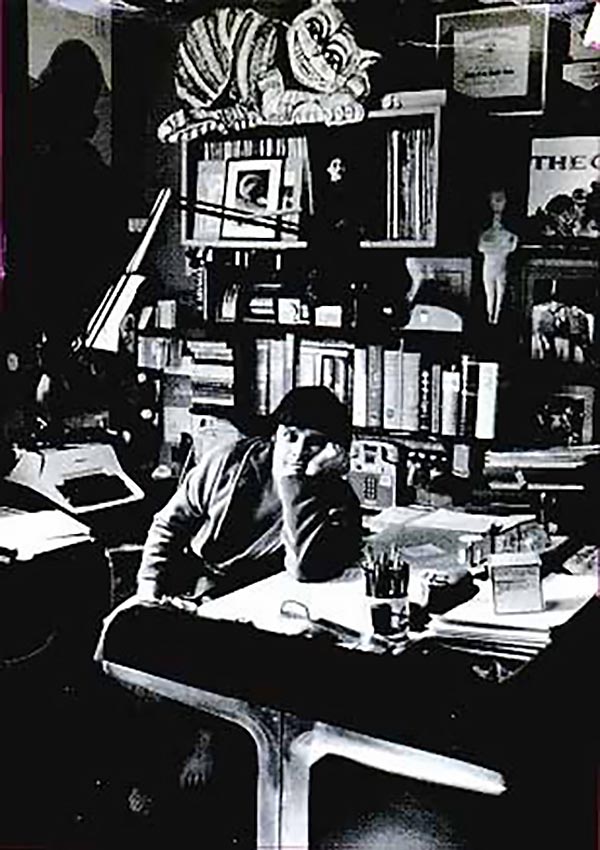
Harlan Ellison, his Olympia SG3, and other stuff - photo credit to MAX KATZ and KAREN FRIEDRICH
Harlan Ellison and his typewriter.  According to Richard Polt, the machine pictured is probably the Olympia SG3. Photo credit to Max Katz and Karen Friedrich.

Writers and their tools, in their workspaces.  We could probably date this photo by the stuff in Ellison’s office — the Cheshire Cat cutout?  Wasn’t that from an Edward Gorey-illustrated version of the Alice in Wonderland story?  What year was that?  The telephone on the wall, the desk scissors design . . . none of those fall into any expertise I have.  Someone else will have to date it.  My TinEye search didn’t shed any useful light.

I found the photo at Richard Polt’s fun site at Xavier University, The Classic Typewriter Page.  Polt is clearly working toward a MacArthur Foundation genius grant with this material.  Well, he would be, were I a judge.  (Who should get credit for the photo?  I don’t know — can you help identify who gets credit? See comment from Mr. Ellison:  ” . . .  image was captured for my 1974 STORY collection, APPROACHING OBLIVION, by MAX KATZ and KAREN FRIEDRICH.”  Credit for the photo gleefully acknowledged here.)

Oh, by the way, stay tuned:  Ellison is trying to sell his first typewriter.  That is a topic worthy of its own post.

Tip of the old scrub brush to the unfortunately moribund The Wit of the Staircase.


Typewriter of the moment: Tina Fey

July 25, 2010

Tina Fey mocks her writing chops

Tina Fey mocks her writing chops (can someone find the origin of this photo? Bust Magazine? Really?)

Tina Fey at her typewriter — an inspiration to writers everywhere.

Tip of the old typewriter scrub brush to Mass Games.

_____________

Update: Um, wow, yeah, it’s Bust Magazine.  And, focusing on typewriters and otherwise cloistered in secondary education, I had missed the controversy.  You might do well to check out Shapely Prose.  Also here.  And Jezebel has something to say, too.

Why does no one worry about the typewriter?


Typewriter of the moment: Ayn Rand

July 15, 2010

Ayn Rand at her typewriter

Ayn Rand at her typewriter

Ayn Rand at her typewriter, in an undated photo (do you know the date?).

Contrary to a popular myth, Rand did not take her name from the typewriter.  From the website of the Ayn Rand Institute:

What is the origin of “Rand”?

[From ARI’s monthly newsletter Impact, 06/2000]
“Ayn Rand, born Alisa Rosenbaum, based her professional first name on a Finnish one [see above]. The source of her last name, however, has been a mystery.

“Although its origin is still uncertain, recent biographical research by Drs. Allan Gotthelf and Michael Berliner has eliminated one possible source. An oft-repeated story claims that Ayn Rand took her last name from her Remington Rand typewriter while she was living in Chicago in 1926. This is false and we would like to put the error to rest.

“While still in Russia, c. 1925, and long before Remington-Rand typewriters were produced, Alisa Rosenbaum had adopted the name ‘Rand.’ Letters written in 1926 from Ayn Rand’s family in Russia already refer to the name ‘Rand.’ These were sent from Russia before Ayn Rand had communicated from America. The Remington and Rand companies did not merge until 1927; ‘Rand’ did not appear on their (or any) typewriters until the early 1930s.

“One lead to the actual source of the name comes from Ayn Rand herself. In 1936, she told the New York Evening Post that ‘Rand is an abbreviation of my Russian surname.’ Originally, we thought that this was a red herring in order to protect her family from the Soviet authorities.

“In 1997 Dr. Berliner noted an interesting coincidence when looking at a copy of Miss Rand’s 1924 university diploma. On the diploma was the name Rosenbaum in the Cyrillic alphabet:

The last three letters clearly look like the Roman letters ‘ayn.’ Richard Ralston then noticed that by covering those letters—and dropping out the second and fourth letters—what remains bears a strong resemblance to the Roman letters ‘Rand.’

“Although far from certain, it appears that the quote in the New York Evening Post may not have been a decoy.”

Her most often used typewriter was a Remington, I’ve read (but can’t find a reference now that I need it).  So far as I have found, however, typewriters were always manufactured under the “Remington” marque, and never as “Remington-Rand.”  Contrary to the implications from the ARI, Remington typewriters were produced from Reconstruction times (circa 1870), originally by the Remington Arms company.  Typewriter manufacturing was spun off from the arms producer in 1886; that company merged with Rand, forming Remington-Rand in 1927.


Typewriter of the moment: Wallace Stegner

June 4, 2010

Wallace Stegner and his typewriter - KUED image

Wallace Stegner and his typewriter – KUED image (via What Fresh Hell Is This?)

Wallace Stegner's books, KUED imageI’ve lived with Wallace Stegner’s work since I first got to the University of Utah.  Stegner was the biographer of Bernard DeVoto, whose works I read in a couple of different classes.

More important, Stegner wrote about the West and wild spaces and places, and how to save them — and why they should be saved.

Salt Lake City’s and the University of Utah’s KUED produced a program on Stegner in 2009 — he graduated from and taught at Utah — a film that wasn’t broadcast on KERA here in Dallas, so far as I can find..

In conjunction with the University of Utah, KUED is honoring alumni Wallace Stegner – the “Dean” of western writers. WALLACE STEGNER, a biographical film portrait, celebrates the 2009 centennial of his birth. Wallace Stegner was an acclaimed writer, conservationist, and teacher. He became one of America’s greatest writers. His books include the Pulitzer Prize-winning “Angle of Repose” and “Beyond the Hundredth Meridian.” His “The Wilderness Letter” became the conscience of the conservation movement. Wallace Stegner mentored a generation’s greatest writers including Ken Kesey, Edward Abbey, and Larry McMurtry. Former Supreme Court Justice Sandra Day O’Connor was a student.

It’s difficult to tell from the photo, but his typewriter here looks a lot like a Royal.

Have you seen the film?

More:


Typewriter of the moment: Jerry Lewis’s pantomime typewriter (with Leroy Anderson)

May 22, 2010

Ms. Fox’s class had a great time with this video — easy to see why, no?

From “Who’s Minding the Store,” a 1963 Paramount release.

I would have sworn I had a post on Leroy Anderson, but it’s not there to link to; you can check him out on PBS, though.  Another good topic to explore, an oversight to amend.

Jerry Lewis’s pantomime typewriter, always with the Leroy Anderson tune behind it, was one of his most famous comedic routines.  It was very popular in Europe, in both Germany and France.  It’s easy to translate.

Tip of the old scrub brush to Ms. Fox.


Progress run amok: No typewriters?

May 22, 2010

Pamela Bumsted sent the link to Boing! Boing!

The Writers Room is kicking out the guy with the last typewriter.

Writers Room logo on Facebook

Writers Room logo on Facebook

The Writers Room is a non-profit that offers cheap working space to writers.  In the old days, that meant a desk and a chair where a writer could use a legal pad and write longhand, or put a typewriter down to type a manuscript.

In 2010, there was just one guy left using a typewriter.  Everyone else had switched to computers.  Boing Boing said:

Greenwich Village’s Writers Room, a low-cost place for writers to rent workspace, has banned mechanical typewriters from its premises, giving Skye Ferrante, the sole remaining typewriter user the choice of switching to a laptop or going elsewhere. He’s not going to switch. Ferrante’s been using the Writers Room for six years, and is distressed at the news that he’s got to leave.

Skye Ferrante at his typewriter - now banned from the Writers Room

Skye Ferrante at his 1929 Royal typewriter - now banned from the Writers Room - photo by Hagen for New York Daily News

What’s this world coming to?

According to the New York Daily News (which probably has typewriters anymore only in its museum, if it has that):

“I was told I was the unintended beneficiary of a policy to placate the elderly members who have all since died off,” said Ferrante, a Manhattan native who’s writing children’s books. “They offered me a choice to switch to a laptop or refund my money, which to me is no choice at all.”

Ferrante was peeved, but not completely surprised.

A growing number of scowls had replaced the smiles that once greeted the arrival of his black, glass-key typewriter.

“The minute the sign came down, I realized there was antagonism from some of the new members,” he said. “They gave me an attitude when they saw me setting up the typewriter.”

Ferrante’s connection to typewriters runs deep. He owns at least five of the old-school machines, his devices of choice since his teens.

“There’s a different commitment when you know you’re making a mark on the page, when you strike a key and bleed ink on the page,” he said.

After being contacted by the Daily News, Writers Room officials told Ferrante he can continue working on his typewriter until the end of his term on June 30.
http://www.nydailynews.com/ny_local/2010/05/20/2010-05-20_untitled__typewriter20m.html?r=ny_local&utm_source=feedburner&utm_medium=feed&utm_campaign=Feed%3A+nydnrss%2Fny_local+%28NY+Local%29#ixzz0odMP9rdB

Heck, they might as well ban pens, pencils and paper.
Progress is okay.  This time, though, they’ve taken it too far.


Typewriter of the moment: Helen Keller

March 14, 2010

Helen Keller at her typewriter, with Polly Thompson,  1933 - American Foundation for the Blind

Helen Keller at her typewriter, with Polly Thompson, 1933 - American Foundation for the Blind photo

Caption from the American Foundation for the Blind:  “This photograph, taken in their home, shows Helen and Polly in front of two large windows. The light is bright outside, and the curtains on the windows are pulled back. Helen is sitting at her typewriter, describing something with her hands to Polly, who is leaning towards her, smiling. Helen has on a dark dress with small light flowers and white trim on the neck and cuffs. Polly is wearing a long black dress, with a white pearl necklace.”

Moral of the photo:  “So don’t tell me you can’t do it.”  “So don’t tell me you don’t have time to write.”  “If Helen Keller could write books on a typewriter — she who could neither see nor hear — I don’t want any excuse from you that has the word ‘can’t’ in it.”

What moral, or other rant, would you propose?

Add to FacebookAdd to NewsvineAdd to DiggAdd to Del.icio.usAdd to StumbleuponAdd to RedditAdd to BlinklistAdd to TwitterAdd to TechnoratiAdd to Furl