Sylvia Plath, author and poet, at her typewriter - photographer unknown to me
Is it a Royal typewriter? Why is it so many photos of people at typewriters show them outdoors — and will there be many pictures of authors at their computers, let alone at their computers outdoors?
Mystery solved? Update December 30, 2011 — looking at the photo of Rob’s Hermes, in comments below, it sure looks to me that Plath’s machine is a Hermes.
Spread the word; friends don't allow friends to repeat history.
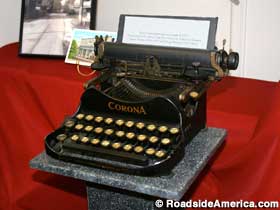
maybe a little late for Christmas: Here’s the typewriter used to answer letters to Santa Claus, at the U.S. Post Office of Santa Claus, Indiana:
Typewriter used to answer letters to Santa Claus, from the U.S. Post Office in Santa Claus, Indiana - Roadside America photo
For 30 years, kids letters to Santa Claus were answered, with the responses typed on this Corona at the Post Office. The machine rests on display at the Santa Claus Museum in Kris Kringle Plaza in Santa Claus, Indiana, about 40 miles east northeast from Evansville (south of Interstate 64).
Answers to letters to Santa Claus are answered from the museum today.
QWERTY Exhibit at the Museum of Printing History, Houston
QWERTY: A Typewriter Retrospective
October 8, 2009– March 20, 2010 Typewriters inhabit a special place in the American psyche. No longer in widespread use, typewriters have been outsourced by the desktop computer, although they maintain a special air of nostalgia. Americans remember their junior high typing class, while many of today’s youngsters have never set eyes on such a machine. Tucked away in closets and in office corners, many typewriters are still occasionally put to good use. In addition to being beautiful specimens of design, who can forget the characteristic music of taps and bells created by a manual typewriter? From the collection of the Museum of Printing History.
More details on the Museum:
The Museum of Printing History
1324 W. Clay Street
Houston, Texas 77019
Hours:
10 a.m. – 5 p.m.
Tuesday – Saturday
713-522-4652
Free admission for self-guided tours
Spread the word; friends don't allow friends to repeat history.
Alan Lomax at the typewriter, 1942, using the "hunt and peck method" of typing - Library of Congress photo
Who was Alan Lomax? Have you really never heard of him before?
Lomax collected folk music, on wire recorders, on tape recorders, in written form, and any other way he could, on farms, at festivals, in jails, at concerts, in churches, on street corners — anywhere people make music. He did it his entire life. He collected music in the United States, across the Caribbean, in Britain, Scotland, Ireland, Spain and Italy.
Alan Lomax, Woody Guthrie, Lillie Mae Ledford and an obscured Sonny Terry, New York, 1944 (Library of Congress Collection - photographer unknown)
Almost all of that collection is in the Library of Congress’s unsurpassed American Folklife collection, from which dozens of recordings have been issued.
Born in 1915, Alan Lomax began collecting folk music for the Library of Congress with his father [John Lomax] at the age of 18. He continued his whole life in the pursuit of recording traditional cultures, believing that all cultures should be recorded and presented to the public. His life’s work, represented by seventy years’ worth of documentation, will now be housed under one roof at the Library, a place for which the Lomax family has always had strong connections and great affection.
Were that all, it would be an outstanding record of accomplishment. Lomax was much more central to the folk revivals in the both England and the U.S. in the 1950s and 19602, though, and in truth it seemed he had a hand in everything dealing with folk music in the English-speaking world and then some. Carl Sagan used Lomax as a consultant to help choose the music to be placed on the disc sent into space with the exploring satellite Voyager, “the Voyager Golden Record.”
Have you listened to and loved Aaron Copland’s “Rodeo,” and the famous passage, “Hoedown?” How about Miles Davis, with the Gil Evans-produced “Sketches of Spain?” [Thank you, Avis Ortner.] Then you know the work of Alan Lomax, as Wikipedia explains:
The famous “Hoedown” in Aaron Copland‘s 1942 ballet Rodeo was taken note for note from Ruth Crawford Seeger‘s piano transcription of the square-dance tune, “Bonypart” (“Bonaparte’s Retreat”), taken from a recording of W. M. Stepp’s fiddle version, originally recorded in Appalachia for the Library of Congress by Alan and Elizabeth Lomax in 1937. Seeger’s transcription was published in Our Singing Country (1941) by John A. and Alan Lomax and Ruth Crawford Seeger.
Miles Davis‘s 1959 Sketches of Spain album adapts the melodies “Alborada de vigo” and “Saeta” from Alan Lomax’s Columbia World Library album Spain.
“To Hear Your Banjo Play” featuring Pete Seeger, written and produced by Alan Lomax.
Trailer for the PBS P.O.V. film, “The Song Hunter,” by Rogier Kappers
John Lennon's manual Imperial typewriter, used when he was a teenager - now owned by Steve Soboroff - Image from Playa Vista Today
Steve Soboroff, CEO of Playa Vista Capital in Playa Vista, California, collects celebrity typewriters on the side. Earlier this year he acquired the typewriter John Lennon used as a teenager, according to Playa Vista Today.
Lennon’s Imperial (The Good Companion Model T) was among the late Beatle’s possessions originally auctioned by his Aunt Mimi to a Liverpool charity involving musical therapy. Soboroff came across Lennon’s writing instrument during an estate sale overseen by Bonhams auction house in England. The portable was originally auctioned through Sotheby’s in 1999. However, the owner succumbed to the economic downturn and put it up for sale earlier this year.
‘I was going to get on an airplane to go get it,’ Soboroff says regarding his summer purchase, which was probably used in the late Beatle’s first attempts at songwriting as a teenager. ‘He was living with his aunt when he owned it,’ he says.
And here’s a photo of John Lennon working at a typewriter other than the Imperial:
Autographed photo of John Lennon working at a typewriter - Image from Playa Vista Today
Soboroff also owns typewriters used by sportswriter Jim Murray, Ernest Hemingway, George Bernard Shaw, Tennessee Williams, and Jack London.
Spread the word; friends don't allow friends to repeat history.
Alistair Cooke's typewriter, displayed at BBC headquarters, Bush House, in London - Photo by Jeff Zycinski
Alas, our students now are too young to remember Alistair Cooke’s hosting of “Masterpiece Theater” on PBS, and of course, back then the BBC America service — if it existed — was available only to shortwave fanatics or people who traveled a lot to the British Isles.
Perhaps more than anyone else other than Winston Churchill, and maybe the Beatles, Alistair Cooke tied England and America together tightly in the 20th century. BBC’s other writers are good to brilliant, but even their obituary for Cooke (March 30, 2004) doesn’t quite do him justice:
For more than half a century, Alistair Cooke’s weekly broadcasts of Letter from America for BBC radio monitored the pulse of life in the United States and relayed its strengths and weaknesses to 50 countries.
His retirement from the show earlier this month after 58 years, due to ill health, brought a flood of tributes for his huge contributing to broadcasting.
Perhaps for Cooke, from Cooke’s broadcasts, we could develop a new variation of the Advanced Placement document-based question: Broadcast-based questions. Heaven knows his Letter From America provided profound material on American history:
In Key West, early on in an apartment near the Ford dealership, where they awaited the delivery of the Ford purchased for Hemingway and his wife Pauline, by Pauline’s Uncle Gus, Hemingway wrote most of A Farewell to Arms, published in 1929.
The house was purchased later. I can’t tell — some say he used here a Royal Quiet DeLuxe.
Steve Allen invented “The Tonight Show” on NBC, and was its first host. It would have been great to have heard his opinion of Jay Leno’s leaving, and Conan O’Brien’s taking over.
Spread the word; friends don't allow friends to repeat history.
He held many jobs, cowboy, police commissioner, governor, military leader, president — but he regarded his profession as “writer.”
Theodore Roosevelt‘s typewriter, a Remington, from his house at Sagamore Hill, New York:
Theodore Roosevelt’s typewriter from his home at Sagamore Hill, New York – Fish and Wildlife Service photo, National Digital Image Library (public domain)
Update, March 16, 2012: There are two versions of the same photo above, if we’re lucky. The designator at the National Digital Library has changed at least twice, leaving this post high and dry. There is another, slightly lower quality version of the photo above. You’re not seeing double, you’re seeing operational redundancy.
1930s era typewriter that accompanied Australian journalist Ron Boland through his journalistic career, a Remington Portable - State Library of South Australia (on loan from Jasin Boland)
For nearly 50 years, this typewriter was the peak of technology, for a world class journalist.
Boland’s life and timeline could make for some interesting projects or study assignments — see Boland’s campaign for topless swimming on Australia’s beaches. Topless swimming for men.
Boland’s work is probably mostly invisible to American students, but it should provide some good enrichment for students of world history.
The case for Australian journalist Ron Boland's Remington Portable typewriter, testifying to the globe trotting done by the typewriter, and Boland. State Library of South Australia
Or, until that account is unsuspended by the forces supporting Donald Trump: Follow @FillmoreWhite, the account of the Millard Fillmore White House Library
We've been soaking in the Bathtub for several months, long enough that some of the links we've used have gone to the Great Internet in the Sky.
If you find a dead link, please leave a comment to that post, and tell us what link has expired.
Thanks!
Retired teacher of law, economics, history, AP government, psychology and science. Former speechwriter, press guy and legislative aide in U.S. Senate. Former Department of Education. Former airline real estate, telecom towers, Big 6 (that old!) consultant. Lab and field research in air pollution control.
My blog, Millard Fillmore's Bathtub, is a continuing experiment to test how to use blogs to improve and speed up learning processes for students, perhaps by making some of the courses actually interesting. It is a blog for teachers, to see if we can use blogs. It is for people interested in social studies and social studies education, to see if we can learn to get it right. It's a blog for science fans, to promote good science and good science policy. It's a blog for people interested in good government and how to achieve it.
BS in Mass Communication, University of Utah
Graduate study in Rhetoric and Speech Communication, University of Arizona
JD from the National Law Center, George Washington University


 Posted by Ed Darrell






 Millard Fillmore's Bathtub