Exciting times: House committee subpoenas

May 6, 2008

Living through the Watergate scandals and the Constitutional crises they produced — and spending part of that time in Washington, D.C., working for the Senate — I got a wonderful view of how constitutional government works, why it is important that good people step up to make it work, and a glimpse of what happens when good people lay back and let the hooligans run amock.

Over the last three months it occurs to me that we may be living in a similar time, when great but latent threats to our Constitution and the rule of law may be halted or rolled back by one John Dean-like character who will stand up before a group of elected officials, swear to tell the truth, and then, in fact, tell the whole truth.

Teachers, are you taking advantages of these lessons in civics that come into our newspapers every day?

We live in interesting times, exciting times — we live in educational times.

You should be clipping news stories on these events, and you should be using them in your classrooms today, and saving them for the fall elections, for the January inauguration, for the new Congress . . . and for your future classes.

What other opportunities for great civics lessons come to our doorsteps every day?


Randy Forbes, you get an “F” in history — I don’t care if you are a Congressman

January 6, 2008

Oy.

U.S. Rep. Randy Forbes, R-Virginia, wants a resolution designating a week in May as “American Religious History Week.”

Alas, alack, and every other epithet you can think of, Forbes’ resolution, H. Res. 888, is loaded to the gills with historical error. Adding hypocrisy to error, Forbes plagiarized a raft of “citations” in a lengthy set of footnotes in an oleaginous “footnoted” version of the resolution. It’s clear that Forbes did not read the sources of the footnotes, and it appears that he didn’t bother to read the footnotes either. The footnotes claim religious language in the case of Vidal v. Girard’s Executors, 43 U. S. 127, 198 (1844), for example, but fail to note that the language mentioned was repudiated by the Supreme Court in their upholding of the will of atheist patriot Stephen Girard, turning back arguments that the U.S. is a Christian nation with Christianity in its common law. Forbes is a member of the Judiciary Committee, and a graduate of the University of Virginia’s law school. Hypothetically, he should know better.

The resolution is so wrong on history, it has the effect of repudiating the No Child Left Behind Act’s call for standards in education, in the worst possible way.

Chris Rodda, the author and indefatigable correcter of such historical error, has a long post at Daily Kos detailing the problems.

Baffled at the astounding lack of scholarship in the resolution, I want to know:

  1. Does Rep. Forbes’ mother know he turns in work like this?
  2. What is the view of any serious Virginia history association?
  3. Will any Virginia university history department endorse the resolution as accurate? Would such a paper not violate ethical standards for a student at Randolph-Macon College (Forbes’s alma mater)?
  4. What is the view of the American Historical Association?
  5. What does the Department of Education say about it? Nothing? How about the mavens at the National Assessment of Educational Progress? Is there any way this resolution could fail to damage the history attainment of the entire nation?
  6. Is Forbes bucking to get on Leno’s “Jaywalking” segment, in the playoffs?
  7. Why does Rep. Forbes hate America’s history teachers so?
  8. Wasn’t there any staffer with enough sense to stop Rep. Forbes from embarrassing himself with this stuff?
  9. Has the House historian signed off on the historical accuracy of the resolution’s “whereas” clauses?
  10. Has Rep. Forbes ever looked at the 23 bas relief portrayals of lawmakers around the House Chamber and wondered who they were, why they were there, and why his resolution insults most of them? (He cites the sculptures in one of the whereas clauses — one might wonder if he ever looks up.)

Tip of the old scrub brush to Ed Brayton at Dispatches from the Culture Wars.
Read the rest of this entry »


Bring back the OTA!

September 14, 2007

Imagine the United States government had an agency that was staffed with experts who were respected by scientists and policy makers of all political stripes.

Imagine this agency did studies on serious issues that would affect the nation in the future, and recommend policies that would allow our nation to take advantage of technology to promote human welfare and our economy, and that would allow our nation to resolve issues that threaten our health, domestic welfare and national security.

Imagine that, because the agency had such strong support and credibility, policy makers would enact recommendations the agency made.

Imagine!?! No, all you need to do is remember the Office of Technology Assessment (OTA), an arm of Congress that provided powerful information, insight and recommendations on technology policies for about two decades, from about 1974 to 1995.

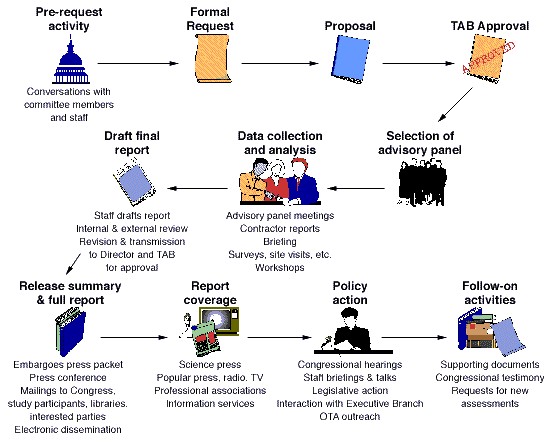
OTA assessment steps Click on thumbnail for chart of the assessment process used by the Office of Technology Assessment to advise Congress on important technology issues.

Now, think about how useful it would be to have such an agency back, to advise our nation on climate change, emergency preparedness, weapons of mass destruction in the post-Soviet era, malaria eradication policies, internet safety and security, and other key issues.

It’s time to bring back the OTA.

Mark Hoofnagle at the Denialism Blog started sounding the conch:

The fact of the matter is that our government is currently operating without any real scientific analysis of policy. Any member can introduce whatever set of facts they want, by employing some crank think tank to cherry-pick the scientific literature to suit any ideological agenda. This is truly should be a non-partisan issue. Everybody should want the government to be operating from one set of facts, ideally facts investigated by an independent body within the congress that is fiercely non-partisan, to set the bounds of legitimate debate. Everybody should want policy and policy debates to be based upon sound scientific ground. Everybody should want evidence-based government.

Go read what he said. Check in with P. Z. Myers’ view. See what John Wilkins says. Hoofnagle lists actions you can take, today, to get the ball rolling.

In the meantime, wander over to the Princeton University site where the OTA’s reports are now archived (I understand the government was going to take it offline, sort of a latter-day burning of the library at Alexandria). Noodle around and look at the report titles. Notice that, though the agency was killed dead by 1995, the agency had reports on climate change. Notice that the agency was a decade or two ahead in urging policies to encourage the internet. Look at the other issues the agency dealt with, look at the legislation that resulted — and you’ll lament with me that we don’t have the agency around today, when the issues are tougher, the technology more difficult to understand, and politics more driven by rumor than fact.

Killing the OTA was the Pearl Harbor of the present war on science. It’s time we started to fight back, to take back the scientific Pacific — our nation’s future is no less in peril now from the war on science, than it was then from hostile nations.

Resources:


August 7, 1964: Gulf of Tonkin Resolution

August 7, 2007

August 7 is the 43rd anniversary of the Gulf of Tonkin Resolution, the resolution which authorized President Lyndon B. Johnson to move troops into South Vietnam to defend U.S. interests.

The resolution passed Congress after what appeared to be attacks on two U.S. Navy ships in the Gulf of Tonkin.  At the time, and now, evidence is weak that such attacks took place.

Santayana’s ghost looks on in wonder.


When things get tough, the patriotic listen to Barbara Jordan

August 2, 2007

Whose voice do you hear, really, when you read material that is supposed to be spoken by God? Morgan Freeman is a popular choice — he’s played God at least twice now, racing George Burns for the title of having played God most often in a movie. James Earl Jones?

Statue of Barbara Jordan at the Austin, Texas, Airport

Statue of Rep. Barbara Jordan at the Austin, Texas airport that bears her name. Photo by Meghan Lamberti, via Accenture.com

For substance as well as tone, I nominate Barbara Jordan’s as the voice you should hear.

I’m not alone. Bill Moyers famously said:

When Max Sherman called me to tell me that Barbara was dying and wanted me to speak at this service, I had been reading a story in that morning’s New York Times about the discovery of forty billion new galaxies deep in the inner sanctum of the universe. Forty billion new galaxies to go with the ten billion we already knew about. As I put the phone down, I thought: it will take an infinite cosmic vista to accommodate a soul this great. The universe has been getting ready for her.

Now, at last, she has an amplifying system equal to that voice. As we gather in her memory, I can imagine the cadences of her eloquence echoing at the speed of light past orbiting planets and pulsars, past black holes and white dwarfs and hundreds of millions of sun-like stars, until the whole cosmic spectrum stretching out to the far fringes of space towards the very origins of time resonates to her presence.

Virgotext carried a series of posts earlier in the year, commemorating what would have been Jordan’s 71st birthday on February 21. (Virgotext also pointed me to the Moyers quote, above.)

Now, when the nation seriously ponders impeachment of a president, for the third time in just over a generation, Ms. Jordan’s words have more salience, urgency, and wisdom. It’s a good time to revisit Barbara Jordan’s wisdom, in the series of posts at Virgotext.

“There is no president of the United States that can veto that decision.”

“My faith in the Constitution is whole.”

“We know the nature of Impeachment. We’ve been talking about it a while now.”

“Indignation so great as to overgrow party interests.”

And finally:

The rest of the hearing remarks are all here. It’s a longer clip than the others but honestly, there is not a good place to cut it.

This is Barbara Jordan on the killing floor.

This was a woman who understands history, who illustrates time and again that we are, with every action, with every syllable, cutting the past away from the present.

She never mentions Nixon by name. There is the Constitution. There is the office of the Presidency. But Richard Nixon the president has already ceased to exist. By the time she finishes speaking, he is history.

“A President is impeachable if he attempts to subvert the Constitution.”

Also see, and hear:

Virgotext’s collection of Barbara Jordan stories and quotes is an excellent source for students on Watergate, impeachment, great oratory, and Barbara Jordan herself. Bookmark that site.

Barbara Jordan, in a pensive moment, in a House Committee room

Rep. Barbara Jordan sitting calmly among tension, at a House Committee meeting (probably House Judiciary Committee in 1974).

Update 2019: Here is the full audio of Barbara Jordan’s speech. It is still salient, and if you listen to it you will understand better what is going on in Congress today.

Barbara Jordan, Statement on the Articles of Impeachment, at AmericanRhetori.com.