You can’t parody this: Jonathan Wells on “Darwinism Top 10”

September 5, 2007

Anti-science and anti-evolution groups’ desperation erupts in odd ways. When scientists get together and discussion turns to the political movement known as intelligent design (ID), they express frustration at the sheer volume of supercilious ideas and claims that surge out of ID advocates. At its heart, this frustration has an almost-humorous puzzle: Scientists cannot tell what is a real claim from ID advocates, or what is a parody of those claims.

Neither can anyone else.

I stumbled into a mackerel-in-the-moonlight* example to show the problem: Jonathan Wells, a minister in the Unification Church of Rev. Sun Myung Moon, wrote a slap-dash screed against evolution published by right-wing cudgel publishing house Regnery, called The Politically Incorrect Guide to Darwinism and Intelligent Design.

Amazon.com invites authors to set up blogs, and Jonathan Wells has one. The only post there is reproduced in full below the fold — a list of . . . um, well . . . a top ten list of something (Wells just calls it a “top ten list”). It consists of amazing flights of fancy surrounding the issue of teaching science in public schools. I promise, I am not making any of this up — when I quote Wells, it will be his words entirely, completely, in context, uncut and unedited. If I didn’t tell you this was not parody, and if you have half your wits, you’d think either I was making it up, or somebody at Amazon was.

Point by point criticism, in brief, below the fold. I promise, I am not making this up.

__________________________________

* John Randolph is reputed to have said of Henry Clay: “Like a rotten mackerel by moonlight, he shines and stinks.” Read the rest of this entry »


D. James Kennedy, 76

September 5, 2007

From the Washington Post:

By KELLI KENNEDY

The Associated Press
Wednesday, September 5, 2007; 11:12 AM

FORT LAUDERDALE, Fla. — The Rev. D. James Kennedy, a pioneering megachurch pastor who became one of the nation’s most prominent Christian broadcasters and a key figure in the rise of the religious right, died Wednesday, a church spokesman said. He was 76.

We wish his family comfort and well.

Kennedy announced his retirement about a month ago. Coral Ridge Ministries, the church he founded in Florida, will continue. One might hope that, with regard to notorious programs he promoted with voodoo history on the founding of the U.S. and voodoo science against biology, some of the his projects will be allowed to expire with him.


Getting Newtonist ideas out of the science books

September 3, 2007

When the Discovery Institute’s campaign against Darwin succeeds, will they be content? Remember, the real war is against materialism, DI says. Will Isaac Newton and the materialist theory of gravity be next?

Here’s a parody that suggests what that campaign would look like, from Tiny Frog. It’s a parody. It’s a hoax.

I said, it’s not real, it’s a parody.  It’s a parody.
Immediate update: Pharyngula picked up on Tiny Frog’s post, too — a sign the post is worth reading, generally.


Vox Day: Trapped in a quote mine cave-in

August 31, 2007

Vox Day, who claims to know more than most mortals can even think about, has fallen into a quote mine. (Quote mine defined.) Worse, the mine appears to have caved in.

Vox Day wishes to make the claim that Darwin is responsible for the evils of the Soviet Union. Apart from the prima facie absurdity of the claim, Vox has a dozen highly tenuous links he wishes to torture into supporting his claim, despite their refusal to do so.

This just in: Since I started out on this particular Fisking, Vox has popped up with this gem:

Unsurprisingly, evolutionists are reacting strongly to my column today. They swear up and down that there is no connection whatsoever between evolution and Communism, despite the fact that every single major Communist not only subscribed to Darwinist evolution but considered Darwin to be second only to Hegel as a pre-Marxist socialist figure.

There is no evidence Stalin or Lenin ever subscribed to evolution theory, and at any rate, Stalin expressly rejected Darwin and evolution, eviscerating the Soviets’ lead in genetics in 1920 by banning the teaching of evolution, banning research in evolution or research that had Darwinian overtones, stripping Darwin-theory subscribing biologists of their jobs, exiling a few to Siberia and death in several cases, and executing a few just for good measure. In place of evolution, Stalin backed Trofim Lysenko who advocated, apart from his creationist-like hatred of Darwin, an odd, almost-Lamarckian idea that stress in utero would change characteristics.

So, for example, Lysenko ordered that seed wheat be frozen, and then planted in winter. The freezing, the Stalin-Lysenko idea held, would make the wheat able to grow in cold weather. The crop failures were so spectacular that at least 4 million people died of starvation in the Soviet Union. By 1954 the crop failures were so massive the Soviet Union had to purchase wheat from the U.S., with loans from the U.S. These loans crippled any hope of the Soviet economy ever breaking out of its doldrums, and started the long slide to the collapse of the Soviet Union. You’d think Vox Day, who professes to be a libertarian and a Christian, would approve of the collapse of the Soviet Union by any cause — but he does not approve of the collapse if it came by a lack of evolution theory.

Vox Day never lets the facts get in the way of a rant. (As evidence that Marx was so deeply influenced by evolution theory, Vox notes that a fellow who knew Darwin, Edward Aveling attended Marx’s funeral. If that doesn’t convince, you, Vox says, Aveling later wrote an article saying it’s true, Marxism was based on evolution theory. So take THAT all you people who think Marxism emphasizes collectivism and the state: Darwin’s individual competition for survival is the REAL root of socialism. No, I’m not making this up — go read it for yourself. Then get some facts — read this account, which includes the guest list of Marx’s funeral. There were only nine people at Marx’s funeral, and Vox got the guest list wrong: Aveling wasn’t there. One more Vox claim refuted.)

Back to the regularly scheduled Vox Day quote mine cave-in, below the fold.

Read the rest of this entry »


Rachel Carson and DDT “ban” save millions of lives

August 27, 2007

[This post has been edited to correct links to go to their new URLs, I hope.  Please note in comments any links that don’t work.]

Some are Boojums is back — that’s good news for truth seekers, science error debunkers and historians who care about accuracy.

Masthead photo for Jim Easter's blog, Some Are Boojums

Masthead photo for Jim Easter’s blog, Some Are Boojums

Some are Boojums author Jim Easter guts the anti-Rachel Carson case in his relaunch post.

Pay particular attention to what Jim writes in conclusion:

That’s right. The 1972 DDT ban did nothing to restrict the chemical’s use against malaria, but had the effect of eliminating the single most intense source of selection pressure for insecticide resistance in mosquitoes. As the rest of the world followed suit in restricting agricultural use of DDT, the spread of resistance was slowed dramatically or stopped. By this single action, William Ruckelshaus — and, credit where it’s due, Rachel Carson — may well have saved millions of lives.

Steven Milloy is invited to add that to the DDT FAQ any time it’s convenient.

Particularly notable is Jim’s work to make available the much miscited administrative law ruling by Judge Edmund M. Sweeney. It is now available on-line, so the critics can now provide accurate citations to the decision, if their intent were to inform the public, instead of maligning the truth and misleading the public.

Mr. Easter’s applied history work in this effort is notable. The internet misses much of near-recent history, especially from the 1960s, 1970s and 1980s. Much of today’s political discussion could benefit from information that would be available in libraries, had libraries not suffered from great budget and priorities cuts in the last 20 years. Jim Easter’s contribution to making a more complete record of the history of DDT and the history of the EPA deserves applause.

Save


You had to be there

August 25, 2007

Jim Easter at Some Are Boojums wondered what it would look like if we assumed in history what creationists claim about biology, geology, paleontology, archaeology and astronomy — “No one alive today was there, so no one can say what happened.”

His detailing of the “10 Questions to Ask Your History Teacher” is a parody of Jonathan Wells’ attempt to get kids to tell biology teachers that biology is hoakum. It’s worth a read again, since the issue heats up again at the Texas State Board of Education.

Get ready, history teachers: Here come the kids with the questions!


Turkish creationists censor 1 million WordPress blogs

August 19, 2007

It’s an act worthy of Nicolae Ceauşescu, or Idi Amin — but the Turkish creationist Adnan Oktar has taken legal action that effectively blocks more than a million weblogs from access in Turkey — all the blogs on WordPress, the host of this blog.

Here’s the general announcement to WordPress clients. This site has the text of the threats from Oktar’s lawyers to WordPress.

Here’s a link to Matt’s blog, which has more discussion.

Adnan Oktar is the guy who pays people to write under the name Harun Yahya. Under that name he has published dozens of anti-evolution screeds. You may recall that, in the past year, he has financed the publication of an 800-page book, handsomely bound with scores of pictures (many of them plagiarized), claiming evolution could not account for features of living things. The scientifically vacuous book was delivered to schools and libraries across Europe in 2006, and then to thousands of U.S. scientists, teachers and libraries earlier in 2007.  (Here’s a good summary of creationism and Islam, from Taner Edis.)

I suggested in comments that protests should be made to the European Union. Turkey is working to gain admittance to the EU, and childish, totalitarian eruptions such as Oktar’s getting a court to censor a million blogs, significantly detract from Turkey’s chances and case. There is high irony here, too — Oktar is one of those who has willingly spread false claims that evolution was a cause of the Holocaust (when he’s not busy denying the Holocaust happened; consistency and accuracy are not among his strong points) — heck, just a few months ago he was claiming evolution is the cause of terrorism.

Do you have better ideas about what to do?

I hope the few of you who read this blog will spread this word far and fast.

Such disruptions of communication over an entire nation are the dreams of terrorists. Are we to understand that Adnan Oktar does this because Darwin convinced him? Or are his actions direct denial of his earlier claims?

I have been a journalist for a long time, having joined the Society of Professional Journalists in 1974. I spent many years in Washington, slugging it out against people who wished they had the power of censorship, and some who actually did have that power in other nations. I do not recall any similarly stupid activity outside of totalitarian governments, most of which are now gone.

Nuts.


Ardeatine Massacre: Bombers were soldiers, not terrorists

August 13, 2007

Our Italian physicist friend, Dorigo, at A Quantum Diaries Survivor reports that an Italian court ruled against a newspaper that started a campaign to deny the history of the Ardeatine Massacre.

Good news today. The supreme court of Cassazione in Italy has ruled that the press campaign labeling “terrorists” the GAP partisans who organized the bombing of Via Rasella in nazi-occupied Rome in 1944, launched by the national newspaper “Il Giornale”, was a striking example of manipulation of historic truth for political means. The newspaper is owned by Paolo Berlusconi (brother of Silvio, formerly premier of Italy in 1994 and 2001-2006), and was directed by Vittorio Feltri . . . a journalist who never hid his sympathy for the extreme right.

What was the Ardeatine Massacre?

Statue memorial to the victims of the Ardeatine Massacre, Italy Wikipedia:

The massacre of Fosse Ardeatine (Italian: Eccidio delle Fosse Ardeatine) took place in Rome, Italy during World War II. On 23 March 1944, 2 German soldiers, 31 Italian soldiers of Battaglione Bozen and a few Italian civilians passing along the road, were killed when members of the Italian Resistance set off a bomb close to a column of German soldiers who were marching on via Rasella[1]. This terrorist attack was led by the Gruppi di Azione Patriottica, of Rosario Bentivegna, Carla Capponi, Antonello Trombadori (Head of GAP in Roma) and the approval of Sandro Pertini (later President of Italian Republic), in order to provocate the reaction of SS troops.

Adolf Hitler is reported but never confirmed to have ordered that within 24 hours, one-hundred Italians were to be shot for each dead German. Commander Herbert Kappler in Rome concluded that ten Italians for each dead German would be sufficient and quickly compiled a list of 320 civilians who were to be killed. Kappler voluntarily added ten more names to the list when the 33rd German/Italian died after the Partisan attack. The total number of people murdered at the Fosse Ardeatine was 335, most Italians. The largest cohesive group among the murdered were the members of Bandiera Rossa, a Communist military Resistance group.

Why is there controversy 60 years later? Read the rest of this entry »


Disturbed congressman

August 10, 2007

Idaho’s Rep. Bill Sali is disturbed. But will he seek treatment?

Idaho Rep. Bill Sali - photo from Spokane Spokesman-Review

Better, might he read the Constitution if we give him the link?

Tip of the old scrub brush to Pharyngula, and to Dispatches on the Culture Wars.

Photo probably from the Spokane, Washington, Spokesman-Review


Fisking “Junk Science’s” campaign for DDT: Point #6

August 9, 2007

Another in a continuing series, showing the errors in JunkScience.com’s list of “100 things you should know about DDT.” (No, these are not in order.)

Steven Milloy and the ghost of entomologist J. Gordon Edwards listed this as point six in their list of “100 things you should know about DDT “[did Edwards really have anything to do with the list before he died?]:

6. “To only a few chemicals does man owe as great a debt as to DDT… In little more than two decades, DDT has prevented 500 million human deaths, due to malaria, that otherwise would have been inevitable.”

[National Academy of Sciences, Committee on Research in the Life Sciences of the Committee on Science and Public Policy. 1970. The Life Sciences; Recent Progress and Application to Human Affairs; The World of Biological Research; Requirements for the Future.]

In contrast to their citation for the Sweeney hearing record, which leads one away from the actual hearing record, for this citation, the publication actually exists, though it is no longer available in print. It’s available on-line, in an easily searchable format. [I urge you to check these sources out for yourself; I won’t jive you, but you should see for yourself how the critics of Rachel Carson and WHO distort the data — I think you’ll be concerned, if not outraged.] The quote, though troubled by the tell-tale ellipses of the science liar, is accurately stated so far as it goes.

The problems? It’s only part of the story as told in that publication.  The National Academy of Science calls for DDT to be replaced in that book; NAS is NOT calling for a rollback of any ban, nor is NAS defending DDT against the claims of harm.  The book documents and agrees with the harms Rachel Carson wrote about eight years earlier.

Cover of the electronic version of Life Sciences, the 1970 book looking to future needs in biology and agriculture.

Cover of the electronic version of Life Sciences, the 1970 book looking to future needs in biology and agriculture.

Milloy (and Edwards, he claims), are trying to make a case that the National Academy of Sciences, one of the more reputable and authoritative groups of distinguished scientists in the world, thinks that DDT is just dandy, in contrast to the views of Rachel Carson and environmentalists (who are always cast as stupid and venal in Milloy’s accounts) who asked that DDT use be reduced to save eagles, robins and other songbirds, fish, and other wildlife, and to keep DDT useful against malaria.

First, there is no way that a ban on DDT could have been responsible for 500 million deaths due to malaria.  Calculate it yourself, the mathematics are simply impossible: At about 1 million deaths per year, if we assume DDT could have prevented all of the deaths (which is not so), and had we assumed usage started in 1939 instead of 1946 (a spot of 7 years and 7 million deaths), we would have 69 million deaths prevented by 2008. As best I can determine, the 500 million death figure is a misreading from an early WHO report that noted about 500 million people are annually exposed to malaria, I’m guessing a bit at that conclusion — that’s the nicest way to attribute it to simple error and not malicious lie. It was 500 million exposures to malaria, not 500 million deaths. It’s unfortunate that this erroneous figure found its way into a publication of the NAS — I suppose it’s the proof that anyone can err.

Read the rest of this entry »


Textbook critic Norma Gabler, 84

July 26, 2007

Appropriate to a discussion of textbook approvals and the Texas State Board of Education comes this news: Norma Gabler died in Phoenix, Sunday. She was 84.

Norma and her husband Mel started the practice of nit-picking textbooks during the approval process, always pushing to get a Christian view inserted into books, especially science and history books. Eventually they founded a non-profit group to criticize texts, Education Research Associates, based in Longview, Texas. Despite the deaths of both Gablers, the non-profit will continue.

Steven Schafersman of Texas Citizens for Science alerted me in an e-mail. The Longview News-Journal carried the news of Mrs. Gabler’s death:

The 84-year-old Longview resident died Sunday in Phoenix, Ariz., after serving for decades as the public face of an effort to bolster both accuracy and conservative beliefs in public school textbooks. She and her husband, Mel, who died in 2004, began their work in 1961 in Hawkins after finding errors in a textbook of one of their sons.

They became nationally famous, and a Rice University professor who was head of the Texas Council for Science Education in 1982 said the Gablers were “the most effective textbook censors in the country.”

They founded the Longview-based nonprofit organization Educational Research Analysts, which describes itself as a conservative Christian organization.

Educational Research Analysts is dedicated to finding factual errors in textbooks, as well as to pointing out “censorship of conservative political or social views,” said Neal Frey, president of the organization who worked with the Gablers since 1982. The group’s work will continue, he said.

The Gablers’ work, he said, had national impact because Texas is such a large buyer of textbooks; what is approved here is often repeated nationally by publishers.

Update, August 2, 2007: Afarensis points us to NPR, who seem to speak admiringly of the dead. Awfully polite of them to do so, unless it’s getting in the way of accuracy.


Spreading miasma on malaria

July 23, 2007

The Straight Dope has a motto: “Fighting ignorance since 1973. (It’s taking longer than we thought.)”

Alas, the motto could work as well for people who understand science, who understand chemistry and biology, and who urge sanity in discussions about DDT, malaria prevention and control, and Rachel Carson.

Photo from a 1950s science text, showing DDT spraying on crowded beach

DDT sprayed on a crowded beach -- photo from an unidentified 1950s publication. Caption in the photo: "This machine is spreading a kind of fog of DDT spray to see if it will kill the mosquitoes and other insects on the beach. Outdoors, the spray soon spreads and does not harm people."

The meme that “Rachel Carson caused millions of deaths” and prompted the disappearance of DDT is factually in error, but popular, and still spreading. It doesn’t help that there are well-funded groups that work hard to spread the disinformation.

As Ben Franklin noted, in a fair fight, truth wins. The difficulty is that the fight for truth about DDT and Rachel Carson has never been fair, and the anti-sense forces have a 25-year head start on wise people like Bug Girl, Deltoid, Rep. Jason Altmire of Pennsylvania, and even dunderheads like me.

How widespread is the damage? Well, how many editorial pieces were there slamming Rachel Carson, falsely, on the event of the 100th anniversary of her birth? Has Sen. Tom Coburn, R-Okla., lifted his holds on naming a post office for her?

The damage continues to spread.

For example, these blogs have fallen victim to the malaria/DDT/Rachel Carson hoax:

a. London Fog, ostensibly about government in London, Ontario, goes off half-cocked on DDT

b. Irrational Optimism, about a Georgian transplanted to Utah, picks up the misunderstandings of DDT

c. The Squamata Report, a general diatribe, accepts at face value all the falsehoods about DDT, especially those that cast scientists and environmentally-concerned politicians in a light where they can be ridiculed

d. PoliPundit.com — not the most bizarre view there, so of course it also accepts the false myths as good data

e. Boots and Sabers, sort of a frat party for young military guys, makes the gung-ho gonzo claim that it would have been worth it to sacrifice bald eagles because DDT could have saved African kids

d. Even Forbes Magazine’s blogs put out the faulty version of the story

e. Red State includes an artless and caustic piece here (repeated during what appears to be a brain power failure at PowerLine)

f. The famous column at the Wall Street Journal, marking a premature end of fact checking at that newspaper’s opinion columns

g. “Rachel Carson’s Genocide,” hysteria at a Ron Paul site misnamed Rational Review

h. Even Nobel Prize winning economists and distinguished federal judges get sucked into the vortex of specious information if they are not scrupulously careful — as Becker and Posner did here, and again here. (See final installment,too.)

And even while fighting ignorance and generally rebutting the wild claims about Rachel Carson, even Cecil Adams at Straight Dope gets suckered in by some of the myths. (In “moderate amounts,” DDT concentrates up to 10 million times in the wild, poisoning birds of prey and predator fishes, especially; DDT is deadly to mosquito-eating birds and bats, and pest-eating lizards; EPA’s hearings on DDT were overwhelmingly in favor of banning the substance — a court suit cited EPA for not moving fast enough to ban such a dangerous substance, and evidence in such trials is not made up; the cause of egg-shell thinning in birds is pretty solidly established to be DDT and its breakdown substances, only the exact process is not well understood; the international treaty against POPs has a specific out-clause for DDT to be used to prevent malaria; and so on).

So, there’s a lot of work to be done, and little time. Stay tuned.

Update: The Capital Times in Madison, Wisconsin, had a wonderful feature on the 1970 hearings in that state to ban DDT,[alternate URL here] and the subsequent success with the spectacular return of the bald eagle to local waterways. In comments, early in the process, the junk science about DDT and malaria appear. It’s everywhere.

P.S. — Here’s a reading for a lecture at Purdue University that neatly summarizes Carson’s life and work, accurately. (In fact, the entire lecture series, by Jules Janick, should prove interesting to people interested in horticulture.)


Not reading for comprehension: Glenn Reynolds, National Geographic and DDT

July 17, 2007

It’s best to avoid the tabloids most of the time, but particularly its good not to rely on tabloids for good information for making policy.

Glenn Reynolds at Instapundit, often an internet tabloid, demonstrates these dangers, especially with regard to the hoax campaign against Rachel Carson and the World Health Organization.

In a post today, Instapundit said:

A REPORT ON MALARIA, from National Geographic.

And note this bit:

Soon after the program collapsed, mosquito control lost access to its crucial tool, DDT. The problem was overuse—not by malaria fighters but by farmers, especially cotton growers, trying to protect their crops. The spray was so cheap that many times the necessary doses were sometimes applied. The insecticide accumulated in the soil and tainted watercourses. Though nontoxic to humans, DDT harmed peregrine falcons, sea lions, and salmon. In 1962 Rachel Carson published Silent Spring, documenting this abuse and painting so damning a picture that the chemical was eventually outlawed by most of the world for agricultural use. Exceptions were made for malaria control, but DDT became nearly impossible to procure. “The ban on DDT,” says Gwadz of the National Institutes of Health, “may have killed 20 million children.”

Read the whole thing. [Emphasis from Instapundit.]

“Malaria: Stopping a Global Killer,” cover of National Geographic Magazine, July 2007. Test to see if your reading comprehension is better than Instapundit’s Glenn Reynolds!

Please do read the whole thing — what is emphasized is not what the brief snippet at Instapundit says at all. The National Geographic article, “Bedlam in the Blood,” gives details of the fight against malaria, including details about how difficult it is to beat. Among other things, the article talks about the medical difficulties and the political difficulties. The article emphasizes that there is not a panacea solution, including especially DDT.

But, that paragraph Reynolds quotes already carries that message. Did you miss it? Reynolds appears to have missed it big time. Here’s the paragraph again, with my emphasis for what you should understand about the difficulties

Soon after the program collapsed, mosquito control lost access to its crucial tool, DDT. The problem was overuse—not by malaria fighters but by farmers, especially cotton growers, trying to protect their crops. The spray was so cheap that many times the necessary doses were sometimes applied. The insecticide accumulated in the soil and tainted watercourses. Though nontoxic to humans, DDT harmed peregrine falcons, sea lions, and salmon, [especially predators of mosquitoes]. In 1962 Rachel Carson published Silent Spring, documenting this abuse and painting so damning a picture that the chemical was eventually outlawed by most of the world for agricultural use [years later]. Exceptions were made for malaria control, but DDT became nearly impossible to procure. “The ban on DDT,” says Gwadz of the National Institutes of Health, “may have killed 20 million children.”

In the critical area of Subsaharan Africa, governments were unable to put together programs to spray for mosquitoes and deliver pharmaceuticals to victims. Although DDT was largely ineffective against the mosquitoes that carried some forms of the disease in that area, the human institutions simply did not exist to make an eradication program work.

Instapundit puts the blame on Rachel Carson, as if the later restrictions on DDT were what she urged, and as if Carson could personally have saved the Belgian Congo, Rwanda, Rhodesia/Zimbabwe and other nations from revolutions that crippled governmental efficacy throughout Africa.

Read the entire article. Malaria eradication in the U.S. was made easier by the fact that the mosquitoes that carry the disease here tend to eschew humans for meals — they bite cattle instead (who have their own forms of malaria). The U.S. had money to put screens on windows, a medical establishment to treat malaria, and the less aggressive form of the malaria parasites.

Subsaharan Africa had none of those advantages. Reynolds suggests, and the Competitive Enterprise Institute says, all of that was Rachel Carson’s fault.

The power of a bad, wrong idea should not be underestimated. Malaria cannot be conquered today without a combination of better medical care, education, strong governmental agencies to carry out government malaria-fighting programs, and consistent work to prevent evolution of malaria parasites into tougher diseases, or malaria-carrying mosquitoes into pesticide-resistant weapons of disease dissemination.

If Reynolds were to actually read Silent Spring, he’d begin to understand the enormity of the problems, and he could become a tool to stop the spread of malaria, instead of a voice unwittingly calling for surrender.

DDT is not a panacea against malaria now. Insects are resistant, the parasites are resistant to medical treatment (and DDT never played a key role in that process), money is scarce for creating and distributing effective blocks to malaria infections, and political institutions to fight the disease are wobbly. None of that is Rachel Carson’s fault. Much of that information was carried in the warnings from Rachel Carson.

But, if you read the article, you understand that DDT never could have been effective against some of the worst forms of malaria. DDT was never a panacea against malaria.

You won’t learn that from tabloid journalism, which offers solutions to difficult problems which are, as Ronald Reagan described them, simple and easy, but also ineffective and wrong. Instapundit misleads with such reports.

Read the rest of this entry »


Update: War against science and Rachel Carson

July 11, 2007

Some links you should check out, in the continuing fight for reason against the bizarre campaign against the reputation of Rachel Carson, against the World Health Organization, and against fighting malaria, and for unwise use of DDT:

1.  Alan Dove, at Dove Docs, notes an entirely new way of thinking about immunity against malaria:  “A New Twist on Herd Immunity”

2.  Insight from Bug Girl:  “Scientists, media, and political activism;”  also check out her post on new research on mosquito bed nets.

3.   Deltoid posted several good pieces since last I linked; go here, and here.  Be ready:  Tinfoil hat brigade comes out in the comments to the first piece.


Another reason why DDT use damages mosquito control: Bats

July 9, 2007

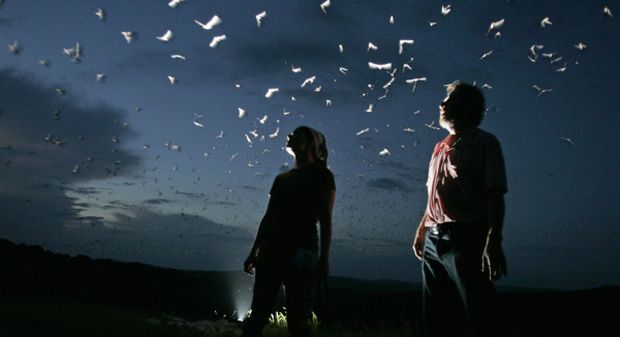
Erich Schlegel photo, bats leaving a cave near Frio, Texas, U of Tenn researchers look on

UTenn grad student Noa Davidai (L) and Prof Gary McCracken watch bats come out of Frio Cave

  • Photos by ERICH SCHLEGEL/DMN

University of Tennessee graduate student Noa Davidai (left) and professor Gary McCracken watch freetail bats emerge from the Frio Cave near Uvalde, Texas. They study the range and value of bats, such as insect control for farmers. And ‘fecal rain’? That enriches soil, Dr. McCracken says. (Dallas Morning News, July 9, 2007, p. 1)

It’s easy to understand. Look at the on-line Dictionary.com definition of the Mexican free-tailed bat, for example:

Mexican free-tailed bat

–noun

any of several small, insect-eating bats of the genus Tadarida, of Mexico and the southwestern U.S., inhabiting limestone caves: residual DDT has reduced most populations.

Dictionary.com Unabridged (v 1.1)
Based on the Random House Unabridged Dictionary, © Random House, Inc. 2006.

Was that difficult? It’s right there in the definition of the animal: DDT kills bats.

Bats eat mosquitoes, those things that carry malaria and other diseases. A Mexican free-tailed bat eats about 70% of its body weight in mosquitoes, every night.

This morning’s Dallas Morning News has a front page story, with great photo, on the value of bats in Texas, “Taking bats to the bank.”

Researchers have long known that bats in Texas caves dine on insect pests. But just how many bats there are and the value of their feeding had proved elusive until a five-year, $2.4 million National Science Foundation study by scientists from Boston University, the University of Tennessee, the U.S. Department of Agriculture and Texas Parks and Wildlife.

From sundown to sunup, the freetail bats consume a staggering 400 metric tons of insects a year in the Winter Garden, or 2 million pounds each night. They range over a radius of 75 miles and feed from ground level to 10,000 feet.

The bats help save $1.7 million annually by preventing crop damage and additional pesticide use in the eight-county Winter Garden, which produces $6 million in cotton each year, according to the report by the Boston University team.

“Most people think of bats as ugly or vile, but there is a real value they provide humankind,” said principal investigator Tom Kunz of Boston University. “The bats are a literal shield for this crop region. But until this project, no one developed a means to measure the specific economic value of bats to agriculture.”

From my experience with agriculture, that $1.7 million figure looks low, way low. Scientific studies like this tend to be very conservative, though, so we can say with great confidence that this is a floor figure.

DDT kills bats, and those bats who don’t die from eating DDT-laced insects often provide meals for predator birds, who then get a greater dose of the next-generation-killing chemical.

Studies have shown that the pesticide DDT often used by farmers in the 1950s and 1960s may also have led to the depletion of large numbers of Mexican free-tailed bats (Clark).The Carlsbad Caverns colony decreased steadily in size from nearly 20 million down to only a couple hundred thousand during the 1960s due to DDT use (Wilson 110).A study in 1974 documented levels of the toxin in fat stores the bats would accumulate before migration, and found that when those fat stores were metabolized during the long flight, DDT levels were high enough to kill many of the bats (Wilson 110).In addition, DDT ingested by mother bats was passed along to their young causing most of them to die before reaching maturity (Wilson 110).Clark’s follow up study in 2001 also showed levels of DDT in bat specimens from the 1950s and 1960s to be considerably higher than in specimens from later decades (Clark).These kinds of toxin levels would account for the dramatic decrease in the Carlsbad bat population.

All of this adds up to a conclusion that critics of Rachel Carson who make the wild claims that DDT is harmless, and that but for DDT mosquito control would have been achieved, and therefore malaria would be wiped out do not have a clue what they are talking about, and probably have some skullduggery in mind when they go after Rachel Carson. Ironically, overuse of DDT actually benefits mosquitoes in the U.S., killing the predators of mosquitoes and other crop and human pests, allowing the mosquitoes to breed and feed uninhibited.

In her book Silent Spring, Rachel Carson had noted a pesticide spill in Austin, Texas, which occurred in 1961 and virtually cleaned out all the fish in the Colorado River downstream — fish, of course, prey on mosquito larvae. DDT use in Texas, therefore, hammers mosquito abatement possibilities at both ends. Read the rest of this entry »