Stealth malaria promotion in favoring DDT over brown pelicans

November 14, 2009

Another blogger decided to take some potshots at the environmental protection success that banning DDT was is.

edwinleap.com laments that the brown pelican flew off the Endangered Species List this week.  “Brown pelicans 1, brown human beings 0,” the headline reads.  The piece claims that banning DDT use in America has somehow increased malaria, or prolonged it, in Africa and Asia.

Clearly the writer can’t didn’t read a map, or figure distances, and knows nothing knew little about the migratory habits of mosquitoes.  Stopping the spraying of DDT in Arkansas didn’t stop the use or manufacture of DDT in Africa nor Asia, anywhere.  Nor did mosquitoes not killed in America fly to Africa to infect kids.  Someone who has decided to rail against wise science probably isn’t interested much in the facts, though.

I responded there:

DDT has never been banned in Africa, nor Asia.  Today, China and India together manufacture thousands of tons of DDT for use around the world.

Odd — in the nations where DDT was banned (for use on agriculture, never to fight malaria), malaria is eradicated or all but eradicated.  In those nations where DDT is still legal, still manufactured, and still used in great quantities, malaria runs rampant.

Perhaps a lack of DDT doesn’t have anything to do with the spread of malaria.

There are very few, if any, serious malaria fighters asking for DDT.  Improved medical care is the basis for beating malaria in humans.  Malaria is a parasite that must live for part of its life cycle in mosquitoes, and for part of its life cycle in humans.  If your goal is to wipe out malaria, you could do it more effectively by wiping out the humans that harbor the parasite.  That would be stupid and cruel, and very expensive.

Fortunately, DDT is not a powerful acute poison to use against the mammals where malaria breeds.  Perhaps unfortunately, it’s no panacea against malaria, either.

Why did African malaria fighters stop using DDT in the middle 1960s?  Mosquitoes had become resistant and immune to DDT.

Ronald Reagan once said for every serious problem there is a solution that is simple, easy, and wrong.  DDT is that simple, easy and wrong solution for malaria.

Why is this man so bigoted Let’s hope it’s ignorance of the issue and not bigotry against brown beings that he thinks leads anyone to think the brown pelican should have been sacrificed, and that  he thinks brown Africans are too stupid to figure out how to fight malaria with DDT, if DDT would in fact save them?  [See Mr. Leap’s comment below. Not stupid at all, he just didn’t have the facts.  Great to find someone willing to admit error.  Clearly, I was wrong assuming he knew better — see edits throughout the post.  It’s actually pleasant to discover one was wrong in a case like this.]

Rachel Carson was right: We should have restricted the use of DDT to save wild populations of animals, and to have preserved its efficacy for fighting malaria in carefully planned and delivered programs to fight malaria and other insect-borne diseases around the world.  Carson proposed we use integrated pest management (IPM) to fight disease, and this is the program and process Africans and Asians have turned to over the past decade as other slap-dash methods of fighting disease faltered.

In diverting attention from improving medical care to fight malaria, to a hopeless campaign to reintroduce DDT where it would not work the miracle claimed, edwinleap.com favors too many people favor  malaria over the kids in reality.  Odd position for a health professional to take, and we can be relatively certain that he’s responding to political hackery, and not basing his views on any sound science or history.

The brown pelicansmigration from the Endangered Species List pays high tribute to Rachel Carson’s views on saving life in the wild, and verification once again that she was right.  Perhaps its time more people paid attention to her accurate and effective ideas about how to fight human disease, without trying to poison all of Africa.

Add to FacebookAdd to NewsvineAdd to DiggAdd to Del.icio.usAdd to StumbleuponAdd to RedditAdd to BlinklistAdd to TwitterAdd to TechnoratiAdd to Furl


Bear facts

September 18, 2009

A grizzly mauled a sheepherder and killed some sheep and dogs, along the Upper Green River in Wyoming.

Ralph Maughn’s blog has a lively and informative discussion on the incident, and on bears and bear protection in general.

For all the hard work they do, North American sheepherders sure seem to me to get short shrift in U.S. markets.  When was the last time you could find anything but New Zealand lamb at your supermarket?  And I ask this from Texas, the largest sheep producing state in the U.S. (with very few grizzlies).

While you’re at Maughn’s blog, look at this piece of good news:  You don’t have to eat ’em.


Poachers kill massive grizzly in Montana

August 24, 2009

Ralph Maughan’s Wildlife News reports that Maximus, an 800-pound grizzly bear thought to be Montana’s second largest, was illegally killed recently.

The poacher shot the bear about four weeks ago.  A reward has been offered for information leading to the capture of the poacher.

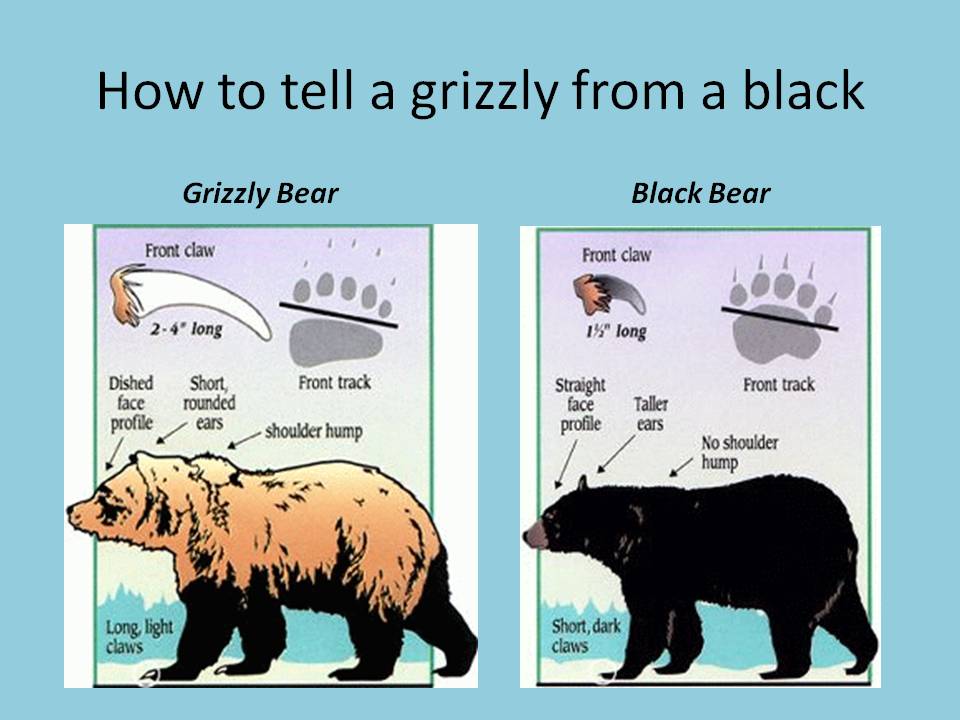
Can you tell a grizzly from a brown bear?  Chart from U.S. Fish and Wildlife Service

Can you tell a grizzly from a brown bear? Chart from U.S. Fish and Wildlife Service

Update, 1-30-2010: The chart linked to above has disappeared in a website redesign.  Below is a crude representation of the chart I made from a U.S. Fish and Wildlife information sheet on grizzlies, here.

How to tell a grizzly from a black (.pdf download)

Grizzly bear/black bear identification chart, adapted from USFWS by Ed Darrell, Millard Fillmore's Bathtub

Grizzly bear/black bear identification chart, adapted from USFWS by Ed Darrell, Millard Fillmore's Bathtub


$36 million to clean up DDT mess

June 12, 2009

One more reminder that DDT is a deadly substance:  EPA announced a program to cap render harmless the largest DDT dump, off the coast of California.

Jeff Gottlieb writes in The Los Angeles Times:

The federal Environmental Protection Agency on Thursday proposed spending at least $36 million to clean up the world’s largest deposit of banned pesticide DDT, which lies 200 feet underwater off the Palos Verdes Peninsula.

Montrose Chemical Corp., which was based near Torrance, released 110 tons of DDT and 10 tons of toxic PCBs into the sewers from 1947 through 1971. The chemicals then flowed into the Pacific.

What do you think?  A substance that is deadly, makes one of the largest and deadliest Superfund sites in America, and costs $36 million in taxpayer smackaroons just to seal up so it won’t kill again — is it “perfectly safe” as the advocates claim?

This is one subject you will not see discussed at Steven Milloy’s sites, Junk Science, nor Green Hell.  You won’t find the Chronically Obsessed with Rachel Carson (COWRC) mentioning this clean-up.

Remind them.

Public hearings on this plan are scheduled for June 23 and 25.

Tip of the old scrub brush to Audublog.


Denialism doesn’t work: Polar bears still in trouble

February 9, 2009

Is there a climate change denialist blog that hasn’t tried to claim that the rest of the world is crazy, and that polar bears are in no danger at all?

As a tactic to save polar bears, denial doesn’t work.  Arctic Economics reports on research showing polar bears often go without food, a bad tactic for long-term survival.

Polar bear in the open ocean, Los Angeles Times photo

Polar bear in the open ocean, Los Angeles Times photo

You want that in English?  Sure:  Polar bears are starving to death because of climate change.  Shifts in the ice have ruined their hunting.

And, as often these days, I mention that here because it is one more case where “falsified data” or “badly placed measuring stations” can’t affect the outcome.  Polar bears don’t read The Economist. Last I checked ticket sales, no polar bear had ever seen Al Gore’s movie, let alone been misled by it.  It cannot be the case that polar bears starve because they believe hyped and false claims about global warming.  Polar bears starve because it’s really warmer.

___________

Update, 3-5-2009 — One of the signs of insanity among warming disbelievers is their practice of censoring comments on their blogs, when the blog owner edits the comments of opponents to make them look silly and, importantly, to keep contrary views backed by reason from infecting the blog.