Texas State Capitol Rotunda — all quiet on the former front, for now

June 28, 2013

A vertical panorama — neat idea.

Joe Deshotel  - Panorama of empty rotunda at Texas Capitol - dome to floor. Posted on Twitter June 27, 2013

Joe Deshotel – Panorama of empty rotunda at Texas Capitol – dome to floor. Posted on Twitter June 27, 2013

This is the building that, just hours before, had been crowded by thousands of people hoping to get into the Texas Senate Chamber to see Sen. Wendy Davis’s filibuster.

Star on the dome of the Texas State Capitol; a similar star is five very long stories below, on the floor.

Star on the dome of the Texas State Capitol; a similar star is five very long stories below, on the floor. Image via Shapleigh.org, “Grover’s Tub.”

Look carefully, and you can see that the guides in the Capitol don’t lie — the star on the dome reflects the star on the floor (or vice versa).

Can you get a similar shot of the rotunda of your state capitol? Would you do it and send it in, or post it and give us the link?

Tip of the old scrub brush to Reeve Hamilton.


Amazon haiku to Sen. Wendy Davis’s pink Mizuno shoes

June 27, 2013

(Yes, you’re right — the shoes are red, not pink.)

Texas State Sen. Wendy Davis‘s filibuster so insinuated itself into our culture already that it is now a part of shoe reviews at Amazon.com:

Mizuno running shoes for sale at Amazon.com -- the same shoes Sen. Wendy Davis wore during her filibuster on June 25, 2012.

Mizuno running shoes for sale at Amazon.com — the same shoes Sen. Wendy Davis wore during her filibuster on June 25, 2012.

Customer Review


147 of 150 people found the following review helpful

5.0 out of 5 stars SHOES HAIKUS, June 27, 2013

By

mistersnoid “mistersnoid”

This review is from: Mizuno Women’s Wave Rider 16 Running Shoe (Apparel)

Wendy wore these, and
she wasn’t even running.
Here’s hopes she soon will!

Standing and talking,
one needs a lot of support.
You have all of ours.

More:

Mizuno's red running shoes, worn by Texas Sen. Wendy Davis.  Image from Outside the Beltway

Mizuno’s red running shoes, worn by Texas Sen. Wendy Davis. Image from Outside the Beltway


All is not lost, is it?

June 26, 2013

NPR moved offices earlier this year.

Tiny Desk Concerts provide a lot of fun in live performance in the offices of a radio network.  To document the move, musically, Tiny Desk called in OK Go.  OK Go is a favorite here at Millard Fillmore’s Bathtub — regular bathing music, you might say.

And in 223 takes, they recorded the move.

I’m especially fond of the elevator ride with Carl Kassell. (At least, that’s who I think it is.)

Who else can you recognize from NPR’s famous voices?

223 Takes – All Is Not Lost, OK Go

Details:

Published on Jun 3, 2013

The Tiny Desk has moved, and OK Go has helped make it so.

Earlier this year, we needed to figure out the best possible way to move my Tiny Desk from NPR’s old headquarters to our new facility just north of the U.S. Capitol. We wanted to go out with a bang and arrive at our new space in style, so our thoughts naturally turned to a catchy pop band we love: OK Go, whose unforgettable videos have been viewed tens of millions of times on YouTube.

Bandleader Damian Kulash used to be an engineer at an NPR member station in Chicago, so we figured he’d be up for helping us execute a simple idea: Have OK Go start performing a Tiny Desk Concert at our old location, continue playing the same song while the furniture and shelving is loaded onto a truck, and finish the performance at our new home. In addition to cameos by many of our NPR colleagues — Ari Shapiro, Audie Cornish, David Greene, Guy Raz, Scott Simon, Alix Spiegel, Susan Stamberg and more — this required a few ingredients: Number of video takes: 223; Percent used in final version: 50; Number of raw audio channels: 2,007; Percent used in final version: 50; Number of microphones: 5; Number of hard-boiled eggs consumed: 8, mostly by bassist Tim Nordwind; Number of seconds Carl Kasell spent in the elevator with OK Go: 98; Number of times Ari Shapiro played the tubular bells: 15; Number of pounds the tubular bells weighed: 300; Number of times the shelves were taken down and put back up: 6; Number of days it took to shoot: 2; Number of cameras: 1

OK Go played “All Is Not Lost” from Of the Blue Colour of the Sky, with words tweaked by the All Songs Considered team. And so begins a new era for the Tiny Desk, after 277 concerts (counting this one) in our old home. — BOB BOILEN

FEATURING
Dan Konopka, Damian Kulash, Tim Nordwind, Andy Ross

CREDITS
Producers: Bob Boilen, Mito Habe-Evans
Directors: Mito Habe-Evans, Todd Sullivan
Audio Engineer: Kevin Wait
Assistant Producer: Denise DeBelius
Camera Operator: Gabriella Garcia-Pardo
Supervising Producer: Jessica Goldstein
Editor: Mito Habe-Evans
Assistant Editor: Gabriella Garcia-Pardo
Production Assistants: Lorie Liebig, Lizzie Chen, Gabriella Demczuk, Marie McGrory, Andrew Prince
Executive Producers: Anya Grundmann, Keith Jenkins
Special Thanks: OK Go and our cast and crew of volunteers.

OK Go at the Albany Tulip Festival

OK Go at the Albany Tulip Festival. Wikipedia image

More:


Dumb ways to die, and a catchy tune

June 25, 2013

Here’s a video I meant to post months ago — but I can’t find it now.  Martketplace had a story on it today.

The idea is, “don’t get hit by a train.”

Still from short movie PSA,

Still from short movie PSA, “Dumb Ways To Die.”

It’s a safety message from Australia.  Highest and best use of PSAs, if you ask me [most links added here].

A clever Australian public service ad campaign promoting train safety has swept a number of advertising prizes at the Cannes Lions International Festival of Creativity, the world’s biggest annual awards show for professionals in the creative communications industry.

In all, the rail safety campaign took home the most prizes ever awarded to one campaign in the festival’s history.

“We’re thrilled with the outcome of the campaign. The main reason for that is that it starts a discussion about train safety in a way that young people will associate. We’ve deliberately not been threatening or shown graphic imagery,” said Leah Waymark, general manager of corporate relations at Metro Trains, Melbourne’s private rail service.

Metro Trains helped to co-produce the three-minute video, “Dumb Ways to Die,” which was created to teach people to be careful around trains. Since its November 2012 release, the video has racked up more than 50 million YouTube views, sparked several parodies, and even spawned an iPhone game. Not bad for a safety warning advertising campaign.

See for yourself:

The vocals remind me of early Edie Brickell and the New Bohemians; I wonder if the artist has any other work out there worth listening to.

It won’t be popular for flash mobs, I predict.

Curious update, September 19, 2013:  This ad has been banned in Russia.  No kidding.

Controversy

Everyone fell head over heels in love with the campaign. Except Russia. (Naturally). The video was censored by the Russian government and viewers were informed that, “This content is not available in your country due to a legal complaint from the government.”   The Russian government convinced itself that this video promotes suicide in an attractive comic format and will entice children and teenagers to “push the red button,” “set fire to their hair” and “poke a grizzly bear with a stick.”

More:

Don’t miss the karaoke version!


What would a Boy Scout do in this situation?

June 25, 2013

This parallels my experience:

How about your experience with Boy Scouts?

Have you seen this PSA on television stations in your town?  Call the stations, ask when they run it.

More:


Got questions about ObamaCare? Check out this site

June 24, 2013

I get e-mail; this one may prove useful to more than a few people, especially anyone who owns a small business and has questions about how ObamaCare — the Affordable Care Act — will affect your taxes, your hiring, your expenses, etc.:

The White House, Washington

Hi, all —

In fewer than 100 days, the new health care reform law takes an important step forward. On October 1, 2013, Health Insurance Marketplaces will open in every state, and millions of Americans will be eligible to apply for coverage. Between now and then, we’re sure that lots of people will be looking for information about the upcoming changes.

That’s why we revamped HealthCare.gov.

On the updated site, you’ll be able to get a personalized list of coverage options, tailored to your situation, and a checklist to help prepare for October 1. You’ll find a rich set of answers to frequently asked questions, powerful search features to help you find the specific information you need, and two great ways to talk to customer service representatives, 24/7: a new 1-800 number (1-800-318-2596) and online chat.

When open enrollment starts on October 1, 2013, you’ll be able to use the site to compare various health care plans side by side to find a plan that fits your life and your budget. You’ll even be able to use HealthCare.gov to apply for coverage or be directed to your own state’s application portal.

We hope you’ll use the site to get answers to your questions about the health care law — and forward this email to your friends so they can do the same.

Thanks!

Tara

Tara McGuinness
Senior Communications Advisor
The White House

P.S. — Have questions about what else you can expect from health care reform? Click here for a timeline of the key features of the Affordable Care Act.

Visit WhiteHouse.gov

[My e-mail address cut out ]

The White House • 1600 Pennsylvania Ave NW • Washington, DC 20500 • 202-456-1111

Several people I’ve run into have questions about the program — some of the questions are serious, and difficult for me to answer, and some are silly (“Why do I have to give up my insurance now?” Answer:  You don’t.)  There’s a great need for answers.  Distortions of the plan from the nasty political fights involved, have taken hold in the mind of many as representations of what the plan weill do.

Go try the site.  Does it answer your questions?  What questions do you have that are not answered by this site?

More:

Screenshot of HealthCare.gov. Click to visit the site.

Screenshot of HealthCare.gov. Click to visit the site.


If you don’t at least check Snopes.com first . . .

June 24, 2013

checking snopes.com before forwarding dumb e-mails.

Definition of “gullible” in a dictionary. Profile photo on Facebook for “checking snopes.com before forwarding dumb e-mails.”

Hannum said there’s a sucker born every minute (and suckers credit it to Barnum).  Do you think it’s that seldom, with the internet?


June 23: Happy birthday, Sholes Typewriter!

June 23, 2013

And so it came to pass that on June 23, 1868, the U.S. Patent Office in the Department of Commerce issued a patent to Messrs. “Sholes, Glidden & Soule” for a “Type-Writer.”

Drawing for a Typewriter, 06/23/1868 (ARC Identifier: 595503); Patented Case Files, 1836 - 1956; Records of the Patent and Trademark Office; Record Group 241; National Archives.

From the U.S. National Archives Administration: Dated June 23, 1868, this is the printed patent drawing for a “Type-Writer” invented by Christopher L. Sholes, Carlos Glidden, and J. W. Soule. Drawing for a Typewriter, 06/23/1868 Drawing for a Typewriter, 06/23/1868 (ARC Identifier: 595503); Patented Case Files, 1836 – 1956; Records of the Patent and Trademark Office; Record Group 241; National Archives.

With a keyboard a lot like a piano, this 1868 invention looks a lot more like the typewriters we know and love than William Burt’s 1829 “typographer.”

Amazing how much this stuff has changed in 150 years, isn’t it?

Tip of the old scrub brush to Jude Crook:

More:

Sholes typewriter, 1873. Museum, Buffalo and E...

Five years after this patent, Mr. Sholes offered this machine for sale, in 1873. Museum, Buffalo and Erie County Historical Society (the history society founded by former President Millard Fillmore, incidentally) Wikipedia photo


Annals of global warming: Keeling Curve gone vertical

June 22, 2013

What is the Keeling Curve?

What does it look like now?  See this graphic from the New York Times:

Keeling Curve graph and grahic, New York Times, May 11, 2013

New York Times, May 11, 2013

See the daily update of the Keeling Curve at the Scripps Institute site, University of California at San Diego.

More:


Unintentional dry humor from CBO; don’t make a Denali out of a molehill, though

June 21, 2013

A mountain by any other name would be just as high. Image of Denali from Tiny Green Cabins

A mountain by any other name would be just as high. Image of Denali from Tiny Green Cabins

I get e-mail from the Congressional Budget Office.  I asked them to keep me posted on the studies they do, and they have.

Today, this:

S. 155, a Bill to Designate a Mountain in the State of Alaska as Denali

cost estimate

June 21, 2013
read complete document  (pdf, 27 kb)

As ordered reported by the Senate Committee on Energy and Natural Resources on June 18, 2013.

CBO estimates that enacting this legislation to name a peak in Alaska would have no significant impact on the federal budget and would not affect direct spending or revenues; therefore, pay-as-you-go procedures do not apply. S. 155 contains no intergovernmental or private-sector mandates as defined in the Unfunded Mandates Reform Act and would not affect the budgets of state, local, or tribal governments.

Calling a mountain by its name won’t affect the budget?  Good news, I’m sure.  Shakespeare was right.

The testimony of National Park Service Deputy Director Peggy O’Dell is instructive:

STATEMENT OF PEGGY O’DELL, DEPUTY DIRECTOR FOR OPERATIONS, NATIONAL PARK SERVICE, DEPARTMENT OF THE INTERIOR, BEFORE THE SUBCOMMITTEE ON NATIONAL PARKS OF THE SENATE ENERGY AND NATURAL RESOURCES COMMITTEE, CONCERNING S. 155, TO DESIGNATE A MOUNTAIN IN THE STATE OF ALASKA AS DENALI.

April 23, 2013

Mr. Chairman, thank you for the opportunity to present the Department of the Interior’s views on S. 155, a bill to designate a mountain in the State of Alaska as Denali.

The National Park Service appreciates the long history and public interest for both the name Mount McKinley and the traditional Athabascan name, Denali. The Department respects the choice made by this legislation, and does not object to S. 155.

Located in what is now Denali National Park and Preserve, the highest peak in North America has been known by many names. The National Park Service’s administrative history of the park notes that, “The Koyukon called it Deenaalee, the Lower Tanana named it Deenaadheet or Deennadhee, the Dena’ina called it Dghelay Ka’a, and at least six other Native groups had their own names for it.

“In the late 18th century various Europeans came calling, and virtually everyone who passed by was moved to comment on it. The Russians called it Bulshaia or Tenada, and though explorers from other nations were less specific, even the most hard-bitten adventurers were in awe of its height and majesty.

“No American gave it a name until Densmore’s Mountain appeared in the late 1880s, and the name that eventually stuck—Mount McKinley—was not applied until the waning days of the nineteenth century,” a gesture of support to then-President William McKinley.

In 1975, the State of Alaska officially recognized Denali as the name of the peak, and requested action by the U.S. Board on Geographic Names to do the same.

In 1980, Congress changed the name of Mount McKinley National Park to Denali National Park and Preserve (P.L. 96-487, Section 202), but did not act on the name change for the mountain.

In Washington, Congress designates mountains.  In Alaska, mountains designate you.

More:

Mount McKinley

Near-antique poster advertising Ranger Services at the National Park Formerly Known as Mount McKinley. Photo by Kirt Baab


Time to raise the minimum wage

June 21, 2013

Illustration for Bloomberg News by Rand Renfrow: $15 Minimum Wage

Illustration for Bloomberg News by Rand Renfrow: $15 Minimum Wage

Robert Reich put it succinctly at his Facebook site [links added here]:

Nick Hanauer, one of the nation’s most successful businessmen, proposed yesterday that the minimum wage be raised to $15 an hour. But wouldn’t that cause employers not to hire workers who were “worth” less, and thereby lead to higher unemployment? No, says Hanauer. By putting more money into the hands of more people, it would stimulate more buying — which would generate more jobs than any jobs that might be lost. Hanauer understands that the basic reason the economy is still limping along is workers are consumers, and workers continue to get shafted, which means consumers lack the purchasing power to get the economy off the ground. A minimum wage of $15 an hour, combined with basic worker standards such as paid sick leave and a minimum of 3 weeks paid vacation per year, should all be in a national campaign for better jobs and a better economy in the 2014 election.

That’s the case, in brief.

Last March Reich said raising the minimum wage to $9/hour was a “no brainer.”

Alas, he didn’t account enough for the anti-brain lobby.

What do you think?

More:

Also good, an update:


Why are flags flying in West Virginia today? Statehood

June 20, 2013

On June 20, 1863, West Virginia joined the fractured union as the 35th state.

Yes, that was during the Civil War.  Yes, West Virginia had been the northwestern counties of Virginia.  No, I’m not sure of the history of how Congress decided Virginia had consented to be divided.

In any case, per the guidelines in the U.S. Flag Code, West Virginians should fly the U.S. flag today in honor of their statehood, 150 years ago.  Lots of celebrations, reenactments, and general festive events are planned in West Virginia this weekend.

West Virginia's State Capitol in Charleston, West Virginia, on December 11, 2011

West Virginia’s State Capitol in Charleston, West Virginia, on December 11, 2011 — built in 1931. From O Palsson’s Flickr collection: “As I was traveling through Charleston, the capital of West Virgina, during blue hour (my favorite time of day) a couple of days after Thanksgiving, I happened upon this beautiful sight of the State Capitol Building reflected in the Kanawha River flowing by in total stillness, so I just had to stop and capture the scene. I didn’t have a tripod handy, so this is not a long-exposure nightshot, just a regular hand-held shot accomplished by bumping up the ISO as much as I dared to get correct exposure at acceptable shutter speed (ended up being 1/40 sec) and doing my best to keep the camera steady.”

Kathryn and I have a few fond memories of Charleston.  Then-West Virginia Attorney General Charlie Brown was one of the few with enough wisdom to offer me a job, when I graduated from the National Law Center at George Washington University as an older student.  Brown promised to clean up West Virginia politics, and he had a lively, very young crew of attorneys fighting coal companies, oil companies, loggers, shady real estate people, and corrupt city, county and state officials.  One fellow in the office complained that he’d “had to argue eight cases” at the State Supreme Court that year, in his first year out of law school.

But the corrupt officials knew what they were doing.  Brown could only offer $25,000 a year, and in Charleston it was unlikely we’d be able to find any work for Kathryn.  Tough to attract crime fighters at less-than crime-fighting rates. It would have been a more than 75% cut in income.  We made a trip there to mull it over, baby on the way (pre-digital photographs buried here in the archives).  Brown got a special dispensation to offer $5,000 more.

Great tour of the Capitol, great interviews with the office lawyers.  Kathryn and I sat for a long while in the deserted West Virginia Supreme Court (sort of tucked into an attic of the Capitol) discussing how in the world we could afford to move the Charleston and take on the work.  We drove around the city, looking at houses for sale and rent; we gazed at the Kanawha River and discussed the future for the city.

We went to dinner in a tiny restaurant touted as Charleston’s finest, which was a long way from good eateries in D.C.  We discussed with our host the cultural pickings in Charleston.  We could give up the symphony but get back to fishing and practice fly fishing . . .

A few tables over, the maitre ‘d brought in a few extra chairs, and then seated Muhammed Ali and his party.  Our waiter asked that we not make a scene.

I don’t remember for what charitable purpose Ali was in Charleston, but the event was over and his hosts took him out to the good restaurant in Charleston, too.

Ali was a slower, sedate and gentle version of the fiery fighter he’d been.  Parkinson’s disease already had him in its grip.  His voice, soft as it could be at times, was still strong enough to carry across a table.  There was a young boy with the group, under five years old.  Ali had lost steps, but not spirit.  He produced a couple of balls from a pocket and proceeded to dazzle the kid with sleight-of-hand magic tricks.  He picked one of the balls from behind the kid’s ear, and the kid giggled wonderfully.  Balls appeared here, disappeared there — I remember thinking how much easier those tricks could be with hands that big; but Ali also had difficulty dealing with a knife and fork.  Working magic tricks pulled years away from Ali, and he seemed much younger, much more deft than he really was.  The little boy laughed and giggled through the meal.  It was a happy affair.

Our dinners finished about the same time.  As we got up, Ali looked over at us and said, “You wonder why I spend so much time with children?  They are the future.”

I turned down the offer from West Virginia.  A job I’d hoped for at American Airlines fell through, but a position opened up at the Office of Educational Research and Improvement (OERI) at Bill Bennett’s Department of Education.  A year or so later I saw small item in the Washington Post that Charlie Brown had been indicted on some charge.  Coal companies still have a lot of clout in West Virginia.

This is an anniversary day for Ali, too:  June 20, 1967, Muhammed Ali was convicted in Houston, Texas, of evading the draft.  That conviction was overturned by the U.S. Supreme Court.

Fly those flags in West Virginia.

More:

U.S. and West Virginia flags flying together.  Photo by Stephen-KarenConn

U.S. and West Virginia flags flying together. Photo by Stephen-KarenConn


Rachel Carson project won first at National History Day competition

June 19, 2013

News from the San Ramon (California) Express [links added here, except for reporter’s contact]:

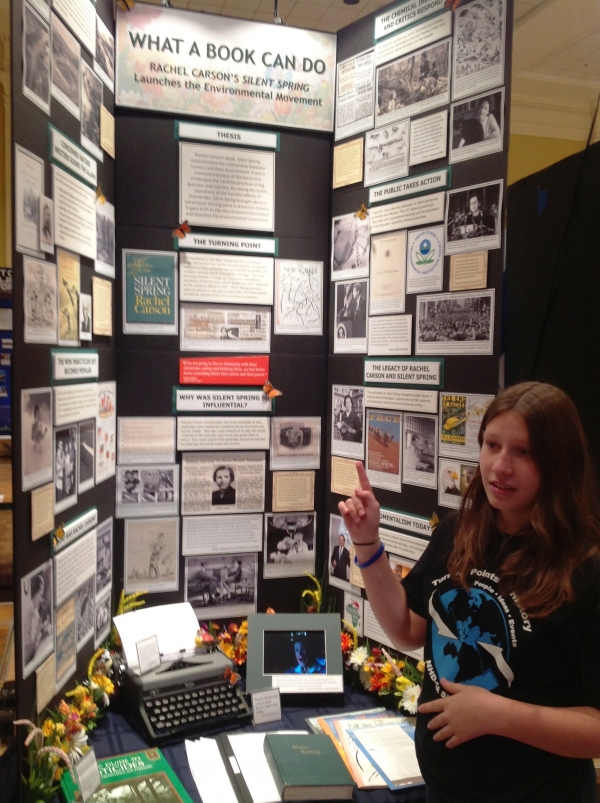
Julienne Sauer in front of her project,

Julienne Sauer in front of her project, “What a book can do — Rachel Carson‘s Silent Spring Launches the Environmental Movement.” (© 2013 San Ramon Express)

San Ramon student takes first at National History Day contest

by Jessica Lipsky

Windemere Ranch Middle School student was one of 30 recognized by the National Endowment for the Humanities (NEH) for their impressive use of historic newspapers in projects presented at National History Day.

Julienne Sauer, who graduated from eighth grade last week, took first place in NEH’s individual exhibit junior division for her project titled “What a book can do — Rachel Carson’s Silent Spring Launches the Environmental Movement.” This year’s National History Day theme was “Turning Points in History: People, Ideas, Events.”

Julienne was also named a National Endowment Humanities Scholar.

The annual event is the culmination of a year-long academic program in which students in middle and high school conduct original historical research for papers, exhibits, websites, documentaries and public performances. Each year more than 600,000 students compete in local, regional and state competitions for a chance to win a spot at the national finals.

This year was the first time NEH awarded prizes to students who incorporated into their projects research using Chronicling America, a free online database of 5 million pages of historic US newspapers dating from 1836 to 1922, digitized through a partnership between NEH and the Library of Congress.

Julienne won a national finalist award at the 2011 National History Day exhibit for her exhibit titled “The Cable Car Wars: A City Debates to Preserve its Character.”

Carson’s work was good enough that, even 49 years after her death, 51 years after the publication of Silent Spring, Carson and the book still inspire students to heights of excellence in study.

More:


You didn’t believe in Ents, and then you met the redwoods

June 19, 2013

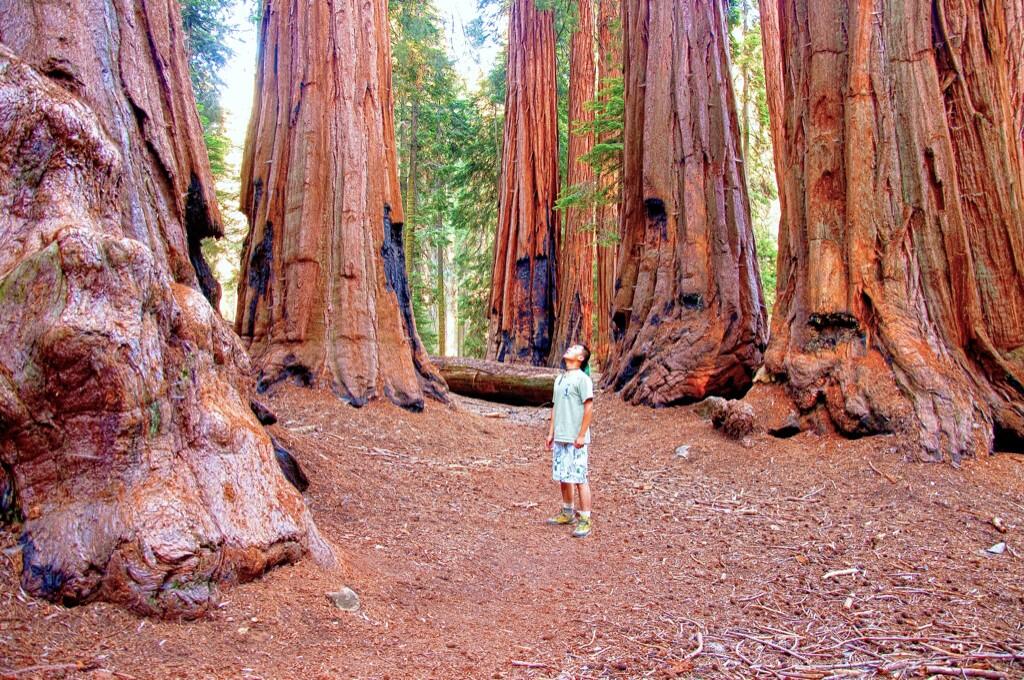
Giant redwoods in Sequoia-Kings National Parks

US Department of Interior, May 30, 2013 – Sometimes you have to look up to appreciate the beauty of America’s great outdoors. @SequoiaKingsNPS


How about another cup of coffee? (Global Warming Conspiracy and Starbucks Cup #289)

June 19, 2013

Encore post from September 17, 2007, and August 2009 — maybe more appropriate today than ever before.

Found this on my coffee cup today (links added here):

The Way I See It #289

So-called “global warming” is just

a secret ploy by wacko tree-

huggers to make America energy

independent, clean our air and

water, improve the fuel efficiency

of our vehicles, kick-start

21st-century industries, and make

our cities safer and more livable.

Don’t let them get away with it!

Chip Giller
Founder of Grist.org, where
environmentally-minded people
gather online.

Starbucks Coffee Cup, The Way I See It #289 (global warming)

Look! Someone found the same cup I found!

I miss those old Starbucks cups — but then, they killed the Starbucks in our town.  I don’t buy the 100 cups of Starbucks coffee I used to get in a year.

More:

Save