New in tattoos: The formula of Wall Street doom

May 11, 2011

Here’s one the prof won’t even care about — you can’t cheat with this one, and if you do, you get burned:

Tattoo of the formula that created the 2008 financial crisise, from Marketplace

Tattoo of the formula that created the 2008 financial crisise, from Marketplace.

Marketplace, the radio program, noted it, and described it:

The financial crisis in one handy tattoo: surely you remember the formula that caused the financial crisis. But you haven’t seen it like this, from a creative friend of Marketplace who works for advertising firm Wieden + Kennedy, based in Portland. He enlisted “the ever-brilliant designer James Tung, computational typeface author Donald Knuth, and the steady hand of Cheyenne at Atlas Tattoo, according to his Facebook post[.]

Earlier, Marketplace interviewed Felix Salmon, who wrote about the formula for Wired.

RYSSDAL: This guy, David Li, what was he trying to do?

SALMON: What David Li was trying to do was look at lots of different bonds and try and work out whether they were all moving in the same direction or not. Whether they were correlated or not. Whether they were independent of each other or not. And he created this astonishing piece of mathematics called the Gaussian copula function, which sought to answer that very question.

RYSSDAL: What does that mean — Gaussian copula? I mean, if I can just take a little sidebar here for a second.

SALMON: People get very scared when they hear the word Gaussian. But this is just one way of looking to see whether one set of probabilities is associated with another set of probabilities. The really key part of the Gaussian copula function is the copula bit. It’s what’s known as a multivariant copula. You can take lots of different bonds or stocks or any kind of securities you like, and you can throw them all into one big equation and out the end get a single number which is easily manipulable and trackable as they say in the world of quantitative finance.

If you mention “Gaussian copula functions” at a cocktail party, you might do well to avoid anyone who appears to know what you’re talking about . . .


May 7: Anniversary of the 27th Amendment to the Constitution

May 8, 2011

Oops.  I forgot this anniversary yesterday.

September 25, 1789, Congress had approved and enrolled the proposals, and sent twelve proposed amendments to the Constitution to the states for ratification.  Ten of the twelve amendments were approved, rather quickly, and by 1791 the were attached to the Constitution.  These ten we now call the Bill of Rights.

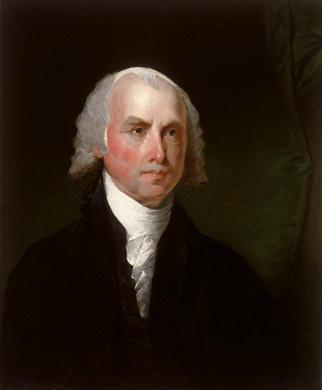
James Madison before he was president

James Madison proposed the first 10 Amendments to the Constitution, and the 27th Amendment; the 203 years it took to ratify the 27th Amendment is the longest legislative process in the history of the U.S., and probably the world.

The two proposals that failed to earn the required approval of three-fourths of the 13 states fell into a special limbo for Constitutional amendments that became clear only in the late 1970s when Congress discussed how long to wait for states to approve the Equal Rights Amendment (this is a much-simplified explanation, I know).  Congress put deadlines on the ratification process in the late 20th century, but the first twelve proposals had no deadlines, nor did any other proposal before the Equal Rights Amendment proposal.  In the 1980s, Congress passed a law that said any amendments floating around, unapproved, would be considered dead after a date certain.  There were six amendments in that category.

Before that date certain passed, more states took a look at one of James Madison’s 1789 proposals.  They liked it, and they ratified it — 34 states total.

That amendment became the 27th Amendment to the Constitution, on May 7, 1992, 203 years after it was proposed:

No law, varying the compensation for the services of the Senators and Representatives, shall take effect, until an election of Representatives shall have intervened.

This is the longest legislative procedure in U.S. history, perhaps the longest ever — it lasted much longer than many nations.  By that ratification in 1992, James Madison became the person who proposed both the first, and last amendments to the Constitution.

Madison’s reaching out from the grave 156 years after his death — he died on June 28, 1836 — is one of the greatest legislative coups in history, too.


Robert Johnson’s centennial, May 8: Memorial to the blues

May 8, 2011

May 8, 2011, is the 100th anniversary of the birth of bluesman Robert Johnson.

Robert Johnson, hat and guitar
Robert Johnson — one of two known photographs of the Delta blues legend

In a fitting tribute to Johnson and an important coming-of-age coming-to-senses moment, First Presbyterian Church in downtown Dallas announced plans to save the old Brunswick Records Building at 508 Park Avenue, a site where Johnson recorded songs in 1937 that changed the blues, changed recording, and left us a legacy of Johnson to study from his short life.

(On at least one day of those 1937 recordings, Johnson could have brushed shoulders with the Light Crust Doughboys, the Texas Swing legends, who were recording in the same building.  The Doughboys set their own pace and gave birth to Bob Wills and the Texas Playboys.  Two of Texas’s greatest music legends, in the same building on the same day, both just stepping on the platform of the train to immortality.)

Saving 508 Park Avenue vexed Dallas for a couple of decades.  First, blues is not the music of Dallas cognescenti, though the world class musicians in town including Dallas Symphony Orchestra’s Jaap van Zweden tend to support the eclectic music scence and honoring musicians of all genres (and Texas is loaded with different music genres).  Second, while Park Avenue may have been a bustling business district adjunct once, Dallas’s city center suffered 50 years of decline after school desegregation.  Parts of downtown and Uptown begin to look prosperous again, but the southern peninsula of the city, away from the now-packed-with-performance venues Arts District, a freeway and ten blocks away from Uptown, with its back up against another freeway, part of Interstate 30 and the famous Dallas Mixmaster.

508 Park Avenue, Dallas, Robert Johnson's early recording site, photo by Justin Terveen for the Dallas Observer in 2011
508 Park Avenue, Dallas, Robert Johnson’s early recording site, photo by Justin Terveen for the Dallas Observer, 2011

Plus, the building is directly across the street from the Stewpot, a kitchen operated by First Presbyterian Church to serve Dallas large and unfortunately thriving homeless population.

Who wants to renovate an abandoned building that has homeless people as scenery for the better part of the day?

Big news this week:  508 Park Avenue was sold to First Presbyterian, who have plans to save the building (and recording studio!), add a performance amphitheatre at one end of the block, and a park at the other.  This is people-friendly development well ahead of its time — there is not a resident population in that part of the city to support such a venue — yet.

Last summer, it was the neighbors, First Presbyterian Church of Dallas, who made an offer to buy 508 Park Avenue and the adjacent building and empty lot. But the deal was contingent on the city allowing the church, which also operates the Stewpot, to tear down an unrelated building next door, at 1900 Young, and replace it with an outdoor amphitheater for church socials and concerts. The Landmark Commission went into last Monday’s meeting with angels on one shoulder and devils on the other: The commission’s task force suggested approval; city staff, denial. The latter would have sent 508 Park Avenue back into purgatory.

But Landmark OK’d the plan, and the church says it will restore 508 Park Avenue to its former glory, inside and out—including the construction of a real recording studio where Johnson once sat and played “Hell Hound on My Trail.”

The church promises: It has musicians lined up to participate, but it can’t yet reveal who. The church promises: 508 Park Avenue will be resurrected.

One hell of a birthday gift for a man who supposedly sold his soul to the Devil.

The second authenticated photo of blues legend Robert Johnson

So, on Robert Johnson’s 100th birthday (assuming he wasn’t really born in 1912 . . . another mystery for another time, perhaps), the news is that the legendary bluesman who burned out like a shooting star helped save one of the few examples of art deco building decoration in Dallas, when a group of Christians who help the homeless, decided to step in an update their downtown Dallas campus.

Every step of the way, it’s an unlikely story.  Truth is, in this case, much, much stranger than fiction.

Ovation Music released to YouTube the video of Eric Clapton playing and singing “Me and the Devil,” at 508 Park Avenue, in the same room where Robert Johnson sang for a record early on.  Johnson recorded the song at that same location on Sunday, June 20, 1937.

508 Park Avenue, Dallas, is already a memorial to Robert Johnson, to the blues, and to the city where these early blues hits were made.  The struggle remains to make the memorial accessible, and not threatened with destruction.

More, resources: 


Heritage Foundation urges that Africa be poisoned

May 7, 2011

Oh, not outwardly anti-Africa, but stupidly so.

The extreme right-wing Heritage Foundation lashed out at health care workers and scientists fighting malaria in Africa and Asia for World Malaria Day, April 25 (HF’s post showed up on May 5).  If these malaria fighters really were smart, HF’s Jane Abel wrote, they’d just poison Africa with DDT instead of protecting children with bednets and working to improve medical care.  According to Abel, DDT is safe for everyone but mosquitoes, and more effective than anything else malaria fighters use — so they are stupid and venal, she asserts, for not using DDT.

Here’s her post:

Environmentalists celebrated World Malaria Day last week (and Earth Day the week prior). Meanwhile, thousands of African children died of malaria.

While these activists may make themselves feel like they’re saving the world, they are ignoring the best possible solution to Africa’s malaria problem: the use of DDT to wipe out the Anopheles mosquito.

Even though the World Health Organization resumed promotion of DDT in September 2006—realizing it had the best track record for saving the lives of 500 million African children—environmentalists are still emphasizing the use of bed nets instead. DDT treatments almost completely eradicated the disease in Europe and North America 50 years ago, but today an African child dies every 45 seconds of malaria.

Providing sub-Saharan Africans with bed nets has had far from acceptable success in delivering the amount of protection needed from mosquitoes. The World Bank touts the fact that 50 percent of children in Zambia are now sleeping under nets as a good thing, but what about the other half who are left defenseless against a killer disease? The Democratic Republic of the Congo had only 38 percent of children under nets in 2010.

One would question why, in the 21st century, people should have to live inside of a net in order to be safe from malaria. The world has a better solution, and it’s not the quarantine of African infants. Dr. John Rwakimari, as head of Uganda’s national malaria program, described DDT, which is nontoxic to humans, as “the answer to our problems.”

World Malaria Day 2011 had the theme of “Achieving Progress and Impact” and aims to have zero malaria deaths by 2015. If the world really wants to make progress and increase the number of lives saved from malaria, it needs to embrace for Africans the best possible technologies available today, and that means DDT.

Here’s my response, which I predict will not show up at HF’s blog in any form*:

DDT is toxic to humans — just not greatly and acutely so.  Ms. Abel should be aware of recent studies that indicate even limited, indoor use of DDT in the end produces a death toll similar to malaria.  But we digress on just one of the errors assumed by Ms. Abel.

If DDT could wipe out malaria-carrying mosquitoes, WHO would not have slowed or stopped its use in 1965, years before anyone thought about banning the stuff.  By 1965 it was clear that overuse of DDT in agriculture had bred mosquitoes that are resistant and even immune to DDTJonathan Weiner noted in his Pulitzer Prize-winning book, The Beak of the Finch, that today every mosquito on Earth carries at least a few copies of the alleles that allow mosquitoes to digest DDT as if it were a nutrient.

DDT cannot be a panacea for malaria.

Please do not forget that malaria is a parasite disease, and that mosquitoes are only the carriers of it.  To truly eradicate malaria, we need to cure the humans — and if we do that, the mosquitoes do not matter.  With no infected humans, mosquitoes have no well of disease to draw from.  Without infected humans, mosquitoes cannot spread malaria.

Only 38 percent of children in Congo sleep under bednets?  I’ll wager that’s twice the percentage of kids that were ever protected from malaria in Congo by DDT.  In actual tests in Africa over the past decade, bednets have proven to reduce malaria by 50 to 85 percent; DDT, on the other hand, reduces malaria only 25 to 50 percent under the best conditions.  If we have to go with one and not the other, bednets would be the better choice.  Nets are much, much cheaper than DDT, too.  DDT applications must be repeated every 6 months, at a cost of about $12 per application per house.  Nets cost about $10, and they last five years.  Nets protect kids for $2 a year, better than DDT; DDT protects kids for $24 a year (that’s 12 times the cost), but not as effectively as nets.

Also, it’s important to remember that DDT has never been banned in Africa.  DDT non-use is much more a result of the ineffectiveness of DDT in many applications — why should we expect Africans to throw away hard-earned money on a pesticide that doesn’t work?

Finally, it’s also good to understand that, largely without DDT, malaria deaths are, today, at the lowest point in human history.  Fewer than 900,000 people a year die from malaria today.  That’s 25% of the death toll in 1960, when DDT use was at its peak.

Ms. Abel assumes that all Africans are too stupid to use DDT, though it might save their children.  He states no reason for this assumption, but we should question it.  If Africans do not use DDT, it may well be because the local populations of mosquitoes are not susceptible; or it could be because other solutions, like bednets, are more effective, and cheaper.

Ms. Abel has not made a case that DDT is the best solution to use against malaria.  DDT cannot improve a nation’s medical care delivery systems, to quickly diagnose and appropriately treat malaria in humans.  DDT cannot make mosquitoes extinct, we know from 66 year of DDT use that mosquitoes always come roaring back.  DDT cannot prevent mosquitoes from spreading malaria as effectively as bednets.

Maybe, just maybe, as evidenced by the dramatic reductions in malaria deaths, we might assume that modern Africans and health care workers know what they’re doing fighting malaria — and they do not need, want, or call for, a lot more DDT than is currently in use.

It’s too bad Heritage Foundation fell victim to so much junk science, and that the otherwise august press release operation pushes the grand DDT hoaxes.  Just once, wouldn’t it be nice if these conservative echo chambers would, instead of recycling the old, wrong press releases of other conservatives, would do a little research on their own, and get the facts right?

_______________

*  It’ll be fun to watch.  I sent my response early, early in the morning while rushing to get a presentation ready, and I made a couple of egregious typos, including identifying Jonathan Weiner as “Stephen Weiner.”  If HF wished to embarrass me, they’d publish that one out of their moderation queue — but I’ll bet that even with my typos, they can’t allow the facts through.  Also, for reasons I can’t figure, some guy named Thurman showed as the author of HF’s piece on May 5.  So I had referred to Mr. Thurman instead of Ms. Abel.  Interesting technical glitch, or story, there.

_______________

Update, May 8:  As we should have expected, Steven Milloy’s Junk Science Side Bar also went on record as favoring the poisoning of Africa rather than the fighting of malaria.  Milloy makes claims that DDT will beat malaria (ostensibly before it kills all life in Africa), but his sources don’t support the claim.  Milloy is always very careful to never mention that, largely without DDT, the death toll from malaria is at the lowest point in human history.  Instead he notes that while malaria fighters promoted World Malaria Day, lots of African kids died of malaria.  That’s true, but misleading.  Because of the malaria-fighting efforts of those Milloy tries to impugn, far fewer African kids die.  Contrary to Milloy’s insane and offensive claims, it’s not alright that “only people” die.  Milloy asserts implicitly that, but for environmentalists, thousands or millions of children would survive that do not know.  That’s not true:  Because of the work that Milloy denigrates, millions fewer die.  It wasn’t environmentalists who overused DDT and rendered it ineffective in the fight against malaria, it was Milloy’s funders.  Follow the money.


O’Donnell: Obama ‘soft on terror?’

May 7, 2011

MSNBC’s Lawrence O’Donnell, in his feature “The Last Word”: Who’s soft on terror?


Congressmen, and idiots

May 6, 2011

Mark Twain, who had covered Congress as a reporter, once quipped:

Suppose you were an idiot. And suppose you were a member of Congress. But I repeat myself.*

Our friend and correspondent Jim Kessler writes of a run-in he had with the staff of Congressman Peter King (Chairman of the Homeland Security Committee):

Peter T. King, Republican, chair of the Homeland Security Committee

Rep. Peter T. King: Are "idiot" and "congressman" redundant?

A day or two ago Congressman King said that we owed the knowledge of who/where the courier that we used to get to bin Laden to Bush’s waterboarding.

And because I’m a general pain in the ass to Republicans I called his office and asked the person who answered if he was standing by that statement.  She said yes.  So then I asked “So…that means the Bush
administration knew how to get to bin Laden for years and didn’t do so?  Does that mean we can prosecute them for knowingly endangering the country?”  Her response was, and I kid you not, “I don’t think you
passed geometery class.”

My response was “What does math have to do with this?”

Her response:  “Geometery isn’t math.”

My response was:  “Yes it is.  Go ask a math professor.  Perhaps next time before you try and act condescending to someone by acting like you’re smarter then them you should actually make sure you’re smarter then them rather then being stupidly arrogant?”

That’s when she hung up on me.

I’m considering writing an editorial to whatever paper is in King’s district where I point out that his staff apparently hasn’t passed high school level math.

I’m not reassured that Congressmen don’t appear to have gotten a lot smarter in the more than 150 years since Twain reported on them.

* Attributed to Twain, supposedly in a writing,  A Biography.  I haven’t confirmed where it is, though I’m pretty sure he actually said it.


War on Education: Is your state short-changing your schools?

May 6, 2011

CertificationMap.com, the group that tracks what is required to get a teaching certificate in each of the 50 states, also does information graphics from time to time.

Got this one from them today:  A map on how states are spending less on education in 2010 than in 2009.

The map should change dramatically when 2011 is taken into account.  This map shows $15 billion less being spent on schools nationwide.  Texas proposes to cut another $3 billion from spending in Texas alone for 2011.

This is a map of the War on Education in the U.S.  It shows that education, and the U.S., are losing the war.

Teacher Certification
Brought to you by Teacher Certification Map and MAT@USC | Masters of Education

Click here for larger version of map, "Is Your State Short-Changing Schools?"

For the blog at CertificationMap.com, there is a call for stories about cutting the funds for education:

Are you a teacher, parent or student who has been short-changed by your school? Send us your story at YourStory@CertificationMap.com by Friday, May 13th. In an effort to remind people that the choices we make now will influence our children tomorrow, we’ll be spending Friday the 13th reposting horror stories that illustrate how failing to make education a priority is ultimately failing our own futures.

As with global warming, we now have denialists in education issues, those who deny the rising tide of mediocrity, and a few who cheer the rise.


Cinco de Mayo is NOT Mexico’s Independence Day

May 5, 2011

(Mostly an encore post, from 2009)

You thought Cinco de Mayo was Independence Day for Mexico?

No, it’s not.

History.com has a nice explanation, with a nice little video

Perhaps the U.S. should celebrate the day, too, at least in those states who were not in the old Confederacy. On May 5, 1862, Mexicans under the command of 33 year old Commander General Ignacio Zaragoza Seguín stopped the quick advance of superior French forces trying to invade Mexico to take it over, at the Battle of Puebla. While France did eventually defeat Mexican forces (after getting 30,000 men in reinforcements), the spirit of May 5 inspired Mexicans to continue to fight for freedom. And ultimately, Mexican forces overpowered and captured the French forces and Emperor Maximilian, who was executed.

Thus ended a great hope for the Confederacy, that French-supported Mexican Army would lend aid to the Confederates in their struggle to secede from the Union.

It is one of the great what-ifs of history: What if France had kept Mexico, and what if French-led Mexican forces backed up the Confederate Army?

One thing is rather sure: Had that happened, and had the Confederacy been successful, we wouldn’t be celebrating Cinco de Mayo in Texas today.

Battle of Puebla, Wikimedia (artist?)

Battle of Puebla, Wikimedia (artist?)

Mexican Independence Day is September 16.

_______________________________________

Update: Sam DeBerry sends a note that Seguin was a Texan. So the Mexican hero of the Battle of Puebla was a Texan. You couldn’t make this stuff up — real history is always more interesting than fiction.


Chess games of the rich and Famous: Marlon Brando and “The Wild One”

May 5, 2011

Image found at the Internet Movie Database:  Marlon Brando playing chess between shots, on the set of the movie, “The Wild One”:

Marlon Brando playing chess on set of "The Wild One"

Image found at IMDB: Marlon Brando playing chess on the set of "The Wild One"


Really, the Texas Republicans yacht to be tossed out

May 4, 2011

Texas’s legislative follies win worldwide attention.  From deepest, darkest Minnesota:

I’m just amazed that Texas citizens will elect congresspeople who will do things like this:

In response to the worst state budget crisis since World War II, the Texas House has proposed slashing $27 billion from the budget, including huge cuts to education, nursing homes, and health care for the poor. Yet last Friday, the Texas House Ways and Means Committee approved a tax break for those who want to buy yachts costing $250,000 or more.

I think every unemployed worker, everyone struggling by on minimum wage, every waitress working for less than minimum wage, every teacher watching her support dwindle, every farmer, every working class person ought to be storming the capitol and lining up the fat cats against the wall…but barring that extreme reaction, shouldn’t we at the very least expect those same people to walk into their voting booths and throw the rascals out?

So, Texas parents, when your kid can’t get an AP class next year, when your kid gets stuck in a class with 37 rowdy kids who don’t care that your kid wants to learn enough to get into college, when your aged uncle gets tossed out of his nursing home because it has to close . . . will you vote these clowns out?

And a tip of the old scrub brush to Pharyngula for alerting us.


Texas Lege plans to throw education under the bus

May 4, 2011

In a desperate attempt to hold on to tax cuts for big oil companies, estate and plantation owners, Republicans in the Texas legislature announced they will steamroll Democrats to throw education under the Texas budget bus.

Seatbelts won’t help the kids in front of the bus.

In a possibly unrelated move, some legislators are re-thinking their plan to allow teachers to carry firearms.

You couldn’t write fiction like this.  Farce with tragic consequences, or pure tragedy?


GOP congressmen get heat from Americans over vote to kill Medicare & cut taxes for the rich

May 1, 2011

Are the Republicans listening to America?  Don’t bet your Medicare on it.

Did you see how arrogant those congressmen were, telling Americans — their constituents —  to stuff it?


Goldie Taylor at TheGrio.com: Why Obama shouldn’t have to “show his papers”

May 1, 2011

More, Resources: 


Typewriter of the moment: Godrej & Boyce, the last manual ever made

April 30, 2011

Can this be correct?

The Daily Mail in London reports that the last manufacturer of manual typewriters in the world, Godrej & Boyce of India, is shutting down production.

Is this the last manual typewriter ever to be made?

Godrej and Boyce, Prima, the last manual typewriter manufactured in the world

The Prima, from Godrej & Boyce; in India, the last company making manual typewriters is closing down

According to the Daily Mail:

It’s an invention that revolutionised the way we work, becoming an essential piece of office equipment for the best part of a century.

But after years of sterling service, that bane for secretaries has reached the end of the line.

Godrej and Boyce – the last company left in the world that was still manufacturing typewriters – has shut down its production plant in Mumbai, India with just a few hundred machines left in stock.

Although typewriters became obsolete years ago in the west, they were still common in India  – until recently.  Demand for the machines has sunk in the last ten years as consumers switch to computers.

The company’s general manager, Milind Dukle, told India’s Business Standard newspaper: ‘We are not getting many orders now.

‘From the early 2000s onwards, computers started dominating. All the manufacturers of office typewriters stopped production, except us.

‘Till 2009, we used to produce 10,000 to 12,000 machines a year. But this might be the last chance for typewriter lovers. Now, our primary market is among the defence agencies, courts and government offices.’

The company is now down to its last  200 machines – the majority of which are Arabic language models.

The firm began production in the 1950s – when Prime Minister Jawaharlal Nehru described the typewriter as a symbol of India’s emerging independence and industrialisation. It was still selling 50,000 models annually in the early 1990s, but last year it sold less than 800 machines.

The first commercial typewriter was produced in the U.S. in 1867 and by the turn of the century had developed into the  standardised format – including a qwerty’ keyboard – that we know today.

Say it ain’t so, Mr. Christopher Latham Sholes!

Godrej & Boyce manufactures several different technology products in its conglomerate of factories — but the typewriter is already gone from their website’s listing of company products.

Electric typewriters will continue to roll off of foreign assembly lines, for companies like Swintec and Brother.

More, resources, etc.: 


Pure political smear from Walter Williams, or is there any factoid to back his claim?

April 30, 2011

Walter Williams wrote a column a dozen years ago in which he made some wild claims about Stanford population biologist Paul Ehrlich.

Stanford University Prof. Paul R. Ehrlich - L A Cicero image

What did he really say?  Stanford University Prof. Paul R. Ehrlich – L A Cicero image

Williams wrote:

Paul Ehrlich wrote The Population Bomb, widely read on college campuses during the late sixties.  Ehrlich predicted that there’d be a major food shortage in the U.S. and “in the 1970s . . . hundreds of millions of people are going to starve to death.”  He forecast that 65 million Americans would die of starvation between 1980 and 1989, and that by 1999 the U.S. population would have declined to 22.6 million.  Ehrlich’s predictions about England were worse:  “If I were a gambler, I would take even money that England will not exist in the year 2000.”

Walter Williams, More Liberty Means Less Government:  Our founders knew this well, Hoover Institution Press Publication No. 453, 1999, p. 134

Recently Williams revived that claim for another column, and the revived claim is all over conservative sites.

Steven Goddard, who appears to be making a living on screwing up references to the work of others, though had restricted most of his error to sciency issues like climate change denial, put up a post repeating Williams’ claim.

I imagined Ehrlich might have said something like that, but most likely in one of his “scenarios” like the three much different disaster scenarios he proposed in his 1968 book Population Bomb So I asked Goddard for a reference (pollution and economic scarcity, disease, and food shortages, were the three apocalyptic horsemen Ehrlich wrote about then).

It didn’t occur to me that the quote attributed to Ehrlich was wholly fictitious, but in more than a week of searching, neither Goddard nor Maurizio Moribito commenting at Goddard’s site can find anything even close to what Williams claimed.  I’ve pored through my old copy of Population Bomb, and it’s not there that I can find, not without a much more thorough reading I don’t have time for right now.  (My copy of Ehrlich’s Population, Resources and Environment is buried somewhere here in my bookshelves — that was the textbook Ehrlich wrote, a book used in a population and ecology course I took in the Biology Department at the University of Utah way back when.  It’s also a favorite book for conservatives to quote mine, wringing fantastic mischaracterizations from the early edition or a later one where Ehrlich and his wife were joined by John Holdren, now an adviser to President Obama.)

Dear Readers, help me out:  Did Ehrlich say anything like what Williams via Goddard claims he said, or did Williams pluck this smear from a some unlighted private library?  Was Williams just playing fast and loose with the truth (again)?

Did Ehrlich ever “predict” 65 million deaths from starvation in America in the 1980s?  Can anyone source the quote?

More, strings to follow:  

Even more stuff on the topic: