
Cartoon by the great Leslie Illington, probably in Punch Magazine, 1941. “In 1940 and 1941 Germany and Italy started swallowing up the Balkan countries. Russia frowns.” Image from Pictures from War and History
Cartoon by the great Leslie Illington, probably in Punch Magazine, 1941. “In 1940 and 1941 Germany and Italy started swallowing up the Balkan countries. Russia frowns.” Image from Pictures from War and History
 Leave a Comment » |
  1941-1945, Chess, Joseph Stalin, World War II | Tagged: 1941, Chess, Hitler, Mussolini, Stalin Balkans, World War II |
  Permalink
 Posted by Ed Darrell

NASA History office (@NASAHistory) Tweeted this out: Happy #FlagDay! Apollo 15 Commander Dave Scott salutes the American flag at the Hadley-Apennine landing site on the Moon, 1971.
You’ve got your flag flying for Flag Day, right?
Flag Day is one of the least holiday-ish commemorative days on the U.S. calendar. I doubt anyone gets the day off. There are a few scheduled events, maybe a flag-raising, or a fly over.
Most of us go to work, we note a few more flags flying. That’s it.
Some newspapers and other news outlets take the opportunity to tell us flag history, or flag etiquette. Mostly Flag Day is a day for people say hurray for the flag!
That’s not bad.
What are other people doing and saying (beyond the other tragedies of the day)?
One of my favorite pictures from Mount Vernon, George Washington’s home. The flag is on a temporary pole — the view from the cupola is fantastic, but few ever get to see it.
https://twitter.com/ColoradoGirl2A/status/874946741157732353
How do you provide real, courtroom-worthy evidence that the Moon landings by Apollo really happened, that they were not hoaxes? You show the prints on the Moon. You show the flag that is still there:
https://twitter.com/selectknowledge/status/875182617871740928
https://twitter.com/EdDarrell/status/874909610305630208
Oh, that NASA History post:
1 Comment | Flag etiquette, Fly your flag today, History | Tagged: Flag Day, Flag etiquette, Fly your flag today, History | Permalink
Posted by Ed Darrell

Flag Day cartoon by Clifford Berryman (Washington Post?); June 14, 1918
Our traditional Flag Day post.
Of course, you’re ready to fly your Stars and Stripes on Tuesday, June 14, right?
You may fly your flag the entire week, Sunday through Saturday, designated Flag Week by law. But please remember to get the flag out on June 14 at least.
Flag Day 2014 celebrates the U.S. flag, now over 200 years since the night (in September) the British invaded Baltimore — the Battle of Baltimore, and the Battle of Baltimore Harbor, during the War of 1812. On that night, Georgetown, D.C., lawyer Francis Scott Key negotiated the release of a physician the British captured during their raid on Washington, D.C. But British officers didn’t want Key to be able to reveal what he might have learned about their next target, Baltimore. So they put Key on a boat to watch as they invaded Baltimore, trying to capture the fort that guarded the harbor, Fort McHenry.
Yes, THAT battle. Key saw the flag at the fort flying, under extreme bombardment, at sunset. The bombardment continued through night. At dawn, on September 14, 1814, Key saw that the massive flag at Fort McHenry still flew, meaning the British invasion failed.
He was inspired to write poem, “The Defense of Fort McHenry.” You know the opening line:
“O! Say can you see by the dawn’s early light, what so proudly we hailed at the twilight’s last gleaming?”
History by Zim has a more detailed account — and this photo, noted as probably the first photograph of that same flag.

From History by Zim: “This is the first known photograph of the American flag taken on June 21, 1873 by George Henry Preble. The flag was flown over Fort McHenry in Baltimore, Maryland during an infamous battle between the British and the United States during the War of 1812. Photo Credit: National Star-Spangled Banner Centennial, Baltimore, Maryland, September 6 to 13, 1914.”
Flag Day, June 14th, marks the anniversary of the resolution passed by the Second Continental Congress in 1777, adopting the Stars and Stripes as the national flag.
Fly your flag today. This is one of the score of dates upon which Congress suggests we fly our U.S. flags.
The first presidential declaration of Flag Day was 1916, by President Woodrow Wilson. Wilson won re-election the following November with his pledge to keep America out of World War I, but by April of 1917 he would ask for a declaration of war after Germany resumed torpedoing of U.S. ships. The photo shows an America dedicated to peace but closer to war than anyone imagined. Because the suffragettes supported Wilson so strongly, he returned the favor, supporting an amendment to the Constitution to grant women a Constitutional right to vote. The amendment passed Congress with Wilson’s support and was ratified by the states.
The flags of 1916 should have carried 48 stars. New Mexico and Arizona were the 47th and 48th states, Arizona joining the union in 1913. No new states would be added until Alaska and Hawaii in 1959. That 46-year period marked the longest time the U.S. had gone without adding states, until today. No new states have been added since Hawaii, more than 57 years ago. (U.S. history students: Have ever heard of an essay, “Manifest destiny fulfilled?”)
150 employees of the National Geographic Society marched in that parade in 1916, and as the proud CEO of any organization, Society founder Gilbert H. Grosvenor wanted a photo of his organization’s contribution to the parade. Notice that Grosvenor himself is the photographer.
I wonder if Woodrow Wilson took any photos that day, and where they might be hidden.
History of Flag Day from a larger perspective, from the Library of Congress:
Since 1916, when President Woodrow Wilson issued a presidential proclamation establishing a national Flag Day on June 14, Americans have commemorated the adoption of the Stars and Stripes by celebrating June 14 as Flag Day. Prior to 1916, many localities and a few states had been celebrating the day for years. Congressional legislation designating that date as the national Flag Day was signed into law by President Harry Truman in 1949; the legislation also called upon the president to issue a flag day proclamation every year.
According to legend, in 1776, George Washington commissioned Philadelphia seamstress Betsy Ross to create a flag for the new nation. Scholars debate this legend, but agree that Mrs. Ross most likely knew Washington and sewed flags. To date, there have been twenty-seven official versions of the flag, but the arrangement of the stars varied according to the flag-makers’ preferences until 1912 when President Taft standardized the then-new flag’s forty-eight stars into six rows of eight. The forty-nine-star flag (1959-60), as well as the fifty-star flag, also have standardized star patterns. The current version of the flag dates to July 4, 1960, after Hawaii became the fiftieth state on August 21, 1959.
Fly your flag with pride today.
Elmhurst flag day, June 18, 1939, Du Page County centennial / Beauparlant.
Chicago, Ill.: WPA Federal Art Project, 1939.
By the People, For the People: Posters from the WPA, 1936-1943
This is an encore post, from June 14, 2009, and other previous Flag Days.
More, and Other Voices:
Leave a Comment » | Flag etiquette, Fly your flag today, History, Star-spangled Banner | Tagged: 1814, Flag Day, Flag etiquette, Fly your flag today, Fort McHenry, Francis Scott Key, History, Star-spangled Banner | Permalink
Posted by Ed Darrell
Love this photo. It says so much.

Science Magazine Tweet: 10 MB hard disk from the 1960s.
Who is the guy in the photo? Pretty sure it’s a contemporaneous picture of the historic artifact.
More:
Leave a Comment » | Computers, History, Technology | Tagged: computers, History, Science Magazine, Technology | Permalink
Posted by Ed Darrell
Incredibly sad photo.

Cullen Crawford posted this on Twitter: “We dip our toes into depressing images on this site but nothing no approaches these torn up lotto ticket on floor of emergency room triage.”
If America is a just and true nation, the Affordable Care Act will be strengthened, not repealed to redistribute wealth to rich guys.
This is not a cartoon. It’s real life.
1 Comment | Affordable Care Act, Health care, ObamaCare | Tagged: ACA, Affordable Care Act, Cullen Crawford, Health care, ObamaCare, Tragedy | Permalink
Posted by Ed Darrell

You’ve seen the ad campaigns for iPhones appealing to your sense of beauty in photographs. Image form Daily Billboard.
A twist on the old saw: Put millions of good cameras in the hands of millions of people, and beauty will result.
Not that beauty will ALWAYS result, but that there will be much beauty found, if for no other reason we have a really beautiful planet.
It’s a commercial, sure. I still like it.
With poetry from Carl Sagan. (It’s not poetry? That’s just the way he wrote?)
And if you want to share it, here’s the YouTube version from Apple:
Spoken text (done by Sagan himself?) comes from Pale Blue Dot, Carl Sagan’s paean to Earth:
The Earth is a very small stage in a vast cosmic arena. In our obscurity, in all this vastness, there is no hint that help will come from elsewhere to save us from ourselves. The Earth is the only world known so far to harbor life. There is no where else, at least in the near future, to which our species could migrate.
Like it or not, for the moment the Earth is where we make our stand. It underscores our responsibility to deal more kindly with one another and to preserve and cherish the only home we’ve ever known.
I wish I’d had this stuff when I was younger; so many beautiful places and people I must recall with only the images in memory!
More:
2 Comments | photography | Tagged: Earth, iPhone, photography | Permalink
Posted by Ed Darrell

Flags at Post Office building, Pennsylvania Ave., Washington, D.C. on Flag Day, 1913. Now commonly referred to as the Old Post Office Building, this is the lobby of the Trump Hotel, 104 years later. 1913 was long before the U.S. Flag Code went into law; how many Library of Congress image, from the National Photo Company Collection.
June holds only two days designated for flying the U.S. flag out of the specific days mentioned in the U.S. Flag Code, and six statehood days, when residents of those states should fly their flags. Plus, there is National Flag Week.
Two Flag Code-designated days:
Several states celebrate statehood. New Hampshire, Virginia, Arkansas, Kentucky, Tennessee and West Virginia celebrate statehood; Kentucky and Tennessee share the same date.
Additionally, Congress passed a resolution designating the week in which June 14th falls as National Flag Week, and urging that citizens fly the flag each day of that week. In 2016 that would the week of June 12, which falls on Sunday, through June 18.
Flag-flying days for June, listed chronologically:
Any resident may fly the flag any day of the year, under the etiquette provided in the Flag Code.
Tip of the old scrub brush to Mike’s Blog Rounds at Crooks and Liars — thanks for the plug!

National Archives caption: This illustration entitled, “Flag Day – 1900”, by cartoonist Clifford Berryman, which appeared in the Washington Post on June 14, 1900, depicts the growth of American influence in the world as the European powers watch in the background as new century is ushered in.
Leave a Comment » | Flag etiquette, Fly your flag today, History | Tagged: Flag Day, Flag etiquette, Fly your flag today, History, United Nations Week | Permalink
Posted by Ed Darrell

Richard Feynman, working with the Rogers Commission on the Challenger Shuttle Disaster, demonstrating effects of cold on the vital O-rings, with a glass of ice-water, a C-clamp and an O-ring. Open University film screen capture
Interesting series of films from The Open University, on “unlikely leaders.” The film on Richard Feynman is a good introduction to his work in a few minutes.
Who the hell is “The Open University?” Their website offers a lot of free courses, but no clue about who finances the bunch, or even where it’s physically headquartered. I gather it’s a British group, but find little substantial information beyond that. Website copyright 2014; it’s got a modest track record.
Nice piece on Feynman. But is it a stealth piece to sucker people in? Feynman would be cautious about jumping on the Open University bandwagon. Or is Open University straight up? Enjoy Feynman.
More:
2 Comments | Education, History, Physics, Richard Feynman, Science | Tagged: Education, History, Physics, Richard Feynman, Science | Permalink
Posted by Ed Darrell

Image and caption from Time: A Boy Scout salutes at the foot of a grave after volunteers placed flags in preparation for Memorial Day at the Los Angeles National Cemetery on May 28, 2016. Richard Vogel—AP
Fly your flag today for Memorial Day.
On Memorial Day, flags should be flown at half-staff until noon, then raised to full staff (and retired at sunset).
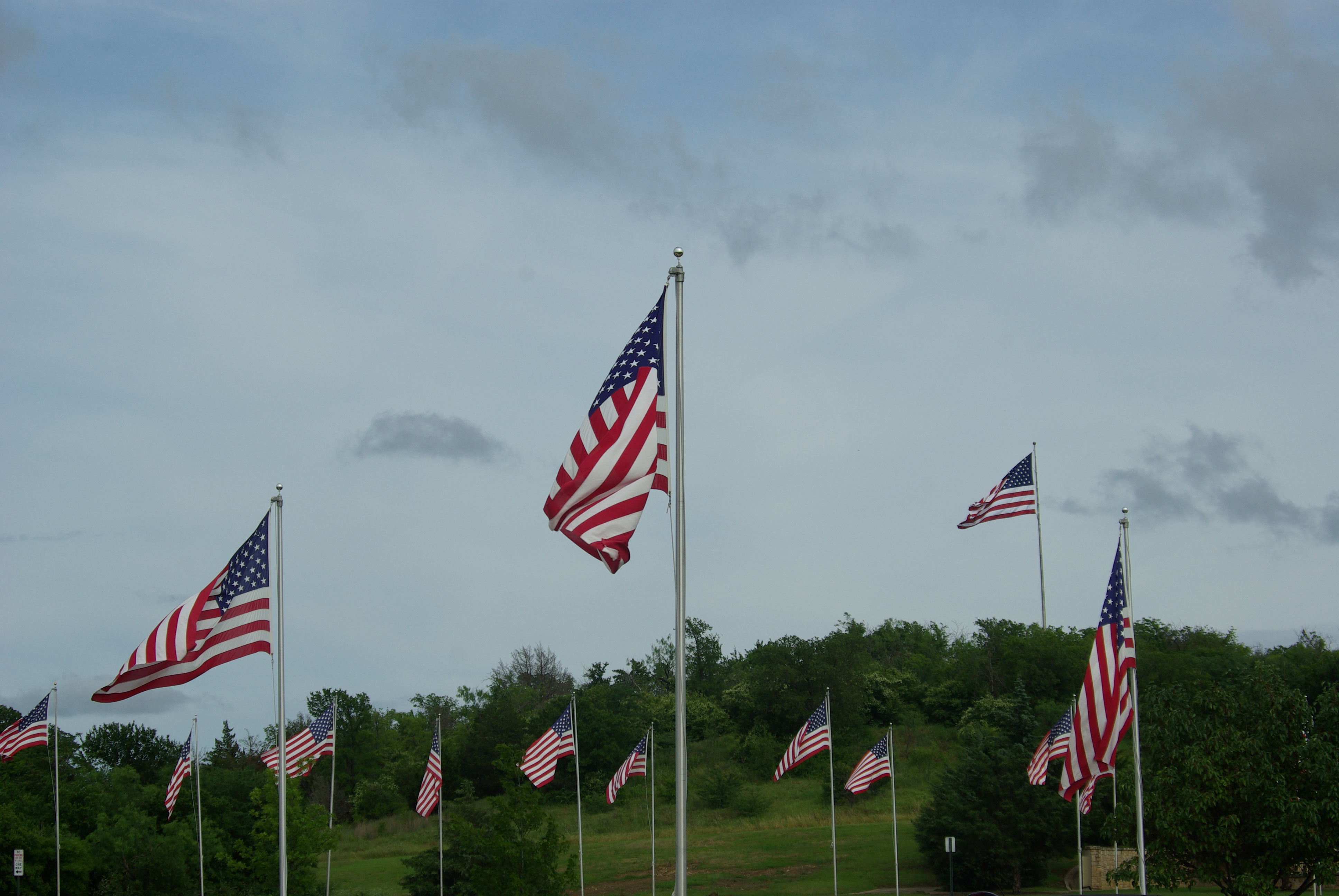
U.S. flags flying at the Dallas-Fort Worth National Cemetery, for Memorial Day 2015. Photo by Ed Darrell. Please use.
Just a reminder: When posting a flag to half-staff, it should be raised with gusto to full staff, then slowly lowered to the half-staff position. On Memorial Day, when changing the flag’s position at noon, simply raise the flag briskly to full staff. At retirement, the flag should be lowered in a stately fashion.
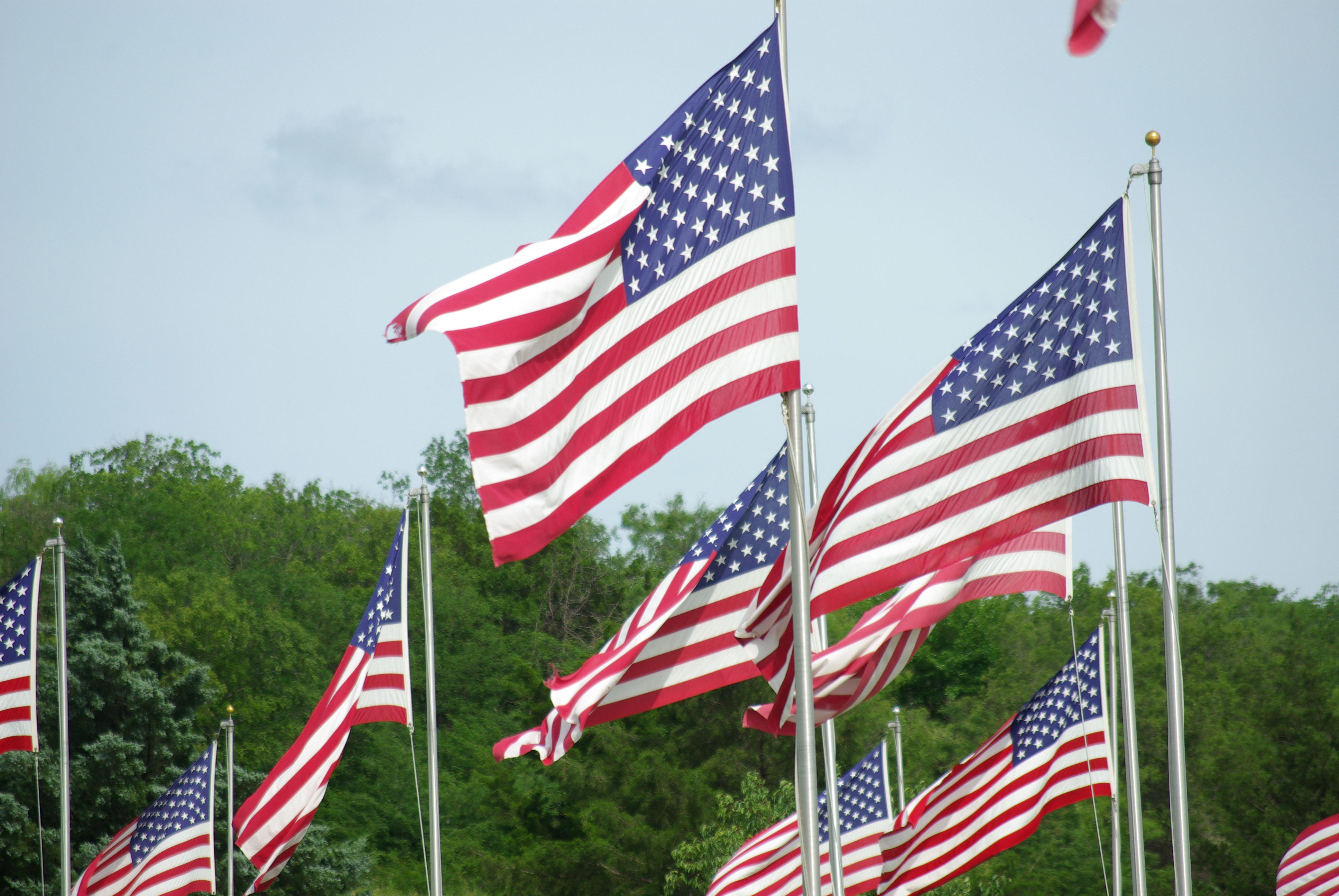
U.S. flags flying at the Dallas Fort Worth National Cemetery, for Memorial Day 2015. You may use this photo.
More:
Leave a Comment » | Flag etiquette, Fly your flag today, History, Holidays | Tagged: Flag etiquette, Fly your flag today, History, Memorial Day | Permalink
Posted by Ed Darrell

Rachel Carson at Hawk Mountain, Pennsylvania. USFWS photo.
Rachel Carson’s birth anniversary in 2017 was remarkably free from attacks by DDT advocates or other people misinformed about her life and work.
Not that those attacks don’t continue on other days, still, but that the critics did not use the occasion of the anniversary of her birth to gang up on news media.
Some of the nice things said on Twitter:
Over the years, Maria Popova at Brainpickings (@brainpicker) collected and republished quite a bit of good biography on Rachel Carson.
https://twitter.com/Laurel_Standley/status/868646209363300353
https://twitter.com/i/web/status/868644265953558528
But:
And earlier:
Leave a Comment » | DDT, Environment, Environmental protection, History, Rachel Carson, Science | Tagged: DDT, environment, History, Rachel Carson, Science | Permalink
Posted by Ed Darrell

President John F. Kennedy speaking to a special joint session of Congress, on May 25, 1961; in this speech, Kennedy made his famous statement asking the nation to pledge to put a man on the Moon and bring him back safely, in the next ten years.
It was an era when Congress would respond when the President challenged America to be great, and Congress would respond positively.
On May 25, 1961, President Kennedy delivered a special message to Congress, on the challenges facing the U.S. around the world, in continuing to build free market economies, and continuing to advance in science, as means of promoting America’s future. He closed with the words that have become so famous. From the Apollo 11 Channel, excerpts from the speech, via Fox Movietone news:
History from the Apollo 11 Channel:
In an address to a Joint session of the United States Congress, Kennedy announces full presidential support for the goal to “commit…before this decade is out, to landing a man on the Moon and returning him safely to the Earth” and urges Congress to appropriate the necessary funds, eventually consuming the largest financial expenditure of any nation in peacetime.
Though Kennedy had initially been convinced that NASA should attempt a manned mission to Mars, NASA Associate Administrator Robert Seamans spent three days and nights working, ultimately successfully, to convince him otherwise.
The complete speech is 46 minutes long. The JFK Library has a longer excerpt in good video I haven’t figured out how to embed here, but it’s worth your look. The Library also features the entire speech in audio format.
NASA has a good site with solid history in very short form, and links to a half-dozen great sites.
Can you imagine a president making such a challenge today?
More:
A lot of people like that photo of President Kennedy before Congress!
https://twitter.com/AxelDiazSSA/status/867778726582521856
https://twitter.com/ThisDayInPast/status/867775769723916289
And then, rather coincidentally, 40 years ago on May 25:
https://twitter.com/TwitterMoments/status/867749117832732672

Yes, this is mostly an encore post. Fighting ignorance requires patience.
1 Comment | Cold War, Famous trials, History, Moon, NASA, Science, Space exploration, Space Race | Tagged: Cold War, famous speeches, History, John F. Kennedy, NASA, Science, Space exploration, Space Race, Turning Points | Permalink
Posted by Ed Darrell

Neal Augenstein at WTOP Radio in Washington, D.C. posted this photo on Twitter: @AugensteinWTOP — Richard Collins III’s graduation gown draped over front row chairs at Bowie State University ceremony. He was murdered Saturday.
Bowie State University honored a man who should have graduated today, Richard Collins III.
Another reminder that senseless violence threatens us all, and that we must oppose all violence, regardless its origin.
More:
1 Comment | Terrorism, Violence | Tagged: Bowie State University, Richard Collins III, Terrorism, Violence | Permalink
Posted by Ed Darrell

“How do you figure that, Hawkeye?” Father Mulcahy, screen capture from video snippet of M.A.S.H.
Our correspondents Jameses, Stanley and Kessler, alerted me months ago to this exchange in the old television show, “M.A.S.H.” In a discussion of the First Battle of Bull Run, we discussed war as hell.
War is worse than hell, they said. Still true.
They pointed to a scene from “M.A.S.H.”
Dialogue borrowed from IMDB:
Hawkeye: War isn’t Hell. War is war, and Hell is Hell. And of the two, war is a lot worse.
Father Mulcahy: How do you figure that, Hawkeye?
Hawkeye: Easy, Father. Tell me, who goes to Hell?
Father Mulcahy: Sinners, I believe.
Hawkeye: Exactly. There are no innocent bystanders in Hell. War is chock full of them — little kids, cripples, old ladies. In fact, except for some of the brass, almost everybody involved is an innocent bystander.
Deep thinking, maybe wisdom, from a mobile operating room filtered through sit-com writers.
M.A.S.H., copyright 20th Century Fox
More:
3 Comments | Famous quotes, History, korean war, Quotes, War | Tagged: Famous quotes, History, Korean War, M.A.S.H., Quotes, War | Permalink
Posted by Ed Darrell

New meaning to “flying the flag”: (Wikipedia caption) A pair of specially painted F-117 Nighthawks fly off from their last refueling by the Ohio National Guard’s 121st Air Refueling Wing. The F-117s were retired March 11 [2008] in a farewell ceremony at Wright-Patterson Air Force Base, Ohio. U.S. Air Force photo/Senior Master Sgt. Kim Frey
The U.S. Flag Code designates Armed Forces Day as one day for all Americans to fly their flags, in honor of those men and women presently serving in any of the Armed Forces.
Activities to honor active duty and active reserve forces occur in hundreds of communities across the nation. Check your local papers.
Remember to fly your flag.
A bit of history, as we’ve noted earlier: After President Truman’s administration brought the management of the armed forces under the umbrella of one agency, the Department of Defense, Truman moved also to unite what had been a separate day of honor for each of the branches of the military, into one week capped by one day for all uniformed defense services.
On August 31, 1949, Secretary of Defense Louis Johnson announced the creation of an Armed Forces Day to replace separate Army, Navy and Air Force Days. The single-day celebration stemmed from the unification of the Armed Forces under one department — the Department of Defense. Each of the military leagues and orders was asked to drop sponsorship of its specific service day in order to celebrate the newly announced Armed Forces Day. The Army, Navy and Air Force leagues adopted the newly formed day. The Marine Corps League declined to drop support for Marine Corps Day but supports Armed Forces Day, too.
In a speech announcing the formation of the day, President Truman “praised the work of the military services at home and across the seas” and said, “it is vital to the security of the nation and to the establishment of a desirable peace.” In an excerpt from the Presidential Proclamation of Feb. 27, 1950, Mr. Truman stated:
Armed Forces Day, Saturday, May 20, 1950, marks the first combined demonstration by America’s defense team of its progress, under the National Security Act, towards the goal of readiness for any eventuality. It is the first parade of preparedness by the unified forces of our land, sea, and air defense.
Celebrations like Armed Forces Day offer good opportunities to promote history. I suspect that the day’s coming always in the middle of May suppresses some of the teaching moment value, as teachers make a final push for end of course tests, finals, and in high schools, for graduation — and as many colleges are already out for the summer. Good materials are available that can be sprinkled throughout a course.

President Truman and other dignitaries on the reviewing stand during an Armed Forces Day parade, (left… – NARA – 200222 (Photo credit: Wikipedia) (Is that Eisenhower on the left?) (Update: Yep! From Wikimedia: Left to right, Gen. Dwight D. Eisenhower, Secretary of Defense Louis Johnson, President Truman, Adm. William Leahy.
For example, this list of world-wide events at the first Armed Forces Day, in 1950, gives a good picture of four years into the Cold War, and would make a good warm-up exercise or even an entire lesson, or offer opportunities for projects:
The first Armed Forces Day came at a time of increased world tensions, political volatility and communist aggression. Some notable events that marked America’s first Armed Forces Week were as follows:
- Bolivian police broke up “alleged” revolutionary communist-led general strike in LaPaz.
- Two U. S. government buildings in Canton, China were taken over by the Chinese Communist Government. The buildings were U. S. property acquired prior to the Communist takeover.
- The Burmese Army recaptured the city of Prome, a strategic communist-rebel stronghold.
- Nicaraguans elect General Anastasio Somoza to a regular six-year term as president.
- French and West German governments expected to talk shortly on the merger of the coal and steel industries of the two countries.
- Communist China lifted the ban on daylight shipping along the Yangtze River due to the decline of Nationalist air activity.
- Norway receives first US military aid in the form of two Dakota planes.
- U. N. Secretary General Trygive Lie seeks West’s acceptance of Red China in the U. N.
- Iran announced close range news broadcasts to the Soviet Union with $56,000 worth of Voice of America equipment.
- Cuba celebrated the 48th anniversary of the establishment of its republic.
- The Red Cross celebrated its 69th birthday.
- Britain ended rationing of all foods except meats, butter, margarine, and cooking fat.
- The U. S. Congress voted to extend the draft. “A Bill to extend registration and classification for the Draft until June 24, 1952 passed the House 216-11.”
- The Allied Command announced it would “ease” the burden of occupation on Austria and would name civilian high commissioners to replace present military high commissioners.
- Soviet authorities in Berlin withdrew travel passes of the U.S. and British military missions stationed at Potsdam in the Soviet zone of occupation.
- The Soviets returned 23 East German industrial plants to East German authorities. The plants had been producing exclusively for the benefit of reparations to the USSR.
- Twenty-eight Soviet vessels, consisting of tugs, trawlers, and supply ships remained in the English Channel as the Western Alliance prepared for air and naval maneuvers. Observers noted that many of them carried rollers at their sterns for trawling nets although no nets were visible.
- Pravda denounced Armed Forces Day, calling it the militarization of the United States. “The hysterical speeches of the warmongers again show the timeliness of the appeal of the Permanent Committee of Peace Partisans that atomic weapons be forbidden.”
- Western Powers renewed their promise to help Mid-Eastern states resist communism. They also announced an agreement to sell arms to Israel as well as to the Arabs.
Veterans Day honors veterans of wars, and those who served in the past; Memorial Day honors people who died defending the nation; Armed Forces Day honors those men and women serving today. Service with two wars, in an “all volunteer” military, is a rough go, especially in times of federal budget cuts. Say a good word about active duty military on Saturday, will you?
More:
Yes, this is mostly an encore post. Fighting ignorance requires patience.
Leave a Comment » | Flag etiquette, Fly your flag today, History, Holidays | Tagged: Armed Forces Day, Flag etiquette, Fly your flag, History | Permalink
Posted by Ed Darrell
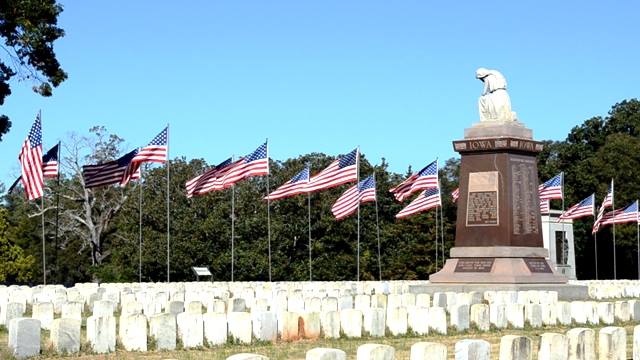
From the Andersonville National Historic Site Twitter account: Our Avenue of Flags went up today in celebration of Memorial Day! You can view these rows of American flags in the cemetery until May 31.
The Andersonville NHS is in Andersonville, Georgia. Memorial Day grew greatly after the U.S. Civil War, as people worked to commemorate those who died in the war, on both sides. Andersonville contributed many of those deaths.
Memorial Day is Monday, May 28, in 2017, a day for all Americans to fly the U.S. flag.

A view from the cemetery at Andersonville NHS. NPS photo.
1 Comment | 1861-1865, Civil War, Fly your flag today | Tagged: Andersonville NHS, Civil War, Fly your flag, History, Memorial Day | Permalink
Posted by Ed Darrell


Ed Darrell on Texas's Colorado River


Come on in, the water's fine. Come often: Cleanliness is next to godliness.


 Millard Fillmore's Bathtub