Cinco de Mayo: NOT Mexico’s Independence Day; should Confederate sympathizers celebrate?

May 5, 2015

(Mostly an encore post, from 2009, with updates)

You thought Cinco de Mayo was Independence Day for Mexico?

No, it’s not.

History.com has a nice explanation, with a nice little video

NPR’s blogs explain: “Cinco de Mayo: Whose holiday is it, anyway?”

“It ain’t about the Margaritas: The real meaning of Cinco de Mayo,” at NPR’s The Takeaway.

Perhaps the U.S. should celebrate the day, too, at least in those states who were not in the old Confederacy. On May 5, 1862, Mexicans under the command of 33 year old Commander General Ignacio Zaragoza Seguín stopped the quick advance of superior French forces trying to invade Mexico to take it over, at the Battle of Puebla. While France did eventually defeat Mexican forces (after getting 30,000 men in reinforcements), the spirit of May 5 inspired Mexicans to continue to fight for freedom. And ultimately, Mexican forces overpowered and captured the French forces and Emperor Maximilian, who was executed.

Thus ended a great hope for the Confederacy, that a French-supported Mexican Army would lend aid to the Confederates in their struggle to secede from the Union.

It is one of the great what-ifs of history: What if France had kept Mexico, and what if French-led Mexican forces backed up the Confederate Army, as Confederates and the French hoped?

One thing is rather sure: Had that happened, and had the Confederacy been successful, we wouldn’t be celebrating Cinco de Mayo in Texas today.

What do the scholars of Lincoln have to add?

Battle of Puebla, Wikimedia (artist?)

Battle of Puebla, Wikimedia (artist?)

Mexican Independence Day is September 16.

_______________________________________

Update: A reader sends a note that Seguin was a Texan. So the Mexican hero of the Battle of Puebla was a Texan. You couldn’t make this stuff up — real history is always more interesting than fiction.


Moon rise over Joshua Tree National Park

May 5, 2015

Four minutes of a glorious full Moon rising over Joshua Tree National Park — reduced to a 6-second Vine.

I do like a little well-done time lapse. In this one, the action of the clouds playing peek-a-boo with the Moon is a lot of fun. It’s just the sort of astronomical action I love to watch in the National Parks.

Desert sunset at Jumbo Rocks Campground, Joshua Tree NP. Photo by Brad Sutton/NPS

Desert sunset at Jumbo Rocks Campground, Joshua Tree NP. Photo by Brad Sutton/NPS

I wonder where Lian Law took that time-lapse of the Moon.  Anyone know?

More:

Screen capture of the Moon rise Vine video by Lian Law, National Park Service.

Screen capture of the Moon rise Vine video by Lian Law, National Park Service.


What dates do we fly the flag in May?

May 2, 2015

"Allies Day, May 1917" -- 1917 oil on canvas by Childe Hassam; National Gallery of Art, Washington, D.C.

“Allies Day, May 1917” — 1917 oil on canvas by Childe Hassam; National Gallery of Art, Washington, D.C. Allies Day is no longer celebrated.

May has three days designated for flying the U.S. flag out of the specific days mentioned in the U.S. Flag Code, and three statehood days, when residents of those states should fly their flags.

Interestingly, the three designated days all float, from year to year:

  • Mother’s Day, second Sunday in May (May 10, in 2015)
  • Armed Forces Day, third Saturday in May (May 16)
  • Memorial Day, the last Monday in May (May 25)

Residents of these states celebrate statehood; South Carolina and Wisconsin share May 23:

  • Minnesota, May 11 (1858, the 32nd state)
  • South Carolina, May 23 (1788, the 8th state)
  • Wisconsin, May 23 (1848, the 30th state)
  • Rhode Island, May 29 (1790, the last of the 13 original colonies to ratify the Constitution)

This year President Obama issued a proclamation calling on citizens to fly the flag on May 1, Law Day (I missed that one).

May 8 marks the 70th anniversary of Victory in Europe Day, the day the Axis Powers in Europe surrendered at the end of World War II.  Some years that day is marked by a proclamation calling for flag flying.  (You may fly your flag then even if Congress and the President do nothing.)

In recent years President Obama has proclaimed May 15 as Peace Officers Memorial Day, with flags to fly at half-staff. We might expect another such declaration in 2015.

May 22 is National Maritime Day, under a Joint Resolution from Congress from 1933. President Obama may be expected to proclaim that day as a day to fly the flag, too.

Gee, eleven events on ten days to fly the U.S. flag.  May could be quite busy for flag fliers.

  1. Law Day, May 1
  2. Victory in Europe Day, May 8
  3. Mothers Day, May 10
  4. Minnesota Statehood, May 11
  5. Peace Officers Memorial Day, May 15 (half-staff flags)
  6. Armed Forces Day, May 16
  7. National Maritime Day, May 22
  8. South Carolina Statehood, AND Wisconsin Statehood, May 23
  9. Memorial Day, May 25
  10. Rhode Island Statehood, May 29

Young public school artists draw award-winning inspiration from endangered species.

May 1, 2015

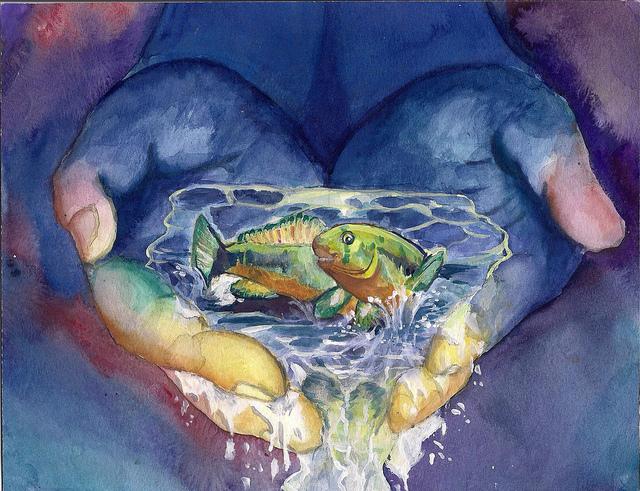
Young artists inspired by #endangeredspecies:1st prize D Starovoytov,6th grade http://1.usa.gov/1Koe2RY  @EcoSchoolsUSA  From @USFWSRefuges

Young artists inspired by #endangeredspecies:1st prize D Starovoytov,6th grade http://1.usa.gov/1Koe2RY @EcoSchoolsUSA From @USFWSRefuges

Maybe someone can make that 6th grader’s day, or life, by asking to purchase that piece (watercolor?) for a few thousands of dollars, to go into a college fund.

The USFWS blog, A Talk on the Wildside, announced the winners of the agency’s 2015 Saving Endangered Species Youth Art Contest.

David Starovoytov, a sixth-grader from California, won the Grand Prize with his art of a Kentucky arrow darter, a beautiful fish found only in eastern Kentucky. During the breeding season, the males are blue-green with scarlet spots and scarlet-orange vertical bars on their body.  The Kentucky arrow darter is a candidate for federal listing under the Endangered Species Act (ESA). Federal candidates warrant ESA protection but are sometimes precluded from listing by other higher priority listing actions (other species are more imperiled and take priority).  Each year, the Service publishes a list and summarizes the current status for all candidate species in its Candidate Notice of Review (CNOR). The CNOR helps landowners and natural resource managers plan conservation to address threats to candidate species. The Kentucky Department of Fish and Wildlife Resources has identified the Kentucky arrow darter as a species of greatest conservation need and has been hard at work conserving it through captive breeding and other projects.  A key threat to the Kentucky arrow darter is degradation of habitat through surface coal mining and other human activities.  Changes in water quality have a profound impact on all aquatic species, including the Kentucky arrow darter.

The darter itself has an interesting story. Cool that a California kid heard the story, and made such a nice work of art.

The rest of the press release, and other winners:

AlligatorFourteen-year-old Seungeun Yi, of California, took second place with art of an American alligator, actually one of our greatest ESA successes. As recently as the 1950s, American alligator populations were at all-time lows as market-hunting and habitat loss decimated the species. ESA protection prohibited hunting, and the alligator began to recover, and states throughout the South helped make sure the population increased. We declared the animal fully recovered in 1987, but related species are still in trouble, so the American alligator is listed as “threatened due to similarity of appearance.

San Francisco garter snake

Another Californian, Mark Deaver, 8, won the Grades k-2 Category with his art of an endangered San Francisco garter snake. The San Francisco garter snake with its turquoise body and orange, black and red-orange stripes, is often called the most beautiful snake in the United States. Because they are so beautiful, some people collect them illegally. But the more significant threat comes from habitat loss. We are working with the California Department of Fish and Wildlife, the National Park Service, Golden Gate National Parks Conservancy, the California Department of Parks and Recreation and other partners to provide habitat for the snake.

eagle

Difei Li, 10, of New Jersey, won the Grades 3-5 Category with art of a bald eagle. Perhaps the ESA success story, the bald eagle population bottomed out in 1963 with just 417 nesting pairs in the contiguous United States. Habitat destruction and degradation, illegal shooting and the widespread use of DDT had sent the eagle population plummeting after World War II. Protecting habitat, banning most DDT use and a host of conservation actions by the American public helped bald eagles make a remarkable recovery. Though removed from the endangered species list in 2007 because their populations recovered sufficiently, bald eagles are protected under the Migratory Bird Treaty Act and the Bald and Golden Eagle Act.

Northern aplomado falconClaire Noelle Kiernicki, 12, of  Illinois, won the Grades 6-8 Category with art of an endangered Northern aplomado falcon. Once widespread throughout the American Southwest, the aplomado falcon disappeared in South Texas in the 1940s and 1950s because of widespread loss of habitat.  An aggressive captive breeding and re-introduction effort has improved population numbers and the aplomado falcon is making a comeback in southern Texas.

bat

Adam Pavan, 15, of California, won the Grades 9-12 Category with art of an endangered Hawaiian hoary bat. Also known as the ‘ope‘ape‘a, populations are believed to be threatened by habitat loss, pesticides, predation, and roost disturbance. Its decline may be primarily due to the reduction of tree cover in historic times, and they may be indirectly impacted by the use of pesticides. Conservation plans guide the management and use of forests to reduce negative efforts to known bat populations and, continued support for the ‘ope‘ape‘a research cooperative.

Congratulations to all the entrants and thank you for helping spread the word about the endangered species of  the United States and its waters.


How do Texas’s voter ID laws hurt Texas voters? This film shows how

April 30, 2015

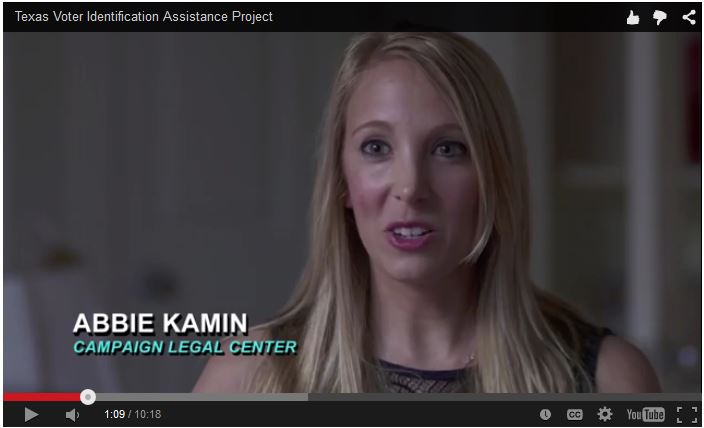
Abbie Kamin, a Houston lawyer assisting Texas voters keep their right to vote, explains how Texas's voter ID laws hurt Texans, and damage democracy in the U.S.

Abbie Kamin, a Houston lawyer assisting Texas voters keep their right to vote, explains how Texas’s voter ID laws hurt Texans, and damage democracy in the U.S.

Video you won’t see at 11.

From the Texas Voter Identification Assistance Project, at the Campaign Legal Center.

Description:
Published on Apr 24, 2015

Under Texas’ new restrictive photo/voter ID law, more than 600,000 Texans now lack sufficient identification to vote in elections, with little to no help from the State of Texas to resolve the problems. The Texas Voter Identification Assistance Project, coordinated by the Campaign Legal Center, a nonpartisan nonprofit, provided assistance to Texas voters who wished to vote but lacked the newly required identification, and thus were disenfranchised.

At the Campaign Legal Center’s site, there’s a press release on the video, released to correspond with arguments on voter identification issues at the Fifth Circuit Court of Appeals.

CLC FILM RELEASE: On Day of Fifth Circuit Oral Argument, Meet Victims of Texas Voter Photo ID Law

CLC Staff

Apr 28, 2015

Today, the Campaign Legal Center released a short film focusing on three lifelong voters disenfranchised by Texas’ voter photo ID law (SB 14), the most restrictive and burdensome voter ID law in the nation.  The ten-minute film produced by Firelight Media traces the efforts of the Campaign Legal Center’s Voter ID Project to assist registered voters to overcome the many hurdles erected by the new law in order to obtain the photo IDs required by SB 14.

Today in Veasey v. Abbott, oral arguments will be heard in a challenge to that law, in the U.S. Court of Appeals for the Fifth Circuit in New Orleans.  Attorneys at the Campaign Legal Center serve as co-counsel for plaintiffs Congressman Marc Veasey, LULAC, and a group of Texas voters.

Following a two-week trial last fall, U.S. District Court Judge Nelva Gonzales Ramos enjoined SB 14, finding that it was as an unconstitutional burden on the right to vote as well as an unconstitutional poll tax, had “an impermissible discriminatory effect against Hispanics and African-Americans, and was imposed with an unconstitutional discriminatory purpose.”  The state defendants immediately appealed Judge Ramos’ decision. In mid-October, the Fifth Circuit Court of Appeals stayed that decision solely to avoid confusion in the November 2014 elections, and the U.S. Supreme Court subsequently refused to vacate the Fifth Circuit’s stay.

The film released today traces the plight of three Texans who were victims of the Texas voter photo ID law and the massive effort required of many voters to exercise their right to vote under the new law.

“These longtime voters were had their voting rights violated because of SB 14 which the District Court found to be unconstitutional and in violation of the Voting Rights Act,” said J. Gerald Hebert, Executive Director of The Campaign Legal Center.  “The plight of these victims, who suffered a violation of their voting rights through no fault of their own, mirrors the evidence that prompted Judge Ramos to strike down Texas’ intentionally discriminatory, modern-day poll tax.”

The first challenge (Veasey v. Perry) to the Texas photo ID law was filed by the Campaign Legal Center and others in the summer of 2013 claiming that SB 14 violates the 1st, 14th, 15th and 24th Amendments to the Constitution, as well as Section 2 of the Voting Rights Act.  Several additional challenges were then brought against the Texas law (including one by the United States).  All of the cases were consolidated in the Southern District of Texas in Corpus Christi.

In addition to overseeing the Voter ID Project, the Campaign Legal Center is part of the legal team representing the Veasey-LULAC plaintiffs that includes Chad Dunn and K. Scott Brazil (Brazil & Dunn), Neil G. Baron, David Richards (Richards, Rodriguez & Skeith), Armand Derfner (Derfner & Altman), and Luis Roberto Vera, Jr. (LULAC).

To read the Legal Center’s Fifth Circuit brief, click here.

To read the District Court decision striking down the Voter ID law, click here.

Tip of Millard’s old scrub brush to Michael Li.


Do something to fight malaria today: April 25, 2015, is World Malaria Day

April 25, 2015

Photo from the World Health Organization (WHO), the lead agency in fighting malaria.

Photo from the World Health Organization (WHO), the lead agency in fighting malaria. “A child dies every minute from #malaria in Africa http://goo.gl/46QhJq #WorldMalariaDay”

One day dedicated to education and spurs to action to beat malaria.

Amazingly, there are ways to get it wrong. Please avoid them.

Don’t claim that all we need to do to beat this nasty disease is shoot environmentalists and poison the world with DDT.  Don’t claim that health workers who risk their lives to prevent malaria with bednets, are misguided. No, Rachel Carson didn’t kill millions with false claims against DDT (in fact, she tried to keep DDT viable as a key tool to fight malaria, but we failed to listen to her in time).

You might kick in $10 to Nothing But Nets, and save a life in the most effective anti-malaria campaign in the last 50 years. In fact, I recommend it.

Have a thoughtful World Malaria Day.

http://twitter.com/bbbrieger/status/588795413387423744


True story: Yellow Rose of Texas saved Texas at the Battle of San Jacinto

April 21, 2015

This is mostly an encore post, for the 179th anniversary of the Battle of San Jacinto.

After suffering crushing defeats in previous battles, and while many Texian rebels were running away from Santa Anna’s massive army — the largest and best trained in North America — Sam Houston’s ragtag band of rebels got the drop on Santa Anna at San Jacinto, on April 21, 1836. Most accounts say the routing of Santa Anna’s fighting machine took just 18 minutes.

San Jacinto Day is April 21. Texas history classes at Texas middle schools should be leading ceremonies marking the occasion — but probably won’t since it’s coming near the end of the state-mandated testing which stops education cold, in March.

Surrender of Santa Anna, Texas State Preservation Board

Surrender of Santa Anna, painting by William Henry Huddle (1890); property of Texas State Preservation Board. The painting depicts Santa Anna being brought before a wounded Sam Houston, to surrender.

San Jacinto Monument brochure, with photo of monument

The San Jacinto Monument is 15 feet taller than the Washington Monument

How could Houston’s group have been so effective against a general who modeled himself after Napoleon, with a large, well-running army? In the 1950s a story came out that Santa Anna was distracted from battle. Even as he aged he regarded himself as a great ladies’ man — and it was a woman who detained the Mexican general in his tent, until it was too late to do anything but steal an enlisted man’s uniform and run.

That woman was mulatto, a “yellow rose,” and about whom the song, “The Yellow Rose of Texas” was written, according story pieced together in the 1950s.

Could such a story be true? Many historians in the 1950s scoffed at the idea. (More below the fold.) Read the rest of this entry »


No, Earth Day does not celebrate Lenin, who was anti-environmentalist – 2015 debunking of the annual Earth Day/Lenin hoax

April 20, 2015

This is mostly an encore post, repeated each year on April 22 and Earth Day — sad that it needs repeating; anti-environmentalists don’t appear to learn much, year to year.  (Yes, some of the links may be dated; if you find one not working, please let me know in comments.)

You could write it off to pareidolia, once.

Like faces in clouds, some people claimed to see a link. The first Earth Day, on April 22, 1970, coincided with Lenin’s birthday. There was no link — Earth Day was scheduled for a spring Wednesday, when the greatest number of college students would be on campus.

Link to permanent Earth Day site, at EarthDay.org

Link to permanent Earth Day site, at EarthDay.org

Now, years later, with almost-annual repeats of the claim from the braying right wing, it’s just a cruel hoax.  It’s as much a hoax on the ill-informed of the right, as anyone else. Many of them believe it.

No, there’s no link between Earth Day and the birthday of V. I. Lenin:

One surefire way to tell an Earth Day post is done by an Earth Day denialist: They’ll note that the first Earth Day, on April 22, 1970, was an anniversary of the birth of Lenin.

Coincidentally, yes, Lenin was born on April 22 (new style calendar; it was April 10 on the calendar when he was born — one might accurately note that Lenin’s mother always said he was born on April 10).

It’s a hoax. There is no meaning to the first Earth Day’s falling on Lenin’s birthday — Lenin was not prescient enough to plan his birthday to fall in the middle of Earth Week, a hundred years before Earth Week was even planned.

About.com explains why the idea of a link between Earth Day and Lenin is silly:

Does Earth Day Promote Communism?
Earth Day 1970 was initially conceived as a teach-in, modeled on the teach-ins used successfully by Vietnam War protesters to spread their message and generate support on U.S. college campuses. It is generally believed that April 22 was chosen for Earth Day because it was a Wednesday that fell between spring break and final exams—a day when a majority of college students would be able to participate.

U.S. Sen. Gaylord Nelson, the guy who dreamed up the nationwide teach-in that became Earth Day, once tried to put the whole “Earth Day as communist plot” idea into perspective.

“On any given day, a lot of both good and bad people were born,” Nelson said. “A person many consider the world’s first environmentalist, Saint Francis of Assisi, was born on April 22. So was Queen Isabella. More importantly, so was my Aunt Tillie.”

April 22 is also the birthday of J. Sterling Morton, the Nebraska newspaper editor who founded Arbor Day (a national holiday devoted to planting trees) on April 22, 1872, when Lenin was still in diapers. Maybe April 22 was chosen to honor Morton and nobody knew. Maybe environmentalists were trying to send a subliminal message to the national subconscious that would transform people into tree-planting zombies. One birthday “plot” seems just about as likely as the other. What’s the chance that one person in a thousand could tell you when either of these guys were born.

My guess is that only a few really wacko conservatives know that April 22 is Lenin’s birthday (was it ever celebrated in the Soviet Union?). No one else bothers to think about it, or say anything about it, nor especially, to celebrate it.

Certainly, the Soviet Union never celebrated Earth Day. Nor was Lenin any great friend of the environment.  He stood instead with the oil-drillers-without-clean-up, with the strip-miners-without-reclamation, with the dirty-smokestack guys.  You’d think someone with a bit of logic and a rudimentary knowledge of history could put that together.

Gaylord Nelson, Living Green image

Inventor of Earth Day teach-ins, former Wisconsin Governor and U.S. Senator Gaylord Nelson

The REAL founder of Earth Day, Wisconsin’s U.S. Sen. Gaylord Nelson, usually recognized as the founder and father of Earth Day, told how and why the organizers came to pick April 22:

Senator Nelson chose the date in order to maximize participation on college campuses for what he conceived as an “environmental teach-in.” He determined the week of April 19–25 was the best bet; it did not fall during exams or spring breaks, did not conflict with religious holidays such as Easter or Passover, and was late enough in spring to have decent weather. More students were likely to be in class, and there would be less competition with other mid-week events—so he chose Wednesday, April 22.

In his own words, Nelson spoke of what he was trying to do:

After President Kennedy’s [conservation] tour, I still hoped for some idea that would thrust the environment into the political mainstream. Six years would pass before the idea that became Earth Day occurred to me while on a conservation speaking tour out West in the summer of 1969. At the time, anti-Vietnam War demonstrations, called “teach-ins,” had spread to college campuses all across the nation. Suddenly, the idea occurred to me – why not organize a huge grassroots protest over what was happening to our environment?

I was satisfied that if we could tap into the environmental concerns of the general public and infuse the student anti-war energy into the environmental cause, we could generate a demonstration that would force this issue onto the political agenda. It was a big gamble, but worth a try.

At a conference in Seattle in September 1969, I announced that in the spring of 1970 there would be a nationwide grassroots demonstration on behalf of the environment and invited everyone to participate. The wire services carried the story from coast to coast. The response was electric. It took off like gangbusters. Telegrams, letters, and telephone inquiries poured in from all across the country. The American people finally had a forum to express its concern about what was happening to the land, rivers, lakes, and air – and they did so with spectacular exuberance. For the next four months, two members of my Senate staff, Linda Billings and John Heritage, managed Earth Day affairs out of my Senate office.

Five months before Earth Day, on Sunday, November 30, 1969, The New York Times carried a lengthy article by Gladwin Hill reporting on the astonishing proliferation of environmental events:

“Rising concern about the environmental crisis is sweeping the nation’s campuses with an intensity that may be on its way to eclipsing student discontent over the war in Vietnam…a national day of observance of environmental problems…is being planned for next spring…when a nationwide environmental ‘teach-in’…coordinated from the office of Senator Gaylord Nelson is planned….”

Nelson, a veteran of the U.S. armed services (Okinawa campaign), flag-waving ex-governor of Wisconsin (Sen. Joe McCarthy’s home state, but also the home of Aldo Leopold and birthplace of John Muir), was working to raise America’s consciousness and conscience about environmental issues.

Lenin on the environment? Think of the Aral Sea disaster, the horrible pollution from Soviet mines and mills, and the dreadful record of the Soviet Union on protecting any resource. Lenin believed in exploiting resources and leaving the spoils to rot in the sun, not conservation; in practice there was no environmental protection, but instead a war on nature, in the Soviet Union.

So, why are all these conservative denialists claiming, against history and politics, that Lenin’s birthday has anything to do with Earth Day?

Can you say “propaganda?” Can you say “political smear?”

2015 Resources and Good News:

2014 Resources and Good News:

2013 Resources and Good News:

Good information for 2012:

Good information from 2011:

Good information from 2010:

2014’s Wall of Shame:

2013 Wall of Shame:

Wall of Lenin’s Birthday Propaganda Shame from 2012:

Wall of Lenin’s Birthday Propaganda Shame from 2011:

Wall of Lenin’s Birthday Propaganda Shame from 2010:

Spread the word. Have you found someone spreading the hoax, claiming Earth Day honors Lenin instead? Give us the link in comments.


Signs of desperate times: What baby needs

April 11, 2015

Wonderful little find on Twitter:

To which @FionaCuffed added,

To which @FionaCuffed added, “Baby sure does!”

Baby needs differ from place to place.

I wonder where that store is, and I wonder if managers ever look at their own signs?

And if they do, do they chuckle?

(That could be a start of a poem, or maybe a short poem all itself:  “baby needs//beers & wines”)


. . . and I can taste and smell the sweet, sweet breeze of a dream

April 7, 2015

Frankie looks out on the life he's living. Film image by Peter H. Reynolds

Frankie looks out on the life he’s living. Film image by Peter H. Reynolds

Is your bus coming?

Will you get on it?

Or will you be late to that “meeting?”

Details:

A powerful tale written by Peter H. Reynolds. Animation and Direction by John Lechner and Peter H. Reynolds. Executive Producer, Gary Goldberger.

What can you do to let that kid out? Will you?

(Just who the hell is Peter H. Reynolds?  Why isn’t he more famous?)


César Chávez Day, 2015

March 31, 2015

features a portrait of Cesar against a background of empty grape fields. It was painted by illustrator Robert Rodriguez from a 1976 photo,

Postage stamp honoring Cesar Chavez in 2003. “The stamp features a portrait of Cesar against a background of empty grape fields. It was painted by illustrator Robert Rodriguez from a 1976 photo,” according to the Cesar Chavez Foundation.

President Obama declared March 31, 2015, César Chávez Day, as he did in 2014.  Here’s the press release version of the proclamation.

For Immediate Release                                                         March 30, 2015

Presidential Proclamation — Cesar Chavez Day, 2015

CÉSAR CHÁVEZ DAY, 2015

– – – – – – –

BY THE PRESIDENT OF THE UNITED STATES OF AMERICA
A PROCLAMATION

For more than two centuries, the arc of our Nation’s progress has been shaped by ordinary people who have dedicated their lives to the extraordinary work of building a more perfect Union.  It is a story of achievement and constant striving that has found expression in places where America’s destiny has been decided — in Seneca Falls, Selma, and Stonewall, and in the golden fields of California where an American hero discovered his mighty voice.  Today, we honor César Chávez and his lifetime of work to make our country more free, more fair, and more just, and we reaffirm the timeless belief he embodied:  those who love their country can change it.

A son of migrant workers and a child of the Great Depression, César Chávez believed every job has dignity and every person should have the chance to reach beyond his or her circumstances and realize a brighter future.  When no one seemed to care about the farm workers who labored without basic protections and for meager pay to help feed the world, César Chávez awakened our Nation to their deplorable conditions and abject poverty — injustices he knew firsthand.  He organized, protested, fasted, and alongside Dolores Huerta, founded the United Farm Workers.  Slowly, he grew a small movement to a 10,000-person march and eventually a 17-million-strong boycott of table grapes, rallying a generation around “La Causa” and forcing growers to agree to some of the first farm worker contracts in history.  Guided by a fierce commitment to nonviolence in support of a righteous cause, he never lost faith in the power of opportunity for all.

As a Nation, we know the struggle to live up to the principles of our founding does not end with any one victory or defeat.  After César Chávez fought for higher wages, he pushed for fresh drinking water, workers’ compensation, pension plans, and protection from pesticides.  He strove every day for the America he knew was possible.  Today, we must take up his work and carry forward this great unfinished task.

When immigrants labor in the shadows, they often earn unfair wages and their families and our economy suffer — that is one reason why we have to fix our broken immigration system and why I keep calling on the Congress to enact comprehensive immigration reform.  We need to continue to defend the collective bargaining rights countless individuals have fought so hard for and ensure our economy rewards hard work with a fair living wage, paid leave, and equal pay for equal work.

César Chávez knew that when you lift up one person, it enriches a community; it bolsters our economy, strengthens our Nation, and gives meaning to the creed that out of many, we are one.  As we celebrate his life, we are reminded of our obligations to one another and the extraordinary opportunity we are each given to work toward justice, equal opportunity, and a better future for every one of our sisters and brothers.

NOW, THEREFORE, I, BARACK OBAMA, President of the United States of America, by virtue of the authority vested in me by the Constitution and the laws of the United States, do hereby proclaim March 31, 2015, as César Chávez Day.  I call upon all Americans to observe this day with appropriate service, community, and education programs to honor César Chávez’s enduring legacy.

IN WITNESS WHEREOF, I have hereunto set my hand this thirtieth day of March, in the year of our Lord two thousand fifteen, and of the Independence of the United States of America the two hundred and thirty-ninth.

[signed] BARACK OBAMA

No call for a flying of flags, but you may certainly fly your Old Glory, if you wish.

More: 


Good news: Malaria deaths cut by half in last 15 years

March 20, 2015

Bad news — still about 600,000 people die from malaria every year, worldwide.

Good news: Dramatic progress against malaria since the turn of the century renews hopes that the disease might be mostly conquered in another 15 to 20 years, and perhaps even obliterated from the Earth. Malaria deaths have been cut in half in the past 15 years, from just over a million a year, to fewer than 610,000.

Since 1963, malaria deaths have been cut more than 80%, from more than 4 million per year, to fewer than 610,000.

That’s dramatic progress.

The Bill and Melinda Gates Foundation shared a video from Comic Relief, a charity set up to fight diseases, featuring David Tennant, perhaps better known the Harry Potter movies and Dr. Who sci-fi series.

Comic Relief isn’t such a big deal in the U.S.  But perhaps you’ll share, and donate?

Red Nose Day was March 13.


Encore: Campaigning Obama visited the Dubliner on St. Patrick’s Day, 2012

March 17, 2015

(This is a slightly-edited encore post, for St. Patrick’s Day — I like the Corrigan Brothers’ droll tune.)

I’d forgotten about the birthers’ greatest nightmare — Obama’s got Irish blood in him!

Democratic Underground features a series of photos of President Obama with an Irish cousin at one of my favorite old haunts in Washington, the Dubliner.

President Barack Obama drinks a Guinness with his ancestral cousin from Moneygall Ireland Henry Healy, center, and the owner of the pub in Moneygall Ireland, Ollie Hayes, right, at The Dubliner Restaurant and Pub and Restaurant on St. Patrick's Day, Saturday, March 17, 2012, in Washington (Official White House Photo by Pete Souza)

President Barack Obama drinks a Guinness with his ancestral cousin from Moneygall Ireland Henry Healy, center, and the owner of the pub in Moneygall Ireland, Ollie Hayes, right, at The Dubliner Restaurant and Pub and Restaurant on St. Patrick’s Day, Saturday, March 17, 2012, in Washington (Official White House Photo by Pete Souza)

Many great memories of the Dubliner, including its own great business success.

In 1974, when I interned at the Senate, the Dubliner was just a small bar on the first floor of the Commodore Hotel.  Rocky Johnson of Sen. Mike Gravel‘s office, one of my roommates, introduced me to Guinness.  The Dubliner was the most reliable source in D.C. at the time.  The bartender was a guy named Paddy.  It was never crowded — and they had good fish and chips with a fine, imported malt vinegar. I wasn’t exactly a regular, but I made several a lot of visits.

Ironically, for my summer job later that year with the Louis August Jonas Foundation, we had a trip to D.C. planned with about 16 “boys from abroad” and the designated hotel was the Commodore — it was cheap and met our needs, being close to the Capitol.  I was asked to chaperone, and happily went.   So Freddy Jonas, the great benefactor of the foundation and Camp Rising Sun, and I could sneak down to the Dubliner for a nightcap after the boys were asleep.  Michael Greene, the foundation’s executive director at the time, warned me that Freddy would always ask if you wanted a second drink, but Freddy would not take one himself — and so, of course, neither should staffers.

One night while Freddy and I were capping off the evening we ran into a friend from my interning, Avis Ortner, a former rodeo barrel rider who had starred in a Kodak commercial series, and who worked in a Washington law firm.  She and Freddy struck it off very nicely.  I was surprised at how much Freddy knew about horses, and the questions he had about rodeo riding.  At some point in the evening he asked me if I were going to have a second drink, and of course I declined.  “Well, you only live once.  Avis and I are having a second one, and you should join us.”  People who knew Freddy well still don’t believe me when I tell them the story.  But it’s true.  It’s the magic of the Dubliner.  [Is Avis still cleaning up at bridge in D.C.? [Yes!]]

I was back in D.C. in 1975, again with the Jonas Foundation bunch, and again at the Commodore.  The Dubliner had a successful year, and had taken over the small cafe/dining room next door to bar.

In 1976 I visited again, and after a very successful year the Dubliner kicked out the gift shop of the hotel and opened a second bar there.  It was crowded on weekends.

In 1979 I moved to D.C.  Within a couple of years the Dubliner bought out the Commodore.  You couldn’t get a seat at the bar most nights.  St. Patrick’s Day 1980 the line wrapped around the block, and though the place never had a great or large stage, the live act was the Clancy Brothers with Tommy Makem, if I recall correctly.

Reconstruction and massive redecorating made the hotel into a great stop, and a sometimes pricey room.  Eventually the bar company sold the hotel, but kept the location for the bar.  After Kathryn and I got married, we’d walk over to the Dubliner for lunch at least a couple of times a month, and the fish and chips at the Dubliner got better.  I may have done in half the cod from the Grand Banks all by myself.

We’ve been in Texas now since 1987.  I miss the Dubliner.  Have been able to make it back only a couple of times.  Obama’s lucky he could get in, on St. Patrick’s Day.  I hope he appreciates his luck.

Yes, this is mostly an encore post.  Fighting ignorance requires patience.

Yes, this is mostly an encore post. Fighting ignorance requires patience.


Cute pictures of polar bears, masking tragedy

March 17, 2015

It came from @planetpics on Twitter.

A beautiful picture of a polar bear cub getting a lift across the water from its mom!  Life on Earth/@planetpics

“A beautiful picture of a polar bear cub getting a lift across the water from its mom!” Life on Earth/@planetpics

Couldn’t help but wonder if that cub will survive the next few months, let alone to adulthood.

Generally, polar bear mothers den on pack ice, and the cub would be kept on the ice while the mother hunted from that platform.  Polar bears can swim, but not well, and not far, usually.  They cannot hunt while swimming.  To eat, they wait on the ice for seals to come up for air, then grab the seals.

Lack of hard ice platforms, pack ice, means mother polar bears can’t hunt to feed their cubs.  While an adult polar bear can swim a distance to find ice, the cubs can’t. And if the adult doesn’t find hard ice, they perish.  Long swims are deadly to cubs.

It’s a cute pic, and we hope momma bear is swimming to an ice platform and can feed that cute little cub so it grows and flourishes.

We know the odds are against it.


March 16, Freedoms Day 2015 – How to celebrate James Madison?

March 16, 2015

Celebrations of James Madison, who was born on March 16, 1751, fall to second tier, a paragraph if we’re lucky in your local newspaper’s “today in history” feature.

March 16 is not a holiday.  It’s not even a Flag Flying Day (though, if you left your flag up for March 15th’s anniversary of Maine’s statehood . . . no one would notice).

Secretary of State James Madison, who won Marb...

Secretary of State James Madison, who won Marbury v. Madison, but lost Judicial review. Photo: Wikipedia

Should we leave James Madison out of our celebrations of history with such vengeance?

Madison left a great legacy.  The question is, how to honor it, and him?

  • Madison is known popularly, especially for elementary school history studies (the few that are done anymore), as the Father of the Constitution.  It’s fitting:  Madison engaged in a great, good conspiracy with George Washington and Alexander Hamilton to get the convention to “amend” the Articles of Confederation and create a better, probably stronger, national government.  But Washington stayed behind the scenes, and pulled very few strings Madison didn’t tell him to pull. Hamilton’s support from New York was weak; while Hamilton played a hugely important role in getting the convention called, and in getting New York to ratify the Constitution with the creation of the Federalist Papers project, the day-to-day operation of the convention and direction of the political forces to make it work, fell to Madison.
  • Madison’s notes on the Philadelphia convention give us the best record of the then-secret proceedings. 

    English: James Madison, fourth president of th...

    Notice the error in this caption:  “James Madison, fourth president of the United States wrote the Constitution at his estate near Orange Virginia, called Montpelier. Pictured here after an extensive renovation.” Photo from Wikipedia.  (James Madison didn’t write the Constitution; it was hammered out in Philadelphia, not Montpelier; the patriot and rake Gouverneur Morris wrote out the final draft.)

  • Madison devised the scheme of getting conventions to ratify the Constitution, instead of colonial/state legislatures.  He had Patrick Henry in mind.  Henry opposed any centralized government for the colonies, to the point that he refused to attend the Philadelphia convention when he was appointed a delegate; by the end of the convention, Henry was off to another term as governor where he hoped to orchestrate the defeat of ratification of the constitution in the Virginia legislature.  Madison circumvented that path, but Henry still threw up every hurdle he could.  (Henry organized the anti-federalist forces in the Virginia Convention, and hoping to kill the Constitution, called it fatally flawed for having no bill of rights; when Madison’s organizing outflanked him, especially with a promised to get a bill of rights in the First Congress, Henry blocked Madison’s election to the U.S. Senate, and organized forces to stop his popular election to the U.S. House.  That failed, ultimately, and Madison pushed the legislative package that became the Bill of Rights).
  • Andrew Hamilton started writing a series of newspaper columns, with John Jay, to urge New York to ratify of the Constitution; but after Jay was beaten nearly to death by an anti-federalist mob, Hamilton invited Madison to step in and help.  Madison ended up writing more than Hamilton and Jay put together, in that collection now known as The Federalist Papers.
  • Madison backed down George Mason, and got the great defender of citizens’ rights to add religious freedom to the Virginia Bill of Rights, in 1776.  Religious freedom and freedom of conscience became a life-long crusade for Madison, perhaps moreso than for Thomas Jefferson.
  • A sort of protege of Thomas Jefferson, Madison pushed much of Jefferson’s democratic and bureaucratic reforms through the Virginia legislature, into law.  Especially, it was Madison who stoppped Patrick Henry’s plan to have Virginia put preachers on the payroll, and instead pass Jefferson’s Statute for Religious Freedom into law in 1786.
  • Madison wrote the best defense of American religious freedom in the Memorial and Remonstrance, a petition to the Virginia legislature to get Jefferson’s bill passed.
  • Madison sponsored and passed more Constitutional Amendments than anyone else in history.  We have 27 amendments to our Constitution.  Madison pushed through the first 10, now known as the Bill of Rights.  In the original package proposed out of Congress were a dozen amendments.  One of those became salient again in the late 20th century, and was finally ratified in 1992 — the 27th Amendment.  Madison is the author of 11 of the 27 amendments, including the first ten and the last one.
  • Yeah, James Madison was the defendant in Marbury v. Madison; he made history even when he didn’t do anything
  • Madison is the only president to face enemy gunfire while president, commanding troops on the frontlines during the British invasion of Washington in 1814.
  • Madison took over the creation of the University of Virginia when Jefferson’s death prevented his following through.
  • Madison’s record as an effective, law-passing legislator is rivaled only by Lyndon Johnson among the 43 people we’ve had as president.  Both were masters at get stuff done.
  • Madison is the ultimate go-to-guy for a partner In his lifetime, to the great benefit of his partners, he collaborated with George Washington to get the convention in Philadelphia; he collaborated with Ben Franklin to get Washington to be president of the Philadelphia convention, without which it could not have succeeded; he collaborated with Hamilton on the Constitution and again on the Federalist papers; he collaborated with Jefferson to secure religious freedom in 1776, 1786, and 1789; Madison collaborated with Jefferson to establish our party political system (perhaps somewhat unintentionally), and to get Jefferson elected president; Madison collaborated with Jefferson and Jay to make the Louisiana Purchase; Madison took James Monroe out of the Patrick Henry camp, and brought Monroe along to be a great federalist democrat, appointing Monroe Secretary of State in Madison’s administration, and then pushing Monroe to succeed him as president.  Also, Madison was a prize student of the great John Witherspoon at what is now Princeton; Witherspoon took Madison, studying for the clergy, and convinced him God had a greater calling for him than merely to a pulpit.

As the ultimate Second Man — when he wasn’t the First Man — Madison’s role in history should not be downplayed, not forgotten.

March 16 is Madison’s birthday (“new style”).

What would be fitting ways to celebrate Madison’s life and accomplishments, on his birthday?  Nothing done so far in the history of the Republic adequately honors this man and his accomplishments, nor begins to acknowledge the great debt every free person owes to his work.

Still, there are encouraging stirrings.

(Dolley Madison?  There are two topics for other, lengthy discussions — one on their marriage, and how they worked together; one on Dolley, a power in her own right.)

Previously, at Millard Fillmore’s Bathtub:

More:

Yes, this is mostly an encore post.  Fighting ignorance requires patience.

Yes, this is mostly an encore post. Fighting ignorance requires patience.