What were scientists saying about global warming in 1971?

November 3, 2011

What did scientists know and say about climate change and global warming in the 1970s?  I keep running into claims by modern climate change denialists that scientists in the 1970s firmly predicted a pending ice age.  This is usually posited to establish that scientists are fools, and that concerns about warming now are probably displaced because the same scientists were in error 40  years ago.

I worked in air pollution studies way back then.  That’s not how I remember it at all.  I remember great, good-natured debates between Ph.Ds in the Department of Biology at the University of Utah, and other scientists from other institutions passing through and working in the field with us.  Greenhouse effect was very well understood even back then, and the discussions were on the nature of just how much human pollution would affect climate, and in which way.

Savvy scientists then well understood that there were two competing trends in air pollution:  Greenhouse gases and particulates and aerosols.  Greenhouse gases would warm the climate, but they were offset by particulates and aerosols that reflect solar radiation back into space before warming can occur.  At least, back then, the particulates and aerosols counteracted the greenhouse gases.

Manhattan skyline enveloped in heavy smog, May 1973: Chester Higgins/NARA. via Mother Jones

EPA collection, Manhattan skyline enveloped in heavy smog, May 1973: Chester Higgins/NARA. via Mother Jones

Looking for something else, I took off my shelf a book we used as a text in air pollution courses at the University of Utah in the 1970s, Whatever Happened to Fresh Air? by Michael Treshow.  Treshow taught at Utah.  He was deeply involved in several research projects on air pollution.  He was also a great conversationalist and competitive tennis player.  His book was a good text, but he intended it to be read by lay people, especially policy makers, also.  It’s easy to fathom, intentionally so.

Here, below, is what Treshow wrote in the early pages about carbon dioxide as an air pollutant, in sketching the global problems of air pollution.  Notice that, while he makes note of the predictions of what would happen with uncontrolled particulate and aerosol pollution, he gives the science straight up, telling what pollution can do, depending on local circumstances and global circumstances.  Treshow notes the research that the denialists cite now, but he explains enough of the science so that any reasonable person should be able to see that, if one form of pollution is controlled and another is not, the effects might be different.

Michael Treshow:

Over the past several million years, the earth’s animal and plant life have reached a workable equilibrium in sharing this atmosphere and keeping the oxygen and carbon dioxide concentrations in balance.  But man, by burning fossil fuels (particularly coal) at an accelerated rate and by removing vegetation at the prodigious rate of 11 acres per second in the U.S., may be upsetting this equilibrium.  Many scientists believe this carbon dioxide build-up is one of the major threats to man’s environment.

Carbon dioxide (CO2) is occasionally regarded as an air pollutant for this reason, even though it is a natural and essential component of the atmosphere.  Certainly the present concentrations are not dangerous; but what would happen if the amount of carbon dioxide in the atmosphere should increase appreciably?  What hazards would be imposed?

An increase in carbon dioxide would benefit the green plants since they need it for photosynthesis.  But what effect would it have on man and animals?  Or on the physical environment?  The main hazard lies in the effect that carbon dioxide has in absorbing the infrared radiation which normally radiates from the earth back to the atmosphere.  If the carbon dioxide content of the lower atmosphere were to increase, it would prevent the infrared heat absorbed by the earth from the sun from reradiating into the atmosphere.  Heat energy would accumulate and cause a general increase in the earth’s temperature.  Such an increase in temperature, often called the “greenhouse effect,” could cause the ice caps to melt, raising the level of the oceans and flooding most of the world’s major cities.

It is awesome to realize that sea level is actually rising.  It is now 300 feet above what it was 18,000 years ago, and is reportedly rising nearly nine inches higher each century.  Beaches are being wasted away and tides lap ever closer to the steps of coastal homes.  But is the displacement of our beaches more closely related to increasing carbon dioxide concentrations or to the normal warming process between ice ages?

Not everyone agrees that carbon dioxide is to blame.  Concentrations vary greatly around the world.  Near urban areas, where fossil fuels are burned, concentrations are high; over forested areas, where plants are rapidly removing the gas, they are low.  Concentrations also vary with the height above the ground, the latitude, whether over the ocean or land and even with the time of day and season of the year.  All of these variables make it difficult to agree on a reasonable average carbon dioxide concentration.

Despite some disagreement, it is generally conceded that carbon dioxide has been added to the atmosphere at an alarming rate during the past century.  Actual measurements show that between 1857 and 1956, carbon dioxide concentrations increased from an average of 0.0293 to 0.0319 percent; 360 X [10 to the 9th] tons of carbon dioxide have been added to the atmosphere by man during this period.  Upwards of a trillion tons will be added by the year 2000.  Such  a tremendous release of carbon dioxide would increase the atmospheric concentrations appreciably unless some mechanism is available to absorb the surplus and to maintain equilibrium.

Extensive measurements suggest that carbon dioxide concentrations near the earth’s surface have increased about 10 percent since 1900.  During this same time, fossil fuel consumption increased about 15 percent.  This is a remarkably, close, meaningful relationship.  The 5 percent difference is readily accounted for, since this much would be absorbed by the ocean or by rocks and living organisms, particularly plants, which absorb much of the surplus carbon dioxide.  In fact, green plants probably have the capacity to absorb and utilize far more carbon dioxide than man is likely to release.

Calculations presented by Gordon MacDonald of the University of California at Santa Barbara show that a 10 percent increase in the total carbon dioxide content theoretically should cause an increase of 0.4° F in the average temperature of the earth.  Although the carbon dioxide content is being increased about 0.06 percent each year by the combustion of fossil fuels, no temperature increase has been demonstrated.  Rather, the average temperature appears to be decreasing.  During the past 25 years, when the addition of carbon dioxide has been most rapid, the average temperature has dropped half a degree.

This temperature drop has been thought to result from the increase in the amount of submicron sized particulates which remain suspended in the atmosphere. These aerosols obstruct the entrance of the sun’s heat and light rays, thereby disrupting the earth’s energy balance.  The effect is one of less heat and lower temperatures.  Dr. William E. Cobb of the National Oceanic and Atmospheric Agency predicts the possibility of another ice age.

Whatever Happened to Fresh Air, Michael Treshow, University of Utah Press, 1971, pp. 3-6.

What changed since then?  The Clean Air Act provided the legal drive to clean particulates and aerosols out of the air.  Alas, we did not then have good controls for greenhouse gases.  The success of the Clean Air Act, and similar laws worldwide, rather left the pollution field open for greenhouse gases.  Without pollution to offset the effects of GHG, warming became the stronger trend.

I think Treshow was quite prescient back then.  His work is still accurate, when we adjust for the events of history that came after he wrote the book.

Time Magazine cover for January 27, 1967, photo by Larry Lee. The photo shows a typical Los Angeles day at 3:30 p.m., with photochemical smog restricting visibility dramatically. Particulate pollution, and sulfates, added to the visibility problems, and made air pollution a greater health hazard. An accompanying story was titled,

Time Magazine cover for January 27, 1967, photo by Larry Lee. The photo shows a typical Los Angeles day at 3:30 p.m., with photochemical smog restricting visibility dramatically. Particulate pollution and sulfates added to the visibility problems, and made air pollution a greater health hazard. An accompanying story was titled, “Ecology: The Menace in the Skies.”

It’s popular among those opposed to the science of climate change to claim scientists don’t know what they’re talking about, because ‘back in the 1970s they predicted a new ice age, and they were wrong.’

Dr. Treshow’s book presents the state of the science of air pollution in the early 1970s. He didn’t “predict” an ice age. He noted that particulate pollution was a major problem, and that particulates and other pollution created a cooling effect that could offset and perhaps overpower the warming effects of CO2, as he discusses in the passage above. In lay terms, in a few brief passages, Treshow notes the conflicting results of different types of pollution.

CO2’s warming effects were well known, and acknowledged. If particulates and other aerosols won the battle to pollute the skies, the Earth would cool. If GHGs won the battle, the Earth would warm.

Claiming scientists “predicted” an ice age tells only half the story, and thereby becomes a grossly misleading, whole lie.

More:


Good news? One denialist non-think-tank shuttered

June 24, 2011

Britain’s Independent reported on June 21 that the London version of the International Policy Network closed its doors.  The group was known for its anti-environmental protection, anti-science, pro-rapacious development stands.

Alas, the U.S. version clings on.

The International Policy Network, once the most persuasive and active think tanks campaigning against climate change science, has disbanded in the UK after what appears to be a spilt between its leading members.

A document released following a Freedom of Information request shows that the charity’ s chairwoman Linda Whetstone and her brother Michael Fisher held a private meeting in which they agreed to abandon the name of IPN UK after more than a decade. The meeting, held by telephone in November 2010, was perfectly within the charity’s rules.

The minutes of the meeting, which cover a single side of an A4 sheet of paper, were obtained by The Independent this week and reveal that Whetstone also resigned from the board of the International Policy Network in the United States, despite being a leading member of the organisation.

This newspaper has also confirmed that Professor Julian Morris, the founding director of the IPN in the UK and then president, is no longer working for the sister organisation in the US where he was earning $137,000. He is now vice president for research at a rival think tank, the Reason Foundation.

Professor Morris, after speaking at a meeting on Wednesday, June 15 being held by a new think tank called the Legatum Institute, said: “The IPN is scaling down. There were two organisations, the IPN US Inc and IPN UK and now the two organisations are pursuing independent paths.”

Asked whether the IPN had split over climate change, he added: “It is a long and complex story. It is what it is. I can see where you’re going with this.”

I wish I were so omniscient.  I wonder where Morris thought that line of questioning was going?

The Independent  summarized some of the less savory parts of the funding issues for the organization (John Mashey surely knows all this):

The closure of the free market IPN follows years of controversy about Exxon funding, alleged links to the tobacco industry and contested claims about AIDs and the pesticide DDT.

It is possible, however, that the closure may be linked to family connections involving David Cameron that meant IPN could no longer exist as a major force of climate denial.

Whetstone is the mother-in-law of Steve Hilton, who is the director of strategy for the prime minister and was godfather to his son Ivan. Hilton is the man who persuaded the Conservative leader to adopt a robust stance on climate change and hug Huskies on the Norwegian glacier to illustrate his commitment.

Hilton’s wife, Rachel Whetstone, is a vice president at Google for communications, which has donated millions to climate change causes, including creating 21 Google Science Communication Fellows.

Linda Whetstone and her brother Michael, the trustees present at the private meeting, are the children of Sir Anthony Fisher who was an ideological disciple and former student of the father of neoliberalism, Friedrich Hayek. Fisher senior masterminded the global network of neoliberal think tanks, including setting up more than 150 organisations himself.

IPN was home to unlikely and highly-questionable science claims, and a refuge for cranks like Roger Bate, whom readers of this blog will recognize from the DDT and Rachel Carson hoax propaganda.

The launch of the International Policy Network’s first publication Adapt or Die was reported in November 2004. The charity claimed climate change was a myth, that sea levels were not rising and that global warming would benefit humans by increasing fish stocks.

At that time Dr Roger Bate was also a director of the IPN. Morris and Bate were both named in a letter asking the tobacco company RJ Reynolds for £50,000 in funding for a book about the “myth of scientific risk assessment” which would deny the effects of passive smoking.

Morris denied involvement, but a book titled What Risk? edited by Bate was later produced in which Bate acknowledged Morris for his support.

The IPN name soon became associated with ExxonMobil after the American oil giant revealed in its own publications that it granted almost £250,000 ($400,000) to the IPN in the US between 2003 and 2006. An examination of IPN UK accounts registered at Companies House revealed that from 2003 to 2005 the US think tank in turn granted £204,379 to the IPN in London.

Exxon stopped funding the IPN following a letter in 2006 from Bob Ward who was then at the Royal Society calling on the world’ s largest seller of fossil fuel to stop funding organisations that were actively spreading misinformation about the science of human forced climate change. Ward is now at the Grantham Institute at the LSE in London.

An IPN statement at the time said: “The implication that IPN is somehow being funded by Exxon to promote ‘climate change denial’ (per the Guardian’s salacious headline) is preposterous nonsense. IPN’s founder and executive director, Julian Morris, has personally been involved in the climate change debate since writing his undergraduate thesis on the subject in 1992 and neither his views nor those of IPN have ever been influenced by any financial contributor.”

It is nothing but good news when such a cloud over the bright sunshine of good science, good information, and good policy, goes out of business.  One may wish there were more good news in store, or that more of the denialist groups would follow the example.

The good a non-profit may do oft dies with its disincorporation papers and is buried in some musty, dusty archive.  The evil such groups do lives on long after — sometimes propogated, zombie-like, in other organizations.

Until its dissolution the IPN has been central to the climate change denial machine. While receiving funding from Exxon, the organisation launched Adapt or Die in Washington in 2004 and published two further climate change books in time for the COP-10 meeting held that year in Argentina.

The IPN also attended the inquiry into the economics of climate change held by the House of Lords economic affairs committee, which was attended by Lord Lawson. Lawson claims in his book, Memoirs of a Tory Radical, that he began to question the science of climate change during the hearings. He would then go on to form the sceptic Global Warming Policy Foundation.

The think tank also established and launched the Civil Society Coalition on Climate Change which, it claims, included 40 other organisations around the world. The IPN then “ coordinated participation of CSCCC members” at the UN climate meeting in Bali in 2008, distributing hundreds of copies of its report to delegates, participants and journalists for free.

The IPN was launched when the UK charity Atlas Economic Research Foundation, which was founded in July 1971, became part of the international network. During its existence the London office of the think tank raised more than £2.5million from donors. The organisation will continue in some form under the name Network for a Free Society.

Despite repeated attempts to contact her Linda Whetstone was unavailable for comment.

Against damaging climate change, we needed to start major pollution clean-up efforts two or three years ago.  IPN’s legacy may yet lie in the destruction yet to be done to to the human race by the harmful effects of uncontrolled, and perhaps, now uncontrollable climate change.  IPN shares some of the blame for the lack of anti-pollution action at the Copenhagen conference at the end of 2009, and for the lack of other coordinated international work to control pollution since then.


Annals of global warming: Records from Mauna Loa show continuing rise in atmospheric CO2

March 26, 2011

NOAA's Mauna Loa Observatory, NOAA photo, 1982, Cmdr. John Bortniak

NOAA's Mauna Loa Observatory, from NOAA At the Ends of the Earth Collection, 1982 NOAA photo by Commander John Bortniak

John Adams observed, and Ronald Reagan was fond of quoting, “Facts are stubborn things . . .”

Here are the facts on atmospheric carbon dioxide (CO2):


Monthly CO2 levels since 1960, Mauna Loa Observatory (Scripps Inst of Oceanography)

Mauna Loa Observatory, Scripps Institution of Oceanography, UCSD (University of Calfornia-San Diego); CO2 concentrations in parts per million (ppm)

As described at the Scripps Institution of Oceanography site:

Description:
Monthly average atmospheric carbon dioxide concentration versus time at Mauna Loa Observatory, Hawaii (20°N, 156°W) where CO2 concentration is in parts per million in the mole fraction (p.p.m.). The curve is a fit to the data based on a stiff spline plus a 4 harmonic fit to the seasonal cycle with a linear gain factor.

Data from Scripps CO2 Program.

For perspective, here’s a chart from Scripps that shows why there is concern over current levels of CO2:

CO2 over the past 420,000 years - Scripps Institution of Oceanography

CO2 over the past 420,000 years - Scripps Institution of Oceanography

Resources, More:


What’s the radiation level right now?

March 19, 2011

Concerned about radiation from Japan?

It’s highly improbable that dangerous levels of radiation would drift more than a few miles from the damaged nuclear power plants in Japan, but maybe seeing some actual readings might convince people there’s not much to worry about — other than our sympathy for Japan, the Japanese people and especially those workers who have stayed on the site of the power plant to work to secure the reactors so they do not become hazards to the population at large.  Those workers may be exposed to significant, harmful radiation, and they deserve all the thanks you can give them.

Below is a map of the contiguous 48 states of the U.S., showing live readings from about a dozen sampling sites across the nation.  The map should update about every minute (if it doesn’t, and  you want to see updates, click through to the Radiation Network site).

Normal background levels are about 25 to 75; a low-level warning might be given if readings are sustained at 100.  These numbers are Counts Per Minute (CPM), a very crude measure from a Geiger counter showing how many radioactive particles or rays hit the sensor in a minute.  It does not distinguish alpha, beta or gamma, and it may be dependent on the design of the Geiger counter, especially the size of the sensor — differently designed machines give different readings even right next to each other.

So it’s a crude count, but it’s a map of counts.

Radiation Network map of radiation in the U.S.  Read legend, use with caution

Radiation Network map of radiation in the U.S. Read legend, use with caution. Click map to go to Radiation Network site.

Here is legend information for the map:

Legend for Radiation Network map

Sampling station symbols, Radiation Network

Nuclear site, calculated by the Radiation Network

At left is a symbol used on the map to mark “nuclear sites” by the Radiation Network.  Note that a nuclear “site” is not necessarily a nuclear power station.  For example, there are nuclear sites designated near Moab, Utah; there are a couple of ore refining facilities or tailing ponds there, but no nuclear power station.  The map shows a nuclear site in the Texas Panhandle.  There is no nuclear power station there.

Instructions on how to read the map, from RadNet:

How to Read the Map:

Referring to the Map Legend at the bottom left corner of the map, locate Monitoring Stations around the country that are contributing radiation data to this map as you read this, and watch the numbers on those monitoring stations update as frequently as every minute (your browser will automatically refresh).  The numbers represent radiation Counts per Minute, abbreviated CPM, and under normal conditions, quantify the level of background radiation, i.e. environmental radiation from outer space as well as from the earth’s crust and air.  Depending on your location within the US, your elevation or altitude, and your model of Geiger counter, this background radiation level might average anywhere from 5 to 60 CPM, and while background radiation levels are random, it would be unusual for those levels to exceed 100 CPM.  Thus, the “Alert Level” for the National Radiation Map is 100 CPM, so if you see any Monitoring Stations with CPM value above 100, further indicated by an Alert symbol over those stations, it probably means that some radioactive source above and beyond background radiation is responsible.

Notice the Time and Date Stamp at the bottom center of the Map.  That is Arizona Time, from where we service the Network, and your indication of how recently the Radiation Levels have been updated to the Map.

(Please note: Any White circles on the map represent Monitoring Stations that are running Simulations, instead of using a real Geiger counter, so any Alert levels that may occur over those stations are to be ignored since they represent only momentary testing.)

Remember, “alert level” is sustained count above 100. But again, be alert that this is only counts per minute, and may be difficult to translate to an accurate radiation reading.

The Radiation Network is an all volunteer operation, no government funding or other involvement.  In fact, the network is seeking volunteers to get a Geiger counter and hook it up to the internet to provide even more real-time readings.  See “How to Participate in the Nationwide Radiation Network.”

If you’re a denier of global warming/climate change, you should use your usual denial tool, claiming that because radiation at background levels is “normal,” no level of radiation can be harmful.  In fact, if you’d make that claim and volunteer to go staff the crews trying to cool the reactors, the entire world would salute you.

Should you be concerned? MIT’s Technology Review explains that the levels of radiation at the plant site itself are quite low, though higher than normal (article by Courtney Humphries).  The article also explains that radiation levels rapidly drop the farther from the plant one is; while we may be able to detect increases in radiation attributable to the radiation from Fukushima site, it is highly unlikely that radiation will exceed safety standards:

In terms of potential health dangers from radiation from the Fukushima Daiichi Nuclear Power Station, “the people who are in the most immediate danger from acute and severe radiation doses are those people who are on site at the moment and who are desperately trying to keep the reactors under control,” says Jacqueline Williams, a radiation oncologist at the University of Rochester Medical Center.

Moving away from the immediate vicinity of the plant, radiation levels drop very rapidly. James Thrall, radiologist-in-chief at Massachusetts General Hospital, says that radiation levels are inversely proportional to the square of the distance from the source: The level at two miles from the source are one-quarter what they are at one mile, and “at 10 miles away, it’s almost an infinitesimal fraction,” he says. Individual exposure also varies widely depending on whether a person is outside or indoors, or shielded with protective clothing. Japanese authorities have evacuated the population living within a 20-kilometer radius of the plant, and have warned those living within 30 kilometers to stay indoors. Some experts say that people living beyond this range have no cause for concern at this time. “This has nothing to do with the general population,” McBride says.

The trickier question is whether lower doses of radiation—well below the threshold of acute illness—could lead to long-term health consequences for those in that area. Thrall says that epidemiological studies on survivors of nuclear attacks on Japan have found that those receiving 50 millisieverts or more had a slightly elevated cancer risk—about 5 percent higher than expected—and that risk seemed to rise with higher exposures. But scientists still vigorously debate whether that risk can be extrapolated down to even lower exposures.

After the nuclear disaster at Chernobyl, the population experienced a surge in thyroid cancers in children. However, scientists found that the culprit was not radiation in the air but radioactive contamination of the ground, which eventually found its way into cow’s milk. Thrall points out that in Japan, this is highly unlikely because the authorities are carefully monitoring the water and food supplies and keeping the public informed, which did not happen at Chernobyl.

More, resources:


Carbon-cutting schemes work, in Great Britain

August 11, 2010

Another press release that will have the climate change critics pulling their hair, from Great Britain’s Department of Energy and Climate Change about the Carbon Reduction Commitment plan (CRC):

50 days for businesses to register for carbon cutting scheme (Press Release)

With just 50 days to go until the end of registration for the Carbon Reduction Commitment Energy Efficiency Scheme (CRC), Greg Barker is calling on the remaining organisations to register now.

Currently 1229 of the organisations required to register have done so.

Launched in April 2010 the CRC requires large public and private sector organisations to register with the Environment Agency by 30th September 2010.

Greg Barker, Energy and Climate Change Minister, said;

“This new Coalition Government wants to boost energy efficiency in business because we know that saving energy saves money. The CRC will encourage significant savings through greater energy efficiency and importantly will make carbon a boardroom issue for many large organisations.

My message to businesses today is to register now. I understand the original complexity of the scheme may have deterred some organisations and I want to hear suggestions as to how we can make the scheme simpler in the future.”

GB Energy Minister Greg Barker and Westminster Fire Station

With just 50 days to go until the end of registration for the Carbon Reduction Commitment Energy Efficiency Scheme (CRC), Greg Barker is calling on the remaining organisations to register now. The Minister visited Westminster Fire Station this month to meet fire fighters and see some of the measures recently installed to improve the station’s energy efficiency.

The London Fire Brigade is one organisation that has registered for the CRC. Energy efficiency projects put in place by the Brigade have led to savings of £260,000 in 2009/10 and over £1 million since the Brigade started focusing on the need to be greener. Despite the organisation growing overall carbon emissions on their buildings are down by over 18% on 1990s levels.

Greg Barker visited Westminster Fire Station this month to meet fire fighters and see some of the measures recently installed to improve the station’s energy efficiency. Chairman and Leader of London Fire and Emergency Planning Authority Councillor Brian Coleman AM, FRSA, said:

“This isn’t just about protecting the environment, it makes excellent business sense. Last year we saved the taxpayer over a quarter of a million pounds by making our fire stations greener and reducing our energy bills.”

The CRC will help to ensure that organisations play their full role in contributing to the UK’s emissions reductions of at least 34% on 1990 levels by 2020 through improved energy efficiency.

  • Find out more about CRC on the DECC website
  • Imagine that: Saving energy both reduces carbon emissions and saves money.

    Add to FacebookAdd to NewsvineAdd to DiggAdd to Del.icio.usAdd to StumbleuponAdd to RedditAdd to BlinklistAdd to TwitterAdd to TechnoratiAdd to Furl


    EPA posts greenhouse gas reporting requirements

    June 29, 2010

    What’s that racket, that squealing, that ‘stuck’ pig noise?

    Orbitals model of sulfur hexafluoride (SF6) - Wikimedia image

    Space-filling model of sulfur hexafluoride (SF6) - Wikimedia image. Sulfur hexafluoride is one of the most powerful greenhouse gases known, with "global warming potential" 22,800 times that of CO2. EPA proposes to measure SF6 emissions as a first step toward reducing emissions. Warming deniers propose to stop the regulations.

    EPA published regulations for measuring greenhouse gases as part of its CO2 emission regulatory program — and the noise is the reaction of the anti-warmists.

    Here’s EPA’s press release — notice the links to longer explanations, and note especially that the regulations are not final yet, but are instead open for public comment.

    FOR IMMEDIATE RELEASE
    June 29, 2010

    EPA Issues Greenhouse Gas Reporting Requirements for Four Emissions Sources

    Agency also to consider data confidentiality

    WASHINGTON The U.S. Environmental Protection Agency (EPA) is finalizing requirements under its national mandatory greenhouse gas (GHG) reporting program for underground coal mines, industrial wastewater treatment systems, industrial waste landfills and magnesium production facilities. The data from these sectors will provide a better understanding of GHG emissions and will help EPA and businesses develop effective policies and programs to reduce them.

    Methane is the primary GHG emitted from coal mines, industrial wastewater treatment systems and industrial landfills and is more than 20 times as potent as carbon dioxide at warming the atmosphere.  The main fluorinated GHG emitted from magnesium production is sulfur hexafluoride, which has an even greater warming potential than methane, and can stay in the atmosphere for thousands of years.

    These source categories will begin collecting emissions data on January 1, 2011, with the first annual reports submitted to EPA on March 31, 2012.

    In a separate proposed rule, EPA is requesting public comment on which industry related GHG information would be made publicly available and which would be considered confidential. Under the Clean Air Act, all emission data are public. Some non-emission data, however, may be considered confidential, because it relates to specific information which, if made public, could harm a business’s competitiveness. Examples of data considered confidential under this proposal include certain information reported by fossil fuel and industrial gas suppliers related to production quantities and raw materials. EPA is committed to providing the public with as much information as possible while following the law.

    The GHG reporting program requires suppliers of fossil fuels or industrial GHGs and large direct emitters of greenhouse gases to report to EPA.  Collecting this data will allow businesses to track emissions and identify cost effective ways to reduce emissions.  EPA is preparing to provide data to the public after the first annual GHG reports are submitted in March 2011.

    There will be a 60-day public comment period on the proposed rules that will begin upon publication in the federal register.

    More information on the final rule to add reporting requirements for four source categories:

    http://www.epa.gov/climatechange/emissions/remaining-source-categories.html

    More information on the proposal on data confidentiality:

    http://www.epa.gov/climatechange/emissions/CBI.html

    R227

    These regulations are those complained about and proposed to be stopped by critics of the campaign to stop global warming.  Alaska’s pro-warming Sen. Lisa Murkowski introduced a resolution to stop these regulations, with the support of junk science lobbyists including the National Center for Policy Research.  Fortunately, on June 10 the Senate voted 47-53 to reject a motion to consider the resolution, S. J. Res. 26, “A joint resolution disapproving a rule submitted by the Environmental Protection Agency relating to the endangerment finding and the cause or contribute findings for greenhouse gases under section 202(a) of the Clean Air Act.”

    Both of Texas’s senators were suckered by the junk science.  Sen. John Cornyn and Sen. Kay Bailey Hutchison both co-sponsored the losing resolution.  Texas Gov. Rick Perry and Attorney General Greg Abbott filed suit to stop the regulations.  Abbott’s opponent in the 2010 elections, Barbara Ann Radnofsky, probably the only one of these Texans who might understand sulfur hexafluoride’s role as a pollutant, criticized the suit and urged Abbott to spend his time protecting Texas oil fields from oil company sabotage.

    Help control emissions from climate “skeptics,” and spread the good word:

    Add to FacebookAdd to NewsvineAdd to DiggAdd to Del.icio.usAdd to StumbleuponAdd to RedditAdd to BlinklistAdd to TwitterAdd to TechnoratiAdd to Furl


    Story of Cap and Trade – yes? no?

    January 11, 2010

    From the same woman who gave us the brilliant “The Story of Stuff” a while back, a new film that says cap-and-trade policies are destructing and not to be trusted. What do you think?

    I think it’s a great explanatory piece, despite my disagreements with her policy.  It’s probably a great film to use in economics class, yes?


    Ugly when they pretend to care

    December 28, 2009

    Kids dressing up as adults are cute.

    Adults dressing up as things they are not can be entertaining at a masquerade.  It’s generally pretty ugly when they dress up as things they are not, for purposes of deception.

    Joe Carter, the superstar blogger of evangelical Christians, posted at First Things, pretending to be upset that Democrats and others who work to control and ameliorate global warming, are missing the boat (so to speak) by not complaining about air pollution from ships, especially super-sized cargo ships.

    (Even the title of the thing is offensive, either in or out of context:  “Sink a ship, save a planet.”  Ah, the humor of the conservative, reality- and humor-challenged.  I’m sure al Quaeda would be happy to oblige Carter and the headline writers.)

    Carter thinks he’s caught environmentalists in some sort of hypocritical stance, worrying about global warming and urging clean air everywhere but from the ships that bring us oil:  ‘If you’re so gosh-darn concerned about global warming, why not worry about the pollution from ships, smarty-pants?’ Joe laments.

    You’d think he’d have bothered to Google the issue first, before pretending he’s the only one who noticed.

    Joe wrote:

    Changing the emissions regulations on the shipping industry seems like a modest, commonsense step toward reducing air pollution. So why doesn’t it get more political attention? Why do hypothetical concerns about potential catastrophic problems always trump those that are causing massive deaths right now?

    With all the focus on man-made global warming, its easy to overlook the fact that man-made pollution is already killing millions of people every year.

    *   *   *   *   *   *   *   *

    Imagine the effect we could have on pollution if we spent as much time, energy, and money on solutions that make a difference for other people’s lives rather than those that merely make us feel good about ourselves.

    Imagine, indeed.  The gall of those environmentalists, warning about global warming but letting their friends in the shipping business get off scot-free, no?

    Reality is that the liberal environmentalists and federal regulators were on the issue earlier, sponsoring legislation to deal with the issue — and President Obama’s Environmental Protection Agency got an agreement earlier this year to go at least part-way to resolving the problems.  EPA monitored air pollution from ships from long ago — at this 2001 EPA meeting in San Francisco, Fischbeck offered a .pdf PowerPoint summary of EPA’s work, the problems of air pollution from ships, the strategies to control the pollution and the benefits of such control.

    Several Members of Congress introduced legislation to fix marine air pollution in the last Congress, and hearings were held on bills that didn’t quite make it into law.  These efforts were follow-on to an international treaty to control marine air pollution; according to the Congressional Research Service’s explanation of the bills and the issue:

    In 1997, the United States and most countries signed an international agreement known as MARPOL Annex VI, setting extremely modest controls on air pollution from ships. The agreement did not enter into force until 2005, and the United States took until July 21, 2008, to enact legislation to implement it (P.L. 110-280). Negotiations to strengthen Annex VI accelerated in 2008, however, and discussions regarding GHG emissions have also begun. While awaiting congressional action and international agreement, the Environmental Protection Agency (EPA), port cities, and states have begun to act on their own. In the 110th Congress, legislation was introduced (S. 1499 / H.R. 2548) to require EPA to dramatically strengthen ship emission standards under the Clean Air Act. S. 1499 was reported, but no further action was taken.

    I suppose it’s too much to expect hard-core rightists to pay attention to international news, but marine air pollution is a topic of international concern, obviously indicated by the MARPOL treaty, but with a lot of other indicators for anyone who chooses to look and study the issue.

    Ships pour out great quantities of pollutants into the air in the form of sulphur and nitrogen oxides.

    The emissions from ships engaged in international trade in the seas surrounding Europe – the Baltic, the North Sea, the north-eastern part of the Atlantic, the Mediterranean and the Black Sea – were estimated to have been 2.3 million tonnes of sulphur dioxide and 3.3 million tonnes of nitrogen oxides a year in 2000.

    In contrast to the progress in reducing emissions from land-based sources, shipping emissions of sulphur and nitrogen oxides are expected to continue increasing by 40-50 per cent up to 2020. In both cases, by 2020 the emissions from international shipping around Europe will have surpassed the total from all land-based sources in the 27 EU member states combined.

    Joe Carter is right that air pollution from ships should be of great concern.  He would be wise to listen to those like former U.S. Rep. Hilda Solis, who sponsored a bill in the 110th Congress to fight marine air pollution.

    And, now that we’ve established that cleaning up marine air pollution is a good idea, and the liberals and environmentalists and Obama administration are already on the job, wouldn’t it also be great if the conservatives who  look at these issues, too, listen to these same people when they warn about the dangers of global warming, and of the dangers of failing to act soon to stop it?

    Joe Carter identified a problem, and he’s discovered that the environmentalists and Democrats he wished to ding for not paying enough attention instead were there before him, and resolved much of the difficulty.

    Anyone want to bet whether Carter will give credit to Obama, EPA and the Democrats in Congress for solving the problems?

    Add to FacebookAdd to NewsvineAdd to DiggAdd to Del.icio.usAdd to StumbleuponAdd to RedditAdd to BlinklistAdd to TwitterAdd to TechnoratiAdd to Furl


    Al Gore shows how green investing works

    November 3, 2009

    Then Vice President Al Gore campaigning in Des Moines, Iowa, November 25, 1999.

    Then Vice President Al Gore campaigning in Des Moines, Iowa, November 25, 1999.

    Among the more amusing about-faces in conservative knee-jerk politics is conservative criticism of Al Gore for being a successful investor.

    No, I’m not kidding.

    Back in April, Gore testified to a House Energy and Commerce Committee in April — one of the committees where Gore was a shining star when he was a Member — and he ran into a challenge from Tennessee Rep. Marsha Blakburn who tried to play bad cop in grilling Gore about his investment work.  Since leaving politics Gore has worked to put his money where his advocacy is, backing green industries and energy efficiency projects. Blackburn is a Republican representing Tennessee’s 7th District. Blackburn appears not to understand how cross-examination works.

    In most discussions I’ve had on warming issues over the past two months, advocates for doing nothing almost always bring up Gore as as “profiteer” for investing in green businesses.

    It’s as if conservatives and Republicans have forgotten how business works in a free-enterprise system, and they think that free enterprise is tantamount to communism.

    T. Boone Pickens used to be a favorite witness for Republicans to call at Congressional hearings.  Pickens was, and still is, a staunch advocate of free enterprise, and he advocates a lot less regulation than most Democrats want.  Then Pickens’s investments, especially his vulture investments in dying companies where he’d sell off the assets and put the company out of existence, were touted by Republicans as indication that Pickens is a genius.

    A hard look at Gore’s investments shows him to be nothing more than a free-enterprise advocate who leads the way in green investments.  He has made huge gambles in businesses that warming skeptics claim won’t work — and his investments have tended to pay off, to the great consternation of warming do-nothings who understand markets.

    This story in the New York Times suggests just how well Gore has done, and how much his leadership in investing might benefit us.  It’s worth bookmarking for your next discussion on what we should do about global warming — because you know somebody will try to make it about Al Gore.  It just galls the heck out of conservatives and anti-science folks that Gore is right so often, and that he is such a practitioner of the Scout Law.

    Anti-pollution is good business.  Reducing the dumping of poisons into the air and water makes sense, and it makes a better economy in the long run.  Sometimes it makes a better economy in the short run, too.  Gore stepped into the marketplace, a very capitalist act.  His investments paid off, demonstrating that markets do work, and demonstrating that green business is smart business.  What are Republicans and conservatives thinking in taking after Gore’s business success?

    Oh — Boone Pickens? He used to have an office in Trammell Crow Tower when our offices at Ernst & Young LLP were a floor or so away.  We shared elevator rides many times, and he is in person as gracious and smart as he appeared in those Congressional hearings years ago.

    His money today?  He’s investing in wind power, because he thinks we need to act now to reduce dependency on oil imports.

    Maybe Republican anti-green politics is coming home to roost.

    Add to FacebookAdd to NewsvineAdd to DiggAdd to Del.icio.usAdd to StumbleuponAdd to RedditAdd to BlinklistAdd to TwitterAdd to TechnoratiAdd to Furl


    “The GOP used to be the party of business”

    September 10, 2009

    Santayana’s Ghost notes there’s an 1852 Whiggy smell about the Republican Party these days.

    Thomas L. Friedman writes at the New York Times:

    The G.O.P. used to be the party of business. Well, to compete and win in a globalized world, no one needs the burden of health insurance shifted from business to government more than American business. No one needs immigration reform — so the world’s best brainpower can come here without restrictions — more than American business. No one needs a push for clean-tech — the world’s next great global manufacturing industry — more than American business. Yet the G.O.P. today resists national health care, immigration reform and wants to just drill, baby, drill.

    “Globalization has neutered the Republican Party, leaving it to represent not the have-nots of the recession but the have-nots of globalized America, the people who have been left behind either in reality or in their fears,” said Edward Goldberg, a global trade consultant who teaches at Baruch College. “The need to compete in a globalized world has forced the meritocracy, the multinational corporate manager, the eastern financier and the technology entrepreneur to reconsider what the Republican Party has to offer. In principle, they have left the party, leaving behind not a pragmatic coalition but a group of ideological naysayers.”

    Drum up some business:

    Add to FacebookAdd to NewsvineAdd to DiggAdd to Del.icio.usAdd to StumbleuponAdd to RedditAdd to BlinklistAdd to TwitterAdd to TechnoratiAdd to Furl


    Global cooling? Sure, if only warming weren’t overpowering nature

    September 5, 2009

    If you do not read Robert Park regularly, you should.  His weekly missive on September 4 succinctly deals with the two big climate change stories of the week, with vim and vigor:

    1.  CLIMATE CHANGE: HOTTEST ARCTIC SUMMER IN 2,000 YEARS.
    A major study published in today’s Science marks a seminal advance in Sediments from Arctic lakes were used to compile proxy for the last 2000 years.  Arctic summer temperature declined for thousands of years due to a shift in Earth’s orbit.  Although the orbital shift has been going on for 8000 years and will continue, an increase in greenhouse gases produced by the overpowered the cooling trend. The warming has been more rapid since about 1950.  Moreover, thawing permafrost will release methane into the atmosphere, accelerating warming.  The latest study comes just months after scientists at NOAA warned that within the next 30 years Arctic sea ice could vanish completely during the summer; that will further accelerate warming due to decline in reflective ice cover.

    2.  CLIMATE SOLUTIONS: IN THE LONG RUN, THERE IS ONLY ONE.
    Even as the study on Arctic warming was making its way into print, a group at the controversial Center proposed a quick geo-engineered solution to.  The group is headed by statistician Bjorn Lomborg, a follower of the late Julian Simon, the libertarian economist at the University of Maryland, who believed there are no limits.  Lomborg proposes puffing lots of white clouds into the atmosphere to reflect sunlight.  It would be the perfect job for Lomborg, who has been puffing clouds of obscurantism since he wrote
    (Cambridge, 2001).  Presumably we should just keep puffing out bigger white clouds to compensate for the ever growing population.

    White clouds of vapor indeed.  Park is a great fog-cutter.

    For example, there is this note from his August 28 edition:

    3. SCOPES REDUX: LOBBYISTS MAY BE NOSTALGIC FOR DAYTON.
    Newspapers around the country have carried the story of the US Chamber of Commerce, the top US lobbying group, calling for the EPA to hold a Scopes- like hearing on the evidence that climate change is man-made. The EPA dismisses such a stunt as a “waste of time,” but that’s the least of its problems. Having lost the contest over scientific peer review of journal articles, the global warming deniers are accused have cooked up a Hollywood stunt.

    Global warming deniers are steamed, and may just stew.

    More:


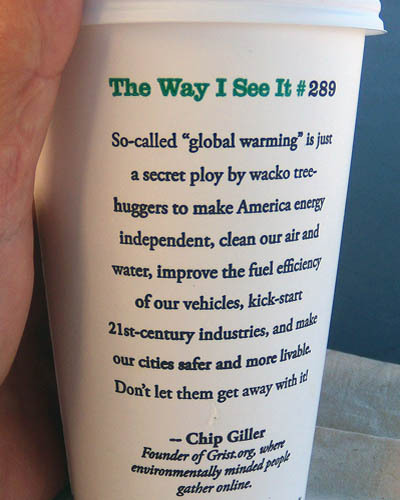
    How about another cup of coffee? (Global Warming Conspiracy)

    August 18, 2009

    Encore post from September 17, 2007 — maybe more appropriate today than ever before.

    Found this on my coffee cup today:

    The Way I See It #289

    So-called “global warming” is just

    a secret ploy by wacko tree-

    huggers to make America energy

    independent, clean our air and

    water, improve the fuel efficiency

    of our vehicles, kick-start

    21st-century industries, and make

    our cities safer and more livable.

    Don’t let them get away with it!

    Chip Giller
    Founder of Grist.org, where
    environmentally-minded people
    gather online.

    Starbucks Coffee Cup, The Way I See It #289 (global warming)

    Look! Someone found the same cup I found!

    Add to FacebookAdd to NewsvineAdd to DiggAdd to Del.icio.usAdd to StumbleuponAdd to RedditAdd to BlinklistAdd to TwitterAdd to TechnoratiAdd to Furl

    Save


    Insurance experts: Get ready for climate change now

    July 12, 2009

    Climate change denialism is an astounding ball of contradictions and conundrums.

    For example, while most denialists claim to be free-market devotees, they pointedly ignore market indications that climate change is real, aggravated by human actions (and inaction), and that humans can do anything about it.

    Look at the insurance industry.  I’ve noted often that, here in Texas, we pay higher premiums on home insurance because climate change has produced worse weather, which costs insurance companies a lot.  Insurance company actuaries are paid to predict the future, reliably.  If they fail, insurance companies die quickly.

    Weather-related catastrophes, such as wildfires, are posing a serious threat to the insurance industry worldwide. (Photograph source: John McColgan, Bureau of Land Management, Alaska Fire Service.) Caption from Berkeley Lab Research News

    Weather-related catastrophes, such as wildfires, are posing a serious threat to the insurance industry worldwide. (Photograph source: John McColgan, Bureau of Land Management, Alaska Fire Service.) Caption from Berkeley Lab Research News

    The “market” girds itself to fight climate change that governments are not going to move fast enough to prevent.  This will cost you a lot of money.

    A good place to go for information about climate change and how it affects is the Lawrence Berkeley Laboratories, a group that studies the future and is no longer limited (if it ever was) to nuclear future issues.

    Insurance in a Climate of Change, The Greening of Insurance in a Warming World, is loaded with information about insurance industry calculations of what the future is, and how insurance companies might and should react to the changes.

    How relevant are weather-related natural disasters for insurers, and is there any evidence that the situation is worsening?

    Globally, we are seeing about $80 billion/year in weather-related economic losses, of which $20 billion (about a quarter) are insured. This is like a “9/11” every year. Weather-related losses represent about 90% of all natural disaster losses, and the data I just cited do not include an enormous amount of aggregate losses from small-scale or gradual, non-catastrophic events (e.g., lightning, soil subsidence, gradual sea-level rise).

    Inflation-adjusted economic losses from catastrophic events rose by 8-fold between the 1960s and 1990s and insured losses by 17-fold. Losses are increasing faster than insurance premiums. The insured share of total losses has increased dramatically in recent decades, and variability is increasing (a key trouble sign for risk-wary insurers). Weather-related catastrophes have clearly visible adverse effects on insurance prices, and availability. Of particular concern are the so-called “emerging markets” (developing countries and economies in transition”, which already have $375 billion per year in insurance premiums (about 12% of the global market at present, but rising). They are significantly more vulnerable to climate change than are industrialized countries. Emerging markets are the center of growth for the industry, yet they are also the center of vulnerability.

    Increased exposures are surely influenced—and no doubt heavily in some areas—by rising demographic and socioeconomic exposures. Yet, the rise in losses has outpaced population, economic growth, and insurance penetration. The science of “attribution analysis” is still in primitive stages, and thus we cannot yet quantify the relative roles of global climate change and terrestrial human activities. Some have prematurely jumped to the conclusion [PDF] that demographic trends explain the entire rise in observed losses. In the year 2005, three independent refereed <!– –>scientific articles drew linkages between hurricane trends and climate change.

    Denialists claim weather stations are badly-placed, and so we need not worry about climate change since warming can’t accurately be measured — never mind the worldwide rise in temperatures of atmosphere and oceans.   Denialists claim that the greenhouse effect cannot be blamed on carbon dioxide emissions since carbon dioxide is such a small proportion of the gases in the atmosphere, apparently wholly unaware of the greenhouse effect in atmospheric gases, or unaware that only a thin pane of glass makes a greenhouse work.  Denialists claim that polar bears do not decline precipitously, yet, so all wildlife will be unaffected – nevermind the dramatic shifts in migration patterns of birds and migrating mammals, and the dramatic shift in the arrival of spring.  Denialists claim that Boston Harbor has survived 300 years of human development, so all harbors can survive any increase in ocean levels, nevermind the pending disasters of islands sinking out of site and destroying entire nations in the South Pacific, and never mind the drownings in Bengla Desh at every cyclone.

    Most denialists rent apaartments or own homes.  Denying the insurance increases will be more difficult, though I fully expect Anthony Watts and Co. will deny that the insurance company actions and studies of global warming are warranted or accurate.

    Is there any good news in all of this?

    By all means. Insurers need to look no farther than their roots as founders of the original fire departments, early advocates for building codes and fire safety, etc. That is to say that insurers’ history is all about risk management and loss prevention. The same thinking can apply in the case of climate change. Just as insurers fought fire risks through encouraging fire safety, better modeling, and fire suppression, so too can they be part of the climate change solution. This can take many forms, ranging from providing new insurance products (e.g., for carbon trading or energy savings insurance [PDF]), to promoting energy-efficient and renewable technologies [PDF] that also help prevent everyday losses, to engaging in the broader policy discussion on climate change. Insurers can also be part of improving the underlying science of climate change, modeling, and impacts assessment. We maintain an extensive compilation of examples of how leading insurers are stepping into the arena in a constructive manner.

    Alas, there is no insurance against the dithering of climate change denialists.

    Go, with all thy internet getting, get thee wisdom.


    Clean energy bill needs your help

    June 25, 2009

    Call your Congressman, the person who represents you in the U.S. House of Representatives, and urge a “yea” vote on the comprehensive clean energy bill.

    You can check your representative at several places, or follow the instructions through RePower America, listed below the video from our old friend Al Gore.

    Repower America said in an e-mail:

    Clean energy bill needs our support

    Any moment now, the House will be voting on the boldest attempt to rethink how we produce and use energy in this country. The bill’s passage is not assured. Call your Representative today.

    • Call 877-9-REPOWER (877-9-737-6937) and we’ll connect you to your Representative right after providing you with talking points. (We’re expecting high call volume, and if you are unable to be connected please use our secondary line, 866-590-0971.)
    • When connected to your Representative’s office, just remember to tell them your name, that you’re a voter, and that you live in their district. Then ask them to “vote ‘yes’ on comprehensive clean energy legislation.”

    They’d like you to report your contact, here.

    What?  You haven’t been following the debate?  Here’s what the pro-pollution, give-all-your-money-to-Canada, Hugo Chavez, and the Saudis group hopesHere’s where the anti-pollution, pro-frog and clean environment people say the proposed act is way too weak as it stands.  Here’s the House Energy and Commerce Committee drafts and discussion of the billConsumer Reports analyzed the bill here (and said it can’t be passed into law fast enough despite its flaws).

    Call now.  Pass the word to your friends.  Tell your children to call — their kids deserve better than the path we’re on now.

    More information and discussion:


    A rationalist on climate change

    December 7, 2008

    Interesting voice on climate change, at Greenfyre.  For teachers, there are interesting sources that should work well in presentations.

    If Anthony Watts slams the site, we’ll know it’s good.