President William Howard Taft signing the bill that made New Mexico a state, in 1912. (Other people in the photo, I have not yet identified). Image from OldPicture.com
New Mexico became the 47th member of the Union on January 6, 1912. New Mexicans should fly their U.S. flags today in honor of statehood, the U.S. Flag Code urges.
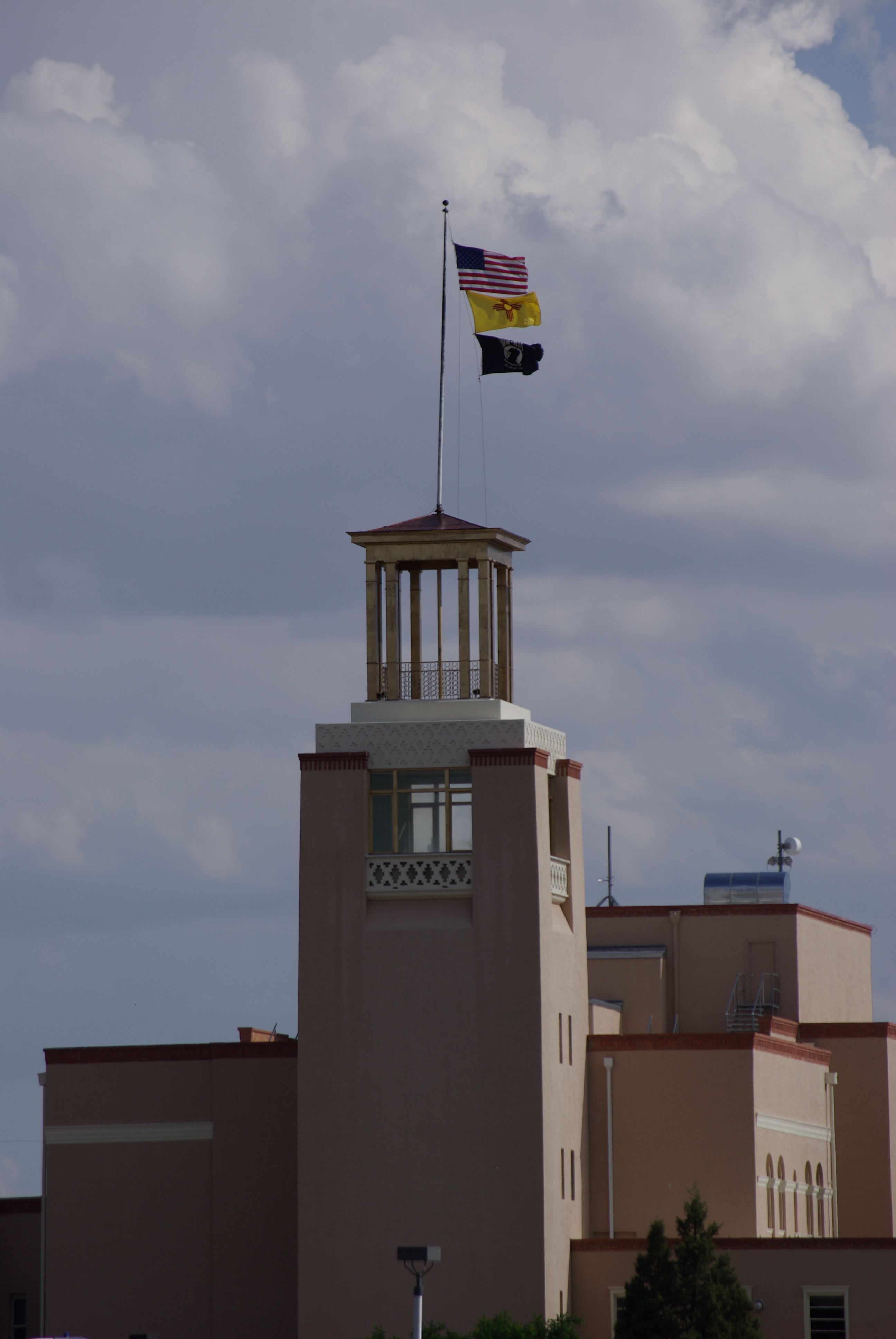
U.S. and New Mexico flags fly from the state education administration building in Santa Fe, 2014. The third flag is the U.S. POW/MIA flag.
I don’t think Statehood Day is a big deal in New Mexico. New Mexicans love art, though, and statehood and history of the land and the peoples who live there are celebrated throughout Santa Fe and New Mexico. The New Mexico Art Museum features a lot about history.
The New Mexico State Capitol is one of the more unique in the U.S. There is no grand dome. Instead, the building is a large, circular structure, a giant kiva, honoring New Mexico’s ancient residents and ancestors.
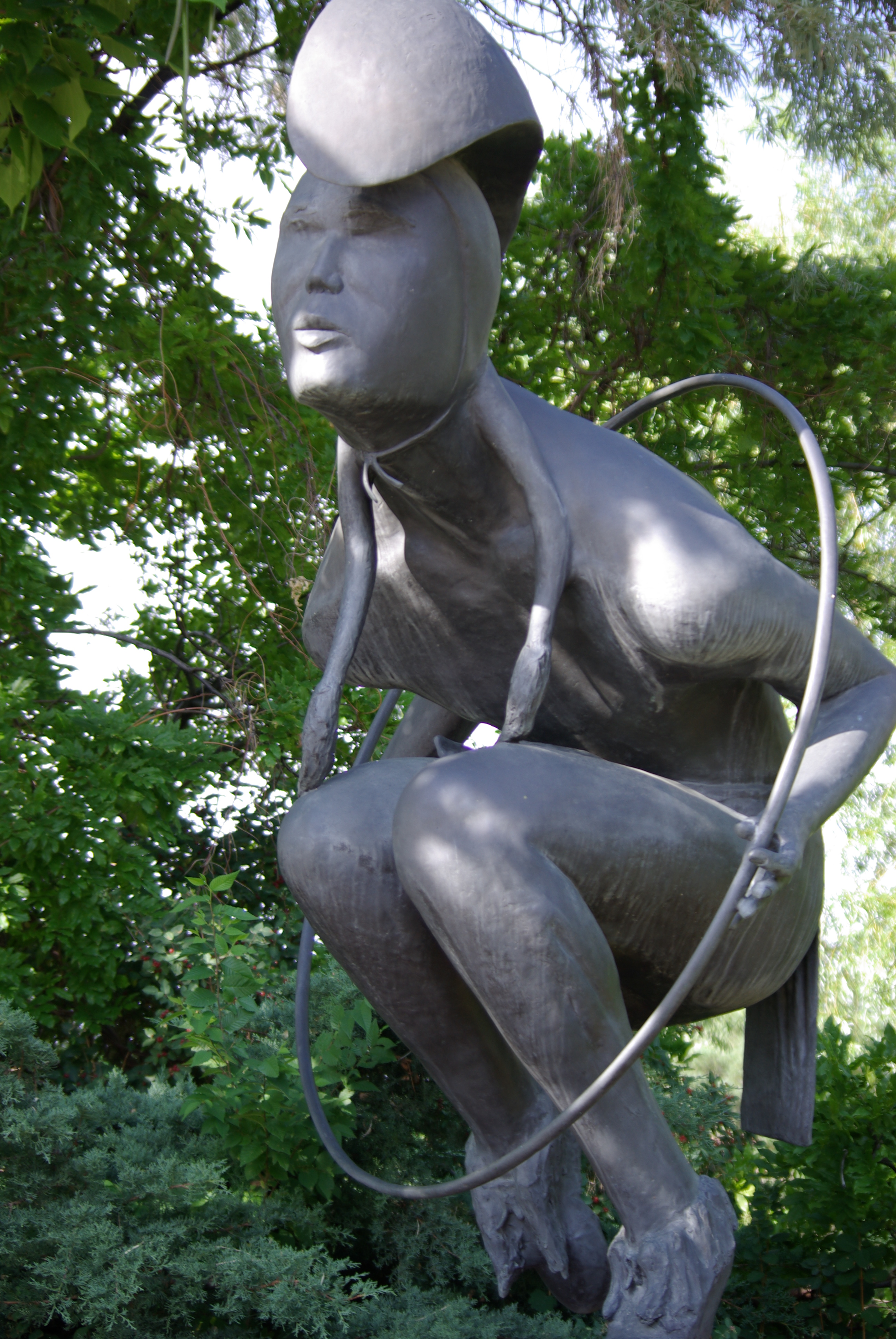
“Emergence,” a representation of the creation of the present Earth and people, by Michael A. Naranjo, 2000. Part of the massive collection of New Mexico Art at the State Capitol — this one outside the building itself.
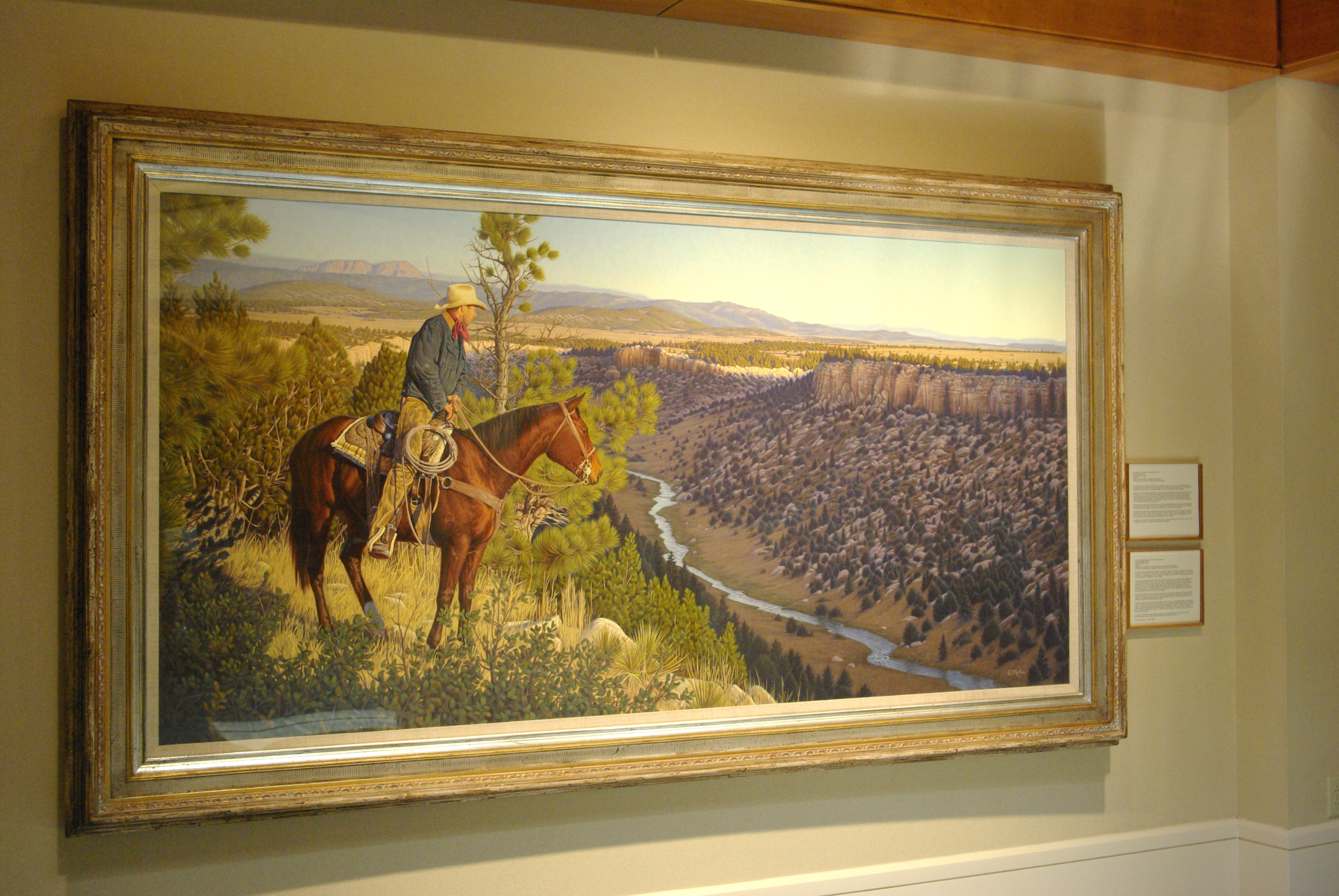
Simple Pleasures of New Mexico, stunning painting in acrylic by Gary Morton, 1992
If you’re in Santa Fe, plan to spend a half of a day, at least, looking at the Capitol and its art collections. There are more than 400 pieces on display, sculpture, paintings, mixed media, and more. It’s a world class gallery, free for the browsing. Much of the art packs a powerful emotional punch, too, such as the sculpture outside the building honoring the vanished native tribes of North America.
USPS stamp honoring the centennial of New Mexico’s statehood, in 2012. The stamp features a representation of the beauty of the state found in its desert hills and mountains. VirtualStampClub.com
Spread the word; friends don't allow friends to repeat history.
Those who cannot remember the past are condemned to repeat it.
==> Georges Santayana, The Life of Reason, vol. 1: Reason in Common Sense)
Those who don’t pay attention to history are condemned to repeat it? Then, gods forbid we should have leaders among the condemned, and heaven keep us from joining their folly.
Has there ever been a good wall that actually worked to keep trouble away? Do we need to rebuild the Berlin Wall in the Americas?
Thomas Nast helped bring down the crooks at Tammany Hall with cartoons. Boss Tweed, the chief antagonist of Nast, crook and leader of the Tammany Gang, understood that Nast’s drawings could do him in better than just hard hitting reporting — the pictures were clear to people who couldn’t read.
But a cartoon has to get to an audience to have an effect.
Here’s a cartoon below, a comment on the security wall being built in Israel, that got very little circulation in the west at Christmas time. Can you imagine the impact had this drawing run in newspapers in Europe, the U.S., and Canada?
It’s a mashup of a famous oil painting* related to the Christian Nativity, from a London-based artist who goes by the name Banksy. (Warning: Banksy pulls no punches; views shown are quite strong, often very funny, always provocative, generally safe for work unless you work for an authoritarian like Dick Cheney who wants no counter opinions.)
Banksy’s modern nativity — does he ever bother to copyright his stuff, or would he rather you broadcast it?
In 1823, the poem “Account of a Visit from St. Nicholas” was published anonymously in the Troy (N.Y.) Sentinel; the verse, more popularly known as “‘Twas the Night Before Christmas,” was later attributed to Clement C. Moore.
Regardless who wrote the poem first published 192 years ago yesterday, how did the poem influence America’s view of St. Nicholas, or Santa Claus? And how much of the Santa Claus story really was invented in America?
Thomas Nast invented Santa Claus? Clement C. Moore didn’t write the famous poem that starts out, “‘Twas the night before Christmas, and all through the house . . . ?”
The murky waters of history from Millard Fillmore’s Bathtub soak even our most cherished ideas and traditions.
Isn’t that part of the fun of history?
In Janaury 1863, Thomas Nast portrayed Santa Claus as he delivered gifts to Union troops a few days earlier in Washington, D.C., wearing a blue, star-spangled coat.
Yes, Virginia (and California, too)! Thomas Nast created the image of Santa Claus most of us in the U.S. know today. Perhaps even more significant than his campaign against the graft of Boss Tweed, Nast’s popularization of a fat, jolly elf who delivers good things to people for Christmas makes one of the great stories in commercial illustration. Nast’s cartoons, mostly for the popular news publication Harper’s Weekly, created many of the conventions of modern political cartooning and modeled the way in which an illustrator could campaign for good, with his campaign against the graft of Tammany Hall and Tweed. But Nast’s popular vision of Santa Claus can be said to be the foundation for the modern mercantile flurry around Christmas.
Nast’s drawings probably drew some inspiration from the poem, “Account of a Visit from St. Nicholas,” traditionally attributed to Clement C. Moore, a New York City lawyer, published in 1822. The poem is among the earliest to describe the elf dressed in fur, and magically coming down a chimney to leave toys for children; the poem invented the reindeer-pulled sleigh.
Modern analysis suggests the poem was not the work of Moore, and many critics and historians now attribute it to Major Henry Livingston, Jr. (1748-1828) following sleuthing by Vassar College Prof. Don Foster in 2000. Fortunately for us, we do not need to be partisans in such a query to enjoy the poem (a complete copy of which is below the fold).
The Library of Congress still gives Moore the credit. When disputes arise over who wrote about the night before Christmas, is it any wonder more controversial topics produce bigger and louder disputes among historians?
Moore is thought to have composed the tale, now popularly known as “The Night Before Christmas,” on December 24, 1822, while traveling home from Greenwich Village, where he had bought a turkey for his family’s Christmas dinner.
Inspired by the plump, bearded Dutchman who took him by sleigh on his errand through the snow-covered streets of New York City, Moore penned A Visit from St. Nicholas for the amusement of his six children, with whom he shared the poem that evening. His vision of St. Nicholas draws upon Dutch-American and Norwegian traditions of a magical, gift-giving figure who appears at Christmas time, as well as the German legend of a visitor who enters homes through chimneys.
Again from the Library of Congress, we get information that suggests that Moore was a minor celebrity from a well-known family with historical ties that would make a good “connections” exercise in a high school history class, perhaps (”the link from Aaron Burr’s treason to Santa Claus?”): (read more, below the fold)
Clement Moore was born in 1779 into a prominent New York family. His father, Benjamin Moore, president of Columbia University, in his role as Episcopal Bishop of New York participated in the inauguration of George Washington as the nation’s first president. The elder Moore also administered last rites to Alexander Hamilton after he was mortally wounded in a tragic duel with Aaron Burr.
A graduate of Columbia, Clement Moore was a scholar of Hebrew and a professor of Oriental and Greek literature at the General Theological Seminary in Manhattan. [See comment from Pam Bumsted below for more on Moore.] He is said to have been embarrassed by the light-hearted verse, which was made public without his knowledge in December 1823. Moore did not publish it under his name until 1844.
Tonight, American children will be tucked in under their blankets and quilts and read this beloved poem as a last “sugarplum” before slipping into dreamland. Before they drift off, treat them to a message from Santa, recorded by the Thomas Edison Company in 1922.
But Henry Livingston was no less noble or historic. He hailed from the Livingstons of the Hudson Valley (one of whose farms is now occupied by Camp Rising Sun of the Louis August Jonas Foundation, a place where I spent four amazing summers teaching swimming and lifesaving). Livingston’s biography at the University of Toronto site offers another path for a connections exercise (”What connects the Declaration of Independence, the American invasion of Canada, the famous poem about a visit from St. Nick, and George W. Bush?”):
Henry Livingston Jr. was born in Poughkeepsie, New York, on Oct. 13, 1748. The Livingston family was one of the important colonial and revolutionary families of New York. The Poughkeepsie branch, descended from Gilbert, the youngest son of Robert Livingston, 1st Lord of Livingston Manor, was not as well off as the more well-known branches, descended from sons Robert and Philip. Two other descendants of Gilbert Livingston, President George Walker Herbert Bush and his son, President-Elect George W. Bush, though, have done their share to bring attention to this line. Henry’s brother, Rev. John Henry Livingston, entered Yale at the age of 12, and was able to unite the Dutch and American branches of the Dutch Reformed Church. At the time of his death, Rev. Livingston was president of Rutgers University. Henry’s father and brother Gilbert were involved in New York politics, and Henry’s granduncle was New York’s first Lt. Governor. But the law was the natural home for many of Henry’s family. His brother-in-law, Judge Jonas Platt, was an unsuccessful candidate for governor, as was his daughter Elizabeth’s husband, U.S. Supreme Court Justice Smith Thompson. Henry’s grandson, Sidney Breese, was Chief Justice of the Illinois Supreme Court.
Known for his encyclopedic knowledge and his love of literature, Henry Livingston was a farmer, surveyor and Justice of the Peace, a judicial position dealing with financially limited criminal and civil cases. One of the first New Yorkers to enlist in the Revolutionary Army in 1775, Major Henry Livingston accompanied his cousin’s husband, General Montgomery, in his campaign up the Hudson River to invade Canada, leaving behind his new wife, Sarah Welles, and their week-old baby, on his Poughkeepsie property, Locust Grove. Baby Catherine was the subject of the first poem currently known by Major Livingston. Following this campaign, Livingston was involved in the War as a Commissioner of Sequestration, appropriating lands owned by British loyalists and selling them for the revolutionary cause. It was in the period following Sarah’s early death in 1783, that Major Livingston published most of his poems and prose, anonymously or under the pseudonym of R. Ten years after the death of Sarah, Henry married Jane Patterson, the daughter of a Dutchess County politician and sister of his next-door neighbor. Between both wives, Henry fathered twelve children. He published his good-natured, often occasional verse from 1787 in many journals, including Political Barometer, Poughkeepsie Journal, and New-York Magazine. His most famous poem, “Account of a Visit from St. Nicholas,” was until 2000 thought to have been the work of Clement Clarke Moore (1779-1863), who published it with his collected poems in 1844. Livingston died Feb. 29, 1828.
Thomas Nast’s full realization of Santa Claus, “Merry Old Santa Claus,” January 1, 1881. Harper’s Weekly, from the Ohio State University Billy Ireland Cartoon Library and Museum, via Bill Cassellman’s site
Our views of Santa Claus owe a great deal also to the Coca-Cola advertising campaign. Coca-Cola first noted Santa’s use of the drink in a 1922 campaign to suggest Coke was a year-round drink (100 years after the publication of Livingston’s poem). The company’s on-line archives gives details:
In 1930, artist Fred Mizen painted a department store Santa in a crowd drinking a bottle of Coke. The ad featured the world’s largest soda fountain, which was located in the department store of Famous Barr Co. in St. Louis, Mo. Mizen’s painting was used in print ads that Christmas season, appearing in The Saturday Evening Post in December 1930.
1936 Coca-Cola Santa cardboard store display
1942 original oil painting – ‘They Remembered Me’
Archie Lee, the D’Arcy Advertising Agency executive working with The Coca-Cola Company, wanted the next campaign to show a wholesome Santa as both realistic and symbolic. In 1931, The Coca-Cola Company commissioned Michigan-born illustrator Haddon Sundblom to develop advertising images using Santa Claus — showing Santa himself, not a man dressed as Santa, as Mizen’s work had portrayed him.
For inspiration, Sundblom turned to Clement Clark Moore’s 1822 poem “A Visit From St. Nicholas” (commonly called “‘Twas the Night Before Christmas”). Moore’s description of St. Nick led to an image of Santa that was warm, friendly, pleasantly plump and human. For the next 33 years, Sundblom painted portraits of Santa that helped to create the modern image of Santa — an interpretation that today lives on in the minds of people of all ages, all over the world.
Santa Claus is a controversial figure. Debates still rage among parents about the wisdom of allowing the elf into the family’s home, and under what conditions. Theologians worry that the celebration of Christmas is diluted by the imagery. Other faiths worry that the secular, cultural impact of Santa Claus damages their own faiths (few other faiths have such a popular figure, and even atheists generally give gifts and participate in Christmas rituals such as putting up a decorated tree).
For over 100 years, Santa Claus has been a popular part of commercial, cultural and religious life in America. Has any other icon endured so long, or so well?
Coca-Cola’s film, “The Legend of Coca-Cola and Santa Claus”:
Beethoven takes an unplanned swim in his rush to the concert hall in Google’s Doodle honoring the composer’s 245th year. Image from Google, via Washington Post
Maybe we should say “happy baptism.” The infant Ludwig von Beethoven was baptized on December 17, 1770; he was born the previous day, perhaps (some historians disagree).
But the point is, Google honors Beethoven with an interactive Google Doodle, one of the best they’ve ever done. The Doodle features the composer finishing scores and heading to the concert hall — with a series of mishaps along the way that scatter his musical scores and leaves them torn up, speared and generally out of order.
Then you, Dear Reader, get a chance to re-arrange the score in order. When you do that, it plays. Finally Beethoven gets to the concert hall.
It’s a great learning device, really. Can Google do this for history? Can we figure out a way to create these for use in our classrooms?
Now that you’ve finished the quizzes, relax for 42 minutes with Beethoven’s Symphony No. 6, The Pastorale, performed by the Bremen symphonie, directed by Paavo Jarvi.
Dear Reader: My apologies. As Cecil might say, we’ve been fighting ignorance since 1973, and it’s taking longer than we thought. My hopes to retire this post have not been realized. Heck, it doesn’t even need much editing from past years. Saints save us, please!
We might pause to reflect, too: Recent years have seen the media rise of actual beheadings. This practice, which now strikes many of us as barbaric, occurs in reality as well as memory and literature; unlike St. Denis, those beheaded do not usually carry on to do anything at all; like St. Denis, they are martyred. Vote well in your local elections, and national elections. Your vote should be directed at preventing anyone’s losing their head, even just figuratively.
Who? He’s the patron saint of Paris (and France, by some accounts), and possessed people. Take a look at this statue, from the “left door” of the Cathedral of Notre Dame in Paris (Cathédrale Notre-Dame de Paris: portail de gauche). He was martyred by beheading, in about 250 C.E.
St. Denis greets vistors to the Cathedral of Notre Dame, Paris (Cathédrale Notre-Dame de Paris: portail de gauche)
According to the Golden Legend, after his head was chopped off, Denis picked it up and walked two miles, preaching a sermon the entire way.[6] The site where he stopped preaching and actually died was made into a small shrine that developed into the Saint Denis Basilica, which became the burial place for the kings of France. Another account has his corpse being thrown in the Seine, but recovered and buried later that night by his converts.[2]
Clearly, he is the guy to pray to about Donald Trump, Ben Carson, Rush Limbaugh, Todd Akin, Paul Ryan, intelligent design, and the Texas State Board of Education, no? In 2013, we added Ted Cruz, Mike Lee, Louis Gohmert, the entire Tea Party, and the entire GOP crew of the House of Representatives. You catch my drift.
Perhaps you can use this factoid to some advantage, enlightenment, and perhaps humor. In Catholic lore, St. Denis is one of the “14 Holy Helpers,” and his aid is sought to help people with headaches, or who have been possessed.
Crazy GOP members who I suspect of having been possessed give me and America a headache. St. Denis seems to be our man. Or saint.
Who else do you know of in this modern, vexatious time, who keeps talking after losing his/her head?
As Rod Stewart sang, just “let your imagination run wild.” Maybe St. Denis is listening.
Another portrayal, in sculpture, of St. Denis. Notice how this one’s face doesn’t really look like the one above? Ouvre du Musée de Cluny, Wikipedia photo by Guillaume Blanchard (Aoineko), June 2001, FinePix 1400Z.
Yes, this is mostly an encore post. I had hoped to have to retire this post someday. I still hope. Perhaps this will be the last year we’ll have so many wackaloons running loose. Pray to St. Denis.
Spread the word; friends don't allow friends to repeat history.
From the Metropolitan Museum of Art in New York City:
From a Tweet by the Met: “Silence is so accurate.” —Mark Rothko, born on this day in 1903. http://met.org/1Wjh0gO
So many take satisfaction in claiming Rothko simple. My experience is museums buzz with alertness wherever his paintings are displayed. Good conversation starters for modern-eras in history, and not just art history.
Mark Rothko was born September 25, 1903, inDaugavpils, Latvia. He defied categorization, but is usually regarded as an abstract expressionist, a member of the New York School.
I like to use films like this as warmups to a year of history, and as a reminder once we get into studying the history of space exploration, of just how far we’ve come in understanding the universe, and how big this place is.
Of course, that means wer are just small parts.
The Eames’s genius showed the scale of things, from a couple picnicking in a park, to the outer reaches of the universe, and then back, zooming into the innermost reaches of a human down to the sub-atomic level.
There’s a series of these films; this one, published on YouTube by the Eames Office, was done in 1977, one of the later versions.
How can you use this in class, teachers? (I recommend buying it on DVD, as I did; better sound and pictures, generally.)
The very recognizable, famous Eames Chair and Ottoman, from Herman Miller. Ideally, you can sit in your Eames Chair while watching “Powers of Ten.” Herman Miller image.
Spread the word; friends don't allow friends to repeat history.
Before I new much about him, back in the late 1970s I fell into tickets to see Pat Metheney and his band (with Lyle Mays) at the old Cellar Door in Washington, D.C. (If I recall correctly; anyone know better?)
The amplifier lineup, as I recall, was most impressive, long before the musicians got on stage. There were two massive pillars of speakers that reminded me much of Blue Cheer and their claim to be the loudest band ever. When Metheny opened up, it was by far the loudest concert I’d ever heard (no, I never did make it to hear Blue Cheer).
I was hooked. It’s been fun watching his journey through many incarnations of his own band, and working with others including Joni Mitchell on the Shadows and Light Tour. I can’t keep up with every release of bands I like, but we have several Metheny discs in vinyl and CD.
I’d heard he has some custom-built instruments, including a 42-string monstrosity. But today on ran into a photo of the beast on Pinterest.
Pat Metheny’s 42-string harp guitar, called a Pikasso guitar (I don’t know why).
That made me curious, so I nosed around and found this video of Metheny and a band in performance, in which he plays this thing. From a 2007 concert, Jazzaldia; the piece is called “The Sound of Water”:
In the video you can see a cord coming out of the instrument. How are the pickups set, and what kind does it use?
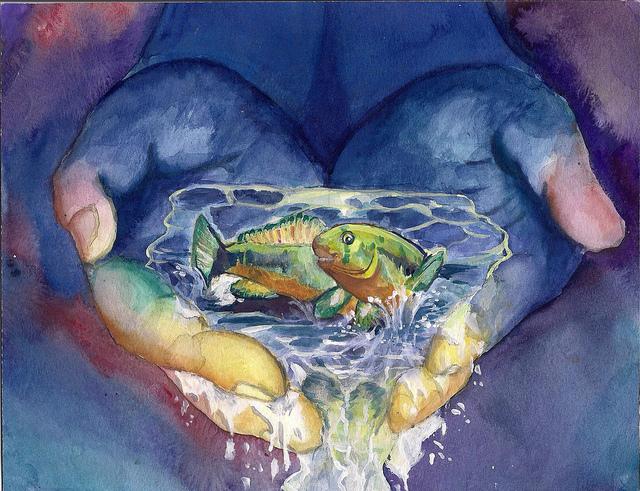
Young artists inspired by #endangeredspecies:1st prize D Starovoytov,6th grade http://1.usa.gov/1Koe2RY @EcoSchoolsUSA From @USFWSRefuges
Maybe someone can make that 6th grader’s day, or life, by asking to purchase that piece (watercolor?) for a few thousands of dollars, to go into a college fund.
David Starovoytov, a sixth-grader from California, won the Grand Prize with his art of a Kentucky arrow darter, a beautiful fish found only in eastern Kentucky. During the breeding season, the males are blue-green with scarlet spots and scarlet-orange vertical bars on their body. The Kentucky arrow darter is a candidate for federal listing under the Endangered Species Act (ESA). Federal candidates warrant ESA protection but are sometimes precluded from listing by other higher priority listing actions (other species are more imperiled and take priority). Each year, the Service publishes a list and summarizes the current status for all candidate species in its Candidate Notice of Review (CNOR). The CNOR helps landowners and natural resource managers plan conservation to address threats to candidate species. The Kentucky Department of Fish and Wildlife Resources has identified the Kentucky arrow darter as a species of greatest conservation need and has been hard at work conserving it through captive breeding and other projects. A key threat to the Kentucky arrow darter is degradation of habitat through surface coal mining and other human activities. Changes in water quality have a profound impact on all aquatic species, including the Kentucky arrow darter.
The darter itself has an interesting story. Cool that a California kid heard the story, and made such a nice work of art.
The rest of the press release, and other winners:
Fourteen-year-old Seungeun Yi, of California, took second place with art of an American alligator, actually one of our greatest ESA successes. As recently as the 1950s, American alligator populations were at all-time lows as market-hunting and habitat loss decimated the species. ESA protection prohibited hunting, and the alligator began to recover, and states throughout the South helped make sure the population increased. We declared the animal fully recovered in 1987, but related species are still in trouble, so the American alligator is listed as “threatened due to similarity of appearance.”
Another Californian, Mark Deaver, 8, won the Grades k-2 Category with his art of an endangered San Francisco garter snake. The San Francisco garter snake with its turquoise body and orange, black and red-orange stripes, is often called the most beautiful snake in the United States. Because they are so beautiful, some people collect them illegally. But the more significant threat comes from habitat loss. We are working with the California Department of Fish and Wildlife, the National Park Service, Golden Gate National Parks Conservancy, the California Department of Parks and Recreation and other partners to provide habitat for the snake.
Difei Li, 10, of New Jersey, won the Grades 3-5 Category with art of a bald eagle. Perhaps the ESA success story, the bald eagle population bottomed out in 1963 with just 417 nesting pairs in the contiguous United States. Habitat destruction and degradation, illegal shooting and the widespread use of DDT had sent the eagle population plummeting after World War II. Protecting habitat, banning most DDT use and a host of conservation actions by the American public helped bald eagles make a remarkable recovery. Though removed from the endangered species list in 2007 because their populations recovered sufficiently, bald eagles are protected under the Migratory Bird Treaty Act and the Bald and Golden Eagle Act.
Claire Noelle Kiernicki, 12, of Illinois, won the Grades 6-8 Category with art of an endangered Northern aplomado falcon. Once widespread throughout the American Southwest, the aplomado falcon disappeared in South Texas in the 1940s and 1950s because of widespread loss of habitat. An aggressive captive breeding and re-introduction effort has improved population numbers and the aplomado falcon is making a comeback in southern Texas.
Adam Pavan, 15, of California, won the Grades 9-12 Category with art of an endangered Hawaiian hoary bat. Also known as the ‘ope‘ape‘a, populations are believed to be threatened by habitat loss, pesticides, predation, and roost disturbance. Its decline may be primarily due to the reduction of tree cover in historic times, and they may be indirectly impacted by the use of pesticides. Conservation plans guide the management and use of forests to reduce negative efforts to known bat populations and, continued support for the ‘ope‘ape‘a research cooperative.
Congratulations to all the entrants and thank you for helping spread the word about the endangered species of the United States and its waters.
San Jacinto Day is April 21. Texas history classes at Texas middle schools should be leading ceremonies marking the occasion — but probably won’t since it’s coming near the end of the state-mandated testing which stops education cold, in March.
Surrender of Santa Anna, painting by William Henry Huddle (1890); property of Texas State Preservation Board. The painting depicts Santa Anna being brought before a wounded Sam Houston, to surrender.
The San Jacinto Monument is 15 feet taller than the Washington Monument
How could Houston’s group have been so effective against a general who modeled himself after Napoleon, with a large, well-running army? In the 1950s a story came out that Santa Anna was distracted from battle. Even as he aged he regarded himself as a great ladies’ man — and it was a woman who detained the Mexican general in his tent, until it was too late to do anything but steal an enlisted man’s uniform and run.
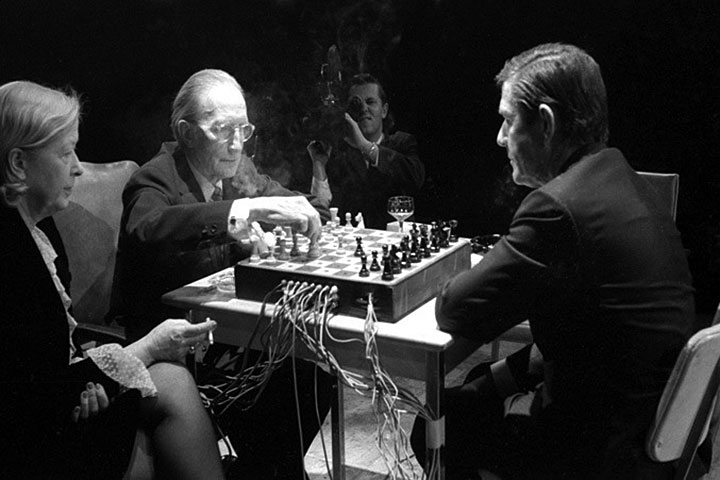
Marcel Duchamp plays white, John Cage plays black, on a chessboard modified to generate tones depending on where the chess pieces are. Toronto, 1968. Teeny Duchamp at far left, cameraman in the background. This was a performance.
Composer John Cage sought him out in Duchamp’s last years, and made a point of meeting with the artist at least once a week. Cage experimented with a chessboard designed to generate music depending on the positions of the chess pieces on the board (hence, the wires). This photo came from a performance at a festival in Toronto in 1968.
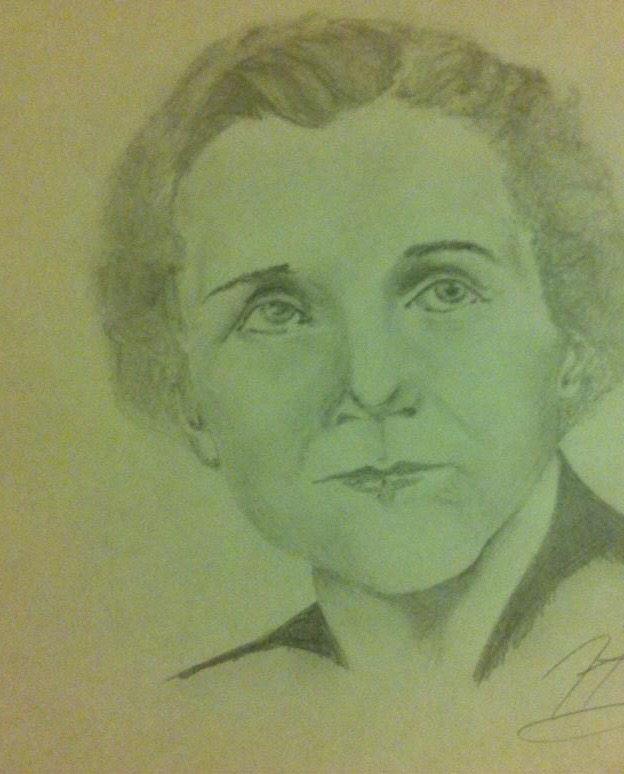
A Canadian artist posted a nice sketch of Rachel Carson on Twitter:
Rachel Carson sketch, by artist @moietymouse
I’m often frustrated at how few good images of Ms. Carson exist on the internet, probably because I see them over and over again in working to stamp out the hoax claims about Carson, DDT and malaria, and environmental protection.
Maybe we can get @moietymouse to make some more? Check out her Twitter feed; maybe she’s got images for sale, and you can encourage her while improving the look of your walls.
A great poster comes from the Academy of American Poets. Most often I think about the poster on April 1, so it’s rare I get one for the classroom in time (I keep them, and recycle them from year to year.)
New Yorker cartoonist Roz Chast designed the poster for National Poetry Month 2015, and it’s wonderful.
New Yorker cartoonist Roz Chast’s design for the poster for National Poetry Month 2015
Poster for the National Cowboy Poetry Gathering in Elko, Nevada, January 26-31, 2015
Probably won’t be a red carpet, but frankly, I’d rather the bottom-feeder TV entertainment news programs would interview cowboys coming in from the dusty trail to recite their saddle-born poetry than interview women in ugly gowns at some Hollywood awards show.
I’d watch to hear the cowboys recite in verse. Cowboy poetry is probably one of the best-attended entertainment events in heaven, I figure.
Some year I’m going to make it to this festival. Alas, not this year.
You?
Press release from Western Folklife Center:
31st National Cowboy Poetry Gathering Begins January 26
(ELKO, NV)— The 31st National Cowboy Poetry Gathering is January 26-31, in Elko, Nevada. The Elko Gathering is the nation’s oldest and largest annual celebration of the cultural traditions of the ranching and rural West. Every year, thousands travel to this high desert town in the heart of winter, to listen, learn and share. Through poetry, music and stories, ranch people express the beauty, humor, creativity and challenges of a life deeply connected to the earth and its bounty.
At the 31st Gathering, more than 55 poets, musicians and musical groups from the U.S., Canada, Australia and Mexico will perform on seven stages at four different venues. The line-up includes poets Baxter Black, Jerry Brooks, John Dofflemyer, Linda M. Hasselstrom, Yvonne Hollenbeck, Wally McRae, Waddie Mitchell and Paul Zarzyski. Musicians and bands include Gretchen Peters, Tom Russell, Ian Tyson, The Western Flyers, Wylie & The Wild West, Eli Barsi, Cowboy Celtic, Don Edwards, Corb Lund & The Hurtin’ Albertans, Gary McMahan and many more! The Gathering also features hands-on workshops in traditional western arts, exhibitions, western dances, films, discussions, open-mic sessions and more. Tickets to the National Cowboy Poetry Gathering can be purchased at http://www.westernfolklife.org, or by calling 888-880-5885.
The 31st National Cowboy Poetry Gathering will also celebrate a little-known corner of Mexico—Baja California Sur—and its rich ranchero culture. The Gathering will welcome Baja’s vaqueros, who will share with their American cowboy counterparts the traditional acoustic music, ranch cuisine, local art and craftwork, traditional lore and humor of their Californio roots. For nearly 300 years, ranching families have carved out an existence in the rugged, arid environment of the sierra of the lower California (Baja) peninsula. These ranching families are the direct descendents of Spanish missionary soldiers, and continue to maintain their horseback traditions, using riding equipment patterned after the horse gear of their Spanish ancestors. They are a living link between Spain and the American buckaroo.
The 31st National Cowboy Poetry Gathering is produced by the Western Folklife Center and supported by NV Energy, Newmont Mining Corporation, Barrick Gold of North America, Nevada Humanities, Nevada Arts Council, National Endowment for the Arts, Elko Convention and Visitors Authority, the City of Elko and many more foundations, businesses and individuals.
The Western Folklife Center is dedicated to exploring, presenting and preserving the diverse and dynamic cultural heritage of the American West.
31st National Cowboy Poetry Gathering Poets and Musicians
Eli Barsi, Moosomin, Saskatchewan, Canada
Mike Beck, Monterey, CA
Baxter Black, Benson, AZ
Dave Bourne, Agoura Hills, CA
Jerry Brooks, Sevier, UT
Cowboy Celtic, Turner Valley, Alberta, Canada
John Dofflemyer, Lemon Cove, CA
Elizabeth Ebert, Lemmon, SD
Don Edwards, Hico, TX
Thatch Elmer, Bear River, WY
Dick Gibford, New Cuyuma, CA
DW Groethe, Bainville, MT
Kenny Hall, Tropic, UT
Linda M. Hasselstrom, Hermosa, SD
Chuck Hawthorne, Manor, TX
Andy Hedges, Lubbock, TX
Carol Heuchan, Cooranbong, New South Wales, Australia
Brenn Hill, Hooper, UT
Yvonne Hollenbeck, Clearfield, SD
Ross Knox, Midpines, CA
Corb Lund & The Hurtin’ Albertans, Edmonton, Alberta, Canada
San Antonio is probably the biggest city represented on that list of performers; most of the others in Texas and Utah (the ones I know best) are small towns, tiny towns. No tuxedoes or Dior gowns there, I’ll bet.
Wouldn’t it be great if the entire event were streamed, and broadcast, and available on DVD?
Unfortunately, we will not have a live broadcast of the National Cowboy Poetry Gathering this year. Funding we were hoping to receive did not come through. However, we will be documenting the Gathering in other ways this year, by filming in the G Three Bar Theater and throughout the event. Stay tuned to our website, Facebook page and YouTube channel to see videos of this year’s Gathering as well as all the great videos of past events. We will also be posting lots of great photographs on Facebook, Twitter and Instagram!
You know, if Entertainment Tonight doesn’t have a full crew there in Elko, the world will be much the poorer for it.
One of my all-time favorite poems, “Reincarnation,” performed by its author, Wallace McRae.
National Heritage Fellow Wallace McRae performs his classic poem “Reincarnation” with friend and fellow Montana poet Paul Zarzyski at the 25th National Cowboy Poetry Gathering in Elko, Nevada. (15,083)
Spread the word; friends don't allow friends to repeat history.
President William Howard Taft signing the bill that made New Mexico a state, in 1912. (Other people in the photo, I have not yet identified). Image from OldPicture.com
New Mexico became the 47th member of the Union on January 6, 1912. New Mexicans should fly their U.S. flags today in honor of statehood, the U.S. Flag Code urges.
U.S. and New Mexico flags fly from the state education administration building in Santa Fe, 2014. The third flag is the U.S. POW/MIA flag.
I don’t think Statehood Day is a big deal in New Mexico. New Mexicans love art, though, and statehood and history of the land and the peoples who live there are celebrated throughout Santa Fe and New Mexico. The New Mexico Art Museum features a lot about history.
The New Mexico State Capitol is one of the more unique in the U.S. There is no grand dome. Instead, the building is a large, circular structure, a giant kiva, honoring New Mexico’s ancient residents and ancestors.
“Emergence,” a representation of the creation of the present Earth and people, by Michael A. Naranjo, 2000. Part of the massive collection of New Mexico Art at the State Capitol — this one outside the building itself.
Simple Pleasures of New Mexico, stunning painting in acrylic by Gary Morton, 1992
If you’re in Santa Fe, plan to spend a half of a day, at least, looking at the Capitol and its art collections. There are more than 400 pieces on display, sculpture, paintings, mixed media, and more. It’s a world class gallery, free for the browsing. Much of the art packs a powerful emotional punch, too, such as the sculpture outside the building honoring the vanished native tribes of North America.
USPS stamp honoring the centennial of New Mexico’s statehood, in 2012. The stamp features a representation of the beauty of the state found in its desert hills and mountains. VirtualStampClub.com
Spread the word; friends don't allow friends to repeat history.
Or, until that account is unsuspended by the forces supporting Donald Trump: Follow @FillmoreWhite, the account of the Millard Fillmore White House Library
We've been soaking in the Bathtub for several months, long enough that some of the links we've used have gone to the Great Internet in the Sky.
If you find a dead link, please leave a comment to that post, and tell us what link has expired.
Thanks!
Retired teacher of law, economics, history, AP government, psychology and science. Former speechwriter, press guy and legislative aide in U.S. Senate. Former Department of Education. Former airline real estate, telecom towers, Big 6 (that old!) consultant. Lab and field research in air pollution control.
My blog, Millard Fillmore's Bathtub, is a continuing experiment to test how to use blogs to improve and speed up learning processes for students, perhaps by making some of the courses actually interesting. It is a blog for teachers, to see if we can use blogs. It is for people interested in social studies and social studies education, to see if we can learn to get it right. It's a blog for science fans, to promote good science and good science policy. It's a blog for people interested in good government and how to achieve it.
BS in Mass Communication, University of Utah
Graduate study in Rhetoric and Speech Communication, University of Arizona
JD from the National Law Center, George Washington University



 Posted by Ed Darrell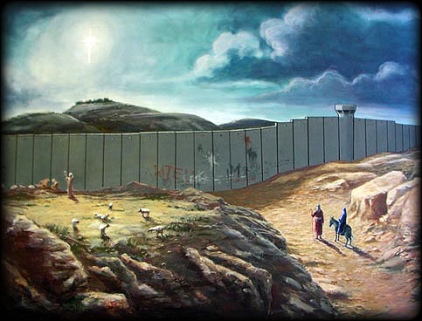









 Millard Fillmore's Bathtub