Christmas 2014: Do we know who invented Santa Claus? Who really wrote the “Night Before Christmas?”

December 23, 2014

An encore post and Millard Fillmore’s Bathtub tradition from 2007, with a few modifications.

“Today in History from the Associated Press notes, for December 23:

In 1823, the poem “Account of a Visit from St. Nicholas” was published anonymously in the Troy (N.Y.) Sentinel; the verse, more popularly known as “‘Twas the Night Before Christmas,” was later attributed to Clement C. Moore.

Regardless who wrote the poem first published 191 years ago today, how has it influenced America’s view of St. Nicholas, or Santa Claus?  And how much of the Santa Claus story really was invented in America?

Thomas Nast invented Santa Claus? Clement C. Moore didn’t write the famous poem that starts out, “‘Twas the night before Christmas, and all through the house . . . ?”

The murky waters of history from Millard Fillmore’s Bathtub soak even our most cherished ideas and traditions.

Isn’t that part of the fun of history?

Santa Claus delivers to Union soldiers, "Santa Claus in Camp" - Thomas Nast, Harper's Weekly, Jan 3, 1863

In Janaury 1863, Thomas Nast portraye Santa Claus delivered gifts to Union troops in Washington, D.C., wearing a blue, star-spangled coat, just a few days earlier.

Yes, Virginia (and California, too)! Thomas Nast created the image of Santa Claus most of us in the U.S. know today. Perhaps even more significant than his campaign against the graft of Boss Tweed, Nast’s popularization of a fat, jolly elf who delivers good things to people for Christmas makes one of the great stories in commercial illustration. Nast’s cartoons, mostly for the popular news publication Harper’s Weekly, created many of the conventions of modern political cartooning and modeled the way in which an illustrator could campaign for good, with his campaign against the graft of Tammany Hall and Tweed. But Nast’s popular vision of Santa Claus can be said to be the foundation for the modern mercantile flurry around Christmas.

Nast is probably ensconced in a cartoonists’ hall of fame. Perhaps he should be in a business or sales hall of fame, too.  [See also Bill Casselman’s page, “The Man Who Designed Santa Claus.]

Nast’s drawings probably drew some inspiration from the poem, “Account of a Visit from St. Nicholas,” traditionally attributed to Clement C. Moore, a New York City lawyer, published in 1822. The poem is among the earliest to describe the elf dressed in fur, and magically coming down a chimney to leave toys for children; the poem invented the reindeer-pulled sleigh.

Modern analysis suggests the poem was not the work of Moore, and many critics and historians now attribute it to Major Henry Livingston, Jr. (1748-1828) following sleuthing by Vassar College Prof. Don Foster in 2000. Fortunately for us, we do not need to be partisans in such a query to enjoy the poem (a complete copy of which is below the fold).

The Library of Congress still gives Moore the credit. When disputes arise over who wrote about the night before Christmas, is it any wonder more controversial topics produce bigger and louder disputes among historians?

Moore was not known for being a poet. The popular story is that he wrote it on the spur of the moment:

Moore is thought to have composed the tale, now popularly known as “The Night Before Christmas,” on December 24, 1822, while traveling home from Greenwich Village, where he had bought a turkey for his family’s Christmas dinner.

Inspired by the plump, bearded Dutchman who took him by sleigh on his errand through the snow-covered streets of New York City, Moore penned A Visit from St. Nicholas for the amusement of his six children, with whom he shared the poem that evening. His vision of St. Nicholas draws upon Dutch-American and Norwegian traditions of a magical, gift-giving figure who appears at Christmas time, as well as the German legend of a visitor who enters homes through chimneys.

Again from the Library of Congress, we get information that suggests that Moore was a minor celebrity from a well-known family with historical ties that would make a good “connections” exercise in a high school history class, perhaps (”the link from Aaron Burr’s treason to Santa Claus?”): (read more, below the fold)

Clement Moore was born in 1779 into a prominent New York family. His father, Benjamin Moore, president of Columbia University, in his role as Episcopal Bishop of New York participated in the inauguration of George Washington as the nation’s first president. The elder Moore also administered last rites to Alexander Hamilton after he was mortally wounded in a tragic duel with Aaron Burr.

A graduate of Columbia, Clement Moore was a scholar of Hebrew and a professor of Oriental and Greek literature at the General Theological Seminary in Manhattan. [See comment from Pam Bumsted below for more on Moore.] He is said to have been embarrassed by the light-hearted verse, which was made public without his knowledge in December 1823. Moore did not publish it under his name until 1844.

Tonight, American children will be tucked in under their blankets and quilts and read this beloved poem as a last “sugarplum” before slipping into dreamland. Before they drift off, treat them to a message from Santa, recorded by the Thomas Edison Company in 1922.

Santa Claus Hides in Your Phonograph
By Arthur A. Penn, Performed by Harry E. Humphrey.
Edison, 1922.
Coupling date: 6/20/1922. Cutout date: 10/31/1929.
Inventing Entertainment: The Motion Pictures and Sound Recordings of the Edison Companies

Listen to this recording (RealAudio Format)

Listen to this recording (wav Format, 8,471 Kb)

But Henry Livingston was no less noble or historic. He hailed from the Livingstons of the Hudson Valley (one of whose farms is now occupied by Camp Rising Sun of the Louis August Jonas Foundation, a place where I spent four amazing summers teaching swimming and lifesaving). Livingston’s biography at the University of Toronto site offers another path for a connections exercise (”What connects the Declaration of Independence, the American invasion of Canada, the famous poem about a visit from St. Nick, and George W. Bush?”):

Henry Livingston Jr. was born in Poughkeepsie, New York, on Oct. 13, 1748. The Livingston family was one of the important colonial and revolutionary families of New York. The Poughkeepsie branch, descended from Gilbert, the youngest son of Robert Livingston, 1st Lord of Livingston Manor, was not as well off as the more well-known branches, descended from sons Robert and Philip. Two other descendants of Gilbert Livingston, President George Walker Herbert Bush and his son, President-Elect George W. Bush, though, have done their share to bring attention to this line. Henry’s brother, Rev. John Henry Livingston, entered Yale at the age of 12, and was able to unite the Dutch and American branches of the Dutch Reformed Church. At the time of his death, Rev. Livingston was president of Rutgers University. Henry’s father and brother Gilbert were involved in New York politics, and Henry’s granduncle was New York’s first Lt. Governor. But the law was the natural home for many of Henry’s family. His brother-in-law, Judge Jonas Platt, was an unsuccessful candidate for governor, as was his daughter Elizabeth’s husband, U.S. Supreme Court Justice Smith Thompson. Henry’s grandson, Sidney Breese, was Chief Justice of the Illinois Supreme Court.

Known for his encyclopedic knowledge and his love of literature, Henry Livingston was a farmer, surveyor and Justice of the Peace, a judicial position dealing with financially limited criminal and civil cases. One of the first New Yorkers to enlist in the Revolutionary Army in 1775, Major Henry Livingston accompanied his cousin’s husband, General Montgomery, in his campaign up the Hudson River to invade Canada, leaving behind his new wife, Sarah Welles, and their week-old baby, on his Poughkeepsie property, Locust Grove. Baby Catherine was the subject of the first poem currently known by Major Livingston. Following this campaign, Livingston was involved in the War as a Commissioner of Sequestration, appropriating lands owned by British loyalists and selling them for the revolutionary cause. It was in the period following Sarah’s early death in 1783, that Major Livingston published most of his poems and prose, anonymously or under the pseudonym of R. Ten years after the death of Sarah, Henry married Jane Patterson, the daughter of a Dutchess County politician and sister of his next-door neighbor. Between both wives, Henry fathered twelve children. He published his good-natured, often occasional verse from 1787 in many journals, including Political Barometer, Poughkeepsie Journal, and New-York Magazine. His most famous poem, “Account of a Visit from St. Nicholas,” was until 2000 thought to have been the work of Clement Clarke Moore (1779-1863), who published it with his collected poems in 1844. Livingston died Feb. 29, 1828.

More on Henry Livingston and his authorship of the Christmas poem here.

Thomas Nast's full realization of Santa Claus, 1881.  Harper's Weekly, from the Ohio State University Billy Ireland Cartoon Collection.

Thomas Nast’s full realization of Santa Claus, “Merry Old Santa Claus,” January 1, 1881. Harper’s Weekly, from the Ohio State University Billy Ireland Cartoon Library and Museum.

Our views of Santa Claus owe a great deal also to the Coca-Cola advertising campaign. Coca-Cola first noted Santa’s use of the drink in a 1922 campaign to suggest Coke was a year-round drink (100 years after the publication of Livingston’s poem). The company’s on-line archives gives details:

In 1930, artist Fred Mizen painted a department store Santa in a crowd drinking a bottle of Coke. The ad featured the world’s largest soda fountain, which was located in the department store of Famous Barr Co. in St. Louis, Mo. Mizen’s painting was used in print ads that Christmas season, appearing in The Saturday Evening Post in December 1930.

1936 Coca-Cola Santa cardboard store display

  • 1936 Coca-Cola Santa cardboard store display

Archie Lee, the D’Arcy Advertising Agency executive working with The Coca-Cola Company, wanted the next campaign to show a wholesome Santa as both realistic and symbolic. In 1931, The Coca-Cola Company commissioned Michigan-born illustrator Haddon Sundblom to develop advertising images using Santa Claus — showing Santa himself, not a man dressed as Santa, as Mizen’s work had portrayed him.
1942 original oil painting - 'They Remembered Me'

  • 1942 original oil painting – ‘They Remembered Me’

For inspiration, Sundblom turned to Clement Clark Moore’s 1822 poem “A Visit From St. Nicholas” (commonly called “‘Twas the Night Before Christmas”). Moore’s description of St. Nick led to an image of Santa that was warm, friendly, pleasantly plump and human. For the next 33 years, Sundblom painted portraits of Santa that helped to create the modern image of Santa — an interpretation that today lives on in the minds of people of all ages, all over the world.

Santa Claus is a controversial figure. Debates still rage among parents about the wisdom of allowing the elf into the family’s home, and under what conditions. Theologians worry that the celebration of Christmas is diluted by the imagery. Other faiths worry that the secular, cultural impact of Santa Claus damages their own faiths (few other faiths have such a popular figure, and even atheists generally give gifts and participate in Christmas rituals such as putting up a decorated tree).

For over 100 years, Santa Claus has been a popular part of commercial, cultural and religious life in America. Has any other icon endured so long, or so well?

________________________
Below:
From the University of Toronto Library’s Representative Poetry Online

Major Henry Livingston, Jr. (1748-1828)

Account of a Visit from St. Nicholas

1 ‘Twas the night before Christmas, when all thro’ the house,

2 Not a creature was stirring, not even a mouse;

3 The stockings were hung by the chimney with care,

4 In hopes that St. Nicholas soon would be there;

5 The children were nestled all snug in their beds,

6 While visions of sugar plums danc’d in their heads,

7 And Mama in her ‘kerchief, and I in my cap,

8 Had just settled our brains for a long winter’s nap –

9 When out on the lawn there arose such a clatter,

10 I sprang from the bed to see what was the matter.

11 Away to the window I flew like a flash,

12 Tore open the shutters, and threw up the sash.

13 The moon on the breast of the new fallen snow,

14 Gave the lustre of mid-day to objects below;

15 When, what to my wondering eyes should appear,

16 But a miniature sleigh, and eight tiny rein-deer,

17 With a little old driver, so lively and quick,

18 I knew in a moment it must be St. Nick.

19 More rapid than eagles his coursers they came,

20 And he whistled, and shouted, and call’d them by name:

21 “Now! Dasher, now! Dancer, now! Prancer, and Vixen,

22 “On! Comet, on! Cupid, on! Dunder and Blixem;

23 “To the top of the porch! to the top of the wall!

24 “Now dash away! dash away! dash away all!”

25 As dry leaves before the wild hurricane fly,

26 When they meet with an obstacle, mount to the sky;

27 So up to the house-top the coursers they flew,

28 With the sleigh full of Toys — and St. Nicholas too:

29 And then in a twinkling, I heard on the roof

30 The prancing and pawing of each little hoof.

31 As I drew in my head, and was turning around,

32 Down the chimney St. Nicholas came with a bound:

33 He was dress’d all in fur, from his head to his foot,

34 And his clothes were all tarnish’d with ashes and soot;

35 A bundle of toys was flung on his back,

36 And he look’d like a peddler just opening his pack:

37 His eyes — how they twinkled! his dimples how merry,

38 His cheeks were like roses, his nose like a cherry;

39 His droll little mouth was drawn up like a bow.

40 And the beard of his chin was as white as the snow;

41 The stump of a pipe he held tight in his teeth,

42 And the smoke it encircled his head like a wreath.

43 He had a broad face, and a little round belly

44 That shook when he laugh’d, like a bowl full of jelly:

45 He was chubby and plump, a right jolly old elf,

46 And I laugh’d when I saw him in spite of myself;

47 A wink of his eye and a twist of his head

48 Soon gave me to know I had nothing to dread.

49 He spoke not a word, but went straight to his work,

50 And fill’d all the stockings; then turn’d with a jerk,

51 And laying his finger aside of his nose

52 And giving a nod, up the chimney he rose.

53 He sprung to his sleigh, to his team gave a whistle,

54 And away they all flew, like the down of a thistle:

55 But I heard him exclaim, ere he drove out of sight –

56 Happy Christmas to all, and to all a good night.

Online text copyright © 2005, Ian Lancashire for the Department of English, University of Toronto. Published by the Web Development Group, Information Technology Services, University of Toronto Libraries. Be sure to visit this site for more information on this poem, on Maj. Livingston, and on poetry in general.

More:


54 years ago today, Ruby Bridges went to school

November 14, 2014

American Experience reminds us:

On November 14, 1960, 6-year-old Ruby Bridges walked into William J. Frantz Elementary School in New Orleans.

It was just last September 8 we wished Ms. Bridges a happy 60th birthday.  What follows it the post I put up then, happy to have an excuse to repeat historic photos, great art from a great American painter, and remind students of history.  September’s post follows.

You don’t recognize her there?

How about in Norman Rockwell’s illustration?

“The Problem We All Live With,” Norman Rockwell, 1964; oil on canvas, Norman Rockwell Museum, Stockbridge, Massachusetts

Ruby Bridges with President Barack Obama, in 2011:

President Obama and Ruby Bridges viewing Normal Rockwall's painting, "The Problem We All Live With," at the White House in 2011. Photo by Pete Souza, public domain.

President Obama and Ruby Bridges viewing Normal Rockwall’s painting, “The Problem We All Live With,” at the White House in 2011. Photo by Pete Souza, public domain.

Ms. Bridges tells some of her story:


Voting in Fort Worth? Drop into the Amon Carter, see how campaigns worked in 1844

November 4, 2014

Election day art — well, this is campaign art, but part of that American tradition of highlighting the public nature of elections and campaigns.

Caption from the Dallas Morning News:  James Henry Beard’s The Illustrious Guest, depicting Henry Clay on the campaign trail in 1844, is on loan to the Amon Carter Museum of American Art.

Caption from the Dallas Morning News: James Henry Beard’s The Illustrious Guest, depicting Henry Clay on the campaign trail in 1844, is on loan to the Amon Carter Museum of American Art.

Yes, there’s Henry Clay — maybe the man most-expected to become president who never did.  No, your high school history class probably didn’t cover Clay well, and most don’t today, either.  Advanced Placement and International Baccalaureate classes may give him part of what he is due.

But there he is, campaigning in 1844, out on the road.  Actually, he’s at the hotel, reading a newspaper — and everyone else stares.  Some people bring their children to see the
Great Clay.

It was Clay’s third run at the presidency, at to be his last.  He ran on the Whig Party ticket, a party that would crash and burn within the decade, sinking from electoral politics forever.  (Millard Fillmore would be last Whig President, ascending from the vice presidency on the death of Zachary Taylor; Taylor was the last elected Whig President.) Clay was amply qualified on paper, and in the minds of most people, to be president.

Henry Clay, Sr. (April 12, 1777 – June 29, 1852) was an American lawyer, politician, and skilled orator who represented Kentucky in both the United States Senate and House of Representatives. He served three different terms as Speaker of the House of Representatives and was also Secretary of State from 1825 to 1829. He lost his campaigns for president in 1824, 1832 and 1844.

In 1824, he ran behind Andrew Jackson and John Quincy Adams. In what Jackson later called the Corrupt Bargain, when no candidate got a majority in the electoral college, and the election went to the House of Representatives (where each state gets one vote!), Clay pulled out, and let it be known that he favored Adams, who had run behind Jackson.  Adams was elected, and appointed Clay to be Secretary of State, the most common stepping stone to the presidency. (Was there a deal cut between Adams and Clay? No evidence can ever quash the suspicions of Jackson and his supporters.)

In 1832, older, wiser, from the Senate and as founder of the Whig Party, Clay ran and lost to Jackson, who won his second term.

In 1844 Clay was 67 years old.  The presidency was open.  Clay sought to walk the fence between groups who favored abolishing slavery, and groups who insisted slavery was necessary for the economy.  He opposed annexing new lands to the U.S., in order to preserve the balance between slave and non-slave states in Congress, especially the Senate.  James K. Polk, a young protege of Andrew Jackson, was chiefly unknown.  But Polk endorsed the idea of the nation’s “manifest destiny,” meaning he supporting annexing lands, sorting out slave/non-slave issues later.  Polk didn’t talk about his views on slavery in territories, and that was enough to mollify anti-slave forces in the party; but Polk was a slave holder, and that encouraged partisans on the other side to believe he’d favor them.  Polk won 49.5% of the popular vote, Clay 48.1%; Clay captured 170 electoral votes when 138 were needed to win.

Clay was, no doubt, more hopeful at the time the painting conveys.

Notice Clay seems to travel alone.  There is not gaggle of reporters, no clutch of campaign aides.  There is no one to fetch the great man a newspaper so he can remain cloistered in his hotel room. It was, in all ways, a much different time.  Voting in the election itself ran for a month, from early November to early December.  How that would have frustrated the television networks!

The painting, on loan to and on display in Fort Worth’s Amon Carter Museum, came to light due to an owner’s bringing it to the Antiques Road Show of PBS, in 2008.  Amon Carter’s curators, always alert to American art and art of the west, worked to get it on display.  That story is told nicely by University of Texas at Dallas art historian Rick Brettell in the Dallas Morning News.

The painting represents the well-dressed — note the red silk living of his top coat — Sen. Henry Clay from Kentucky in the middle of a common tavern during his final run for office. He is at a stop on the campaign trail — his luggage is piled up on the right — and is catching up on the news in front of a stove. The tavern itself is respectable, and one small child, representing the future, looks intently at Clay, while two women and another child peep in curiously from the door. The entire painting projects an air of democratic common sense.

The painting actually focuses on the class differences between Clay and his constituents and represents the great politician as being out of touch with “the American people” — lost in his paper. Clay was a member of the American party that was dominant in the early 19th century and was called the Democratic-Republican Party. He had become a Whig long before the 1844 election, which he lost to James Polk.

With his beautiful clothes and his disdain for those around him, he is as out of touch as many of today’s politicians with their wealthy backers and super-PACS. What we learn from this trenchant analysis of 19th-century politics is that history does repeat itself. Interestingly, Clay, as a slave owner, opposed the annexation of Texas to the republic, a major issue in the election of 1844, for fear that it would exacerbate the debate about slavery then raging in America. How right he was.

Had Clay won instead, would Texas be a part of the U.S. today? Something to ponder on election day 2014 — or to visit, if you’re voting in Fort Worth.

More:


Election day art of Norman Rockwell, and the unpredictability of elections

November 4, 2014

Can’t let election day go by without at least noting this great, undersung painting by Normal Rockwell, “Election Day (1944)”:

Norman Rockwell, Election Day, 1944, watercolor and gouache, 14 x 33 1/2 in., Museum purchase, Save-the-Art fund, 2007.037.1.

Norman Rockwell, Election Day, 1944, watercolor and gouache, 14 x 33 1/2 in., Museum purchase, Save-the-Art fund, 2007.037.1.

Remember when people used to dress up to go to the polls?

In 1944 President Franklin Roosevelt ran for an unprecedented fourth term.  Most Americans did not know it, but he was deathly ill at the time.  He dropped Vice President Henry Wallace from his ticket — some argue it was a mutual disaffection at that time — and selected the relatively unknown young Missouri U.S. Sen. Harry S Truman for the vice president’s slot.

In November 1944, D-Day was known to be a successful invasion, and most Americans hoped for a relatively speedy end to World War II in both Europe and the Pacific.  Within the next ten months, the nation would endure the last, futile, desperate and deadly gasp of the Third Reich in the Battle of the Bulge, the liberation of Berlin in April 1945, and end of the war in the European Theatre on May 8; the Battle of Leyte Gulf, the Philippines Campaign, and the bloody, crippling battles of Iwo Jima and Okinawa in the Pacific Theatre, and then the first use of atomic weapons in war, at Hiroshima and Nagasaki (and we hope, the last use).

Voters in Cedar Rapids could not have known that.  They did not know that, regardless their vote for FDR or his Republican challenger, New York Gov. Thomas Dewey, Harry S Truman would be president within six months, nor that the entire world would change in August 1945.

This painting captures a time of spectacular moment, great naivity, and it pictures the way history got made.

For a 2007 exhibition, the Cedar Rapids Museum of Art offered this history:

Norman Rockwell: Fact & Fiction

September 12, 2009 – January 3, 2010

In 2007, the citizens of Cedar Rapids rallied together to purchase a series of watercolors destined for the auction block in New York. These five watercolors, by acclaimed 20th century American artist Norman Rockwell, depicted scenes associated with an election day and were created specifically for the November 4, 1944 issue of the Saturday Evening Post. To complete the Post commission, Rockwell traveled to a quintessential Midwestern town, Cedar Rapids, to study local citizens as models for his series of images.

In the 65 years since his visit, numerous anecdotes and stories have arisen about the artist’s time in Cedar Rapids and the creation of this work. This exhibition uses these five, newly conserved and restored watercolors and a related oil painting from the Norman Rockwell Museum, along with numerous photographs taken by local photographer Wes Panek for Rockwell, to investigate the many facts and fictions associated with Rockwell’s visit and this set of watercolors.

Norman Rockwell: Fact & Fiction has been made possible in part by Rockwell Collins, Candace Wong, and local “Friends of Norman Rockwell.” General exhibition and educational support has been provided by The Momentum Fund of the Greater Cedar Rapids Community Foundation.

Friends of Norman Rockwell: Wilma E. Shadle, Howard and Mary Ann Kucera, Jean Imoehl, Ben and Katie Blackstock, Marilyn Sippy, Chuck and Mary Ann Peters, Phyllis Barber, Ann Pickford, Anthony and Jo Satariano, Barbara A. Bloomhall, Virginia C. Rystrom, Jeff and Glenda Dixon, Robert F. & Janis L. Kazimour Charitable Lead Annuity Trust, Fred and Mary Horn, Mrs. Edna Lingo, John and Diana Robeson, Jewel M. Plumb, Carolyn Pigott Rosberg, Mr. and Mrs. Robert J. Buchacek, Dan and Anne Pelc, Mary Brunkhorst, and John and Diana Robeson.

I am amused and intrigued that this scene also closely resembles the scene when I voted in Cheverly, Maryland, in 1984 — down to the dog in the picture.  Oh, and most of the women didn’t wear dresses, none wore hats, and I was the only guy in the room with a tie.

Roosevelt won the 1944 election in an electoral college landslide, 432 to 99, but Dewey won Iowa, and we might assume Dewey won Cedar Rapids, too.

And that Truman guy?  Rockwell came back to the topic of elections four years later, when Truman was running for election to the office he’d filled for nearly four years, with another classic, American election portrayal.

“Election Day,” by Norman Rockwell, 1948

More:


Yes, this is an encore post.

Yes, this is mostly an encore post.


Election Day 2014: Fly your flag, and VOTE!

November 4, 2014

Saint Louis Art Museum, St. Louis, Missouri George Caleb Bingham (American, 1811–1879). The County Election, 1852. Oil on canvas. 38 x 52 in. (96.5 x 132.1 cm). Gift of Bank of America.

The County Election, 1852. Saint Louis Art Museum, St. Louis, Missouri George Caleb Bingham (American, 1811–1879).  Oil on canvas. 38 x 52 in. (96.5 x 132.1 cm). Gift of Bank of America.

Every polling place should be flying the U.S. flag today.  You may fly yours, too.  In any case, if you have not voted already, go vote today as if our future depends upon it, as if our nation expects every voter to do her or his duty.

Today the nation and world listen to the most humble of citizens.  Speak up, at the ballot box.

Did you notice?  In George Caleb Bingham’s picture, there are no U.S. flags.  You may fly yours anyway.

The whole world is watching.

More:

Yes, this is an encore post.

Yes, this is an encore post. I really like Bingham’s painting.


October 9 – St. Denis’s Day, patron saint for those who have lost their head (Tea Party? House GOP?) 2014 edition

October 9, 2014

Dear Reader: My apologies. As Cecil might say, we’ve been fighting ignorance since 1974, and it’s taking longer than we thought.  My hopes to retire this post have not been realized.  Heck, it doesn’t even need much editing from last year. Saints save us, please!

We might pause to reflect, too:  2014 has seen the media rise of actual beheadings.  This practice, which now strikes many of us as barbaric, occurs in reality as well as memory and literature; unlike St. Denis, those beheaded do not usually carry on to do anything at all; like St. Denis, they are martyred. Vote well in 2014.  Your vote should be directed at preventing anyone’s losing their head, even just figuratively.

October 9 is the Feast Day of St. Denis.

Who?  He’s the patron saint of Paris (and France, by some accounts), and possessed people.   Take a look at this statue, from the “left door” of the Cathedral of Notre Dame  in Paris (Cathédrale Notre-Dame de Paris: portail de gauche).  He was martyred by beheading, in about 250 C.E.

English: Cathédrale Notre-Dame de Paris: porta...

St. Denis greets vistors to the Cathedral of Notre Dame, Paris (Cathédrale Notre-Dame de Paris: portail de gauche)

Our trusty friend Wikipedia explains:

According to the Golden Legend, after his head was chopped off, Denis picked it up and walked two miles, preaching a sermon the entire way.[6] The site where he stopped preaching and actually died was made into a small shrine that developed into the Saint Denis Basilica, which became the burial place for the kings of France. Another account has his corpse being thrown in the Seine, but recovered and buried later that night by his converts.[2]

Clearly, he is the guy to pray to about Michelle Bachmann, Rush Limbaugh, Todd Akin, Paul Ryan, intelligent design, and the Texas State Board of Education, no?  In 2013, you can add Ted Cruz, Mike Lee, Louis Gohmert, the entire Tea Party, and the entire GOP crew of the House of Representatives.  You catch my drift.

Perhaps you can use this factoid to some advantage, enlightenment, and perhaps humor.  In Catholic lore, St. Denis is one of the “14 Holy Helpers,” and his aid is sought to help people with headaches, or who have been possessed.

Crazy GOP members who I suspect of having been possessed give me and America a headache.  St. Denis seems to be our man.

Who else do you know of in this modern, vexatious time, who keeps talking after losing his/her head?

As Rod Stewart sang, just “let your imagination run wild.”  Maybe St. Denis is listening.

More:

Statue to St. Denis, in Cluny

Another portrayal, in sculpture, of St. Denis. Notice how this one’s face doesn’t really look like the one above? Ouvre du Musée de Cluny, Wikipedia photo by Guillaume Blanchard (Aoineko), June 2001, FinePix 1400Z.

Yes, this is mostly an encore post. I had hoped to have to retire this post someday.  I still hope.  Perhaps this will be the last year we’ll have so many wackaloons running loose. Pray to St. Denis.


227 years ago today, in this room

September 17, 2014

Independence Hall, Philadelphia; room where the Constitution was created and signed; Dept of Interior photo

Caption from Department of Interior’s Tumblr site: 225 years ago today, the Constitution of the United States was signed in Independence Hall. Today, you can tour the Hall and see where the Declaration of Independence and Constitution were both signed, and you can also view the Liberty Bell [close by]. This is a site not to miss while visiting Philadelphia.
Photo: National Park Service

Does this room look a little familiar?  You’ve probably seen Howard Chandler Christy’s painting of the event we celebrate today.

Howard Chandler Christy’s “Signing of the Constitution,” 1940

Howard Chandler Christy’s “Signing of the Constitution,” 1940; Architect of the Capitol image. This massive, 20′ x 30′ painting hangs in the House Wing of the U.S. Capitol, in the east stairway — a location where, alas, most people cannot get to without a guide anymore.

Click to the Architect of the Capitol’s site for the story of the painting, intended by Congress to fill a gap in the story of America told by art in the Rotunda and throughout the halls of the building.

Dr. Gordon Lloyd, Pepperdine University, creator of the interactive

Dr. Gordon Lloyd, Pepperdine University’s School of Public Policy, and expert in the Constitution and its history.  I met Lloyd almost a decade ago, in programs for history teachers, sponsored by the Bill of Rights Institute, Liberty Fund, and National Endowment for the Humanities.

My old friend Dr. Gordon Lloyd of Pepperdine University, working with the Ashbrook Center for Public Affairs, created a study tool from the Christy painting which should be used a lot more in classrooms.  Click over to the Edsitement site, and see for yourself.

Every year there are a few more tools on the internet to study the Constitution with, for teachers to use in the classroom on Constitution Day and every day.  I wonder what will be the effects in another decade.

How important is it that students learn the Constitution, what it says, and how it affects our daily lives?  How important is it that students learn the history of the creation of the Constitution, and does that history reverberate for those students as they venture out into their roles as citizens in the republic created by the document?

More:

This is an encore post.

This is an edited encore post.


Star-spangled Banner’s 200th – with the Steep Canyon Rangers (again)

September 14, 2014

Now everybody’s celebrating.  Time for a quick reprise of this post from June.

Published on Jun 19, 2014

Grammy Award winning bluegrass band the Steep Canyon Rangers, well known for their work with Steve Martin, perform a special version of “The Star-Spangled Banner” for the Smithsonian’s National Museum of American History in honor of the song’s 200th anniversary.

The museum will “Raise It Up!” and celebrate the 200th anniversary by uniting the original manuscript with the flag at the Museum from June 14-July 6, 2014 and holding a special event at the museum on Flag Day (Saturday, June 14, 2014). Join the party: http://anthemforamerica.smithsonian.com/

Special thanks to the team at Wool and Tusk for their hard work and creativity: Scott Mele, Roger Pistole, Derek West, Joe Pisapia, David Bartin, Michael Freeman, Alexis Kaback, Daniel Walker, Jeff Rosen, Harvey Moltz, and Greg and Erin Whiteley.

More:

The flag that flew over Fort McHenry at the Battle of Baltimore, 1814. Smithsonian image.

The flag that flew over Fort McHenry at the Battle of Baltimore, 1814. Smithsonian image.

This is an encore post.

This is an encore post.


Civil rights icon Ruby Bridges, 60 today

September 8, 2014

Happy birthday, Ruby Bridges!

You don’t recognize her there?

How about in Norman Rockwell’s illustration?

“The Problem We All Live With,” Norman Rockwell, 1964; oil on canvas, Norman Rockwell Museum, Stockbridge, Massachusetts

Ruby Bridges with President Barack Obama, in 2011:

President Obama and Ruby Bridges viewing Normal Rockwall's painting, "The Problem We All Live With," at the White House in 2011. Photo by Pete Souza, public domain.

President Obama and Ruby Bridges viewing Normal Rockwall’s painting, “The Problem We All Live With,” at the White House in 2011. Photo by Pete Souza, public domain.

Ms. Bridges tells some of her story:


73 156+ things to celebrate about America on the Fourth of July

July 4, 2014

In no particular order, leaving many gaps, on the Fourth of July I celebrate America, and these things about America:

  1. The Apollo Project that put humans on the Moon

    Apollo 11:  Astronaut Buzz Aldrin beside the solar wind experiment. NASA photo

    Apollo 11: Astronaut Buzz Aldrin beside the solar wind experiment. NASA photo

  2. Interstate Highway System
  3. Yellowstone National Park
  4. Edward Abbey
  5. Rainbow Bridge National Monument
  6. The New York Public Library
  7. Jello
  8. Baltimore, home of the Orioles, and playing field for Johnny Unitas
  9. Death Valley, the lowest point in North America, and generally the hottest.
  10. Denali, the highest point in North America, so high it makes its own weather
  11. New Orleans Jazz
  12. Grant Wood’s paintings
  13. Mark Twain
  14. Dred Scott
  15. Thurgood Marshall, and Brown v. Topeka Board of Education
  16. U.S. Highway 101, especially where you can see the Pacific Ocean
  17. Route 66
  18. Hot dogs
  19. Ketchup, or catsup if you prefer
  20. Salsa in a bottle
  21. Miles Davis
  22. Aldo Leopold
  23. French fries, with ketchup, without ketchup, with mayonnaise, with Big H Sauce
  24. Grand Canyon National Park
  25. The Mississippi River
  26. “Ol’ Man River”
  27. Meredith Willson, and “The Music Man!”
  28. Emily Dickinson
  29. Falling Water
  30. Pikes Peak
  31. Bluegrass music
  32. Philly Cheese Steaks
  33. Phyllis Wheatley
  34. Steinway Pianos
  35. Chicken Fried Steak
  36. Amish barn raisings
  37. James Levine
  38. Cheeseburgers
  39. Sojourner Truth
  40. Kansas City Jazz
  41. Onion Rings
  42. Peanut Butter
  43. Leo Fender and the electric guitar
  44. Les Paul and tape loops
  45. Gibson Guitars
  46. Chicago Jazz
  47. Martin Guitars
  48. Mississippi Delta Blues
  49. Chicago Electric Blues
  50. Woody Guthrie
  51. John Philip Sousa
  52. Phillip Glass
  53. Commander Lloyd Bucher and the U.S.S. Pueblo
  54. Frank Lloyd Wright, and Prairie Architecture
  55. Mies van der Rohe
  56. Beale Street in Memphis
  57. Richard Feynman, and his memoirs
  58. Broadway in New York
  59. Bonfires along the Mississippi near Baton Rouge
  60. Indianapolis 500
  61. Daytona Speedway
  62. Fenway Park
  63. Crabcakes from the Chesapeake
  64. Golden Gate; and the Golden Gate Bridge
  65. Kennedy Center in Washington, D.C.
  66. Monticello, Virginia
  67. Cape Hatteras and the lighthouse
  68. Mount Timpanogos in Utah
  69. Great Dismal Swamp, Virginia
  70. Great Houses of Newport, Rhode Island
  71. Bluebirds at the Yorktown Battlefield Monument
  72. Colorado River through Grand Canyon
  73. Bluebell Ice Cream
  74. Ben and Jerry’s Ice Cream
  75. Mt. Rushmore National Monument
  76. Lake of the Woods
  77. Pete Seeger
  78. Walt Whitman
  79. Robert Service’s poems
  80. Girls Scouts of America
  81. Little League Baseball
  82. Frederick Douglass
  83. College World Series in Omaha, Nebraska
  84. Henry David Thoreau
  85. Niagara Falls
  86. Adirondack Park, New York
  87. Sitting on the porch at Mount Vernon, Virginia, watching bald eagles cross the Potomac River
  88. Condors soaring near Big Sur, California
  89. Irving Berlin, and “God Bless America”
  90. Frank Sinatra
  91. Jonathan Winters
  92. Hollywood Movies
  93. Airplane graveyard at Davis-Monthan Air Force Base near Tucson, Arizona
  94. Upper and Lower Antelope Canyon, near Page, Arizona
  95. The Shiprock, New Mexico
  96. Chrysler Building, and the Empire State Building
  97. Blue Ridge Parkway
  98. Susan B. Anthony
  99. Everett Dirksen
  100. Cade’s Cove, Great Smoky Mountains National Park
  101. Red touring “buses” in Glacier National Park
  102. Fog rolling over the Marin Headlands, Marin County, California
  103. The Beach Boys
  104. Skiing and snowboarding, at Solitude, Alta, Hunter Mountain, Park City, Sundance
  105. The Alpine Loops — both of them, Utah and Colorado
  106. The Virginian Hotel and Cafe, Medicine Bow, Wyoming
  107. American Bison, in Yellowstone, at Antelope Island, in the Henry Mountains, in the LBJ Grasslands
  108. Osprey at the Blackwater National Wildlife Refuge, Maryland
  109. Painted Buntings at Colorado Bend State Park, Texas
  110. Dissident tradition that gives us Edward Snowden
  111. King of France Tavern, and Treaty of Paris Restaurant, Annapolis, Maryland
  112. The Triple Crown: Kentucky Derby, Preakness, and Belmont Stakes
  113. Jackie Robinson
  114. Sandy Koufax
  115. Jerry West
  116. Secretariat
  117. Lewis and Clark
  118. Sacagawea
  119. U.S. Women’s Soccer Team
  120. Eugene Debs
  121. AAA Baseball, and the other minor leagues
  122. Texas Barbecue
  123. Louis Armstrong
  124. Ella Fitzgerald
  125. Duke Ellington
  126. Ballet West
  127. Second City
  128. The Groundlings
  129. Harriet Tubman
  130. Owl Burgers at the Owl Cafe in Albuquerque, New Mexico
  131. Seattle Opera
  132. Appalachian Trail
  133. Linda Rondstadt; Linda singing canciones
  134. Dolly Parton, Emmy Lou Harris, and Linda Rondstandt singing tight three-part harmonies
  135. Edward Hopper

    “Morning Sun,” Edward Hopper, 1952

  136. The Marfa Lights
  137. Sloop Clearwater, and the Hudson River
  138. Rafting on the Snake River out of Jackson Hole, Wyoming
  139. Acadia National Park
  140. The Moffatt Tunnel, and the passenger trains that go through it (R.I.P. old Prospector and California Zephyr; long live the new Prospector and Zephyr)
  141. Chesapeake Bay Bridge-Tunnel
  142. Brooklyn Bridge
  143. Hires Drive-in and the Big H Burger, 4th South in Salt Lake City
  144. Old North Church, Boston
  145. Any country road in Vermont or New Hampshire, when the autumn leaves are turning
  146. Virgin River Narrows, Zion Canyon National Park
  147. Platte River when the big birds are migrating
  148. The oldest European building in America, the church at Fulton, Missouri
  149. Harley-Davidson plant in Milwaukee, Wisconsin — across the street from the Miller Brewery
  150. Wisconsin bratwursts
  151. Harry Houdini
  152. Harriett Beecher Stowe
  153. Grits served four ways at a diner in Charleston, South Carolina
  154. Salmon smoked by Native Americans in Puget Sound
  155. Varsity Drive In, in Atlanta
  156. Raspberry milkshakes at Bear Lake, Utah
  157. Maple syrup from Vermont
  158. Sam Weller’s Zion Book Store, Salt Lake City
  159. Old Angler’s Inn, on the C&O Canal
  160. Central Park, New York City
  161. Seabiscuit
  162. Babe Ruth
  163. Lou Gehrig
  164. Renée Fleming
  165. Willie Nelson
  166. Thomas Jefferson and John Adams, and their friendship
  167. Boeing 707, and the aircraft plants that make them
  168. Howard Zinn
  169. Solid state electronics, and the Chip that Jack Kilby Built
  170. Tennessee Valley Authority
  171. Noam Chomsky
  172. A. Phillip Randolph
  173. Ford, Chrysler and General Motors
  174. Mother Jones (Mary Harris Jones)
  175. Gold dome of the Colorado Capitol; the copper domes of the Arizona and Utah Capitols
  176. Things named after John Muir. many in places you would not expect, as well as quite a number of elementary schools
  177. Boy Scouts of America
  178. The United States Marine Corps
  179. Side Street Cafe, Honolulu
  180. Buzz Aldrin
  181. John Glenn
  182. Greensborough Four
  183. Freedom Riders
  184. Freedom Summer
  185. GI Bill
  186. Dennis Banks
  187. Gloria Steinem
  188. Joni Mitchell, Neil Young, Farley Mowat and all the other Canadians who come south of the border to make us think
  189. Bob Marshall Wilderness Area
  190. Twin Peaks Wilderness Area
  191. Bonneville Salt Flats
  192. Damon Runyon, and “Guys and Dolls”
  193. Utah Phillips
  194. Et cetera
  195. Et cetera

Okay, Dear Reader: What have I left off the list?

(Maybe we should hold on to this list for Thanksgiving. We have a lot to be grateful for, and a lot of people to give thanks to.)


Glorious images of the Sun, from NASA

July 3, 2014

Who’d have thought of such an image, before we used satellites to look?

NASA SDO images of the Sun

From NASA: Image info: This combination of three wavelengths of light from NASA’s Solar Dynamics Observatory shows one of the multiple jets that led to a series of slow coronal puffs on January 17, 2013. The light has been colorized in red, green and blue. Credit: NASA SDO

NASA’s press release, from June 27, 2014:

A suite of NASA’s Sun-gazing spacecraft have spotted an unusual series of eruptions in which a series of fast puffs forced the slow ejection of a massive burst of solar material from the Sun’s atmosphere. The eruptions took place over a period of three days, starting on Jan. 17, 2013. Nathalia Alzate, a solar scientist at the University of Aberystwyth in Wales, presented findings on what caused the puffs at the 2014 Royal Astronomical Society’s National Astronomy Meeting in Portsmouth, England.

The sun’s outermost atmosphere, the corona, is made of magnetized solar material, called plasma, that has a temperature of millions of degrees and extends millions of miles into space. On January 17, the joint European Space Agency and NASA’s Solar and Heliospheric Observatory, or SOHO, spacecraft observed puffs emanating from the base of the corona and rapidly exploding outwards into interplanetary space. The puffs occurred roughly once every three hours. After about 12 hours, a much larger eruption of material began, apparently eased out by the smaller-scale explosions.

By looking at high-resolution images taken by NASA’s NASA Solar Dynamics Observatory (Little SDO), or SDO, and NASA’s Solar Terrestrial Relations Observatory, or STEREO, over the same time period and in different wavelengths, Alzate and her colleagues could focus on the cause of the puffs and the interaction between the small and large-scale eruptions.

“Looking at the corona in extreme ultraviolet light we see the source of the puffs is a series of energetic jets and related flares,” said Alzate. “The jets are localized, catastrophic releases of energy that spew material out from the sun into space. These rapid changes in the magnetic field cause flares, which release a huge amount of energy in a very short time in the form of super-heated plasma, high-energy radiation and radio bursts. The big, slow structure is reluctant to erupt, and does not begin to smoothly propagate outwards until several jets have occurred.”

Because the events were observed by multiple spacecraft, each viewing the sun from a different perspective, Alzate and her colleagues were able to resolve the three-dimensional configuration of the eruptions. This allowed them to estimate the forces acting on the slow eruption and discuss possible mechanisms for the interaction between the slow and fast phenomena.

“We still need to understand whether there are shock waves, formed by the jets, passing through and driving the slow eruption,” said Alzate. “Or whether magnetic reconfiguration is driving the jets allowing the larger, slow structure to slowly erupt. Thanks to recent advances in observation and in image processing techniques we can throw light on the way jets can lead to small and fast, or large and slow, eruptions from the Sun.”

Van Gogh painted rather unusual images of the Sun and stars; Turner painted perhaps more life-like images.   There are many interesting views of the Sun in art, by Monet, and many, many others.

Vincent van Gogh,

Vincent van Gogh, “Sower with the Setting Sun”

But who conceived of any image like this one from NASA, above?

What private entity could ever do that?  

J. M. W. Turner,

J. M. W. Turner, “Caernarvon Castle,” 1799

Claude Monet,

Claude Monet, “Impression Sunrise”

British biologist J. B. S. Haldane said:

I have no doubt that in reality the future will be vastly more surprising than anything I can imagine. Now my own suspicion is that the Universe is not only queerer than we suppose, but queerer than we can suppose.

♦   Possible Worlds and Other Papers (1927), p. 286

Haldane may as well have added, the universe is not only more beautiful that we imagine, but more beautiful than we can imagine.  Reality trumps fiction yet again.


Star-spangled Banner’s 200th – with the Steep Canyon Rangers

June 26, 2014

Published on Jun 19, 2014

Grammy Award winning bluegrass band the Steep Canyon Rangers, well known for their work with Steve Martin, perform a special version of “The Star-Spangled Banner” for the Smithsonian’s National Museum of American History in honor of the song’s 200th anniversary.

The museum will “Raise It Up!” and celebrate the 200th anniversary by uniting the original manuscript with the flag at the Museum from June 14-July 6, 2014 and holding a special event at the museum on Flag Day (Saturday, June 14, 2014). Join the party: http://anthemforamerica.smithsonian.com/

Special thanks to the team at Wool and Tusk for their hard work and creativity: Scott Mele, Roger Pistole, Derek West, Joe Pisapia, David Bartin, Michael Freeman, Alexis Kaback, Daniel Walker, Jeff Rosen, Harvey Moltz, and Greg and Erin Whiteley.

More:

The flag that flew over Fort McHenry at the Battle of Baltimore, 1814. Smithsonian image.

The flag that flew over Fort McHenry at the Battle of Baltimore, 1814. Smithsonian image.


Insta-Millard: The vultures in Detroit’s bankruptcy

May 9, 2014

Maybe there’s a John Waters movie in the story.

From Metrotimes, the alternative weekly paper in Detroit:

Jerry Vile strikes again. The artist (and volunteers) stuck about 100 plastic lawn flamingos painted to look like vultures — one can imagine Vile lovingly glueing on the feathers — on the front lawn of the Detroit Institute of Arts. A banner was also erected, reading “Happy Bankruptcy: You’re Getting Flocked! Vultures by the Scads, LLC.”

It’s Vile’s latest prank that targets Detroit’s bankruptcy and the threat of selling the DIA’s artwork to appease “creditor vultures.” Within the past year the artist has put out an ad for Detroit’s liquidation in Metro Times, rolled out an oversized can of Crisco in front of the Joe Louis fist, and  placed price tags on public art throughout the city.

The only statement the artist has made so far about the vultures is a post on his Facebook page that says, “Sssssshhhhhhhh. Can’t wait to get a look at Beal’s face when he pulls up to work tomorrow.”

Negotiations are ongoing in regard to an $816 million so-called “grand bargain” — funded by numerous foundations, the state, and the DIA itself — that would spin the DIA into a new nonprofit and prevent the sale of any city-owned art. Meanwhile, Lansing is setting up a board that could oversee Detroit’s pensions and finances for 20 years, and also potentially appropriate $194.8 million from the state’s rainy day fund toward Detroit’s bankruptcy.

Plastic vultures on the lawn of the Detroit Institute of Arts - Metrotimes photo

Plastic vultures on the lawn of the Detroit Institute of Arts – Metrotimes photo


Berlin Wall in the U.S., the FDR Library

March 31, 2014

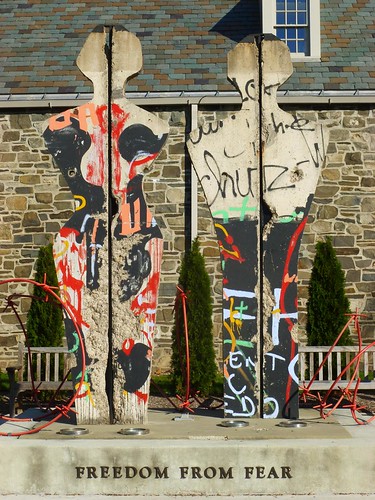
"Freedom from Fear," sculpture made from cutouts of sections of the Berlin Wall, photo by gwenvasil, FDR Home & Presidential Library Hyde Park, NY, October 20, 2013.

“Freedom from Fear,” sculpture made from cutouts of sections of the Berlin Wall, photo by gwenvasil, FDR Home & Presidential Library Hyde Park, NY, October 20, 2013.

Interesting, perhaps somewhat silly sculpture, found on the grounds of the Roosevelt Family estate in Hyde Park, New York, near the FDR Library and Museum.

Unless and until one knows the rest of the story.

  • These rather free form human forms, covered in what looks like graffiti, were cut from sections of the Berlin Wall, after the collapse of East Germany.
  • This is close to the bust of FDR’s ally in war for peace, Winston Churchill.  Appropriate, because,
  • Sculpture was created by Churchill’s granddaughter, Edwina Sandys.
  • Actually, these  sculptures were arranged together in a suite, in an area now known as Freedom Court
    • “In 2007, a new dimension was added to this hallowed ground by the construction of the Freedom Court. In honor of the friendship between the two legendary leaders, Edwina was instrumental in commissioning a bronze bust of Winston Churchill by sculptor Oscar Nemon, to be placed opposite one of FDR already in existence. The two sculptures flank the entrance to the court so that now and forever the two old wartime allies will be able to look at each other in a dynamic ‘outdoor room’ made of trees and shrubs.”Edwina’s ‘BreakFree’ now stands center stage in the Freedom Court, bearing witness to the ideals these great statesmen stood for, and bringing all three sculptures together in a magical web of connectedness.”
  • Segments of the Berlin Wall from which these cutouts came now stand in Fulton, Missouri, at the National Churchill Museum — the cutout figures were christened “BreakFree” by Edwina Sandys; the wall, from which they came, is called “BreakThrough.”

A few parts of the Berlin Wall are displayed across the U.S.  At Fulton, Missouri, are eight segments, made into liberating art by Edwina Sandys; at Hyde Park, New York, the cutouts from those segments form another artwork dedicated to freedom.  Other pieces of the wall and one of the guard towers, can be seen at the Newseum in Washington, D.C.

Nice touch to borrow the phrase from FDR’s “Four Freedoms” speech for the pedestal.

I found this photo from a Tweet from the FDR Library earlier today, alerting people to the collection of photos at the Flickr site of gwenvasil.  Follow the links, you’ll find other photos worth serious pondering.

More:


π Day tribute from Arches National Park

March 14, 2014

Happy Pi Day!

Arches National Park Happy Pi Day! “PsyPhi” by Pete Apicella, 2010 Community Artist in the Parks (kh)

Hey, I wonder when Fibonacci’s birthday falls. π