Fort Worth area teachers: Amon Carter Museum workshop on art from the Gilded Age

November 29, 2010

From the Amon Carter Museum education department (in Fort Worth):

During the Gilded Age, the U.S. economy boomed, the population soared, and Americans flourished. Well, not all Americans; for some this time was not prosperous. During an educator workshop on December 9, [2010] explore both sides of this period using paintings and sculpture from the Amon Carter’s collection.  [Send a note of interest to: education@cartermuseum.org.]

Eastman Johnson, Bo-Peep (Amon Carter Museum)

Eastman Johnson (1824–1906), Bo-Peep, 1872, oil on canvas, Amon Carter Museum of American Art, Fort Worth, Texas, 1980.

Or just sign up:

Thursday, December 9, 2010 – 5:00pm – 7:00pm

The Gilded (or Not-So-Gilded) Age

Educator Workshop: $12 for museum members and $15 for nonmembers

During the Gilded Age (late 1800s to the early 1900s), the U.S. economy boomed, the population soared, and Americans prospered. Well, not all Americans; for some this time in American history was not prosperous. Explore both sides of this period using paintings and sculpture from the Amon Carter’s collection. This workshop is most appropriate for educators of all grade levels teaching English, language arts, social studies, U.S. history, and visual art, although others may benefit. Refreshments are provided from 4:30 to 5 p.m.

Download registration form


It’s a movement! Hallelujah!

November 22, 2010

Holy frijole, Batman!  It’s a virus, and it’s spreading!

Ellie was listening.  She’s gotta be behind this:

Details at YouTube:

On Nov.13 2010 unsuspecting shoppers got a big surprise while enjoying their lunch. Over 100 participants in this awesome Christmas Flash Mob. This is a must see!

This flash mob was organized by http://www.AlphabetPhotography.com to wish everyone a very Merry Christmas!

Special thanks to Robert Cooper and Chorus Niagara, The Welland Seaway Mall, and Fagan Media Group.

More:


Hams squared: Presidents left holding the ham

November 13, 2010

You could call it art.

Millard Fillmore, holding a ham - by Bijijoo

Millard Fillmore, holding a ham - by the artist known as Bijijoo

Perhaps it is related to the rain and the clouds:  An Oregon artist painted portraits of the U.S. presidents, each holding a pink ham.  A big ham.

No kidding.  Salon explained:

As it turns out, “The Presidential Ham” is both real and utterly hilarious. Since 2006, Oregon artist bijijoo (real name: M.T. Horne) has painted pictures of each president holding a giant, pink piece of pork. Some, like Abraham Lincoln, are fiercely protective of their meat; others, like Richard Nixon, look proud and dismissive. But each image has a very clear and important message: I am a president, and I am holding this ham.

Some people may be suspected of having too much time on their hands.  Or too much ham.

No, Millard Fillmore was not the first president to put ham into the White House.

Tip of the old scrub brush to Dr. Bumsted.


Academy Award winner: “Logorama”

August 16, 2010

Delightfully creative.  Surely there is at least a bell ringer in here, just in identifying the different logos.  For economics and sociology classes, this is a study in branding, done in very interesting fashion.

Can you use it in class, even at 16 minutes?  The language may be too edgy for freshman and sophomores, yes?

A short description from the Vimeo post, by Marc Altshuler, who owns the company who created and recorded the music for the film:

This is a short film that was directed by the French animation collective H5, François Alaux, Hervé de Crécy + Ludovic Houplain. It was presented at the Cannes Film Festival 2009. It opened the 2010 Sundance Film Festival and won a 2010 academy award under the category of animated short.

In this film there are two pieces of licensed music, in the beginning and in the end. All the other music and sound design are original. The opening track (Dean Martin “Good Morning Life”) and closing track (The Ink Spots “I don’t want to send the world on fire”) songs are licensed pre-existing tracks. All original music and sound design is by, human (www.humanworldwide.com)

Brilliant little work even if you can’t use it in class.


Dan Valentine – My Sister/My Brother, part 1

August 11, 2010

By Dan Valentine

MY SISTER / MY BROTHER – Part 1

One magical, fairy-tale of an evening, back in 1998, my baby sister Valerie—she is eight-years younger than myself—was knighted by Her Majesty Queen Beatrix of the Netherlands.

And I was there!

She is one of the few ballerinas and/or Americans ever to be so honored.

Funny, just a few short years before in Manhattan, after my sister had performed onstage with the great Russian dancer Rudolf Nureyev—yes, that one!—my mom had doused out a cigarette in the Queen’s half-empty cocktail.  At a reception for members of the Dutch community in town (Walter Cronkite was there), my mom, looking around for an ashtray and not finding one nearby, spotted a half-filled drink and plopped her cig in it.  A moment later, the Queen came back, after a brief newspaper interview, to finish her toddy, only to find a, well, you-know-what in it.

But back to little sister’s knighthood.

Earlier that morning, I had attended a ballet class with my sister.  Ballerinas and their male counterparts take class every day of the week to brush up on their technique and such.  They stretch, move to the Barre, and do sequences in the center of the floor for an hour or so.  This is followed by grueling hours of rehearsals for upcoming and/or present performances.  So, anyway, I was standing by the wayside watching a Russian ballerina from the Bolshoi twirl around and around and around.  We made eye contact and she fainted, dead away.  In my dreams, I caught her in my arms.  In reality, she slumped to the floor.  I like to think it was caused by my George Clooney good looks, but it was probably caused by exhaustion.

That day, for a short time, I was the talk of the company.

Her lifemate, Roeland Kerbosch, an award-winning Dutch film director, had informed me a short time beforehand what was to take place that evening.  I remember smoking—of course! as they say in the Netherlands—by the stage door of the Muziektheater in Amsterdam when my sister showed to suit up.  She told me that she was worried about that night’s performance.  Can’t remember why.  All I was thinking was:  Val, this is going to be one of, if not thee greatest night of your life.

Utah-born ballerina Valerie Valentine, Dutch National Ballet

Valerie Valentine, Dutch National Ballet

Later that evening, Valerie—I call her Val, sometimes Vali—was dancing onstage when suddenly everyone but herself stopped in their tracks.  The conductor put down his baton.  The music stopped.  The performance came to a halt.  My sister, in the middle of a pas de deux or whatever, looked around perplexed.  What the heck is going on?

After a moment, the Mayor of Amsterdam walked on stage and bestowed upon her the Order of the Dutch Lion—the highest honor a non-military person can receive in the Netherlands—in recognition for her 25 years of “significant contribution to the art of dance.”

He read from a scroll:  “Admired for her energy and dedication to her work, Valerie Valentine’s beautiful sense of line, strong technique and expressive, magical stage presence have inspired not only choreographers, but photographers and filmmakers as well . . .”

Needless to say, there was a party afterward.  Cocktails, hors d’œuvres, a band, dancing, etc.  I was very happy for my sister, ecstatically so.  But I left the celebration shortly after it began.

I can’t remember feeling sadder.

Sitting at an outside cafe, just a few a blocks away, was my artist brother Jimmy, uninvited (and rightly so; he was literally crazy as hell), doing his best to drink himself to death, an endeavor he would shortly accomplish.

He died four years later, age 48, in Torremolinos, Malaga, Spain . . . on Valentine’s Day.

Add to FacebookAdd to NewsvineAdd to DiggAdd to Del.icio.usAdd to StumbleuponAdd to RedditAdd to BlinklistAdd to TwitterAdd to TechnoratiAdd to Furl


Some teachers had great summer experiences

August 6, 2010

One of our more adventurous teachers spent the summer on a Fulbright-Hays program in Senegal, in West Africa.

Lunch in Senegal, William Adkins photo

No, that's not William Adkins. That's his lunch one day in Senegal.

William Adkins’ African adventure blog is here.  Mine it for stuff you can use in economics, art, world history, world geography, or anything else.  He’ll probably give you free reign to use the photos for classroom presentations.

What did you do on your summer vacation?

Add to FacebookAdd to NewsvineAdd to DiggAdd to Del.icio.usAdd to StumbleuponAdd to RedditAdd to BlinklistAdd to TwitterAdd to TechnoratiAdd to Furl


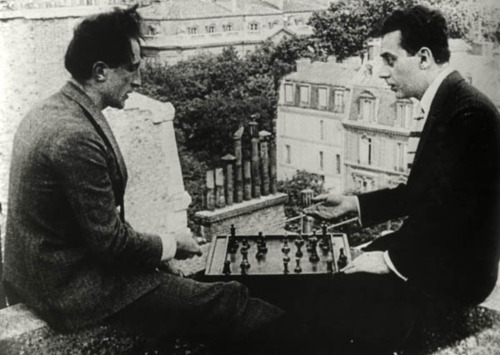
Chess games of the rich and famous: Duchamp vs. Man Ray

July 9, 2010

Marcel Duchamp and Man Ray play chess on a rooftop in Paris.

Duchamp again, this time on a rooftop in Paris, playing chess against Man Ray.

The photograph is later than 1915, when Duchamp moved to the U.S. to avoid World War I, and met Ray; it is probably after 1918.

The two even played chess in a movie:

Man Ray directed a number of influential avant-garde short films, known as Cinéma Pur, such as Le Retour à la Raison (2 mins, 1923); Emak-Bakia (16 mins, 1926); L’Étoile de Mer (15 mins, 1928); and Les Mystères du Château de Dé (20 mins, 1929). Man Ray also assisted Marcel Duchamp with his film Anemic Cinema (1926) and Fernand Léger with his film Ballet Mécanique (1924). Man Ray also appeared in René Clair‘s film Entr’acte (1924), in a brief scene playing chess with Duchamp.

The photo above is a still from that 1924 René Clair movie — it comes about 4:30 into the movie (the version shown here is half of the 20-minute movie, with a very modern, surrealist music score added; you can see the entire movie from Pathé, with a more contemporary score, here).

https://vimeo.com/488844088

Update, March 14, 2011:  See also this story from 2008 about Duchamp’s need to play chess, featuring of photo of Duchamp, Teeny Duchamp and the composer John Cage deeply engrossed in a game.  A good read about chess, and Duchamp.

Tip of the old scrub brush to ArtLex.com.


Chess games of the rich and famous: Marcel Duchamp

July 6, 2010

Duchamp playing chess

Sculptor and conceptual artist Marcel Duchamp playing chess. Unknown photographer, via Concepts into Virtualities

Marcel Duchamp, according to Andrew Stafford:

Marcel Duchamp (1887-1968), the painter and mixed media artist, was associated with Cubism, Dadaism and Surrealism, though he avoided any alliances. Duchamp’s work is characterized by its humor, the variety and unconventionality of its media, and its incessant probing of the boundaries of art. His legacy includes the insight that art can be about ideas instead of worldly things, a revolutionary notion that would resonate with later generations of artists.

Also, he liked to play chess.

Marcel Duchamp with chess set designed by his friend, Max Ernst

Marcel Duchamp with chess set designed by his friend, Max Ernst

The photograph at left comes from ChessMate.com:

. . . Marcel Duchamp, enjoying a chess set designed and presented to him by fellow artist, Max Ernst.

To say that Duchamp was an avid chess player would be an understatement. He played at approximately expert to master strength, and it is well known that he had — during the later part of his formidable career as a visual artist — given up the pursuit of art in favor of chess.

Here is an interesting quote about art and chess that is attributed to Marcel Duchamp:

“I am still a victim of chess. It has all the beauty of art — and much more. It cannot be commercialized. Chess is much purer than art in its social position.”

You will also want to see:

  • “Half-naked Thursday:  Eve Babitz with Marcel Duchamp,” at You Can Hire An Artist.   Is it safe for work or school?  The photo shows Duchamp in a gallery filled with his works at in 1963, playing chess with Eve Babitz, who is nude.   (The museum is identified as the “Pasadena Art Museum,” which would be the Pasadena Museum of Art of California See the explanation from Kathleen Benton in comments; I think it more likely that the museum is the Norton Simon Museum, also in Pasadena, but showing much more modern art and European art. (The Pasadena Art Museum is wonderful, by the way — an outstanding place to spend an afternoon; the Norton Simon is one you must see in your lifetime.)
  • “Not Wanting to Say Anything About Marcel,” by John Cage, at the Norton Simon Museum in Pasadena.

Chess games of the rich and famous: Bob Dylan, by Daniel Kramer

July 3, 2010

Bob Dylan at the chessboard, Woodstock, New York, 1964 - photo copyright Daniel Kramer

Bob Dylan at the chessboard, Woodstock, New York, 1964 – low resolution version of the original photo, copyright by Daniel Kramer – Barbara Archer Galleries

A good decade before I got to Woodstock.

Daniel Kramer began photographing Bob Dylan early in Dylan’s career, making many of the best shots available.

This 1964 photo of Dylan playing chess in Woodstock, New York, featured in an exhibition of Kramer’s photographs put on by Barbara Archer Galleries in 2005.

From the exhibit’s biography of Kramer:

Daniel Kramer is a New York-based photographer and film director who is long recognized for his portraits and picture stories in national and international magazines and books. Shortly after opening his first studio in New York City, Daniel Kramer saw Bob Dylan perform The Lonesome Death of Hattie Carroll on television in 1964. Even after the show ended, Kramer couldn’t shake the image of Dylan from his mind. “I was completely taken by what this man had done and how he had done it. His performance was perfect. With simple, basic tools – his voice, a guitar, and a harmonica, he drove his message deep into my mind. I was aware that I was seeing a very important talent.”

In August 1964, after months of phone calls and letters to Dylan’s manager, Albert Grossman, Kramer was given the opportunity to arrange a portrait sitting in Woodstock, New York with the twenty-three-year old performer who was by then in the process of becoming an international star. The two men quickly developed a warm and trusting professional relationship that allowed for many extraordinary photographic sessions. “Photography has brought me into contact with many notable people, including Presidents of the United States, and I have happily had the opportunity to meet and talk with prominent people in all walks of life,” comments Kramer. “Although many of these encounters were memorable, my association with Dylan has a special meaning.”

Many of these photographs were first published in Kramer’s 1967 book bob dylan, the first major work about the performer-songwriter (reprinted as Bob Dylan: A Portrait of the Artist’s Early Years, 2001). They were also used on the album covers for Highway 61 Revisited (1965), Biograph (1985) and Bringing It All Back Home (1965), which was nominated for a Grammy and selected by Rolling Stone as one of the “100 Greatest Album Covers of All Time.” A number of rare and previously unpublished pictures by Kramer also appear in the 52-page booklet and packaging that accompanies Bob Dylan’s two-CD set, Live 1964: Concert at Philharmonic Hall – The Bootleg Series, Volume 6 (2004) and on the cover of a three-CD boxed set BOB DYLAN the collection (2004).

Daniel Kramer’s photographs have also been exhibited or collected by such museums as the Whitney Museum of American Art, The International Center of Photography in New York, The Smithsonian’s National Portrait Gallery in Washington, D.C., The Experience Music Project in Seattle, The Rock and Roll Hall of Fame and Museum in Cleveland, and in numerous national and international galleries.

An interesting three-way marriage of the young Bob Dylan, a great photographer in Daniel Kramer, and one of the world’s oldest and most respected games of skill, chess. Go see all the photos.

More: 


Very large bird

June 30, 2010

DFW Airport - Kenny Darrell leaves for Greece

Kathryn, Kenny, Kenny's grandfather Ken Knowles, under the giant wishbone at DFW Airport

Actually, he’s been in Crete now for two weeks, and he’s deep into training for how to teach.  I’m just slow on getting the posts up.

Kenny left for Greece, despite the lack of visitor facilities on either side of the TSA checkpoints, we all went along for the ride and the farewell, Kathryn, Kathryn’s father Ken Knowles, and I.  Airport art and history displays always fascinate me — there are some great pieces hidden away in U.S. airports.  Sometimes the airlines even spring to pay for the stuff (I wonder how much this thing cost).

A great place for a photo of a family  wishing someone bon voyage. A wishbone, how appropriate.  Was this just a coincidence, or is it a little, pricey arty joke?  “Silver bird.”  Oh.  Right.

It’s metal.  I think it’s the wishbone of a Boeing 767.

Kenny leaves for Greece - detail - IMGP2085

Kenny Darrell and his grandfather, Ken Knowles; DFW Airport, under the giant wishbone -- Kathryn snapping a shot at the right.

Bon voyage, Kenny!

Terry Allen sculpture, Wish, 2005 (DFW Airport)

Terry Allen sculpture, Wish, 2005 (DFW Airport)

More:


Educating for a creative society

June 29, 2010

Just as a reminder about what we’re doing in education, I hope every teacher and administrator will take three minutes and view this video (that allows you some time to boggle).

Surely you know who Tom Peters is.  (If not, please confess in comments, and I’ll endeavor to guide you to the information you need.)

Technically, Texas’s early elementary art standards are not so bad as Peters describes them.  But, check this document, from the Texas Education Code (§117.1. Implementation of Texas Essential Knowledge and Skills for Fine Arts, Elementary).  Do a search of the Texas standards and count how many times students are expected to stay “within guidelines.”


Rachmaninoff on Mercury: A double ring crater

June 24, 2010

Rachmaninoff Crater on Mercury, NASA photo

Rachmaninoff Crater on Mercury, NASA photo

Rachmaninoff crater on Mercury - NASA photo

Click on the thumbnail image for a much larger version of the photo

News from NASA about a cool picture and feature on Mercury:

Rachmaninoff on Mercury

The International Astronomical Union (IAU) recently approved the name Rachmaninoff for an intriguing double-ring basin on Mercury. This basin, first imaged in its entirety during MESSENGER’s third Mercury flyby, was quickly identified as a feature of high scientific interest, because of its fresh appearance, its distinctively colored interior plains, and the extensional troughs on its floor. The basin’s name honors the Russian composer, pianist and conductor, Sergei Rachmaninoff (1873-1943).

IAU names craters on Mercury after “deceased artists, musicians, painters and authors who have made outstanding or fundamental contributions to their field and have been recognized as art historically significant figures for more than 50 years.” The process of proposing a new crater name includes gathering fundamental information about the crater, such as the crater’s central latitude, central longitude, and diameter. Justification is provided as to why the crater is of sufficient scientific importance to be named, and details are provided about the name choice, including sources that support the worthy contributions made by that individual. Ten newly named craters join 42 others named since MESSENGER’s first Mercury flybyin January 2008.

Image Credit: NASA/Johns Hopkins University Applied Physics Laboratory/Carnegie Institution of Washington

Tip of the old scrub brush to Eric Koenig.


Typewriter of the moment: Jerry Lewis’s pantomime typewriter (with Leroy Anderson)

May 22, 2010

Ms. Fox’s class had a great time with this video — easy to see why, no?

From “Who’s Minding the Store,” a 1963 Paramount release.

I would have sworn I had a post on Leroy Anderson, but it’s not there to link to; you can check him out on PBS, though.  Another good topic to explore, an oversight to amend.

Jerry Lewis’s pantomime typewriter, always with the Leroy Anderson tune behind it, was one of his most famous comedic routines.  It was very popular in Europe, in both Germany and France.  It’s easy to translate.

Tip of the old scrub brush to Ms. Fox.


Wildflower Monday: Calfornia poppies

May 17, 2010

California poppies, near Bitter Creek - photo by Amanda Holland

California poppies, near Bitter Creek - photo by Amanda Holland

Kathryn got stuck in traffic on Spur 408 Friday evening.  She happily reported that a few bluebonnets remain, covered by now-taller grasses.  We’re in the seventh week of our Texas wildflower panorama.

But Amanda Holland’s shot of California poppies in the wild hills near Bitter Creek caught my eye.  Amanda’s out saving birds — the best photos of the wild almost always come while you’re on the way to do great stuff, I think.  That’s a good reason to find a job that gets you out of doors, and into the wild.

Notice that, even in the wild, in near-wilderness, there are still signs of human actions.  See the contrails?


Thinking of Banksy

May 12, 2010

There’s the relatively new movie.  There’s the news from Toronto.  There’s the real stuff:

"Indoor" art from Banksy - the Flower Chucker 2

"Indoor" art from Banksy - the Flower Chucker 2 (give the guy credit -- can his kind of art be copyrighted, or just never stolen?)