Remember the sage grouse? People groused because the U.S. Department of Interior Fish and Wildlife Service determined most populations of western sage grouse are threatened enough to earn listing as an endangered species under the Endangered Species Act — but then refused to list the bird, because other plants and animals are even more threatened, and need attention sooner. (I was one of those people complaining.)
Ranchers across the west are being offered millions of dollars in aid from the federal government to make their operations more environmentally sustainable and reduce their impact on the sage grouse the U.S. Department of Agriculture announced today.
“USDA will take bold steps to ensure the enhancement and preservation of sage grouse habitat and the sustainability of working ranches and farms in the western United States,” Agriculture Secretary Tom Vilsack said. “Our targeted approach will seek out projects that offer the highest potential for boosting sage-grouse populations and enhancing habitat quality.”
The Department of Agriculture’s Natural Resources Conservation Service will soon begin accepting applications for two federal programs aimed at reducing threats to the birds such as disease and invasive species and improving sage-grouse habitat. The agency will have up to $16 million at its disposal for the programs.
The Wilderness Habitat Incentive Program provides up to 75 percent cost-share assistance to create and improve fish and wildlife habitat on private and tribal land.
Sage grouse face a difficult future. State wildlife management agencies face a tough future, too, in trying to save the birds. The nation needs energy resources found, often, where the sage grouse need lands to meet, mate and raise their young. It’s a difficult balancing act.
Steve Schafersman sends along a press release; Texas college biology departments continue to advance science and education despite foggings from the State Board of Education. Odd thought: You can be relatively certain that you can avoid Don McLeroy, David Bradley or Cynthia Dunbar, by being at the Alkek Library Teaching Theatre on the evening of March 23; learning will be occurring there at that time, and so it is a cinch that the leaders of the Austin Soviet will not be there:
Evolution expert to deliver lecture at Texas State
SAN MARCOS — Jerry A. Coyne, professor in the Department of Ecology and Evolution at the University of Chicago, will present an evening talk and book signing at 7 p.m. Tuesday, March 23, at the Alkek Library Teaching Theatre on the campus of Texas State University-San Marcos.
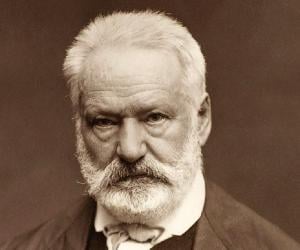
Jerry Coyne and friend (image stolen from Larry Moran's Sandwalk; pretty sure he won't mind)
Admission is free and doors will open at 6:30 p.m. A book signing with light refreshments will take place following the lecture.
Coyne is an evolutionary biologist whose work focuses on understanding the origin of species. He has written more than 100 peer-reviewed scientific papers on the subject.
In addition, he is a regular contributor to The New Republic, the Times Literary Supplement, and other periodicals. He runs the popular Why Evolution is True blog, and is an internationally known defender of evolution and critic of creationism and intelligent design.
The book Why Evolution is Truehas received widespread praise for providing a clear explanation of evolution, while succinctly summarizing the facts supporting this revolutionary theory.
Coyne’s lecture is sponsored by the Department of Biology and the Philosophy Dialogue Series at Texas State. Contact Noland Martin (512) 245-3317 for more information. For more information about Coyne and his book, please visit his blog: http://www.jerrycoyne.uchicago.edu. [and Why Evolution is True]
This lecture is part of a larger series on philosophy and science, featuring a few lectures that appear designed solely to irritate P. Z. Myers:
Philosophy dialogue to take up evolution, identity
Texas State philosopher Jeffrey Gordon will be among the speakers at the university’s Philosophy Dialogue Series in the next two weeks. Texas State photograph.
STAFF REPORT
The Philosophy Dialogue Series at Texas State will present evolution and identity as its discussion topic for the next two weeks in Room 132 of the Psychology Building on campus.
Following is the schedule of events, giving the discussion titles, followed by the speakers.
March 16: 12:30 p.m. – Evolution and the Culture Wars, Victor Holk and Paul Valle (Dialogue students). 3:30 p.m. – Arabic Culture 101: What You Need to Know, Amjad Mohammad (Arabic Language Coordinator).
March 17: 2 p.m. – Phenomenology of Humor, Jeffrey Gordon (Philosophy)
March 18: 12:30 p.m. – Stayin’ Alive: Does the Self Survive? Blaze Bulla and Sky Rudd (Dialogue students).
March 19: 10 a.m. – Sustainability group, topic be announced, Laura Stroup (Geography). 12:30 p.m. – Talk of the Times, open forum.
March 23: 12:30 p.m. – Evolution: An Interdisciplinary Panel Discussion, Harvey Ginsberg (Psychology), Peter Hutcheson (Philosophy), Kerrie Lewis (Anthropology), Rebecca Raphael (Philosophy & Religious Studies). Special guest panelist, Jerry Coyne, University of Chicago (Evolutionary Biology). Evening lecture – Why Evolution is True, Jerry Coyne, University of Chicago, time and place to be announced.
March 25: 12:30 p.m. – Constructing a Masculine Christian Identity: Sex, Gender, and the Female, and Martyrs of Early Christianity, L. Stephanie Cobb, Hofstra University (Religion and Women’s Studies).
March 26: 10 a.m. – Sustainability Group: Civic Ecology, and The Human Rights of Sustainability, Vince Lopes (Biology), Catherine Hawkins (Social Work). 12:30 p.m. – Talk of the Times, open forum.
Sponsors of the Philosophy Dialogue Series include: the American Democracy Project, the College of Liberal Arts, Common Experience, the Gina Weatherhead Dialogue Fund, the New York Times, the National Endowment for the Humanities, Phi Sigma Tau, University Seminar, the University Honors Program, the Provost and Vice President for Academic Affairs and the Vice President for Student Affairs.
For more information about this topic, contact Beverly Pairett in the Department of Philosophy at (512) 245-2285, or email philosophy@txstate.edu. A complete schedule of discussion topics and presentations can be found at http://www.txstate.edu/philosophy/dialogue-series/Dialogue-Schedule.html.
Probably can’t make it to San Marcos from Dallas on a school night. San Marcos biology and social studies students, and teachers, should plan to be there.
Spread the word; friends don't allow friends to repeat history.
Two earthquakes ravage American nations, tsunamis, freakishly large snowstorms, still trouble in Iraq and Afghanistan, Iran in turmoil and ruled by some sort of crazy, North Koreans still starve so the nation can make a nuclear sabre to rattle.
Another prominent, but much more reasonable Republican member of the SBOE also lost: Geraldine “Tincy” Miller, in Dallas. Miller was so expected to win that race that almost no one was watching, and little is in public about the winner of the race.
Election results from Tuesday’s primary election in Texas mean that the State Board of Education will change dramatically. It would be almost impossible for any of the changes to be bad ones. McLeroy led the anti-evolution force on the board. McLeroy was the ringleader to gut and racialize English standards earlier, and he’s been the point man in the attempt to gut and de-secularize social studies standards.
Board member Cynthia Dunbar, another “social conservative,” did not run for re-election.
In the governor’s race, anti-education, anti-science Gov. Rick Perry won big over the state’s popular Republican U.S. Sen. Kay Hutchison. Third place in that race went to the Teabagger candidate.
No Teabagger won any race in Texas.
It’s not that Texas has suddenly gained reason. The dissension on the SBOE, demonstrated by the Texas Senate’s rejection of McLeroy’s renomination to be chairman of the body, just got to be too much. Texans like their crazies to be sane enough to get things done, and not so noisily crazy as to attract attention to the state’s shared insanity.
Sunlight cast on the actions of the board, especially by groups like the Texas Freedom Network, informed Texans. And now the people of Texas have spoken.
Neil Shubin’s Your Inner Fish reads well, and it reveals evolution as easy to understand from a morphological view of life as revealed by fossils and modern animals.
Shubin released the illustrations from the book for teachers to use — a rather rare and great contribution to evolution.
As I sit with officials from the Texas Education Agency and the Dallas ISD discussing what goes on in our classrooms, I often reflect that the drive to testing frequently pushes education out of the classroom.
One of my favorite education blogs, the Living Classroom, comes out of a the West Seattle Community School where, many days — perhaps most days — education goes on in wonderful ways. No test could ever capture the progress made.
Asher and his amazing squid, The Living Classroom, West Seattle Community School
It’s pretty colorful, even for a squid, but I’ll wager the kid now knows more about squids than most Texas ninth grade biology students. Of course, sewing squids is not among the list of Texas Essential Knowledge and Skills. What Asher now knows . . . such learning would have to be smuggled into a Texas classroom.
When education is outlawed, only outlaws will have education.
Spread the word; friends don't allow friends to repeat history.
And the “Origin” changed everything. Before the “Origin,” the diversity of life could only be catalogued and described; afterwards, it could be explained and understood. Before the “Origin,” species were generally seen as fixed entities, the special creations of a deity; afterwards, they became connected together on a great family tree that stretches back, across billions of years, to the dawn of life. Perhaps most importantly, the “Origin” changed our view of ourselves. It made us as much a part of nature as hummingbirds and bumblebees (or humble-bees, as Darwin called them); we, too, acquired a family tree with a host of remarkable and distinguished ancestors.
The reason the “Origin” was so powerful, compelling and persuasive, the reason Darwin succeeded while his predecessors failed, is that in it he does not just describe how evolution by natural selection works. He presents an enormous body of evidence culled from every field of biology then known. He discusses subjects as diverse as pigeon breeding in Ancient Egypt, the rudimentary eyes of cave fish, the nest-building instincts of honeybees, the evolving size of gooseberries (they’ve been getting bigger), wingless beetles on the island of Madeira and algae in New Zealand. One moment, he’s considering fossil animals like brachiopods (which had hinged shells like clams, but with a different axis of symmetry); the next, he’s discussing the accessibility of nectar in clover flowers to different species of bee.
At the same time, he uses every form of evidence at his disposal: he observes, argues, compares, infers and describes the results of experiments he has read about, or in many cases, personally conducted. For example, one of Darwin’s observations is that the inhabitants of islands resemble — but differ subtly from — those of the nearest continents. So: birds and bushes on islands off the coast of South America resemble South American birds and bushes; islands near Africa are populated by recognizably African forms.
Of course you –you cognescenti, you — know Judson is the wit behind Dr. Tatiana’s Sex Advice to All Creation, a thoroughly delightful, funny and scientifically accurate book. Which brings to my mind this question: Why are scientists, and especially evolutionary scientists, so funny and charming, in stark contrast to the dull proles of creationism?
And, were he not ill at the time, can you imagine what a fantastic dinner guest Charles Darwin himself would be?
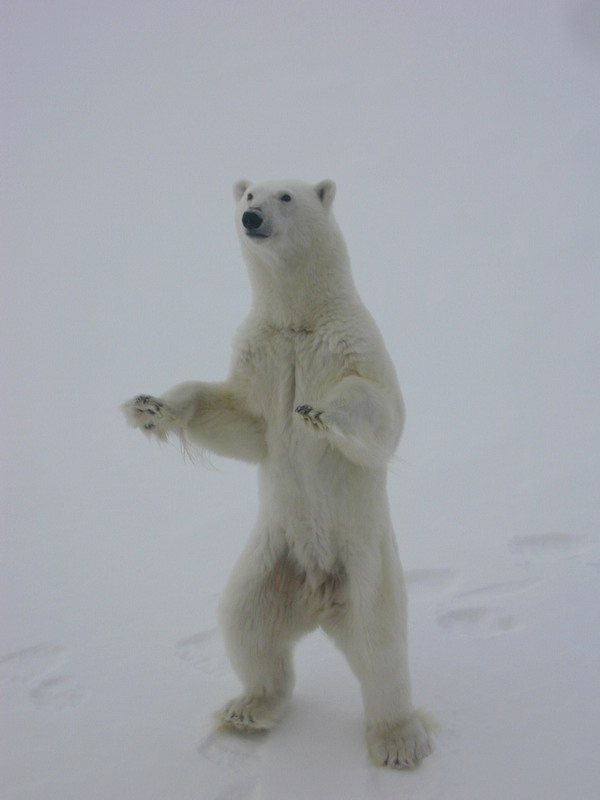
“Take it easy! Calm down, stick to the facts!” Polar bear photo by Kathy Crane, NOAA Arctic Research Office
There is no dramatic finding in the release. After you read it, you’ll probably wonder, too, why climate change skeptics don’t want you to read this press release:
The 15th meeting of the IUCN Polar Bear Specialist Group (PBSG), hosted by the Greenland Institute of Natural Resources, was held at the Greenland Representation in Copenhagen Denmark , June 29-July 3, 2009. The Polar Bear Specialist Group is composed of researchers and managers representing each of the five circumpolar nations that signed the International Agreement for the Conservation of Polar Bears of 1973. Since the late 1960s, the members of PBSG have met every 3 to 5 years under the umbrella of the Species Survival Commission of the IUCN (the International Union for the Conservation of Nature and Natural Resources) to review and exchange information, and make recommendations for research and management of polar bears throughout the Arctic.
The PBSG renewed the conclusion from previous meetings that the greatest challenge to conservation of polar bears is ecological change in the Arctic resulting from climatic warming. Declines in the extent of the sea ice have accelerated since the last meeting of the group in 2005, with unprecedented sea ice retreats in 2007 and 2008. The PBSG confirmed its earlier conclusion that unabated global warming will ultimately threaten polar bears everywhere.
The PBSG also recognized that threats to polar bears will occur at different rates and times across their range although warming induced habitat degradation and loss are already negatively affecting polar bears in some parts of their range. Subpopulations of polar bears face different combinations of human threats. The PBSG recommends that jurisdictions take into account the variation in threats facing polar bears.
The PBSG noted polar bears suffer health effects from persistent pollutants. At the same time, climate change appears to be altering the pathways by which such pollutants enter ecosystems. The PBSG encourages international efforts to evaluate interactions between climate change and pollutants.
The PBSG endorses efforts to develop non-invasive means of population assessment, and continues to encourage jurisdictions to incorporate capture and radio tracking programs into their national monitoring efforts. The members also recognized that aboriginal people are both uniquely positioned to observe wildlife and changes in the environment, and their knowledge is essential for effective management.
The PBSG recognizes that where habitats are stable, polar bears are a renewable resource, and reaffirmed its support of the right of aboriginal groups to harvest polar bears within sustainable limits. The PBSG noted that the population of polar bears in Baffin Bay, shared between Greenland and Canada, may simultaneously be suffering from significant habitat change and substantial over harvest, while at the same time interpretations by scientists and local hunters disagree regarding population status. Similarly, the Chukchi Sea polar bear population which is shared by Russia and the United States is likely declining due to illegal harvest in Russia and one of the highest rates of sea ice loss in the Arctic. Consistent with its past efforts to coordinate research and management among jurisdictions, the PBSG recommended that the polar bear populations in Baffin Bay and the Chukchi Sea be reassessed and that harvests be brought into balance with the current sustainable yield.
A variety of management changes have occurred since the PBSG last met in 2005. The PBSG members were particularly pleased that quotas for the harvest of polar bears in Greenland were implemented in January 2006, and that quota reductions have been implemented in some parts of Greenland. Also since the last meeting, the government of Nunavut reduced the harvest quota in Western Hudson Bay because of the documented population decline.
The PBSG reevaluated the status of the 19 recognized subpopulations of polar bears distributed over vast and relatively inaccessible areas of the Arctic. Despite the fact that much new information has been made available since the last meeting, knowledge of some populations is still poor. Reviewing the latest information available the PBSG concluded that 1 of 19 subpopulations is currently increasing, 3 are stable and 8 are declining. For the remaining 7 subpopulations available data were insufficient to provide an assessment of current trend. The total number of polar bears is still thought to be between 20,000 and 25,000. However, the mixed quality of information on the different subpopulations means there is much room for error in establishing that range. That potential for error, given the ongoing and projected changes in habitats and other potential stressors is cause for concern. Nonetheless, the PBSG is optimistic that humans can mitigate the effects of global warming and other threats to polar bears, and ensure that they remain a part of the Arctic ecosystem in perpetuity.
Dr. Erik Born from the Greenland Institute of Natural Resources was elected as the new chairman of the group after Dr. Andrew Derocher from the University of Alberta, who has been serving as chair since 2005.
Well, there is that proclamation of optimism in the penultimate paragraph, that humans can mitigate threats to bears, including global warming. Is that why they don’t want you to read it?
She’s being called Ida (EE-duh, to the Brits, EYE-duh to Bob Wills fans). How could you miss all the hype about her unveiling this week?
Science fans complain that the hype might be over done. Creationists appear a bit panicked by the developments.
Ida herself? She’s beautiful. Here’s an interview with Michael Novacek from the American Museum of Natural History in New York, carried on the public television news program World Focus.
Here’s a collection of British television stories on Ida, including David Attenborough’s animation of the reconstruction of her skeleton — some great graphics:
President John F. Kennedy’s Science Advisory Council (PSAC) studied Rachel Carson’s best-selling book, Silent Spring, checking it for scientific accuracy. Kennedy read the book himself, but sought expert advice before doing anything. Meanwhile, DDT manufacturers bankrolled an extensive public relations campaign claiming DDT was safe, and suggesting Carson was less than a careful writer and scientist.
Reading Carson’s book changed many people’s ideas about the environment and inspired some to take action. People wrote to their representatives in congress and asked them to do something about the misuse of pesticides. When several senators created a committee to research environmental dangers, they asked Carson to speak to them about pesticides. Carson recommended that the government regulate and reduce pesticide use, and that it ban the most toxic pesticides. She said that a citizen of the United States had the right “to be secure in his own home against the intrusion of poisons applied by other persons.”
President Kennedy understood the importance of Carson’s book. He asked his Science Advisory Committee to research Carson’s claims in Silent Spring. In 1963 the Committee released a report called “The Uses of Pesticides.” It supported Silent Spring. Environmental activists continued to push the government to regulate pesticides. Changes in federal law in 1964 required companies to prove that something did not cause harm before they could sell it. In 1972, activists pushed for and won a ban on DDT, the pesticide that started Carson’s research for Silent Spring. And in 1970 the Environmental Protection Agency (EPA) was created “in response to the growing public demand for cleaner water, air and land.” Who knows what the world would be like today if Rachel Carson had not written Silent Spring?
Some radicals argue that Rachel Carson’s legacy is tarnished, that she was in error about DDT, and somehow that translates into many deaths as a result of malaria, as if DDT worked against malaria parasites themselves. With such a strong propaganda campaign of disinformation plaguing us today, we do well to pause and remember that Carson’s work was subjected to intense, careful scrutiny by scientists from the start. Carson’s reporting was accurate, and her legacy of environmental protection and saving lives should be celebrated.
Are you out near Conroe on Sunday? April 26 is the third (and last) day of Texas Forest Expo 2009 at the Conroe Convention Center.
It’s free. It’s kid friendly ( a great place to take Cub Scouts or a group of Boy Scouts working on the Forestry merit badge). I’d be there if I could.
Get your name on the mailing list for notice for next year’s expo.
Spread the word; friends don't allow friends to repeat history.
Or, until that account is unsuspended by the forces supporting Donald Trump: Follow @FillmoreWhite, the account of the Millard Fillmore White House Library
We've been soaking in the Bathtub for several months, long enough that some of the links we've used have gone to the Great Internet in the Sky.
If you find a dead link, please leave a comment to that post, and tell us what link has expired.
Thanks!
Retired teacher of law, economics, history, AP government, psychology and science. Former speechwriter, press guy and legislative aide in U.S. Senate. Former Department of Education. Former airline real estate, telecom towers, Big 6 (that old!) consultant. Lab and field research in air pollution control.
My blog, Millard Fillmore's Bathtub, is a continuing experiment to test how to use blogs to improve and speed up learning processes for students, perhaps by making some of the courses actually interesting. It is a blog for teachers, to see if we can use blogs. It is for people interested in social studies and social studies education, to see if we can learn to get it right. It's a blog for science fans, to promote good science and good science policy. It's a blog for people interested in good government and how to achieve it.
BS in Mass Communication, University of Utah
Graduate study in Rhetoric and Speech Communication, University of Arizona
JD from the National Law Center, George Washington University


 Posted by Ed Darrell









 Millard Fillmore's Bathtub