Chess games of the rich and famous: Aboard the Endurance, trapped in ice

June 14, 2012

Expedition photographer Frank Hurley and meteorologist Leonard Hussey play chess aboard the ‘Endurance’ trapped in ice in 1915, in the Antarctic. RoyalCollection.org.uk via Pau Pascual Duran.

Trapped by ice, members of Sir Ernest Shackleton’s exploration team aboard the Endurance needed activities to keep themselves sane, do doubt.

Does chess really qualify as one of those activities?

If Hurley, the expedition photographer, was in the picture, who was behind the camera?

Description of the photo at the Royal Collection:

Creator:  Frank Hurley (1885-1962) (photographer)
Creation Date: 1915
Materials: Silver bromide print
Dimensions: 15.4 x 20.5 cm (image)
RCIN 2580072
Acquirer: George V, King of the United Kingdom (1865-1936)
Provenance: Presented to King George V, 1917
Description:  Photograph taken on board Endurance of Frank Hurley (1885-1962) sitting on the left as he is concentrates on a game of chess with Leonard Hussey (1891-1964) while on watch. Beside them lie the remains of a supper of tea, bread and sardines. Leonard Hussey later practised as a doctor, until his retirement in 1957.

Tip of the old scrub brush to Pau Pascual Duran.

Endurance final sinking in Antarctica

Endurance final sinking in Antarctica (Photo credit: Wikipedia)

Save

Save


Chess games of the rich and Famous: Marlon Brando and “The Wild One”

May 5, 2011

Image found at the Internet Movie Database:  Marlon Brando playing chess between shots, on the set of the movie, “The Wild One”:

Marlon Brando playing chess on set of "The Wild One"

Image found at IMDB: Marlon Brando playing chess on the set of "The Wild One"


Tony Horowitz on Ray Charles and chess

September 21, 2010

Trumpeter Tony Horowitz, one of those portrayed playing chess with Ray Charles, wrote in to compliment Charles on his chess acumen, and acumen at life in general.  Take a look again at Ray Charles and Tony Horowitz playing Chess Games of the Rich and Famous.


Chess games of the rich and famous: Duchamp vs. Man Ray

July 9, 2010

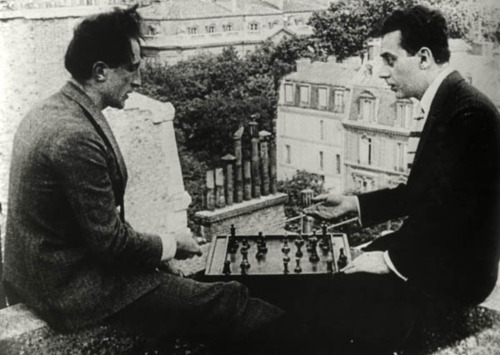
Marcel Duchamp and Man Ray play chess on a rooftop in Paris.

Duchamp again, this time on a rooftop in Paris, playing chess against Man Ray.

The photograph is later than 1915, when Duchamp moved to the U.S. to avoid World War I, and met Ray; it is probably after 1918.

The two even played chess in a movie:

Man Ray directed a number of influential avant-garde short films, known as Cinéma Pur, such as Le Retour à la Raison (2 mins, 1923); Emak-Bakia (16 mins, 1926); L’Étoile de Mer (15 mins, 1928); and Les Mystères du Château de Dé (20 mins, 1929). Man Ray also assisted Marcel Duchamp with his film Anemic Cinema (1926) and Fernand Léger with his film Ballet Mécanique (1924). Man Ray also appeared in René Clair‘s film Entr’acte (1924), in a brief scene playing chess with Duchamp.

The photo above is a still from that 1924 René Clair movie — it comes about 4:30 into the movie (the version shown here is half of the 20-minute movie, with a very modern, surrealist music score added; you can see the entire movie from Pathé, with a more contemporary score, here).

https://vimeo.com/488844088

Update, March 14, 2011:  See also this story from 2008 about Duchamp’s need to play chess, featuring of photo of Duchamp, Teeny Duchamp and the composer John Cage deeply engrossed in a game.  A good read about chess, and Duchamp.

Tip of the old scrub brush to ArtLex.com.


Chess games of the rich and famous: House Speaker Joe Cannon vs. Congress

July 7, 2010

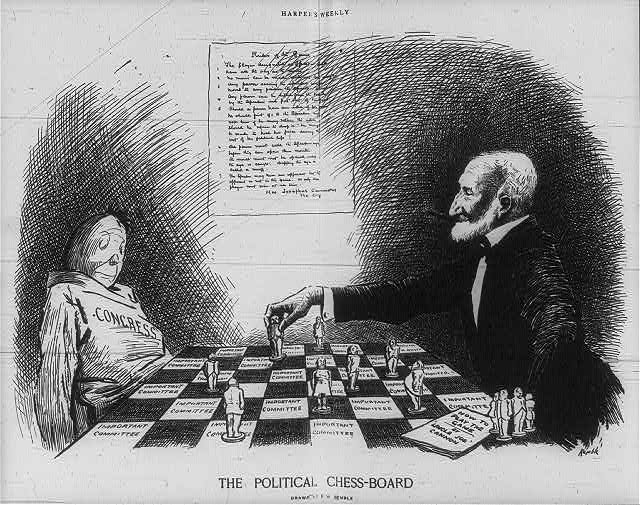
Cartoon - Cannon, Joe, The Poltiical Chessboard, Harpers 2-05-1910 - 3b23316r

The Poltiical Chessboard, Harper's Magazine, February 5, 1910, by E. W. Kemble - Library of Congress image

Description from the Library of Congress:

Joseph Cannon playing chess with straw man labelled “Congress,” using toy men on chessboard with squares labelled “important committee” and “freak committee.”

Legendary House Speaker Joe Cannon — after whom the Cannon House Office Building is named — is remembered for the almost absolute power he held over the House of Representatives.  Here’s the generic description at Wikipedia:

House Speaker Joseph G. Cannon - Wikimedia image, photo from October 1915

House Speaker Joseph G. Cannon - Wikimedia image, photo from October 1915

Cannon wielded the office of Speaker with unprecedented power. At the time of Cannon’s election the Speaker of the House concurrently held the chair of the Rules Committee, which determined under what rules and restrictions bills could be debated, amended, and voted on, and in some cases whether they would be allowed on the floor at all. As such, Cannon effectively controlled every aspect of the House’s agenda: Bills reached the floor of the house only if Cannon approved of it, and then in whatever form he determined—with he himself deciding whether and to what extent the measures could be debated and amended.

Cannon also reserved to himself the right to appoint not only the chairs of the various House committees, but also all of committees’ members, and (despite the seniority system that had begun to develop) used that power to appoint his allies and proteges to leadership positions while punishing those who opposed his legislation. Crucially, Cannon exercised these powers to maintain discipline within the ranks of his own party: the Republicans were divided into the conservative “Old Guard,” led by Cannon, and the progressives, led by President Theodore Roosevelt. His committee assignment privileges ensured that the party’s Progressive element was essentially powerless in the House, and his control over the legislative process obstructed progressive legislation.

Progressives wished to break Cannon’s ability to control so completely the flow of legislation.  By early 1910, progressives in the Republican Party especially chafed under Cannon’s rule.  Anxious for revolt, they struck on March 17, just a few weeks after this cartoon appeared.

On March 17, 1910, after two failed attempts to curb Cannon’s absolute power in the House, Nebraska Representative George Norris [of Nebraska] led a coalition of 42 progressive Republicans and the entire delegation of 149 Democrats in a revolt. With many of Cannon’s most powerful allies absent from the Chamber, but enough Members on hand for a quorum, Norris introduced a resolution that would remove the Speaker from the Rules Committee and strip him of his power to assign committees.

While his lieutenants and the House sergeant-at-arms left the chamber to collect absent members in attempt to rally enough votes for Cannon, the Speaker’s allies initiated a filibuster in the form of a point of order debate. When Cannon supporters proved difficult to find (many of the staunchest were Irish and spent the day at various St. Patrick’s Day celebrations), the filibuster continued for 26 hours, with Cannon’s present friends making repeated motions for recess and adjournment. When Cannon finally ruled the resolution out of order at noon on March 19, Norris appealed the resolution to the full House, which voted to overrule Cannon, and then to adopt the Norris resolution.

Cannon managed to save some face by promptly requesting a vote to remove him as Speaker, which he won handily since the Republican majority would not risk a Democratic speaker replacing him. However, his iron rule of the House was broken, and Cannon lost the Speakership when the Democrats won a majority later that same year.

Instead of the Speaker’s wishes, committee assignments and chairs were selected by a seniority system.

Cannon lost his seat representing Illinois in the progressive tide of 1912, but regained it in 1914, and served another four terms in the House, to 1922.

I have found no information on whether Cannon actually played chess.

Norris’s star was on the rise at the same time.  Though he supported Theodore Roosevelt in the election of 1912, when Roosevelt bolted the Republican Party and ran as a Progressive or “Bullmoose Party” nominee for president, Norris stayed with the Republican Party and won election to the U.S. Senate in 1912.

Norris became an isolationist, and was one of six senators to vote against the declaration of war in 1917 that pushed the U.S. into World War I.  Norris also opposed the Versailles Treaty, and played an important role in keeping the treaty from U.S. ratification.  He supported Franklin Roosevelt’s New Deal Reforms a decade-and-a-half later, and one of the early dams of the Tennessee Valley Authority is named for him.  Norris’s role in the New Deal, and in pushing progressive reforms well into the 20th century, is not fully appreciated, for example:

In 1932, along with Rep. Fiorello H. La Guardia, Norris secured passage of the Norris-La Guardia Act, which outlawed the practice of requiring prospective employees not to join a labor union as a condition of employment (the so-called yellow-dog contract) and greatly limited the use of court injunctions against strikes.

A staunch supporter of President Roosevelt’s New Deal programs, Norris sponsored the Tennessee Valley Authority Act of 1933. In appreciation, the TVA Norris Dam and a new planned city in Tennessee were named after him.[3][4] Norris was also the prime Senate mover behind the Rural Electrification Act that brought electrical service to under-served and unserved rural areas across the United States.

Switching to the Democratic Party in 1936 when the Republicans fell into the minority, Norris generally supported New Deal efforts but did not fear to oppose ideas he found unworthy, regardless their source or party connection.  His opposition to President Franklin Roosevelt’s “court packing” plan helped smother the idea.  Norris finally lost election in 1942.  Norris is one of eight U.S. senators profiled in John F. Kennedy’s book, Profiles in Courage.


Chess games of the rich and famous: Marcel Duchamp

July 6, 2010

Duchamp playing chess

Sculptor and conceptual artist Marcel Duchamp playing chess. Unknown photographer, via Concepts into Virtualities

Marcel Duchamp, according to Andrew Stafford:

Marcel Duchamp (1887-1968), the painter and mixed media artist, was associated with Cubism, Dadaism and Surrealism, though he avoided any alliances. Duchamp’s work is characterized by its humor, the variety and unconventionality of its media, and its incessant probing of the boundaries of art. His legacy includes the insight that art can be about ideas instead of worldly things, a revolutionary notion that would resonate with later generations of artists.

Also, he liked to play chess.

Marcel Duchamp with chess set designed by his friend, Max Ernst

Marcel Duchamp with chess set designed by his friend, Max Ernst

The photograph at left comes from ChessMate.com:

. . . Marcel Duchamp, enjoying a chess set designed and presented to him by fellow artist, Max Ernst.

To say that Duchamp was an avid chess player would be an understatement. He played at approximately expert to master strength, and it is well known that he had — during the later part of his formidable career as a visual artist — given up the pursuit of art in favor of chess.

Here is an interesting quote about art and chess that is attributed to Marcel Duchamp:

“I am still a victim of chess. It has all the beauty of art — and much more. It cannot be commercialized. Chess is much purer than art in its social position.”

You will also want to see:

  • “Half-naked Thursday:  Eve Babitz with Marcel Duchamp,” at You Can Hire An Artist.   Is it safe for work or school?  The photo shows Duchamp in a gallery filled with his works at in 1963, playing chess with Eve Babitz, who is nude.   (The museum is identified as the “Pasadena Art Museum,” which would be the Pasadena Museum of Art of California See the explanation from Kathleen Benton in comments; I think it more likely that the museum is the Norton Simon Museum, also in Pasadena, but showing much more modern art and European art. (The Pasadena Art Museum is wonderful, by the way — an outstanding place to spend an afternoon; the Norton Simon is one you must see in your lifetime.)
  • “Not Wanting to Say Anything About Marcel,” by John Cage, at the Norton Simon Museum in Pasadena.

Chess games of the rich and famous: Bob Dylan, by Daniel Kramer

July 3, 2010

Bob Dylan at the chessboard, Woodstock, New York, 1964 - photo copyright Daniel Kramer

Bob Dylan at the chessboard, Woodstock, New York, 1964 – low resolution version of the original photo, copyright by Daniel Kramer – Barbara Archer Galleries

A good decade before I got to Woodstock.

Daniel Kramer began photographing Bob Dylan early in Dylan’s career, making many of the best shots available.

This 1964 photo of Dylan playing chess in Woodstock, New York, featured in an exhibition of Kramer’s photographs put on by Barbara Archer Galleries in 2005.

From the exhibit’s biography of Kramer:

Daniel Kramer is a New York-based photographer and film director who is long recognized for his portraits and picture stories in national and international magazines and books. Shortly after opening his first studio in New York City, Daniel Kramer saw Bob Dylan perform The Lonesome Death of Hattie Carroll on television in 1964. Even after the show ended, Kramer couldn’t shake the image of Dylan from his mind. “I was completely taken by what this man had done and how he had done it. His performance was perfect. With simple, basic tools – his voice, a guitar, and a harmonica, he drove his message deep into my mind. I was aware that I was seeing a very important talent.”

In August 1964, after months of phone calls and letters to Dylan’s manager, Albert Grossman, Kramer was given the opportunity to arrange a portrait sitting in Woodstock, New York with the twenty-three-year old performer who was by then in the process of becoming an international star. The two men quickly developed a warm and trusting professional relationship that allowed for many extraordinary photographic sessions. “Photography has brought me into contact with many notable people, including Presidents of the United States, and I have happily had the opportunity to meet and talk with prominent people in all walks of life,” comments Kramer. “Although many of these encounters were memorable, my association with Dylan has a special meaning.”

Many of these photographs were first published in Kramer’s 1967 book bob dylan, the first major work about the performer-songwriter (reprinted as Bob Dylan: A Portrait of the Artist’s Early Years, 2001). They were also used on the album covers for Highway 61 Revisited (1965), Biograph (1985) and Bringing It All Back Home (1965), which was nominated for a Grammy and selected by Rolling Stone as one of the “100 Greatest Album Covers of All Time.” A number of rare and previously unpublished pictures by Kramer also appear in the 52-page booklet and packaging that accompanies Bob Dylan’s two-CD set, Live 1964: Concert at Philharmonic Hall – The Bootleg Series, Volume 6 (2004) and on the cover of a three-CD boxed set BOB DYLAN the collection (2004).

Daniel Kramer’s photographs have also been exhibited or collected by such museums as the Whitney Museum of American Art, The International Center of Photography in New York, The Smithsonian’s National Portrait Gallery in Washington, D.C., The Experience Music Project in Seattle, The Rock and Roll Hall of Fame and Museum in Cleveland, and in numerous national and international galleries.

An interesting three-way marriage of the young Bob Dylan, a great photographer in Daniel Kramer, and one of the world’s oldest and most respected games of skill, chess. Go see all the photos.

More: 


Chess games of the rich and famous: Ben Franklin and Lady Howe

November 17, 2009

Ben Franklin plays chess with Lady Howe, 1867 painting by Edward Harrison May

"Lady Howe mates Ben Franklin," 1867 painting by Edward Harrison May - public domain

Resources:


Chess games of the rich and famous: Will Smith

November 17, 2009

Actor Will Smith and chess board, photo by Robert Snyder

Actor Will Smith and chess board, photo by Robert Snyder

Actor Will Smith worked with chess masters to improve his game — literally.  Photo and story from 2001 at The Chessdrum.


Chess games of the rich and famous: Begin vs. Brzezinksi

October 18, 2009

Israel's Prime Minister Menachim Begin and Carter administration National Security Advisor Zbigniew Brzezinski square off, at Camp David, Maryland - 1978

Israel's Prime Minister Menachim Begin and Carter administration National Security Advisor Zbigniew Brzezinski square off, at Camp David, Maryland - 1978 (September?)

Zbigniew Brzezinski likes chess.  One of his books on diplomacy compares good diplomacy to a chess game – 1997, The Grand Chessboard. In 1978, a nearly two-week negotiating session with President Jimmy Carter acting as intermediary between Egypt’s President Anwar Sadat and Israel’s Prime Minister Menachim Begin led to the peace treaties between Egypt and Israel, known as the Camp David Accords.

This photograph probably was taken sometime during that period in September 1978.

Your move:

Add to FacebookAdd to NewsvineAdd to DiggAdd to Del.icio.usAdd to StumbleuponAdd to RedditAdd to BlinklistAdd to TwitterAdd to TechnoratiAdd to Furl


Chess games of the rich and famous: Willie Nelson

October 11, 2009

Willie Nelson playing chess on the band bus - Texas School of Music Collection

Willie Nelson playing chess on the band bus - Texas School of Music Collection

Did Willie ever play Ray Charles in chess?  Did anyone get a photo of the game?


Chess games of the rich and famous: Ray Charles and Tony Horowitz

October 10, 2009

Ray Charles plays chess with trumpeter Tony Horowitz.  Undated photo, from Tony Horowitz

Ray Charles plays chess with trumpeter Tony Horowitz. Circa 1973, photo from Tony Horowitz

One more indication of the extreme genius of Ray Charles.  How does a blind person play chess?  Very well, it appears.

Tip of the old scrub brush for inspiration to Grandmaster Raymond Keene and Bishop Berkeley. They also call our attention to this photo — on a school bus?

Ray Charles and chess board - Life Magazine photo

Ray Charles and chess board - Life Magazine photo


World class chess in Dallas, November 30

November 30, 2008

Looking for something to do in Dallas today?

Go see some international, championship chess sponsored by the University of Texas – Dallas’s world-beating chess team.  The UT-Dallas Grand Master Invitational Tournament has round 9 scheduled to begin at 11:00 a.m., at the Hilton Garden Inn in Richardson, Texas. These are top-level matches (practice rounds for UT-D’s chess team sometimes affect international rankings), so play should continue for quite a while after the start.

Through the MonRoi site, you can watch the chess matches of the Dallas Tournament live — or at least, animations of the boards showing the moves.  You have to register, but it’s free.

Below the fold, the complete press release with all details, from UT-Dallas.

Read the rest of this entry »


Chess games of the rich and famous: IBM 360, circa 1974

June 17, 2008

IBM 360 playing chess in 1974; five men unidentified; Chilton.org

IBM 360/195 playing chess, November 1974, probably in the world computer chess championships. MASTER Team, from left: Alex Bell, Peter Kent, John Birmingham, John Waldron (a British chess player)

Annual Report, C & A Division, Rutherford Laboratories, United Kingdom, 1974.

No details are offered in the 1974 report; it appears that the machine is playing someone at a remote location, linked by telephone. According to the report, “The only major hardware change made to the IBM System 195 Central Computer during 1974 was the addition in March of a third megabyte of main core. The system has now given consistently high performance for a period of three years and from this experience it is now possible to predict its maximum capability when fully loaded.”

At another section of the Rutherford Lab’s online materials you can view a short history of computer chess playing.


Chess games of the rich and famous: Helen Keller and Anne Sullivan

June 7, 2008

Helen Keller and Anne Sullivan Play Chess, AFB photo

Helen Keller, left, and her teacher Anne Sullivan play chess, in 1900. Photo from the American Foundation for the Blind.