NAACP petition to Hollywood movie makers for Black History Month

February 11, 2012

Good idea, I think:

NAACP

Ed,

Growing up, I remember marveling at the stories about the bravery, courage, and patriotism demonstrated by the Tuskegee Airmen.

I was happy to see them gain renewed recognition through the recent film Red Tails. Their story of persevering through a pervasive culture of prejudice to become American heroes is one we should tell more often.

But as we celebrate Black History Month and honor the African-American heroes in our lives, we must remember that films celebrating the contributions of people of color remain few and far between. That’s why I’m asking you to sign onto a letter asking movie studios to bring more of these stories to the silver screen.

Sign our letter encouraging Hollywood to create more films like Red Tails, celebrating the contributions of African-Americans throughout our history:

http://action.naacp.org/letter-to-studio

The facts about the production of films showing African-American heritage, and the employment of African-Americans in Hollywood, are alarming.

In 2009, Screen Actors Guild President Ken Howard said, “the diverse and multicultural world we live in today is still not accurately reflected in the portrayals we see on the screen.” And last year, the Writers Guild of America released a study showing the minority share of employment in feature films had fallen to 5%, its lowest level in ten years.

We must reverse these trends. With your help, we can send a message to the Hollywood studios that the public wants to see more films on the contributions of diverse communities, written, directed, and produced by filmmakers from all walks of life.

Make no mistake — we have come a long way since the Tuskegee Airmen flew in the face of a society that thought them incapable of achieving the feats of bravery they regularly demonstrated. Now we must ensure their legacy will be passed on to future generations.

Join us in telling Hollywood we need more films celebrating African-American culture and contributions:

http://action.naacp.org/letter-to-studio

After you sign the letter, I hope you’ll go see Red Tails in the theaters this weekend. It’s a great way to continue celebrating Black History Month. And if you have already seen it, see it again!

Thank you,

Vic Bulluck

Executive Director
NAACP Hollywood Bureau

P.S. Join us on February 17th as we honor those who have achieved milestones in the fields of social justice and art. The 43rd Annual NAACP Image Awards will air live on NBC at 8:00 p.m. (7:00 p.m. central).

Have you seen “Red Tails” yet?  What did you think?

(Oy.  Have you heard the controversy in Dallas about taking classes to see it?)

More:


Quote of the moment: Una Mulzac, ‘learn, teach’

February 11, 2012

From her obituary in the New York Times, Sunday February 5, 2012:

Ms. Mulzac’s profession was selling books at Liberation Bookstore, a Harlem landmark that for four decades specialized in materials promoting black identity and black power.  On one side of the front door, a sign declared,

“If you don’t know, learn.”

On the other:

“If you know, teach.”

Ms. Mulzac died at a hospital in Queens on January 21, at the age of 88.

Sign of Liberation Bookstore, Harlem, founded by Una Mulzac (1923-2012)

Una Mulzac at the door of Liberation Bookstore, in Harlem.  Harlem World image

Una Mulzac at the door of Liberation Bookstore, in Harlem. Harlem World image

More:


“I’ll have a cup of soup, a grilled cheese sandwich, a cup of coffee, and my civil rights, please”

February 1, 2012

Today is the 52nd anniversary of the Greensboro sit-in. Be sure to read Howell Raines’ criticism of news media coverage of civil rights issues in last year’s New York Times: “What I am suggesting is that the one thing the South should have learned in the past 50 years is that if we are going to hell in a handbasket, we should at least be together in a basket of common purpose.”

Four young men turned a page of history on February 1, 1960, at a lunch counter in a Woolworth’s store in Greensboro, North Carolina.

Ezell A. Blair, Jr. (now Jibreel Khazan), Franklin E. McCain, Joseph A. McNeil, and David L. Richmond, sat down at the counter to order lunch. Because they were African Americans, they were refused service. Patiently, they stayed in their seats, awaiting justice.

On July 25, nearly six months later, Woolworth’s agreed to desegregate the lunch counter. One more victory for non-violent protest.

Ezell A. Blair, Jr. (now Jibreel Khazan), Franklin E. McCain, Joseph A. McNeil, and David L. Richmond leave the Woolworth store after the first sit-in on February 1, 1960. (Courtesy of Greensboro News and Record)

Ezell A. Blair, Jr. (now Jibreel Khazan), Franklin E. McCain, Joseph A. McNeil, and David L. Richmond leave the Woolworth store after the first sit-in on February 1, 1960. (Courtesy of Greensboro News and Record) (Smithsonian Institution)

News of the “sit-in” demonstration spread. Others joined in the non-violent protests from time to time, 28 students the second day, 300 the third day, and some days up to 1,000. The protests spread geographically, too, to 15 cities in 9 states.

On the second day of the Greensboro sit-in, Joseph A. McNeil and Franklin E. McCain are joined by William Smith and Clarence Henderson at the Woolworth lunch counter in Greensboro, North Carolina. (Courtesy of Greensboro News and Record)

Smithsonian caption: "On the second day of the Greensboro sit-in, Joseph A. McNeil and Franklin E. McCain are joined by William Smith and Clarence Henderson at the Woolworth lunch counter in Greensboro, North Carolina. (Courtesy of Greensboro News and Record)"

Part of the old lunch counter was salvaged, and today is on display at the Smithsonian Institution’s Museum of American History. The museum display was the site of celebratory parties during the week of the inauguration as president of Barack Obama.

Part of the lunchcounter from the Woolworths store in Greensboro, North Carolina, is now displayed at the Smithsonians Museum of American History, in Washington, D.C.

Part of the lunchcounter from the Woolworth's store in Greensboro, North Carolina, is now displayed at the Smithsonian's Museum of American History, in Washington, D.C.

Notes and resources:

Student video, American History Rules, We Were There – First person story related by Georgie N. and Greg H., with pictures:

Associated Press interview with Franklin E. McCain:

This is mostly an encore post.


Fly your flag today, in honor of the Rev. Dr. Martin Luther King, Jr.

January 16, 2012

You already have it up and waving, right?  Did I really need to remind you?

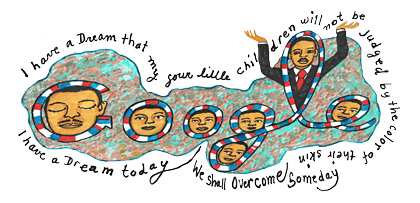
Google logo for Martin Luther King, Jr., Day 2012

Google logo for Martin Luther King, Jr., Day 2012 - click for more information

Fly your flag today, in honor of our nation, and in honor of our nation’s honoring the memory and legacy of the Rev. Dr. Martin Luther King, Jr.

U.S. law encourages Americans to fly the U.S. flag on holidays and a few other occasions. Congress set aside the third Monday in January as a holiday to commemorate the life of the Rev. Dr. Martin Luther King, Jr.

To honor Dr. King, for several years civil rights leaders and others have urged us to find some way to serve our communities on this day — Americans have done it long enough to make it a tradition. Here’s the official find-a-way-to-serve page from the the federal government; look out your window, go spend a few minutes at your city hall, post office, or at the biggest church in town, or walk into any middle school in America, and opportunities to serve will caress you at every turn.

More, much more:

King, by photographer Ben Fernandez's "Countdown to Eternity"

King, by photographer Ben Fernandez's portfolio of photos from one year in the life of Dr. King, "Countdown to Eternity"

MLK logo from Google mlk2010

Google's logo for Martin Luther King, Jr. Day, 2010 - click for more information


Heart of Atlanta Motel and civil rights

December 28, 2011

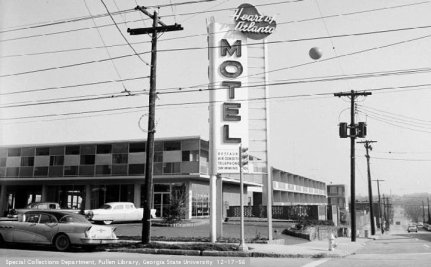
PG posted this photo in one of his collections at Chamblee54:

Heart of Atlanta Motel, 1956 - Special Collections and Archives,Georgia State University Library

Heart of Atlanta Motel, 1956 - Special Collections and Archives,Georgia State University Library

I wondered whether this is the motel in the case testing the 1964 Civil Rights Act — and sure enough, it is.  The case was decided, finally, by the U.S. Supreme Court in 1964, Heart of Atlanta Motel, Inc., v. United States, 379 U.S. 241 (1964) .

This important case represented an immediate challenge to the Civil Rights Act of 1964, the landmark piece of civil rights legislation which represented the first comprehensive act by Congress on civil rights and race relations since the Civil Rights Act of 1875. For much of the 100 years preceding 1964, race relations in the United States had been dominated by segregation, a system of racial separation which, while in name providing for “separate but equal” treatment of both white and black Americans, in truth perpetuated inferior accommodation, services, and treatment for black Americans.

During the mid-20th century, partly as a result of cases such as Powell v. Alabama, 287 U.S. 45 (1932); Smith v. Allwright, 321 U.S. 649 (1944); Shelley v. Kraemer, 334 U.S. 1 (1948); Sweatt v. Painter, 339 U.S. 629 (1950); McLaurin v. Oklahoma State Regents, 339 U.S. 637 (1950); NAACP v. Alabama, 357 U.S. 449 (1958); Boynton v. Virginia, 364 U.S. 454 (1960) and probably the most famous, Brown v. Board of Education of Topeka, 347 U.S. 483 (1954), the tide against segregation began to turn. However, segregation remained in full effect into the 1960s in parts of the southern United States, where the Heart of Atlanta Motel was located, despite these decisions.

The Atlanta Time Machine, a great collection of photos in the history of Atlanta and Georgia, has more photos, and this description of the site:

The Heart of Atlanta motel, located at 255 Courtland Street NE, was owned by Atlanta attorney Moreton Rolleston Jr.  Rolleston, a committed segregationist, refused to rent rooms at his hotel to black customers.  Upon passage of the Civil Rights Act of 1964, Rolleston immediately filed suit in federal court to assert that the law was the result of an overly broad interpretation of the U.S. Constitution’s commerce clause.  Rolleston represented himself in the case, HEART OF ATLANTA MOTEL, INC. v. UNITED STATES ET AL., which  went all the way to the United States Supreme Court.  Rolleston lost when the Supreme Court ruled that Congress was well within its powers to regulate interstate commerce in such a manner.  The Hilton Hotel now stands on the former site of the Heart of Atlanta Motel.

Texts in law school rarely have illustrations.  I know the motel mostly as a citation on pages of text, great grey oceans of somnambulent text.  This case is important in civil rights, though it is mentioned almost never in history texts.  What are these cases really about?  These photos offer us insight.

The Heart of Atlanta Motel aspired to greatness in the late 1950s and 1960s — evidenced by this publicity flyer photo from the Atlanta Time Machine; notice the flag flying for the motel’s Seahorse Lounge (Atlanta is landlocked):

Heart of Atlanta Motel publicity photo - Atlanta Time Machine

Heart of Atlanta Motel publicity photo - Atlanta Time Machine; not just a podunk "motor lodge," but a "resort motel." Click for larger image.

For the 1960s, this place offered great amenities, including two swimming pools and in-room breakfast service.

Flyer for the Heart of Atlanta Motel, circa 1960 - Atlanta Time Machine image

Flyer for the Heart of Atlanta Motel, circa 1960 - Atlanta Time Machine image

This photo is amusing — I can just imagine the difficulties of launching a motor boat of this size in one of the swimming pools, obviously for a publicity stunt.  The photo is dated February 27, 1960, in the Pullen Library Collection.

Boat in the pool at the Heart of Atlanta Motel, 1960 - Atlanta Time Machine image

Boat in the pool at the Heart of Atlanta Motel, 1960 - Atlanta Time Machine image

To compare how times have changed, you may want to look at this aerial photo of the area, including the Heart of Atlanta Hotel, and compare it with modern photos which show the Hilton Hotel that replaced the property.

Rolleston appears to have had a big ego.  As noted above, he represented himself in this case, and he argued it in the Supreme Court.  Here’s a picture from about that time, from the University of Missouri-Kansas City Law School “Famous Trials” site:

Moreton Rolleston, Jr., owner of the Heart of Atlanta Motel and the attorney who argued the case at the Supreme Court - UMKC Law School image

Moreton Rolleston, Jr., owner of the Heart of Atlanta Motel and the attorney who argued the case at the Supreme Court - UMKC Law School image; photo: Wayne Wilson/Leviton-Atlanta

You may decide for yourself whether this fits the old legal aphorism that a lawyer who represents himself in a case has a fool for a client.  The Oyez site at the University of Chicago provides access to the audio of the oral arguments.  Did Rolleston argue ably?  Rolleston argued against Archibald Cox, who went on to fame in the Watergate scandals.  This appears to have been Rolleston’s only appearance before the Supreme Court; it was Cox’s ninth appearance (he argued 20 cases before the Court in his career, several well known and notable ones).

Heart of Atlanta vs. United States was argued on October 5, 1964.  The opinion was issued on December 14, 1964, a 9-0 decision against Rolleston and segregation authored by Justice Tom C. Clark (one of Dallas’s earliest Eagle Scouts).

This was a fight Mr. Rolleston picked.  He was not cited nor indicted for violation of the Civil Rights Act, but instead asked for an injunction to prevent the law’s enforcement; according to the published decision,

Appellant, the owner of a large motel in Atlanta, Georgia, which restricts its clientele to white persons, three-fourths of whom are transient interstate travelers, sued for declaratory relief and to enjoin enforcement of the Civil Rights Act of 1964, contending that the prohibition of racial discrimination in places of public accommodation affecting commerce exceeded Congress’ powers under the Commerce Clause and violated other parts of the Constitution. A three-judge District Court upheld the constitutionality of Title II, §§ 201(a), (b)(1) and (c)(1), the provisions attacked, and, on appellees’ counterclaim, permanently enjoined appellant from refusing to accommodate Negro guests for racial reasons.

Oyez summarizes the case question:

Facts of the Case 

Title II of the Civil Rights Act of 1964 forbade racial discrimination by places of public accommodation if their operations affected commerce. The Heart of Atlanta Motel in Atlanta, Georgia, refused to accept Black Americans and was charged with violating Title II.

Question 

Did Congress, in passing Title II of the 1964 Civil Rights Act, exceed its Commerce Clause powers by depriving motels, such as the Heart of Atlanta, of the right to choose their own customers?

The decision turned on the commerce clause, and the reach of Congressional power to regulate interstate commerce.

Decision: 9 votes for U.S., 0 vote(s) against
Legal provision: Civil Rights Act of 1964, Title II

The Court held that the Commerce Clause allowed Congress to regulate local incidents of commerce, and that the Civil Right Act of 1964 passed constitutional muster. The Court noted that the applicability of Title II was “carefully limited to enterprises having a direct and substantial relation to the interstate flow of goods and people. . .” The Court thus concluded that places of public accommodation had no “right” to select guests as they saw fit, free from governmental regulation.

Good decision.

Heart of Atlanta Motel is gone.  The site is occupied by the Hilton Atlanta, today.


Strike a blow for freedom and the Constitution: Read a banned book!

September 26, 2011

John Maunu reminded me this week is Banned Books Week.  Details from the American Library Association:

Banned Books Week 2011

September 24−October 1, 2011

Banned Books Week (BBW) is an annual event celebrating the freedom to read and the importance of the First Amendment.  Held during the last week of September, Banned Books Week highlights the benefits of free and open access to information while drawing attention to the harms of censorship by spotlighting actual or attempted bannings of books across the United States.

Intellectual freedom—the freedom to access information and express ideas, even if the information and ideas might be considered unorthodox or unpopular—provides the foundation for Banned Books Week.  BBW stresses the importance of ensuring the availability of unorthodox or unpopular viewpoints for all who wish to read and access them.

The books featured during Banned Books Week have been targets of attempted bannings.  Fortunately, while some books were banned or restricted, in a majority of cases the books were not banned, all thanks to the efforts of librarians, teachers, booksellers, and members of the community to retain the books in the library collections.  Imagine how many more books might be challenged—and possibly banned or restricted—if librarians, teachers, and booksellers across the country did not use Banned Books Week each year to teach the importance of our First Amendment rights and the power of literature, and to draw attention to the danger that exists when restraints are imposed on the availability of information in a free society.

Banned Books Week is sponsored by the American Booksellers Association; American Booksellers Foundation for Free Expression; the American Library Association; American Society of Journalists and Authors; Association of American Publishers; and the National Association of College Stores.  It is endorsed by the Center for the Book in the Library of Congress. In 2011, the Comic Book Legal Defense Fund; National Coalition Against Censorship; National Council of Teachers of English; and PEN American Center also signed on as sponsors.

For more information on getting involved with Banned Books Week: Celebrating the Freedom to Read, please see Calendar of Events, Ideas and Resources, and the new Banned Books Week site. You can also contact the ALA Office for Intellectual Freedom at 1-800-545-2433, ext. 4220, or bbw@ala.org.


Barbara Ehrenreich wonders: What’s the real poverty rate in America?

August 10, 2011

Barbara Ehrenreich, “How America turned poverty into a crime,” Salon.com, August 9, 2011:

At the time I wrote “Nickel and Dimed,” I wasn’t sure how many people it directly applied to — only that the official definition of poverty was way off the mark, since it defined an individual earning $7 an hour, as I did on average, as well out of poverty. But three months after the book was published, the Economic Policy Institute in Washington, D.C., issued a report entitled “Hardships in America: The Real Story of Working Families,” which found an astounding 29 percent of American families living in what could be more reasonably defined as poverty, meaning that they earned less than a barebones budget covering housing, child care, health care, food, transportation, and taxes — though not, it should be noted, any entertainment, meals out, cable TV, Internet service, vacations, or holiday gifts. 29 percent is a minority, but not a reassuringly small one, and other studies in the early 2000s came up with similar figures.

The big question, 10 years later, is whether things have improved or worsened for those in the bottom third of the income distribution, the people who clean hotel rooms, work in warehouses, wash dishes in restaurants, care for the very young and very old, and keep the shelves stocked in our stores. The short answer is that things have gotten much worse, especially since the economic downturn that began in 2008.

Liberty does not flow to those who lack the money to eat, or keep warm.  We have strides to make to get to “liberty and justice for all.”

Libertarians, why do you oppose liberty for poor-but-working people?


Little Rock’s Central High School, monument for civil rights

July 1, 2011

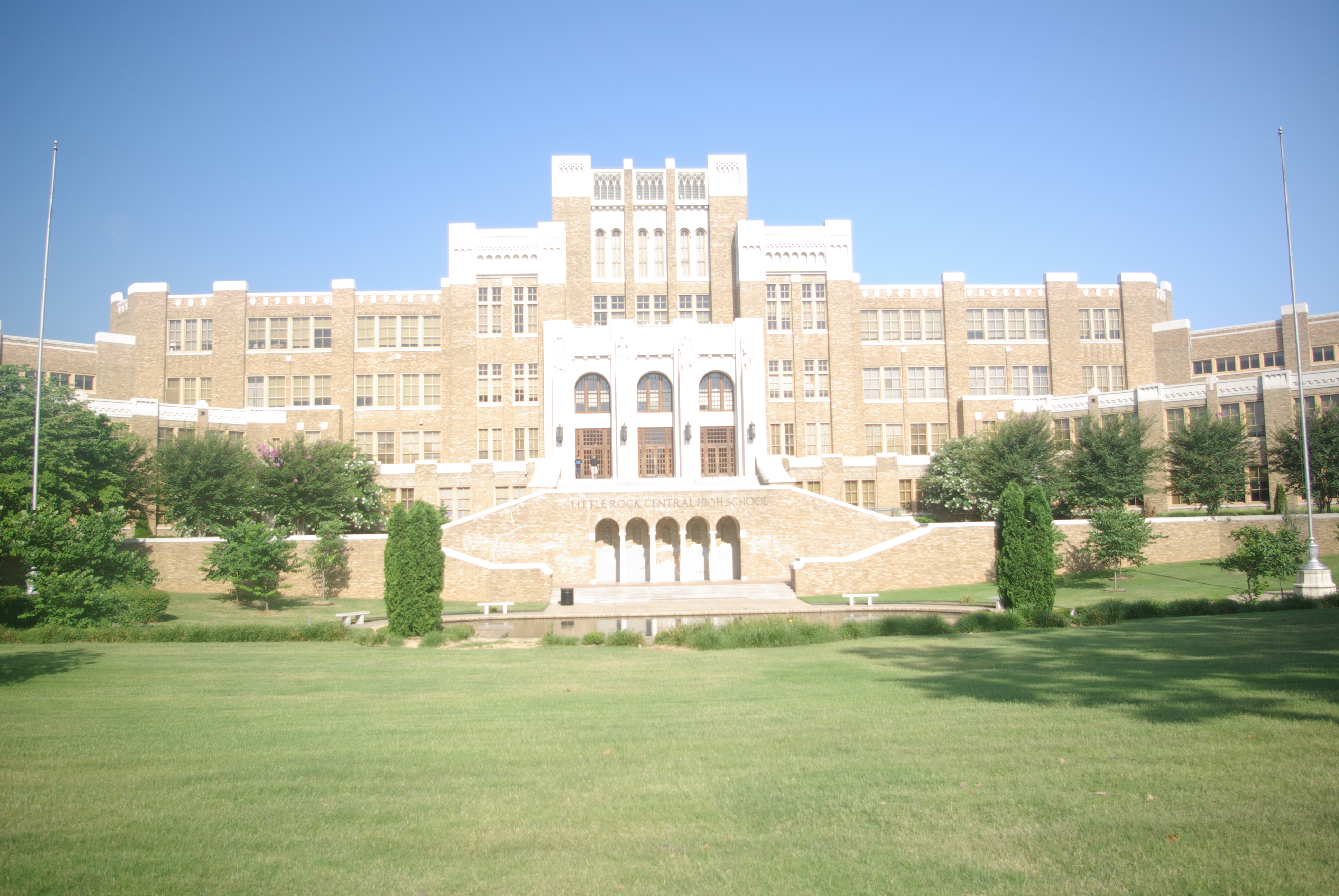
On the way out of Little Rock, Arkansas, after our day at the William Jefferson Clinton Presidential Library and Museum, we stopped at the Little Rock Central High School National Historic Site.

Little Rock Central High School in 2011, photo by Ed Darrell - use permitted with attribution

Little Rock Central High School in 2011, photo by Ed Darrell - use permitted with attribution

In 1957 nine African American kids tried to enroll at the school, breaking high school segregation in Little Rock.  After assuring President Dwight Eisenhower that the Arkansas National Guard would preserve the peace, Gov. Orval Faubus ordered the Guard to keep the students out.  Eisenhower called up the Guard to federal duty, and sent in the 101st Airborne from the regular U.S. Army to enforce the desegregation rules.  (Imagine any president doing that today!)

Pre-Art Deco front of Little Rock Central High School, built in 1927 - photo 2011 by Ed Darrell, use permitted with attribution

Pre-Art Deco front of Little Rock Central High School, built in 1927

Eventually Little Rock closed down all the schools for more than a year, and then federal courts ordered the schools opened, but desegregated.  One black student graduated that first year, Ernest Green.  The other eight all graduated, but from other schools around the world.

Today, it’s history, even in Little Rock.

Little Rock Central High remains in use today.  The National Park Service maintains a visitor center across the intersection from the school, with the old Magnolia Oil gas station, restored, on another corner, and a monument to the Little Rock Nine and civil rights on the remaining corner  (Magnolia Oil was absorbed into Mobil, which took on Magnolia’s flying horse emblem).  Our Dallas Independent School District, Teaching American History Grant group visited in mid-June.  Classes were out.   The visitor center remains open year around.

I was particularly curious to see whether and how the historical events, and the commemoration of them, affect the school itself.
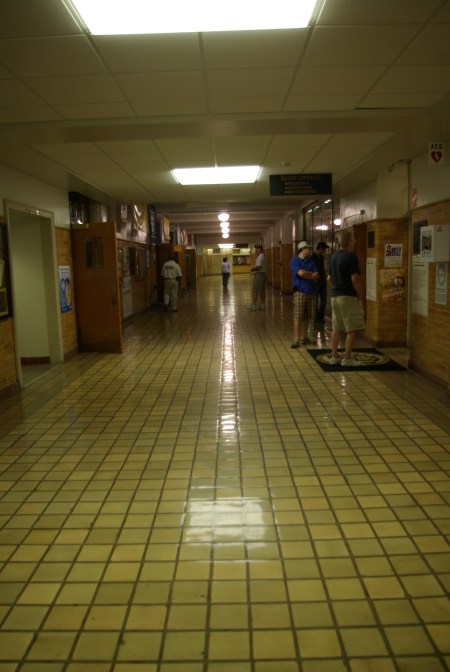
Hallway inside Little Rock Central High School, photo by Ed Darrell, use permitted with attribution

The hallway outside the auditorium on the main floor of Little Rock Central High School.

On the inside, it’s a normal American high school — though in a grand building (I’d compare this to Ogden, Utah’s Ogden High School, a WPA-style project of a decade later’s construction, and a grand old building students and citizens have come to love).

Walls bear posters from student clubs.  Signs direct students to classes, or the auditorium, or the lunchroom.  The office looks more like the 1970s than the 1930s — I suspect it has been updated.  Ceilings have been redone since 1927, with newer fluorescent lighting and acoustic ceiling tiles, which only brings the architecture of 1927 down to 1970s box-style building standards.

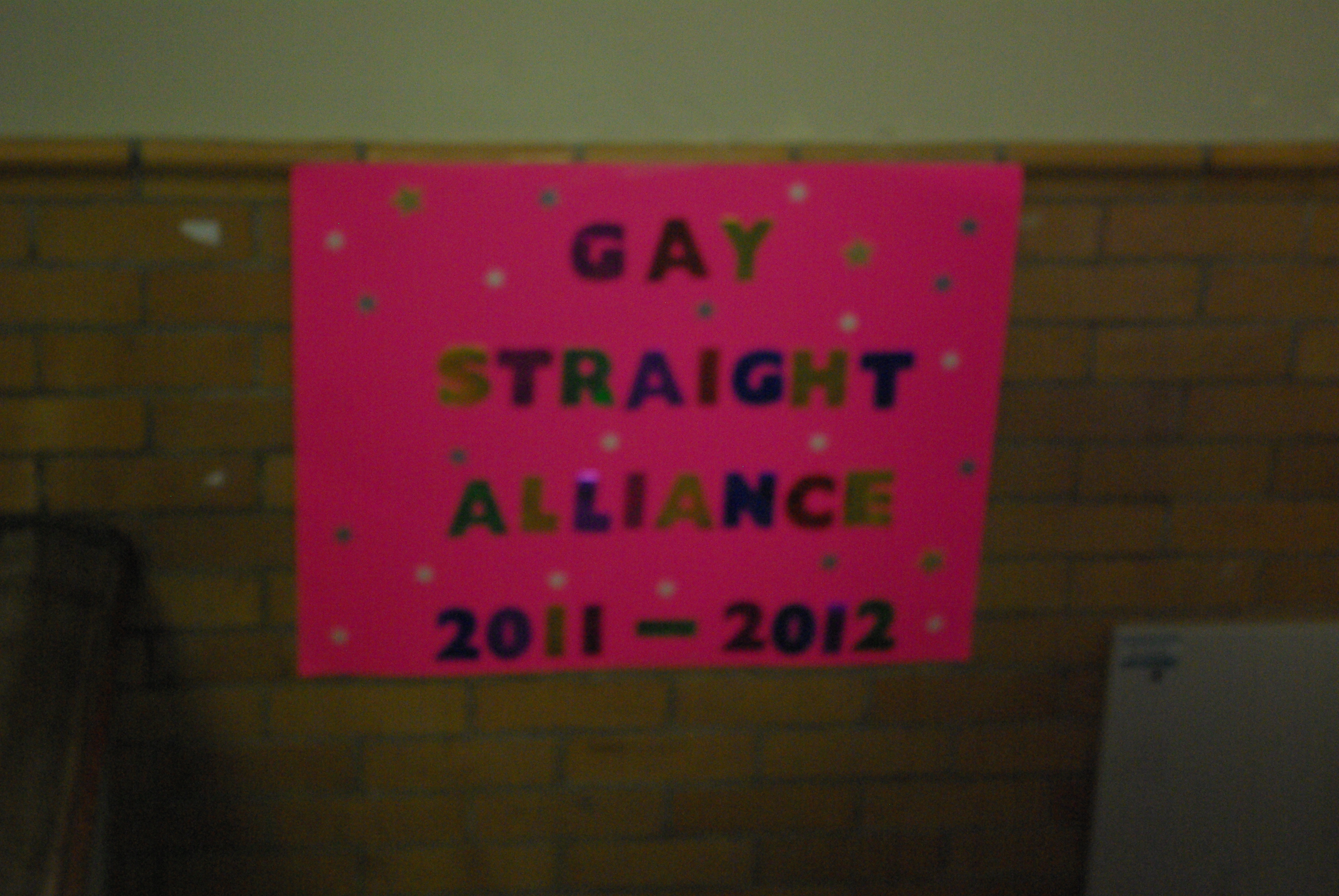
Sign announcing a club meeting, Little Rock Central High School, 2011 - photo by Ed Darrell, use permitted with attribution

Walls of Little Rock Central carry notices of club meetings, much as in 1957. Some of the clubs have changed; the Gay-Straight Alliance probably was not active in LIttle Rock in 1957. Changes in U.S. culture in the 54 years since the Little Rock Nine, are reflected in the citizens and their actions, and not necessarily in the physical buildings.

It’s a working school, and not a monument on a pedestal frozen in time in any sense.

The school opened 30 years before it became an icon in the struggle for civil rights.   It is a massive structure, intended perhaps as a sort of monument to Little Rock and to Education.  NPS describes it at their website:

Built in 1927 as Little Rock Senior High School, Central was named “America’s Most Beautiful High School” by the American Institute of Architects.

Designed as a mix of Art Deco and Collegiate Gothic architectural styles, the building is two city blocks long and includes 150,000 square feet of floor space. More than 36 million pounds of concrete and 370 tons of steel went into the building’s construction. It cost $1.5 million to construct in 1927. The school received extensive publicity upon its opening. An article in the Arkansas Gazette said, “we have hundreds of journalists in our fair city for the dedication” of the new high school.

At its construction, Central’s auditorium seated 2,000 people and included a 60 x 160 ft. stage that doubled as the gymnasium. A new library was built in 1969 and named for longtime principal Jess W. Matthews.  In 1953 the school’s name was changed to Little Rock Central High School, in anticipation of construction of a new high school for white students, Hall High School in Pulaski Heights.

Computer classroom at Little Rock Central High, June 2011 - photo by Ed Darrell; use premitted with attribution

Computer classroom at Little Rock Central High - Historic preservation cannot prevent the updating of classroom technology. Wiring these classroomms for computer networks must be quite difficult.

I thought it interesting that the original construction did not include a library.  The auditorium’s doubling as a basketball gymnasium explains the massive stage — suitable for Las Vegas, really.  “Multi-purpose” building for schools originated much earlier than the 1970s as I had imagined.  The 1927 plans included neither the tendency to overbuild fschools for athletics, nor today’s pre-occupation with making schools appear as academic enclaves.

Visiting the site you can learn that the $1.5 million cost consumed the entire building budget for the district in 1927.  In keeping with the separate but equal doctrine of the times (see Plessy v. Ferguson), the Little Rock district “planned” to build a high school for blacks at the same time.  No money remained for either design or construction.

City leaders — I would imagine black city leaders, without much help from whites, but I may be too cynical — raised money to pay the same architects to create a complementary design for the school that would be called Dunbar.  Private funding paid for construction, too.  Exactly this sort of discrimination against blacks roiled across America from 1896 into the 1950s — only 16 states banned discrimination by race, with laws that were not always enforced.  These issues were key to several of the cases rolled into the Supreme Court appeal that we usually call simply The Brown Decision — facilities were involved in the cases in Topeka, Kansas, Prince Edward County, Virginia, Delaware, and Washington, D.C.

Looking at Little Rock Central High School today one can see the physical manifestation of the insidious separate but equal doctrine, and understand perhaps why it collided with the drive for rights in Little Rock, at the corner of 14th Street and South Park Street.  The school’s address is listed as 1500 South Park.  14th Street, running along the north edge of campus, has been renamed Daisy L. Gatson Bates Drive, in honor of the NAACP organizer who provided wise counsel, sage advice, a ride to school on most mornings and friendship to the students who made up the Little Rock Nine.

A large amount of history resides in Little Rock.

Ha! — You don’t need to rely on my photos at all.  Turns out NPS has a photo slide show at their website.  Note how my ideas paralleled theirs — and honest, I didn’t see that before our tour.  Actually, the auditorium curtains were closed, nor did we get into the balcony — the photo from NPS is much better than any I got.

Nota bene: The intense, three-year program of study of U.S. history for this three dozen or so teachers is made possible by a grant from the U.S. Department of Education, a Teaching American History Grant.  Such grants fund the study of American history for teachers across the nation, to spur better teaching from greater understanding and knowledge of history.  These grants generally float at the top of the pool of programs to be cut first when the budget axes fall.  We are grateful to the Department of Education.  And while my writings here do not necessarily reflect the views of any of my employers, past or present, they should — and the Senate, Department of Education and others in the stream of funding would be well-advised to continue these grants.


Anniversary of the Magna Carta, 1215

June 15, 2011

On June 15, 1215, King John affixed his seal to the Magna Carta, in a ceremony at Runnymede, England.

An encore post:

Runnymede, Magna Carta Isle, photo by Wyrdlight, Antony McCallum, 2008 (Wikimedia)

What event critical to western history and the development of the democratic republic in the U.S. happened here in 1215?

A teacher might use some of these photos explaining the steps to the Constitution, in English law and the heritage of U.S. laws. Other than the Magna Carta, all the events of Runnymede get overlooked in American studies of history. Antony McCallum, working under the name Wyrdlight, took these stunning shots of this historic meadow. (He photographs stuff for studies of history, it appears.)

Maybe it’s a geography story.

View of Runnymede Meadow from Engham Village -- Wyrdlight photo through Wikimedia

View of Runnymede Meadow from Engham Village — Wyrdlight photo through Wikimedia

Several monuments to different events of the past millennium populate the site. The American Bar Association dedicated a memorial to the Magna Carta there — a small thing open to the air, but with a beautiful ceiling that is probably worth the trip to see it once you get to England.

Wikipedia explains briefly, with a note that the ABA plans to meet there again in 2015, the 800th anniversary of the Great Charter:

Magna Carta Memorial


The Magna Carta Memorial & view towards the ‘medes’


Engraved stone recalling the 1985 ABA visit

Situated in a grassed enclosure on the lower slopes of Cooper’s Hill, this memorial is of a domed classical style, containing a pillar of English granite on which is inscribed “To commemorate Magna Carta, symbol of Freedom Under Law”. The memorial was created by the American Bar Association to a design by Sir Edward Maufe R.A., and was unveiled on 18 July 1957 at a ceremony attended by American and English lawyers.[5]

Since 1957 representatives of the ABA have visited and rededicated the Memorial renewing pledges to the Great Charter. In 1971 and 1985 commemorative stones were placed on the Memorial plinth. In July 2000 the ABA came:

to celebrate Magna Carta, foundation of the rule of law for ages past and for the new millennium.

In 2007 on its 50th anniversary the ABA again visited Runnymede and during the convention installed as President Charles Rhyne who devised Law Day which seeks in the USA an annual reaffirmation of faith in the forces of law for peace.

The ABA will be meeting at Runnymede in 2015 on the 800th anniversary of the sealing of the original charter.

The Magna Carta Memorial is administered by the Magna Carta Trust, which is chaired by the Master of the Rolls.[10]

In 2008, flood lights were installed to light the memorial at night, but due to vandalism they now lie smashed.

I’ll wager the lights get fixed before 2015.


Detail of the Magna Carta monument at Runnymed...

Detail of the Magna Carta monument at Runnymede. I took this photo some time in the early Eighties. (Photo credit: Wikipedia)


Detail of ceiling of the Magna Carta Memorial detailing play of light, and star pattern, Runnymede – Wikimedia image

More, resources:

Also on June 15:


Civility? Doing lunch the rights way, North Carolina, February 1, 1960

February 1, 2011

Today is the 51st anniversary of the Greensboro sit-in. Be sure to read Howell Raines’ criticism of news media coverage of civil rights issues in last year’s New York Times: “What I am suggesting is that the one thing the South should have learned in the past 50 years is that if we are going to hell in a handbasket, we should at least be together in a basket of common purpose.”

Four young men turned a page of history on February 1, 1960, at a lunch counter in a Woolworth’s store in Greensboro, North Carolina.

Ezell A. Blair, Jr. (now Jibreel Khazan), Franklin E. McCain, Joseph A. McNeil, and David L. Richmond, sat down at the counter to order lunch. Because they were African Americans, they were refused service. Patiently, they stayed in their seats, awaiting justice.

On July 25, nearly six months later, Woolworth’s agreed to desegregate the lunch counter. One more victory for non-violent protest.


Ezell A. Blair, Jr. (now Jibreel Khazan), Franklin E. McCain, Joseph A. McNeil, and David L. Richmond leave the Woolworth store after the first sit-in on February 1, 1960. (Courtesy of Greensboro News and Record)

Ezell A. Blair, Jr. (now Jibreel Khazan), Franklin E. McCain, Joseph A. McNeil, and David L. Richmond leave the Woolworth store after the first sit-in on February 1, 1960. (Courtesy of Greensboro News and Record) (Smithsonian Institution)

News of the “sit-in” demonstration spread. Others joined in the non-violent protests from time to time, 28 students the second day, 300 the third day, and some days up to 1,000. The protests spread geographically, too, to 15 cities in 9 states.

On the second day of the Greensboro sit-in, Joseph A. McNeil and Franklin E. McCain are joined by William Smith and Clarence Henderson at the Woolworth lunch counter in Greensboro, North Carolina. (Courtesy of Greensboro News and Record)

Smithsonian caption: "On the second day of the Greensboro sit-in, Joseph A. McNeil and Franklin E. McCain are joined by William Smith and Clarence Henderson at the Woolworth lunch counter in Greensboro, North Carolina. (Courtesy of Greensboro News and Record)"

Part of the old lunch counter was salvaged, and today is on display at the Smithsonian Institution’s Museum of American History. The museum display was the site of celebratory parties during the week of the inauguration as president of Barack Obama.

Part of the lunchcounter from the Woolworths store in Greensboro, North Carolina, is now displayed at the Smithsonians Museum of American History, in Washington, D.C.

Part of the lunchcounter from the Woolworth's store in Greensboro, North Carolina, is now displayed at the Smithsonian's Museum of American History, in Washington, D.C.

Notes and resources:

Student video, American History Rules, We Were There – First person story related by Georgie N. and Greg H., with pictures:

Associated Press interview with Franklin E. McCain:

This is mostly an encore post.


Republicans and Tea Party usher in school segregation in Wake County, North Carolina

January 17, 2011

No comment here, just the facts:  Republican school board in N.C. backed by tea party abolishes integration policy


Stunning photo: What happened here, 795 years ago?

December 5, 2010

Runnymede, Magna Carta Isle, photo by Wyrdlight, Antony McCallum, 2008 (Wikimedia)

What event critical to western history and the development of the democratic republic in the U.S. happened here in 1215?

A teacher might use some of these photos explaining the steps to the Constitution, in English law and the heritage of U.S. laws.  Other than the Magna Carta, all the events of Runnymede get overlooked in American studies of history. Antony McCallum, working under the name Wyrdlight, took these stunning shots of this historic meadow.  (He photographs stuff for studies of history, it appears.)

Maybe it’s a geography story.

View of Runnymede Meadow from Engham Village -- Wyrdlight photo through Wikimedia

View of Runnymede Meadow from Engham Village -- Wyrdlight photo through Wikimedia

Several monuments to different events of the past millennium populate the site.  The American Bar Association dedicated a memorial to the Magna Carta there — a small thing open to the air, but with a beautiful ceiling that is probably worth the trip to see it once you get to England.

Wikipedia explains briefly, with a note that the ABA plans to meet there again in 2015, the 800th anniversary of the Great Charter:

Magna Carta Memorial


The Magna Carta Memorial & view towards the ‘medes’


Engraved stone recalling the 1985 ABA visit

Situated in a grassed enclosure on the lower slopes of Cooper’s Hill, this memorial is of a domed classical style, containing a pillar of English granite on which is inscribed “To commemorate Magna Carta, symbol of Freedom Under Law”. The memorial was created by the American Bar Association to a design by Sir Edward Maufe R.A., and was unveiled on 18 July 1957 at a ceremony attended by American and English lawyers.[5]

Since 1957 representatives of the ABA have visited and rededicated the Memorial renewing pledges to the Great Charter. In 1971 and 1985 commemorative stones were placed on the Memorial plinth. In July 2000 the ABA came:

to celebrate Magna Carta, foundation of the rule of law for ages past and for the new millennium.

In 2007 on its 50th anniversary the ABA again visited Runnymede and during the convention installed as President Charles Rhyne who devised Law Day which seeks in the USA an annual reaffirmation of faith in the forces of law for peace.

The ABA will be meeting at Runnymede in 2015 on the 800th anniversary of the sealing of the original charter.

The Magna Carta Memorial is administered by the Magna Carta Trust, which is chaired by the Master of the Rolls.[10]

In 2008, flood lights were installed to light the memorial at night, but due to vandalism they now lie smashed.

I’ll wager the lights get fixed before 2015.

Detail of ceiling of the Magna Carta Memorial, Runnymede - Wikimedia image

Detail of ceiling of the Magna Carta Memorial detailing play of light, and star pattern, Runnymede - Wikimedia image

More, resources:


December 1: Remembering when Rosa Parks stood up for freedom, by sitting down

December 1, 2010

Rosa Parks being fingerprinted, Library of Congress

Mrs. Parks being fingerprinted in Montgomery, Alabama; photo from New York World-Telegram & Sun Collection, Library of Congress

Rosa Parks: “Why do you push us around?”

Officer: “I don’t know but the law is the law and you’re under arrest.”

From Rosa Parks with Gregory J. Reed, Quiet Strength
(Grand Rapids, MI: Zondervan Pub. House, 1994), page 23.

Photo: Mrs. Parks being fingerprinted in Montgomery, Alabama; photo from New York World-Telegram & Sun Collection, Library of Congress

Today in History at the Library of Congress provides the simple facts:

On the evening of December 1, 1955, Rosa Parks, an African American, was arrested for disobeying an Alabama law requiring black passengers to relinquish seats to white passengers when the bus was full. Blacks were also required to sit at the back of the bus. Her arrest sparked a 381-day boycott of the Montgomery bus system and led to a 1956 Supreme Court decision banning segregation on public transportation.

Rosa Parks made a nearly perfect subject for a protest on racism. College-educated, trained in peaceful protest at the famous Highlander Folk School, Parks was known as a peaceful and respected person. The sight of such a proper woman being arrested and jailed would provide a schocking image to most Americans. Americans jolted awake.

Often lost in the retelling of the story are the threads that tie together the events of the civil rights movement through the 1940s, 1950s and 1960s. As noted, Parks was a trained civil rights activist. Such training in peaceful and nonviolent protest provided a moral power to the movement probably unattainable any other way. Parks’ arrest was not planned, however. Parks wrote that as she sat on the bus, she was thinking of the tragedy of Emmet Till, the young African American man from Chicago, brutally murdered in Mississippi early in 1955. She was thinking that someone had to take a stand for civil rights, at about the time the bus driver told her to move to allow a white man to take her seat. To take a stand, she kept her seat. [More below the fold] Read the rest of this entry »


Conviction in Massachusetts church arson — hate crimes laws at work

November 4, 2010

Did you see this press release from the U.S. Department of Justice?  Prosecutors got a conviction in a 2008 arson of a church in Massachusetts.

Here’s the press release:

For Immediate Release
November 1, 2010

U.S. Department of Justice
Office of Public Affairs

Massachusetts Man Sentenced to Federal Prison for Burning African-American Church
WASHINGTON—Benjamin Haskell was sentenced by U.S. District Judge Michael A. Ponsor in Springfield, Massachusetts to nine years in prison and three years of supervised release for his role in the 2008 burning of the Macedonia Church of God in Christ, a predominately African-American Church, on the morning after President Barack Obama was elected as the first African-American president of the United States. In addition, Haskell will pay more than $1.7 million in restitution, including $123,570.25 to the Macedonia Church.

On June 16, 2010, Haskell, 24, of Springfield, pled guilty to conspiring to injure, oppress, threaten, and intimidate the mostly African-American parishioners of the Macedonia Church in the free exercise of the right to hold and use their new church building, which was under construction, and to damaging the parishioners’ new church building through arson and obstructing their free exercise of religion because of their race, color, and ethnic characteristics.

At the earlier plea hearing, a prosecutor told the court that had the case proceeded to trial, the government’s evidence would have proven that in the early morning hours of Nov. 5, 2008, within hours of President Barack Obama being elected, Haskell and his co-conspirators agreed to burn down, and did burn down, the Macedonia Church’s newly constructed building where religious services were to be held. The building was 75 percent completed at the time of the fire, which destroyed nearly the entire structure, leaving only the metal superstructure and a small portion of the front corner intact. Investigators determined that the fire was caused by arsonists who poured and ignited gasoline on the interior and exterior of the building.

Haskell confessed to the crime and admitted that prior to the presidential election, he and his co-conspirators used racial slurs against African-Americans and expressed anger at the possible election of Barack Obama as the first African-American president. Haskell admitted that after Obama was declared the winner of the election, he and his co-conspirators walked through the woods behind the Macedonia Church to scout out burning it down. Then, in the early morning hours of Nov. 5, 2008, Haskell and his co-conspirators went back to the church, poured gasoline inside and outside of the church, and ignited the gasoline.

“The freedom to practice the religion that we choose without discrimination or hateful acts is among our nation’s most cherished rights,” said Thomas E. Perez, Assistant Attorney General in charge of the Justice Department’s Civil Rights Division. “As seen here today, the Department will prosecute anyone who violates that right to the fullest extent of the law.”

“The burning of the Macedonia Church because of racial hatred and intolerance was a vicious attack on one of our most cherished freedoms—to worship in the religion of our choice safely and without fear of discrimination,” said U.S. Attorney for the District of Massachusetts Carmen Ortiz. “The successful investigation, prosecution, and punishment of those who committed this hateful act is a clear statement that law enforcement will do all in its power to protect our citizens’ civil rights.”

“While the Bureau of Alcohol, Tobacco and Firearms (ATF) is charged with investigating some of the most violent crimes, I consider the arson to be one of the most serious and dangerous offenses. Not only was this case about the burning of a house of worship, it cut to the very heart of our most valued rights, that of religious freedom. I want to acknowledge all of our partners who assisted in bringing the individuals responsible for this fire to justice,” said ATF Special Agent in Charge Guy Thomas.

“Today’s sentencing represents just one more step toward closure and healing, not only for the victims of this hate crime, but for the Springfield community as a whole. The FBI, along with its federal, state, and local law enforcement partners, remains committed to protecting each and every citizen’s civil rights, and will aggressively investigate any violation of those rights, bringing the perpetrators to justice,” said Richard DesLauriers, Special Agent in Charge of the FBI.

The case was prosecuted by Assistant U.S. Attorneys Paul H. Smyth and Kevin O’Regan of the U.S. Attorney’s Springfield Office, and Nicole Lee Ndumele, Trial Attorney in the Department of Justice’s Civil Rights Division.


Compare and Contrast assignment: Martin Luther King, Jr., and Glenn Beck

August 29, 2010

From The Other 98%:

MLK's and Glenn Beck's achievements compared - from The Other 98%

Which one would you choose to follow? Which one would you choose to emulate?

Teachers, don’t you wish a student would turn in something like this from time to time?

Tip of the old scrub brush to Earthaid3.